Home Blog Page 274

Alveo to launch first residential village in Negros Occidental

AYALA LAND, INC.

ALVEO LAND CORP., the upscale residential arm of Ayala Land, Inc. (ALI), is expanding its presence in the Visayas with its first residential village in Negros Occidental.

The development will be located within Northpoint, ALI’s 215-hectare mixed-use estate in Talisay City, the property developer said in a statement on Monday.

“This milestone signals Alveo’s confidence in the province’s long-term potential and its commitment to delivering communities that endure,” it said.

The property will be designed with a mix of lifestyle-led amenities while balancing residents’ privacy. Alveo Land has yet to provide further details on its upcoming Northpoint village project.

The upcoming village will “reflect Alveo’s hallmark principles of sustainability, design excellence, and community-centric living — carefully attuned to the natural landscape, pace and character of Negros,” it added.

The estate is also home to The Enclaves at Northpoint, a 33-hectare development by ALI’s flagship luxury brand, Ayala Land Premier (ALP).

The company’s expansion in Northpoint aligns with its push to support the province’s economic growth and enhance everyday living, ALI said.

“This deep familiarity with the province’s character and potential has laid a strong foundation for thoughtfully planned communities that are both sustainable and responsive to local context,” the company added.

The Negros Island Region posted 5.9% gross domestic product growth in 2024, with Negros Occidental’s economy expanding by 5.1%.

Alveo Land’s portfolio includes 70 residential and mixed-use communities across 13 locations. Its properties include high-rise condominiums, residential lots, and township developments in Nuvali, Laguna; Quezon City; Bonifacio Global City; Makati City; and Alabang, Muntinlupa City.

ALI’s premium residential segment, which includes Alveo and ALP, recorded a 5% increase in its nine-month revenues in 2025 to P36.7 billion, according to the company’s latest quarterly report.

At the local bourse on Monday, ALI shares declined by 0.23% or five centavos to close at P21.25 each. — Beatriz Marie D. Cruz

SEC upholds fine vs NOW Corp. over disclosure issue

NOW-CORP.COM

THE SECURITIES and Exchange Commission (SEC) En Banc has denied the appeal of NOW Corp., upholding an earlier P1-million fine for a securities law violation related to market disclosure.

In a regulatory filing on Monday, NOW Corp. said the SEC En Banc had issued a resolution denying its petition to reverse the regulator’s order over its disclosure, which the commission found to be misleading in relation to the alleged liability of the company’s affiliate to the government.

NOW Corp. said it intends to appeal the SEC En Banc’s decision before the Court of Appeals, adding that it is contesting the commission’s ruling.

“The foregoing incident has no impact on the financial condition and business operations of the Company since the Company intends to further appeal the decision to the appropriate appellate court,” the company said.

The issue stemmed from NOW Corp.’s regulatory filing in 2021 following a report that the government, through the National Telecommunications Commission (NTC), was seeking resolution of NOW Telecom Co., Inc.’s alleged P2.6-billion unpaid fees.

“The Securities and Exchange Commission En Banc has denied the appeal of NOW Corp. and its chairman, Mel V. Velarde, and affirmed P1-million fines each for violating securities law over a market disclosure the regulator found misleading,” the SEC said.

The company had earlier told the stock exchange that it was not a party to the Supreme Court case and had invoked the sub judice rule. NOW Corp. said it had “no knowledge of the specific details surrounding the alleged motion.”

The commission rejected NOW Corp.’s defense, saying the company’s disclosure was untenable and misleading.

“The Commission ruled that the appeal was ‘bereft of merit,’ upholding two earlier orders of its Enforcement and Investor Protection Department (EIPD) and ordering NOW Corp. and Velarde to pay the penalties,” the SEC said in a statement.

The SEC also directed the EIPD to investigate any possible liability of NOW Corp.’s other board directors to determine whether they may be held accountable in their personal capacities.

The commission noted that although the statement might have been narrowly true, it was “nonetheless delusive and calculated to be misunderstood.”

“Certainly, the public was not concerned with the procedural filing of the NTC Motion; but was concerned with the alleged P 2.6-billion liability,” it said. — Ashley Erika O. Jose

LGU consolidation and declining unemployment

Last Friday, Feb. 6, the 4th Ruperto P. Alonzo UP School of Economics Program in Development Economics annual memorial lecture was held at the UP School of Economics (UPSE) in Diliman, Quezon City. The main speaker was Department of Budget and Management (DBM) Acting Secretary Rolando Toledo and the two discussants were UPSE Prof. Cielo Magno and Congressional Policy and Budget Research Department (CPRBD) head Romulo Emmanuel “Jun” Miral, Jr.

Mr. Toledo discussed the various reforms that the DBM has started and is continuing so that there will be more transparency and accountability in budget planning to disbursement, including the use of blockchain to control corruption and help achieve fiscal consolidation.

Ms. Magno mentioned the big increase in unprogrammed appropriations under the current administration that even bumped off counterpart funding for foreign assisted projects.

Mr. Miral discussed the Philippines’ high number of local government units (LGUs) and their overlapping functions with National Government agencies, leading to legislators raiding national revenues for local projects that contributed to the flood control corruption and related scandals.

I particularly like the two slides he showed, which I integrated into one of the tables accompanying this piece. The Philippines has the greatest number of first-tier LGUs, meaning there are many local politicians (governors, city mayors, vice-governors, vice-mayors, and provincial and city councilors).

Consider the scope of the land they control. Indonesia has 47,700 sq.km. of land per province or independent city, Malaysia has 20,300 sq.km., Vietnam has 9,200 sq.km., Thailand has 6,600 sq.km., meanwhile the Philippines has only 2,500 sq.km. per province or independent city.

Our three industrialized neighbors have reduced and consolidated their LGUs. Japan cut their municipalities from 15,900 to only 1,700. China cut their counties from 2,000 to 1,300 (see Table 1).

Retired faculty member Winnie Monsod spoke during the open forum and castigated UPSE alumni who were in high government positions when the infrastructure corruption was building and blew up. Retired faculty and former Finance Secretary Ben Diokno also spoke, and he explained the budget-bloating role of legislators which is outside the control of the Executive. Both Monsod and Diokno were my teachers at UPSE, as was Ruping Alonzo.

The closing remarks were made by Mel Alonzo, Ruping’s widow (the couple were my wedding godparents). Ninang Mel thanked the UPSE and the Program in Development Economics Alumni Association for continuing the memorial lectures in honor of Ruping, now the fourth year in a row.

A yummy reception was prepared by the Philippine Center for Economic Development for the speakers, UPSE officials and faculty, PDE alumni, and friends. San Miguel Corp. donated a few cases of canned beer. My special thanks to Ferdie Constantino, the former CFO of San Miguel, for endorsing my request for a quick donation as I wrote to him only three days before the lecture.

LABOR DATA
This week the Philippine Statistics Authority released the country’s labor data for December 2025, and we see that unemployment was at 4.4% and the full year unemployment was 4.2%. This is higher than in 2024 but lower than the levels in 2022-2023.

I checked the unemployment numbers of other countries in 2025, and ours was the second highest in the ASEAN-6 but lower than India and China, and lower than many North American and European countries.

While most Asian nations have seen declining or flat unemployment rates from 2022 to 2025, the US and many European countries have had high or rising unemployment over the same period, especially Austria, Poland, Germany, and the UK (see Table 2).

Consistent with the decline in Philippines unemployment, the Philippines Stock Market recently rebounded from a low of 5,600 last November, to 6,400 recently. Some things were put in good order by the administration led by the Executive Secretary, Ralph Recto.

A good observation was also made by Jesus L. Arranza, Chairman Emeritus of the Federation of Philippine Industries (FPI). He said, “President Marcos is doing the right thing by staying focused on the work. His calm, steady demeanor signals that he’s in control and well on top of the situation, and markets respond to that kind of leadership. Calmness begets calmness.

“For the business community, the message is simple: keep building, keep investing, keep doing our part in growing the economy. We condemn those behind the flood control anomalies and want swift accountability. But we also have to stay anchored on the country’s economic goals. You rarely go wrong when you respect duly constituted authority and keep the focus where it belongs — on progress.”


Bienvenido S. Oplas, Jr. is the president of Bienvenido S. Oplas, Jr. Research Consultancy Services, and Minimal Government Thinkers. He is an internationa fellow of the Tholos Foundation.

minimalgovernment@gmail.com

Peso weakness may persist as slowing exports put pressure on external position

BW FILE PHOTO

FITCH SOLUTIONS unit BMI expects the peso to weaken to the P59.50 level against the dollar by the end of the year due to weaker export growth, further monetary easing from both the Bangko Sentral ng Pilipinas (BSP) and the US Federal Reserve, and faster inflation.

Still, it sees the central bank defending the currency to prevent it from surpassing the P60 level to curb imported inflation, it said in a report dated Feb. 6.

BMI expects the peso to trade sideways at the P59 range in the next three to six months as weak economic prospects have reinforced expectations of further rate cuts from the BSP.

“The recent appreciation stems mainly from broad-based softness in the USD (US dollar), with the dollar index down 1.5% from its peak on Jan. 19. Even with the recent rebound, the peso continues to underperform relative to the 100-day and 200-day moving averages, reflecting persistent depreciation pressure,” it said.

“We think expectations of a 25-basis-point (bp) rate cut by Bangko Sentral ng Pilipinas in February are already priced in. The weak second-half 2025 growth reinforces this narrative, which will bring the Philippines-US policy rate differential back to its narrowest at 50 bps.

We expect the countervailing forces of a weaker dollar and the BSP cutting rates ahead of the US Fed to keep the peso range-bound over the next few months.”

Philippine gross domestic product (GDP) growth slowed to 3% in the fourth quarter of 2025 from 5.3% in the same period a year prior and the revised 3.9% in the third quarter. This brought the full-year average to a five-year low of 4.4%, well below the government’s 5.5%-6.5% goal.

BSP Governor Eli M. Remolona, Jr. earlier said that a rate cut is possible at the Monetary Board’s Feb. 19 meeting, depending on whether the slowdown in economic growth last year was caused by weak demand.

However, the central bank last week reaffirmed that it was nearing the end of its current easing cycle. The Monetary Board has lowered benchmark borrowing costs by 200 bps since August 2024, bringing the policy rate to 4.5%.

BMI said the BSP is likely to follow up the expected 25-bp cut this month with another quarter-point reduction within the year to support growth and as inflation is expected to remain within their 2%-4% annual target.

“We expect the US-Philippines policy rate differential to remain narrow at 75 bps by end-2026, which is tighter compared to historical levels… Our Americas team also forecasts the Fed to cut rates by 50 bps in 2026, as it approaches the end of an easing cycle, which means there will be little relief to the peso on this front,” it said.

An expected pickup in Philippine inflation this year following last year’s low prints could also be a source of weakness for the currency towards the end of the year, it added.

The peso will remain weak as the country’s external position could also come under pressure this year as exports could begin to slow down due to the higher tariffs imposed by the US.

“In 2025, merchandise exports rose by 15.2% y-o-y (year on year), supported by export frontloading and AI (artificial intelligence)-driven tech exports, which also drove a narrowing of the current account deficit from 4.0% in 2024 to an estimated 3.4% in 2025. Even so, the peso depreciated by 1.5% y-o-y in 2025 as corruption concerns weighed on investor confidence,” BMI said.

“Looking ahead to 2026, the tailwind from exports on the peso will fade. While the AI boom should provide support to exports, we expect export frontloading to fade. The 19% ‘reciprocal’ tariff levied on Philippine exports to the US since August 2025 will start feeding through and dampen trade with the US — the Philippines’ largest export market. Against this backdrop, we maintain that export growth will moderate in 2026, which will weigh on the peso.” — Aaron Michael C. Sy

3 Doors Down singer Brad Arnold dies at 47 following cancer diagnosis

NEW YORK — Brad Arnold, a founder and lead singer of American rock band 3 Doors Down, died on Saturday, nine months after disclosing that he had kidney cancer, the group said. He was 47.

Mr. Arnold said in a May 2025 social media video that he had been diagnosed with advanced-stage clear cell renal carcinoma that had spread to one of his lungs. 3 Doors Down canceled their planned 2025 summer tour because of his illness.

3 Doors Down, formed in 1996 in Escatawpa, Mississippi, rose to popularity in 2000 with the Arnold-penned single “Kryptonite,” which peaked at No. 3 on the Billboard Hot 100. Other hits included “When I’m Gone” and “Here Without You,” both top-five singles on the Billboard Hot 100. The band has been described as post-grunge, alternative rock, and hard rock.

“As a founding member, vocalist, and original drummer of 3 Doors Down, Brad helped redefine mainstream rock music, blending post-grunge accessibility with emotionally direct songwriting and lyrical themes that resonated with everyday listeners,” the band said in a statement posted on its official Instagram account.

Mr. Arnold died peacefully surrounded by loved ones including his wife Jennifer, according to the statement. The statement did not state where Mr. Arnold died.

“Above all, he was a devoted husband to Jennifer, and his kindness, humor and generosity touched everyone fortunate enough to know him,” the band’s statement said. “Those closest to him will remember not only his talent, but his warmth, humility, faith and deep love for his family and friends.” — Reuters

Aboitiz Land turns over 400 units in LIMA Estate villages

Master plan of The Villages at LIMA Estate — ABOITIZLAND.COM

ABOITIZ LAND, INC., the real estate arm of the Aboitiz group, said it has turned over 400 units across two residential villages within LIMA Estate in Batangas, with its residential and business expansions contributing to rising property values.

In a statement on Monday, the company said it recently launched amenity blocks in its 17-hectare (ha) Brook Village and 18-ha Sierra Village, its two neighborhoods within The Villages at LIMA Estate.

Amenities in the properties include modern clubhouses, swimming pools, play areas, and basketball courts.

“Through the launch of the Brook and Sierra amenities, the development continues to enhance lifestyles and reinforce long-term value, offering spaces where families can create lasting memories and investors can witness the growth potential of LIMA Estate firsthand,” Aboitiz Land said.

This comes as property values within Brook and Sierra have surged since their launch, the company added. This also led to the launch of Meadow Village, the third subdivision within The Villages at LIMA Estate, in 2022.

Brook Village features single-attached houses with floor areas of 65 square meters (sq.m.) to 80 sq.m., while Sierra offers 93-sq.m. townhouses and single-detached houses sized 103 sq.m. to 150 sq.m.

The villages are located near Biz Hub at LIMA Estate, the province’s central business district. The mixed-use development currently hosts over 180 locators and more than 71,000 employees.

It is also near The Outlets @LIMA Estate, Batangas’ first and largest outdoor lifestyle mall under the Aboitiz Group; The Exchange, which has a transport terminal and retail spaces; The Golf Range @LIMA Estate; and Aboitiz Pitch, a multi-sport venue with two football fields.

Aboitiz Construction, the conglomerate’s construction arm, said last year it would target the completion of the fourth phase of LIMA Estate’s expansion by 2027.

Located in Malvar, Batangas, the 1,100-ha LIMA Estate is an economic zone registered with the Philippine Economic Zone Authority and is one of the country’s largest mixed-use estates.

On Monday, shares of Aboitiz Equity Ventures declined by 1.05%, or 35 centavos, to close at P32.85 apiece. — Beatriz Marie D. Cruz

Megaworld eyes P6.5-B sales from Palawan condo project

Sánte Residences Palawan — MEGAWORLD CORP.

TAN-LED property developer Megaworld Corp. is ramping up its provincial expansion with its third residential development within its ecotourism township in Palawan, which is expected to generate P6.5 billion in sales.

The 460-unit project will rise within the 462-hectare Paragua Coastown in San Vicente, Palawan, with construction targeted for completion by 2031, the company told the stock exchange on Monday.

The 14-storey development, called Sánte Residences Palawan, will offer 32.5-square-meter (sq.m.) studio units; 81.5-sq.m. one-bedroom units; 107.5-sq.m. one-bedroom bi-level units; 120-sq.m. two-bedroom units; 146-sq.m. two-bedroom bi-level units; 138.5-sq.m. three-bedroom units; and 179.5-sq.m. three-bedroom bi-level units.

Unit prices will start at P9 million, Megaworld Palawan Head of Sales and Marketing Javier Romeo K. Abustan said during a briefing.

The property is being positioned as the Philippines’ first WELL-certified residential development, in line with Megaworld’s push to integrate sustainability and wellness features into its portfolio.

Sánte Residences Palawan will incorporate sustainability features such as low-flow fixtures in toilet and kitchen areas, occupancy sensors to conserve energy, high energy-efficiency-rated equipment, a rainwater harvesting system, and a materials recovery facility.

The basement and ground-floor parking areas will also include electric vehicle-ready slots, the company said.

The development will offer views of Pagdanan Bay and nearby forests, with angled balcony pods designed to highlight the area’s coastal and mountainous landscape.

Planned wellness facilities include a gym, Verve Studio, and a quiet lounge. It will also feature a halotherapy center, which uses salt therapy as part of its wellness offering.

Its hydro-kinetics pool will offer different hydrotherapy features aimed at soothing muscles and improving circulation. The Sánte Botanique Garden will provide residents with access to sustainably grown produce.

Other amenities on the second level include a function room, a dedicated co-working space, a daycare center, a fitness center, a game room, an infinity lap pool, a kiddie pool, an outdoor playground, and an outdoor lounge.

Paragua Coastown is also set to host two Megaworld hotels — Savoy Hotel Palawan and Paragua Sands Hotel — which will offer a combined 617 room keys.

The township adds to the developer’s existing projects in the area, including Paragua Beach Village and Oceanfront Premier Residences.

The township is located near the province’s 15-kilometer Long Beach and is about five minutes from San Vicente Airport, making it accessible to both local and foreign visitors, the company said.

Megaworld shares rose by 1.35%, or three centavos, to close at P2.26 apiece on Monday. — Beatriz Marie D.  Cruz

When restraint is tested: ASEAN, China, and the future of the code of conduct

WIKIMEDIA
WIKIMEDIA

Under the Philippines’ ASEAN Chairship, ASEAN leaders are meeting again to finalize a code of conduct (CoC) for the South China Sea (SCS).

In 2002, ASEAN and China issued the Declaration on the Code of Parties (DoC) in the South China Sea, which aimed to underscore the importance of aligning member states’ conduct in the SCS with the UN Charter, the United Nations Convention on the Law of the Sea (UNCLOS), and the Treaty of Amity and Cooperation principles. ASEAN and China also declared that they would promote exercising self-restraint, which at that time was phrased to include refraining from escalation, from occupying uninhabited islands and features, and settling their differences. Going back to the essence of the DoC is significant, as it reveals the ASEAN’s bare minimum desires, which include peaceful settlement of disputes, maritime functional cooperation, and confidence-building measures.

In 2026, however, it has become difficult to raise expectations that the ASEAN and China will be able to address the bottlenecks that have accompanied debates over the code’s legality and binding nature, its geographic scope, the form of dispute settlement, and the operationalization of self-restraint — the latter perhaps foremost among these. Foreign Affairs Secretary Ma. Theresa P. Lazaro has said that her work as the Philippines’ chair of the ASEAN is guided not only by optimism but also by pragmatism, which leads us to ask a familiar question: Is there hope for a South China Sea code of conduct? What role can it still play in promoting meaningful self-restraint?

My take is to adopt a pragmatic approach and argue for pushing for the code as an indispensable mechanism for managing crises that, as analysts have warned, could push certain countries, including the Philippines, to the brink of war in the South China Sea.

Recent developments have markedly altered our already asymmetrical relationship with China, as well as the conditions in the West Philippine/South China Sea, where China has openly eroded the DoC’s principle of self-restraint. There are three focal points of escalation of China’s aggression: the Panatag/Scarborough, Ayungin/Second Thomas, and Escoda/Sabina shoals, where control of these features would tighten China’s hold on vital shipping lanes and waterways, providing military footholds for its nine-dash line claims while directly challenging the Philippines’ sustained and lawful claims to the West Philippine Sea.

Since 2024, China’s actions in these areas have resulted in dangerous collisions, including the June 17, 2024, incident, which seriously injured a Philippine Navy sailor who lost a thumb. Additionally, the more recent Aug. 11, 2025, collision involved a large Chinese navy destroyer that collided with a Chinese Coast Guard vessel, an incident that could have killed Chinese citizens and which China did not publicly disclose. The same incident could have killed Filipinos had the Chinese vessel successfully rammed the Philippine ship it was pursuing. Against this backdrop, regional elites are increasingly pressing the United States to publicly clarify the threshold for invoking the 1951 PHL-US. Mutual Defense Treaty, arguing that clearer red lines would strengthen deterrence and regional stability.

Further altering the status quo in the West Philippine/South China Sea is President Ferdinand “Bongbong” Marcos, Jr.’s response: one that has shifted what scholars refer to as “alliance-led resistance.” This approach, however, has been de-risked by diversifying partnerships with like-minded states and by harnessing a comprehensive archipelagic defense posture that underpins Philippine maritime security. It is within this alliance-centered and defense-oriented framework that on Aug. 11, 2025, Mr. Marcos also openly acknowledged the Philippines’ potential embroilment in the Taiwan conflict, saying that “we do not want to go to war, but I think if there is a war over Taiwan, we will be in drawn… hihilahin tayo sa ayaw man o sa gusto natin (we will be pulled in whether we want to or not)… kicking and screaming, we will be drawn and dragged into that mess.” In doing so, he not only publicly situated the Philippines within a possible US response to a China invasion of Taiwan, but also crystallized a South China Sea-Taiwan nexus that amplifies escalation risks across theaters.

Against this backdrop, expectations surrounding the Code of Conduct have become more restrained. For the Philippines, the increasingly complex strategic environment has highlighted the difficulty, but also the necessity, for it to balance engagement with realism, as it contends with the imperative of translating the ASEAN DoC’s political commitments into meaningful self-restraint, while managing diplomacy, alliance relations, and external defense.


Alma Maria O. Salvador, PhD, is an associate professor of Political Science at the Dr. Rosita G. Leong School of Social Sciences, Ateneo de Manila University. is an associate professor of Political Science at Ateneo de Manila University.

Peso strengthens to near four-month high as geopolitical concerns ease

BW FILE PHOTO

THE PESO appreciated to a near four-month high against the dollar on Monday on improved sentiment amid news of progress in talks between the United States and Iran.

The local unit rose by 13 centavos to close at P58.455 versus the greenback from its P58.585 finish on Friday, data from the Bankers Association of the Philippines showed.

This was the peso’s strongest finish in almost 16 weeks or since it ended at P58.41 on Oct. 22, 2025.

The local currency opened Monday’s trading session stronger at P58.50 against the dollar. Its intraday best was at P58.38, while its worst showing was at P58.55.

Dollars traded dropped to $1.08 billion from $1.62 billion on Friday.

“The dollar-peso closed lower on improving risk sentiment following some progress on US-Iran talks,” a trader said in a phone interview.

Iran and the US pledged to continue the talks following what both sides described as positive discussions on Friday in Oman, Reuters reported. That eased the concern that a failure to reach a deal might nudge the Middle East closer to war, as the US has positioned more military forces in the area.

The peso was also supported by data showing that the country’s dollar reserves hit a multi-month high in January, Rizal Commercial Banking Corp. Chief Economist Michael L. Ricafort said in a Viber message.

The Philippines’ gross international reserves rose by 8.95% to a 16-month high of $112.515 billion in January from $103.271 billion in the same month a year ago, based on preliminary data from the Bangko Sentral ng Pilipinas. This was the highest level since the $112.707 billion recorded at end-September 2024.

Month on month, it went up by 1.52% from $110.833 billion in December.

For Tuesday, the trader said the peso could consolidate as markets await the release of the latest US nonfarm payrolls data.

The trader sees the peso moving between P58.30 and P58.60 per dollar, while Mr. Ricafort expects it to range from P58.35 to P58.55.

Meanwhile, the yen strengthened in Asian trading on Monday after Japanese Prime Minister Sanae Takaichi swept to victory in Sunday’s election, abruptly reversing a six-day string of losses as traders bet fiscal stimulus will boost the stock market, Reuters reported.

The yen erased an earlier 0.3% decline, which saw the currency reach its weakest in two weeks, before strengthening 0.4% to 1 ¥56.52 against the dollar.

The yen also retraced losses against other currencies, which earlier saw it reach its weakest on record against the Swiss franc and trade near the weakest point since the creation of the euro.

The US dollar index was down 0.2% at 97.38 at the start of a week that will see several key data releases out of Washington, including retail sales, inflation and Wednesday’s delayed jobs report.

Traders are considering whether the Federal Reserve will ease policy later this year following signs of stress in the labor market. Fed funds futures are now pricing an implied 17.9% probability of a 25-basis-point cut at the central bank’s next meeting, down from an 18.4% chance on Friday, according to the CME Group’s FedWatch tool. — A.M.C. Sy with Reuters

Paramount sues over rights to Scream mask

PARAMOUNT SKYDANCE and film producer Spyglass Media Group sued Hollywood makeup and special-effects studio Alterian, Inc. in California federal court on Friday to defend their rights to the “Ghostface” mask made popular by the Scream horror movie series.

Paramount and Spyglass said Alterian had tried to “strong-arm” them into paying millions of dollars to avoid a copyright lawsuit weeks before the latest sequel Scream 7 is released later this month.

An attorney for Alterian said it planned to file a lawsuit over the Scream mask later on Friday. Spokespeople for Paramount and Spyglass did not immediately respond to requests for comment on the complaint. The movie companies said in Friday’s lawsuit against Alterian that they properly licensed the mask from the costume company that created it, and that Alterian had forfeited its right to sue by raising its claims too late, noting that the first Scream movie was released in 1996.

“It is a familiar trope of horror films that characters ignore danger until it is too late. In cinema, delay heightens suspense,” Paramount said in the complaint. “In the law, unreasonable delay is called laches, and in appropriate circumstances it can foreclose claims for relief.”

Alterian was founded by makeup and effects designer Tony Gardner. His studio has worked on films including Zombieland, Jackass, and Hairspray and helped create the iconic helmets for electronic music duo Daft Punk.

According to Paramount and Spyglass’ complaint, Mr. Gardner said he created the Ghostface mask in 1991. The lawsuit said that after “sporadic” settlement discussions, Alterian threatened to sue the movie studios in January for using the mask without a license.

The studios said they license the mask from costume maker Fun World, which also claims to have created the mask in 1991. Spokespeople for Fun World, which is not involved in the case, did not immediately respond to a request for comment on the complaint.

Paramount and Spyglass said Alterian has never taken legal action against Fun World or sued over previous Scream movies. They requested a court ruling that Alterian’s claims are time-barred and that they did not violate its copyrights. — Reuters

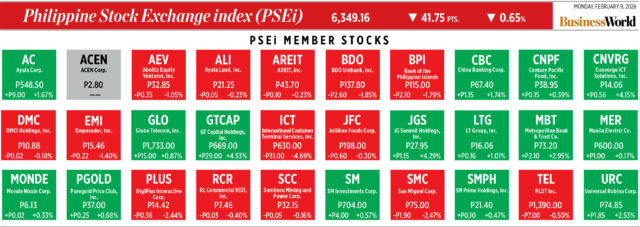
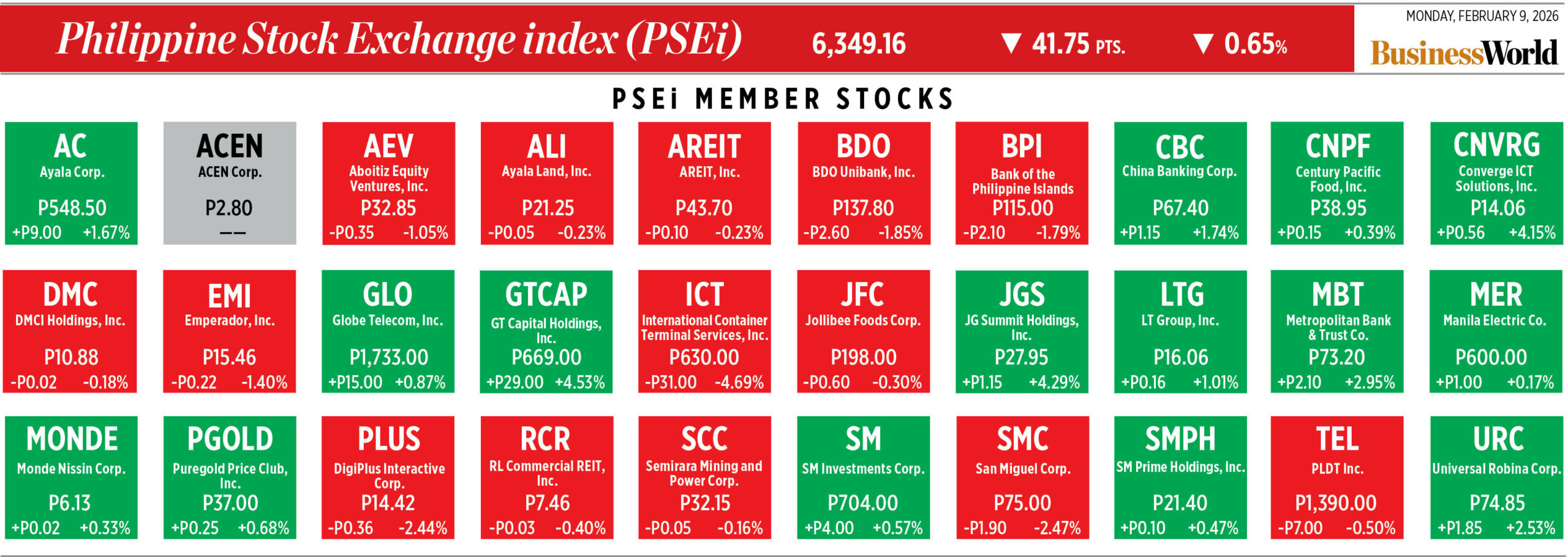
How PSEi member stocks performed — February 9, 2026

Here’s a quick glance at how PSEi stocks fared on Monday, February 9, 2026.


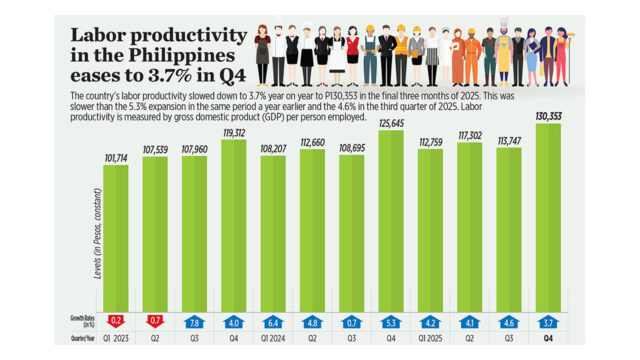
Labor productivity in the Philippines eases to 3.7% in Q4

The country’s labor productivity slowed down to 3.7% year on year to P130,353 in the final three months of 2025. This was slower than the 5.3% expansion in the same period a year earlier and the 4.6% in the third quarter of 2025. Labor productivity is measured by gross domestic product (GDP) per person employed.