Home Blog Page 2713

DITO CME’s ‘Secure Horizons 2024’ tackles cybersecurity challenges in the Philippines

Cybersecurity is one of the many areas where the Philippines needs to enhance its capabilities in order to protect its digital users. The country ranks second in the cybersecurity company Kaspersky’s global cyber-attack of 2023 list while only placing 45th out of 164 countries in the National Cyber Security Index (NCSI) by the e-Governance Academy Foundation.

In response to this growing threat, DITO CME Ventures, Inc., a wholly-owned subsidiary of publicly-listed DITO CME Holdings Corp., recently brought together top experts from both the public and private sectors for its first-ever one-day live event focused on cybersecurity with the theme “Secure Horizons 2024: Navigating Tomorrow’s Cyber Threats with Today’s Innovative Solutions.”

DITO’s Secure Horizons event began with a speech from the company’s President and COO Donald Patrick Lim, where he mentioned that the event almost did not push through due to the inclement weather brought on by Typhoon Enteng and the southwest monsoon.

“Cyberthreats wait for no man and no perfect weather; it could just come at any time. Thus, we made a conscious decision to push through because as they say, the show must go on,” he said.

The DITO CME COO also noted that the Philippines has been a target of numerous cyberattacks over the past months and shared that other companies have been asking him about what’s been recently happening on the cybersecurity front.

“These attacks have not been limited to any one single institution, they span government agencies, private enterprises, and even critical national infrastructure. This growing threat landscape underscores a pressing reality: our vulnerability as a nation,” he said.

Mr. Lim mentioned that rapid digital transformation, lack of focus on cybersecurity, limited investments in cybersecurity infrastructure, and its geopolitical position in Southeast Asia make the Philippines an attractive target for cyberattacks either state-sponsored or launched by transnational criminal groups.

To make the country more cyber-secure, he recommends that private and public institutions work together and invest in robust cybersecurity measures, including adopting the latest technologies, conducting regular audits, as well as training their workforce to identify, anticipate and respond to both present and future cyberthreats.

He added that there is a need for a comprehensive cybersecurity policy and legislation that provides a clear framework for protecting critical infrastructure, responding to incidents, and prosecuting cybercriminals. In addition, he recommends the integration of cybersecurity into the education curricula and running awareness campaigns to ensure that every citizen knows their role in safeguarding the digital future.

“Cybersecurity is not just a technical issue, it is a strategic imperative. The frequency and impact of cyberattacks in our country highlight the need for action. We must act collectively and decisively… Together we can build a safer digital future for our nation,” Mr. Lim said.

The event also featured a keynote speech from Department of Information and Communications Technology Director of the Cybersecurity Bureau Jose Carlos “Caloy” P. Reyes, where he spoke about the critical importance of national cybersecurity strategies and ongoing initiatives to bolster the country’s resilience against cyber threats.

Other experts from the public sector who spoke during the event include PCol. Jay Guillermo, division chief of the Cybercrime Unit of the Philippine National Police; Col. Francel Margareth Taborlupa, chief of the Information Systems Management Division of the Armed Forces of the Philippines; and Monchito B. Ibrahim, executive member at National Innovation Council.

Meanwhile, several prominent private sector experts also shared their valuable insights and expertise during the event: Red Rock IT Security, Inc. Chief Technology Officer Raymond Nunez; Impact Solutions Research Institute Founder and Senior Consultant Jan Chavez-Arceo; Blackpanda Group CEO Gene Yu; Hacktiv Colab, Inc. CEO Paul Soliman; Hacktiv Colab, Inc. Chief AI and Data Strategist Ziggy Zulueta; Asian Institute of Management Adjunct Professor Edwin Concepcion; and, ATTN Live Chief Innovation Officer and University of Michigan Professor Tim Bates.

Topics such as data privacy, artificial intelligence, blockchain, deep fakes, and even the West Philippine Sea were all covered by these experts to highlight the challenges and emerging risks in the digital landscape of the Philippines.

In closing the event, Mr. Lim expressed his appreciation towards the attendees, sponsors, experts, and stakeholders who made the event possible and highly successful notwithstanding the poor weather. He summarized the key take-aways presented by each speaker.

“Cybersecurity is not the responsibility of one single entity, it is a collective mission. Therefore, one of the recurring themes of this conference is the interconnected nature of our challenges in this rapidly growing digital space. Our security is only as good as our weakest link,” he said.

Taking off from the success of this initial event, Secure Horizons plans to do a roadshow across different key cities in the Philippines with Visayas and Mindanao legs. These will culminate in the Secure Horizons Roadshow in Manila, before the end of 2025. More details to come.


Spotlight is BusinessWorld’s sponsored section that allows advertisers to amplify their brand and connect with BusinessWorld’s audience by publishing their stories on the BusinessWorld Web site. For more information, send an email to online@bworldonline.com.

Join us on Viber at https://bit.ly/3hv6bLA to get more updates and subscribe to BusinessWorld’s titles and get exclusive content through www.bworld-x.com.

Taste the Bold Flavors of the North at Hann Resorts

Pampanga, often celebrated as the culinary heartland of the Philippines, has long attracted food enthusiasts from near and far. Known for its rich heritage and vibrant flavors, the province offers a gastronomic experience that is both traditional and innovative. From the savory goodness of sisig to the sweet delight of tibok-tibok, Kapampangan cuisine showcases a profound love for food that has been passed down through generations. Yet, as the world evolves and tastes change, Pampanga continues to adapt, adding new dimensions to its culinary landscape.

Hann Resorts, an iconic landmark in Clark, Pampanga, introduces a whole new dining experience, offering a compelling reason to travel just an hour and a half from Manila by land or conveniently accessed by air via Clark International Airport. This integrated resort is home to a world-class gaming facility, and internationally renowned hotels like the Clark Marriott and Swissotel Clark, together operating a total of 15 restaurants, cafes, and bars — a diverse culinary option awaiting to be explored.

A culinary world tour under one roof

Robert Czeschka, Executive Chef of Clark Marriott

Hann Resorts presents a global culinary journey, a vibrant tapestry of local and international flavors all under one roof. Guests can travel from European classics to Asian delicacies, to innovative fusions of international culinary traditions.

Tomahawk Steak at Smoki Moto

Specialty dining destinations at Clark Marriott are directed by Executive Chef Robert Czeschka. One of the best restaurants in Central Luzon is Smoki Moto, specializing in Korean, Japanese, and American cuisines. This well-loved restaurant features premium Black Angus Beef, including a 1.6-kg Tomahawk Steak infused with roasted garlic olive oil and served with baguette, parmesan whipped potatoes, grilled asparagus, and port wine jus.

Interior of Smoki Moto, Clark Marriott

Located on the 17th floor, Smoki Moto offers breathtaking views of the Zambales mountain ranges, making it an ideal spot for a romantic dinner or a nightout with friends. The restaurant features modern interiors, including a dramatic “hanging” nook that adds a unique touch to the dining experience. It also boasts a teppanyaki-style private dining area for a more intimate meal.

Goji Kitchen+Bar is the leading buffet restaurant in Clark known for its wide array of international dishes for breakfast, lunch, and dinner. It highlights a Kapampangan station showcasing the province’s signature dishes such as sisig and buro.

Lucas Zhou, Executive Chinese Chef of Clark Marriott

Wu Xing, led by Executive Chinese Chef Lucas Zhou, offers an extensive selection of signature Cantonese dishes in an elegant setting. Renowned by locals and tourists alike, Wu Xing’s authentic Peking duck is a standout, marinated and roasted with locally sourced star-apple firewood, resulting in tender, flavorful meat and crispy skin.

Peking Duck and signature dishes of Wu Xing

Smoki Moto, Goji Kitchen+Bar and Wu Xing are listed as TripAdvisor’s best restaurants in Clark.

Roald Schuur, Area Culinary Director of Swissôtel Clark

Two-year-old Swissotel Clark elevates the dining experience with specialty restaurants led by Area Culinary Director, Chef Roald Schuur. Guests indulge in a wine-filled adventure at Ristorante di Verona, where Italian fun dining awaits. Don’t miss their authentic lasagna, baked until golden and crisp on top, offering a comforting and well-balanced blend of flavors. Savor a homemade pizza quattro formaggi, perfectly prepared in a wood-fired brick oven. For the main event, the mouthwatering tomahawk steak, is perfect for sharing and pairs wonderfully with fine wine.

Authentic lasagna at Ristorante di Verona

Inspired by the young romantic setting of Shakespeare’s Romeo and Juliet, the restaurant’s posh interiors set the stage for an equally delightful culinary offers. The unique decor, featuring industrial ceilings and mirrored walls, reflects its playful dining concept, creating an inviting and sophisticated atmosphere.

Interior of Ristorante di Verona, Swissotel Clark

Markt, the all-day dining restaurant, pays tribute to its Swiss heritage by drawing inspiration from Europe’s bustling marketplaces. Guests can enjoy ordering from dynamic food stations, including salads, appetizers, stews, pasta, fried dishes, grilled meat and fish, and desserts.

Spice, conveniently located near the gaming floor, offers quick and flavorful meals featuring local and Asian favorites. This Asian restaurant serves a mix of Chinese, Thai, Vietnamese, Japanese, and Indonesian street food, bursting with flavor and spices. Menu highlights include Pad Thai, Laksa, Beef Salpicao, homemade steamed buns, and dimsum. Don’t forget to try their unique and refreshing drinks, artisanal craft beers, and iced teas named after local cities in Pampanga: Angeles C-tea, Mabalacat C-tea, and San Fernando C-tea.

A culinary destination in Pampanga, Hann Resorts is where travelers can explore dining at new heights. With the expertise of the executive chefs, who use the freshest ingredients and incorporate impressive cooking techniques, bold flavors abound in every dish. With its unique ambiance, refreshing views of nature, and exceptional 5-star service, dining is a feast for both the palate and the senses. Whether you’re savoring a gourmet meal or enjoying a casual bite, each experience is crafted to delight. Traveling all the way to Clark becomes a journey worth making, promising a culinary adventure you won’t forget. #BoldFlavors

Learn more about Hann Resorts at www.hannresorts.com or on Facebook and Instagram at @hannresorts.


Spotlight is BusinessWorld’s sponsored section that allows advertisers to amplify their brand and connect with BusinessWorld’s audience by publishing their stories on the BusinessWorld Web site. For more information, send an email to online@bworldonline.com.

Join us on Viber at https://bit.ly/3hv6bLA to get more updates and subscribe to BusinessWorld’s titles and get exclusive content through www.bworld-x.com.

Geopolitics and economic opportunities

FREEPIK

The Philippines has repeatedly failed to take economic advantage of geopolitical events.

It was Thailand, for example, that benefited from the 1985 Plaza Accord agreement which forced the Japanese to revalue the yen. Faced with a stronger yen, Japanese manufacturers relocated to Thailand. Thailand became the “Detroit of Asia” as Toyota, Honda, Isuzu and other Japanese car makers made it a base for manufacturing and exporting to other countries in Asia and beyond.

In contrast, despite its large English-speaking, relatively educated workforce, the Philippines lost investors due to its unstable political environment, lack of infrastructure, unstable power supply, and investment-unfriendly and anti-foreign laws, starting with the 1987 Constitution. As a result, the country chose to export its people instead.

For these same reasons, the Philippines continues to lose out in the geopolitical conflict between China and the West. Investors have been skipping the Philippines and heading to Vietnam and India as their insurance against further escalation of the US-China rivalry. Meanwhile, Chinese investors, faced with more expensive labor and a shrinking demographic labor pool, are also going to Vietnam, despite the history of tense Vietnam-Chinese relations.

The Philippines continues to lose manufacturing investors. Intel left the country for Vietnam, and even Korean investors, led by Samsung, have spurned the country for Vietnam. Given the close relations between South Korea and the Philippines, forged during the Korean War, one would have thought the Philippines would be a preferred investment and tourism destination for Koreans. Alas, the Philippines continues to be the bride left at the altar.

Scanning the newspaper pages, I still see many economic opportunities the Philippines can exploit, but will we?

For example, Canada and Australia are beginning to limit the number of foreign students in their universities. An expanding foreign student population is being blamed for high housing rental prices, competition for scarce jobs, and overall decline in quality of living both in Australia and Canada even if education exports contribute to a significant share of their respective GDPs. In Australia, educational exports contribute $20 billion to the economy and are the fourth biggest export after iron ore, gas, and coal. However, for political reasons, Australia and Canada are taking away the welcome mat for foreign students and hurting their economies instead.

Why don’t we take advantage of this geopolitical development and present ourselves as an alternative to English-based tertiary education? After all, we cater to foreign students from India, Nepal, and Africa for health sciences education, and various nationalities for English language education. We certainly cannot offer ourselves as an alternative to those seeking top-tier university and post-graduate education or those seeking education as a path to permanent migration in Australia or Canada. However, we can still catch some spillovers from those who have been turned away from Australia and Canada and are looking for English-based tertiary education. We can build on our education exports as another growth driver if we are intelligent and decisive enough. However, to reach that goal, we must do several things.

First, we must remove the Constitutional restriction on foreign investment in education. Removing the restriction is already part of Resolution of Both Houses (RBH) No. 7*, which amends the Constitution on foreign ownership in education, advertising, and public utilities. It is too bad these Constitutional amendments have been stalled in the Senate, but we are missing a gigantic opportunity by not doing so.

If we allow foreign investment in education, we may be able to get prestigious foreign universities to establish campuses here, especially since their home countries have started to limit international student enrollment. Having these foreign universities here will not only raise the level of tertiary education in the Philippines but also attract foreign students to come and study in the Philippines and graduate with a degree from a prestigious foreign university, say the University of Sydney or Duke University. Imagine the spillover effects on the economy in terms of housing, food, and tourism.

Second, we must also remove the constitutional restriction on the practice of professions without the need for an enabling law. This will not only make it easier for foreign professors to teach in the Philippines (the Philippine Regulation Commission considers teaching a practice of a profession) but also expand the number of foreign student graduates who have studied here, especially much-needed doctors and nurses, to practice in the Philippines.

At the very least, Congress should amend the Foreign Medical Practices Act, to enable foreign medical students who have studied in the Philippines to get a license to practice here if they pass the Physician Licensure Examination (PLE). About 10,000 Indian medical students in the Philippines face a problem since India recently mandated a reciprocity arrangement for citizens who have studied abroad to get a license to practice in India aside from an alignment of medical curriculums. If we don’t reciprocate, the number of Indian medical students in the Philippines may dry up and present huge opportunity losses to our private colleges and universities.

Third, the Free Tertiary Education Act, which provides free tuition at state universities and colleges for P40 billion annually, should be converted into a scholarship fund for poor students instead. 

The College Tuition Law is wrong for many reasons. It subsidizes state schools, whether performing or not, so rich and middle-class students in those schools get free tuition. The more affluent students, especially those from private schools, are more likely to be admitted to those state schools, thereby creating a bias against poor students. This exacerbates income inequality. It is also inefficient since the cost of graduating a student in state schools is higher than in private colleges and universities.

Most importantly, it provides unfair competition to more efficient and better-managed private colleges and universities. As a result of this law, several private educational institutions have gone out of business and weakened the nation’s capacity to provide tertiary education.

Last, the growth of the education export sector should be part of the country’s development plan and should be an area to shower with government incentives and support.

Other geopolitical developments, from the demographic collapse in Japan, South Korea, and even Thailand, to political instability in Bangladesh and Thailand, can be exploited by the Philippines with the right policies. However, I will discuss these in another column.

Given our labor rigidities and the poor state of our infrastructure, we may be unable to attract many manufacturing investors despite Western governments’ push for “friend-shoring.” We may have no choice but to seek growth in services. Geopolitics presents us with an opportunity to grow our education export services sector. Let’s seize the day. n

*“A Resolution of Both Houses of Congress Proposing Amendments to Certain Economic Provisions of the 1987 Constitution of the Republic of the Philippines, Particularly on Articles Xll, XlV, and XVl.”


Calixto V. Chikiamco is a member of the board of IDEA (Institute for Development and Econometric Analysis).

totivchiki@yahoo.com

SM Prime shares dip despite developments

SM Prime Holdings, Inc. shares dipped last week despite news about its mall expansion plans and investor expectations of a rate cut, according to analysts.

Data from the Philippine Stock Exchange showed 28.39 million shares worth P857.4 million exchanged hands from Sept. 2-6, making the listed property developer the 10th most actively traded stock in the local bourse last week.

Shares in the Sy-led company finished trading at P30.10 on Friday. The stock price fell by 2.7% from a week earlier. For the year, the stock also declined by 8.5%.

Mercantile Securities Corp. Head Trader Jeff Radley C. See said in an e-mail that the listed property developer’s rally was driven by investors’ anticipation of a rate cut this year.

He also said that this would be bullish for SM Prime because it would make borrowing money cheaper.

In its Aug. 15 Monetary Board Meeting, the Bangko Sentral ng Pilipinas (BSP) cut benchmark interest rates by 25 basis points to 6.25%, its first cut in nearly four years.

With this, BSP Governor Eli M. Remolona, Jr. also signaled another rate cut before the end of the year.

Latest government data showed inflation for August slowed to 3.3% from 4.4% in July, the slowest pace in seven months and settling within the central bank’s target of 2-4%.

Last week, reports showed that the property developer is focusing on expanding its mall business in the Philippines due to its competitive advantages while maintaining stable operations in China.

Executive Committee Chairman Hans T. Sy also added that SM Prime is on track with its reclamation project, mentioning that there are ongoing discussions about potential partnerships for development and added that the budget for the reclamation is almost P150 billion.

This reclamation project is for the 360-hectare SM Smart City development, which is linked to the Mall of Asia Complex.

SM Smart City is designed as a mixed-use development similar to the Mall of Asia reclamation project. The property developer aims to finish the project and turn it over to the Pasay City local government by 2028.

SM Prime’s continued international expansion, especially in China coupled with its aggressive domestic growth, demonstrates its strong position as a regional real estate leader, Mark V. Santarina, trader at Globalinks Securities and Stocks, Inc., said in a Viber message.

He added that the company’s significant investments reinforce its commitment to growth both locally and overseas.

In the second quarter, SM Prime Holdings ‘attributable net income grew by 16% to P11.68 billion from P10 billion a year earlier.  Meanwhile, consolidated revenues increased by 8.8% to P33.97 billion from P31.22 billion.

For the first half of the year, net income grew by 13.5% to reach P22.07 billion, whereas consolidated revenues for the six-month period grew by 8.1% to P64.69 billion.

For Mr. See, he pegged the resistance at P31, while the support levels were at P29.65 and 27.85.

“The stock might range for now between P29.65 and P31,” Mr. See added. Abigail Marie P. Yraola

Spatio: a new face for Robinsons

Going beyond a department store

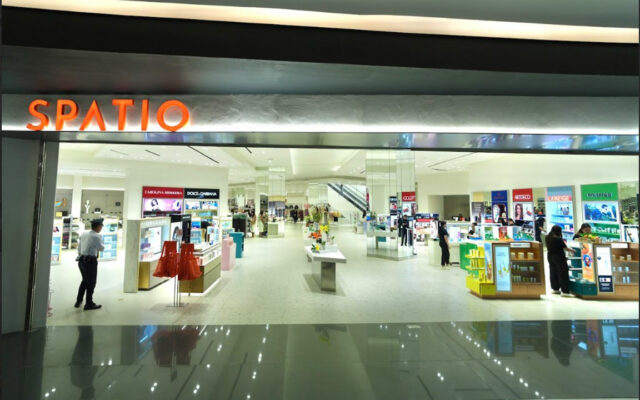
THE OPUS MALL down C5 is fast becoming a place to be, and Spatio is just going to add to the buzz.

Spatio is the latest concept from Robinsons Retail, under JG Summit Holdings, Inc. During its opening on Sept. 5, shoppers and guests were taken to all its three floors, spanning Men, Travel, Watches, Women, Beauty, and even a play space for children near the Home department. It also boasts of its own wine bar (Bar Shu), a barbershop (Bruno’s Barbers), and a day spa (Laybare Plus).

The first floor boasts of a Sole Academy, which Robinsons Retail acquired late last year. Their space inside Spatio includes a cleaning service for sneakers, as well as selections from Nike, Adidas, New Balance, Asics, and Saucony.

Martin de Leon, Deputy General Manager for Spatio, estimates that the store measures around 7,500 sq.m. spread across three floors. “This has actually evolved into more of a concept store, than a department store. It’s not your usual,” he told BusinessWorld. “The concepts that you can find are more concept or more store-in-store.” For example, he points out that British brand Kangol’s first physical store in the Philippines is in Spatio, and that Martha Stewart’s home products are in the store as a store-in-store concept (meaning they carry the full line). All in all, to Mr. De Leon’s estimate, Spatio carries close to 200 brands.

A surprising find are the artisanal fair staples like Pinas Sadya, Calli, and Vesti and local designers like Rhett Eala. Although they already have solo stores in other upscale malls, they’re not exactly department store finds. “We want to kind of put a home to all these really good brands. There’s no reason to wait for a pop-up. We definitely want this to be a destination where we can support local brands and what they stand for,” said Mr. De Leon.

He emphasizes, however, “We don’t want to position this as a luxury brand per se. We have what we call our department store staples,” he said, and familiar brands like Bench come into the mix. “We want this to be still an accessible store. I guess the positioning is quite unique. It’s not all over P10,000. You can come here and still find your basic black and whites, and find something less than P500.”

That’s quite true: their beauty department has staples like Maybelline, and a few steps over, you can find a blazer by a local designer for P12,000. Just down the escalator is luxury luggage by Bric’s Milano, with some bags at P40,000.

As for rolling out the concept in other Robinsons malls, he said, “We want to focus on this first, but definitely, as we grow the business, we will continue to explore other opportunities for Spatio.”

Spatio is located at Opus Mall, Bridgetowne Destination Estate, Quezon City. — Joseph L. Garcia

Truckin’ in the city

PHOTO BY DYLAN AFUANG

Mitsubishi’s competent pickup makes a case for trucks as urban transport

By Dylan Afuang

DRIVING the 2024 Mitsubishi Triton only within the confines of the city makes one wonder if the number of buyers who choose trucks as urban transport have had the right idea all along.

The latest Triton — the successor to the Strada nameplate — comes in seven variants, with prices ranging from P1.134 million to P1.909 million. Through the Triton GLS 4×2 AT (P1.582 million), a model that’s positioned below the range-topping Athlete, we explored Mitsubishi Motors Philippines Corp.’s (MMPC) entry to the growing pickup truck market.

Indeed, sales figures (and a personal observation) reflect the market’s growing preference toward passenger pickup trucks, a vehicle category that’s defined by the Department of Trade and Industry (DTI) as light commercial vehicles (LCVs).

For the first half of 2024, sales of CVs in general rose by 9.8% to 166,404 units from 151,567 units in the same period a year ago, according to a joint report of the Chamber of Automotive Manufacturers of the Philippines, Inc. (CAMPI) and the Truck Manufacturers Association (TMA).

Occasionally, friends or casual acquaintances would inquire whether a particular pickup truck or midsize SUV would be suitable as everyday transport. We would notice such vehicles’ prevalence in the streets, another sign of that vehicle segment’s rising popularity.

And so the Triton GLS joins the throngs of large vehicles in the city’s heavy traffic and cramped parking spaces. What makes it stand out, however, is the truck’s striking exterior, recognized in the iF Design Award 2024, and body length (plus 60mm) and wheelbase (plus 130mm) increases over its predecessor.

These result in a roomier cabin for five passengers, and a ride quality that’s more stable and better handles road imperfections than before. On the other hand, the vehicle’s larger exterior means that parking becomes a tad more difficult than usual.

However, parking sensors and 360-degree camera offer a fine view of parking building walls and erring motorcycles on the road, and the relatively quick steering makes weaving in traffic manageable. For safety, the model offers regular cruise control, forward collision warning, and blind spot monitoring.

The following convenience features found in the Triton GLS, meanwhile, are expected in the price: Charging ports with USB-C, wireless charging, nine-inch infotainment screen with Apple CarPlay and Android Auto, remote locking, and push-button start. Exclusive to the GLS is a cosmetic package that includes step boards, 16-inch gray alloy wheels, and a bed roll bar.

The cargo bed boasts an unobstructed space that can be maximized by 1,115kg worth of cargo. During our urban-centered drive, the cargo space even proved too excessive for a trip to collect groceries and an office chair. The space is more suited for, say, moving large furniture or hauling heavy suitcases or bags of cement.

The truck’s 2.4-liter, four-cylinder, single-turbo diesel mill is certainly an efficient and strong companion. In a progressive manner, it courses 181hp and 430Nm of torque to the rear wheels through a six-speed automatic. The engine consumes 8kpl in crawling traffic, and up to 20kpl on an almost-empty Skyway.

Pickup trucks, by their design, feel too cumbersome for urban duties. These vehicles work better in commercial use cases, and the same can be said for the Triton. Nonetheless, the Triton stands out by virtue of its comfortable cabin, decent equipment with the GLS 4×2, and potentially efficient and reliable mechanicals.

SRA hoping fertilizer additive saves costs for sugar farmers

REUTERS

THE Sugar Regulatory Administration (SRA) said that it is looking to increase the use of non-traditional fertilizer additives for sugar cane production.

In a statement, the regulator said that a recently opened Beneficial Micro-Organisms (BMO) facility could expand the use of the fertilizer additive.

“(The) BMO proved helpful during the prolonged dry spell early this year because it is a foliar fertilizer and can reduce regular fertilizer inputs by about 30%or more,” Ma. Theresa Alejandrino, the facility’s supervising science research specialist, said.

Sugarcane production declined 42.3% year on year during the second quarter to 1.63 million metric tons (MMT), according to the Philippine Statistics Authority (PSA).

The SRA said the P6-million facility has the potential to reduce the cost of fertilizer inputs for sugarcane growers. Its funded was authorized by the Sugar Industry Development Act or Republic Act 10659.

“It is actually a technology that has been used as early as the 1990s as it basically functions as prevention for plant diseases, but it is only recently that farmers were interested in using it amidst rising cost of fertilizers,” Ms. Alejandrino said.

SRA board member David Andrew L. Sanson said cane farmers were able to save about P6,000 per hectare due to the use of the BMO additive.

“The SRA can increase BMO production that we hope will be utilized by our farmers, especially the small farmers that comprise a huge chunk of our sugar producers, and make sugar farming sustainable,” Mr. Sanson added.

Last year, the SRA distributed more than 10,000 gallons of BMO to over 200 beneficiaries. It was used on up to 1,000 hectares of land planted to sugarcane.

Ms. Alejandrino said that the use of the additive promotes germination, flowering, fruition, and ripening of cane crops.

“It also improves physical, chemical, and biological environment of the soil and produces high levels of beneficial enzymes and organic acids that help build solid soil structure,” she added.

Based on the SRA’s initial estimates, raw sugar production could drop to 1.78 MMT for the 2024-2025 crop year, compared to the 1.92 MMT actual output for the 2023-2024 crop year. — Adrian H. Halili

AI adoption key for finance sector growth in PHL

REUTERS

WITH RAPID DEVELOPMENT and innovation happening over the past few years, the adoption of generative artificial intelligence (AI) is set to open more growth opportunities in businesses and industries. Industry leaders have quickly come to recognize the potential of AI in many applications, which is why it’s become a race to properly utilize the technology.

The finance sector is one such field that’s ripe for the major growth that AI can unlock. In a recent presentation, Jackie Wang, Google country director for the Philippines and Thailand, shared three ways for banks, lenders, and other financial institutions to get in on the action and jump-start growth opportunities using the power of AI:

• Properly chart your organization’s roadmap for AI adoption: A clear plan has to be put in place in order to maintain a competitive advantage and maximize the establishment of AI in your company. Google has developed an assessment framework to measure how far along organizations are in adopting AI-powered marketing solutions and how successfully the plan is being implemented.

• Stand out and stay ahead with AI-powered marketing: The first part will lead to the adoption of AI-powered tools in efforts to generate leads. Google’s Demand Gen tool helps businesses optimize creative content to be as relevant as possible to customers all along the consumer journey. Meanwhile, lapsed customers can be re-engaged with Google’s App Campaigns for engagement, which uses generative AI to design highly effective ad formats and assets to bring them back. Local banks have already managed to use Google’s AI tools to earn leads.

For example, Security Bank Corp. recorded 83% more leads at a reduced cost per lead of 54% using AI-generated ads. Meanwhile, Union Bank of the Philippines, Inc. used Google’s AI-powered Performance Max tool to increase credit card conversions, hitting a 90% approval rate and netting a 77.6% return on their ad spend.

• Train people how to best use AI: Of course, AI still needs human intellect and insight to create the best results. The technology can boost their efficiency and productivity, which in turn leads to better performance for the organization.

In the bigger picture, AI also facilitates innovation by identifying new opportunities and accelerating product development. By skilling and training employees to get essential AI skills, such as those offered in Google AI Essentials online course, businesses can nurture, attract, and retain top talent and stay competitive in the ever-evolving digital landscape.

“In today’s rapidly evolving financial landscape, AI adoption isn’t merely a competitive advantage, it’s a necessity,” said Ms. Wang. “By embracing AI tools and innovation, local financial institutions can be well-positioned to win customers and achieve long-term growth.”

Patronage politics has caused the loss of health insurance coverage for millions of Filipinos

Busting the Universal Health Care dream? The Congress-approved cash sweep of government-owned and -controlled corporations (GOCCs) did not exempt the Philippine Health Insurance Corp. or PhilHealth for a reason. PhilHealth seemed vulnerable with its large reserves and a damaged reputation during COVID-19.

To make things worse, PhilHealth’s budget for premiums was reduced by 50%, leaving at least 11 million indirect members and 18 million dependents without health coverage this year.

While the Department of Budget and Management (DBM) claims all of this happened because legislators hold the keys to the budget, the final nail in the coffin was driven by the DBM’s inability to advise the President that Congress had cut PhilHealth’s budget for the health coverage of millions of Filipinos and that PhilHealth could be adversely affected by a provision that would allow the Department of Finance (DoF) to take up billions more from it.

The Universal Health Care (UHC) Law clearly requires government support for premiums in Section 10 of the law:

Provided, That for indirect contributors, premium subsidy shall be gradually adjusted and included annually in the General Appropriations Act (GAA): Provided, further, That the funds shall be released to PhilHealth: Provided, furthermore; That the DoH (Department of Health), in coordination with PhilHealth, may request Congress to appropriate supplemental funding to meet targeted milestones of this Act: Provided, finally, That for every increase in the rate of contribution of direct contributors and premium subsidy of indirect contributors, PhilHealth shall provide for a corresponding increase in benefits.”

By reducing budget support to P40 billion, PhilHealth will start incurring deficits in its program for indirect contributors which will jeopardize its ability to pay benefits.

Congress, during the bicameral committee conference, took P40 billion from PhilHealth and transferred much of it to the DoH’s MAIP (Medical Assistance to Indigent and Financially Incapacitated Patients) Program. The DoH had only requested P22.263 billion for MAIP, but Congress, through the bicameral committee conference, inflated the program to P58.093 billion. While the DoH gained P35.83 billion, PhilHealth had to shed 11 million indirect members. The irony of it all is that one must be a PhilHealth member to avail oneself of the MAIP.

MAIP is favored by most legislators who give health assistance to constituents through Guarantee Letters (GL) to pay for health costs that PhilHealth cannot cover with its limited benefit packages that usually only cover 20-30% of hospital bills.

MAIP has become the preferred option due to the failure of the DoH, PhilHealth, and local government units (LGUs) to implement the UHC law. Funds from sin taxes and premiums from the direct contributors accumulate in PhilHealth when LGUs and the DoH do not deliver the services that PhilHealth can pay for.

PhilHealth can continue to increase benefits, but if the claims are insufficient in number and value and the eligible members decline, contributions will accumulate in PhilHealth. Congress will then lose interest in funding a UHC law through PhilHealth and instead continue funding MAIP where they can exercise patronage politics, which is most important during election years.

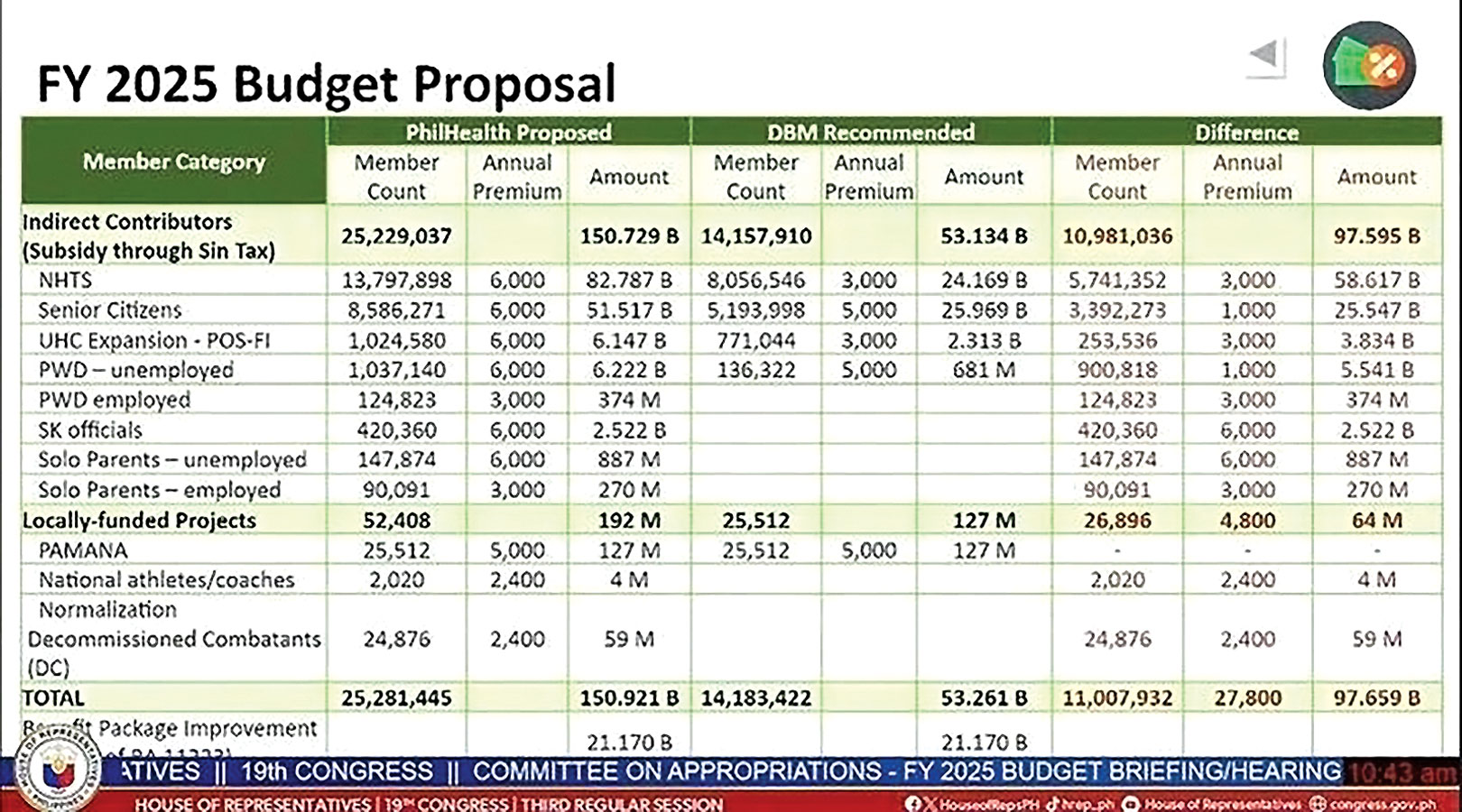
For 2025, DBM must explain why it has recommended a reduction of indirect contributors from 25,229,037 to 14,157,910. The slide included here clearly shows a reduced member count.  This effectively removes 10,981,036 indirect contributors. With an average of two dependents per indirect member, that will mean over 30 million Filipinos without health insurance coverage next year.

DBM has also recommended a premium of P3,000 for the poor individual covered by the 4Ps (Pamilyang Pilipino Pantawid Program) and P5,000 for each senior citizen in 2025, which is below the P6,000 annual premium to retain membership. This will reduce coverage to only six months for 4Ps and 10 months for senior citizens. This could actually lead to even lower coverage for 4Ps members and seniors compared to 2024.

No one can predict who will need healthcare at any given time, which is why universal coverage is essential. The fact that only 15% of indirect members made claims in 2022 should not be used as a justification to deny coverage to everyone, particularly the poor and elderly. In a year, public health planners usually presume that 20% of the population will get sick, and 5% may require hospitalization. By proposing to cover with inadequate coverage only 14 million indirect members in 2025, has the DBM pre-determined who will get sick next year?

Further, the DoF’s claim that the government has provided excess amounts to fund the premiums of the poor does not hold water.

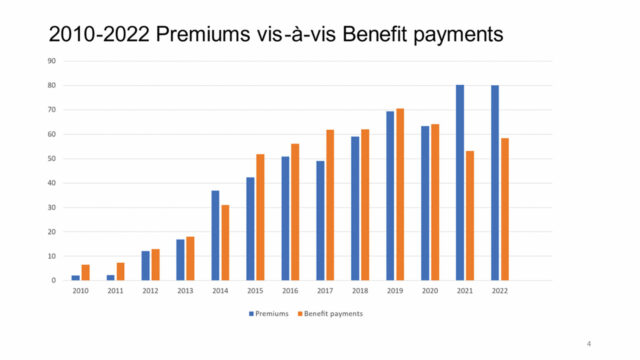
PhilHealth’s annual reports and the General Appropriations Acts (GAA) for the period 2010-2022 show that the GAA-provided “subsidies” were used up and had deficits in 10 out the first 13 years of the social health insurance program.

This author estimates from its reports that PhilHealth received P564.46 billion contributions for indirect members, and that it paid out P553.599 billion in claims. The DoF’s study only focused on the last three years (2021-2023) to determine the P89.9 billion, neglecting the many years of deficits of the program.

Furthermore, the GAA of 2023 only showed P61.229 billion for premium payments. When PhilHealth reported benefit payments for 2023 amounting to P58.7 billion on Sept. 4, 2024, that would only leave PhilHealth with P2.529 billion, not P38.8 billion in 2023.

So, one would wonder why is the PhilHealth reserve fund growing if most government contributions are being paid out?

PhilHealth annual reports for 2018-2022 show the expansion of the direct contributors in numbers and contributions (see the table).

The table, derived from PhilHealth’s annual reports for 2018-2022, shows that direct contributors increased by 7,536,785, contributing P165.9 billion to the reserve fund in surplus contributions. This constitutes at least a third of PhilHealth’s reserve funds.

For argument’s sake, presuming that the DoF Circular ordering the transfer of PhilHealth funds is legal, PhilHealth must still reexamine the source of the P89.9 billion it intends to turn over to DoF and ensure that not one peso is coming from direct contributions. If any amount is being sourced specifically from direct contributions, DoF might be dipping into the pockets of contributing members, which could be an illegal tax on PhilHealth member contributions.


Jeepy Perez, MD specializes in public health administration and primary healthcare and has worked with nine Health secretaries and three Economic Planning secretaries since 1992. He was undersecretary for Population and Development and executive director of the country’s Commission on Population and Development up to Sept. 8, 2022, when he retired.  He occasionally writes for Action for Economic Reforms.

Metro Pacific Water Solutions targets market leadership

METRO Pacific Water Solutions, a water and wastewater technology provider, is aiming to capture a larger share of the local market as it pursues new projects, the company’s president said.

“Right now, we’re serving about less than 10% of the available market. There are many players. But we also want to also expand,” Metro Pacific Water Solutions President and Chief Executive Officer Christopher Andrew B. Pangilinan told reporters on the sidelines of a launch event last week.

Mr. Pangilinan said that the company is looking to expand its wastewater services in Iloilo and Dumaguete, where it already has a presence.

“We also manage the water distribution in Iloilo and Dumaguete. Those are the areas that we’re looking at right now. We want to concentrate first locally,” he said.

According to Mr. Pangilinan, Metro Pacific Water Solutions is exploring new technologies to replace the membrane bioreactor process currently used in its treatment plants.

“We’re looking at new technology since there’s a very rapid evolution for both water and wastewater treatment. Early this year, we’ve been going around, talking to several technology partners, trying to expand the capacity of the company,” he said.

“One concern with sewage treatment plants is the space that is needed. We’re looking at new technologies that can be more compact and more suitable for our market here,” he added.

Some of the company’s clients include contracts with SM Malls, WalterMart, and PLDT Inc.

On Friday, Metro Pacific Water Solutions launched its rebranding from the previous name, Ecosystem Technologies International, Inc., as the company is now 100% owned by Metro Pacific Water.

Metro Pacific Water is the water infrastructure investments subsidiary of Pangilinan-led conglomerate Metro Pacific Investments Corp. (MPIC).

“We embark on a new chapter with the rebranding of Metro Pacific Water Solutions. This transformation represents our unwavering commitment to delivering sustainable and innovative water solutions for the Filipino people,” Mr. Pangilinan said.

“We are excited to leverage the combined expertise of the old Ecosystem Technologies brand and Metro Pacific Group to create a lasting positive impact on our environment and communities. We remain dedicated to our mission of partnering with the government in protecting the environment and ensuring access to clean water for all,” he added.

Metro Pacific Water Solutions has over 30 years of experience. It offers various services including design, engineering, construction, operation, and maintenance of water and wastewater treatment facilities.

The company has built around 700 plants and is operating over 100 sewage treatment plants nationwide.

MPIC is one of the three key Philippine units of Hong Kong-based First Pacific Co. Ltd., the others being Philex Mining Corp. and PLDT Inc.

Hastings Holdings, Inc., a unit of PLDT Beneficial Trust Fund subsidiary MediaQuest Holdings, Inc., has a majority share in BusinessWorld through the Philippine Star Group, which it controls. — Revin Mikhael D. Ochave

Almodovar’s The Room Next Door triumphs at Venice Festival

VENICE — Spanish director Pedro Almodovar’s first English-language movie The Room Next Door, which tackles the hefty themes of euthanasia and climate change, won the prestigious Golden Lion award at the Venice Film Festival on Saturday.

Starring Tilda Swinton and Julianne Moore, the film received an 18-minute standing ovation when it premiered at Venice earlier in the week — one of the longest in recent memory.

Mr. Almodovar is a darling of the festival circuit and was awarded a lifetime achievement award at Venice in 2019 for his bold, irreverent, and often funny Spanish-language features.

He also won an Oscar in the best foreign language category for his 1999 film All About My Mother.

Now aged 74, he has decided to try his hand at English, focusing his lens on questions of life, death, and friendship. Speaking after collecting his prize, he said euthanasia should not be blocked by politics or religion.

“I believe that saying goodbye to this world cleanly and with dignity is a fundamental right of every human being,” he said, speaking in Spanish.

He also thanked his two female stars for their performances.

“This award really belongs to them, it’s a film about two women and the two women are Julianne and Tilda,” he said.

While The Room Next Door had been widely tipped to win, the runner-up Silver Lion award was a surprise, going to Italian director Maura Delpero for her slow-paced drama set in the Italian Alps during World War Two — Vermiglio.

Australia’s Nicole Kidman won the best actress award for her risqué role in the erotic Babygirl, where she plays a hard-nosed CEO who jeopardizes both her career and her family by having a toxic affair with a young, manipulative intern.

Ms. Kidman was in Venice on Saturday, but did not attend the awards ceremony after learning that her mother had died unexpectedly.

France’s Vincent Lindon was named best actor for The Quiet Son, a topical, French-language drama about a family torn apart by extreme-right radicalism.

The best director award went to American Brady Corbet for his 3-1/2 hour-long movie The Brutalist, which was shot on 70mm celluloid and recounts the epic tale of a Hungarian Holocaust survivor played by Adrien Brody, who seeks to rebuild his life in the United States.

“We have the power to support each other and tell the Goliath corporations that try and push us around: ‘No, it’s three-and-a-half hours long and it’s on 70mm,” he told the auditorium on Saturday.

ROAD TO OSCARS
The festival marks the start of the awards season and regularly throws up big favorites for the Oscars, with eight of the past 12 best director awards at the Oscars going to films that debuted at Venice.

The prize for best screenplay went to Murilo Hauser and Heitor Lorega for I’m Still Here, a film about Brazil’s military dictatorship, while the special jury award went to the abortion drama April, by Georgian director Dea Kulumbegashvili.

Sarah Friedland, an American-Jewish filmmaker, won the best director award for Familiar Touch in Venice’s Horizons section, which runs alongside the main competition. She used her acceptance speech to denounce Israel’s war in Gaza.

“I must note I am accepting this award on the 336th day of Israel’s genocide in Gaza and 76th year of occupation,” she said to loud applause. “I believe it is our responsibility as film workers … to address Israel’s impunity on the global stage.”

Among the movies that left Venice’s Lido island empty-handed were Todd Phillips’s Joker: Folie à Deux, starring Joaquin Phoenix and Lady Gaga, the sequel to his original The Joker which claimed the top prize here in 2019.

Luca Guadagnino’s Queer, with Daniel Craig playing a gay drug addict, and Pablo Larrain’s Maria Callas biopic Maria, starring Angelina Jolie as the celebrated Greek soprano, also won plaudits from the critics but did not get any awards.

The Venice jury this year was headed by French actress Isabelle Huppert.

LIST OF WINNERS AT THE 2024 VENICE FILM FESTIVAL
GOLDEN LION for best picture: The Room Next Door by Pedro Almodovar (Spanish production)

SILVER LION runner-up prize: Vermiglio by Maura Delpero (Italy, France, Belgium)

Best Director: Brady Corbet for The Brutalist (Britain)

Best Actress: Nicole Kidman for Babygirl (United States)

Best Actor: Vincent Lindon for The Quiet Son (France)

Best Screenplay: Murilo Hauser and Heitor Lorega for I’m Still Here (Brazil, France)

Special Jury Award: April by Dea Kulumbegashvili (France, Italy, Georgia)

Best Young Actor: Paul Kircher for And Their Children After Them (France)

Reuters

Treasury bill, bond rates may drop on Fed bets

STOCK PHOTO | Image by RJ Joquico from Unsplash

RATES of the Treasury bills (T-bills) and Treasury bonds (T-bonds) on offer this week are expected to go down in anticipation of the US Federal Reserve’s monetary easing action this month.

The Bureau of the Treasury (BTr) will auction off P20 billion in T-bills on Monday, or P6.5 billion in 91- and 182-day papers and P7 billion in 364-day debt.

On Tuesday, the government will offer P30 billion in reissued seven-year T-bonds with a remaining life of four years and eight months.

Yields on the T-bills and T-bonds on offer this week may track the week-on-week decline in secondary market rates, Rizal Commercial Banking Corp. Chief Economist Michael L. Ricafort said in a Viber message.

The reissued bonds could fetch yields ranging from 5.975% to 6.025%, a trader said in an e-mail.

“All eyes are on tonight’s US jobs data, where the survey has been the lowest in two years. Global markets are basically hinged on the data and could open up the strong resistance at 6% for local bonds,” the trader said on Friday.

At the secondary market, the 91-, 182-, and 364-day T-bills saw their yields go down by 0.04 basis point (bp), 1.07 bps, and 0.91 bp week on week to end at 5.9150%, 5.9879%, and 6.0734%, respectively, based on PHP Bloomberg Valuation Service Reference Rates data as of Sept. 6 published on the Philippine Dealing System’s website.

The seven-year bond also inched down by 0.08 bp week on week to fetch 6.0606%, while the five-year debt, the tenor closest to the remaining life of the papers on offer this week, slipped by 0.12 bp to end at 6.0420% on Friday.

Secondary market yields mostly slipped last week as the market awaited the release of key US economic data, which could affect the Federal Reserve’s policy decision this month, and following slower-than-expected Philippine headline inflation in August, Mr. Ricafort said.

“Softer US economic data could support increased odds of Fed rate cuts in the coming months that could be matched locally,” he added.

Financial markets initially raised the chances of a half-point rate cut at the Fed’s Sept. 17-18 policy meeting to above 50% before slashing them to 25%, CME Group’s FedWatch Tool showed, Reuters reported. The odds of a 25-bp rate reduction increased to 75% from 57% earlier.

The Fed has maintained its policy rate in the current 5.25%-5.5% range for more than a year, having raised it by 525 bps in 2022 and 2023.

Meanwhile, the Bangko Sentral ng Pilipinas (BSP) on Aug. 15 reduced its policy rate by 25 bps to 6.25%, marking its first easing move in nearly four years.

BSP Governor Eli M. Remolona, Jr. has said they could cut rates by another 25 bps within the year. 

Last week, the BTr raised P22.6 billion from the T-bills, higher than the planned P20 billion, as total bids reached P53.105 billion.

Broken down, the Treasury borrowed P6.5 billion as programmed from the 91-day T-bills as tenders for the tenor reached P18.01 billion. The average rate for the three-month papers declined by 1.9 bps to 5.947%. Accepted rates ranged from 5.94% to 5.96%.

Meanwhile, the government hiked its award of 182-day securities to P9.1 billion versus the original P6.5-billion plan as bids for the tenor reached P19.26 billion. The average rate of the six-month T-bill stood at 6.002%, up by 0.6 bp, with accepted rates at 5.98% to 6.02%.

Lastly, the Treasury raised P7 billion as planned via the 364-day debt papers as demand for the tenor totaled P15.835 billion. The average rate of the one-year debt inched up by 1.8 bps to 6.04%, with accepted rates at 6% to 6.055%.

Meanwhile, the reissued seven-year T-bonds on offer on Tuesday were last auctioned off on Aug. 6, where the BTr raised P30 billion as planned at an average rate of 6.107%, below the 6.5% coupon.

The Treasury wants to raise P195 billion from the domestic market this month, or P80 billion through T-bills and P115 billion via T-bonds.

The government borrows from local and foreign sources to help fund its budget deficit, which is capped at P1.48 trillion or 5.6% of gross domestic product for this year. — AMCS with Reuters

ADVERTISEMENT
ADVERTISEMENT