Home Blog Page 269

Supreme Court voids Napocor health plan

WIKIMEDIA/PATRICKROQUE01

THE SUPREME Court has ordered officials and employees of the National Power Corp. (Napocor) to return more than P34 million in private health insurance premiums, ruling that the payments constituted an illegal use of public funds.

In a 21-page decision promulgated on April 22, 2025 and made public on Feb. 20, the High Court upheld a ruling by the Commission on Audit disallowing the payments for a Group Hospitalization and Life Insurance Plan from April 2014 to March 2015.

State auditors had flagged the expenditure in 2015, citing a rule that prohibits government agencies from procuring private health insurance since employees are already covered by the Philippine Health Insurance Corp.

Napocor officials argued that the payments were authorized under a collective negotiation agreement and were meant to improve employee welfare. However, the High Court ruled that such agreements cannot override existing audit rules and national compensation laws.

The tribunal noted that while the Electric Power Industry Reform Act allows some flexibility in compensation, it does not grant the state company blanket authority to bypass the Salary Standardization Law in granting benefits.

The court held the former Napocor president and chief executive officer, a vice-president and a human resource manager liable for approving the disbursements and ordered them to return the amounts.

Employees who received the benefits were also directed to refund what they had obtained, while officials whose roles were limited to certifying fund availability were cleared of liability.

In the decision penned by Associate Justice Amy C. Lazaro-Javier, the court stressed strict adherence to fiscal rules to safeguard public funds. The ruling is final, and the obligation to return the disallowed amounts stands. — Erika Mae P. Sinaking

Ex-Pres. Duterte’s legal team named

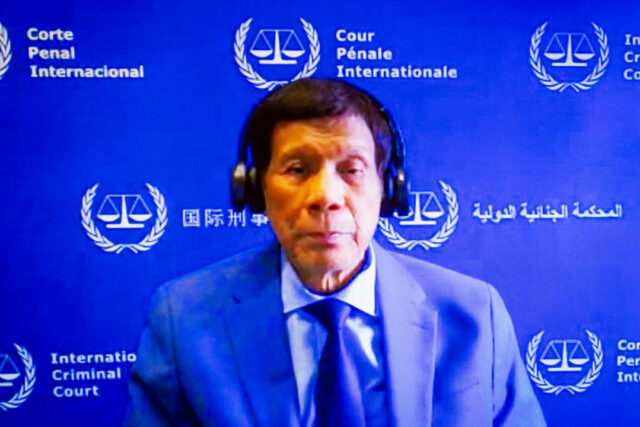
FORMER PRESIDENT RODRIGO R. DUTERTE — INTERNATIONAL CRIMINAL COURT / COUR PÉNALE INTERNATIONALE

THE DUTERTE family on Sunday said that six former Cabinet members of ex-President Rodrigo R. Duterte will be in attendance for his confirmation hearing on Feb. 23, on Monday by the International Criminal Court (ICC).

In a statement, the Office of the Vice-President said former Executive Secretary Salvador C. Medialdea, ex-Chief Legal Counsel Salvador S. Panelo, ex-Labor chief Silvestre H. Bello III, former LTFRB head Martin B. Delgra III, former Internal Revenues chief Caesar R. Dulay, and ex-PAGCOR President Alfredo Cereza Lim will act as Mr. Duterte’s Filipino legal team.

It said that the lawyers will attend the Confirmation of Charges hearing in order to ensure that he is properly represented by a Filipino legal team.

“We thank the legal team for their continued dedication and professionalism during this critical time,” it added.

The Duterte family also said that the ICC has not approved any in-person family visits during Mr. Duterte’s hearing, but telephone calls will continue to be made available.

The former chief executive is expected to face the international tribunal’s Pre-Trial Chamber I as judges determine whether there is enough evidence to try Mr. Duterte for crimes against humanity stemming from his administration’s bloody anti-drug campaign. The hearing is set for four days from Feb. 23-27.

Mr. Duterte was arrested last year by the International Criminal Police Organization after the ICC issued a warrant against him. He was flown to The Hague in the Netherlands hours later to face charges for his Drug War. — Adrian H. Halili

PAGASA says rains to ease this week

DOST-PAGASA FB PAGE

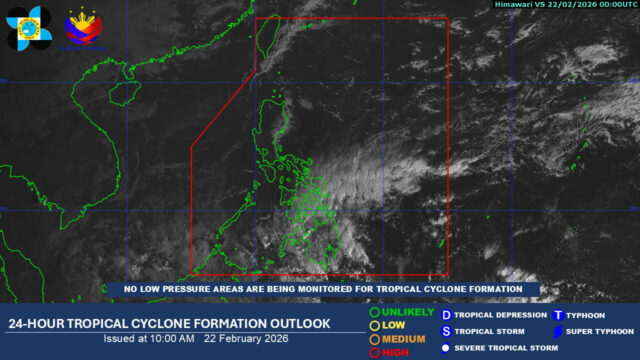
THE shear line and the northeast monsoon will shape weather conditions across the Philippines this week, with rains gradually easing but localized thunderstorms expected to persist in parts of Luzon and the Visayas, the state weather bureau reported on Sunday.

In its 5 a.m. briefing, the Philippine Atmospheric, Geophysical and Astronomical Services Administration (PAGASA) said the shear line — the convergence of cold northeasterly winds and warm easterlies — is affecting the eastern Visayas, while the northeast monsoon, or amihan, continues to influence Luzon and the rest of the Visayas. Easterlies are prevailing over Mindanao.

No low-pressure area or tropical cyclone is being monitored within or near the Philippine area of responsibility.

From Tuesday through Thursday, the monsoon’s influence may further weaken, limiting isolated light rains to far northern Luzon.

Elsewhere in Luzon, including Metro Manila, localized thunderstorms driven by daytime heating are expected to become the dominant weather pattern.

The shear line is also expected to bring cloudy skies, scattered rains and thunderstorms in the Visayas and parts of northern Mindanao, including Eastern Visayas, Central Visayas, Dinagat Islands, Surigao del Norte, Camiguin and Misamis Oriental.

Residents in flood- and landslide-prone areas were advised to remain vigilant, particularly in communities that have experienced persistent rainfall in recent days.

PAGASA said the shear line may gradually weaken in the coming days, though easterlies could continue to trigger rain showers over Caraga and Northern Mindanao.

No gale warnings have been raised over any of the country’s seaboards, signaling generally moderate sea conditions for the week ahead. — Chloe Mari A. Hufana

Hasten EU trade talks, gov’t urged

REUTERS

A PHILIPPINE lawmaker on Sunday urged trade officials to accelerate negotiations on a free trade agreement with the European Union (EU), saying the deal could open more markets for Filipino exporters amid shifting global trade dynamics.

Bohol Rep. Kristine Alexie B. Tutor also urged the Trade department to finalize a trade pact with Chile as the Philippines must still hedge its markets against uncertainties, even as the US Supreme Court struck down President Donald J. Trump’s sweeping tariff policy.

“It is in the Philippines’ interest to find other markets, make new friends, and forge new economic ties,” Ms. Tutor, who heads the House Globalization and World Trade Organization Committee, said in a statement. “Free trade is the sensible path forward, not high tariffs and economic disruption.”

Mr. Trump on Saturday announced a 15% across-the-board tariff on US imports from all countries, as he aimed to preserve his trade agenda a day after the Supreme Court struck down his use of an emergency economic law and ruled he had exceeded his authority when he imposed sweeping duties. The Philippines had faced a 19% levy on its goods since August last year as part of Mr. Trump’s drive to narrow Washington’s trade gap and boost domestic manufacturing. Tariffs have become the 79-year-old leader’s preferred tool to pursue that objective, a strategy that has since ushered in economic volatility and reshaped trade flows globally.

Manila has since sought to expand its trade ties, with authorities aiming to seal a free trade pact with the EU this year. A similar deal with Chile is also being eyed for signing by end-2026.

“I gently prod our Department of Trade and Industry to conclude the new trade agreements with the European Union and Chile this year,” said Ms. Tutor. “We must partake of the trade growth the EU and South America have mapped out.”

“Much better access to the export markets of the European Union, as well as South America, is what Filipino exporters need to create jobs and grow micro, small and medium enterprises,” she added. — Kenneth Christiane L. Basilio

P39.8B allotted for calamities

PHILIPPINE STAR/KRIZ JOHN ROSALES/PPA POOL

THE PHILIPPINE government has set aside P39.8 billion in its disaster fund this year to respond to calamities, a congressman said on Sunday.

In a statement, House Minority Leader and Party-list Rep. Marcelino C. Libanan said Congress hiked by 90% the allotted disaster response fund for 2026 from P21 billion set last year, in a move aimed at strengthening the government’s capacity to respond to calamities in the disaster-prone nation.

The Philippines is among the world’s most disaster-prone countries. It is hit by an average of 20 typhoons a year, and a 2017 World Bank report estimates the country suffers $3.5 billion (P206 billion) in annual asset losses from storms and earthquakes.

Mr. Libanan said the government has P15.3 billion allotted for rehabilitation programs for local government units, P12.5 billion earmarked for repairs and construction of disaster-related facilities, and P11 billion set aside for direct aid and relief to affected communities.

Another P1 billion has been allotted for disaster adaptation programs under the government’s “People Survival Fund,” he added.

“The disaster-response funds cover natural and human-induced calamities, epidemics as declared by the Department of Health, crises from armed conflicts, insurgency, terrorism, and other catastrophes,” he said. — Kenneth Christiane L. Basilio

Chinese Embassy denies links to detained Mongolian jet fighter pilot

BEIJING on Sunday denied having affiliations with a detained Mongolian national, allegedly trained as a jet fighter pilot under the People’s Liberation Army (PLA), the Chinese Embassy in Manila said.

“To the best of our knowledge, this individual has no affiliation with China,” Deputy Spokesperson of the Chinese Embassy Guo Wei said in a statement.

The Bureau of Immigration (BI) last week said that a Mongolian national was arrested in Zambales for alleged espionage activities. The agency added that he held a jet fighter license from the PLA Air Force Aviation University, which he did not disclose when he enrolled as a pilot student.

“Prejudging the matter before the facts are fully ascertained is fundamentally flawed and runs counter to basic principles of objectivity,” Mr. Guo added.

The BI said that they had flagged the Mongolian nation for conducting aerial photography of the Iba Airport and its neighboring Palauig River during flight exercises.

Zambales province’s western coastline faces the South China Sea, vital to the Philippines’ effort to counter China’s expansive claim of the waterway. — Adrian H. Halili

Probe of geriatric care facilities sought

A LAWMAKER on Sunday called for a congressional inquiry into the state of geriatric care facilities, warning that existing institutions may be inadequate to meet the needs of the country’s growing elderly population.

Party-list Rep. Leila M. de Lima said she filed House Resolution No. 666 to identify policy gaps in the accessibility, affordability and quality of existing support systems for senior citizens, and to recommend legislative measures aimed at improving care for the aged.

“Every Filipino senior citizen deserves to live their remaining years with security, compassion, and the full measure of dignity guaranteed under the Constitution and international human rights instruments,” she said in a statement.

The Philippines is projected to become an “aging society” by 2030, driven by declining fertility rates and increasing life expectancy, Ms. de Lima said, citing a demographic study.

“There is a clear and urgent need for stronger government support in providing and promoting long-term care services and regulated institutional living arrangements for older persons, especially for those who have no one to take care of them,” she said. — Kenneth Christiane L. Basilio

Culture-driven livelihoods in Mountain Province get stronger gov’t backing

BONTOC, Mountain Province — Culture-driven enterprises in Mountain Province are getting a fresh boost as the national government steps up support for community-based livelihood projects that combine income generation with heritage preservation.

The initiative is anchored on the Sustainable Livelihood Program (SLP) of the Department of Social Welfare and Development (DSWD), which funds and mentors organized community associations.

During a Feb. 20 visit to Bontoc, DSWD Secretary Rexlon T. Gatchalian reaffirmed support for micro-enterprises rooted in local identity, following President Ferdinand R. Marcos, Jr.’s directive to check projects on the ground.

In Barangay Maligcong, members of the KAPANATA SLP Association (SLPA) demonstrated their coffee-making process and proposed expansion into tea production, and tourism partnerships with local guides.

Mr. Gatchalian welcomed the plan, saying culturally-anchored businesses have longer staying power than conventional small enterprises and urged proponents to craft clear business plans to position Mountain Province as a tourism destination.

Mr. Gatchalian with DSWD spokesperson Irene Dumlao and DSWD-Cordillera regional officials also visited the Balili Kalalaydan SLPA’s meat-processing enterprise, citing it as proof that community-driven projects can grow steadily with sustained support. “The more unique the product line, the more excited we are,” Mr. Gatchalian said, noting that tourism-oriented ventures — from coffee and tea to guided tours — offer both income and cultural preservation.

Aside from visiting the SLPAs, the DSWD chief led the ribbon-cutting of a community footpath project in Sitio Fang-urao, Maligcong.

He also highlighted similar thriving SLP-backed initiatives across the Cordillera, including in Abra, Benguet, Kalinga, and Apayao, where weaving, rice production, coffee, bamboo crafts, and agroforestry enterprises strengthen local economies and preserve heritage.

Declared an adopted son of Mountain Province with the cultural name “Sumeg-ang,” Mr. Gatchalian assured local leaders that distance from Metro Manila would not limit support. “Mountain Province has vast potential, and the national government will continue backing projects that are meaningful, productive, and culturally rooted,” he said, emphasizing that community-driven, culture-based enterprises are key to inclusive and sustainable growth. — Artemio A. Dumlao

Asian economies weigh impact of Trump’s new tariff moves

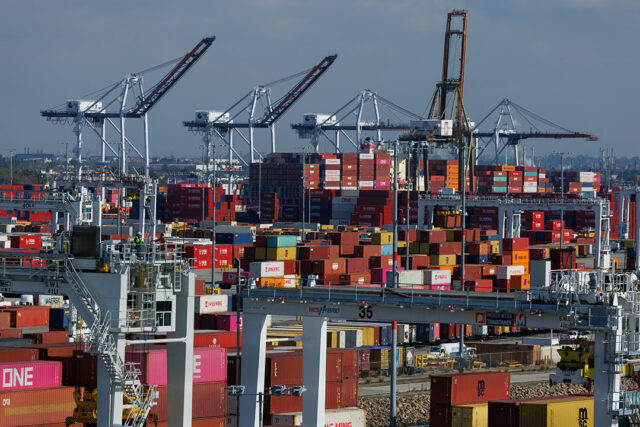
A drone view shows shipping containers from China at the Port of Los Angeles in Wilmington, California, Feb. 4, 2025. — REUTERS

HONG KONG/TAIPEI — US trading partners in Asia were weighing fresh uncertainties this weekend after President Donald Trump announced a new tariff on imports, hours after the Supreme Court struck down many of the sweeping levies he used to launch a global trade war.

The court’s ruling invalidated a number of tariffs that the Trump administration had imposed on Asian export powerhouses from China and South Korea to Japan and Taiwan, the world’s largest chipmaker and a key player in tech supply chains.

Within hours, Trump said he would impose a new 10% duty on US imports from all countries starting on Tuesday, which he raised to 15% on Saturday. The levies, under a different law, are set for 150 days, prompting analysts to warn that more measures could follow, threatening more confusion for businesses and investors.

TARIFF ‘FIASCO’
Before the ruling, Trump’s tariff push had strained Washington’s diplomatic relations across Asia, particularly for export-reliant economies integrated into US-bound supply chains.

In Japan, a government spokesman said on Saturday that Tokyo “will carefully examine the content of this ruling and the Trump administration’s response to it, and respond appropriately.”

On Sunday, Itsunori Onodera, an executive of Prime Minister Sanae Takaichi’s Liberal Democratic Party and a former defence minister, called Trump’s new tariffs “outrageous”.

“As an ally, I’m worried this will only accelerate countries distancing themselves from the US,” Onodera, the LDP tax policy chief, who is not in government, told a talk programme on Fuji Television.

China, which is preparing to host Trump in late March, has not responded to the latest tariff moves with the country on an extended holiday. But a senior financial official in China-ruled Hong Kong described the US situation as a “fiasco”.

Christopher Hui, Hong Kong’s secretary for financial services and the treasury, said Trump’s new levy served to underscore Hong Kong’s “unique trade advantages”.

“This shows the stability of Hong Kong’s policies and our certainty … it shows global investors the importance of predictability,” Hui told a media briefing on Saturday when asked how the new tariffs would affect the city’s economy.

Hong Kong operates as a separate customs territory from mainland China, a status that has shielded it from direct exposure to US tariffs targeting Chinese goods.

While Washington has imposed duties on mainland exports, Hong Kong-made products have generally faced lower tariff rates, allowing the city to maintain trade flows even as Sino-US tensions escalated.

MORE CONFUSION AFTER RULING, ANALYSTS SAY
As Trump’s levies escalated through 2025 and early 2026, corporate disclosures tracked by Reuters showed firms across the Asia‑Pacific region reporting financial hits, supply shifts and withdrawals.

Friday’s ruling concerns only the tariffs launched by Trump on the basis of the International Emergency Economic Powers Act, or IEEPA, intended for national emergencies.

Trade policy monitor Global Trade Alert estimated that by itself, the ruling cuts the trade-weighted average US tariff almost in half from 15.4% to 8.3%.

For those countries on higher US tariff levels, the change is more dramatic. For China, Brazil and India, it will mean double-digit percentage-point cuts, although to still-high levels.

In Taiwan, the government said it was monitoring the situation closely, noting that the US government had yet to determine how to fully implement its trade deals with many countries.

“While the initial impact on Taiwan appears limited, the government will closely monitor developments and maintain close communication with the US to understand specific implementation details and respond appropriately,” a cabinet statement said.

Taiwan has signed two recent deals with the US – a memorandum of understanding last month that committed Taiwan to invest $250 billion, and a deal was signed this month to lower what Trump calls “reciprocal” tariffs.

Even before Trump raised his new levy to 15%, analysts said the court ruling might offer little relief for the global economy. They warned of looming confusion as trading nations brace for moves by Trump to find other means of using levies to circumvent the ruling.

Thailand’s Trade Policy and Strategy Office head Nantapong Chiralerspong said the ruling might even benefit the country’s exports as uncertainty drove a fresh round of “front-loading”, where shippers race to move goods to the US, fearing even higher tariffs. — Reuters


South Korea protests Japanese event over disputed islands

STOCK PHOTO | Image by Vitamin from Pixabay

SEOUL — South Korea on Sunday protested a Japanese government event commemorating a cluster of disputed islands between the two countries, calling the move an unjust assertion of sovereignty over its territory.

In a statement, the foreign ministry said it strongly objected to the Takeshima Day event held by Japan’s Shimane prefecture and to the attendance of a senior Japanese government official, urging Japan to immediately abolish the ceremony.

The tiny islets, known as Takeshima in Japan and Dokdo in South Korea, which controls them, have long been a source of tension between the two neighbors, whose relations remain strained by disputes rooted in Japan’s colonial rule of the Korean peninsula from 1910 to 1945.

“Dokdo is clearly South Korea’s sovereign territory historically, geographically and under international law,” the ministry said, calling on Japan to drop what it described as groundless claims and to face history with humility.

The ministry summoned a top Japanese diplomat to the ministry building in Seoul to lodge a protest.

A person at Japan’s foreign ministry said no one was available on Sunday to comment. A call to the Prime Minister’s Office went unanswered. The government sent a vice-minister from the Cabinet Office, not a cabinet minister, to the ceremony.

Seoul has repeatedly objected to Japan’s territorial claims over the islands, including a protest issued on Friday over comments by Japan’s foreign minister during a parliamentary address asserting Tokyo’s sovereignty over the islets.

The territory lies in fertile fishing grounds and may sit above enormous deposits of natural gas hydrate that could be worth billions of dollars, Seoul has said. — Reuters

Russia hits Ukraine energy infrastructure with major missile, drone strikes, Kyiv says

Army soldier figurines are displayed in front of the Ukrainian and Russian flag colors background in this illustration taken, Feb. 13, 2022. — REUTERS/DADO RUVIC/ILLUSTRATION

KYIV — Russia attacked Ukraine with dozens of strike drones and ballistic and cruise missiles, focusing on energy infrastructure, the Ukrainian military and local officials said on Sunday.

The overnight strikes hit Kyiv and the region around the capital, the Black Sea port Odesa and central Ukraine, they said.

At least one person was injured in the Kyiv region, with damage reported in five districts where more than a dozen houses were damaged, regional Governor Mykola Kalashnyk said on the Telegram messaging app.

Odesa Governor Oleh Kiper wrote on Telegram that a nighttime drone attack on the energy infrastructure of the region caused fires that had been extinguished.

Russia attacks the Ukrainian energy system almost daily, striking thermal power plants and electrical substations.

Attacks on power stations, the energy transmission system and the gas sector are important elements of the full-scale invasion of Ukraine launched by Russia in February 2022. Moscow says it is seeking to undermine Ukraine’s ability to fight. — Reuters

Australia rejects report it is repatriating families of IS militants from Syrian camp

STOCK PHOTO | Image by Rebecca Lintz from Pixabay

AUSTRALIA’S center-left government on Sunday rejected a local media report that said it was working to repatriate Australians in a Syrian camp holding families of suspected Islamic State (IS) militants.

The 34 women and children were released on Monday from the camp in northern Syria but returned to the detention center due to technical reasons. The group is expected to travel to Damascus before eventually returning to Australia, despite objections from ruling and opposition lawmakers.

On Sunday, Home Affairs Minister Tony Burke rejected claims made in a report in the Sunday Telegraph, asserting that official preparations were under way for the cohort’s return.

“In that report, it makes a claim that we are conducting a repatriation. We are not,” Mr. Burke told Australian Broadcasting Corp. television.

“It claims we have been meeting with the states for the purposes of a repatriation. We have not,” Mr. Burke added.

Prime Minister Anthony Albanese, who leads Australia’s Labor Party, said this week his government would not help the group return to Australia.

The return of relatives of suspected IS militants is a political issue in Australia, which has seen a surge in popularity of the right-wing, anti-immigration One Nation party led by Pauline Hanson.

Islamic State, the Sunni Muslim militant group, is listed as a terrorist organization in Australia, with membership of the group punishable by up to 25 years in prison. Australia also has the power to strip dual nationals of citizenship if they are an Islamic State member. — Reuters

ADVERTISEMENT
ADVERTISEMENT