Home Blog Page 2684

Increased social development funding pushed
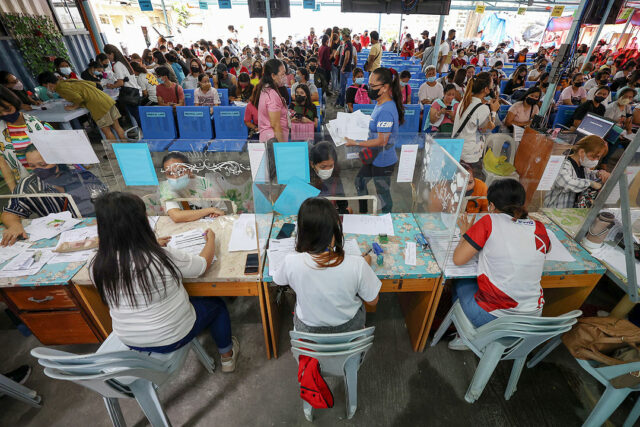
PHILIPPINE STAR/KRIZ JOHN ROSALES

By Kenneth Christiane L. Basilio, Reporter

THE HOUSE of Representatives should look at increasing funding to agencies responsible for social development under the proposed P6.352-trillion national budget to spur inclusive socioeconomic growth next year, analysts said at the weekend.

The budgets allotted to the Health, Social Welfare, Labor, Agriculture, and Trade and Industry departments are not enough to alleviate economic pressures faced by Filipinos, such as the rising costs of commodities, they added.

“The budgets for agriculture, agrarian reform and irrigation, trade and industry, education, health and social welfare remain seriously underfunded when measured against the magnitude of current problems,” Jose Enrique “Sonny” A. Africa, executive director at think tank IBON Foundation, said in a Viber message.

“Decent standards of living for all Filipinos because of universal social services and an economy with robust Filipino industry and vibrant agriculture are among the foundations for meaningful nation-building. The proposed 2025 budget is unfortunately not oriented toward this,” he added.

The Department of Budget and Management (DBM) in July submitted to the chamber its proposed P6.352-trillion national budget for 2025, which is equivalent to 22.1% of gross domestic product and 10.1% higher than the P5.768-trillion budget this year.

Under the 2025 National Expenditure Program, the DBM slashed the proposed budgets for agriculture, health, and social welfare by 4.7%, 7.6%, and 3.4%, respectively. Allocations for labor were also decreased by 26.1%, with trade and industry receiving a 3.9% cut.

“Most of the key departments that are crucial in boosting economic growth and promoting socio-economic development suffered cuts,” Zy-za Nadine M. Suzara, an independent budget analyst and former executive director of policy think-tank Institute for Leadership, Empowerment, and Democracy, said in a Viber message.

Ms. Suzara said the government was unable to provide bigger allocations to “marginalized sectors” such as agriculture and health for 2025 due to limited fiscal space resulting from bloated unprogrammed appropriations in the previous years.

BLOATED UNPROGRAMMED FUNDS
“The national budgets in the past three fiscal years are defective because the bicameral moved priority projects to unprogrammed appropriations, which are merely stand-by appropriations,” she said. “By placing them there, priority projects have lost guaranteed cash cover.”

Unprogrammed appropriations for 2024 ballooned by more-than-double to P731.45 billion from the proposed P281.91 billion as Congress shifted funding for education and social protection projects into it.

“Priority projects that were reallocated to unprogrammed appropriations in the 2024 budget are the foreign-assisted projects of DoTr (Department of Transportation) and DPWH (Department of Public Works and Highways), as well as portions of funding for education, health and social protection programs such as the Universal Access to Tertiary Education, PUV (Public Utility Vehicle) Service Contracting, various agri-fisheries programs,” she said.

The ballooning of unprogrammed appropriations in the previous budget “is a result of the surreptitious insertion by Congress of pork barrel funds,” Filomeno S. Sta. Ana III, coordinator of Action for Economic Reforms, said in a Viber message.

House Speaker and Leyte Rep. Ferdinand Martin G. Romualdez in August said the unprogrammed appropriations cannot be considered as pork barrel funds, citing differences in their technical definition.

The Priority Development Assistance Fund, colloquially known as pork barrel, is a discretionary lump sum fund to members of Congress meant to finance local projects within their legislative districts. It was discontinued in 2013 following the Philippines’ Supreme Court decision declaring it unconstitutional after state auditors found gross misuse in prior years.

Minority lawmakers from the Makabayan bloc in August called the ballooning of unprogrammed appropriations a new form of pork barrel with Party-list Rep. Raoul Danniel A. Manuel arguing it “bastardizes” the budget process and weakens congressional oversight on the budget.

“As a consequence of prioritizing pork in the previous years’ national budgets, the allocative efficiency of the 2025 proposed budget is compromised,” Ms. Suzara said. “The Marcos government is neither expanding more targeted and strategic socio-economic projects because of chronic inefficiency and underspending of many government agencies.”

Lawmakers should “temper their greed” to make the proposed 2025 national budget more efficiently allocated, according to Ms. Suzara.

PLENARY DEBATES
The House will begin plenary debates on the proposed budget on Monday, with a target of passing the budget bill by Sept. 25, Mr. Romualdez said in a statement on Sunday.

The committee on Tuesday last week finished reviewing the proposed budgets of each government agency, with the panel submitting the 2025 General Appropriations Bill for plenary deliberations on Thursday.

The 2025 GAB mostly retained the proposed expenditures submitted by the Budget department, with reallocations only happening to the Office of the Vice President’s proposed budget.

The House appropriations panel unanimously slashed the OVP’s budget by 64% to P733 million from P2.03 billion due to project redundancies with the Health and Social Welfare departments.

The reallocated amount would be equally split at P646 million between the Social Welfare departments aid program for indigent Filipinos and the Health departments medical assistance initiative.

“This is a reasonable budget reduction as it re-channels these funds toward agencies which can more directly serve Filipino families,” Terry L. Ridon, a public investment analyst and convener of think-tank InfraWatch PH, said in a Viber Message.

Congressmen are likely to augment funding for the Social Welfare and Public Works departments, Ms. Suzara said, noting these are agencies where the budget for their localities’ infrastructure projects and social aids are lodged.

Reallocations to the Department of Public Works and Highways, however, should not come from agencies concerning social development, such as the Health and Social Welfare departments, Leonardo A. Lanzona, an economics professor at the Ateneo de Manila University, said in a Facebook Messenger chat.

Mr. Ridon said lawmakers should also look at boosting state funding to the Department of Information and Communications Technology (DICT) amid hacking incidents to government servers.

The DICT’s proposed 2025 budget rose by 33.6% to P9.2 billion from its 2024 P6.9-billion budget.

“With increasing government digitalization, cybersecurity should become a pillar of funding concern across agencies, led by the DICT,” he said.

There must be a consensus between leaders of both the Senate and the House for reallocations to be successfully augmented, Assistant Minority Leader and Party-list Rep. Marissa P. Magsino said in a Viber message.

DBM: Special rights laws funded

BW FILE PHOTO

THE DEPARTMENT of Budget and Management (DBM) has provided funding to special human rights for next year, a Budget official said, clarifying an earlier claim by the Commission of Human Rights (CHR) that special rights measures were unfunded under their proposed P1.1-billion budget for 2025.

The CHR in early September said that special human rights laws, including measures addressing human trafficking, violence against women and their children and crimes against humanity, did not receive a single centavo under the proposed P6.352-trillion 2025 national budget.

“The special laws being claimed by the CHR as unfunded are laws already integrated and part of the regular programs of the agency which are annually provided funding under the General Appropriations Act,” DBM Undersecretary Godess Hope Libiran said in a Viber message last week.

“The CHR represented that funding requirements for said laws are sourced from the existing programs of the CHR since the same are already part of the mandate of the agency,” she added.

The government has provided P471 million for the fulfillment for the commission’s human rights protection and promotion programs this year, according to document provided by Ms. Libiran. — Kenneth Christiane L. Basilio

Faster hiring of teachers needed

DEPED.GOV.PH

A PHILIPPINE senator urged the Department of Education (DepEd) to speed up its hiring process for educators to address the country’s need to fill 26,000 positions next year amid a teacher shortage.

In a statement, Senator Sherwin T. Gatchalian said DepEd can take up to six months to hire new teachers, with the country lacking more than 46,000 teachers to service 43,000 schools nationwide.

DepEd earlier said it is looking to create 20,000 new teaching positions next year to work on this shortage.

“The number of teachers we need continues to grow with our student population, and filling the 26,000 vacant positions would help address the teacher shortage,” the senator said.

DepEd is keen on using artificial intelligence-based education platforms to compensate for the shortage of teachers among other resources gaps next year, Education Secretary Juan Edgardo “Sonny” M. Angara told a Senate finance committee hearing last week.

Mr. Gatchalian also cited the need for more administrative officers at the Education department to lighten the nonteaching workload of public school teachers.

Under the agency’s proposed P793.177-billion budget next year, P3.43 billion will be used to hire employees for nonteaching positions.

Based on a report from the Second Congressional Commission on Education, each public school teacher has to deal with at least 50 administrative tasks. — John Victor D. Ordoñez

Mountain Province gets peace fund

BAGUIO CITY — The Mountain Province will receive a P105-million funding for projects that will boost the peace and development in the province.

The funds will come from the Office of the Presidential Adviser on Peace, Reconciliation, and Unity (OPAPRU).

OPAPRU Secretary Carlito G. Galvez said the fund will be used for various projects as part of the government’s anti-insurgency program, including infrastructure projects such as farm-to-market roads, among others.

Mr. Galvez said the Cordillera Region is the epicenter of peace and development, citing the highland region as once a stronghold of the communist movement in the 1980s.

OPAPRU has already earmarked around P600 million this year to fund 15 peace and development projects, mostly implemented in Kalinga, Apayao, Ifugao, and Mountain Province.

According to the OPAPRU chief, Cordillera is a model of peace and development compared to other regions vis-à-vis the insurgency issue. — Artemio A. Dumlao

Efforts against dirty money backed

COTABATO CITY — Various sectors have assured support for the government’s anti-money laundering thrusts in Maguindanao del Sur province, intended to stop circulation of funds for terrorism and other organized crimes, including trafficking of narcotics.

Radio reports on Sunday stated that the Department of Justice, Maguindanao del Sur Gov. Mariam S. Mangudadatu, Bangsamoro Regional State Prosecutor Rohaira A. Lao and officials of police units in the province cooperated in facilitating a workshop on detection and investigation of money laundering cases for law-enforcement agents based in the province from Sept. 10 to 12.

Members of the Islamic religious community in Central Mindanao and the chairman of the Bangsamoro Business Council, entrepreneur-lawyer Ronald Hallid D. Torres, had also relayed to reporters that they will support the government’s anti-money laundering campaign in Maguindanao del Sur and in other provinces around.

Brig. Gen. Prexy D. Tanggawohn, director of PRO-BAR also, and the commander of 6th ID, Major Gen. Antonio G. Nafarrete have also both directed their offices and units to support the program. — John Felix M. Unson

JICA narrowing down lineup of PHL projects to about 10

THE Japan International Cooperation Agency (JICA) is considering funding over 10 projects in the Philippines, including railway and other infrastructure, next year. 

“We are now preparing more than 10 candidate projects for the next year,” JICA Chief Representative in the Philippines Takema Sakamoto told reporters on the sidelines of an event on Friday.

These projects include bridges, railway, and road infrastructure, he said.

“But, of course, it depends on both countries’ screening processes and budget constraints… but JICA is keen to promote and formalize more projects in the double digits.”

Mr. Sakamoto has said he hopes to disburse Philippine loans exceeding the ¥300 billion to ¥400 billion (around P115 billion to P153 billion) approved last year.

JICA typically supports up to 80% of a project’s total cost, he said.

“I am in a position to convince Tokyo to get more resources, and from this point of view, one important element is a good track record of the ongoing projects. Otherwise, I cannot get more trust from our national taxpayers.”

“The Philippines is a very reliable partner. So, I stress the importance of the good progress of the ongoing projects,” Mr. Sakamoto said, citing the North-South Commuter Railway, Metro Manila Subway, and flood control projects.

In March, the Department of Finance and JICA signed the third tranche of a ¥150-billion loan agreement for the first phase of the Metro Manila Subway Project.

The 33-kilometer underground railway system will traverse eight cities in Metro Manila, including key business districts. It is estimated to cost P488.5 billion and is due for completion by 2029.

Last year, JICA also signed a ¥270-billion loan with the Philippines for the NSCR.

JICA and the Asian Development Bank are co-financing the P873-billion NSCR. The 147-kilometer railway will connect Malolos, Bulacan with Clark International Airport and Tutuban, Manila with Calamba, Laguna. It will have 35 stations and three depots.

Mr. Sakamoto also cited the need to speed up JICA-supported flood management projects.

The agency has been collaborating with the government on the Pasig-Marikina River Channel Improvement Project Phase 4, as well as river improvement projects in Cavite, Cagayan De Oro, and Davao.

In January, JICA and the Department of Public Works and Highways (DPWH) signed a new technical cooperation to improve the country’s flood control strategy. This includes the updating of masterplans and pre-feasibility studies.

‘ROOM TO IMPROVE’
Mr. Sakamoto said the Philippines has “much room to improve” in regard to the time it takes to implement foreign-assisted projects.

Longer decision-making and land acquisition processes, as well as untimely payments are the major reasons for project delays, he added.

Rene S. Santiago, former president of the Transportation Science Society of the Philippines, said loans extended to the Philippines may decrease with further project delays.

“Every lender has its own lending cap, similar to commercial banks’ single borrower’s limit. Poor utilization rate also signals to lenders that it’s time to trim their loan volumes,” he said via Viber.

Earlier this year, President Ferdinand R. Marcos, Jr. issued Executive Order No. 59, which seeks to fast-track its priority infrastructure projects. Administrative Order No. 20 was also signed to hasten land acquisition for railway projects.

Japan was the top source of official development assistance (ODA) in 2023 with a total portfolio of $12.07 billion. This accounted for 32.36% of the Philippines’ total ODA for the period. — Beatriz Marie D. Cruz

Incheon Airport seen helping elevate NAIA to international standard

NINOY AQUINO INTERNATIONAL AIRPORT (NAIA) Terminal 3 — PHILIPPINE STAR/MIGUEL DE GUZMAN

By John Victor D. Ordoñez, Reporter

INCHEON International Airport Corp.’s (IIAC) technical know-how is expected to help partner San Miguel Corp. (SMC) bring Ninoy Aquino International Airport (NAIA) to a global standard of quality, South Korean Ambassador to the Philippines Lee Sang-hwa said.

“We hope that they can leverage their expertise and worldwide reputation in modernizing NAIA… they are closely consulting with their counterparts including SMC and we hope Incheon’s expertise and views will be well reflected in the decision-making process,” he told BusinessWorld.

“I believe that (IIAC) have almost daily conversations with SMC… I hope things will improve faster than normal.”

The SMC-led New NAIA Infrastructure Corp., which includes the operator of South Korean’s main international airport, took over NAIA operations on Sept. 14, with plans to improve the airport’s roads, expand its terminal and capacity, and upgrade the passenger experience.

The NNIC also includes RMM Asian Logistics, Inc., a logistics company involved in infrastructure projects and RLW Aviation Development, Inc., a Philippine company.

Mr. Lee said IIAC has experts posted to Manila for discussions with their SMC counterparts on plans to improve NAIA.

“Incheon’s main role is to raise NAIA to global airport standards in order for Manila to compete with the region’s international hubs such as Singapore and Hong Kong,” Terry L. Ridon, a public investment analyst and convenor of the think tank InfraWatch PH, said via Messenger chat.

SMC President and Chief Executive Officer Ramon S. Ang told a forum last week that the conglomerate expects to show results and improvements to the airport within six months.

NAIA ranked 199th out of 239 airports in 69 countries in the 2024 global airport ranking report released by flight compensation company AirHelp.

Incheon International Airport was ranked 68th in the same global ranking.

SMC has said it would be spending about P3 billion and P5 billion on a new off-ramp from NAIA Expressway to Terminal 3, while also considering curb pricing schemes for the airport.

The Philippine Institute for Development Studies, in a study last year, said the airport suffered from both passenger and runway congestion.

Rene S. Santiago, former president of the Transportation Science Society of the Philippines, said that while Incheon has a world-class record and is capable of bringing about improvements to NAIA, SMC will ultimately call the shots.

“The situation here is vastly different from Korea’s… SMC is the dominant partner who will set the pace,” he said via Viber.

The Department of Tourism (DoT) is aiming for 7.7 million international tourist arrivals this year.

As of Aug. 7, the Philippines has received 3.62 million inbound visitors, with 92% of them being foreigners, the DoT said last month.

Senators have started floor debate on a bill seeking to provide non-resident tourists VAT refunds for purchases worth at least P3,000, to encourage more visitor spending.

“SMC’s main role is navigating the country’s complex regulatory environment and providing leadership, strategy and financing to the nation’s international gateway,” Mr. Ridon said.

Solicited bidding scheme considered for Davao Int’l Airport modernization

CAAP

THE Department of Transportation (DoTr) said it wants the auction to modernize and operate Davao International Airport to be a solicited process.

The DoTr has said a conglomerate expressed interest in submitting an unsolicited proposal for the airport project.

“They said they are interested in Davao airport, but they have not formally submitted a proposal,” Transportation Secretary Jaime J. Bautista said.

Mr. Bautista declined to identify the company.

“They just expressed interest, they must submit within this year. Because I am planning to make it solicited,” he said.

The DoTr tapped the Asian Development Bank as its transaction advisor for the project, Mr. Bautista said.

If the government takes the solicited proposal route, the terms of reference will already have been defined and thus will go faster, Mr. Bautista noted, judging from the experience of bidding out the Ninoy Aquino International Airport (NAIA) upgrade. This project is considered the fastest public-private partnership (PPP) to progress from submission to investment coordination committee approval and concessions signing.

“Look at our experience with NAIA, it is fast. If we take the solicited route, it will only take a year,” Mr. Bautista said.

On Sept. 14, the San Miguel-led New NAIA Infrastructure Corp. took over the operations and maintenance of the Philippines’ main gateway.

In June, the PPP Center said it delisted the unsolicited proposal for the development, operations, and management of the Davao International Airport, which likely signals the DoTr’s intent to go the solicited route for the project. — Ashley Erika O. Jose

OP control of NIA seen boosting funding prospects for irrigation

EMBASSY OF JAPAN HANDOUT PHOTO

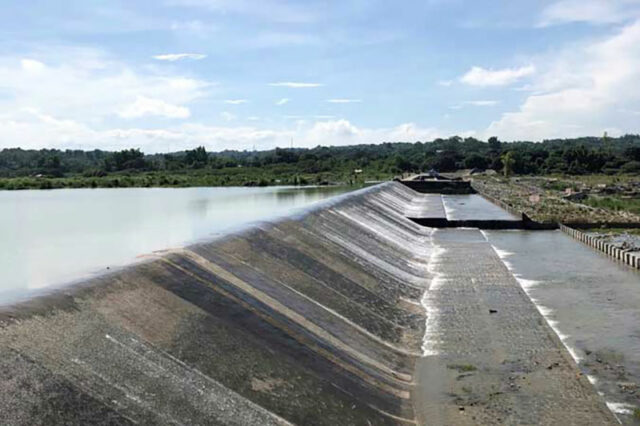
THE government’s transfer of the National Irrigation Administration (NIA) to the Office of the President (OP) is expected to improve its access to funding, analysts said.

“Placing NIA under the OP would help the agency get proper and timely funding,” Federation of Free Farmers National Manager Raul Q. Montemayor said via Viber.

He added that the move could have knock-on effects on the funding of other agencies like the National Food Authority in the form of marketing support to farmers and the Department of Public Works and Highways in terms of building irrigation infrastructure and farm-to-market roads.

“There should however be proper coordination with Department of Agriculture (DA) programs and implementers,” Mr. Montemayor said.

Last week, President Ferdinand R. Marcos, Jr. issued Executive Order (EO) No. 69 transferring control of the NIA from the DA. EO 69 cited the need to streamline and rationalize the functions of the irrigation agency.

In his State of the Nation Address, Mr. Marcos pushed for more irrigation dams and bulk water projects to ensure sufficient usable water for communities.

“It is highly likely NIA will secure additional funding for irrigation projects,” University of Asia and the Pacific Center for Food and Agribusiness Executive Director Marie Annette Galvez-Dacul said via Viber.

She added that the transfer would hasten the decision-making and approval process for major irrigation projects.

On the other hand, Former Agriculture Undersecretary Fermin D. Adriano said that the NIA should have been kept within the purview of the DA. 

“Management-wise, NIA should be under the DA because the former’s services cater to DA’s major clients, which are the palay farmers,” Mr. Adriano said via Viber.

“This assumes that DA leadership understands the science of raising palay productivity, lowering production costs and increasing farmer incomes,” he added.

Leonardo A. Lanzona, Jr., a professor of economics at the Ateneo de Manila, said the NIA mandate is to support agricultural production, and thus should be headed by the DA.

“The NIA does not belong in the OP but in the DA. Irrigation is only of the inputs for production. If improperly applied, in certain situations it can be either ineffective or disruptive to other inputs, such as labor,” Mr. Lanzona said via Facebook messenger.

Only 68% of the country’s farmland is irrigated as of 2023, or an estimated 2.11 million hectares, leaving 1.1 million hectares yet to be irrigated. — Adrian H. Halili

Dimalanta case resolution seen as critical to making progress on power projects

ENERGY Secretary Raphael P.M. Lotilla

ENERGY Secretary Raphael P.M. Lotilla said a prompt resolution is needed following the suspension of the Energy Regulatory Commission (ERC) chairperson, to ensure that energy projects make progress.

“I’m hopeful that this can be addressed and resolved so that we’ll be able to continue to move forward,” Mr. Lotilla told reporters on the sidelines of an event in Taguig City last week, referring to the six-month suspension imposed by the Ombudsman on Monalisa C. Dimalanta.

Mr. Lotilla said “a number of decisions” need to be made by the ERC at the moment.

“We look forward to this being resolved so that we can resume working, especially on the new projects that the President has envisioned for the country,” Mr. Lotilla said.

“So whether the projects are conventional or renewable, or new sources of energy, we need the Energy Regulatory Commission on board,” he added.

In an order dated Aug. 27 but made public on Sept. 5, the Ombudsman suspended Ms. Dimalanta for six months without pay over a complaint filed by the National Association of Electricity Consumers for Reforms, Inc.

The consumer group claimed that the ERC “failed to recalculate the rate of Meralco (Manila Electric Co.) that protects the interest of the public and runs counter to the objective of the ERC’s Performance Based Regulation.”

“The charges against her involve grave misconduct, grave abuse of authority, gross neglect of duty and conduct prejudicial to the best interest of the service,” according to the Ombudsman. 

In a statement last week, Ms. Dimalanta’s office said she and her lawyers “are studying the matter in order to (pursue) all available legal remedies given the circumstances.”

In compliance with the order, she immediately ceased to perform her functions as chairperson and chief executive officer of the power regulator.

The office noted, however, that all operations of the agency will continue to function “to the extent possible and as required by the exigencies of service.”

Ms. Dimalanta’s office said that the Office of the Executive Secretary will appoint an officer-in-charge to lead the ERC. — Sheldeen Joy Talavera

Australia-PHL trade, investment expected to grow 10% this year

PHILIPPINES.AUSTAL.COM

TRADE and investment between Australia and the Philippines could grow by 10% this year, aided by the investment missions exchanged by the two countries, an Australian Embassy official said.

“It should grow by 10%. It’s going to grow. There are now so many Australian companies that are coming here, and Filipinos are coming to Australia,” Luisa Rust, minister-counselor and senior trade and investment commissioner of the Australian Embassy, told reporters on Friday.

She cited the base the two countries are starting from as “so low now … we are underperforming if you look at the volume that is in Singapore, Indonesia, or Thailand; we are not performing as well as we should be.”

In 2023, two-way trade between Australia and the Philippines totaled P378 billion, while two-way investment was P321 billion.

There are over 250 Australian companies operating in the Philippines, with staffing of 44,000.

According to Ms. Rust, Australian companies are not that familiar with the Philippines.

“I think when they think about exporting, they go to Singapore, Indonesia, and Vietnam, and that is why (trade) missions are so important,” she said.

“We need to bring them here to see how developed Manila is and the consumer economy in action … so that they really understand that there is this great opportunity that is here to be able to sell their products,” she added.

According to Australian Ambassador to the Philippines Hae Kyong Yu, a business delegation composed of Australian technology firms will be visiting the Philippines in March.

“This is very much where we felt that there was an opportunity for Australian companies with cutting edge technology in some of these digitalization spaces to come in and share their technology and experience with you,” Ms. Yu said at a briefing on Friday.

The delegation is hoping to find “local partners (with whom) to roll some of this out for the benefit of the Philippines,” she added.

Ms. Rust said that the focus of the mission is cybersecurity, financial technology, AI, and blockchain.

“Those are what Australia is good at, and we make sure that we match them up with what the demand is in the Philippines,” Ms. Rust said.

“We always bring about 20 so that we can make sure that we can do some really good tailored business matching, finding partners for them to work with, like maybe Filipino tech companies or potential customers for their technology,” she added. 

On Friday, the Australian Embassy brought together Australian businesses operating in the Philippines for updates on developments within their industries.

Among them is Austal Philippines, which discussed the possibility of developing a vessel for the Philippine Coast Guard (PCG) and the construction of hydrogen- and wind-powered vessels.

Austal Philippines President Wayne Murray said that the company is currently in talks with the PCG on a vessel that can match up well with ships fielded by the China Coast Guard.

Austal operates a shipyard in Cebu.

“There are no firm contracts at the moment, but we’ve been working with their technical team to establish (specifications) on a vessel that would… match what the Chinese Coast Guard is doing, or preferably be better than them,” Mr. Murray said.

He added that the company is working with a European firm on a hydrogen-powered vessel, while the wind-powered vessel is being studied for routes between Europe and the Americas.

Another company at the briefings was Qantas, which said that a new service to Brisbane will be launched next month.

Qantas Manager of Communications and Government Affairs Oliver Craven-McLeay said the new service is optimized for connections to New Zealand and the rest of Australia.

“If you think about our current Sydney services, they’re very heavy with corporate traffic … These Brisbane services would be much more about visiting family and friends, serving tourism opportunities in both directions,” he said. 

“There’s a huge number of Filipinos who are interested in Australia and vice versa. So we’re really excited about these flights,” he added. — Justine Irish D. Tabile

Navigating change: 10 key shifts shaping sustainability in the Philippines 

(First of two parts)

IN BRIEF:

• As a signatory to the Paris Agreement, the Philippines is advancing towards a low-carbon economy with the proposed Low Carbon Economy Investment Act, incentivizing decarbonization plans and carbon pricing.

• New legislation, including the Carbon Rights Act and BSP Circulars on Environmental and Social Risk Management Systems, is set to redefine sustainable investment and risk management in the financial sector.

• The SEC’s upcoming sustainability reporting form aligns with global standards, enhancing transparency and aiding investors in assessing climate-related risks and opportunities.

The Philippines is at a pivotal moment in its sustainability journey, driven by a blend of regulatory reforms, market dynamics, and heightened climate awareness. These developments create both risks and opportunities for businesses operating in the country and global investors interested in sustainable investments.

As the nation confronts the realities of climate change and its potential impacts, there is a growing consensus among policymakers, business leaders, and civil society on the need for a strategic and coordinated approach to sustainability. This collective push towards environmental stewardship is shaping new business models and investment strategies that prioritize long-term resilience and ethical practices. The Philippine commitment to this transition is reflected in a series of progressive policies and initiatives that aim to align economic development with sustainable outcomes.

This first part of the article explores the first five key shifts that are shaping the sustainability landscape in the Philippines, focusing on the implications for businesses and the opportunities for investors in this emerging low-carbon economy. It explores the upcoming Low Carbon Economy Investment Act, the proposed carbon rights legislation, BSP Circulars 1128 and 2022-042, BSP Circular 1187, and the upcoming Philippine SEC sustainability reporting form.

UPCOMING CARBON PRICING POLICY – LOW CARBON ECONOMY INVESTMENT ACT (HB 7705)
The proposed Low Carbon Economy Investment Act, or House Bill 7705, is poised to be a transformative force in the Philippines’ shift towards a low-carbon economy. This bill requires covered enterprises with substantial contributions to greenhouse gas (GHG) emissions develop decarbonization plans aligned with a pathway to limit global temperature rise to below 2°C. Additionally, it introduces a carbon pricing mechanism for emissions that exceeds established milestones, creating a decarbonization fund. This fund will be reinvested into viable low-carbon projects, presenting significant opportunities for enterprises and investors committed to sustainable development.

PROPOSED CARBON RIGHTS LEGISLATION
Congress has introduced the Carbon Rights Act (HB 10635), which aims to address the barriers to investing in carbon forestry and other carbon projects. This legislation seeks to define ownership of carbon rights and establishes mechanisms for their transfer. By clarifying these ownership rights and enabling corresponding adjustments, the bill facilitates Philippine participation in global carbon markets under Article 6 of the Paris Agreement. For investors, particularly those focused on nature-based solutions, this bill presents new opportunities to invest in carbon projects that are critical to achieving global emission reduction targets.

BSP CIRCULARS 1128 AND 2022-042 ON ENVIRONMENTAL AND SOCIAL RISK MANAGEMENT
Bangko Sentral ng Pilipinas (BSP) Circulars 1128 and 2022-042 require financial institutions to integrate Environmental and Social Risk Management Systems (ESRMS) into their credit risk assessments. These regulations compel banks to conduct climate risk assessments, including stress testing, as part of their underwriting processes. Companies with strong sustainability and climate risk management practices are likely to benefit from easier access to finance, while those slower to adapt may face higher borrowing costs. These circulars also ensure that climate risks are systematically integrated into the financial sector, promoting long-term resilience and stability.

BSP CIRCULAR 1187 – SUSTAINABLE FINANCE TAXONOMY
BSP Circular 1187 introduces the Sustainable Finance Taxonomy Guidelines (SFTG), a framework that classifies economic activities based on their environmental and social sustainability. The taxonomy uses a “traffic light” system —green for aligned activities, amber for transitional activities, and red for non-aligned activities. This classification is crucial for guiding banks and investors in directing capital toward projects that support climate change mitigation and adaptation. By preventing greenwashing, the SFTG ensures that sustainable finance practices in the Philippines are both transparent and credible.

UPCOMING SEC SUSTAINABILITY REPORTING FORM
The Securities and Exchange Commission (SEC) is set to introduce a mandatory sustainability reporting form for publicly listed companies, requiring disclosures aligned with International Financial Reporting Standards (IFRS) S1 and S2. These standards emphasize the identification and management of climate-related risks and opportunities, encouraging companies to integrate sustainability into their core business strategies. For investors, these reporting requirements will provide critical insights into the sustainability practices of Philippine companies, facilitating more informed and responsible investment decisions.

CHARTING A SUSTAINABLE PATH
The Philippines stands at a crossroads in its sustainability journey, with recent regulatory reforms and evolving market dynamics steering the nation towards a greener future. As climate change becomes an increasingly pressing global issue, the country is responding with innovative and comprehensive legislative measures and initiatives that aim to reduce carbon emissions and promote sustainable practices, while fostering economic growth, enhancing community resilience, and ensuring environmental justice.

The impending introduction of the SEC’s mandatory sustainability reporting form marks a significant step towards greater transparency and accountability in corporate environmental practices. By aligning with international standards, this move propels companies toward more sustainable operations and equips investors with the requisite information to make responsible decisions. As the nation forges ahead with these regulatory changes, businesses can play a pivotal role in the transition to a sustainable economy, with the potential to set a precedent for other emerging markets in the region.

The second part of this article will discuss the roadmap for IFRS S1 and S2 adoption, the severity of rising climate-related loss and damage, rising growth in electric vehicle (EV) adoption, emergence of green steel in construction, decarbonization of the aviation industry, and the innovative approaches and opportunities that are emerging for businesses ready to adapt and thrive in this new landscape.

This article is for general information only and is not a substitute for professional advice where the facts and circumstances warrant. The views and opinions expressed above are those of the author and do not necessarily represent the views of SGV & Co.


Bonar A. Laureto is an assurance principal and leads Climate Solutions under the Sustainability Services team of SGV & Co.

ADVERTISEMENT
ADVERTISEMENT