Home Blog Page 268

More on tanking

The stretch run of a National Basketball Association (NBA) campaign is supposed to sharpen competitive instinct. Instead, it has increasingly underscored calculation, and not of the kind that produces better basketball. The league now finds itself confronting reality rarely acknowledged in such blunt terms: Losing, in some corners, has become a strategy. Not a byproduct of rebuilding, not a consequence of injuries, but a conscious plan of action.

Late last week, the NBA signaled it finally had enough. Commissioner Adam Silver informed general managers that new anti-tanking rules are coming next season. To give teeth to its most aggressive attempt yet to disrupt incentives that reward failure, the league is considering sweeping changes to the draft sweepstakes: freezing standings earlier, limiting repeated high picks, tying odds to multi-year performance, and even expanding lottery eligibility. The message is clear; the system that was designed to help struggling teams recover has instead incentivized them to lose more efficiently.

Silver has been unusually candid. He believes the behavior is worse now than in recent memory, and the league is searching for “fresh thinking” to correct inducements that have drifted badly off course. His reaction alone would have been significant, but what transformed the discussion from procedural to moral was the intervention of one of the NBA’s newest power brokers. Suns owner Mat Ishbia did not merely criticize tanking; he denounced it in no uncertain terms. He called it “losing behavior done by losers,” a deliberate corruption of competition. More provocatively, he said it is “much worse than any prop bet scandal,” framing intentional losing not as clever roster management but as a direct assault on the integrity of the sport itself.

The escalation of rhetoric was nothing short of remarkable. Match manipulation is typically discussed in the shadow of gambling investigations, legal risk, and criminal liability. Yet Ishbia argued that the normalization of openly engineered losing, in the form of deliberate shutdowns, scheduled absences, and performance management designed to fail, is more corrosive. It happens in plain sight, under the banner of “long-term planning.”

Unfortunately, dramatic reform carries complications. Even before formal adoption, the proposed anti-tanking measures have drawn criticism. Some observers argue the league is constructing a patchwork of deterrents that could well punish legitimately rebuilding teams or those undone by injuries or circumstances beyond their control. Others suggest the NBA is just responding to optics, particularly in an era of legalized sports betting, instead of addressing structural stimuli embedded in the draft itself.

In other words, the league may be trying to regulate symptoms rather than redesign the underlying mechanism that makes losing valuable in the first place. Which, in a nutshell, is the paradox professional leagues have never fully solved. Competitive balance requires helping weaker teams. On the flipside, helping weaker teams inevitably fuels motivation to become even more handicapped, or at least appear so at the right time. The draft lottery was meant to blunt that incentive. Instead, front offices learned to manage probability as carefully as they manage salary caps.

To be sure, tanking is not novel to front offices looking to get ahead in every possible way. It has always been an option. What is different is the scale, the sophistication, and the openness with which it is now discussed: ranked, modeled, and even admired in certain analytical circles. Losing is no longer merely tolerated; it is evaluated for efficiency. And because this is what the NBA wants to reverse, the success of the coming reforms becomes secondary to what they represent. The league is publicly acknowledging that its competitive framework has drifted far enough from sporting instinct to require structural correction. A commissioner is admitting the problem has intensified. An owner is declaring that strategic defeat undermines legitimacy.

The NBA has always thrived on the drama of promise: young stars rising, franchises reborn, fortunes reversed. Tanking, in its most aggressive form, rewrites the narrative. It replaces ascent with postponement. It turns hope into inventory. It transforms losing from hardship to asset accumulation. And that, more than any rule change, is what the league aim to eliminate. Bottom line, it does not want to lose the meaning of winning.


Anthony L. Cuaycong has been writing Courtside since BusinessWorld introduced a Sports section in 1994. He is a consultant on strategic planning, operations and human resources management, corporate communications, and business development.


Camarines Norte award marks first deal for offshore wind port

RAWPIXEL.COM-FREEPIK

THE first contract to redevelop a port dedicated to servicing offshore wind farms has been awarded, with Mercedes, Camarines Norte set for a P2.27-billion  overhaul, the Philippine Ports Authority (PPA) said.

The PPA said it awarded the contract to the joint venture of Khan Kon Chi Construction and Development Corp. and SB Construction Corp. The contract covers the first phase of the redevelopment project, Energy Undersecretary Giovanni Carlo J. Bacordo told BusinessWorld.

The auction was conducted by the PPA earlier this month.

Khan Kon Chi Construction is a Davao-based engineering and construction firm while SBS Construction is a general engineering contractor.

The second phase of the redevelopment is scheduled for bidding in the second or third quarter this year, putting Mercedes in position to become the first port capable of servicing the offshore wind industry, Mr. Bacordo said.

“Mercedes is the most advanced of the three identified ports and is fully funded by the PPA,” he said.

The PPA also designated Sta. Clara port in Batangas for redevelopment to service offshore wind farms.

Mr. Bacordo said Sta. Clara port is being structured as public-private partnership project due to its scale and cost.

“A feasibility study is currently being prepared, with technical support, and the port is envisioned primarily as a marshalling port with future manufacturing potential,” he said.

He said redeveloping the port may cost about P3.1 billion.

The Philippines is hoping to generate output from offshore wind by 2028 as it pushes to diversify the national power mix and reduce dependence on fossil fuels. — Sheldeen Joy Talavera

Air passenger traffic exceeds pre-pandemic levels in 2025 

CLARK INTERNATIONAL AIRPORT

AIR PASSENGER volume rose 4.06% to 62.34 million in 2025, exceeding pre-pandemic levels for the first time, the Civil Aeronautics Board (CAB) said.

Domestic passenger traffic rose 3.45% to 33.24 million in 2025, according to the CAB.

International passenger volume rose 4.75% to 29.10 million.

Last year’s total passenger traffic was 3.79% higher than the pre-pandemic volume of 60.07 million recorded in 2019.

Domestic passenger volume accounted for  about 54.92% of last year’s total.

Budget carrier Cebu Pacific and its units carried a total of 16.20 million passengers, while its regional brand Cebgo flew 2.06 million, and AirSwift Transport, Inc. carried a total of 429,222.

Flag carrier Philippine Airlines carried 1.35 million passengers, and its regional brand PAL Express logged 8.39 million.

Philippines AirAsia, Inc., operator of low-cost carrier AirAsia Philippines, reported 4.60 million passengers in 2025.

The CAB said foreign carriers logged a total of 15.01 million international passengers, while Philippine carriers reported a total 14.09 million. — Ashley Erika O. Jose

NFA rice auction raises P936.5M

PHILSTAR FILE PHOTO

THE National Food Authority (NFA) said it auctioned nearly 90% of its ageing rice stocks on Friday, generating P936.5 million and freeing up warehouse space for fresh palay (unmilled rice) procurement.

“We are very pleased with the results, which allowed us to raise P936.5 million compared to the target amount of P912.4 million,” NFA Administrator Larry R. Lacson said in a statement on Sunday.

The NFA said it offered 737,339 50-kilo bags of milled rice that had been stored for three to 18 months. Of the 83 lots offered, 57 were awarded, equivalent to 604,364 bags or 88% of the total volume.

Mr. Lacson said the average price of the rice sold was P28 per kilo, exceeding the floor prices of P22.52-P25.16, depending on the age of the inventory.

“The strong average price of P28 per kilo, well above the set floor prices, signals firm demand despite the age of the stocks,” the NFA said.

It said 39 bidders purchased bid documents, and 19 expected to secure contracts, subject to post-qualification and validation.

Agriculture Secretary Francisco P. Tiu Laurel, Jr., who chairs the NFA Council, said the auction’s outcome will help the NFA expand procurement from farmers.

“More important than the revenue the auction raised is the space it cleared in warehouses that will allow NFA to buy more palay from our farmers at a fair price,” he said.

The NFA said it plans to use the additional warehouse capacity to store grain procured at a minimum price of P17 per kilo for wet palay and P21 per kilo for dry palay.

“With added liquidity and expanded storage capacity in the coming months, the NFA is positioning itself to step up market intervention as harvest season advances, aiming to support farmgate prices while keeping buffer stocks manageable,” it said.

Mr. Lacson has said that the NFA is also considering shifting from centralized to regional auctions of ageing rice to speed up inventory turnover and allow more bidders to participate.

He said holding regional auctions is expected to improve efficiency and reduce congestion at the NFA central office.

The NFA said it is also considering holding auctions on a regular cycle, possibly every two months, and lowering the minimum bid volume to attract more participants. — Vonn Andrei E. Villamiel

Onion import clearances frozen as harvest approaches peak

BUREAU OF CUSTOMS

THE Department of Agriculture (DA) said it suspended the issuance of sanitary and phytosanitary import clearances (SPSIC) for red onions as the domestic harvest approaches its peak.

“We have not been  issuing any import permits or SPSIC since the end of January,” Agriculture Secretary Francisco P. Tiu Laurel, Jr. told BusinessWorld via Viber.

Mr. Laurel said the DA typically suspends the issuance of import clearances ahead of the local harvest season. The red onion harvest in the Philippines usually begins in January and peaks in March.

Mr. Laurel said most of the red onions approved for import have already arrived, with only a few shipments expected.

“Almost all shipments have arrived, and most of them have actually (been sold). There are only a few containers arriving now, in insignificant quantities, mainly because they were delayed at transshipment points,” Mr. Laurel said.

He said the DA will resume the issuance of import clearances by around September.

An industry official said the suspension came too late to shield farmers from price disruption.

“It should have started as early as December… If imports are still coming in until February, that becomes a pretext to dump imports during the harvest period to force down farmgate prices and undercut farmers,” Jayson H. Cainglet, executive director of the Samahang Industriya ng Agrikultura, told BusinessWorld via Viber.

The Philippine Statistics Authority reported that the farmgate price of domestic red onion dropped 28.42% to P43.97 per kilo in February from P61.43 a year earlier.

Mr. Cainglet said the Bureau of Plant Industry (BPI) should have already estimated harvest volumes by July to help determine the appropriate level of imports.

The DA, however, has said that the supply of imported red onions is not sufficient to drive down farmgate prices, contrary to farmers’ claims.

“The numbers show that current stocks from imports are not overwhelming the market but merely plugging a supply gap,” Mr. Laurel said last week.

The BPI estimated that the supply of imported red onion, including the remaining expected shipments, will likely last only until March 6, just as the domestic harvest begins to peak.

The DA earlier said it will probe the continued decline in farmgate prices despite the limited imported supply.

Meanwhile, Mr. Cainglet said the DA needs to address structural challenges in the onion industry, including inadequate post-harvest facilities, high intermediary margins as the product passes from farmgate to retail, and elevated logistics costs.

“Onions should actually be the easiest to monitor because they are harvested only once a year and the major production hubs are already identified,” he added. — Vonn Andrei E. Villamiel

2026 budget release rate hits 62.6%

BW FILE PHOTO

THE Department of Budget and Management (DBM) said 62.6% of the 2026 national budget had been released by the end of January.

According to the Status of Allotment Releases report, the DBM disbursed P4.25 trillion out of the P6.793-trillion budget for the year, leaving P2.54 trillion undistributed.

The release rate was behind the 64.9% pace of January 2025.

Of the total released, P2.759 trillion went to government agencies, a category that posted a disbursement rate of 74.9%.

Meanwhile, P121.918 billion was released to Special Purpose Funds and P1.37 trillion went to automatic appropriations.

The Department of Public Works and Highways (DPWH) received only 12.1% or P63.92 billion of its P529.595 billion allocation as of last month, likely reflecting the spending safeguards set in after last year’s infrastructure corruption scandal.

The Special Purpose Fund release rate was 16.9% or P121.92 billion.

Automatic appropriations releases totaled P1.37 trillion, including P82.19 billion for government agencies’ retirement and life insurance premiums, P1.19 trillion for the National Tax Allotment, and P93.98 billion for the Block Grant. — Aaron Michael C. Sy

ERC sets offshore wind ceiling price at P11/kWh

STOCK PHOTO | Image by Nicholas Doherty from Unsplash

THE Energy Regulatory Commission (ERC) said the ceiling price for offshore wind projects in the fifth green energy auction round (GEA-5) at P11 per kilowatt-hour (kWh).

This exceeded the preliminary rate of P10.3859 per kWh. The ERC cited revised output estimates, reflecting new project costs and changes in inflation and foreign exchange assumptions.

In a statement on Friday, the ERC said these factors were partly offset by the reduction or removal of some components, including the cost of equity and decommissioning costs.

The ERC said it will conduct additional consultations to finalize indexation, which is a one-time tariff adjustment mechanism that accounts for cost changes between project award and commercial operation.

“Stakeholder feedback will help ensure that the indexation framework reflects project cost realities while maintaining consumer protection,” the ERC said.

The ceiling price, or the green energy auction reserve (GEAR) price, serves as the maximum price in pesos per kWh that will guide bidding during the auction.

The approved GEAR price will be used for GEA-5, which targets 3,300 megawatts of fixed-bottom offshore wind capacity for delivery between 2028 and 2030.

Jose M. Layug, Jr., president of the Developers of Renewable Energy for Advancement, Inc., said the ERC has set a “judicious” GEAR price for offshore wind.

“We hope that this rate encourages bidders to participate in the auction and for the DoE to register as many serious bidders as possible for an inclusive and competitive final bid price that will benefit the consumers,” he said via Viber.

The Philippines is hoping to start generating offshore wind power by 2028, as it pushes to diversify its energy mix and reduce dependence on fossil fuels.

It expects offshore wind to play a key role in achieving the target of increasing renewable energy’s share in the power mix to 35% by 2030 and 50% by 2040.

Consumers will absorb a green energy tariff, reflected in their monthly electricity bills through the green energy auction allowance.

Winning bidders will be given a 20-year supply delivery period, with green energy tariff payments starting with commissioning and registration with the electricity spot market. — Sheldeen Joy Talavera

Nordic chamber sees investor caution until reforms take hold 

PHILIPPINE STAR/MICHAEL VARCAS

FOREIGN INVESTORS will likely remain cautious about the Philippines until reforms are put in place to ensure regulatory certainty and reduced operating costs, the Nordic Chamber of Commerce of the Philippines, Inc. said.

The caution will continue “until investors see actual government reforms,” NordCham Philippines Senior Research Analyst Vanna Pesa said in a briefing late Thursday.

She noted that even before the infrastructure corruption scandal in the third quarter of 2025, foreign direct investment (FDI) had been volatile.

FDI inflows declined to a six-month low of 17.8% to $376 million in June, shortly before the corruption scandal erupted in July.

Ms. Pesa attributed this to uncertain laws and regulations, as well as high operating and business costs.

Looking ahead, FDI inflows will likely come from Asia “as the Philippines forges more economic and defense agreements… especially with Japan and South Korea,” Ms. Pesa said.

She noted that from January to November 2025, 95.1% of FDI inflows came from Asia, including Japan, Singapore, South Korea, Taiwan, and Malaysia.

Ms. Pesa also noted that the Philippine economy may still be feeling the impact of the corruption scandal this year.

“Spillover effects of the whole infrastructure corruption scandal may still manifest within the first half of the year, and we are also on the lookout on other risks to growth, like geopolitical uncertainties,” she said.

Philippine economic growth slowed to a post-pandemic low of 4.4% in 2025, amid adverse weather conditions and the flood control corruption scandal that weighed on government spending and investor confidence.

“We expect that 2026 growth will be driven by domestic consumption… supported by within-target inflation, the government’s optimism in labor market conditions, and the flow of remittances,” Ms. Pesa said. — Beatriz Marie D. Cruz

Reflections on the tax audit suspension and its resumption

IN BRIEF:

• The Bureau of Internal Revenue (BIR) suspended tax audits to address systemic weaknesses and improve the integrity of audit operations.

• The suspension was lifted with new guidelines that emphasize a single-instance audit framework, consolidation of pending audits, and a more objective selection process to enhance transparency and accountability.

• Taxpayers now must adapt to a more structured audit environment that prioritizes compliance, documentation, and preparedness, fostering a fairer tax landscape that benefits both the government and taxpayers.

The suspension of tax audits by the Bureau of Internal Revenue (BIR) was not simply an operational interruption. It was an institutional acknowledgment that something deeper needed attention.

For taxpayers and practitioners alike, it validated the long-held view that tax enforcement is only effective when grounded in a fair, consistent and well-controlled audit process. As the BIR seeks to modernize and enhance the integrity of its audit operations, both taxpayers and practitioners are left to navigate the implications of these changes.

This article explores the basis for the suspension, the resumption of audit activities, and the new framework that will govern tax audits moving forward.

The suspension was first imposed through Revenue Memorandum Circular (RMC) No. 107-2025 on Nov. 24, following numerous concerns raised by taxpayers, stakeholders and internal units about irregular audit practices and inconsistencies across audit execution.

Through RMC No. 1092025, issued on Dec. 12, the BIR clarified that the purpose of the suspension was to address systemic weaknesses in the audit process, protect taxpayer rights, and improve the integrity of audit operations. The BIR acknowledged the need to correct operational issues and develop a more transparent, standardized and modernized audit system.

The suspension was formally lifted through RMC No. 82026 dated Jan. 27, restoring all tax audit and field operations previously suspended under RMC Nos. 1072025 and 1092025.

This included the resumption of:

• Issuance of Electronic Letters of Authority (eLAs), Mission Orders (MOs), and Tax Verification Notices (TVNs)

• Continuation of previously suspended audit cases

• Enforcement, verification, assessment, and collection activities requiring field audits

• All other actions which are necessary to protect revenue or enforce compliance.

All tax audit and related field operations must comply with the new guidelines provided under Revenue Memorandum Order (RMO) No. 1-2026, also dated  Jan. 27.

RMO No. 12026 introduced a refreshed audit framework centered on consistency, control, and accountability. Among its key reforms are:

Single-instance audit framework. Taxpayers will now be subject to only one eLA per taxable year covering all internal revenue tax types, including value-added tax (VAT), subject to limited exceptions such as fraud cases, onetime transactions, tax clearance requests and business closure cases. This framework addresses the long-standing issue of overlapping or redundant audits.

Consolidation of pending eLAs. Beginning March 4, all pending eLAs for the same taxpayer and taxable year will be automatically consolidated into a single eLA unless the taxpayer opts out through a written request.

System-assisted and anonymized selection and assignment process. New eLAs will now be issued through a system-assisted, anonymized selection and assignment process that relies on automated risk parameters. This reduces discretion, minimizes potential manipulation, and supports a more objective audit selection process.

Removal of VAT audit sections and audit task forces. The BIR abolished the VAT Audit Sections and other audit task forces, confining audit authority to the Large Taxpayers Service and regional offices to ensure clearer oversight.

Proper audit and assessment procedures. The RMO required the use of standardized audit checklists, complete documentation of audit activities, and signed minutes of discussions by both the taxpayer and the Revenue Officer. It also prohibits the issuance of unreasonable assessments. Assessment notices must address only the issues that remain unresolved after the discrepancy discussion and must clearly present their factual and legal bases, in compliance with due process requirements.

The resumption of audits under this revised framework marks a shift not only in policy but in tax audit culture. What began as a temporary stop has become a pivotal point, reshaping expectations for both the BIR and the taxpayers it oversees.

Moving forward, taxpayers can expect:

• More structured and transparent audits

• Closer scrutiny of both factual findings and legal bases

• Greater emphasis on documentation and record-keeping

• Stronger accountability and oversight from revenue officers

With RMC No. 82026 lifting the audit suspension and RMO No. 12026 reshaping the audit system into one that is more data-driven, risk-based, and accountable, taxpayers now operate in a more rigorous landscape.

In this environment, preparedness is more than a defensive measure. It is a strategic practice that safeguards business continuity, supports compliance, and strengthens trust in the tax system. A tax audit may begin with the BIR, but the advantage always belongs to the taxpayer who is ready.

As the BIR implements these reforms, the emphasis on transparency, accountability, and fairness in the audit process is expected to foster a more equitable tax environment. Taxpayers must adapt to this new framework by enhancing their compliance practices and ensuring that they are well-prepared for audits.

The changes signal a commitment to a more robust and trustworthy tax system that benefits both the government and the taxpayers it serves. By embracing these developments, stakeholders can work collaboratively towards a more efficient and fair tax landscape.

This article is for general information only and is not a substitute for professional advice where the facts and circumstances warrant. The views and opinions expressed above are those of the author and do not necessarily represent the views of SGV & Co.


Noel Andro D. Bico is a senior director from the Global Compliance & Reporting Sub-Service Line of SGV & Co.

Marcos faces reform test as Duterte signals 2028 presidential ambition

Vice President Sara Z. Duterte-Carpio announces her intention to run for president during a press conference in Mandaluyong City, Feb. 18, 2026. — PHILIPPINE STAR/MIGUEL DE GUZMAN

By Chloe Mari A. Hufana and Kenneth Christiane L. Basilio, Reporters

PRESIDENT Ferdinand R. Marcos, Jr. faces mounting pressure to deliver on key reforms after Vice-President Sara Duterte-Carpio signaled her intention to run for President in 2028, a move analysts said effectively opens the next race two years early.

Political observers said the early declaration reframes disputes — including impeachment complaints — within the context of an emerging presidential contest, raising the stakes for both camps.

Gary G. Ador Dionisio, dean of the School of Diplomacy and Governance at De La Salle-College of St. Benilde, said Malacañang must show measurable progress on priority legislation and longstanding commitments.

“The administration should focus on its target programs and ensure these are implemented, especially the priority bills it has identified,” he said on the sidelines of a political event in Makati City.

Delivering results on economic reforms, anti-dynasty measures and high-profile corruption cases would strengthen the administration’s standing ahead of what could be a prolonged campaign cycle, he added. Addressing controversies such as the multibillion-peso flood control scandal would also test its credibility.

Ederson DT. Tapia, a political science professor at the University of Makati, said Ms. Duterte’s announcement appears calibrated to reshape the political narrative.

By formalizing a bid long expected by allies and rivals alike, she could frame impeachment efforts as partisan attacks rather than accountability measures, he said.

“She made that declaration to transform the narrative into being less about accountability and more about political retribution,” Mr. Tapia told BusinessWorld at the same event.

Four impeachment complaints have been filed against Ms. Duterte since early February by civil groups, alleging misuse of P612.5 million in confidential funds allocated to her office and the Education department when she was secretary. The complaints cite corruption, unexplained wealth, constitutional violations and betrayal of public trust.

‘BEST FORM OF DEFENSE’
Mr. Tapia noted that even if Ms. Duterte were to resign, impeachment proceedings could continue and still result in perpetual disqualification from public office upon conviction.

“In that sense, resignation does not automatically neutralize accountability risks,” he said.

Arjan P. Aguirre, an assistant political science professor at the Ateneo de Manila University, said declaring a presidential bid lets Ms. Duterte recast scrutiny as evidence of political strength.

“She reframes scrutiny as evidence of her viability or winnability,” he said. A resignation, if it happens, could also be presented as a protest against what she might characterize as a weaponized impeachment process.

Anthony Lawrence A. Borja, an associate political science professor at De La Salle University, described the move as strategic. “Offense is the best form of defense,” he said in a Facebook Messenger chat, noting that an early declaration could solidify her core supporters and influence undecided political figures.

Dennis C. Coronacion, chairman of the University of Santo Tomas Political Science Department, said the announcement might prompt lawmakers to reassess alliances and clarify loyalties well ahead of the next election cycle.

FOREIGN POLICY STAKES
The developing 2028 race could also shape the Philippines’ foreign policy direction.

Sherwin E. Ona, associate professor of political science and development studies at the De La Salle University, said a Duterte presidency could revive closer engagement with Beijing, particularly if economic conditions weaken and Chinese financing becomes more attractive.

“There will be more dependence on China because they need to recoup political capital,” he told BusinessWorld.

Under Mr. Marcos, Manila has strengthened ties with traditional allies such as the US and expanded cooperation with partners in Europe and Asia. The administration has also pursued broader diversification of economic and security partnerships.

A policy shift in 2028 could recalibrate those alignments, Mr. Ona said, especially if a new administration reassesses existing agreements.

Former President Rodrigo R. Duterte, Ms. Duterte’s father, pivoted toward Beijing during his tenure, seeking infrastructure financing and investment despite tensions in the South China Sea.

In 2016, a United Nations-backed arbitral tribunal ruled that China’s expansive “nine-dash line” claim in the disputed waterway was inconsistent with the United Nations Convention on the Law of the Sea. Beijing rejected the ruling and continues to assert its claims.

More recently, China’s foreign ministry cautioned Filipino officials over statements critical of Beijing. Manila’s Department of Foreign Affairs rebuked the Chinese Embassy for suggesting that deteriorating ties could cost Filipinos “millions of jobs,” saying such rhetoric risked being seen as coercive.

Mr. Ona said the Marcos administration should continue diversifying partnerships to reduce vulnerability to shifts in geopolitical alignment.

Ms. Duterte’s declaration comes amid intensifying tensions between her camp and the Marcos administration. Mr. Marcos is limited to a single six-year term and has yet to name a clear successor.

Analysts said 2026 could prove pivotal, as coalition-building and local political contests might shape the strength of any administration-backed candidate.

By stepping into the race early, Ms. Duterte raises the political cost of removal efforts against her, Mr. Tapia said. The move could complicate impeachment proceedings in the House of Representatives, though lawmakers have said the process would continue regardless of her political plans.

ICC sets Duterte pre-trial in closely watched case

FORMER PRESIDENT RODRIGO R. DUTERTE — PCOO

By Erika Mae P. Sinaking

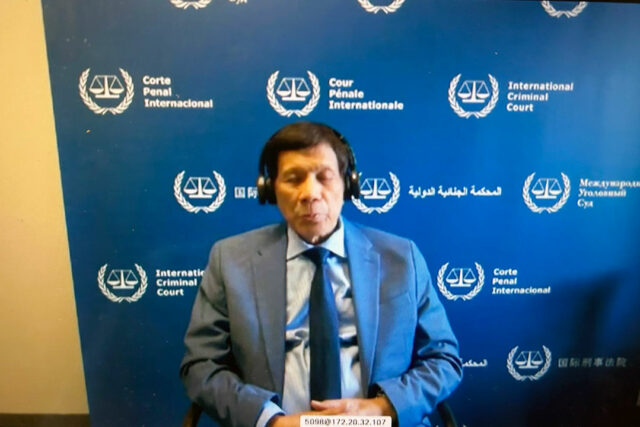
THE International Criminal Court (ICC) is set to hold a pre-trial hearing with former President Rodrigo R. Duterte on Feb. 23 to 27, marking a key procedural stage in the crimes against humanity case linked to his anti-drug campaign.

The hearing comes after Pre-Trial Chamber I on Feb. 20 rejected a defense motion seeking to disqualify the Common Legal Representatives for Victims, Filipino lawyers Joel R. Butuyan and Gilbert T. Andres, along with case manager Nicolene S. Arcaina.

Within hours of the ruling, Mr. Duterte’s legal team filed a request for leave to appeal, arguing that the decision raises questions about the “fairness and transparency” of the proceedings.

The defense had alleged “impediments to representation” and possible conflicts of interest related to Ms. Arcaina’s previous professional roles. However, the chamber, led by Presiding Judge Iulia Antoanella Motoc, ruled that the claims lacked a clear legal basis.

It described the arguments as “speculative and hypothetical,” saying the defense had failed to show how past professional relationships would compromise the lawyers’ duty to act in the best interests of victims.

In seeking leave to appeal, the defense said the ruling creates what it called a “structural imbalance” inconsistent with the ICC’s code of professional conduct. It argued that appellate guidance is needed to avoid further disputes that could delay proceedings.

The four-day hearing is not a trial but a pre-trial proceeding to determine whether there is sufficient evidence to move the case forward.

ICC spokesperson Oriane Maillet said in a video advisory that judges would assess whether the prosecution has established substantial grounds to believe Mr. Duterte committed the crimes.

“At this stage, the judges will not decide on Mr. Duterte’s innocence or guilt,” she said. “Instead, the pre-trial judges decide whether there is enough evidence against Mr. Duterte for the case to go to trial.”

The chamber will hear arguments from the prosecution, the defense and the victims’ legal representatives. Judges are expected to issue a decision within 60 days after the hearing.

Mr. Duterte, who is in ICC custody in The Hague, has waived his right to attend the hearing. His legal team earlier argued that he was unfit to stand trial due to health concerns, but the chamber ruled on Jan. 26 that independent medical assessments found him mentally and physically fit to participate.

Aurora Corazon A. Parong, co-chairperson of the Philippine Coalition for the ICC, described the confirmation hearing as a critical milestone.

“It is only after this hearing that the judges can decide if there is evidence for a trial for crimes against humanity of murder and attempted murder,” she said in a Facebook Messenger chat, adding that prosecutors have submitted more than 1,000 pieces of evidence.

Ms. Parong also rejected Mr. Duterte’s claim that the case is politically motivated, pointing to publicly available videos in which he issued orders to kill suspected drug offenders and promised protection to police officers.

The dispute over the victims’ legal team has also highlighted the role of victims under the Rome Statute, the ICC’s founding treaty. Unlike in many domestic systems, victims before the ICC may participate in proceedings through legal representatives.

Jose Sonny G. Matula, chairman of the NAGKAISA labor coalition, said victims are recognized as rights-holders, not merely witnesses.

“Under Article 68(3), they are mandated to be heard,” he said. “They should have counsel who understands the language, culture and wounds of the Philippines in the Duterte case.”

Mr. Matula said effective representation requires lawyers who can communicate directly with victims and families, explain legal developments and reflect the broader harm caused by the anti-drug campaign, including community fear, stigma and economic loss.

Supporters of the appointed counsel argue that their longstanding engagement with victims’ families places them in a strong position to fulfill that role as the case moves to its next stage.

The confirmation hearing will determine whether the case proceeds to full trial, setting the course for one of the most closely watched proceedings before the ICC in recent years.

Senate minority bloc move may undermine ICC process

PHILSTAR FILE PHOTO

By Adrian H. Halili, Reporter

THE SENATE minority bloc’s move to prioritize local remedies over international jurisdiction could weaken accountability mechanisms and strain the Philippines’ standing under international legal frameworks, political analysts said.

Anthony Lawrence A. Borja, an associate political science professor at De La Salle University, said Senate Resolution No. 307 could expose domestic institutions to political pressure while undermining the country’s credibility overseas.

“To affirm local remedies is to pander to citizens who would like to seek justice for their favored chief through local courts, regardless of whether their sense of nationalism is authentic or not,” he said in a Facebook Messenger chat.

Filed last week, the resolution urges Philippine authorities to ensure that Filipinos are first afforded due process in local courts before being surrendered to international tribunals.

The measure was introduced after the International Criminal Court (ICC) identified Senators Ronald “Bato” M. dela Rosa and Christopher Lawrence “Bong” T. Go as co-perpetrators in the anti-drug campaign of former President Rodrigo R. Duterte. The ICC has not issued arrest warrants against the two senators.

Mr. Go has denied the allegations. Mr. dela Rosa has not attended Senate sessions in recent months following reports of a possible warrant.

Dennis C. Coronacion, chairman of the University of Santo Tomas Political Science Department, said the resolution risks weakening accountability.

“This institutional practice of ‘protecting one’s own’ weakens accountability and obstructs the dispensation of justice,” he said via Messenger.

Hansley A. Juliano, a political science lecturer at the Ateneo de Manila University, questioned the resolution’s credibility, noting that it was introduced by senators allied with the former President.

“It’s not about sovereignty or prioritizing local remedies; it’s about protecting the Dutertes,” he said via Messenger.

The resolution argues that naming the two senators in ICC documents could make them vulnerable to extradition without first exhausting remedies under Philippine law. It calls on the government to ensure access to domestic legal processes before surrendering any Filipino to an international court.

Mr. Borja warned that challenging international mechanisms could place the Philippines at odds with agreements it had signed.

“If it does not work, then it affirms our membership and would set us apart from more problematic states that would rather suspend the provision of justice rather than allow an international court to participate,” he said.

Mr. Juliano added that the proposal could amount to political signaling unless it secures broad Senate support. A resolution would require backing from at least two-thirds of lawmakers to carry significant institutional weight.

The Philippines withdrew from the ICC in 2018 upon Mr. Duterte’s order after the tribunal began examining alleged abuses linked to his anti-drug campaign. The withdrawal took effect in 2019, though the court maintains jurisdiction over crimes committed while the country was still a member.

Mr. Duterte was arrested last year through the International Criminal Police Organization after an ICC warrant and was flown to The Hague to face charges of crimes against humanity. He is awaiting further proceedings before the court.

ADVERTISEMENT
ADVERTISEMENT