Home Blog Page 2640

Meralco mobility arm partners with Uratex for EV adoption

MOVEM Electric, Inc., the sustainable mobility arm of Manila Electric Co. (Meralco), has partnered with foam and mattress maker Uratex Group of Companies to support the latter’s logistics operations.

Movem handed over to Uratex an electric light delivery truck and a 60-kilowatt direct current fast charger for its manufacturing plant in Plaridel, Bulacan, the company said in a statement on Tuesday.

This move is intended to support Uratex’s plan to boost its adoption and deployment of electric vehicles (EVs) with “a convenient and accessible charging solution to its drivers and operations,” the company said.

“Our vision of driving the Philippines’ journey towards an emissions-free transportation sector is only made possible through working with like-minded partners such as Uratex,” said Raymond B. Ravelo, president of Movem, and first vice-president and chief sustainability officer of Meralco.

“Together, we will continue to promote key initiatives in vehicle electrification, helping protect and preserve our planet, and ultimately powering good lives for all,” he added.

Uratex Managing Director Peachy C. Medina said that the company has been gradually converting its internal fleet to electrical as part of its commitment to achieve its zero emissions goal.

“Movem assisted us from our initial inquiry, choosing the right model fit for our purpose, delivery, installation, and trained our drivers and maintenance personnel,” she said.

Meralco said it has supported Uratex to meet the latter’s requirements to switch to renewable energy sources under the government’s Green Energy Option Program.

The power distributor established Movem last year as its new subsidiary that will focus on the development and deployment of various electric transportation solutions.

Meralco’s controlling stakeholder, Beacon Electric Asset Holdings, Inc., is partly owned by PLDT Inc.

Hastings Holdings, Inc., a unit of PLDT Beneficial Trust Fund subsidiary MediaQuest Holdings, Inc., has an interest in BusinessWorld through the Philippine Star Group, which it controls. — Sheldeen Joy Talavera

Auto Sales (August 2024)

PHILIPPINE automotive sales grew by an annual 6.6% in August, despite a decline in passenger car sales, according to an industry report. Read the full story.

Auto Sales (August 2024)

El Salvador muralists paint over traces of violence in San Salvador neighborhood

MEJICANOS, El Salvador — From the window of her tin-sided shop outside El Salvador’s capital San Salvador, Esmeralda Quintanilla watches artists get to work in her neighborhood on walls still pockmarked by bullet holes from the country’s civil war and gang conflict.

Armed with brushes, paint, and spray cans, muralists and graffiti artists have already covered the walls of several of the 40 five-story units in a housing complex in the Zacamil neighborhood of the Mejicanos district.

“With the murals, everything looks really nice,” said Ms. Quintanilla, a 55-year-old seamstress who has lived in the neighborhood nearly half her life.

“You start to see all this and it gives the place a different image. I feel really happy, proud.”

The dozen murals already completed include a Mesoamerican pyramid, pixelated depictions of the Virgin Mary, and works straight out of the artists’ imaginations.

The initiative in the once-violent neighborhood is led by a Salvadoran foundation that seeks to fill communities with art. Its aim in Zacamil is to create stories-high murals over the next two years on nearly every wall of the complex, which houses around 4,000 residents.

Zacamil got a break from decades of violence two years ago, when President Nayib Bukele launched a nationwide crackdown on gangs. The state of emergency — which human rights groups have said Mr. Bukele must end amid reports of abuses — has put almost 82,000 alleged gang members in prison.

Even with the murals improving the neighborhood’s appearance, chronic infrastructure issues remain, with garbage piled up in the streets and storm drains clogged. TV antennas, power cables, and clothes strewn out windows across clotheslines also dot the neighborhood.

Many Zacamil residents fled in 1989 when fighting between the Salvadoran army and the former leftist guerrilla group, Farabundo Marti National Liberation Front (FMLN) nearly destroyed the Mejicanos district.

When they returned, many found homes damaged by two earthquakes in 2001 or invaded by gang members.

“There are always problems, but this is (giving the neighborhood) a facelift,” said a 70-year-old resident who declined to give his name.

El Salvador’s bloody, 12-year civil war from late 1979 to January 1992 killed more than 75,000 people. — Reuters

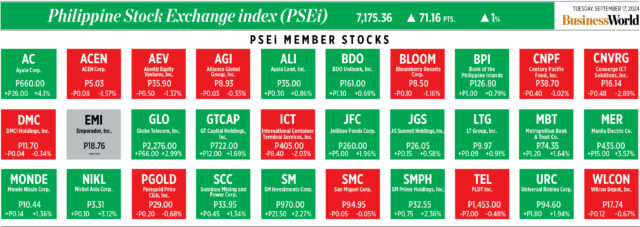
How PSEi member stocks performed — September 17, 2024

Here’s a quick glance at how PSEi stocks fared on Tuesday, September 17, 2024.


Analysts: Marcos may have violated law with Duran Duran birthday bash

PRESIDENT FERDINAND R. MARCOS, JR. — PHILIPPINE STAR/RYAN BALDEMOR

By Kyle Aristophere T. Atienza, Reporter

PHILIPPINE President Ferdinand R. Marcos, Jr. might have violated the law for accepting a birthday bash thrown by “old friends” on Sept. 13, and where 1980s British pop rock band Duran Duran  performed, according to political analysts.

The concert gift for the President’s 67th birthday celebration goes against the country’s Code of Conduct for public officials, they said, adding that the presidential palace should apologize and disclose the event’s sponsors.

Duran Duran charges as much as $1 million per booking, according to Celebrity Talent International’s website.

The palace did not immediately reply to a Viber message seeking comment.

At the weekend, the Presidential Communications Office said Mr. Marcos celebrated his birthday “with his signature compassion for the needy and the sick, and his deep appreciation for the farmers who feed the nation.”

“After a tiring day filled with official engagements, he attended a party thrown by his old friends at a hotel in Pasay, and to his surprise and appreciation, music was provided by Duran Duran,” it added.

Michael Henry Ll. Yusingco, a lawyer and a research fellow at the Ateneo Policy Center, said Section 7 of the Code of Conduct and Ethical Standards for Public Officials provides that public officials and employees “shall not solicit or accept, directly or indirectly, any gift, gratuity, favor, entertainment, loan or anything of monetary value from any person in the course of their official duties or in connection with any operation being regulated by, or any transaction which may be affected by the functions of their office.”

Presidential Decree No. 46, a decree signed by no less than Mr. Marcos’s father and namesake, states that it is “punishable for any public official or employee, whether of the national or local governments, to receive directly or indirectly, and for private persons to give, or offer to give, any gift, present or other valuable thing on any occasion.”

“Even if presidential immunity takes precedence in this case, that argument must still be made,” Mr. Yusingco said in an e-mail. “At this point, the wrong that needs to be corrected goes beyond what is provided by law.”

“It’s all about doing the right thing in the context of our problems with patronage politics, graft and corruption, and bureaucratic inefficiencies.”

FATHER’S ‘EXTRAVAGANCE’
He said Filipinos should reject political leaders who conduct themselves in such an “irresponsible and tone-deaf manner.” “The administration must apologize to the public for organizing or allowing such a lavish event to be organized.”

Philip Arnold P. Tuaño, dean of the Ateneo de Manila University School of Government, noted that while it’s not clear whether the President was aware about the concert before entering the Pasay hotel, “it would have been best if he had already informed his friends and associates that the holding of extensive entertainment events is out of place in his administration.”

Doing so would show that he promotes the code, which calls on public officials to have ordinary lifestyles, he said in an e-mail.

“By constantly reminding his official family in government and also their associates of the need for simplicity of lifestyle, the President can foster a culture of prudence, modesty and accountability,” he said.

“This would help avoid even the appearance of impropriety, reinforcing public trust and ensuring that the administration’s actions are aligned with the values of transparency and good governance,” he added.

Terry L. Ridon, a lawyer and former party-list lawmaker, the presidential palace should not downplay the concert as merely a gift from the President’s friends.

“Malacañang should disclose the identities of the event’s private sponsors and a full accounting of the expenses should be made available so the public can make a clear determination of whether the prohibition against receiving gifts was violated,” he said in an e-mail.

He said the private sponsors should have had “simple political sense.” “The fallout from the event had clearly subjected the President to embarrassment and tarnished his political capital amid intense national political intramurals with his former election allies,” he added.

Anthony Lawrence A. Borja, who teaches political science at De La Salle University, said impeachment is unlikely to gain traction at the House of Representatives.

“As for the general public, the opposition would deem it as reminiscent of Marcos Sr.’s extravagance,” he said in a Facebook Messenger chat.

A pro-Duterte vlogger reported on the Duran Duran gig for Mr. Marcos, accusing the President of bringing the British band into the country using public funds.

Mr. Borja said the President’s supporters “would simply swallow the palace excuse and deem it as a private manifestation of Filipinos’ love for parties and grand celebrations.”

A Social Weather Stations poll released last week showed that the rating of the Marcos government rose to a “good” +40 in June from a “moderate” +29 in March.

The June 23-July 1 poll showed that 62% of adult Filipinos were satisfied, 22% were dissatisfied, and 15% were neutral with the government’s performance.


Peso extends climb on bets of big Fed cut

BW FILE PHOTO

THE PESO strengthened to a fresh six-month high against the dollar on Tuesday amid growing bets of a 50-basis-point (bp) rate cut by the US Federal Reserve this week.

The local unit closed at P55.695 per dollar on Tuesday, appreciating by 19.3 centavos from its P55.888 finish on Monday, Bankers Association of the Philippines data showed.

This was the peso’s best close in six months or since its P55.58-a-dollar finish on March 18.

The peso opened Tuesday’s session stronger than Monday’s close at P55.78 against the dollar. Its weakest showing was at P55.84, while its intraday best was at P55.655 versus the greenback.

Dollars exchanged inched up to $1.26 billion on Tuesday from $1.2 billion on Monday.

“The dollar-peso closed lower mainly because of increasing bets for a 50-bp rate cut at the Fed’s meeting,” a trader said by phone.

Expectations of a larger Fed cut led to a weaker dollar on Tuesday, Rizal Commercial Banking Corp. Chief Economist Michael L. Ricafort said in a Viber message.

For Wednesday, the trader said the peso could trade sideways ahead of the Fed’s policy decision.

The trader sees the peso moving between P55.50 and P56 per dollar on Wednesday, while Mr. Ricafort expects it to range from P55.60 to P55.80.

The dollar traded near its lowest levels of the year on Tuesday, on the eve of the expected start to a US easing cycle that markets are betting may begin with an outsized rate cut, Reuters reported.

The yen eased back to 140.58 after a jaunt to the stronger side of 140 during holiday thinned trade on Monday.

It has fallen the most this year so has the most room to rally on a dovish turn from the US central bank. A sustained break of 140.00 would open the way to a low from last January at 127.215.

Fed funds futures have rallied to push the chance of a 50-bp rate cut to 69%, against 30% a week ago. The odds have narrowed sharply after media reports revived the prospect of a more aggressive easing.

Meanwhile, the Bank of Japan is expected to keep policy steady on Friday but signal that further interest rate hikes are coming, perhaps turning the next meeting in October into a live one.

The US dollar index held at 100.6, not far from its 2024 low made last month at 100.51. — AMCS with Reuters

Armscor launches firearm line for PHL law enforcers

ARMSCOR GLOBAL DEFENSE, INC. on Tuesday launched a line of firearms that are tailor fitted to Filipino law enforcers’ needs. The biggest defense manufacturer in the Philippines and one of the largest in Asia said unit RIA Defense worked with science and technology experts and former military and police personnel for the design and development of the guns. — CHLOE MARI A. HUFANA

By Chloe Mari A. Hufana, Reporter

ARMSCOR GLOBAL DEFENSE, Inc. (AGDI) on Tuesday announced the launch of Rock Island Armory (RIA) Defense, a homegrown Filipino company that is “set to change the landscape in the local firearms manufacturing industry.”

Armscor, the biggest defense manufacturer in the Philippines and one of the largest in Asia, said RIA Defense worked with science and technology experts and sought the expertise of seasoned former military and police personnel for the design and development of products that are tailor fitted to Filipino law enforcers.

“[RIA] Defense is the only locally designed and manufactured firearms company that has been consulting with ex-law enforcement and military personnel and industry experts to provide our country’s operators with a gun that is suited for their environment,” Armscor Assistant Vice-President (AVP) Daniel A. Tuason told a news briefing in Marikina City.

In a separate statement, AGDI said foreign manufactured guns do not consider the Filipino physique, tropical environment, varying threat levels, budget constraints and foreign trade restrictions.

“Most of the firearms and ammunition manufacturers from abroad develop their weapons with their law enforcement and military counterparts, which for the most part means that they’re trying to solve the problems of the West,” Mr. Tuason said.

The gun company launched the RD4P Cobra, a short-stroke gas piston rifle that can shoot after being submerged in water, and the RD1 multi-caliber pistol platform that can fire 9mm rounds or 22TCM armor-piercing rounds through a conversion kit. The firearm, which can penetrate body armor with protection level III, allows the user to deal with higher threat levels.

Armscor said they developed the guns for three years.

The rifle will be sold exclusively to local law enforcement authorities, while the pistol will be available for commercial sale.

Armscor Executive Vice-President and Chief Operating Officer Felino A. Neri IV said 70-80% of their guns are exported to 60 different countries, with the United States accounting for top sales. About 15% come from civilian purchases and the rest is from the Philippine government.

Armscor Chairman, President and Chief Executive Officer Martin O. Tuason cited the importance of the country’s Self Reliance Defense Posture bill, which has been ratified by both Houses of Congress and is now awaiting the President’s signature.

The priority bill seeks to develop the country’s defense industry by boosting the local production of defense supplies like materiel and bullets.

“This law is going to give Filipino companies or joint ventures with other foreign companies here in the Philippines opportunities to create jobs for Filipinos,” he said.

He added that they employ about 2,000 Filipino workers at their Marikina facility alone.  With the new range of firearms, they aim to provide more jobs to Filipinos, he added.

Mr. Neri cited the Marawi siege by Islamic terrorists in 2017, noting that the government lacked the proper ammunition at the time.  The siege lasted for five months, which depleted the government’s ammunition supply.

The homegrown gun company said it delivered 3,000 firearms in five days and 30,000 rounds of ammunition for government forces, the only private manufacturer that was able to supply the military at a critical time.

“When something happened, we didn’t have ammunition. We were waiting for a procurement or a bid that the government [was securing], by the time they were able to send the ammunition here, the war was over,” he told reporters on the sidelines of the briefing.

Armscor’s AVP noted that once the Self Reliance Defense Posture bill is signed into law, the Philippines could stockpile ammunition to be self-sufficient in case war erupts.

“If we go to war with any country at this point, what do we have? We can’t wait for an international company to send us ammunition. It has to come from us,” he added.

“With RIA Defense, we want to demonstrate that a Filipino company can manufacture world-class products designed by the Filipino, which can help strengthen the defense capabilities of the Philippines and also build its reputation as a globally competitive defense manufacturer,” he said in a separate statement.

PHL stocks surge on strong data before Fed meet

BW FILE PHOTO

PHILIPPINE STOCKS continued to rally on Tuesday amid strong economic data and growing expectations of an outsized rate cut by the US Federal Reserve this week.

The benchmark Philippine Stock Exchange index (PSEi) increased by 1% or 71.16 points to end at 7,175.36 on Tuesday, while the broader all shares index surged by 0.79% or 30.17 points to close at 3,850.17.

This was the PSEi’s highest close in over 29 months or since it ended at 7,203.47 on March 31, 2022. Year to date, the main index is now up by 11.25% or 725.32 points from its end-2023 close of 6,450.04.

“The local market extended its gains this Tuesday. Investors showed appreciation for the July cash remittances data and the Board of Investments’ (BoI) approved investment pledges as of Sept. 16, both of which have shown good figures,” Philstocks Financial, Inc. Senior Research Analyst Japhet Louis O. Tantiangco said in a Viber message.

Cash remittances climbed by 3.1% to $3.085 billion from $2.992 billion a year ago, Bangko Sentral ng Pilipinas (BSP) data showed. This was the highest monthly level since the $3.28 billion recorded in December 2023.

Meanwhile, the BoI has approved 225 investment pledges worth P1.35 trillion this year, already surpassing 2023’s total, it said on Monday.

“Hopes of a dovish monetary policy outlook for both the Federal Reserve and the BSP also helped in keeping the market’s upward movement,” Mr. Tantiangco said.

“The local bourse extended its rally… as optimism grew around an expected rate cut from the Federal Reserve following tomorrow’s policy meeting,” Regina Capital Development Corp. Head of Sales Luis A. Limlingan said in a Viber message.

Markets are now pricing in a 67% chance that the Fed could ease rates by half a percentage point at the conclusion of its Sept. 17-18 monetary policy meeting, after a slew of media reports revived the prospect of more aggressive easing, Reuters reported.

Most sectoral indices closed higher on Tuesday. Holding firms went up by 1.84% or 111.20 points to 6,133.17; property rose by 1.48% or 42.11 points to 2,879.67; industrials climbed by 1.39% or 131.17 points to 9,560.68; mining and oil increased by 1.22% or 98.37 points to 8,103.18; and financials added 0.77% or 16.82 points to end at 2,199.91.

Meanwhile, services fell by 0.76% or 16.91 points to 2,208.50.

“Ayala Corp. led the index members, jumping 4.1% to P660. Converge ICT Solutions, Inc. was at the bottom, falling 2.89% to P16.14,” Mr. Tantiangco said.

Value turnover surged to P6.69 billion on Tuesday with 712.81 million issues switching hands from the P3.96 billion with 724.3 million shares traded on Monday.

Decliners outnumbered advancers, 117 versus 94, while 41 names closed unchanged.

Net foreign buying climbed to P806.45 million on Tuesday from P158.29 million on Monday. — R.M.D. Ochave with Reuters

Immigration looking at P200-M bribe for Guo escape

PHILSTAR FILE PHOTO

By John Victor D. Ordoñez, Reporter

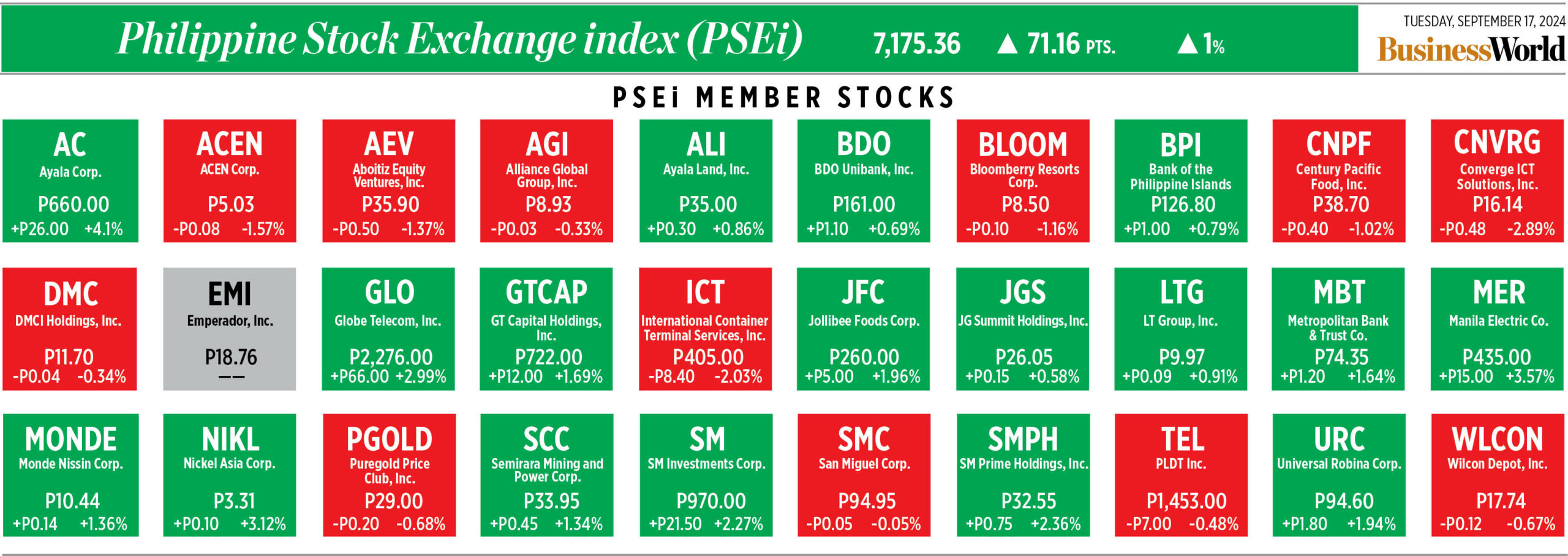
THE Bureau of Immigration (BI) on Tuesday said it is investigating a lead on one of its high-ranking officers who allegedly accepted a P200-million bribe from a former town mayor in exchange for her escape in July.

“We have received intelligence information regarding this amount, but we are still validating if a person associated with the BI received this,” bureau Intelligence Division chief Fortunato S. Manahan, Jr. told a Senate hearing.

The Senate is looking into ex-Bamban Mayor Alice l. Guo’s alleged links to Chinese criminal syndicates. She has been accused of having links with illegal Philippine Offshore Gaming Operators (POGO). She has denied the allegations and insists she is a natural-born Filipino.

Ms. Guo left the Philippines in July but was deported after she was arrested in Jakarta this month.

Mr. Manahan said the bureau would immediately file criminal charges if it finds proof that the Immigration officer colluded with the former mayor.

At the same hearing, retired General Raul P. Villanueva, senior vice president of Philippine Amusement and Gaming Corp.’s (Pagcor) security and monitoring cluster, said a former national police chief might have also helped Ms. Guo escape.

“There were discussions [about the bribe], including a Philippine National Police (PNP) official who was involved but I cannot confirm this yet,” he told senators in mixed English and Filipino.

Ms. Guo, who was arrested in Jakarta on Sept. 4, earlier told senators that she fled the country via a yacht.

She has been accused of coddling an illegal POGO in Bamban, Tarlac, where she ran and won for the first time as mayor in 2022. Raided by authorities in March, an illegal hub on land she partially owned had been linked to scamming operations.

Meanwhile, Senator Sherwin T. Gatchalian said he is seeking a probe into banks failing to flag suspicious transactions linked to POGOs, which are companies that operate online casinos and target Chinese clients.

“The failure of these banks to report these dubious transactions raises the matter of the effectiveness of their internal controls and procedures for identifying and reporting suspicious transactions,” he said in a statement, citing Senate Resolution 1193, which he filed on Sept. 11.

He cited 2020 banking transactions in the hundreds of millions of pesos from companies supposedly owned by Ms. Guo.

The Anti-Money Laundering Council (AMLC) and several other agencies in late August jointly filed multiple complaints of money laundering against Ms. Guo and 35 others before the Justice department.

On top of this, Ms. Guo is facing lawsuits before the Ombudsman and Commission on Elections (Comelec).

The National Bureau of Investigation earlier matched her fingerprints with a Chinese national named Guo Hua Ping.

In his third address to Congress, Philippine President Ferdinand R. Marcos, Jr. ordered Pagcor to shutter POGO companies by the end of the year, citing their links to human trafficking and torture.

A former national police chief helping the dismissed mayor escape would show that POGO money could influence the highest ranks of the government if proven true, Senator Ana Theresia N. Hontiveros said at the same hearing.

“If we don’t stop the plague, the next President, senators, the next government leaders of our country may be bankrolled by POGO money,” she told the hearing in mixed English and Filipino.

DHSUD to finish 12,000 housing units by yearend

PHILSTAR FILE PHOTO

THE DEPARTMENT of Human Settlements and Urban Development (DHSUD) is set to finish over 12,000 housing units under the state’s flagship socialized housing program, a congressman said on Tuesday, a far cry from the one million units annually promised by President Ferdinand R. Marcos, Jr. in his first year in office.

The Human Settlements department is expected to complete 12,731 socialized housing units out of about 198,000 units currently being constructed, Navotas Rep. Tobias Renald “Toby” M. Tiangco said as he sponsored department’s budget before the House of Representatives.

“The target for housing units, under the 4PH (Pambansang Pabahay para sa Pilipino Program), is 198,111 units. However, only 12,731 units are expected to be delivered,” he said during the House plenary deliberation on the agency’s proposed national budget for next year.

In 2022, Mr. Marcos vowed to build one million housing units per year until the end of his term to settle the government’s 6.5 million socialized housing backlog.

The Human Settlements department in April said before a House panel that it is looking at finishing around 80,000 housing units before yearend. “We’re projecting to finish at least 80,000 housing units, if we’re not being conservative,” DHSUD Director Frank Lloyd C. Gonzaga told congressmen in Filipino.

The government finds it difficult to accomplish building one million housing units annually due to construction delays and a lack of a budget, Mr. Tiangco said, resulting in the agency recalibrating its housing target.

“The housing backlog is six million units… but only 3,236,100 units will be completed by 2028,” he added.

It would cost about P4.07-trillion to accomplish the housing backlog, which would be funded in tranches through sovereign guarantee, according to Mr. Tiangco.

“For 2024, the sovereign guarantee required is P108 billion; for 2025, the required guarantee is P783 billion; in 2026, it’s P1.468-trillion,” he said. “For 2027, the requirement is P1.212-trillion, and for 2028, it’s P507 billion.”

Mr. Marcos in August approved the use of a sovereign guarantee as a funding mechanism for the government’s flagship socialized housing program due to slow private financing.

The National Housing Authority (NHA) and Social Housing Finance Corporation (SHFC) would use the sovereign guarantee as developmental loans to fund the construction of public housing infrastructure, Mr. Tiangco said. — Kenneth Christiane L. Basilio

Explain 2018 net worth, Roque told

PCOO.GOV.PH

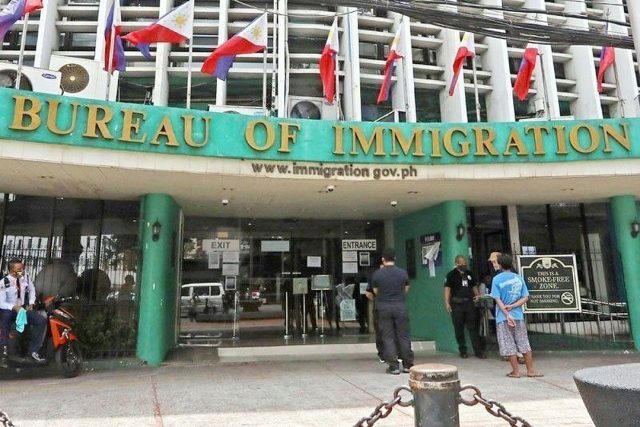
EX-PRESIDENTIAL Spokesperson Herminio “Harry” L. Roque should explain the increase in his net worth from 2016 to 2018 before a House of Representatives committee looking into the operations of illegal online casinos, a congressman said on Tuesday, urging him to surrender to authorities.

“Harry Roque appears to be acting weird and strange by mocking the Lower House’s Quad Committee instead of justifying the sudden but unexplained increase of his wealth — from P125,000 in 2016 to P125,000,000 in 2018 — which were believed to have possibly come from POGO (Philippine Offshore Gaming Operators),” Surigao del Norte Rep. Robert Ace S. Barbers said in a statement.

Mr. Roque, however, argued in a Viber message that “that has no relation in aid of legislation to POGO.”

The former presidential spokesperson was tagged by the House’s so-called “quad-committee,” consisting of the public order and safety, dangerous drugs, public accounts, and human rights panels, as having ties to illegal POGO through a firm owned by his family.

The panel cited Mr. Roque in contempt for failing to submit documents requested by lawmakers, which they said could explain the wealth boom. They subsequently served an arrest warrant against him following a detention order. — Kenneth Christiane L. Basilio

Printing digital Nat’l IDs illegal

PHILSTAR FILE PHOTO

THE Philippine Statistics Authority (PSA) on Tuesday warned against the illegal printing of the digital Philippine Identification System (PhilSys) card or the National ID in plastic cards.

“The PSA informs the public and relying parties that the printing of the Digital National ID in polyvinyl chloride (PVC) or plastic cards is strictly prohibited,” the local statistics office said in a statement.

Only the PSA is authorized to print and issue the National ID cards, it said.

Those found guilty of illegally printing the digital National IDs will be imprisoned for up to six years and will be slapped with a fine of up to P3 million, according to the law.

Of the 89.7 million total registrations for the National ID, around 55 million have received their physical cards, PSA Assistant National Statistician Emily R. Pagador told reporters on Monday.

This leaves a 35-million backlog of physical cards yet to be delivered.

While the ID cards have yet to be printed, PhilSys registrants may avail digital versions of their IDs for government and bank transactions, PSA said.

The Bangko Sentral ng Pilipinas (BSP) recently mandated all BSP-Supervised Financial Institutions to accept all forms of the National ID, including the digital version. — Beatriz Marie D. Cruz