
How PSEi member stocks performed — September 24, 2024
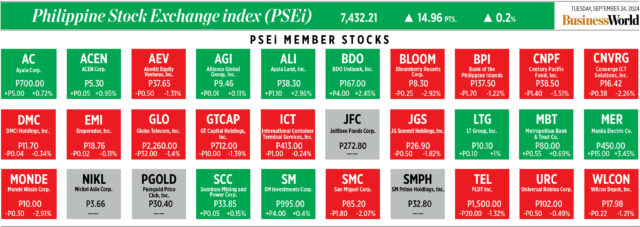
Here’s a quick glance at how PSEi stocks fared on Tuesday, September 24, 2024.
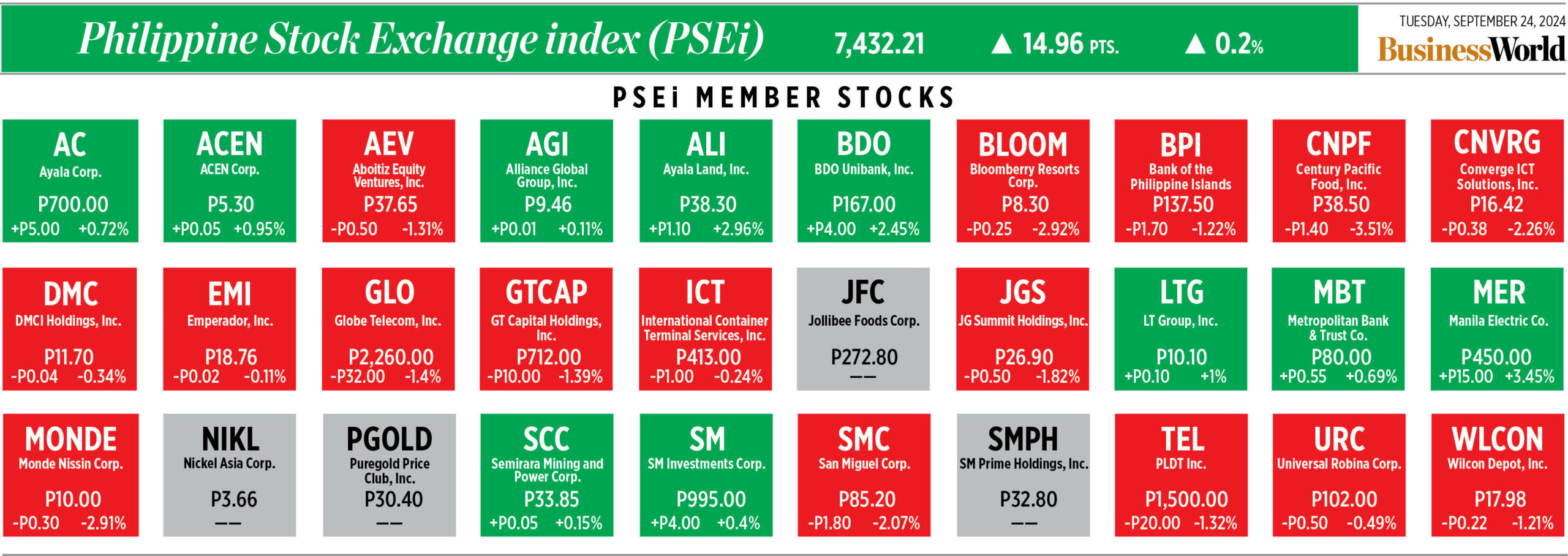

Here’s a quick glance at how PSEi stocks fared on Tuesday, September 24, 2024.
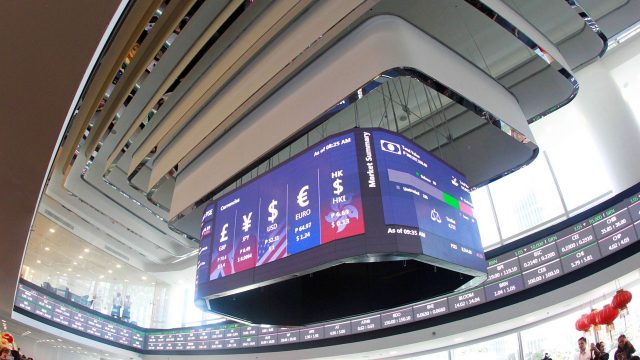
PHILIPPINE SHARES climbed further on Tuesday amid expectations of more rate cuts by the Bangko Sentral ng Pilipinas (BSP) and the US Federal Reserve.
The Philippine Stock Exchange index (PSEi) rose by 0.2% or 14.96 points to close at 7,432.21 on Tuesday, while the broader all shares index increased by 0.13% or 5.48 points to end at 3,963.50. This was a fresh 31-month high for the PSEi as this was its best finish since 7,440.91 on Feb. 22, 2022.
“Investors took cues from Wall Street’s record performance overnight, driven by optimism towards the Fed’s monetary policy stance,” Philstocks Financial, Inc. Senior Research Analyst Japhet Louis O. Tantiangco said in a Viber message. “Positive sentiment towards the policy outlook of the Bangko Sentral ng Pilipinas also helped in maintaining the upward momentum.”
US stocks closed modestly higher on Monday, Reuters reported. The Dow Jones Industrial Average rose 61.29 points or 0.15% to 42,124.65; the S&P 500 gained 16.02 points or 0.28% to 5,718.57; and the Nasdaq Composite gained 25.95 points or 0.14% to 17,974.27.
Comments on Monday from three reserve bank presidents were the main focus as investors searched for clues on why the central bank kicked off its easing cycle with an outsized 50-basis-point (bp) cut.
Fed officials including Raphael Bostic, Neel Kashkari, and Austan Goolsbee supported the central bank’s last rate cut and voiced support for more cuts for the rest of the year.
Meanwhile, Finance Secretary Ralph G. Recto, who sits on the central bank’s Monetary Board, said on Tuesday the monetary authority can afford to slash interest rates further and match the size of the US Federal Reserve’s rate cut.
Slowing inflation allowed the central bank to cut its benchmark borrowing rate by 25 bps to 6.25% in August, its first rate cut since November 2020, ahead of major central banks, including the Fed.
BSP Governor Eli M. Remolona, Jr. had earlier flagged there was room for one more interest rate cut this year. The BSP’s next meeting is on Oct. 17.
“Local shares rose on Tuesday, supported by the BSP’s reserve requirement cut and China’s new stimulus measures,” Regina Capital Development Corp. Head of Sales Luis A. Limlingan added in a Viber message.
Majority of sectoral indices closed higher on Tuesday. Property rose by 0.95% or 28.22 points to 2,989.96; financials went up by 0.43% or 10.30 points to 2,372.48; industrials increased by 0.09% or 8.81 points to 9,756.33; and mining and oil climbed by 0.05% or 4.91 points to 8,532.13.
Services dropped by 0.61% or 13.96 points to 2,250.79; and holding firms went down by 0.02% or 1.73 points to 6,295.96.
Value turnover improved to P11.79 billion on Tuesday with 1.02 billion issues switching hands from the P8.72 billion with 698.15 million shares traded on Monday.
Advancers narrowly beat decliners, 102 versus 100, while 57 names closed unchanged.
Net foreign buying surged to P2.99 billion on Tuesday from P1.77 billion on Monday. — R.M.D. Ochave with Reuters

THE PESO on Tuesday sank to the P56-per-dollar level for the first time in almost two weeks after Finance Secretary Ralph G. Recto said the Bangko Sentral ng Pilipinas (BSP) has space for a big rate cut following the US central bank’s move last week.
The local unit closed at P56.245 per dollar on Tuesday, falling by 27.5 centavos from its P55.97 finish on Monday, Bankers Association of the Philippines data showed.
Tuesday’s close was the peso’s worst showing in two weeks or since it ended at P56.385 against the dollar on Sept. 10. This was also the first time the local unit finished at the P56 level since Sept. 12’s P56.20.
The peso opened Tuesday’s session weaker at P56.05 against the dollar. Its intraday best was at P55.97, while its worst showing was at P56.33 versus the greenback.
Dollars exchanged rose to $1.8 billion on Tuesday from $1.39 billion on Monday.
The peso dropped after the dollar rallied overnight and following dovish signals from Mr. Recto, a trader said by phone.
Mr. Recto, who sits on the central bank’s Monetary Board, said on Tuesday the monetary authority can afford to slash interest rates further and match the size of the US Federal Reserve’s rate cut, Reuters reported.
“The Fed reduced by 50 basis points (bps). I think we can also do half a percent,” Mr. Recto a told a media briefing.
Inflation would likely ease to 2.5% in September, he said, the slowest in nearly four years, after rising at an annual pace of 3.3% the previous month. Mr. Recto said that could settle at 3.4% this year, within the central bank’s 2% to 4% target range.
Slowing inflation allowed the central bank to cut its benchmark borrowing rate by 25 bps to 6.25% in August, its first rate cut since November 2020, ahead of major central banks, including the Fed.
The Fed started cutting rates on Sept. 18 with a larger-than-usual half-percentage-point reduction, which will likely be followed by a 25-bp cut in both November and December, according to a Reuters poll.
BSP Governor Eli M. Remolona, Jr. had earlier flagged there was room for one more interest rate cut this year. The BSP’s next meeting is on Oct. 17.
The peso was also dragged down by higher global crude oil prices and US Treasury yields amid renewed geopolitical tensions in the Middle East, Rizal Commercial Banking Corp. Chief Economist Michael L. Ricafort said in a Viber message.
For Wednesday, the trader sees the peso moving between P55.90 and P56.40 per dollar, while Mr. Ricafort expects it to range from P56.15 to P56.35. — AMCS with Reuters
THE PHILIPPINES continues to expect the free trade agreement (FTA) with South Korea to take effect within the year with ratification still pending on the Korean side, according to the Department of Trade and Industry.
“When it comes to the effectivity of the FTA, we are targeting effectivity this year. At least on our side, we’re done with the ratification process,” Trade Undersecretary Allan B. Gepty told BusinessWorld on the sidelines of a budget hearing at the Senate on Tuesday.
“We’re just waiting for South Korea to finish their full domestic process of ratification. But I understand they are now in the process of seeking the approval of their National Assembly,” he added.
He said the optimism stems from the scheduled visit of the South Korean leader next month.
“We are very happy that yesterday, finally, the Senate concurred on the ratification of the bilateral FTA. That is timely because I understand that the president of South Korea (Yoon Suk Yeol) will be visiting the country in October,” he said.
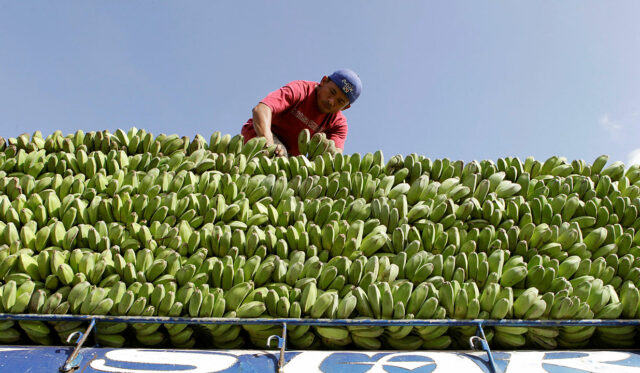
“Of course, it is also good news for our banana industry because if there is one sector that will mainly benefit from the FTA, that will be them,” he added.
South Korea was the country’s third-biggest banana export market last year, accounting for $164.54 million or 13% of fresh banana exports in 2023.
In the first quarter, banana exports to South Korea hit $102.58 million, well ahead of the year-earlier pace.
On Monday, the Senate ratified the FTA between the Philippines and South Korea, which will remove Philippine tariffs on 96.5% of goods from South Korea and Korean tariffs on 94.8% of Philippine products.
Signed in September last year, the FTA allowed the Philippines to secure the elimination of 1,531 tariff lines on agricultural goods, of which 1,417 would be removed after the FTA enters into force.
It will also remove 9,909 tariff lines of industrial goods, 9,747 of which would be removed after the deal enters into force.
According to Mr. Gepty, the agreement will come into force on the first day of the second month, or on such other date as the parties may agree, after they notify the completion of all necessary domestic legal procedures. — Justine Irish D. Tabile

THE EXECUTIVE ORDER that established the “green lane” scheme for expediting approvals of strategic projects needs to be turned into a law to assure investors, the Board of Investments (BoI) said.
At a budget briefing on Tuesday, Trade Undersecretary and BoI Managing Head Ceferino S. Rodolfo said getting green lane legislation passed is among the priorities of the Department of Trade and Industry (DTI).
“The first step that we are undertaking now is to legislate green lanes para magkaroon ng ipin (for it to have teeth),” Mr. Rodolfo said.
“Right now, the mandate flows from Executive Order (EO) No. 18, which was issued by the President. It will be better if we put it into law,” he added.
In February 2023, the government established via EO 18 the “green lane” system at all government offices, expediting approvals and permits for strategic investments.
According to Mr. Rodolfo, the BoI had endorsed P4.1 trillion worth of investments to the One Stop Action Center for Strategic Investments (OSACSI) as of Sept. 23. The investments are to fund 126 projects, mostly in the renewable energy (RE) industry.
Investments in RE projects increased after the government allowed full foreign ownership in the sector. Previously the cap was 40%.
BoI Investment Assistance Service and OSACSI Director Ernesto C. delos Reyes, Jr. said that making EO 18 into a law would institutionalize green lanes, leaving them immune to changes with the turnover of administrations.
“This will further streamline processes as the bill would also cover simultaneous processing,” he said.
He added such legislation will set a budget to pay for dedicated staff.
Mr. Rodolfo said a green lane law will attract more strategic investment in “the kind of projects where the government is more strict, like RE and mining.”
On May 2023, Rep. Jose Manuel F. Alba filed House Bill 8039, calling for green-lane processing of permits for strategic investments.
The House Committee on Trade and Industry is set to tackle the bill in November, according to Mr. Delos Reyes.
BUDGET
Meanwhile, the DTI said it is seeking an additional P347 million in funding to set up an e-commerce bureau.
Trade Undersecretary Mary Jean T. Pacheco said the e-commerce bureau is a requirement of the Internet Transactions Act.
“Section 7 of the Republic Act 11967 (calls for) the creation of an e-commerce bureau that will ensure the implementation of the law,” she said.
“It will regulate all internet transactions in cooperation with other agencies of government,” she added.
She said that the additional funding will go mainly to personal services and maintenance and other operating expenses.
“We requested a plantilla of 174,” she said, noting that the staffing is needed in part to handle consumer complaints.
For 2025, the DTI is requesting a budget of P10.6 billion, P2 billion of which will go to government corporations attached to the DTI.
“There will be an increase for our attached corporations but a slight decrease for the Office of the Secretary and its attached agencies,” Assistant Secretary Kristian R. Ablan said.
“In total, the DTI Office of the Secretary is requesting P6.4 billion, while its attached agencies are requesting P1.9 billion,” he added. — Justine Irish D. Tabile

THE Department of Agriculture (DA) said on Tuesday that it is seeking to collaborate with the Philippine Ports Authority (PPA) and Bureau of Customs to improve its farm import estimates.
“This would help up improve our supply and price forecasting and avoid artificial shortages caused by product hoarding,” Agriculture Secretary Francisco P. Tiu Laurel, Jr. said in a statement.
He added that the data gathered could determine which importers that need to be blacklisted.
Mr. Laurel said the objective of the tieup is to better time imports of farm goods to optimize the food supply.
The DA said that it is also looking to “ensure that imported agricultural food products are immediately delivered to warehouses and sold on the market.”
Last week, Mr. Laurel said the delay in lowering rice prices was due to bottlenecks at the ports, with imports remaining stalled after being landed.
The PPA has said that about 20,000 metric tons (MT) of imported rice have been unclaimed, noting that consignees could be waiting for the price of rice to rise because their cost of acquisition was high.
President Ferdinand R. Marcos, Jr. signed Executive Order No. 62 in June, lowering the tariff on imported rice to 15% from 35% until 2028, to help lower the price of the grain and blunt its impact on inflation.
Mr. Laurel said that rice prices could begin to ease by mid-October, while its full impact may be felt by January next year.
The DA has said that the lower tariffs on rice would lead to a P5 to P7 per kilogram drop in imported rice prices.
Rice imports totaled 3.09 million MT as of Sept. 19, according to the Bureau of Plant Industry. — Adrian H. Halili

US BIOTECH company Thermo Fisher Scientific, Inc. said it is expanding its Philippine workforce to staff a new Quezon City facility.
“Our new global business services center will enhance and expand our operational presence in the region and play a pivotal role within our extensive Global Shared Services network,” Konrad Bauer, senior vice-president, Global Business Services at Thermo Fisher Scientific, told BusinessWorld in an e-mail interview on Sept. 23.
On Aug. 29, the company cut the ribbon on the center, which will provide specialized financial and customer services to its clients in the healthcare and biotech sectors.
The center expands Thermo Fisher’s global shared services network, which consists of five locations worldwide.
He said the new facility will start with a team of 100 employees, with plans to increase to over 450 by the end of 2026.
“We’re also building on our presence in the Philippines, where we already have 1,400 colleagues working on clinical trials and commercial activities,” Mr. Bauer said.
Thermo Fisher aims to enhance its support for regional customers in the healthcare and biotech sectors using the local talent base, he added.
“Our plans include partnering with universities for STEM (science, technology, engineering, and mathematics) education and internships, supporting national science objectives through government engagement, and participating in community initiatives that promote science and technology,” Mr. Bauer said.
He also noted that the biotech industry in the Philippines is “on the verge of an exciting transformation,” driven by rising investment and strong government support.
“Key advancements are unfolding in healthcare with innovative drug development and diagnostics, agricultural biotech with breakthroughs in crop yields and sustainability, and environmental biotech with cutting-edge waste management and bioremediation,” Mr. Bauer added.
He also noted that research institutions like the Philippine Genome Center are fueling this growth, and a supportive regulatory environment and enhanced intellectual property protections are paving the way for a “vibrant future.”
“Ultimately, our efforts in the Philippines are designed to help advance scientific knowledge and innovation that address some of the world’s most pressing challenges,” Mr. Bauer said. — Aubrey Rose A. Inosante

ARTIFICIAL INTELLIGENCE (AI) can help the government detect business activity that violates competition law, the Philippine Competition Commission (PCC) said.
“In terms of performing our mandate, I think the application of AI can help us monitor all possible business activity,” PCC Executive Director Kenneth V. Tanate told BusinessWorld on the sidelines of a forum on Tuesday.
AI can help monitor the production and entry of goods into the country and spot trends indicative of uncompetitive behavior, he said.
“If we see that there is a competition issue, through Generated AI information, we can easily investigate. We can pinpoint businesses that may commit violations of Philippine competition law.”
To accelerate the public’s adoption of AI, legislators must prioritize the passage of the Konektadong Pinoy bill, National Economic and Development Authority (NEDA) Undersecretary Krystal Lyn T. Uy said.
“AI needs internet to use. If many parts of the country are unconnected, then they will be unable to use the technology,” she said on the sidelines of the forum.
Previously called the proposed Open Access in Data Transmission Act, the measure seeks to provide affordable internet access by promoting fair competition and removing barriers to entry in the data transmission sector.
House legislators already approved the measure in December, while it awaits second reading at the Senate.
Only 33% of households have access to fixed broadband, with only 70% of the population with an active mobile broadband subscription, the World Bank said in a blog.
In the Philippines, the cost of fixed broadband charges represents 11% of per capita gross national income — double the ASEAN (Association of Southeast Asian Nations) average.
The Philippines may unlock value estimated at P2.6 trillion annually if domestic business can introduce AI to their daily operations, NEDA Secretary Arsenio M. Balisacan said in July. — Beatriz Marie D. Cruz
THE Asian Development Bank (ADB) will increase its investments in reducing lead exposure in the Asia-Pacific, noting the health and economic costs it imposes on countries in the region.
In a statement, the Manila-based multilateral lender said it has entered into partnerships with various institutions to eliminate childhood lead exposure by 2040.
The Partnership for a Lead-Free Future, in collaboration with United Nations Children’s Fund and the US Agency for International Development, will target high-risk countries like Bangladesh, Indonesia, India, and Nepal.
The bank will also integrate lead elimination into its universal healthcare support programs, starting with the Philippines.
“Lead exposure doesn’t just affect children’s health — it holds back entire economies,” ADB Vice-President for East and Southeast Asia and the Pacific Scott Morris was quoted as saying.
“We will dedicate ADB’s expertise and resources to help ensure that countries across Asia and the Pacific can mitigate lead exposure, enhance public health, and secure a healthier, more productive future for all.”
Lead is a strong neurological and cardiovascular toxicant, accounting for about 1.5% of global deaths yearly, UNICEF and nonprofit organization Pure Earth said in a 2020 report.
At least 400 million children in the region are affected by toxic lead exposure, causing major economic losses, health risks, and cognitive impairments, ADB said.
Lead-related cognitive underdevelopment costs $1 trillion in economic losses yearly, it added.
The bank has also begun discussions on lead contamination with the governments of the Philippines, India, and Indonesia, it said.
The ADB is also looking to develop a Chemical and Wastes Financing Partnership Facility, which will focus on chemical management, especially on lead mitigation. This will be done in collaboration with the Global Environment Facility and the United Nations Industrial Development Organization.
“Through these programs, ADB has been working to ensure equitable access to health services, address gender-specific health needs, and mitigate the health impacts of climate change,” the bank said. — Beatriz Marie D. Cruz

INTERNATIONAL Business Machines Corp. (IBM) and the United Nations Development Programme (UNDP) have developed artificial intelligence (AI) tools bringing data-driven decision-making to the fore to facilitate a just energy transition.
The models are Electricity Access Forecasting, which will contain data from countries including the Philippines and the statistical geospatial model, Clean Energy Equity Index, IBM said in a statement on Tuesday.
“Bringing together UNDP’s knowledge and global leadership in sustainable development and IBM’s breakthrough innovations in AI and hybrid cloud, we are proud to unveil solutions that demonstrate the power of technology to make a lasting, positive impact on our environment and in our communities,” Justina Nixon-Saintil, IBM vice-president and chief impact officer said.
She said making these accessible to the public will empower organizations and community members in making impactful energy decisions around the world.
“The Electricity Access Forecasting AI model uses the IBM watsonx AI and data platform, IBM Cloud, and an open-source machine learning library to provide future forecasts at scale of electricity access through 2030,” IBM said.
This evaluates factors such as population, infrastructure, urbanization, elevation, and satellite data in addition to land use data provided by IBM Environmental Intelligence.
The model will contain data from 102 countries from the Global South, including those in Africa, Asia-Pacific, Latin America, and the Middle East.
On the other hand, the Clean Energy Equity Index, developed by IBM and UNDP together with Stony Brook University, is a first-of-its-kind statistical geospatial model combining geospatial analytics with environmental, economic and social factors.
Education, greenhouse gas emissions, and relative wealth are factored in to generate a Clean Energy Equity score of 0-1.
This score reflects both opportunities for clean energy development as well as urgency, with a view towards achieving equity and a just transition. — Aubrey Rose A. Inosante

MORE than half of European businesses surveyed see ASEAN as providing the best economic opportunities over the next five years, the European Union-ASEAN Business Council (EU-ABC) said.
In EU-ABC’s 10th EU-ASEAN Business Sentiment Survey, 61% of the 399 respondents singled out the region as the source of the best economic opportunities.
“Over the 10 years that the Council has conducted the survey, our respondents regularly report that ASEAN is the region of best economic opportunity, and they see it as a region where they intend to increase investment and trade,” EU-ABC Chairman Jens Rübbert said in the report.
The survey found that 86% of respondents expect the level of their trade and investment in the ASEAN market to increase over the period and believe that ASEAN economic integration is important to the success of their business in the region.
“What is harkening is that many of our respondents are showing an inclination to expand their operations in the region, with high numbers reporting an intent to do so in Indonesia and Thailand in particular,” said Mr. Rübbert.
The survey showed that 76% of the European firms expressed a strong sentiment to expand in Indonesia, while 70% said that they might expand in Thailand.
In the Philippines, around 60% of the respondents said that they may expand, surpassing the results for Brunei, Cambodia, Laos, and Myanmar.
“While our respondents report a high level of importance for ASEAN’s regional economic integration plans to their business operations, it is also clear from the results that they have little or no faith in ASEAN’s ability to deliver fully on those plans,” the EU-ABC official said.
In the survey, 88% of the respondents said that there are too many barriers to the efficient use of the supply chain in the region, from only 72% of 599 respondents saying the same last year.
Some 40% of European businesses also cited increasing non-tariff barriers to trade in the region, a big jump from only 8% last year.
Meanwhile, only 2% of the respondents said that customs procedures in the ASEAN region are speedy and efficient.
In terms of trade agreements, 88% of the European businesses said that a region-to-region free trade agreement (FTA) will deliver more advantages than a series of bilateral FTAs. The same number said that they are at a disadvantage due to the lack of region-to-region FTAs.
“The continued absence of a region-to-region FTA between the EU and ASEAN is perceived as a disadvantage, emphasizing the importance of stronger, more proactive engagement from the EU to ensure that European businesses can thrive in ASEAN’s dynamic markets,” EU-ABC said.
It added that to realize the potential in the ASEAN market, ASEAN policymakers must work on removing existing barriers, enhancing economic integration, and forging stronger ties with the EU through comprehensive trade agreements. — Justine Irish D. Tabile

THE PHILIPPINES is considering all security options that would deter Chinese aggression in the South China Sea, after the US said it does not plan on pulling out its missile system it left in Manila, according to the country’s Defense chief.
“Whatever will serve our deterrent purpose for our national defense, of course that is open for consideration,” Defense Secretary Gilberto Eduardo Gerardo C. Teodoro, Jr. told reporters on the sidelines of a Senate hearing on his agency’s budget for 2025.
Washington has no plans to withdraw its Typhon missile system from the Philippines and is studying its use in a regional conflict, Reuters earlier reported.
China and Russia have criticized the move, saying it could fuel an arms race in the region.
“Why don’t they look at their own offensive missile capabilities and remove them, destroy their nuclear weapons and get out of the West Philippine Sea?” Mr. Teodoro said. “Why are they picking on a country which is seeking to strengthen its credible deterrent posture?”
The Chinese Embassy in Manila did not immediately reply to a Viber message seeking comment.
The US Army flew the Typhon, which can launch missiles including SM-6 missiles and Tomahawks with a range exceeding 1,600 kilometers (994 miles), to the Philippines in April in what it called a “historic first” and a “significant step in our partnership with the Philippines.”
The Philippines is open to acquiring the Typhon midrange missile system, Agusan del Norte Rep. Jose “Joboy” S. Aquino II said last week, as he sponsored the 2025 budget of the Defense department.
But there was no offer yet from the Philippines to buy the missile system and it is not included in the Defense department’s military modernization wish list that will be funded by standby funds in the 2025 national budget, he told the House of Representatives plenary.
The Chinese Foreign Ministry has said Manila and its allies ganging up on Beijing would only worsen tensions and destabilize the region.
Manilla, Washington, Ottawa and Canberra held their first joint military exercises in the South China Sea on Aug. 7 and 8 amid Beijing’s increased military buildup in the waterway.
The United States, a treaty ally of the Philippines, has held similar exercises with other countries in the disputed water, having carried out drills with Manila and Tokyo in June.
The Philippines and China have resumed diplomatic talks on how to ease tensions, even as both sides insisted on upholding their sovereign rights over features in the South China Sea.
The two nations have traded accusations of intentional ramming of each other’s vessels in a series of clashes last month, just after reaching a pact on resupply missions to a beached Filipino naval ship at Second Thomas Shoal.
Philippine Foreign Affairs Secretary Enrique A. Manalo has said Manila does not want to gang up on China with the international community, as it considers bringing the sea dispute to the United Nations General Assembly.
“So, if they’re throwing stones right now, let them remove their nuclear arsenal, withdraw from places that they are not supposed to be,” Mr. Teodoro said.
“How can a country, which is seeking to protect its exclusive economic zone from unlawful aggression, be a cause of instability in the Indo-Pacific, [if it] does not have offensive nuclear weapon capabilities, has not reclaimed islands and has not claimed a non-dash line which is illegal and absurd?” he added.
Mr. Manalo in July assured his Chinese counterpart that the presence of the missile system in his country posed no threat to China and would not destabilize the region.
China has fully militarized at least three of several islands it built in the South China Sea, which it mostly claims in full despite a 2016 arbitral ruling that backed the Philippines, arming them with anti-ship and anti-aircraft missiles, the US has said.
China says its military facilities in the Spratly Islands are purely defensive, and that it can do what it likes in its own territory.
China claims almost the entire South China Sea, including parts claimed by the Philippines, Brunei, Malaysia, Taiwan and Vietnam.
Portions of the waterway, where $3 trillion worth of trade passes yearly, are believed to be rich in oil and natural gas deposits, as well as fish stocks. — John Victor D. Ordoñez
