Home Blog Page 2616

SEC opens Koronadal office

THE Securities and Exchange Commission (SEC) recently inaugurated a new extension office in Koronadal City, South Cotabato to strengthen its services in Mindanao.

The extension office, opened on Sept. 20, is on the second floor of the South Cotabato Gymnasium and Cultural Center along Alunan Avenue, the corporate regulator said in an e-mailed statement on Monday.

“The inauguration of the SEC Koronadal extension office marks our fifth extension office in the Mindanao region, bringing us closer to our goal of expanding our services to growing business hubs in the country,” SEC Chairperson Emilio B. Aquino said.

“The commission recognizes the need for our services to be more accessible and convenient to encourage entrepreneurs to take advantage of the corporate vehicle in setting up their business, so that they be contributors to overall economic growth,” he added.

According to the SEC, the new extension office will provide easier access to services such as company registration and compliance monitoring, and investor education activities.

Businesses and investors in Soccsksargen (South Cotabato, Cotabato, Sultan Kudarat, Sarangani, and General Santos) can now head to the Koronadal extension office instead of going to Davao City for their transactions.

Other SEC extension offices can be found in Baguio, Tarlac, Legazpi, Cebu, Bacolod, Iloilo, Tacloban, Zamboanga, Davao, and Cagayan de Oro. — Revin Mikhael D. Ochave


21 Blaan families get pigs, feeds

REUTERS

KORONADAL CITY — Blaan chieftains were elated with the inclusion of 21 more families in nearby Tampakan, South Cotabato as beneficiaries of a joint pig-raising project of their tribal council, local officials and a private company.

Radio reports here on Monday quoted the Blaan leader Domingo N. Collado, an appointed indigenous people’s mandatory representative to the Tampakan Sangguniang Bayan, as saying that the families were given piglets vaccinated against African Swine Fever and feeds under the joint livelihood program of tribal leaders, municipal officials and the Sagittarius Mines, Inc. (SMI).

The project is part of efforts of tribal leaders, municipal officials and the SMI to generate livelihood for marginalized families in ancestral lands in Tampakan and in three other towns nearby, Columbio in Sultan Kudarat, Malungon in Sarangani, and Kiblawan in Davao del Sur.

The SMI was contracted by the national government to operate the Tampakan Copper-Gold Project starting 2025. It will cover Blaan domains in Tampakan and in Columbio, Malungon, and Kiblawan. Experts in the central office of the Department of Environment and Natural Resources and mining engineers from Europe had placed at no less than US$ 200 billion their least estimate of the value of copper and gold deposits in Tampakan, awaiting exploration.

The project, supported by the multi-sector, interagency Regional Development Council 12, has written permission from Blaan tribal councils in South Cotabato and from the National Commission on Indigenous Peoples. — John Felix M. Unson

Cannabis couriers seized in Kalinga

ELSA OLOFSSON-UNSPLASH

BAGUIO CITY — Two alleged couriers attempting to smuggle out P6 million worth of marijuana were flagged by authorities on Sunday at a checkpoint in Lubuagan, Kalinga.

Policemen said the two suspects were flagged down during regular peace and order operations in the area and noticed suspicious bags at the passenger side of the vehicle.

Fifty marijuana bricks were found inside the duo’s vehicle, prompting the arrest. It also included a tubular form of dried marijuana leaves and stalks wrapped with transparent plastic, weighing 51 kilos.

The marijuana seized from the suspects has a combined value of P6,120,000.

The duo, whose identities were not disclosed by authorities, will be slapped with illegal drug charges. — Artemio A. Dumlao

Rice buildup in port could mean holdout for better prices — PPA

BW FILE PHOTO

By Kyle Aristophere T. Atienza, Reporter

HUNDREDS of containers bearing rice remain unclaimed in port, with the port regulator saying that importers may be awaiting better market prices or trying to save on warehousing costs.

Speaking at a Palace briefing, Philippine Ports Authority (PPA) General Manager Jay Daniel Santiago acknowledged the possibility that importers were timing their withdrawals of rice from the Manila International Container Terminal with an eye towards market prices and storage costs.

Market conditions are at the moment not favorable to importers because of government efforts to lower rice prices, including the reduction in tariffs, he noted.

Mr. Santiago said the shipments that had been overstaying totaled 888 containers, of which 300 were claimed this weekend after the authorities warned that shipments were building up.

Mr. Santiago added that the ports are not congested. He was addressing claims that the slow unloading of imported rice shipments is delaying the expected fall of rice retail prices, foiling government plans to contain inflation.

Mr. Santiago noted that keeping containers in port is cheaper than holding shipments in private warehouses.

“Because of our exposition of overstaying containers of rice, 300 containers were pulled out by their consignees at the weekend,” Mr. Santiago said.

He said options for the disposal of the shipments deemed abandoned by the Bureau of Customs include auction or donation to government agencies like the Department of Social Welfare and Development.

Some of the shipments will be declared abandoned starting Oct. 1, he said.

Agriculture Undersecretary Arnel V. de Mesa said the 888 containers held about 23,000 metric tons (MT) of imported rice, equivalent to 0.75% of all imports so far this year.

Imports in the year to date amounted to 3,093,000 MT.

“This is just a small amount, but if we look at the absolute value, this is still 23,000 metric tons,” Mr. De Mesa said.

The Bureau of Customs at the weekend said only 630 containers of rice remained at the port, noting that none of the shipments still unclaimed were staying in excess of 30 days.

Mr. Santiago cited instances of containers remaining in port for as long as 275 days.

The government will monitor other commodities like pork, chicken, and onions to ensure they are not overstaying, Mr. De Mesa said. 

Agriculture Secretary Francisco Tiu Laurel, Jr., has said that the delayed release of rice imports from ports was a factor in the delayed fall in rice prices.

The government aims to reduce rice prices by P5 to P7, in part by bringing in cheaper imports.

Inflation eased to 3.3% last month from 4.4% in July, as food price growth moderated while transport costs declined.

The share of rice in inflation fell to 14.7% from 20.9% in July and 22.5% in June.  It remained the largest component of inflation in August.

House to adopt Senate version of VAT refunds for tourists measure

PHILSTAR FILE PHOTO

THE House of Representatives will adopt the Senate’s version of a measure allowing tourists to claim value-added tax (VAT) refunds, with a legislator citing “direct instructions” from President Ferdinand R. Marcos, Jr. to expedite the bill’s approval.

The House’s version was deemed to contain “no substantial or fundamental differences with the House version,” Albay Rep. Jose Ma. Clemente S. Salceda said.

Both House Bill No. 7292 and Senate Bill No. 2415 allow a VAT refund on P3,000 worth of goods provided they are taken out of the country within 60 days.

The Senate version adds that the P3,000 threshold is subject to a review every three years by the Finance department, with the department required to employ the services of “reputable, globally recognized, and experienced VAT refund operators” to establish the refund system.

“We are very amenable to the Senate version, which doesn’t really deviate much from the House version,” he said in a statement. 

As such, the measure will no longer require a bicameral conference committee to convene to harmonize both chambers’ versions.

Mr. Salceda, who heads the House ways and means panel, said he will recommend to Speaker and Leyte Rep. Ferdinand Martin G. Romualdez for the chamber to adopt the measure in plenary.

The measure’s approval is expected to spur tourist spending, according to Mr. Salceda.

“Together with more modern airports and investments in the hospitality sector, we hope that the VAT refund for tourists will boost the country’s bid for more tourist dollars,” he said.

“It’s part of a comprehensive strategy to bolster tourism. We are anticipating NAIA (Ninoy Aquino International Airport) improvements with the privatization, as well as the new Bulacan Airport,” Mr. Salceda said.

The government could apply the tourist VAT refund system to other taxes, should the chosen provider do a “great job,” he said. He raised the prospect of helping the government improve its performance in VAT refunds overall. — Kenneth Christiane L. Basilio

PSEi rallies to 7,400 level after jumbo RRR cut

BW FILE PHOTO

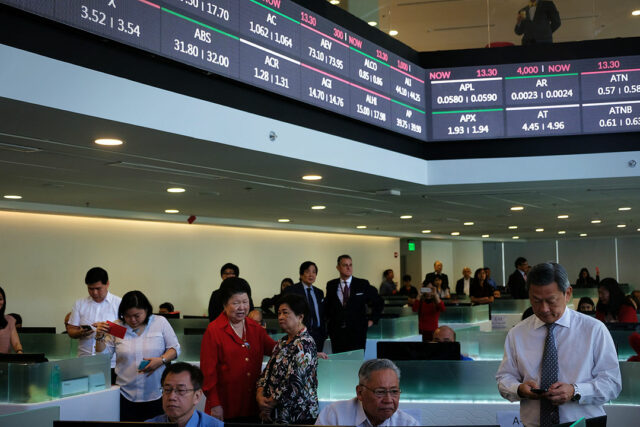
THE MAIN INDEX surged to the 7,400 level on Monday, notching its best finish since February 2022 and marking its return to bull market territory, after the Bangko Sentral ng Pilipinas (BSP) announced a jumbo cut in banks’ reserve ratios.

The Philippine Stock Exchange index (PSEi) rose by 2.27% or 164.93 points to end at 7,417.25 on Monday, while the broader all shares index gained by 1.6% or 62.40 points to finish at 3,958.02.

This was the PSEi’s best close in 31 months or since it finished at 7,440.91 close on Feb. 22, 2022. It was also the first time the index ended above the 7,400 mark since March 2022.

“The benchmark index continued its very bullish momentum to close at its highest level since February 2022 on the back of the BSP’s significant reduction of the reserve requirement ratio (RRR) and strong foreign fund flows,” Chinabank Capital Corp. Managing Director Juan Paolo E. Colet said in a Viber message.

He added that the PSEi is now in bull market territory as it is now up by more than 20% from the 52-week low of 6,158.48 logged on June 21, 2024.

“The market is technically overbought and we expect a pullback very soon,” Mr. Colet said.

The BSP on Friday said it will reduce the RRR for universal and commercial banks and nonbank financial institutions with quasi-banking functions by 250 basis points (bps) to 7% effective on Oct. 25.

It will also cut the RRR for digital banks by 200 bps to 4%, while the ratio for thrift lenders will be reduced by 100 bps to 1%. Rural and cooperative banks’ RRR will likewise go down by 100 bps to 0%.

“The local bourse opened the week above 7,400 ahead of key data releases. In the US, the durable goods report on Thursday and the core personal consumption expenditures inflation report on Friday will be closely monitored for inflation signals,” Regina Capital Development Corp. Head of Sales Luis A. Limlingan said in a Viber message.

“Several Federal Reserve officials are also set to speak, potentially providing insights into monetary policy,” he said.

Almost all sectoral indices closed higher on Monday. Financials climbed by 3.68% or 84.05 points to 2,362.18; services surged by 2.01% or 44.72 points to 2,264.75; holding firms increased by 1.95% or 120.65 points to 6,297.69; property went up by 1.71% or 50.02 points to 2,961.74; and industrials inched up by 1.06% or 102.93 points to 9,747.52.

Meanwhile, mining and oil inched down by 0.01% or 1.04 points to 8,527.22.

Value turnover declined to P8.72 billion on Monday with 698.15 million issues changing hands from the P16.98 billion with 1.09 billion shares traded on Friday.

Advancers outnumbered decliners, 121 versus 93, while 52 names were unchanged.

Net foreign buying went up to P1.77 billion on Monday from P1.28 billion on Friday. — Revin Mikhael D. Ochave

Peso slumps on fresh geopolitical concerns

BW FILE PHOTO

THE PESO slumped against the dollar on Monday to end near the P56 level due to renewed geopolitical concerns as the conflict between Israel and Hezbollah continued.

The local unit closed at P55.97 per dollar on Monday, falling by 28 centavos from its P55.69 finish on Friday, Bankers Association of the Philippines data showed.

The peso opened stronger at P55.67 against the dollar, which was already its intraday best. Its worst showing was at its closing level of P55.97 versus the greenback.

Dollars exchanged went down to $1.39 billion on Monday from $1.67 billion on Friday.

“The dollar-peso pair traded higher on towering risk sentiment over geopolitical tensions after Hezbollah launched rockets into Israel on Sunday and ahead of the US PCE (personal consumption expenditures) report later this week,” a trader said by phone.

Higher global crude oil prices and US Treasury yields also dragged the peso down on Monday, Rizal Commercial Banking Corp. Chief Economist Michael L. Ricafort said in a Viber message.

For Tuesday, the trader sees the peso moving between P55.60 and P56.10 per dollar, while Mr. Ricafort expects it to range from P55.85 to P56.05.

Israeli Defense Minister Yoav Gallant said the public must be calm after the military launched its most widespread wave of air strikes against Iran-backed Hezbollah, targeting Lebanon’s south, eastern Bekaa valley and northern region near Syria, Reuters reported.

Earlier, Israeli army spokesperson Avichay Adraee said that air strikes on houses in Lebanon, in which “Hezbollah-hid weapons” are imminent.

The latest attacks came amid some of the heaviest cross-border exchanges of fire in almost a year of conflict raging alongside the war between Israel and Hamas in Gaza.

Israeli warplanes carried out an intense wave of air strikes on towns along Lebanon’s southern border and even further north on Monday morning, according to Reuters witnesses.

A rocket hit an uninhabited mountainside east of the Lebanese port city of Byblos on Monday, a resident and Lebanese state media said, in an area that has not previously been hit by airstrikes. The area falls between Christian and Shi’ite villages.

Hezbollah’s al-Manar television reported Israeli airstrikes targeting the outskirts of many towns and villages in the south and the Bekaa Valley in eastern Lebanon. Footage showed columns of smoke rising over the south.

In addition to striking the Bekaa Valley region of eastern Lebanon, warplanes also carried out airstrikes on the Hermel area in northern Lebanon, Hezbollah’s al-Manar reported.

Hezbollah and Israel exchanged heavy fire into Sunday, as the Lebanese militant group sent rockets deep into northern Israeli territory after facing intense bombardment.

Hezbollah has come under intense pressure since thousands of pagers and walkie-talkies used by Hezbollah members exploded on Tuesday and Wednesday.

The attack, an unprecedented breach of security, was widely blamed on Israel, which has not confirmed or denied responsibility. — A.M.C. Sy with Reuters

Bill granting VAT refund for non-resident visitors approved in Senate on final reading

PHILSTAR FILE PHOTO

THE SENATE on Monday approved on third and final reading a bill that seeks to establish a value-added tax (VAT) refund mechanism for nonresident visitors.

Twenty senators voted in favor of Senate Bill No. 2415, allowing eligible tourists to avail of VAT refunds for local purchases of goods worth at least P3,000. The House of Representatives approved a counterpart bill on third and final reading in March 2022.

Senate Minority Leader Aquilino Martin Pimentel III voted against the bill, saying that the Philippines was better off improving the tourist experience and tax administration.

“We have already lost billions in revenue due to these inefficiencies, compounded by ghost receipts, fraud, and an exemption-plagued tax system,” he told the Senate floor after his vote.

“There are far more important matters pending before this august body that deserve our attention and prioritization.”

Citing a 2018 World Bank study, he said the Philippines has lost about P539 billion in potential revenue due to VAT leakages and exemptions.

Enrico P. Villanueva, a senior lecturer at the University of the Philippines Los Baños Economics Department, said the system could be used to promote the Philippines as a premier shopping destination in Southeast Asia, but added that the government should partner with the private sector to boost tourist transportation and infrastructure.

“It is really more of a bonus rather than a primary factor in enticing tourists,” he said in an X message. “There are more important factors that the Tourism department should look into to enhance the value proposition of the country as a destination.”

“By allowing foreign visitors to claim VAT refunds on goods they purchase in our country, we create an environment that not only attracts more tourists but also encourages them to spend more on our products, which will eventually be taken out of the country,” Senator Sherwin T. Gatchalian, who sponsored the measure, told the Senate floor following its approval. — John Victor D. Ordoñez

5 regions selected for 7-year agri climate resilience project

PHILIPPINE STAR/KRIZ JOHN ROSALES/PPA POOL

THE Department of Agriculture (DA) said that its $39.2-million climate resiliency program will operate in five vulnerable regions, benefiting 1.25 million farmers.

In a statement, the DA said the seven-year Adapting Philippine Agriculture to Climate Change (APA) project will promote “the adoption of climate-resilient farming practices, empowering farmers to establish sustainable enterprises.”

Within the five regions, which are the Cagayan Valley, the Cordillera Administrative Region, Bicol, Northern Mindanao, and Soccsksargen, the project will roll out across nine provinces and 100 municipalities.

The project is a partnership with the Food and Agriculture Organization (FAO) and the government weather service, known as PAGASA (Philippine Atmospheric, Geophysical and Astronomical Services Administration).

“Our combined efforts in implementing the APA Project will strengthen the foundation of progressive and resilient communities that we have begun through our various climate-resiliency-building initiatives,” Agriculture Secretary Francisco P. Tiu Laurel, Jr. said.

FAO Country Representative to the Philippines Lionel Henri Valentin Dabbadie said that the project will have long-term benefits for vulnerable farmers.

“It’s about creating opportunities for growth in the fields and through agricultural enterprises, ensuring that future generations continue to benefit from the rich agricultural heritage of the Philippines,” Mr. Dabbadie added.

The DA said that the program would expand on its Adaptation and Mitigation Initiative in Agriculture Program.

The project is financed under a Green Climate Fund grant amounting to $26.3 million with additional funding from the Philippine government of $12.9 million. — Adrian H. Halili

FinTech Alliance eyes opportunities provided by Konektadong Pinoy bill

THE passage of the Konektadong Pinoy (or Open Access in Data Transmission) bill will allow broadband infrastructure development in rural areas, thereby increasing access to transaction accounts, FinTech Alliance.PH said.

In a statement on Monday, FinTech Alliance.PH said the passage of the measure will help the Bangko Sentral ng Pilipinas (BSP) achieve its goal of bringing access to transaction accounts to 70% of adults.

“The Konektadong Pinoy bill is poised to be a crucial policy enabler, ensuring that every Filipino, regardless of their location, gains access to financial technology,” according to Angelito M. Villanueva, founding chairman of FinTech Alliance.PH.

The BSP’s recent financial inclusion survey indicates that 70% of salaries in the private sector are still paid in cash.

The central bank hopes to increase online payments to 60-70% of all retail transactions by volume by 2028, in line with the Philippine Development Plan.

In July, the BSP reported that digital payments made up 52.8% of retail transaction volume last year.

According to FinTech Alliance.PH, the bill will help provide access to affordable, reliable, and secure internet connections, which is vital to the adoption of digital payments.

“The Konektadong Pinoy bill seeks to bridge the digital divide by encouraging the entry of more internet service providers (ISP) to improve service quality,” it said.

“It also includes consumer protection provisions, such as ISP performance standards and enhanced cybersecurity safeguards, which are not present in current laws,” it added.

Identified among the priority bills of the Legislative-Executive Development Advisory Council, the Konektadong Pinoy bill aims to simplify the approval process for network operators, promote efficient management of the radio spectrum, and promote sharing of infrastructure.

The House of Representatives passed a version of the measure on third reading in December 2022, while its Senate counterpart, Senate Bill No. 2699, is currently set for floor debate. — Justine Irish D. Tabile

Safety monitoring at construction sites to undergo streamlining — Labor dep’t

PHILIPPINE STAR/RUSSELL PALMA

THE Department of Labor and Employment (DoLE) said it and other agencies hope to streamline safety monitoring at construction sites after setting the guidelines for a joint administrative order (JAO).

On Monday, DoLE, together with the departments of Public Works and Highways, Transportation, and Trade and Industry, through the Construction Industry Authority of the Philippines (CIAP), signed the guidelines for implementing JAO No. 1, Series of 2022.

The JAO promotes the welfare of construction workers. It updates JAO No. 01 Series of 2011 with additional provisions related to public health emergencies.

“The guidelines outlined in the JAO ensure that the construction industry remains compliant with the prevailing safety and health standards, protecting workers from undue risks and hazards,” according to the JAO.

“This is particularly essential in terms of crises when the health and safety of our workforce become even more vulnerable,” it added.

DoLE Bureau of Working Conditions Director Alvin B. Curada said that the JAO aims to ensure that all construction companies are compliant with labor law, especially on occupational safety and health standards.

In particular, he said that the JAO will help DoLE identify which projects to inspect first after evaluating data from the various partner agencies.

“This JAO will (help identify) the projects that we need to prioritize. Because we (the agencies) have lists of registered establishments and ongoing projects. From there you can easily target which are the vertical construction projects where many of the accidents happen,” Mr. Curada told BusinessWorld on the sidelines of the signing ceremony.

“Those will be the priorities. While we cannot cover everything due to limited resources, (the JAO) will help us focus on where, when, and who to inspect because of the sharing of information,” he added.

Liberito V. Espiritu, chairman of the CIAP-Philippine Domestic Construction Board, said the updated version of the JAO includes the implementing guidelines to be followed by each agency.

He added that the JAO will also help make the construction industry more competitive, bringing it in line with worker safety practices in other countries.

“In other countries, they prioritize safety … So we should also prioritize safety,” he said. — Justine Irish D. Tabile

PAGCOR revises distribution of bingo revenue

PHILIPPINE STAR/KRIZ JOHN ROSALES


PHILIPPINE AMUSEMENT and Gaming Corp. (PAGCOR) said it has increased its distribution of proceeds from its bingo games to 50% from 40% previously.

The old 40% payout level went to local government units and non-governmental organizations from ticket sales generated by its ‘Bingo for a Cause’ program, PAGCOR said in a statement.

“The revised bingo package will give our partners the option to sell tickets from as low as P100 to P1,000 each, depending on the package that they choose,” PAGCOR Assistant Vice-President Maria Teresa D. Ocampo said in the statement.

The proceeds may also increase depending on the volume of ticket sales, she said.

The ‘Bingo for a Cause’ program, formerly known as the Mobile Bingo Project, aims to crowd out illegal bingo games and promote PAGCOR as a supporter of community development.

It also seeks to establish a “mutually beneficial” relationship with socio-civic groups and empower the latter to be self-sustaining via state bingo revenues.

Ms. Ocampo said the government’s bingo program gives the public the opportunity to participate in “lawful” bingo games “while contributing to worthy causes.”

“Like any game of chance, only PAGCOR has the mandate to authorize bingo activities; hence bingo games without PAGCOR’s permission are illegal,” Ms. Ocampo added.

In the second quarter, PAGCOR reported a 19.83% year-on-year decline in revenue from bingo operations to P4.69 billion. Bingo revenue also fell 2.49% from the first quarter.

Gross gaming revenue in the three months to June rose 32.32% to P89.23 billion, led by electronic games. — Beatriz Marie D. Cruz