Home Blog Page 2615

For a show about witches, Agatha All Along has very little magic

By Esther Zuckerman, Bloomberg

TV Review
Agatha All Along
Disney+

ONDISNEYPLUS.DISNEY.COM

AGATHA HARKNESS, the Marvel witch played with fabulous flair by Kathryn Hahn, became a sensation largely thanks to the jaunty earworm “Agatha All Along,” which she performed in the seventh episode of Disney’s 2021 hit series WandaVision. A chorus asks: “Who’s been messing up everything?” To which Hahn winningly sings, in her best Broadway belt: “It’s been Agatha all along!”

Given that WandaVision was the first Marvel franchise to drop on streaming service Disney+, and that critics largely agreed the series felt like a creative leap forward (and away from the already tired Marvel Cinematic Universe), Hahn’s star turn all but guaranteed her a spinoff.

Three years later, Walt Disney Co. has made good with Agatha All Along, a nine-episode series stacked with a dream-team cast of divas and character actresses that also features another original, surprisingly good tune from songwriters Robert Lopez and Kristen Anderson-Lopez. To get to the good stuff, though, you’ll have to make it through an uneven story setup that makes you wonder whether the series will stick its landing.

The last time we saw Agatha in WandaVision, Wanda Maximoff (Elizabeth Olsen, absent from Agatha All Along thus far) trapped her in the town of Westview, leaving her powerless and hallucinating. The first episode of Agatha picks up where WandaVision left off, opening with a parody of an HBO drama: Still under Wanda’s spell, Agatha believes herself to be Agnes, a small-town detective hunting down the killer of a Jane Doe. It’s a not-so-subtle spin on Mare of Easttown, with Hahn doing her best bad impression of Kate Winslet (and a Saturday Night Live sketch).

Although it’s very funny, it also feels like filler leading up to the real action, which kicks off with a mysterious goth teenage boy (Heartstopper’s Joe Locke). He arrives in town and awakens Agatha from her stupor. Meanwhile she has another visitor: a vengeful witch from her past, Rio Vidal, portrayed with a sexy villainy by Aubrey Plaza. Rio warns that a menacing cohort known as the Salem Seven is on the way to kill Agatha, angry at a past offense.

It’s not until the second episode, which was released alongside the first on Wednesday, (after that it’s on a one a week schedule) that we get to the real meat of the plot. To fully regain her powers, Agatha has to assemble a coven and walk a dangerous magical byway that will end in either death or enhanced power. The path is known as the Witches’ Road, the route to which is summoned via a ballad on which the cast expertly harmonizes. (This isn’t the last time you’ll hear “The Ballad of the Witches’ Road,” which I found myself involuntarily humming the day after I watched the screeners.)

The coven is one I’d happily join. Theater legend Patti LuPone is magisterially kooky as Lilia Calderu, a brassy soothsayer who’s working as a cheap psychic when Agatha approaches. Former SNL cast member Sasheer Zamata’s Jennifer Kale is a potions master who’s taken to selling wellness items such as probiotic candles. And Ali Ahn is Alice Wu-Gulliver, a ne’er-do-well nepo daughter of a formerly powerful witch rock star who’s been reduced to working security at a Hot Topic-type store.

The other sorceresses are skeptical of Agatha’s intentions — as they should be, because she has only her own interests at heart. But despite their reservations, they team up with Agatha on her quest, all in need of their own type of fulfillment. They’re also joined by the nonwitch, suburban gardener Mrs. Hart (Debra Jo Rupp, a holdover from WandaVision), who thinks Agatha is inviting her to a party; in reality, Agatha needs someone with a green thumb to complete the coven. Eventually, Plaza’s Rio is also integrated back into the fold, bringing with her the brand of wide-eyed, alluring chaos in which the actress specializes.

In its initial episodes, Agatha All Along, created by Jac Schaeffer, offers up a lot of mysteries. The biggest one: Who is this goth boy whom Agatha simply calls “Teen,” since whenever he tries to say his own name a spell prevents him from doing so? Locke brings an adorable earnestness to the part, which one has to assume will somehow be complicated as the narrative progresses. Two other questions: Just who is Rio Vidal? And what is her history with Agatha? Plaza and Hahn’s scenes together bristle with a palpable chemistry that’s not entirely chaste, and therefore quite radical for a Marvel product (though we’ll see how far they actually take it).

The fun really begins when the ladies hit the literal road and are greeted with a series of magical trials that test their supernatural abilities. Without spoiling too much: Each trial comes with a variety of absurd costumes. The first includes a setup that plays like a Nancy Meyers movie gone horribly wrong. That’s followed by one with the cast in groovy 1970s wigs, forced to rock out to stop a curse.

If the rest of the series’ nine episodes follow this path, with each installment providing another goofy trial, Agatha All Along should be a swell, silly time. That said, the emotional stakes so far feel remarkably thin. It’s unclear why we should care whether Agatha regains her power, other than that it’s amusing to watch Hahn and her co-stars ham it up.

When Marvel premiered WandaVision, it was the start of a new era for the studio. It was less about introducing new superheroes and more about expanding the boundaries of what was possible within the medium, inflecting existing characters with real pathos. It was a Marvel product that transcended the Marvel baggage. Three years later, Agatha All Along arrives as a bit of an afterthought. It’s got its charms, but it feels haphazardly thrown together, and the magic isn’t fully there.

Aeon Luxe tops off 2 towers of Aeon Bleu Residences in Davao

DAVAO CITY — Aeon Luxe Properties, Inc. (ALPI) recently conducted a ceremonial topping off for the two towers of its condominium development, Aeon Bleu Residences.

The topping off ceremony, held on Friday last week, signified the completion of the structural frameworks for the two 26-storey towers, 20 months following the groundbreaking in December 2022.

The increase in inquiries and reservations reflects strong support from brokers, sellers, future residents, and investors, said Ian Y. Cruz, president and chief executive officer of Aeon Luxe Properties.

Situated on a 1.6-hectare property along Bacaca Road, Aeon Bleu Residences aims to set a new standard in upscale living in Davao City with its six medley-themed pools and exclusive Club Aeon amenities, according to the company.

“All designed to provide not just comfort but a true sense of community for our residents,” Mr. Cruz said.

The project is a six-tower mixed-use development, comprising two residential towers, one condotel, one corporate tower, Club Aeon, and one future development. The tallest buildings will be up to 26 storeys.

Towers 1 and 2 will house the residential flats of Aeon Bleu, while Tower 3 is a hotel-operated condotel equipped with revolutionary technology like a digital concierge, fiber optic backbone, and smart home features.

Mr. Cruz told Businessworld that Tower 3 will also reach its topping this year and is expected to bring more upscale hotel rooms for future guests.

The company is eyeing the turnover of the three towers in December 2025, he added.

The master plan includes Tower 4, a corporate tower with shared workspaces and private offices. 

Club Aeon at Tower 5, the crown jewel of the Aeon projects, features a luxury lobby, basketball court, fitness facility, children’s playroom, entertainment area, and a unique six-themed pool.

Tower 6, a premium residence, will offer the most luxurious units, an infinity pool, and large office spaces on its top floor. — Maya M. Padillo

Reserve Bank of Australia set to extend pause as housing crisis props up prices

REUTERS

AUSTRALIA’S record household debt was a key factor in the Reserve Bank of Australia’s (RBA) cautious approach to tightening, and now housing is an important consideration in the RBA becoming an outlier in the easing cycle and keeping interest rates on hold this week.

Housing costs, including rents, constitute roughly a fifth of Australia’s consumer basket and are the biggest driver of inflation after services. That helps explain Governor Michele Bullock’s hawkish rhetoric and why economists see the RBA holding the cash rate at a 12-year high of 4.35% on Tuesday — and keeping it there until at least February.

As the Federal Reserve kicked off its easing campaign last week, the RBA’s message had been clear: it’s “premature” to consider rate cuts. Underlying inflation in Australia is running at 3.9% — well above the 2-3% target — and the RBA expects it will only return to the band in late 2025.

“The Australian circumstance is perhaps no coincidence given that the RBA has been less aggressive than the Fed in raising the policy rate to tackle inflation,” said Stephen Miller, an investment strategist at GSFM. “The flip side is that it might need to exercise a little more patience when it comes to cutting.”

Many economists, including Westpac Banking Corp. and Goldman Sachs Group, Inc., expect the RBA will undertake a shallow easing cycle when it finally starts cutting, reflecting its cash rate peaking 1 percentage point below the Fed’s.

From the outset, the RBA has been concerned about how much tightening Australians could absorb given they are among the most indebted in the developed world. But it’s the supply side that has turned out to be the main problem as a surge in post-pandemic immigration and soaring residential construction costs triggered a housing squeeze. That sent rents soaring, adding to inflation, and kept property prices rising in a period of restrictive policy.

Mortgage lending, excluding refinancing, rose 3.9% in July from a month earlier, while home loans to investors jumped 5.4% to be up 35.4% from a year earlier, according to government data. The level of investor lending, at A$11.7 billion ($7.97 billion), is close to a January 2022 peak.

The strong demand for housing has come as build times for new projects have blown out since the pandemic by around 20% from approval to completion, while costs have risen by around 40%, according to Masters Builders CEO Denita Wawn.

“The government’s priority should be growing the building and construction workforce,” Wawn said, calling for a boost in the number of skilled migrants. “Domestically, we cannot fill this gap.”

Residential construction has the second-largest economic multiplier of all 114 industries that make up Australia’s economy, according to a government report. Underlining the sector’s importance, each A$1 million of residential construction output supports nine jobs across the economy.

Soaring input costs and a nationwide shortage of housing drove annual rental inflation to 7.3% in the June quarter, while home prices are at record highs in Sydney. The danger is that any rate cut will further fuel the property market.

Still, some economists reckon the RBA won’t wait for a cooling in housing before embarking on rate cuts.

The RBA’s rate hikes have slowed economic growth markedly, largely due to weak consumption while strong population gains and higher government spending have kept Australia out of recession. The labor market, meanwhile, remains surprisingly resilient with the unemployment rate holding at 4.2% in August.

Oxford Economics reckons Australia hasn’t really experienced this combination of anemic gross domestic product growth and very low unemployment in its recent history. Economist Sean Langcake pointed to weak productivity and a monetary-fiscal “policy mismatch” among factors making for a slow disinflation cycle. He expects rate cuts to only begin in the second quarter of next year.

Gareth Aird at Commonwealth Bank of Australia, the nation’s largest lender, says the outlook for housing inflation is “slowly improving,” as price pressures for both construction inputs and rents begin to cool.

“A firmer disinflationary pulse than the RBA expects in the third quarter of 2024 is a necessary ingredient to see the RBA commence an easing cycle this calendar year,” said Aird. “But the evolution of the unemployment rate will also play a big role when the central bank joins its global peers in cutting rates.” — Bloomberg

Philippines rises in 2024 Asia Power Index

The Philippines went up a notch to 15th out of 27 countries and territories in the 2024 Asia Power Index by the Lowy Institute. With an overall score of 14.7 points out of 100, the country was classified as a “middle power” in the region. The index measures resources and influence to rank the relative power of states in Asia through eight thematic measures (See Philippines’ 2024 profile).

Philippines rises in 2024 Asia Power Index

How PSEi member stocks performed — September 23, 2024

Here’s a quick glance at how PSEi stocks fared on Monday, September 23, 2024.


Philippines to continue patrols in disputed water

PHILIPPINE COAST GUARD PHOTO

By Kenneth Christiane L. Basilio, Reporter

THE PHILIPPINES will continue sending coast guard ships and reinforcement to Sabina Shoal in the South China Sea, where China is allegedly doing small-scale reclamation, a top security official said on Monday.

“We can send a ship, and we can send Air Force planes,” National Security Council (NSC) Assistant Director-General and spokesman Jonathan E. Malaya told BusinessWorld in an interview in Filipino.

“It’s really the Coast Guard who’s doing the maritime [patrols],” he added, noting that military assets would only be used to provide support.

Mr. Malaya said the Armed Forces of the Philippines (AFP) would always be just on the sidelines, “in the same manner that the Chinese Coast Guard is accompanied by the People’s Liberation Army Navy from afar.”

“We are using all our surveillance capacities,” he added.

BRP Teresa Magbanua on Sept. 14 left Sabina Shoal, which Manila used as a staging ground for resupply missions to Second Thomas Shoal, because it had accomplished its mission, the Philippines’ National Maritime Council said last week.

The Chinese Coast Guard confirmed the departure of the ship after lingering there since April in what China viewed as an “illegal action,” according to state-owned Xinhua News Agency.

China took measures against Philippine vessel 9701 in accordance with the law, while repeated Philippine attempts to organize replenishment of the vessel had failed, Xinhua quoted China Coast Guard spokesman Liu Dejun as saying.

The Southeast Asian nation’s sustained presence at the feature, aiming to monitor what it suspects to be China’s small-scale reclamation activities has angered Beijing, turning the shoal into their latest flashpoint in the contested waters.

Mr. Malaya, who attended a House of Representatives budget hearing for the NSC, said the Philippines had sent another ship to Sabina Shoal to replace BRP Teresa Magbanua, the Philippine Coast Guard’s (PCG) biggest ship, “because it’s part of our exclusive economic zone, and it’s our right to monitor what’s happening there.”

Mr. Malaya said the new vessel was sent there to check on China’s reclamation activities at the disputed shoal.

He said the PCG now has the capacity for long-term deployment, but from here on, Manila prefers not to broadcast its plans.

“We no longer want to disclose how long that ship will be there, the Philippine government has been criticized of being loud compared with China, which prefers to keep silent,” Mr. Malaya said. “So we also don’t want to telegraph our punches to China.”

The Philippine Foreign Affairs department this month said it had expressed its displeasure with Beijing over an Aug. 31 collision in which BRP Teresa Magbanua was hit thrice by a Chinese vessel.

The Chinese Coast Guard vessel had caused significant damage to the Philippine ship and endangered the lives of its personnel, a Philippine task force said.

The Chinese side made a similar claim, with Mr. Liu saying that the smaller PCG vessel “deliberately” collided with their ship.

Sabina has been a staging ground for Philippine resupply missions to Second Thomas Shoal, where Manila grounded a World War II era ship in 1999 to serve as an outpost for a handful of Filipino soldiers.

Manila and Beijing came up with a resupply deal in July after a June 17 standoff where Chinese forces threatened, using bladed weapons, Filipino troops delivering supplies to the Navy outpost, according to the Philippine military.

China claims sovereignty over most of the South China Sea, overlapping into maritime zones of Brunei, Indonesia, Malaysia, the Philippines, and Vietnam.

In 2016, a United Nations-backed tribunal in the Hague voided China’s expansive claims for being illegal. Beijing has ignored the ruling.

Sabina Shoal is about 140 kilometers (km) away from the Philippine island of Palawan and about 1,200 km from Hainan island, the nearest major Chinese landmass.

Marcos signs Magna Carta for Seafarers measure into law

PHILIPPINE President Ferdinand R. Marcos, Jr. poses for a selfie after signing into law the Magna Carta for Seafarers bill in a ceremony at the presidential palace. The law will protect Filipino seamen’s rights, ensure fair wages and safe working conditions, and boost their skills. — PPA POOL

PRESIDENT Ferdinand R. Marcos, Jr. on Monday signed into law a bill that seeks to improve the working conditions of Filipino seamen and provide incentives to the sector.

In a speech at the signing ceremony at the presidential palace, the President said the Magna Carta for Filipino Seafarers would protect Filipino seamen’s rights, ensure fair wages and safe working conditions and boost their skills.

“When we speak of protection, we speak of shielding our seafarers not only from the perils of the sea, but from exploitation and discrimination that have too often been tolerated,” he said. “Specifically, the magna carta will strengthen our legal framework to ensure that Filipino seafarers receive adequate training, secure contracts, just wages and fair benefits.”

“The law would help bolster and further the country’s status as the biggest supplier of seafarers worldwide,” Michael L. Ricafort, chief economist at Rizal Commercial Banking Corp., said in a Facebook Messenger chat. “That, in turn, would further boost remittances from seafarers and lead to faster economic growth.”

The palace had yet to issue a copy of the signed law, but based on a government handout, the law will define government agencies’ and stakeholders’ roles in “achieving common goals to guarantee accountability, efficiency and clarity.”

Senate President Francis Joseph G. Escudero, who was present at the signing ceremony, in a statement said the law spells out the rights of seafarers including their right to just terms and conditions of work, right to self-organization and to collective bargaining, and right to educational advancement and training at “reasonable and affordable” costs.

It also spells out their right to safe passage and travel, consultation, free legal representation, immediate medical attention, access to communications, record of employment or certificate of employment, and fair treatment in case of a sea accident.

“The law also enumerates the duties of a seafarer, such as complying with the terms and conditions of the employment contract and being diligent in the performance of duties relating to the ship,” Mr. Escudero said.

The law would harmonize policies among several agencies including the Commission on Higher Education, Technical Education and Skills Development Authority, Department of Foreign Affairs, Department of Health, Philippine Coast Guard, Department of Labor and Employment, Department of Migrant Workers and Maritime Industry Authority (Marina), according to the Transportation department.

The law was signed more than a year after the European Commission cited deficiencies in the Philippines’ seafarer education, training and certification system.

Under the new law, Marina now has jurisdiction over maritime education, with powers to accredit, regulate and monitor education and training institutions offering maritime degree programs and technical courses.

“This requires Marina to come up with a different program for seafarers in domestic trade,” according to the handout.

The Philippines is the biggest source of seamen worldwide, accounting for over 20% of the total. Money sent home by sea-based Filipino workers inched up by 0.9% to $568 million (P31.8 billion) in July.

Speaker Martin G. Romualdez said the law would help the Philippines keep its status as the “largest supplier of seafarers in the world.” “Their remittances contribute significantly to keeping the economy on the high-growth path,” he said in a statement. — Kyle Aristophere T. Atienza

Senate body swiftly approves President’s 2025 budget

BW FILE PHOTO

THE Senate finance committee on Monday swiftly ended its hearing on the Office of the President’s P10.5-billion proposed budget for next year, after senators chose not to raise questions about its spending plan, citing “parliamentary courtesy.”

In under 10 minutes, Senate President Pro-Tempore Jose “Jinggoy” P. Estrada, Jr. moved to end the budget briefing “in the spirit of parliamentary courtesy” to the Executive branch.

Senators Maria Lourdes Nancy S. Binay-Angeles and Mary Grace Natividad S. Poe-Llamanzares backed the motion.

Ms. Llamanzares, who heads the finance committee, lauded the creation of a Presidential Office for Child Protection, which she said is crucial to the safety of Filipino children.

Under Executive Order 67, which President Ferdinand R. Marcos, Jr. issued last month, the body will oversee government programs on the prevention of online sexual abuse and exploitation of children.

It will submit policy recommendations to the President and work with agencies such as the Council for the Welfare of Children to come up with an updated National Plan of Action for Children.

Based on a 2022 International Justice Mission report, nearly half-a-million Filipino children were trafficked to produce pornography in 2022.

The United Nations Children’s Fund has said about 20% of children aged 12-17 were prone to online sexual abuse and exploitation, with 23% of children not telling anyone of the harm they had experienced.

The House of Representatives committee on appropriations on Sept. 9 also quickly approved the President’s budget, even as lawmakers questioned why confidential and intelligence funds make up half of the President’s budget.

Mr. Marcos’ office is seeking P4.56 billion in secret funds next year — P2.25 billion in confidential funds and P2.31 billion in intelligence budgets, based on the 2025 National Expenditure Program.

These funds are meant for surveillance and intelligence information-gathering activities, according to a 2015 joint circular between the Commission on Audit, Defense, Budget, and Interior and Local Government departments.

“In turn, it is our duty to support this commitment by approving the budget that will be the instrument for achieving our national goals,” Mr. Estrada said. “We trust in the transparent and accountable stewardship of public funds by the Office of the President.” — John Victor D. Ordoñez

CREATE MORE may improve Philippines’ credit rating and investment outlook

POLLOC FREEPORT AND ECOZONE — BARMM FACEBOOK PAGE

By Kenneth Christiane L. Basilio, Reporter

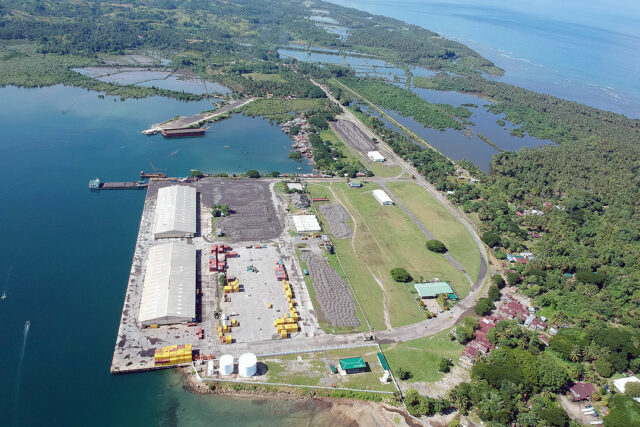
THE PHILIPPINES is expected to receive an “A-level” credit rating and improved investment outlook from credit rating agencies by 2028 once “pro-investment” policies, such as the measure seeking to lower taxes on domestic and foreign companies, take effect, a congressman said on Monday.

“The global environment is challenging. High energy and food prices persist – and overall sentiment is gloomy, especially with China’s slowdown and continuing challenges in Europe,” Albay Rep. Jose Ma. Clemente S. Salceda said in a statement.

“And yet, the country’s prospects remain strong. This is in large part due to the President’s decisively pro-investment and fiscally responsible policies,” he added, citing the Corporate Recovery and Tax Incentives for Enterprises Maximize Opportunities Reinvigorating the Economy (CREATE MORE) bill.

The bill, as ratified by both Houses of Congress, lowers taxes on domestic and foreign firms to 20% from 25%. It will also allow fuel suppliers serving tax-exempt entities to be eligible for tax refunds; and local government units to set the local tax for registered business enterprises at up to 2% of gross income.

Mr. Salceda, who chairs the House Committee on Ways and Means, added he is working with President Ferdinand “Bongbong” R. Marcos, Jr. and Congress to push for “reforms to boost the capital and investment markets. That will grow our base further.”

“I’m sure we will get an upgrade in rating or outlook from one of the Big Three next year,” he said, referring to S&P Global Ratings, Moody’s Ratings and Fitch Ratings.

Mr. Salceda’s outlook is also supported by the country’s growing balance of payments surplus, which stood at $88 million in July from $62 million in June, tamed inflation, and timely approval of the 2025 budget.

“I think, before the end of PBBM’s term in 2028, the country will be at the A-level ratings,” he added.

In August, Moody’s affirmed the Philippines’ investment grade rating of “Baa2” and outlook as “stable;” while Japan-based credit watcher Rating and Investment Information Inc. last month upgraded the Philippines’ credit rating to “A-” from last year’s rating of “BBB+” with a positive outlook.

“As our biggest lender, investor, and trading partner, Japan understands this country’s fundamentals better than any other country in the world. And I’m sure the Big Three will follow, especially if growth tracks targets this year,” he said.

While the CREATE MORE could boost foreign investment and stimulate economic growth, the government should also address its national debt management and look at further developing the country’s financial sector, Security Bank Corp. Chief Economist Dan J. Roces said in a Viber message.

“A comprehensive approach that addresses various factors, including debt management, financial sector development, and sustainable practices, is essential for long-term success,” he said.

The government would also need to support its manufacturing and agriculture industries to boost the country’s per capita income, improving efforts to achieve a higher credit rating, Rizal Commercial Banking Corp. Chief Economist Michael L. Ricafort said in a Viber message.

Mpox poses low risk to SE Asia

AN ILLUSTRATION of mpox virus particles. — FRED HUTCH CANCER CENTER/HANDOUT VIA REUTERS

THE MPOX outbreak in Central and Eastern Africa poses low risks to Southeast Asian economies, but a major outbreak could hamper international travel, Fitch Solutions’ unit BMI said.

“Our view for Southeast Asia is that the risk is very low, for reasons including mpox being less contagious than other rapidly spreading infectious diseases, and availability of vaccines and other medical countermeasures,” Ben Yau, Pharmaceuticals & Healthcare Analyst at BMI, said in an e-mail.

World Health Organization Director-General Tedros Adhanom Ghebreyesus called mpox a “public health emergency of international concern” amid the recent surge of mpox cases in African countries.

Mpox can be transmitted through close contact, contaminated materials, or through infected animals.

Despite this, BMI noted that mpox is less contagious than diseases that spread globally like the coronavirus or the severe acute respiratory syndrome or SARS.

The mpox outbreak is also mainly contained in rural areas in Africa that are rarely traveled, it said.

“Travel to and from these regions is difficult and rare at the best of times, and local medical authorities have already launched screening efforts to prevent the spread of the disease to major urban centers (such as Kinshasa) or across international borders, BMI said in a report.

Further, policy makers now have access to vaccines and non-pharmaceutical interventions, decreasing risks of an mpox transmission, it added.

“Governments elsewhere in the world are in a much better starting position than they have been for previous health emergencies.”

However, a high-profile outbreak in major tourist destinations may still pose “greater economic costs,” BMI said, citing Morocco, Turkey, and the Gulf states as the most exposed.

“While widespread transmission outside of the currently affected areas is unlikely, it remains possible that a small but widely-publicized outbreak could cause some economic disruption by deterring international travel,” Mr. Yau said.

BMI noted that a large-scale outbreak in Qatar or the United Arab Emirates, which have direct flights to Rwanda and Uganda, may pose significant risk for economies dependent on international travel tourism, BMI said.

Other countries at risk of mpox exposure due to direct flights from African countries include France, Belgium, Egypt, United Arab Emirates, Netherlands, and India.

Local authorities’ response to a possible outbreak, as well as preexisting views on safety, would help prevent the transmission of mpox through travel, BMI said.

John Paolo R. Rivera, Senior Research Fellow at the Philippine Institute for Development Studies, said the Philippine government must bolster its information campaigns and review safety and hygiene protocols to prevent the spread of mpox.

“It (mpox) may hamper travel preferences and propensity as a reaction to the possibility of contracting the virus due to physical interaction,” he said in a Viber message.

The Philippines recorded 18 mpox cases as of Aug. 18, the Health Secretary Teodoro J. Herbosa said last week. — Beatriz Marie D. Cruz

RFID maintaining balance scrapped

PHILIPPINE STAR/MIGUEL DE GUZMAN

THE Toll Regulatory Board (TRB) on Monday said it had scrapped a policy mandating motorists to keep a P100 maintaining balance in their radio frequency identification (RFID) accounts.

The move would enable them to reload their toll accounts on a per-trip basis, TRB Executive Director Alvin A. Carullo said at a Palace briefing.

There were about 100,000 vehicles without RFID tags as of May 2024, accounting for 4.8% of motorists in the country, according to the TRB.

It said 3.6% of those who have installed RFIDs nationwide were not properly reloading their accounts, exacerbating queues at toll gates.

The Transport department on Sunday postponed the implementation of new tollway guidelines, including the imposition of fines on motorists with RFID and insufficient amount on their account, to 2025. — Kyle Aristophere T. Atienza

2% more drivers join new PUV plan

PHILIPPINE STAR/WALTER BOLLOZOS

THE RATE of industry consolidation under the Philippines’ transport modernization program saw a 2% increase since May, the government said, as jeepney drivers and operators held a nationwide strike.

Transport groups Manila and Piston on Monday said they were expecting 90,000 drivers and operators to join their two-day nationwide strike against the costly and long-delayed Public Utility Vehicle (PUV) modernization program, in a move that transport officials downplayed.

Separate photos from Manibela showed commuters in Pasig, Las Piñas, and Quezon City in Metro Manila and Dasmariñas City in Cavite province flocking to street sides to wait for a jeepney ride.

“The passengers are really miserable because of the abuses of the Department of Transportation (DoTR) and the Land Transportation Franchising and Regulatory Board (LTFRB),” Manibela said in its photo caption in Filipino.

LTFRB Chairperson Teofilo E. Guadiz III said at a Palace briefing on Monday that 83% of jeepney drivers and operators have consolidated or joined cooperatives under the modernization program.

“So, we have 17% [left],” he said, noting that such a figure does not necessarily represent drivers and operators who are against the consolidation policy. 

“We are talking of the groups, that’s more or less mga 5%.”

The Transport department in May reported an 81% consolidation rate, 61% of which or 30,561 jeepney units were in Metro Manila. The agency had said such a nationwide rate was enough to transit commuters in Metro Manila and other areas.

“On the ongoing transportation strike, we cannot turn our back to the vast majority of transport groups who understand and subscribe to the public transport modernization program,” Transport Secretary Jaime J. Bautista said at the briefing.

“The call of PISTON and Manibela to scrap the program is non-negotiable,” he said. “These two groups cannot be allowed to derail the program.”

He said the Transport department was working on instruction of Senate President Francis “Chiz” G. Escudero that “no one gets left behind.”

The senator advised the Department of Transportation earlier this month to keep reaching out to drivers and operators who did not heed its requirement for them to consolidate into cooperatives or corporations by April 30.

The agency “should continue to reach out to these groups and not close the door on them completely.”

At the 11 a.m. briefing, Mr. Guadiz downplayed the impact of the transport strike, saying reports of stranded people only showed ‘’regular traffic’’ situation on a Monday.

“I am glad to tell you that there were no stranded passengers due to the transport strike,”’ he said in Filipino, adding that only a few joined the transport strike.

A report by a commuter network showed police personnel barricading Monumento Circle in Caloocan City with their motorcycles and mobiles.

There were 11 strike centers in Metro Manila.

Mr. Guadiz said the government was prepared to provide free rides and that the Philippine police forces were ready to “ensure peace and order.”

“So as of this time, no one got stranded.” — Kyle Aristophere T. Atienza