Home Blog Page 2581

Irrigation project under study using canals to retain rainwater

PHILIPPINE STAR/ MICHAEL VARCAS

THE Department of Agriculture (DA) said it is studying the use of peripheral canals to retain rainwater for irrigation.

“What we will do is offset the water so that it does not go directly to the sea, but it can be used in irrigation,” Agriculture Undersecretary Roger V. Navarro said on the sidelines of a forum organized by the Financial Executives Institute of the Philippines.

He added that the DA is looking to partner with the departments of Public Works and Highways, Interior and Local Government, and Environment and Natural Resources, the National Irrigation Administration (NIA), and the Bureau of Soils and Water Management.

The DA’s flagship projects include increasing irrigation to underserved farming areas.

President Ferdinand R. Marcos, Jr. issued Executive Order No. 69 transferring the NIA to the control of the Office of the President, which is expected to improve NIA’s access to funding.

Mr. Marcos has pushed for more irrigation dams and bulk water projects to ensure sufficient usable water for communities.

Only 68% of the country’s farmland was irrigated as of 2023, equivalent to 2.11 million hectares, leaving 1.1 million without access.

“You can just imagine we have 2.6 meters of rainfall every year. That’s a lot of water. The problem is we are doing flood control but don’t consider our production areas,” Mr. Navarro added.

The Philippines faces an average of 20 typhoons a year. In August, Metro Manila and nearby provinces were flooded due to the typhoon-enhanced southwest monsoon. — Adrian H. Halili

GOCC subsidies drop in August

PHILSTAR FILE PHOTO

BUDGETARY support for state-owned corporations fell sharply in August, the Bureau of the Treasury said.

Subsidies provided to government-owned and -controlled corporations (GOCCs) dropped 51.93% year on year to P9.1 billion.

Month on month, GOCC subsidies fell 15.1% from P10.72 billion in July.

State-owned firms receive monthly subsidies from the government to support their daily operations if revenue is insufficient.

The National Irrigation Authority (NIA) received the top allocation at P5.6 billion, taking up 61.54% of all subsidies.

This was followed by the Philippine Crop Insurance Corp. (PCIC) with P1.9 billion and the Local Water Utilities Administration with P287 million. Both firms did not receive subsidies in the previous month.

State-owned firms that received at least P100 million in subsidies include the Philippine Heart Center with P177 million, the Philippine Children’s Medical Center P154 million, the National Kidney and Transplant Institute P133 million, the Philippine Fisheries Development Authority P111 million, and the Philippine Coconut Authority P100 million.

Firms that obtained at least P50 million in subsidies were the Social Housing Finance Corp. (P82 million), the Cultural Center of the Philippines (P80 million), the Light Rail Transit Authority (P72 million), the Lung Center of the Philippines (P70 million), the Development Academy of the Philippines (P64 million), and the National Housing Authority (P50 million).

At least P20 million in subsidies were given to the Philippine Rice Research Institute (P38 million), the National Dairy Authority (P30 million), the Philippine Institute for Development Studies or PIDS (P21 million), and the Aurora Pacific Economic Zone and Freeport Authority (P20 million).

In August, no subsidies were given to the Bangko Sentral ng Pilipinas, the National Home Mortgage Finance Corp., the Bases Conversion and Development Authority, the Philippine Deposit Insurance Corp., the Small Business Corp., the National Power Corp., and the Philippine Health Insurance Corp.

Also receiving zero subsidies were the National Electrification Administration, the National Food Authority (NFA), the Philippine Postal Corp., the Power Sector Assets and Liabilities Management Corp. (PSALM), the Subic Bay Metropolitan Authority, the Sugar Regulatory Authority, and the Tourism Promotions Board.

As of the end of August, GOCC subsidies dropped 24.89% year on year to P87.03 billion.

During the eight-month period, the NIA received the most subsidies at P48.89 billion, followed by PSALM (P8 billion), NHA (P3.8 billion), PCIC (P2.8 billion), and the NFA (P2.25 billion).

In August, subsidies fell after the government pursued fiscal consolidation, PIDS senior research fellow John Paolo R. Rivera said.

“The decline in subsidies is a continuation of the effects of declining availability of government funds due to the high utilization of funds for infrastructure spending, social protection programs, calamity response, and debt servicing,” he said via Viber. — Beatriz Marie D. Cruz

Realizing transformation success through the human element

IN BRIEF: 

• Companies are engaging in transformational activities at an accelerated rate, making the ability to transform successfully and continuously in response to disruption essential for an organization’s survival.

• Human factors were commonly identified as a primary reason for the result of transformations.

• To take their transformation efforts to a higher level, organizations must focus on placing humans at the heart of their strategies.

Transformation is important for the enduring success of any organization. However, there has recently been a noticeable shift in its frequency and pace. The EY Global Board Risk Survey revealed that 82% of board members and CEOs believe market disruptions are happening more frequently, and with greater impact. As a result, companies are engaging in transformational activities at an accelerated rate — making the ability to transform successfully and continuously in response to disruption, essential for an organization’s survival.

EY and the University of Oxford’s Saïd Business School collaborated to look into more modern and effective methods for driving organizational change. The approach placed a greater emphasis on human factors, which was commonly identified as a primary reason for the failure of transformations. It was observed that not only is the rate of transformation failure excessively high, but it also imposes a human toll that organizations can no longer tolerate.

The research indicates that 85% of senior leaders have participated in at least two major transformations in the past five years. Furthermore, 67% of those surveyed acknowledged that they have been part of at least one transformation that did not perform well during this period. While not surprising, it was astonishing that companies continue to accept this high rate of failure as the cost of change. By any other measure or in any other scenario, such a level of performance would be unacceptable.

This research underscores that the complex factors determining whether a transformation succeeds or fails are deeply connected to the human element, a pattern that holds true across various industries and geographies. Adequate support can transform the increased stress associated with transformation into a catalyst for enhanced performance and drive progress. To optimize their chances of success, organizations must become proficient in these key areas.

CULTIVATE ESSENTIAL LEADERSHIP SKILLS
In the study, employees identified leadership as the primary factor influencing transformation outcomes, regardless of whether it was successful or not. Leaders themselves considered leadership to be the most critical element in successful transformations, but deemed it insignificant when the transformation did not meet expectations.

It’s essential for leaders to confront their own fears, worries, and uncertainties about the path that lies ahead. For instance, 47% of participants from highly successful transformations reported that leaders were open to ideas from junior staff members, compared to 29% from less successful transformations.

INSPIRE THROUGH A SHARED AND COMPELLING VISION
The vision is the cornerstone of any transformation. Leaders should extend their search for an inspiring vision beyond their personal scope, their organization, and even their industry. They should cast a broad net to employ future-oriented planning to uncover bold new possibilities, shaping a vision that garners widespread support and resonates emotionally with everyone involved. Close to half (47%) of participants from highly successful transformations acknowledged that the vision was clear and persuasive, in contrast to just 26% from transformations that did not perform well.

For the vision to take hold, leaders must effectively convey the reasons behind the need for transformation, rather than merely dictating the actions required. Nearly half (48%) of employees from successful transformations reported that leaders successfully communicated the reasons for organizational change, as opposed to 25% from unsuccessful transformations.

FOSTER A CULTURE THAT ENCOURAGES INPUT
In the qualitative analysis of the research, employees involved in unsuccessful transformations expressed feelings of being ignored, unsupported, and stressed both during and after the process. Subsequent discussions found leaders surprised at these findings and their lack of awareness regarding the significant emotional impact an unsuccessful transformation has on employees.

Leaders must channel the appropriate emotions to keep employees committed and driven, while also offering sufficient emotional support to stave off worry and exhaustion. According to the predictive model used in the study, increasing emotional support raised the average probability of a successful transformation by 17%. By being attuned to the emotional state of employees throughout the transformation, leaders can detect early signs of trouble and implement changes to steer the transformation back on course.

EMPOWER THROUGH CLEAR RESPONSIBILITIES
There will be unexpected developments, and intermittent pauses in any transformation journey. Leaders must strike a balance between providing structure and discipline while allowing space for creativity and innovation. Over half (52%) of participants from successful transformations reported that employees had well-defined roles and responsibilities, and 49% indicated that decision-making powers were distributed clearly and suitably throughout the organization.

Leaders should promote a culture of trial and error by shifting from a mindset of avoiding failure at all costs to one that embraces rapid learning from failures. Minor setbacks can pave the way for significant achievements, while a fear of failure often results in lost opportunities. Forty-six percent of respondents from successful transformations said they established a process that fosters innovative experimentation without the risk of such experimentation adversely affecting careers or compensation.

LEVERAGE TECHNOLOGY AND SKILLS TO DRIVE ACTION
Technology is not the end goal, but it is instrumental in bringing the vision to fruition. Selecting the appropriate technology is essential to achieving the vision and streamlining the transformation process. Leaders identified the effective deployment of technology as the second most important factor for a successful transformation and its ineffective use as the second leading cause of poor performance. Nearly half (48%) of those from successful transformations reported that their organizations had made the right technological investments to support their transformation goals, as opposed to 33% from less successful transformations.

It’s vital to consider the emotional reactions that come with the introduction of new technology. Employees from underperforming transformations are 25% more likely to associate transformation with concerns about job stability (49% compared to 39%). Others might view technology as a substitute for human interaction, which is crucial for the emotional health of employees and the smooth functioning of the organization.

Leaders should focus on demonstrating progress rather than striving for perfection. By combining recruitment, upskilling or reskilling, partnerships, and outsourcing, leaders can foster the appropriate digital mindset and skills to actualize the potential benefits of technology. Forty-nine percent of participants from successful transformations indicated that their organizations possessed the necessary digital skills and mindset for the transformation, compared to 35% from less successful transformations.

COLLABORATE TO CONNECT AND CREATE
In contrast to traditional corporate cultures that favored a directive, top-down hierarchy with employees carrying out a vision dictated by their leaders, the current continuous state of transformation demands mutual reliance and teamwork. Leaders must cultivate a culture that promotes connectedness and inventiveness, creating an environment where employees feel secure to explore new methodologies — both digital and agile — that foster innovation, engagement, and rewarding work experiences.

Forty-four percent of those from successful transformations reported that their organization’s culture supported the adoption of new work practices, as opposed to 28% from less successful transformations. For new work practices to thrive, leaders and employees must work together to recalibrate the dynamics of delegation, ownership, and empowerment. Forty-two percent of participants from successful transformations noted that a new organizational culture was intentionally defined and put into practice as part of the transformation initiative.

HARNESS THE HUMAN ELEMENT
Leaders are aware that their organizations must undergo change, yet the challenge of transformation can leave many feeling inundated. In a time characterized by relentless change, complacency is not a viable option.

By tapping into the collective strength of their employees and by applying best practices in relation to each of the factors mentioned, leaders can steer their organizations towards a successful transformation. To take their transformation efforts to a higher level, organizations must focus on placing humans at the heart of their strategies.

This article is for general information only and is not a substitute for professional advice where the facts and circumstances warrant. The views and opinion expressed above are those of the author and do not necessarily represent the views of SGV & Co.


Rossana A. Fajardo is the consulting leader of SGV & Co.

Dynastic politicians seen hijacking party-list system in 2025 elections

PHILSTAR FILE PHOTO

By Kenneth Christiane L. Basilio, Reporter

RICH FILIPINOS seeking to enter politics and politicians whose terms have ended are likely to run for office through the party-list system, which could dilute sectoral representation at the House of Representatives, political analysts said.

About 80% of the more than 300 congressmen are district representatives, while the rest of the seats are allotted to party-lists, supposedly to help sectors push their legislative agendas.

“In the 2025 midterm elections, we are expecting more party-list groups who will have their nominees from powerful dynasties and nominees who are popular and rich,” Arjan P. Aguirre, who teaches political science at the Ateneo de Manila University, said in a Facebook Messenger chat.

“This tells us that party-list groups who do not belong to the wealthy, popular and powerful groups are having a hard time winning the system,” he added.

Congressmen have three-year terms and may be re-elected for a total of three consecutive terms.

The 1987 Constitution created the party-list system, but it was not until eight years later that an enabling law came to force.

“Since 2013, the average growth of the number of participating party-list groups is 21.3%. The biggest jump was in 2022, when we saw a 32% increase in participating parties with 43 seats to 177 from 134,” Mr. Aguirre said.

He added that some party-list nominees had been “linked to a dominant dynasty in a locality, wealthy industry, or entertainment or popularity-oriented venture.”

Party-list groups are now also campaigning through “popular nominees,” he added. “This is one of the effects of the Supreme Court decision to open the space of the party-list system to mainstream parties and groups alongside sectoral groups of the marginal sectors in society.”

The tribunal in 2013 ruled political parties could also participate in the party-list system, allowing “ideology-based and cause-oriented parties” to run for a seat in the House.

The landmark ruling “is a step in the right direction,” Edmund Tayao, president of Political Economic Elemental Researchers and Strategists, said in a separate Viber message. “The problem is we don’t have a working appreciation of what a real political party is.”

“We don’t have ‘real’ political parties so we have a flawed idea of what it is, thus preventing a much-needed appreciation of their significance,” he added.

He said campaign rules for party-lists are “deficient” because these focus on their nominees instead of the groups themselves.

“The whole setup is problematic,” Mr. Tayao said. “The presence and dominance and further strengthening of dynasties is due largely to the prevailing political system,which is… an archaic political setup. It will never have room for genuine marginalized groups.”

The Commission on Elections (Comelec) should revise the Election Code by incorporating “fundamental changes” in what defines a political party, he said.

In a statement on Sunday, militant group Bayan Muna condemned what it called the exploitation by the political elites of the congressional party-list system, urging the House to take up a bill preventing the “infiltration of political and economic elites” in party-list groups.

Filed in 2022 by Party-list Reps. France L. Castro, Arlene D. Brosas and Raoul Danniel A. Manuel, House Bill No. 211 seeks to restore the “original purpose” of the party-list system by ensuring that registered groups truly represent marginalized groups through a public hearing by the Comelec.

The bill disqualifies former officials from President down to town mayors, as well as ex-Cabinet members. “Senators and congressmen must also be disqualified,” Neri J. Colmenares, one of Bayan Muna’s nominees in the midterm elections next year, said in the statement.

“You already won in the senatorial or congressional elections because of your wealth, and now you still want to join the party-list?” he asked. “We owe it to the Filipino people to protect the spaces intended for their genuine representation,” he added in Filipino.

PHL embassies on alert for attacks on anniversary of Hamas assault on Israel

THE PHILIPPINE government at the weekend said it was on alert for potential security risks in the Middle East as the world marks the anniversary of the Oct. 7 militant attack that led to the conflict in Gaza.

“Either Israel will do something symbolic, or the other side will do something symbolic,” Foreign Affairs Undersecretary Eduardo Jose A. de Vega told a news briefing.

Foreign Affairs Deputy Assistant Secretary for the Middle East Marlowe A. Miranda said Philippine envoys were on alert for possible “signs” of conflict. “In those circumstances, Filipinos overseas will rely on advisories from our embassies,” he said.

Mr. De Vega noted that Israel could protect itself, including the 30,000 Filipinos who live there, from potential missile attacks. “They have the defense mechanism necessary to repel all these missile attacks.”

Tensions in the Middle East continue to escalate after Israel’s bombardment of Gaza in response to missile attacks by militant group Hamas on Oct. 7 last year.

Israel launched a ground operation into southern Lebanon earlier this week, as it vowed to conduct raids against “Hezbollah terror targets” that it said were an “immediate threat” to northern Israeli communities.

Hezbollah spokesman Mohammed Afif last week said there had been “no direct ground clashes” with Israeli forces, denying that they had crossed into southern Lebanon, based on a Reuters report.

The group was “ready for a direct confrontation with the enemy forces that dare or attempt to enter Lebanese territory and to inflict the greatest losses on them.”

Mr. De Vega said more than 100 Filipinos were set to be repatriated from Lebanon in batches on Oct. 11 to 28 amid Israeli bombardments.

They include 15 Filipinos whose repatriation scheduled for Sept. 26 did not proceed after commercial flights were canceled. 

Mr. De Vega said the Department of Foreign Affairs (DFA) is prepared to help undocumented Filipinos whose passports are being withheld by their employers.  “If they don’t have a passport, we can always issue travel documents for them to go home.”

He said many Filipinos in Lebanon refuse to go home. He added that the DFA was not seeking to raise the alert for Lebanon to Level 4, which would trigger mandatory evacuation.

“Israel has not conducted a full-scale ground assault like we’ve seen, for example, in 1982 or 2006,” he said. “Of course, we need prayers, so that as we see in our analysis, this will not explode.” — Kyle Aristophere T. Atienza

LGUs’ PPP projects face funding gap, political pressure

PHILIPPINE STAR/JOHN FELIX M. UNSON

LACK of funding for project development and political pressures that increase the cost of private sector expenses are among the barriers to public-private partnerships (PPP) at the local level in the Philippines, according to the PPP Center.

Still, at least three provinces, two cities and one municipality have successfully pursued PPPs and adopted practices that their peers could learn from, the agency said.

In an e-mail to BusinessWorld, the PPP Center said PPP remains a viable option for local government in financing local infrastructure projects such as public markets, slaughterhouses, hospitals and water supply systems.

It said there have been several digitalization and information and communications technology-related PPP projects at the local level. Local governments “see this as a way to make certain facilities, processes, and public services more efficient.”

“Local government units (LGU) that used to lack the capacity to enact their own PPP regulation now have the PPP Code as the implementation-ready legal framework that they can use to jumpstart their PPPs,” PPP Center Deputy Executive Director Jeffrey I. Manalo said.

He said the provinces of Negros Occidental, Cavite and Bataan, the cities of Iloilo and Baguio, and the municipality of Vaggao in Cagayan province are some of the LGUs with a steady project pipeline involving PPPs, both solicited and unsolicited.

These local governments have sought feedback from stakeholders and potential investors to ensure that PPP projects are commercially, economically and technically viable.

“The firm commitment of these LGUs is crucial in developing and implementing successful PPP projects,” Mr. Manalo said. “The political will of local leaders plays a vital role, especially during the approval and implementation phases of these projects.”

He noted while local PPP projects in the pipeline remain mostly unsolicited, there’s “increasing interest” from LGUs in developing their own PPPs and pursuing them using the solicited PPP track.

The government of President Ferdinand R. Marcos, Jr. has vowed to harness the potential of PPPs to boost Philippine infrastructure. In December, he signed the PPP Code or Republic Act No. 11966, which amended the Build-Operate-Transfer (BOT) Law to create a unified legal framework for all PPPs at the national and local levels.

Mr. Manalo said major obstacles to PPP projects at the local level include lack of funding to conduct their own preparatory or project development studies and their lack of capacity to develop business cases and assess solicited and unsolicited proposals.

He also cited local political pressures that in some cases have forced local officials to keep water tariffs low “to the point that these may already be below the cost-recovery levels for potential private sector counterparts.”

The center also cited right-of-way issues during the implementation stage and operational challenges in monitoring private sector counterparts. 

It said highly urbanized cities and large municipalities often get unsolicited proposals from the private sector due to their commercial potential.

Smaller or less urbanized LGUs are usually advised to adopt a clustering-based approach, under which LGUs are clustered under one PPP arrangement or contract to create a sizeable demand.

“This is intended to optimize investment costs and arrive at designs that are both technically and financially feasible.”

The center said it has developed an LGU PPP Strategy that focuses on assistance to LGUs through capacity-building and technical assistance in pursuing bankable PPP projects.

The project is in line with the government’s aim to expand development in the regions and spread economic growth outside Metro Manila, the agency said. “More LGUs now see PPPs as an engine for growth and driver of economic opportunities.” — Kyle Aristophere T. Atienza

Slower inflation implies moderate erosion of real wages, analysts say

PNA FILE PHOTO

By Chloe Mari A. Hufana, Reporter

THE PHILIPPINE INFLATION in September, which slowed to an over four-year low, implied a moderate erosion of workers’ real wage as it remains below the cost of living, labor experts said.   

University of the Philippines Diliman School of Labor and Industrial Relations Assistant Professor Benjamin B. Velasco said that while slower inflation is welcome news, it implies that real wages have not increased.

“As per the Philippine Statistics Authority (PSA), whole-year inflation in 2023 was 6%. The recent National Capital Region minimum wage of P35 is a 5.7% rise over P610,” he told BusinessWorld in a Facebook Messenger chat over the weekend.

“We will have to see how the 2024 average inflation is, compared with 2023 inflation. Nominal minimum wages rose just below inflation. Real wages are stagnant or even dipped slightly, which is actually the long-term trend in the Philippines,” he added.

The consumer price index slowed to 1.9% year on year in September from 3.3% in August and 6.1% a year ago, the PSA said on Friday. This was linked to the declining food and transport costs.

“Prices still increased even if by a small amount. This implies a reduction of purchasing power,” Mr. Velasco noted.

Core inflation, which excludes volatile prices of food and fuel, eased to 2.4% in September from 5.9% a year ago. Core inflation averaged 3.1% in the January-September period.

Broken down, food inflation slowed to 1.4% from 4.2% in August and 10% in the previous year.

BOTTOM 30%
Mr. Velasco said inflation for the bottom 30% of the population is “usually higher,” citing a PSA report in 2023 which showed yearly inflation for the bottom 30% was 6.7%.

“As for the bottom 30%, the basket of goods of the poorer Filipinos is skewed for food. Unfortunately, food inflation is greater than nonfood inflation,” he said. “Despite lower inflation, we need pro-active interventions to assist [the] working poor and [the] poorest of the poor.”

Bukluran ng Manggagawang Pilipino National President Renecio “Luke” S. Espiritu, Jr. said the slower inflation rate last month is not “worth celebrating” as wages remain insufficient to cover day-to-day cost of living.

“Beyond looking at the inflation rate, let us look at the daily lives of the average Filipino,” he told BusinessWorld in a Facebook Messenger chat over the weekend.

“For a worker, a low inflation rate means little if the cost of everyday living remains sky-high and wages remain to be way below the cost of living.”

He added that the high costs of essential services, like electricity, water, and telecommunications continue to burden micro, small, and medium enterprises.

“There will be no ease for the working Filipino if wages do not keep up with inflation,” he added. “The little increases we get in the minimum wage do not reflect reality when it comes to actual needs of a working-class family.”

Federation of Free Workers President Jose Sonny G. Matula echoed that the drop in inflation would not necessarily help ease the burden of minimum wage workers.

“Even with lower inflation, many workers are still grappling with the effects of high living costs from previous inflationary periods,” he said in a Viber message.

“Minimum wage earners, in particular, have seen their purchasing power significantly reduced, and wage increases remain necessary to bring them back to a level where they can meet basic needs,” he added.

LEGISLATE WAGE HIKES
Both labor leaders reiterated their call for a legislated wage hike, noting the current daily minimum wages per region do not align with the inflation rates.

“While this (slower inflation) provides a window for wage hikes, especially where workers have long been demanding fair compensation, (such as) workers without a union and without bargaining power, it ultimately depends on how businesses choose to allocate their savings,” Mr. Matula added.

In February, the Senate approved on third and final reading a P100 across-the-board minimum wage increase for workers in the private sector. The House of Representatives has yet to pass similar legislation.

The current daily minimum wage in the capital region is P645 for non-agricultural workers and P608 for workers in agriculture and service/retail establishments employing 15 workers or fewer.

BoC seizes P2-M illegal onions

BUREAU OF CUSTOMS

THE Customs bureau’s Manila port last week confiscated P2 million worth of onions without proper sanitation permits.

The shipment, which contained 25 kilograms of onions, reportedly came from China, the Bureau of Customs (BoC) said in a statement.

“Upon verification, it was confirmed that the shipment lacked the required Sanitary and Phytosanitary Import Clearance (SPSIC) from the Department of Agriculture – Bureau of Plant Industry (DA-BPI), leading to the issuance of a Warrant of Seizure and Detention against it,” the statement read.

“This recent seizure reflects our firm resolve in ensuring that products that are noncompliant with laws, rules and regulations do not infiltrate our markets,” Customs-Port of Manila District Collector Rizalino Jose C. Torralba was quoted as saying.

As of end-August, the BoC has seized P61.16 billion worth of smuggled goods from 1,231 operations.

Enforcing import regulations would help avoid the entry of unsafe agricultural commodities and enhance public trust, Customs Commissioner Bienvenido Y. Rubio said. — Beatriz Marie D. Cruz

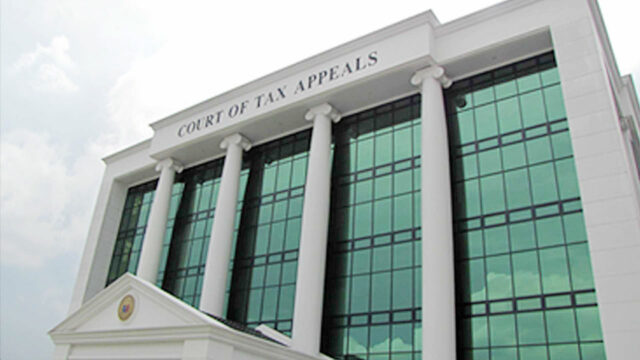
Dole tax petition vs Davao junked

CTA.JUDICIARY.GOV.PH

THE Court of Tax Appeals (CTA) junked the petition of Dole Philippines, Inc.-Stanfilco Divison which challenged Davao City’s Watershed Code and environmental tax, citing lack of jurisdiction.

The tax court’s Second Division said the environmental tax is a regulatory fee, not a tax intended to generate revenue.

“Correspondingly, this Court is without jurisdiction to entertain the present appeal of the assailed Decision and assailed Order issued by the Regional Trial Court (RTC),” the 17-paged decision, penned by Associate Justice Corazon G. Ferrer-Flores, read.

“The Court finds that the Environmental Tax imposed under Section 17 of Davao City Ordinance No. 0310-07 is not a tax,” it added in a decision publicized on Oct. 2.

The case began when Dole, Inc. challenged Davao City’s Watershed Code, enacted by then-Mayor Rodrigo R. Duterte in 2007, seeking to nullify the law and declare the collection of the environmental tax incorrect and illegal.

It also asked the local government, under his successor Sara Z. Duterte-Carpio, to refund the P3.32 million environmental tax that it had paid under protest. 

The banana exporter initially filed its petition before the Davao City RTC but did not win, prompting to elevate the case before the CTA.

The firm argued the environmental fee was excessive, oppressive, confiscatory, arbitrary, and discriminatory, adding it was not a regulatory fee but a tax.

Assuming it is a fee, it should be declared invalid for imposing an excessive amount, it said.

The CTA clarified that if the main goal of an imposition is to raise revenue, it is considered a tax. However, if it is mainly meant to regulate, it is classified as a regulatory fee even if it also generates some revenue. — Chloe Mari A. Hufana

P1.6-B Sorsogon assets flagged

PHILIPPINE STAR/ MICHAEL VARCAS

THE Commission on Audit (CoA) has flagged the provincial government of Sorsogon over its failure to insure P1.62 billion worth of properties, risking massive loss of government assets due to man-made or natural calamities.

State auditors said only P671.2 million, 29.2% of P2.3 billion assets of Sorsogon provincial government were insured.

This leaves P1.62 billion of properties at risk of damage, violating the Property Insurance Law of 1951 and a CoA circular requiring all government assets and properties to be insured by the Government Service Insurance System.

“Examination of the insurance policies over properties likewise disclosed that only 29.26% or ₱671,201,751 of its ₱2,293,533,967 insurable properties were covered by insurance policies for various risks such as fire, lightning, earthquake, typhoon and flood, while 70.74% or ₱1,622,332,215 were not covered by any insurance policy,” part of the CoA report stated.

“The noncompliance with the requirement denied the government adequate and reliable protection against any damage to or loss of its properties or assets and interests due to fortuitous events and/or casualty,” state auditors added.

The Provincial Government of Sorsogon did not immediately reply to a Facebook Messenger chat seeking comment. — Kenneth Christiane L. Basilio

Isabela City now ‘Abu Sayyaf free’

COTABATO CITY — Officials have declared Isabela City in Basilan as fully cleared from the presence of the Abu Sayyaf terror group, a result of cross-section peace initiatives.

Brig. Gen. Alvin V. Luzon, commander of the Army’s 101st Infantry Brigade in Basilan, told reporters via Facebook Messenger on Sunday that credit for the feat should go to the Isabela City Peace and Order Council and the administration of Basilan Gov. Hadjiman H. Salliman.

The multi-sector, inter-agency Isabela City peace and security council, led by Mayor Sitti Djalia Turabin-Hataman, has members from the local Muslim and Christian religious communities.

Luzon, local leaders led by Ms. Turabin-Hataman and her spouse, Basilan Congressman Mujiv S. Hataman, and Army Brig. Gen. Leonardo I. Peña, who is commander of the anti-terror Joint Task Force Orion, together officiated last week the symbolic declaration of Isabela City as “Abu Sayyaf free,” meaning totally liberated from the presence of the group.

Units of the 101st Infantry Brigade, the Basilan Provincial Police Office, Salliman and his constituent-mayors in the province had earlier declared, one after another, as Abu Sayyaf free all the 11 towns in the province and its second city, Lamitan, which has 45 barangays. — John Felix M. Unson

Youth-laden ROS faces titleholder TNT in Governors’ Cup semifinals

RAIN OR SHINE ELASTO PAINTERS — PBA.PH

IT WAS A GREAT TEST of toughness against Magnolia and because of it, Rain or Shine (ROS) coach Yeng Guiao believes his youth-laden charges will be better equipped when they challenge titleholder TNT in the PBA Governors’ Cup semifinals.

“We’re a young team and to beat Magnolia in a (sudden death) Game 5, where everything was at stake (was a big morale boost),” Mr. Guaio said after finishing off the Hotshots, 114-110, Saturday night.

That series was an up-and-down for the Elasto Painters, who showed stern stuff bouncing back from deflating losses in Games 2 and 4, 69-121 and 100-129, respectively, and getting the job done in a thrilling KO.

As Magnolia was the more playoffs-experienced team, Mr. Guiao told his young guns like Jhonard Clarito, Adrian Nocum, Andrei Caracut, Keith Datu, Anton Asistio and Felix Lemetti to watch the Hotshots’ veterans closely and pick up a thing or do.

Well, that’s exactly what the E-Painters’ did with big help from the ever dependable Aaron Fuller.

In the best-of-seven semis, it will essentially be the same for ROS against the Tropang Giga, who have at their disposal the likes of Jayson Castro, Kelly Williams, RR Pogoy, the fast-maturing Calvin Oftana and prolific reinforcement Rondae Hollis-Jefferson.

And just like Magnolia, the Chot Reyes-coached TNT is a heavyweight with defensive orientation.

The best-of-seven Final Four between TNT, the topnotcher of Group A, and ROS, the No. 1-ranked squad of Group B, will blast off on Wednesday.

The protagonists will engage in a playoffs showdown for the second straight conference after fighting in a best-of-three in the Season 48 Philippine Cup quarterfinals. That went the full distance with Elasto Painters prevailing by the skin of their teeth in the decider, 110-109. — Olmin Leyba

ADVERTISEMENT
ADVERTISEMENT