Home Blog Page 2579

Debt yields go down on slower Sept. inflation
By Lourdes O. Pilar, Researcher

YIELDS on government securities (GS) fell last week amid slower September inflation and expectations of more rate cuts at home and in the United States.

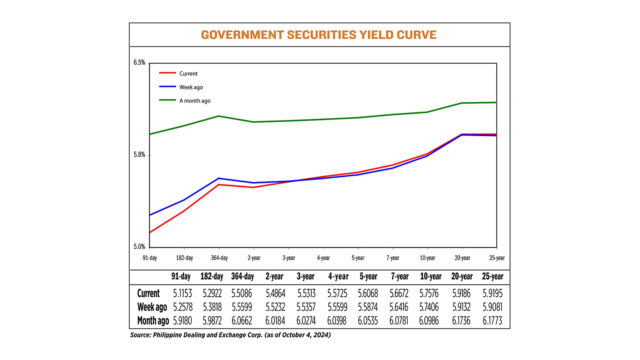
GS yields, which move opposite to prices, went down by an average of 2.12 basis points (bps) week on week, based on the PHP Bloomberg Valuation Service Reference Rates as of Oct. 4 published on the Philippine Dealing System’s website.

Rates at the short end of the curve declined, with the 91-, 182-, and 364-day Treasury bill going down by 14.25 bps, 8.96 bps and 5.13 bps to yield 5.1153%, 5.2922% and 5.5086% respectively.

At the belly, yields ended mixed. Rates of the two- and three-year Treasury bonds (T-bonds) dropped by 3.68 bps (to 5.4864%) and 0.44 bp (5.5313%), respectively, while yields on the four-, five-, and seven-year T-bonds rose by 1.26 bps (to 5.5725%), 1.94 bps (5.6068%) and 2.56 bps (5.6672%), respectively.

At the long end of the curve, rates of the 10-, 20- and 25-year T-bonds went up by 1.70 bps (to 5.7576%), 0.54 bp (5.9186%) and 1.14 bps (5.9195%), respectively.

Total GS volume traded reached P53.18 billion on Friday, higher than the P47.88 billion seen on Sept. 27.

“Local bond yields declined significantly over the weekly with more notable declines on the short end as market participants anticipate stronger rate cuts from the BSP (Bangko Sentral ng Pilipinas) and the US Federal Reserve amid continued weakness in inflation,” the bond trader said in an e-mail.

“Participants nevertheless remained cautious amid the renewed escalation of geopolitical conflicts in the Middle East during the week, which sparked inflationary concerns from spike in global crude oil prices,” the trader added.

Jonathan L. Ravelas, senior adviser at Reyes Tacandong & Co., said in a Viber message that GS yields moved mostly sideways last week with a downward bias after Philippine inflation eased more than expected last month.

Headline inflation slowed to an over four-year low of 1.9% in September from 3.3% in August and 6.1% a year ago, the Philippine Statistics Authority reported on Friday.

This was below the BSP’s 2%-2.8% forecast for the month and the 2.5% median estimate yielded in a BusinessWorld poll of 15 analysts.

The September print was the slowest in over four years (52 months) or since the 1.6% print in May 2020.

In the first nine months, headline inflation averaged 3.4%, matching the central bank’s full-year forecast and well within its 2-4% annual target.

Analysts said the lower September consumer price index (CPI) gives the BSP space to bring down benchmark interest rates further.

BSP Governor Eli M. Remolona, Jr. has said the Monetary Board could slash benchmark interest rates by 50 bps more this year and deliver two more 25-bp cuts at its next two meetings scheduled for Oct. 16 and Dec. 19.

The central bank began its easing cycle in August, cutting its policy rate for the first time in nearly four years by 25 bps to 6.25% from the over 17-year high of 6.5%.

Meanwhile, Fed Chair Jerome H. Powell last week adopted a more hawkish tone in a speech at a conference in Tennessee, saying the world’s biggest central bank would likely stick with quarter-percentage-point interest rate cuts moving forward, Reuters reported.

The Fed kicked off its easing cycle with a larger-than-expected half-point reduction last month, bringing its target rate to the 4.75%-5% range.

On Friday, a stronger-than-expected jobs report reassured investors who had worried the economy may be getting too weak.

US job gains increased in September by the most in six months, and the unemployment rate fell to 4.1%, the report showed.

Traders further reduced bets on a 50-bp reduction at the Federal Reserve’s Nov. 6-7 meeting. Traders are now pricing in just an 8% chance of a 50-bp rate cut, down from around 31% earlier on Friday, the CME Group’s FedWatch Tool showed.

For this week, GS yields may continue to go down, the analysts said.

“Bond yields could decline further following the softer-than-expected Philippine inflation report and concerns over the lingering weakness in the US labor market. Moreover, expectations of dovish policy cues from the Fed minutes and softer US consumer inflation report might likewise exert downward pressure on yields,” the bond trader said.

Minutes of the Fed’s Sept. 17-18 meeting will be released on Oct. 9 (Wednesday), while September US consumer price index data will be out on Oct. 10 (Thursday.)

“Expect rates to move sideways as risks arising from geopolitical tensions caused by the strike in US ports,” Mr. Ravelas added.

US East Coast and Gulf Coast ports were reopened on Friday after dockworkers and port operators reached a wage deal to settle the industry’s biggest work stoppage in nearly half a century, but clearing the cargo backlog will take time, Reuters reported.

The strike ended sooner than investors had expected, weakening shipping stocks as freight rates were no longer expected to surge.

At least 54 container ships had lined up outside the ports as the strike prevented unloading, according to Everstream Analytics, threatening shortages of anything from bananas to auto parts. More ships are sure to arrive.

Pricing platform Xeneta said it was likely to take two to three weeks for the normal flow of goods to be reestablished.

The International Longshoremen’s Association (ILA) workers union and United States Maritime Alliance port operators announced the deal late on Thursday. Sources said they had agreed a wage hike of around 62% over six years, raising average wages to about $63 an hour from $39 an hour.

The ILA launched the strike by 45,000 port workers, their first major work stoppage since 1977, on Tuesday, affecting 36 ports from Maine to Texas. JPMorgan analysts estimated the strike would cost the US economy around $5 billion per day.

The disruption was a headache for Democratic President Joseph R. Biden’s administration ahead of the Nov. 5 presidential election pitting Democratic Vice-President Kamala Harris against Republican former President Donald Trump. It threatened to dent US employment figures in a report due to be released shortly before Election Day.

Many retailers said they had stocked early for the coming holiday shopping season, and that a short strike would likely not have much impact on availability of products.

The tentative deal on wages has ended the strike, but only extends the current contract to Jan. 15. The two sides will continue to talk about other issues, such as the ports’ use of automation that workers say will lead to job losses. — with Reuters


Dairy workers in California being monitored for bird flu after positive tests at two farms

USDA PHOTO

WASHINGTON — Health officials in California are monitoring other exposed workers for symptoms on two dairy farms where two human cases of bird flu were confirmed Thursday, the Centers for Disease Control and Prevention (CDC) said.

Sixteen human bird flu cases have been reported in the US this year, including the two workers who tested positive in California. Fifteen of those cases were in farm workers at infected poultry or dairy farms.

Public health officials say the risk to the general public from bird flu is low. The sick workers had only conjunctivitis, or pink eye, and did not report respiratory symptoms, Nirav Shah, principal deputy director at CDC, said Friday.

More than 250 dairy herds in 14 states have tested positive for bird flu this year, including 56 in California, according to the US Department of Agriculture (USDA). The CDC is continuing to investigate whether any healthcare workers may have been infected with bird flu after one person tested positive in Missouri, Mr. Shah said.

The agency’s testing of seven blood samples from healthcare workers who were exposed to the sick person, which would indicate whether they had previously contracted the virus, could take another two weeks, he said.

The bird flu strain detected on the two California farms is the same as has been detected on dairy farms in other states and the affected farms are quarantined, Eric Deeble, deputy undersecretary for marketing and regulatory programs at USDA, said on the call.

Colorado, which in the spring was a hot spot for bird flu spread on dairy farms, now has just one positive herd, indicating success of the state’s mandatory bulk milk testing, Mr. Deeble said.

Pasteurized dairy products remain safe to consume, Steve Grube, chief medical officer at the Food and Drug Administration’s  (FDA) Center for Food Safety and Applied Nutrition, said on the call.

The FDA said Thursday that it will soon launch a study of raw cow’s milk at some dairy plants to better understand the prevalence of the bird flu virus in the milk supply. — Reuters

Globe shares rise after GCash prospects, improved network

GLOBE Telecom, Inc.’s shares rose last week amid GCash’s prospects of listing overseas and innovations in its own digital network.

Globe was the sixth most actively traded stock last week, with a total of 586,630 shares amassing a total value of P1.40billion traded from Sept. 30 to Oct. 4, data from the Philippine Stock Exchange showed.

Globe stock closed at P2,400 apiece on Friday, up by 6.3% from P2,258 finish last Sept. 27. The stock climbed by 39.5% since its P1,720 close last Dec. 29, 2023.

Globe’s stock price has risen in recent months due to increased investor interest stemming from its growth drivers such as mobile data, GCash, and prepaid fiber, said Stephen Gabriel Y. Oliveros, research associate at China Bank Securities Corp., in an e-mail.

Last week, Globe saw success in its tests with global satellite company Lynk Global’s low-earth orbit satellites. The company was able to transmit text messages in a trial run at a dead spot in San Marcelino, Zambales.

The Ayala-led telecommunications company has invested P265 billion to expand its network to geographically isolated and disadvantaged areas over the past three years. The company also spent an additional P236 billion in operational expenses during the same period to enhance its network capabilities.

Its partnership with Lynk catalyzed Globe stock price growth within the week of the partnership’s announcement, last June.

“This development should bode well for the company as this could further improve network experience for Globe’s subscribers. This should also allow Globe to better reach underserved markets, ultimately propping up revenue prospects over the coming quarters,” Mr. Oliveros said.

Last Wednesday, GCash was reported considering an overseas listing amid delays in its local initial public offering plans. Listing abroad could attract a wider investor base and potentially higher valuations.

Globe Fintech Innovations, Inc. (Mynt), parent company of GCash, secured new investments last August from Ayala Corp. and Mitsubishi UFJ Financial Group. The deal has propelled Mynt’s valuation to $5 billion.

Globe Fintech Innovations operates the mobile payment and remittance service through its subsidiary G-Xchange, Inc. Globe’s digital network functions as a transport channel for the service.

Globe owns 36% ownership interest in Mynt.

Mr. Oliveros said that the rise can also be attributed to “expectations of better cost dynamics as Globe continues to deleverage and reduce capital expenditures (capex).”

Globe invested P28.3 billion in capital expenditure (capex) during the first half of the year, representing a 25% decrease compared to the same period in 2023.

The bulk of its first-half capital expenditures were directed toward data infrastructure. The investment was made to ensure customers maintain continuous access to its digital services.

“Recall telcos have ramped up their capex spend from 2020-2023 to upgrade their networks in light of increased demand for fiber internet, which consequently raised profitability concerns from investors given its impact on costs and debt levels,” Mr. Olivares added.

Globe’s revenues were flat at P89.63 billion in the first semester. Its attributable net income, meanwhile, inched up by 1.6% year on year to P14.55 billion in the first six months of the year.

Mr. Oliveros expects Globe’s core net income to reach P21.5 billion by the end of the year.

He pegged his support and resistance for next week at P2,340 and P2,480, respectively. — P.O.A. Montalvo

Inflation rates in the Philippines

Headline inflation sharply slowed to an over-four year low in September as food and transport costs declined, giving the Philippine central bank space for further policy easing. Read the full story.

Inflation rates in the Philippines

Transforming the country’s mental healthcare system

FERNANDO CFERDOPHOTOGRAPHY-UNSPLASH

The second week of October every year is National Mental Health Week. The World Health Organization (WHO) describes mental health as a state of mental wellbeing that enables people to cope with the stresses of life, realize their abilities, learn well and work well, and contribute to their community.

Mental health conditions can cause difficulties in all aspects of life, including relationships with family, friends, and community. They can result from or lead to problems at school and at work. People with severe mental health conditions die 10 to 20 years earlier than the general population, explains the WHO.

The economic consequences of mental health conditions are also enormous, with productivity losses significantly outstripping the direct costs of care, the WHO added.

At least 3.6 million Filipinos suffer from mental, neurological, and substance use disorders, according to the Department of Health (DoH). The 2021 Young Adult Fertility and Sexuality Study (YAFS5), which was conducted at the height of the COVID-19 pandemic, found that the percentage of Filipinos aged 15 to 24 who ever considered ending their life or attempted suicide more than doubled between 2013 and 2021. Likewise, the percentage of Filipino youth who often felt depressive symptoms almost doubled from 2013 to 2021. Depressive symptoms include feeling lonely, sad, or depressed, and feeling disliked by other people.

Almost nine out of 10 employees in the Philippines (87%) experience work-related mental health issues, a recent study by an insurance company showed. The mental health issues reported by the respondents included fatigue, trouble sleeping, stress and anxiety, loss of interest, difficulty concentrating, loss of self-confidence, a feeling of worthlessness, and appetite or eating disorders.

Access to mental health services in the country can still be improved, with less than one mental health worker for every 100,000 Filipinos according to the Philippine Mental Health Association, an NGO composed of mental health professionals and advocates.

A 2023 study showed that 40% of local mental health professionals consider high financial cost as the top barrier for patients seeking access to mental healthcare in the country. Cost was followed closely by stigma-related barriers, namely embarrassment or shame (35.9%), concern about being perceived as “crazy” (31.0%) or weak (30.3%), and concern about the reaction of family (23.4%) and other people (22.1%).

The study was conducted by the Harvard Humanitarian Initiative as part of its HHI Resilient Communities program in cooperation with the Philippine Psychiatric Association and Psychological Association of the Philippines.

Recognizing the urgency of addressing this problem, the DoH in collaboration with the WHO launched the 2024-2028 Philippine Council for Mental Health (PCMH) Strategic Framework. The framework will guide the development and implementation of mental health policies, programs, and services to address the significant burden of mental illness and improve mental health and wellbeing in the country.

Aligned with the DoH 8-Point Action Agenda and formulated through the inputs of various government agencies and key stakeholders, the five-year strategic plan aims to reduce premature mortality, prevent and treat substance abuse effectively, and reduce the vulnerability of individuals and communities to mental, neurological, and substance use disorders.

Since the enactment of the Mental Health Act in 2018, the DoH has scaled up mental health services and the provision of quality essential medicines, including mental health medicines. The Health department has also capacitated health and non-health personnel at the primary care level through the continuous implementation of the Mental Health Gap Action Program (mhGAP) in local government units. The National Center for Mental Health’s 24/7 crisis hotlines were also established.

Areas for improvement remain, according to Filipino psychiatrist Dr. Rowalt Alibudbud in his paper “Towards transforming the mental health services of the Philippines,” published in the peer-reviewed journal The Lancet Regional Health — Western Pacific in October 2023.

The paper pointed out that mental health services in the country are concentrated in psychiatric hospitals and outpatient care services in general hospitals, with limited integration into primary healthcare and informal community support. As such, it recommended the establishment of community-based mental health services and implementation of processes to improve mental healthcare accessibility and affordability.

The paper also underscored the importance of integrating different levels of care to ensure an efficient and responsive mental healthcare system. Resources in tertiary-level services, including psychiatrists and emergent services, can be harnessed to facilitate the training of primary care workers and establish referral centers within communities.

The research-based pharmaceutical industry is actively engaged in the global fight against mental and neurological disorders. We have more than 200 compounds in research and development, and several on-the-ground partnerships to help patients.

Our industry believes that multistakeholder participation and a whole-of-society approach are crucial in transforming the country’s mental healthcare system to reduce the burden of mental and neurological disorders and improve mental health among Filipinos. Overcoming stigma; strengthening primary care services; and engaging the social, economic, and education branches of government and across sectors are pivotal tasks for the country’s health community.


Teodoro B. Padilla is the executive director of Pharmaceutical and Healthcare Association of the Philippines which represents the biopharmaceutical medicines and vaccines industry in the country. Its members are in the forefront of research and development efforts for COVID-19 and other diseases that affect Filipinos.

Style (10/07/24)


barenbliss has new pouch

THE Korean make-up brand barenbliss has partnered with Good Juju, a local utility tote bag brand for an exclusive collaboration, launching the limited edition barenbliss x Good Juju Bliss Jelly pouch. The pouch gets a barenbliss makeover as part of the makeup brand’s campaign for its Plum Makes Plumping Lip Gloss. The Bliss Jelly pouch includes barenbliss makeup essentials, and one can customize their pouch’s contents by choosing from different shades of Plum Makes Plumping Lip Gloss, Apple Makes Adorable Mousse Tint, and Dream Chaser Quad Eyeshadows. This limited-edition kit is now available at barenbliss’ official stores on Shopee Mall and TikTok Shop for P999.


Dermorepubliq releases travel sizes

Dermorepubliq has launched Dermo Cuties, a travel-sized collection of its serums and toners. The Dermo Cuties collection includes travel-sized versions of the 5% Niacinamide + Hyaluronic Acid Serum and the 2% Salicylic Acid (BHA) Deep Pore Care Toner, priced at P149. Founder Keith Sta. Barbara said, “These trial-sized ‘cuties’ makes it easy for skincare beginners and loyal users alike to explore our range without the expense of full-sized essentials. Their affordability makes them easy to add to shopping carts alongside our best-sellers.” The collection was made available for purchase exclusively on TikTok starting Sept. 29, followed by an extended release across other online platforms on Sept. 30. A wider market restock is scheduled for Oct. 10, coinciding with the 10.10 double-digit sale, after which the products will be permanently available.


New Balance WRPD Runner colorway launched

New Balance is launching the latest WRPD Runner colorway launching exclusively at Foot Locker with a global campaign featuring brand ambassador and 2023 NBA World Champion Jamal Murray. The WRPD Runner’s recognizable foundations provide a stable launching pad for innovative new designs and features. Rooted in FuelCell performance and design, the WRPD runner is a futuristic take on the classic running-inspired design. The new WRPD Runner colorway in Linen/Sea Salt/Dolce is now available at select Foot Locker branches.

Brand reignition

The Volvo XC40 Recharge is the BEV version of the most compact and affordable Volvo in the local market. Available locally in a sole P8 Recharge Twin Motor variant, it is priced at P3.99 million. — PHOTO BY DYLAN AFUANG

Recharge models are at the forefront of Volvo PHL’s presence boost

By Dylan Afuang

WHILE VOLVO revised its plans to offer only battery electric vehicles (BEVs) by 2030, the XC40 and C40 Recharge — the Swedish auto marque’s BEVs and its latest models to arrive here — appear to lead the brand’s presence boost in the Philippine market.

By 2030, Volvo aims that 90% of its sales will comprise plug-in hybrid (PHEVs) or BEVs, with 10% to be accounted for by mild hybrids (MHEVs) that merely use electricity to supplement a combustion engine. Citing sliding demand for BEVs, many European car makers have also expressed a similar shift in their electrification targets.

Upcoming models from Volvo Philippines would potentially follow this new goal, company Sales and Marketing Director Cyrus Dan Catapang told “Velocity” during the brand’s “Recharge the Drive” event held at its showroom along Pasong Tamo in Makati City recently. The affair showcased to potential customers the XC40 and C40 Recharge BEVs.

The XC40 Recharge is the BEV version of the most compact and affordable Volvo in the local market, which is also available here in gasoline-hybrid form. The C40 Recharge is virtually the same vehicle, but sports a sleek, sloping roofline. These crossovers are available here in P8 Recharge Twin Motor guises (P3.99 million for the XC40, and P4.190 million for the C40).

Both Volvo crossovers are equipped with brand hallmarks, such as advanced safety engineering and gadgets, and sustainable interior materials, and what their model designations suggest, powered by electric motors mounted on their front and rear axles that spin the XC and C40 Recharge’s four wheels. The cars boast a range north of 500km.

The Volvo Philippines official shared that the company’s traditional customers are warmly considering the latest Volvo cars and their new means of propulsion. The distributor also aims for its customers retain their loyalty to the brand, establish a better presence in the local premium vehicle market, and improve its after-sales services.

“Our marketing strategy for this year and for the coming years is to rebrand Volvo,” Mr. Catapang responded to a question from “Velocity.” “We promise to be more visible, (for example) through ads and social media.”

He added, “We will also renew our relationships (with established Volvo customers and have them) renew confidence in us.” The company plans to add more retail and servicing sites soon. Currently, Volvo Makati is the brand’s sole dealership and service center in the country.

During a brief test drive of the C40, we saw that Volvo still makes comfortable seats, and that the brand still prioritizes users’ ease of operation, owing to the car’s intuitive infotainment screen that enables access to the majority of the vehicle’s features. All drivers and passengers, meanwhile, will appreciate the C40’s seamless power delivery, serene ride, and refined cabin.

For safety, the Recharge cars come with adaptive cruise control with Pilot Assist, Blind Spot Information System, 360-degree camera, traffic sign recognition, rear collision warning, run-off mitigation system, and slippery road alert system. Volvo boasted that the cars’ cabins and batteries are protected by an “advanced structure and safety cage.”

Other models in the Volvo Philippines’ lineup are MHEV versions of the compact XC40 and XC60 crossovers, and full-size XC90 SUV and S90 sedan. Interested customers are invited to contact Volvo Sales at 0967-172-9366 for more information.

Macasaet steps down as SSS chief

BW FILE PHOTO

SOCIAL SECURITY SYSTEM (SSS) President and Chief Executive Officer Rolando L. Macasaet has stepped down from his position effective Oct. 6 (Sunday).

This marks the end of his near two-year stint at the helm of the state pension fund, which began on Jan. 5, 2023, SSS said in a statement on Sunday.

Malacañang has yet to announce the next SSS head.

Media reports over the weekend said Mr. Macasaet resigned to run for a party-list post.

Under Mr. Macasaet’s term, SSS reached a record-high three million new members in the first nine months of 2024. This was more than double the number of new members recorded in the same period last year.

This puts the pension fund on track to have four million to five million new members for this year.

SSS’ net income rose by 58% to a record P83.13 billion in 2023. — AMCS

France offers 75 million euros for disease-hit sheep farms

REUTERS

PARIS — France will provide 75 million euros in aid for sheep farms hit by a fast-spreading virus, Prime Minister Michel Barnier said Friday in a show of support for struggling farmers despite a budget crisis facing the new government.

Livestock disease outbreaks as well poor harvests and plans by dairy giant Lactalis to cut milk purchases have rekindled discontent among French farmers who staged large-scale protests earlier this year.

The funds for sheep farms affected by a new variant of the bluetongue virus, which is spread by insects and can be deadly for sheep, cattle, and goats, are in addition to a free vaccination program that the government has extended to the whole of the country for sheep flocks.

Speaking at a livestock fair in central France, Mr. Barnier also said the government would put in place state-guaranteed loans to provide short-term relief for worst-off farms.

Mr. Barnier nonetheless reiterated that his administration was bound by a budget squeeze as it aims to find 40 billion euros in savings. In a nod to recent heavy rain and farmer resentment at environmental regulation, he announced a seasonal cut-off date for spreading livestock manure on farmland would be extended from Oct. 1 to Nov. 15.

The government will relaunch in January parliamentary debate on a farming bill, Mr. Barnier added, after the legislation drafted in response to this year’s protests was delayed by the snap election that led to the formation of Mr. Barnier’s minority government. — Reuters

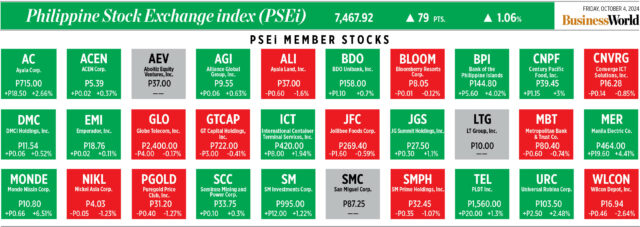
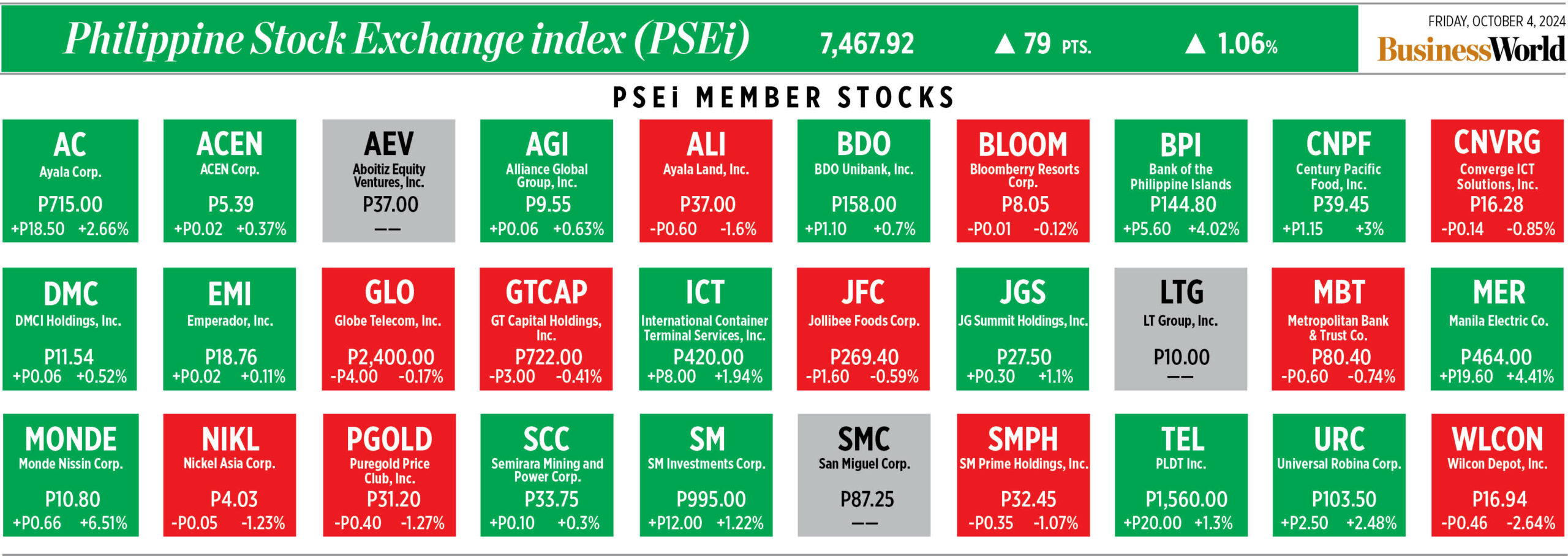
How PSEi member stocks performed — October 4, 2024

Here’s a quick glance at how PSEi stocks fared on Friday, October 4, 2024.


Stocks may extend climb on slower Sept. inflation

BW FILE PHOTO

PHILIPPINE SHARES may climb further this week after September headline inflation settled below 2% for the first time in over four years, bolstering bets of further interest rate cuts by the Bangko Sentral ng Pilipinas (BSP).

On Friday, the benchmark Philippine Stock Exchange index (PSEi) rose by 1.06% or 79 points to close at 7,467.92, while the broader all shares index went up by 1.48% or 58.99 points to end at 4,041.65.

This was the PSEi’s best finish in more than two-and-a-half years or since it closed at 7,502.48 on Feb. 9, 2022.

Week on week, the PSEi climbed by 0.53% or 39.62 points from its 7,428.30 finish on Sept. 27, logging its fifth consecutive week of gains.

“The bellwether index mostly held steady but gained momentum towards the end of the week after local inflation hit a four-year low. After a weak start, the PSEi managed to eke out gains,” 2TradeAsia.com said in a market note.

“Despite the episodes of profit taking, the local market still managed to close the week with gains and in the process closed above 7,400,” Philstocks Financial, Inc. Senior Research Analyst Japhet Louis O. Tantiangco said in a Viber message.

For this week, inflation data released on Friday could prop up Philippine stocks, he said.

“The below-expected inflation print of the Philippines for September is seen to boost market sentiment due to its positive implications on the local economy. The low inflation figure could mean stronger household consumption, which would benefit our overall economic growth given its significant contribution. The low inflation also strengthens the case for the continuation of the BSP’s monetary policy easing,” Mr. Tantiangco said.

Headline inflation slowed to 1.9% in September from 3.3% in August and 6.1% a year ago, the Philippine Statistics Authority reported on Friday.

This was below the BSP’s 2%-2.8% forecast for the month and the 2.5% median estimate yielded in a BusinessWorld poll of 15 analysts. It was also the slowest in over four years or since the 1.6% print in May 2020.

In the first nine months, headline inflation averaged 3.4%, matching the BSP’s full-year forecast.

However, Mr. Tantiangco warned that the growing conflict in the Middle East is a risk for the market. “An escalation of tensions are expected to raise oil prices and cause negative spillovers to the rest of the global economy. It is expected to weigh on sentiment.”

“Chart-wise, the market may continue to test the 7,400 level. If it holds its ground at the said line, this will be considered as its support, while its next resistance is seen at 7,700,” he added.

Meanwhile, Rizal Commercial Banking Corp. Chief Economist Michael L. Ricafort said in an e-mail that the PSEi’s immediate support is at 7,060-7,220 and resistance is at 7,552.70-7,800.

For its part, 2TradeAsia.com placed the market’s immediate support at 7,100, primary resistance at 7,500, and secondary resistance at 7,650. — Revin Mikhael D. Ochave

Peso may stay at P56 level as US data dampen hopes of big Fed rate cut

BW FILE PHOTO

THE PESO may stay at the P56-per-dollar level this week after strong US jobs data tempered market expectations of large rate cuts by the US Federal Reserve.

The local unit closed at P56.295 per dollar on Friday, strengthening by 7.5 centavos from its P56.37 finish on Thursday, Bankers Association of the Philippines data showed.

However, week on week, the peso declined by 21.8 centavos from its P56.077 finish on Sept. 27

The peso recovered against the dollar on Friday after September inflation slowed to an over four-year low, Rizal Commercial Banking Corp. Chief Economist Michael L. Ricafort said in a Viber message.

“The dollar-peso closed lower following the release of lower local inflation data,” a trader likewise said by phone.

Headline inflation slowed to an over four-year low of 1.9% in September from 3.3% in August and 6.1% a year ago, the Philippine Statistics Authority reported on Friday.

This was below the BSP’s 2%-2.8% forecast for the month and the 2.5% median estimate yielded in a BusinessWorld poll of 15 analysts.

The September consumer price index was also the slowest in 52 months or since the 1.6% print in May 2020.

In the first nine months, headline inflation averaged 3.4%, matching the central bank’s full-year forecast and well within its 2-4% annual target.

For this week, the trader said the peso could remain at the P56 level against the dollar following strong September US employment data.

The trader sees the peso moving between P56 and P56.40 per dollar this week.

Meanwhile, Mr. Ricafort expects the local unit to range from P56.20 to P56.40 on Monday.

The dollar jumped to a seven-week high on Friday and was on track to post its best week since September 2022 after a surprisingly strong jobs report for September led traders to cut bets that the Federal Reserve will make further 50-basis-point (bp) rate cuts, Reuters reported.

US nonfarm payrolls increased by 254,000 jobs last month, beating the 140,000 new jobs that economists polled by Reuters had anticipated.

The unemployment rate also unexpectedly slipped, to 4.1% from 4.2% in August.

Improving economic data and more hawkish comments from Fed Chair Jerome H. Powell last week, when he pushed back against expectations of continuing hefty rate cuts, led traders to reduce bets on a 50-bp reduction at the Fed’s next meeting on Nov. 6-7.

Those odds were completely wiped out after Friday’s data. Traders are now pricing in no chance of a 50-bp rate cut, down from around 31% earlier on Friday and 53% a week ago, the CME Group’s FedWatch Tool shows. A 25-bp reduction is seen as almost certain, with traders also seeing a small chance that the Fed will leave rates unchanged.

Bank of America expects the Fed to cut rates by 25 bps per meeting through March 2025, followed by reductions of 25 bps each quarter until the end of 2025, BofA US economist Aditya Bhave said in a report on Friday.

Chicago Fed President Austan Goolsbee called the data “superb” and said more labor market data along those lines would boost his confidence the economy is at full employment with low inflation.

The dollar index reached 102.69, the highest level since Aug. 16, and was on track for its best weekly percentage gain since September 2022.

The dollar has also been boosted by safe-haven demand on concerns about widening conflict in the Middle East. — Aaron Michael C. Sy with Reuters

ADVERTISEMENT
ADVERTISEMENT