Home Blog Page 2528

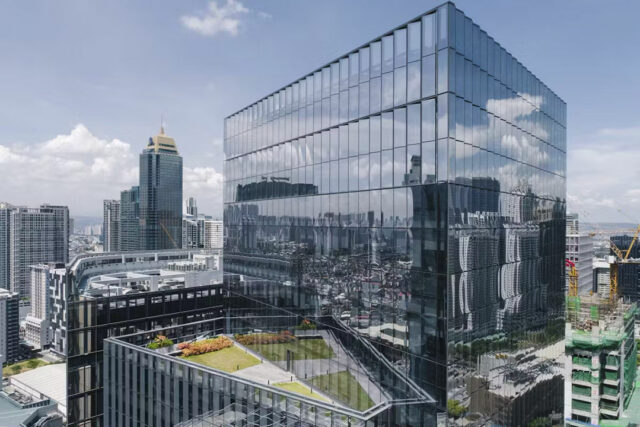
Arthaland to inject P1.7B into subsidiary Pradhana Land

ARTHALAND.COM

LISTED property developer Arthaland Corp. is investing P1.7 billion in its subsidiary Pradhana Land, Inc. for a future project.

Arthaland will subscribe to 17 million preferred shares of Pradhana at P100 apiece, the property developer said in a regulatory filing on Thursday.

“This is the investment vehicle that will be used by the corporation for its future project, the details of which will be disclosed at the appropriate time,” Arthaland said.

“Preferred shares are voting and have such features as the Pradhana board of directors prescribe, but in no case shall such shares be cumulative or redeemable at the option of the holder,” it added.

Pradhana Land was incorporated in September 2019 with the primary purpose of engaging in the real estate development business.

Recently, Arthaland subscribed to 180,000 preferred shares of subsidiary Bhavya Properties, Inc. at P100 per share, equivalent to P18 million.

The additional equity will fund Bhavya’s working capital requirements while ensuring compliance with its financial covenants.

Bhavya is developing the Eluria luxury residential condominium project in Makati. It is a 31-storey luxury residential project with large and limited edition designed residences.

Eluria will feature a heated saltwater leisure and lap pool, an indoor children’s playroom, a function hall, a potager garden at the roof deck, and chauffeur shuttle services to select nearby destinations.

On Thursday, Arthaland shares were unchanged at 41 centavos per share. — Revin Mikhael D. Ochave

J-Hope, of South Korea’s BTS, finishes military service

WONJU, South Korea — K-pop star J-Hope, a member of the supergroup BTS, was discharged from South Korea’s military on Thursday after 18 months of duty, sparking enthusiasm among fans and investors for a potential reunion of the boy band next year.

J-Hope, 30, is the second member of the seven-member group to wrap up the mandatory national service that has put their music careers on hold, after oldest member Jin finished his service in June.

Wearing a uniform and a black beret, J-Hope smiled as he greeted Jin and around 100 cheering fans as well as reporters upon his release at a military base in Wonju, Gangwon province.

“Thanks to the fans, I was able to finish it (the service) safely, with good health,” he told those gathered.

“What I’ve felt for the past a year-and-a-half is that a lot of soldiers are working hard, dedicating themselves, and doing so much to protect the country,” he added, asking the public for their interest and love for those serving in the military.

Shares in HYBE, the label which houses BTS, rose 7% in early afternoon trade versus a flat wider market.

The final four members of the group began their service in December 2023, with the band expected to reunite in 2025 after all have completed their military duty.

“I’m really hoping to see them (all BTS members) again together,” said Constanza Godoy, 33-year-old Chilean fan who went to see J-Hope leave the military.

“I think that after this short time apart they will be more close, and they will bring more stories to their songs, to their lyrics.”

BTS ranks 41th among best-selling artists of all time according to chartmasters.org on a list headed by The Beatles.

Since their debut in 2013, they have sold more than 56 million physical albums and singles, and tallied six No. 1 albums on the Billboard 200, according to chartmasters.org and Billboard.

South Korea requires all able-bodied men between the ages of 18 and 28 to serve between 18 and 21 months in the military or social service, but it revised the law in 2020 to let globally recognized K-pop stars delay signing up until age 30. — Reuters

Issues against some discipline policies

What are the improper ways in which the human resource (HR) department and managers discipline employees? What can be done? — Lemon Lime

Not only HR people and line executives but their unprincipled lawyers as well. Some lawyers give only shallow advice to management and embolden them in the process while resorting to malicious means to defeat employee claims at the labor department and elsewhere.

That’s more of an exception rather than the general rule. To fully appreciate the accuracy of the claim I am making, just spend one day talking to workers with pending complaints against their employer.

You’d be surprised at the kind of labor justice practiced by employers and the quality of HR personnel making appearances at labor proceedings.

So let’s talk about the uneducated approaches taken by some HR people and line managers. On top of my list is the inadequacy or incompleteness of incident reports summarizing the alleged violations.

Many times, their Notice to Explain (NTE) lacks clearly worded specifics of particular provisions or provisions that have been violated, including the absence of the complainant’s affidavit and their witnesses. HR people would simply allege wrongdoing without giving the bill of particulars.

Another issue is the stiff timelines for employees to submit a written reply, say within 24 to 48 hours. Some labor jurisprudence considers ample time to be at least five working days.

OTHER ISSUES
I’ve read, reviewed, and evaluated hundreds of company codes of conduct. About 70% of them lack guidance on how line executives should manage difficult employees. In addition to the three elements stated above, let’s explore the following:

Perceptions of HR as the hatchet department. Employee discipline is job number one for team leaders, line supervisors, and department managers. It cannot be delegated fully to HR. Their actions could prove to be too little, too late. HR’s role must be understood as the internal expert and consultant on the matter.

The code of conduct as a basic reference. All employees must be given a printed copy of the code of conduct. It must also be posted in the company’s intranet, giving all stakeholders instant access. Issuing a copy of the code is imperative as it contains an employee acknowledgement of receipt and affirmation that they understand its contents.   

Key elements of the code of conduct. It must include the company’s mission, vision, and value statements; management commitment to due process; a step-by-step flowchart starting from an incident report; definition of offenses; and the schedule of penalties ranging from oral reprimand, written reprimand, suspension from work, and termination of employment.

Specific roles of HR and line executives. It’s not the job of HR to personally handle each employee case, regardless of its gravity. The line executives are the first line of defense of management. However, the signature of the HR manager may be included in the NTE, if so desired by the line manager, and in case of termination of employment.

Absence of an NTE template. It’s also advisable to include examples of a model incident report, the NTE and its contents, a Notice of Management Decision, and a memo template of a written reprimand, suspension, and dismissal notice. Note also, that there should be a template for a memo in case of an oral reprimand. This is for record purposes.

Composition of management disciplinary committee. Depending on the character or personality of an employee undergoing disciplinary proceedings, and in cases of dismissal from employment, an organization must gather all department heads to decide on difficult cases. Otherwise, their second-in-command may take on the job of handling cases of non-management employees.

Open-door policy and whistleblower program. This allows disgruntled parties the option of a back channel to share important information, particularly when the employee being investigated is a high-ranking official.

POSITIVE DISCIPLINE
Every organization must have a code of conduct that regulates its employees’ behavior. This is important in instilling a culture of order and discipline. However, over several decades, the code of conduct has come to represent a narrow understanding of employee discipline, giving little importance to instilling good behavior through a two-way communication system.

Studies have shown that positive discipline is more effective in changing employee behavior. It starts by allowing everyone to build self-confidence and discipline with the help of proactive engagement approaches that must be initiated by line executives. Without them, it will be difficult to have positive discipline.


Send your comments or questions to elbonomics@gmail.com or via https://reyelbo.com. You may also contact Rey Elbo on Facebook, LinkedIn, or X. Receive free insights that we may publish in this space. Anonymity is guaranteed.

BSP coin deposit machine collections breach P1-billion mark

A STORE OWNER inserts her coins in a coin deposit machine. — BSP

THE BANGKO SENTRAL ng Pilipinas’ (BSP) coin deposit machines (CoDMs) have collected currency valued at over P1 billion as of Oct. 11, it said on Thursday.

“Since its launch, the CoDMs have accumulated more than 260,000,000 pieces of coins and facilitated more than 240,000 transactions,” the BSP said in a statement.

The BSP and its retail partners launched the deposit machines in June 2023 to help promote efficient coin recirculation.

The initiative aims to address the artificial coin shortage in the financial system and help ensure that only fit and legal tender currency is available for public use.

“Building on this success, the BSP will expand the project by installing 25 more CoDMs nationwide in 2025,” the central bank said.

“This will make it more convenient for Filipinos to deposit their idle coins, helping recirculate them back into the economy while promoting cashless transactions. By increasing accessibility, the BSP aims to reach more communities and ensure that the benefits of the CoDM initiative are widely felt across all regions.”

There are currently 25 deposit machines available in the Greater Manila Area, which are in select retail establishments of the SM Store, Robinsons Supermarket and Festival Mall.

All denominations of the BSP Coin Series and New Generation Currency Coins Series are accepted by the CoDMs. Unfit and demonetized coins, foreign currency, and foreign objects are rejected by the machines.

The value of coins deposited in CoDMs may be credited to an individual’s account in GoTyme Bank or e-wallets GCash or Maya, or converted into shopping vouchers.

“In using the machines, the BSP reminds customers that coins must not be taped or bundled, must not come with other objects like buttons, magnets, nails, tokens, screws, or washers, and should be gently placed in the coin slot in handfuls,” the central bank said.

“Furthermore, the BSP advises customers to ensure their e-wallet accounts are valid, active, and within the prescribed transaction limits.” — Luisa Maria Jacinta C. Jocson

Time for the Philippines to decouple economically from China

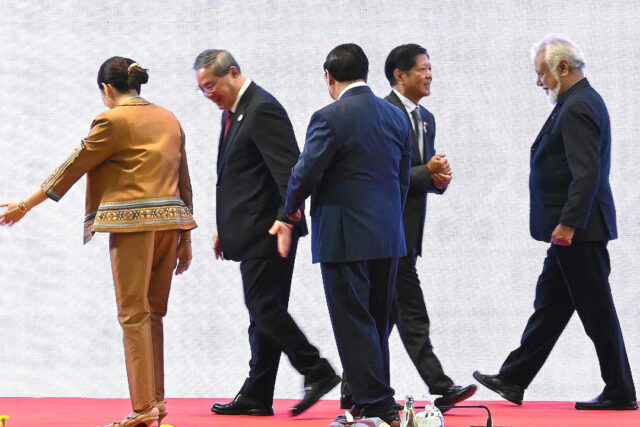
PRESIDENT Ferdinand R. Marcos, Jr. was photographed with Thailand Prime Minister Paetongtarn Shinawatra, Chinese Premier Li Qiang, and East Timor Prime Minister Kay Rala Xanana Gusmao before the start of 27th ASEAN-China Summit at Lao National Convention Center in Vientiane, Lao PDR. — PPA POOL PHOTO BY REVOLI CORTEZ

It was certainly a proud moment in the history of Philippine foreign relations. Speaking at the ASEAN gathering in Laos last week, “Philippine President Ferdinand Marcos challenged Chinese Premier Li Qiang over recent clashes in the South China Sea,” AFP reported on Oct. 10. As a diplomat attending the meeting told reporters: “you cannot separate economic cooperation from political security.” And indeed, Marcos the Younger was fully in the right when he “told the meeting that ASEAN and China cannot pretend that all is well on the economic front when there are tensions on the political front.”

Which leads us to what my BusinessWorld colleague (and one of the country’s finest columnists) Nonoy Oplas wrote recently: “The share of China in total Philippine imports keeps rising, from 20% in 2018 to 26% in January to July this year. The share of China in our exports remains flat at 13% from 2018 to 2024.

“The above numbers seem to contradict the frequent narrative and surveys that say Filipinos distrust China,” he wrote in his column, My Cup of Liberty (“Low unemployment and more trade with more countries,” Oct. 10). “Of every $4 of Philippines imports, $1 is from China — from toys, shoes, and electronics to trucks, buses, and bulldozers.”

As BusinessWorld itself reported on Oct. 11 (“Trade gap widens to $4.38B in August”), of our total trade, “62.2% was imported goods, while the remaining 37.8% was made up of exports.” And the “value of imported goods rose by 2.7% to $11.12 billion in August from $10.83 billion a year prior. Meanwhile, imports of raw materials and intermediate goods grew by 5.2% year on year to $4.06 billion in August. This made up 36.5% of total imports.”

However, more significantly from the national security perspective, “imported capital goods picked up by 9.6% annually to $3 billion, while imports of consumer goods was steady at $2.24 billion. Imports of mineral fuels, lubricants and related materials slid by 9.1% to $1.79 billion in August.”

And our biggest source of imports? “China was the biggest source of imports valued at $2.79 billion, accounting for a quarter of the total import bill in August.” The Philippines thus has a trade deficit with China at nearly $2 billion.

There is clearly an urgent need for the Philippines to decouple its economy from China. For one, it will allow our domestic manufacturing and other industries to grow, not be suffocated by Chinese competition, what with the latter’s advantages of a managed currency, government subsidies, lower wages, and lower electricity costs.

Another reason has to do with ensuring a policy consistent with Philippine democratic values, which is clearly at odds with China’s more autocratic and less human rights-oriented leanings:

“China today also has a clearly more authoritarian system than western democracies. And China is still much poorer than its democratic counterparts, despite being the world’s second-largest economy. China’s GDP per capita is not even a fifth of that of the US, and it is facing major economic challenges of its own,” wrote Renaud Foucartte in The Conversation (“Nobel economics prize: how colonial history explains why strong institutions are vital to a country’s prosperity — expert Q&A,” Oct. 14).

The truth is, “Xi Jinping’s increasingly authoritarian regime is the reason why China’s economy is ‘rotting from the head’,” wrote Foucartte.

Of course, one can quibble as to whether the Philippines should decouple or de-risk from China. But as my former PwC colleague Alex Capri, now a Hinrich Foundation research fellow and a lecturer at the National University of Singapore and NUS Lee Kuan Yew School of Public Policy (as well as the author of Techno-Nationalism: How it’s reshaping trade, geopolitics, and society) pointed out: “Like decoupling, de-risking is motivated by a desire to reduce reliance on a single supplier or to protect against potential economic or geopolitical events. Unlike decoupling, de-risking seeks to continue basic trade and investment activities — once the risks have been dealt with. The line between de-risking and decoupling, however, often becomes blurred” (“China decoupling versus de-risking: What’s the difference?,” www.hinrichfoundation.com, Dec. 12, 2023).

Nevertheless, whether it be decoupling or de-risking, there is clearly a need (as I pointed out in my column, “The business sector must join our national security architecture,” on Sept. 27) to wean our businesses from its addiction to Chinese imports and “galvanize the business sector into joining our national security efforts, creating a vision they can buy into and unquestionably support. For far too long, China’s propagandizing — which included huge investments, infrastructure loans, and trade promises — have been allowed to cause a divide between sovereignty and business interests, resulting in the weakening of Philippine resolve on defense. Recruiting Philippine business into the national security architecture not only informs more key players as to the actual stakes involved but also greatly enhances the resources (material and intellectual) needed to defend the country.”

Indeed, economic security is also national security. Thus, while pivoting away from China will certainly not hurt the latter, it will however effectively concretize and insulate Philippine security from external pressures.


Jemy Gatdula is the dean of UA&P Law, as well as a Philippine Judicial Academy law lecturer for constitutional philosophy and jurisprudence.

https://www.facebook.com/jigatdula/

Twitter @jemygatdula

Prime Infra unit tapped for Bulacan waste disposal services

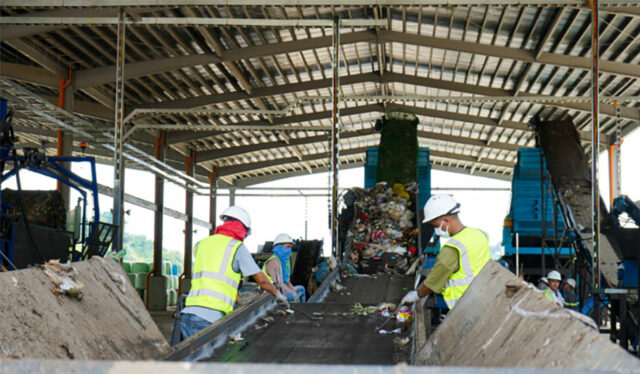
BULACAN MUNICIPALITIES shift to Prime Waste Solutions Pampanga for enhanced waste disposal — Prime Infra

PRIME Integrated Waste Solutions, Inc. (PWS), a subsidiary of Prime Infrastructure Capital, Inc. (Prime Infra) has started servicing towns in Bulacan.

San Ildefonso, Bocaue, Pulilan, and Sta. Maria have chosen PWS’s facility in Porac, Pampanga, for their waste disposal needs, the Razon-led firm said in a statement on Thursday.

PWS’s Porac facility can handle up to 5,000 tons of solid waste daily, using technology to maximize resource recovery, aiming to reduce landfilled waste by 20% or less.

“PWS Pampanga continues to widen its coverage in the region as more customers recognize the value of our sustainable waste management solutions,” PWS Pampanga President Cara T. Peralta said.

On Oct. 6, PWS Pampanga said it started to handle the collection of residual waste in the Clark Freeport and Special Economic Zone as the exclusive service provider recognized by the Clark Development Corp.

With its location, PWS Pampanga said it can meet the waste management needs of businesses and local governments throughout Central Luzon and Northern Luzon.

“PWS’s innovative practices are transforming traditional waste management methods into more responsible solutions,” Ms. Peralta said.

She added that partnerships with its clients not only streamline waste disposal but also “highlight a collective commitment to environmental responsibility within the region.”—Aubrey Rose A. Inosante

Disney introduces new US park perk: Skip the long lines for $400

The Radiator Springs Races is one of the rides at the Disney California Adventure Park that are included in the Lightning Lane Premier Pass. — DISNEYLAND.DISNEY.GO.COM

WALT DISNEY CO. is introducing a new theme-park perk for rides such as Indiana Jones and Rise of the Resistance, where the waits can be over an hour long. For $400 a person, guests can skip the lines at many popular attractions.

Resorts in Southern California and Florida will begin testing the Lightning Lane Premier Pass starting Oct. 23 and Oct. 30, respectively, according to company websites. The pass allows a visitor to use the Lightning Lane entrance once at numerous busy rides for a whole day.

Only “very limited quantities” of the Lightning Lane Premier Pass will be available, Disney said. The rollout of the feature coincides with a slowdown in business at the company’s resorts.

The current prices will run through Dec. 31. After that, Disney expects the new pass to be priced at $300 to $400 a day per guest, based on the date and demand.

Earlier this month, Disney increased the price of tickets to its two Disneyland theme parks in California by about 6% on most days. The most expensive — typically weekends and holidays — climbed 6.2% to $206. The lowest-priced admission, available for at least 15 days in January and February, will stay at $104, unchanged since 2019.

The new line-cutting option builds on a number of features for guests who are willing to spend more see more of the attractions. For example, a Lightning Lane Multi Pass lets guests choose rides where they want to skip the lines, starting at $32 per ticket per day. A Lightning Lane Single Pass is a one-time option to skip the line for a top attraction. They vary by date and attraction.

For the very well-heeled, there’s a VIP Tour. Prices can range from $500 to $700 an hour for groups of up to 10, according to the PlanDisney website. — Bloomberg

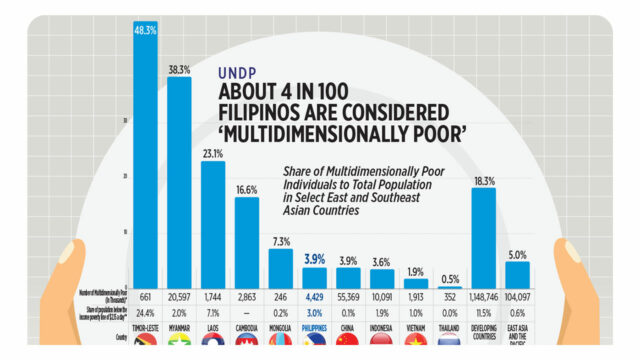
UNDP: About 4 in 100 Filipinos are considered ‘multidimensionally poor’

The share of “multidimensionally poor” in the Philippines reached 3.9% or 4.43 million Filipinos, according to the latest estimates from the Global Multidimensional Poverty Index by the United Nations Development Program (UNDP) and the Oxford Poverty and Human Development Initiative (OPHI). This was better than the 18.3% share in developing countries and the 5% in the East Asia and the Pacific region. The report added that around 3% of Filipinos are living below the income poverty line of $2.15 a day.

UNDP: About 4 in 100 Filipinos are considered ‘multidimensionally poor’

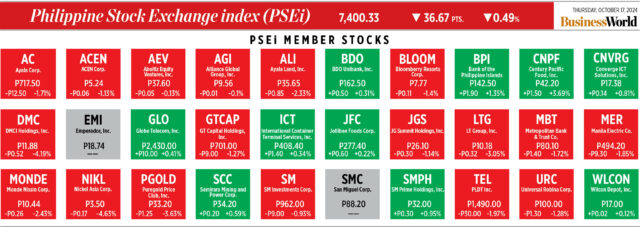
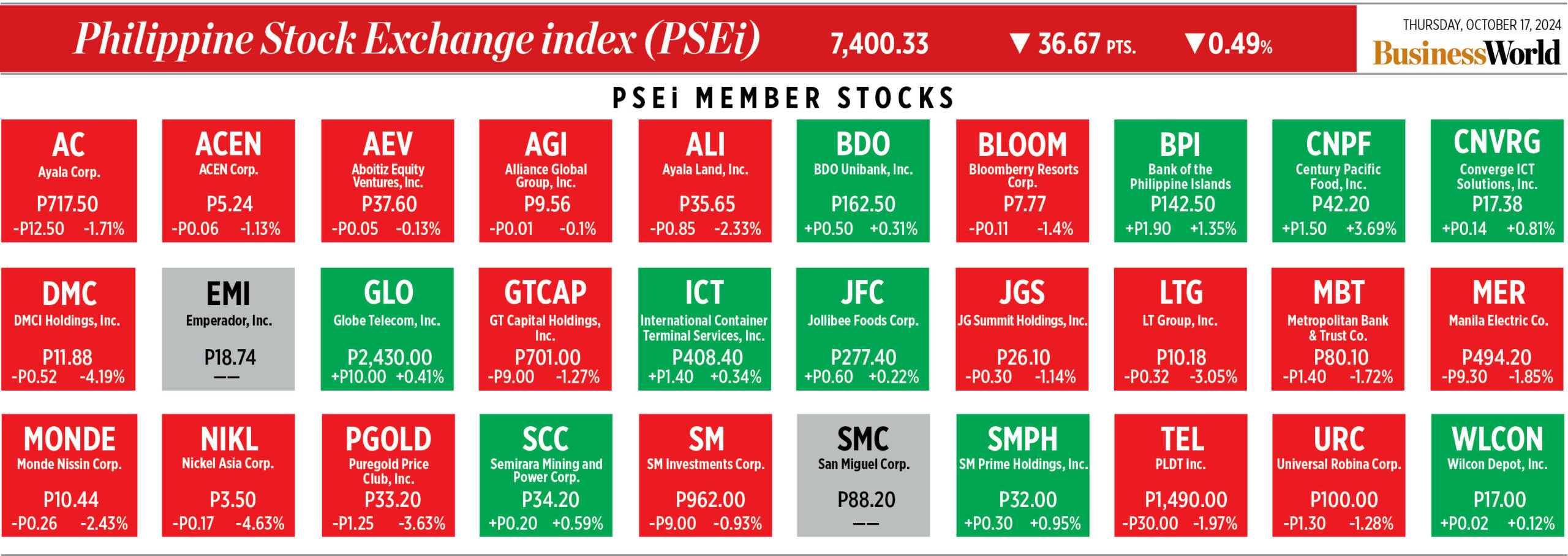
How PSEi member stocks performed — October 17, 2024

Here’s a quick glance at how PSEi stocks fared on Thursday, October 17, 2024.


Senate urged to let automatic power price hikes within approved brackets

PHILIPPINE STAR/EDD GUMBAN

By John Victor D. Ordoñez, Reporter

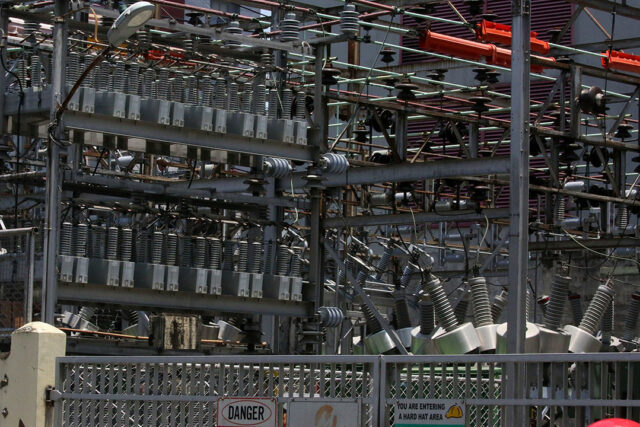
THE Department of Energy (DoE) on Thursday urged senators to amend the Energy Regulatory Commission (ERC) charter to allow price increases without regulatory approval as long as these fall within a set benchmark or bracket.

This would allow the regulator to do away with the cumbersome approval process that power distributors have complained about, Energy Undersecretary Sharon S. Garin told a Senate hearing looking at changes to the 23-year-old Electric Power Industry Reform Act (EPIRA).

“If the distribution utility applies for this (price increase) and it is within the benchmark and they can prove that they followed a fair, transparent procurement process, then it should not be a full-blown process but just a summary procedure that will be shorter,” she said.

The energy official said the move would also free the ERC from its time-consuming function as a quasi-judicial court when hearing price petitions.

At the hearing, Senator Sherwin T. Gatchalian pushed to empower the ERC to speed up the approval of power supply deals amid constant blackouts in the country.

“The resetting of rates is one of the most important activities of the Energy Regulatory Commission because it determines the appropriate rates entities should charge,” he said.

Ms. Garin added that her agency is also finalizing proposals for penalties the ERC can impose in cases of economic sabotage in the power generation sector.

“We are trying to finalize how to define economic sabotage as far as energy is concerned and maximize the penalty for a fault made by industry players,” she said in mixed English and Filipino.

In his third address to Congress, President Ferdinand R. Marcos, Jr. sought a review of EPIRA to address issues hounding the energy sector, particularly high energy prices.

Energy Undersecretary Rowena Cristina L. Guevarra told senators in May that 4,000 megawatts of power might be added to the country’s power generation capacity by the end of the year.

She said some power plants that eye setting up shop this year are falling behind in the application process but are ready to start operations.

“Our goal is that people have access to electricity in a reliable manner and not in intermittent energy,” Senator Pilar Julianna S. Cayetano, who heads the energy committee, told the hearing.

“We need our regulatory bodies to be on the ball, to be able to react quickly and not three years later, not five years later,” she added.

House of Representatives bills seeking to amend EPIRA are pending with its energy committee.

The House energy panel is considering changes to the ERC charter that will speed up the approval process through benchmark rates, according to a draft bill dated Sept. 1 previously obtained by BusinessWorld.

It is also considering a new provision in the charter that requires the ERC to rule on administrative cases within 30 days.

Philippine lawmakers have committed to fast-track amendments to EPIRA, which is one of the President’s priority measures.

Analysts earlier said lawmakers should limit cross-ownership and address privatization concerns under EPIRA to boost competition.

Think tank Center for Energy Research and Policy said cited the need to reform the power procurement process and increase investment incentives to boost competition.

It has also recommended enhancing the regulatory powers of the Department of Energy and the ERC.

EPIRA restructured the electric power industry by privatizing the generation, transmission, distribution and supply of power in 2001.

Under Section 5 of the law, cross-ownership — the concentration of ownership in two or more related businesses — is only outlawed between a transmission company and any company in generation and distribution.

Australia eyes more than P4B a year to support PHL mining, RE, infrastructure

DEPARTMENT OF EDUCATION FACEBOOK PAGE PHOTO

By John Victor D. Ordoñez, Reporter

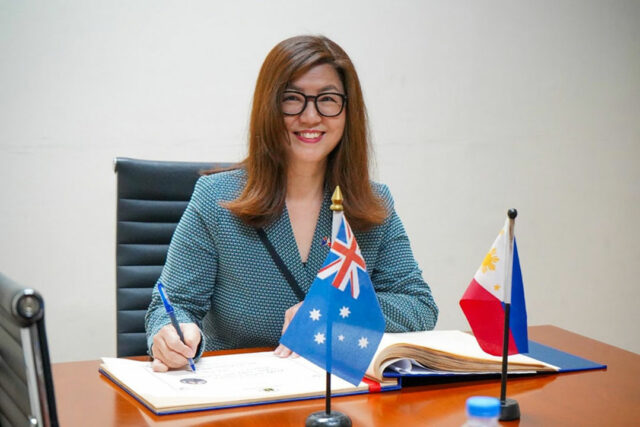
AUSTRALIA plans to provide the Philippines more than P4 billion yearly until 2029 in official development assistance (ODA) to support mining, infrastructure, renewable energy (RE) and agriculture, as part of the country’s five-year development partnership plan with the Southeast Asian nation.

“We are talking about multiples of more than P4 billion per year of predominantly official development assistance in the Philippines to help [it] achieve good economic reforms,” Australian Ambassador to the Philippines Hae Kyong Yu told a news briefing in Makati after the launch of the program.

She said the Australian Embassy in Manila has brought in Australian mining tax experts to work with their Philippine counterparts as Congress deliberates on a measure that seeks to develop a new tax regime for the industry.

The embassy has also been encouraging players in the Australian mining industry to partner with mining companies in the Philippines on mining best practices.

Senators are set to continue floor debates on a proposal for a five-tier margin-based royalty rate system for the sector ranging from 1% to 5%, and a five-tier windfall profit tax system from 1% to 10%.

The House of Representatives approved its version of the measure in September last year.

Senate Bill No. 2826 seeks a royalty of 5% from large-scale miners inside mineral reservations based on gross output, while those outside reservations will follow the five-tier margin regime.

The government expects to generate P6.26 billion in yearly revenues from the mining tax regime, according to the Department of Finance.

The existing tax system for mining companies requires them to pay corporate income, excise, royalty, local business and real property taxes, as well as fees to indigenous communities.

President Ferdinand R. Marcos, Jr. on Wednesday urged the Senate to fast-track the measure’s approval.

Ms. Yu noted that about P3.6 billion of Australian’s planned annual funding assistance would be in the form of official development assistance.

In the past two decades, funding assistance from Australia to the Philippines has reached about P63 billion.

“We will support Philippine government agencies to implement key economic reforms, partner with the Philippines in key sectors including infrastructure, RE, telecommunications and digitization,” Australian Foreign Affairs and Trade Secretary Jan Adams said in a speech at the launch of the partnership.

Canberra will also work with Manila to improve its cash transfer and social protection programs for poor Filipinos. It will also partner with Philippine institutions to boost human capital and skill development programs to raise the employability of Philippine workers.

“These are sectors where Australia believes we have a comparative advantage… We’ll be looking to help develop your mining sector,” Ms. Yu said.

Two-way trade between the countries reached P378 billion last year, while more than 250 Australian companies employed 44,000 Filipinos.

Trade and investment between Canberra and Manila could grow by 10% this year, Luisa Rust, minister-counselor and senior trade and investment commissioner of the Australian Embassy, earlier told reporters.

“The development partnership plan builds on our countries’ close partnership, and sets out how we will pursue our shared development priorities so that together, we can shape a peaceful, stable and prosperous region,” Ms. Yu said.

Marcos leads inauguration of Sorsogon sports complex

FORMER Vice-President Maria Leonor “Leni” G. Robredo greets President Ferdinand “Bongbong” R. Marcos, Jr. as former Senator Paolo Benigno A. Aquino IV looks on at a holding area before the President inaugurated a 12,000-capacity sports arena in Sorsogon province. — PCO

PRESIDENT Ferdinand R. Marcos, Jr. on Sunday led the inauguration of a 12,000-capacity sports arena in Sorsogon in the Bicol region, at an event attended by his closest rival in the 2022 presidential race.

The arena, which can accommodate up to 20,000 for full-house sports activities, could serve as a national training camp for Filipino athletes, he said in a speech. It is a step toward increasing the number of Filipino Olympians, he added.

The President said the arena could be used for conferences, summits, concerts and competitions.

Mr. Marcos briefly shook hands with former Vice-President Maria Leonor “Leni” G. Robredo and ex-Senator Paolo Benigno “Bam” A. Aquino IV at a holding area before leading the inauguration.

Senate President Francis “Chiz” G. Escudero, who was Sorsogon governor before returning to the Senate in 2022, said he had invited Ms. Robredo to welcome the President on behalf of the Bicol region.

“We may have opposing beliefs and opinions, but I know that we are one in our goal to improve the lives of every Filipino,” Mr. Marcos said in his speech in Filipino.

Mr. Marcos lost to Ms. Robredo by a hair in the 2016 vice presidential race. He filed an election lawsuit, alleging fraud, that the Supreme Court unanimously dismissed in 2021.

He made a comeback in 2022 by beating Ms. Robredo in the presidential election. He became the first candidate in the history of the Fifth Republic to win by a majority, getting nearly 59% of the vote. — KATA

ADVERTISEMENT
ADVERTISEMENT