Home Blog Page 2519

Crickets get crunchy as Singapore approves edible insects in bid to ensure food security

REUTERS

SINGAPORE — At Singapore’s House of Seafood restaurant, the fish-head curry comes with a side of crunchy crickets, the tofu has bugs crawling out of it and the patrons can’t get enough.

The seaside restaurant is the first eatery to put insects on the menu after the city state’s food authority this month approved for human consumption 16 species ranging from crickets to grasshoppers, grubs and mealworms after two years of deliberation.

Crickets and other insects have long been enjoyed as street food in Southeast Asia, but not in the wealthy financial hub, where food imports come with restrictions for safety and hygiene purposes.

Francis Ng, chief executive of House of Seafood, said customers love it when the dishes play up the insects, like that tofu dish he plated to look like bugs were crawling out of it, and a dish of glutinous rice balls studded with silkworms.

“It looks scarier so customers can film for their TikTok,” said Mr. Ng, adding that his phone has been ringing off the hook with customers eager to book a tasting.

The restaurant has drafted a menu with 30 dishes that feature insects, which they can sell to the general public once their importers are approved by the food authority.

For now, Mr. Ng is offering free samples. In 2019, Singapore declared it was aiming to produce 30% of its nutritional needs by 2030 instead of the current model where 90% of food is imports, and food security expert Paul Teng said insects could certainly help move towards this goal — if people got over “the yuck factor.”

“Most insects are almost all protein,” said Mr. Teng, who works at the Nanyang Technological University’s S. Rajaratnam School of International Studies, adding that there needs to be local production to make this alternative protein source affordable.

“Getting people to accept insects in their diet is a challenge. But really, it’s a normal food item. Let’s do something about it to prepare the consumer for it,” he said. “Me personally, I have no problem eating insects.”

The United Nations has deemed bugs a sustainable source of protein to feed a global population estimated to swell to 9.7 billion by 2050 and global food security issues due to extreme weather and conflicts have also increased the interest in the high-quality, economical nutrition that bugs provide.

In Singapore, all insects approved for human consumption must be farmed in a controlled environment and not harvested from the wild, and cannot be fed contaminants like manure or rotten food, according to the food agency.

In tandem, the Food and Agriculture Organization has been promoting farming of insects for human consumption and animal feed, and there has been local interest to import insects, but cost remains a barrier for now: Mr. Ng said insects make up 10% of his costs at the House of Seafood, and they are all imported.

“The price is definitely higher than eggs,” he said.

It’s too early to tell if insects will become a feature of the Singapore diet or whether demand will fizzle out as it has for fake meat products.

But for now, some diners say they are happy to develop a taste for bugs.

“If they have a higher source of protein, why not? I’ll add it to my daily meal and daily food intake,” said Bregria Sim, a 23-year-old logistics executive, adding she would pay around S$40 ($30) for the novelty dishes. — Reuters


Drinking’s cancer link is underrated

TIRACHARDZ-FREEPIK

NOW that the vast majority of Americans don’t smoke, it’s hard to know what we’re supposed to do about the recent news that 40% of cancer cases are preventable. Drinking alcohol is one of the top risk factors — and yet doctors aren’t talking to patients about its connection to cancer.

Alcohol was third behind obesity and smoking among the “modifiable” risk factors according to this new study. You can’t walk into a doctor’s office without being put on a scale, and everyone knows smoking causes cancer, but drinking a glass of wine or two every night? Not long ago, that was considered healthy — due, researchers now say, to a systematic error in several widely publicized earlier studies.

And drinking is a bigger cancer risk factor for women than it is for men. About 300,000 women are diagnosed with breast cancer in the US each year. It’s by far the most common potentially lethal cancer among nonsmoking women.

Alcohol consumption accounts for about 16% of breast cancers, said the lead author of the study, Farhad Islami of the American Cancer Society. Most of the increased risk is attributable to people who exceed the current health guidelines of no more than one drink a day for women. But even a drink a day raises risk — especially if you’re filling up a big wine glass.

Drinkers of both sexes have an increased risk of liver cancer, esophageal cancer, and other malignancies of the digestive tract, but these are not nearly as common as breast cancer.

There are still many critical questions that experts can’t answer until there’s more research: How much is a woman’s lifetime breast cancer risk elevated by heavy or binge drinking in college and early adulthood? How much can a woman reduce her risk by going from moderate drinking to abstaining? Are there women with certain risk factors that make them more prone to cancer induced by alcohol use? How and why does alcohol raise breast cancer risk?

There are a few studies suggesting that alcohol can cause breast cancer by increasing the amount of estrogen circulating in the bloodstream. Should women taking hormone replacement therapy skip the daily glass of wine? It might make sense, but it remains in the realm of things that need more study.

Instead, doctors usually recommend diligent annual screening mammograms if you want to try HRT, but of course, screening doesn’t prevent cancer. In the most optimistic estimates, programs of regular screening mammograms reduce cancer death by 20%, but more recent studies show less benefit along with a serious risk of unnecessary treatment.

In one of the many articles on the limitations of mammography, professor of medicine Russell Harris of the University of North Carolina suggests it’s more important for doctors to council women to stop smoking, maintain a healthy weight, and cut back on drinking.

In June, the New York Times tried to quantify the risk of moderate drinking. One researcher said drinking seven drinks a week only costs you about two and a half months of life. The researcher, Tim Stockwell of the Canadian Institute for Substance Use Research, emphasized that was an average — most people may lose nothing, but a few will lose a lot.

It’s hard to isolate the effects of drinking because it’s tied up with other behaviors and conditions, he told me. Take the “sick quitter effect,” he said. People who get serious warnings from their doctors often quit drinking, and so studies can show a correlation between quitting drinking and getting sick — because getting sick caused people to quit. And some people don’t ever drink because they have health problems or are on medications. Missing that link is one reason earlier studies showed — wrongly — that moderate drinking was beneficial.

Some people who don’t drink any alcohol might compensate with other unhealthy behaviors. For example, consumption of sugary soda might explain a high incidence of heart disease and diabetes in Middle Eastern countries where many people never drink alcohol for religious reasons.

With alcohol, risk is associated with lifetime consumption, Stockwell said, and some studies show that a long-term pattern of youthful excess puts you at higher risk of heart disease when you’re older. We need more research to know how lifetime patterns of drinking affect cancer risk — all we know is that if you want to minimize your risk, it’s better not to drink.

But of course, minimizing risk isn’t everything. Drinking is an important part of celebrations and socializing, and we have to weigh those benefits against the health risks. Some people have a highly tuned palate and get enormous pleasure from fine wine, while some of us are just as happy with a fake beer as long as the company is genuine.

It’s also a major quality of life issue to be cancer-free, rather than facing surgery, radiation, or chemotherapy. To estimate the trade-offs, we deserve better information — both from researchers and from our doctors.

BLOOMBERG OPINION

Artefino returns this month

ARTEFINO, one of the highlights of the circuit of artisanal fairs in the city since 2017, returns on Aug. 22 to 25 at The Fifth at Rockwell, Makati.

This year, they’re revamping their “Pamana” (inheritance) theme (launched back in 2018) with “Kapamana.”

“When we briefed our brand partners about Kapamana, it felt like a full circle moment for us,” said Marimel Francisco, Artefino co-founder in a release. “We have always talked about instilling culture and heritage in the next generation. The focus remains the same, but we are turning the spotlight on contemporary expressions that are rooted in our history. It’s essentially heritage, but not in an old-fashioned way.”

Cedie Lopez-Vargas, Artefino co-founder, in an interview with BusinessWorld on Aug. 1 at the fair’s launch at the new SoFA (School of Fashion and the Arts) Design Institute campus in Rockwell, discussed how they make the idea of heritage fresh: “We’re not just talking about craftsmanship and artisanship. We’re taking the conversation to a higher level. What are we leaving behind for the next generation? You’re not just leaving behind crafts and tradition. What kind of world are you leaving?

“When you think about dressing up, you think in terms of ‘what can I upcycle, what can I refresh,’ rather ‘what can I buy that’s new?’”

While showcasing about 100 brands this year, one of their highlights precisely summarizes that thought: HeArteFino (the fair’s CSR arm) will serve as a platform for a limited edition collection by artist Patty Eustaquio for Bayo Atelier. Natural fabrics printed with Ms. Eustaquio’s artwork (in biodegradable ink) were combined with native-woven textiles, with a zero-waste directive. The combination meant avant-garde silhouettes (because of the necessity with working with the fabric’s shape as-is), multiple ways to wear them, and limited numbers.

Artefino is one of the pillars that make Filipino aesthetics cool right now: it began in the 2010s, and now in the 2020s, it’s no longer uncommon to see Filipiniana-inspired clothes in the street, which used to be dominated by Western and East Asian styles. We asked Ms. Lopez-Vargas how Artefino had a hand in this, and said, “We like to think we created more awareness for that movement, by trying to find ways to contemporize how you dress Filipino,” she said.

As we spoke to her, we pointed to her skirt, which resembled the tapis worn with the traditional Traje de Mestiza dress. She corrected us, saying that it was actually an apron — inspired by the tapis, yes, but with more practical pockets. “It’s not costumey, it’s not too contrived.” — Joseph L. Garcia

MG celebrates 100th year with ‘unbeatable deals’

IMAGE FROM SAIC MOTOR PHILIPPINES, INC.

THE MG (Morris Garages) brand marks 100 years since its famous octagon logo was registered as a trademark, and MG Philippines is capitalizing on this milestone with offers for customers.

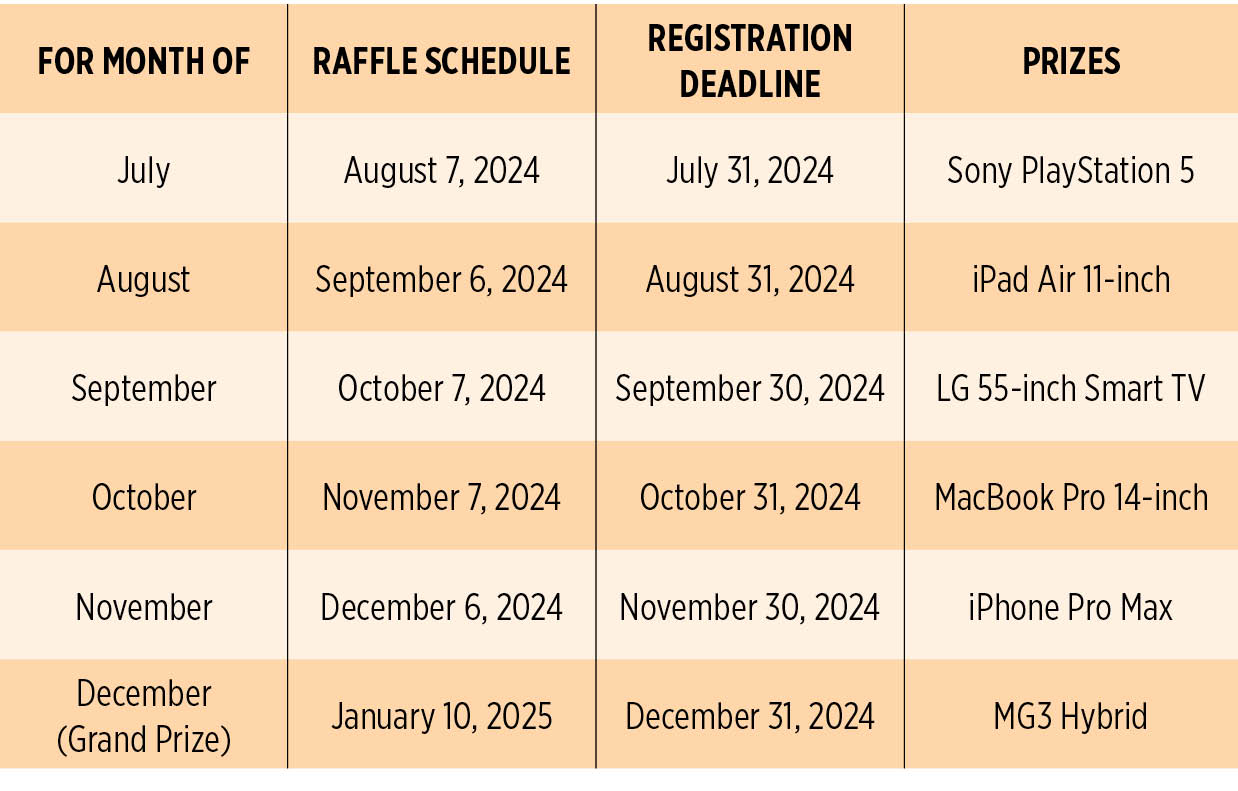
From July 22 to Dec. 31, 2024, MG customers can get up to 15% discount on parts and labor, and stand a chance to win an MG3 Hybrid+ and other prizes. Preventive maintenance schedule (PMS) work, prepaid PMS, general job repairs, and body repair services worth a minimum of P2,000 (net of discounts) per visit are entitled to a free 36-point safety checkup, up to 15% discount on parts and up to 10% discount on labor, and earn for the customer one raffle coupon per service transaction.

People who purchase any of the participating MG vehicles during the program period will receive two raffle coupons. Participants must fill out the registration form after scanning the QR code located at the dealer’s transaction area to earn their raffle entry.


“Year 2024 has been a landmark year for the iconic British brand in the Philippines,” said SAIC Motor Philippines, Inc. in a release. The company made its foray into the hatchback segment with the MG3, and introduced the MG ONE, Cyberster, G50 Plus, and more.

Monthly winners can still join the subsequent draws and the grand raffle. Losing entries from the monthly draws will be included in the succeeding draws, giving participants multiple chances to win. Said MG Philippines President Felix Jiang, “MG has been a part of automotive innovation for 100 years, providing quality vehicles and exceptional service. Our commitment to excellence continues as we celebrate this milestone and look forward to many more years of serving our customers.”

For more info, visit www.mgmotor.ph or any MG dealership.

Here is the raffle schedule, along with the prizes.

ICTSI shares up on new equipment news, Q2 earnings prospects

RAZON-LED International Container Terminal Services, Inc. (ICTSI) was the most actively traded stock last week, with its share price rising following news of the commissioning of three new cranes and the commencement of its Berth 8 expansion at its Manila terminal.

Data from the Philippine Stock Exchange showed that ICTSI was the most actively traded stock in terms of value turnover, with P2.84 billion worth of 8.04 million shares exchanging hands from July 29 to Aug. 2.

The listed port operator’s shares closed at P350 each on Friday, 1.4% lower than its July 26 close of P355. Year to date, the stock has increased by 41.8%.

Rastine Mackie D. Mercado, research director at China Bank Securities Corp., said that positive global macroeconomic trends, such as expectations of a soft landing for the US economy and the prospects of interest rate cuts from the US Federal Reserve and the Bangko Sentral ng Pilipinas, have supported the listed port operator’s price action this week.

Similarly, Jeff Radley C. See, head trader at Mercantile Securities Corp., noted that bullish sentiment has lifted the index, as the US Fed is likely to begin rate cuts in September 2024.

“The [second-quarter] earnings report is what investors are anticipating that the company will be reporting good earnings,” Mr. See said in a Viber message.

Last week, the Enrique K. Razon, Jr.-led company saw developments including the full operation of its three new quay cranes at Manila International Container Terminal (MICT).

In a statement, MICT Chief Executive Officer Christian L. Lozano said that this acquisition is a significant step for MICT’s expansion and modernization. The addition of quay cranes will enable more efficient handling of cargo loads, leading to faster vessel turnaround times and improved operations overall.

ICTSI also stated that the commissioning of these three cranes demonstrates MICT’s commitment to providing the highest levels of port services and enhancing the terminal’s capacity to handle the growing demands of modern container shipping.

MICT is one of the three terminals in the Port of Manila and has the largest quay crane fleet with 18 units. The additional cranes have improved operational efficiencies, allowing the terminal to better manage peak periods and high cargo volumes, ensuring smoother and more predictable operations for all stakeholders, ICTSI also said in its statement.

Additional reports show that the Manila terminal has begun the second phase of its Berth 8 expansion, which will include building a 300-meter wharf and a 10-hectare container yard. Upon completion, the expansion will increase MICT’s capacity by 200,000 twenty-foot equivalent units (TEUs) to 3.5 million TEUs.

Berth 8 will be equipped with three quay cranes to efficiently handle ultra-large container vessels with capacities of up to 18,000 TEUs. These new cranes are scheduled to arrive in 2027, ICTSI said.

“The second phase of development for MICT’s Berth 8 will increase the terminal’s throughput capacity by 6%, which should further support ICT’s thrust to expand volumes,” Mr. Mercado said in an e-mail.

He added that the commissioning of three new quay cranes should benefit ICTSI in terms of operational efficiency, increased volume, and potential margin improvements.

In the first quarter, ICTSI reported a 35.7% year-on-year rise in its attributable net income to $209.88 million. Its consolidated revenues also grew by 15.4% to $685.19 million.

Mr. Mercado estimates that core earnings for the full year 2024 will reach $740 million.

Expectations of continued earnings growth, resulting from volume expansion and robust yields per TEU amidst upward tariff adjustments across its global terminals, could entice investors to consider the port operator, Mr. Mercado said.

“Capacity expansion through either organic or M&A (merger and acquisition) opportunities (i.e., Durban terminal in South Africa, MICT), and attractive dividend prospects given expectations of earnings growth” can also be considered by investors.

“We see current support at P349, while resistance is at P370,” Mr. Mercado said.

For Mr. See, technically speaking, “the chart made a bearish divergence as the price continues to rise but RSI (relative strength index) indicator is showing a decrease in strength.”

He pegged support levels at P388 and P315, while resistance levels at P360, and 373, respectively. — Abigail Marie P. Yraola

Yields on gov’t debt rally amid policy easing hopes

YIELDS on government securities (GS) traded in the secondary market went down last week amid heightened expectations of rate cuts by both the Bangko Sentral ng Pilipinas (BSP) and the US Federal Reserve.

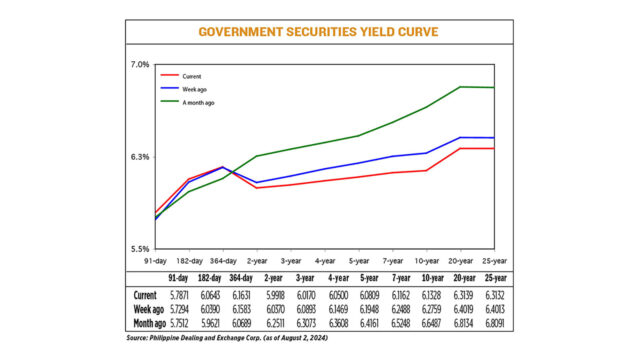
Bond yields, which move opposite to prices, fell by an average of 6.29 basis points (bps) week on week, based on PHP Bloomberg Valuation Service Reference Rates data as of Aug. 2 published on the Philippine Dealing System’s website.

At the short end of the curve, rates went up. Yields on the 91-, 182- and 364-day Treasury bills rose by 5.77 bps (to 5.7871%), 2.53 bps (6.0643%) and 0.48 bp (6.1631%), respectively.

Meanwhile, yields on Treasury bonds (T-bonds) went down across all tenors last week.

At the belly of the curve, the two-, three-, four-, five- and seven-year T-bonds declined by 4.52 bps (to 5.9918%), 7.23 bps (6.0170%), 9.69 bps (6.0500%), 11.39 bps (6.0809%), and 13.26 bps (6.1162%), respectively.

Lastly, at the long end of the yield curve, the 10-, 20-, and 25-year debt papers likewise saw their rates fall by 14.31 bps (to 6.1328%), 8.8 bps (6.3139%), and 8.81 bps (6.3132%) respectively.

GS volume traded stood at P31.8 billion on Friday, lower than the P34.19 billion recorded on July 26.

“Optimism on an August rate cut by BSP pushed domestic yields lower, supported by Fed Chair Jerome H. Powell’s statements suggesting a cut in borrowing costs could be on the table,” Jonathan L. Ravelas, senior adviser at Reyes Tacandong & Co., said in a Viber message.

“Local fixed-income markets had a strong rally to end July, mirroring the sharp decrease in US Treasury yields overseas. The long-end tenors were once again the winner for last week’s session as the investors stocked up on duration in anticipation of the expected rate cuts by the BSP in the following months,” Alessandra P. Araullo, chief investment officer at ATRAM Trust Corp., likewise said in a Viber message.

Mr. Powell’s dovish remarks at the close of the Federal Open Market Committee’s July 30-31 meeting also caused GS yields to go down, she added.

“Market players were keen on risk-taking as the longer-term bonds were heavily lifted. Bonds with maturities of more than 10 years saw yields decrease by an average of 12 bps,” Ms. Araullo said.

BSP Governor Eli M. Remolona, Jr. earlier said the Monetary Board may deliver its first rate cut in over three years at its Aug. 15 review — the only policy meeting scheduled in the third quarter — as they expect inflation to continue easing this semester.

The Monetary Board could reduce borrowing costs by 25 bps in the third quarter and by another 25 bps in the fourth quarter, he said.

The BSP in July kept its policy rate at a 17-year high of 6.5% for a sixth straight meeting after raising interest rates by a cumulative 450 bps from May 2022 to October 2023.

Meanwhile, Mr. Powell said on Wednesday interest rates could be cut as soon as September if the US economy follows its expected path, putting the central bank near the end of a more than two-year battle against inflation but square in the middle of the nation’s presidential election campaign, Reuters reported.

The Fed ended its latest two-day policy meeting with a decision to hold its benchmark interest rate steady in the 5.25%-5.5% range that was set a year ago, but its statement softened the description of inflation and said the risks to employment were now on a par with those of rising prices — neutral language that opens the door for rates to fall after more than two years of tightening credit.

Mr. Powell pushed the message even further forward in his post-meeting press conference, noting that price pressures were now easing broadly in the economy — what he called “quality” disinflation — and that if coming data evolve as anticipated, support for cutting rates will grow.

Investors saw Mr. Powell’s comments as clearly setting the stage for a reduction in borrowing costs at the Fed’s Sept. 17-18 meeting.

Meanwhile, weak US data reaffirmed investor worries last week, fueling a sell-off in global equities and pressuring US Treasury yields to multi-month lows, Reuters reported.

The US Labor department reported last week that the US unemployment rate jumped to near a three-year high of 4.3% in July amid a significant slowdown in hiring.

July US nonfarm payrolls report, which showed job growth slumped to 114,000 new hires in July from 179,000 in June.

The market mood soured after data showed a measure of manufacturing activity from the Institute for Supply Management dropped to an eight-month low in July at 46.8.

The yield on benchmark US 10-year notes fell 18 bps to 3.798%. The 2-year note yield, which typically moves in step with interest rate expectations, fell 28.5 bps to 3.8798%.

For this week, Ms. Araullo said the release of July Philippine inflation data will be a major driver for yields.

“The BSP has estimated the year-on-year figure to fall between 4.0% and 4.8%, which is higher than June’s 3.7%. A further upside surprise may cause investors to take profit and we may finally see some short-term market correction,” she said.

The Philippine Statistics Authority is set to release inflation data on Tuesday (Aug. 6).

A BusinessWorld poll of 15 analysts last week yielded a median estimate of 4% for the consumer price index in July. This matches the lower end of the BSP’s forecast.

If realized, July inflation would be faster than 3.7% in June but slower than 4.7% a year earlier. It would also mark the eighth straight month that inflation settled within the BSP’s 2-4% annual target.

“Another event that may affect yield movement is the five-year bond auction. Investors may look to trim some positions in anticipation of the fresh supply,” she added.

On Tuesday, the Treasury will offer P30 billion in reissued seven-year T-bonds with a remaining life of four years and nine months.

For his part, Mr. Ravelas said GS yields could move sideways to lower in the near term ahead of the BSP’s expected monetary easing. — Lourdes O. Pilar with Reuters

‘Disastrous’ drought threatens to wipe out Sicilian goat breed

REUTERS

SAN CATALDO, Italy — A blazing sun shining on the arid hills of San Cataldo in Sicily signals only despair for goat breeder Luca Cammarata as he tries to find something for his herd to eat among the barren landscape.

“The grazing land is zero,” Mr. Cammarata told Reuters, looking sadly at his Girgentana goats, a local breed that he and his fellow herders have sought to protect and nurture but which is now threatened with extinction.

A water shortage is hitting central areas of Sicily such as San Cataldo, in the province of Caltanissetta, very hard, and reservoirs are running dry or operating at very low levels.

A prolonged drought last year led Sicilian authorities to ration water, even for domestic use in major cities.

Breeders, struggling to get their water, now fear they may soon be forced to send the animals, bred for centuries for dairy products including ricotta cheese, to slaughter.

“There is no other way, no other solution,” Mr. Cammarata said. “If every last drop of water falling from the sky is not collected, Sicily will become a desert.”

The cost of water consumption has doubled for Mr. Cammarata and he has to rely on the Carabinieri Forestry Department’s tanker truck that every 15 days reaches the province’s farms and livestock breeders.

“We are giving support to these farms struggling with this unprecedented drought,” said Alessandro Panzarella, a member of the Carabinieri Command for Forest, Environment and Agri-Food, who with his olive-green tanker truck drives along arid and dusty roads to help bring vital supplies.

“With only one tanker truck for the whole province, it becomes impossible to meet the needs of all the farmers,” he said. “We visit many farms throughout the province of Caltanissetta and the situation is disastrous.”

Agricultural production across Italy shrank last year as wine, fruit and olive oil output all took a hit from extreme weather events linked to climate change.

Sicily has suffered months of below-average rainfall, with the Italian government declaring a state of emergency. The island has suffered with climate change-related high temperatures, setting a European heat record in 2021 of 48.8 degrees Celsius. — Reuters

We stand for integrity

PRESSFOTO-FREEPIK

Unethical business practices undermine social progress and result in inequality. They also break trust and tarnish the reputation of those involved in unprofessional conduct. Most importantly, unethical practices in the healthcare sector harm patients and their families.

In a show of commitment to ethical business practices, the Pharmaceutical and Healthcare Association of the Philippines (PHAP) has reinvigorated its “I Stand for Integrity” campaign, which was first launched in 2013.

This initiative underscores the crucial role of integrity in advancing patient welfare, good corporate citizenship, and healthcare innovation in the country. The reaffirmation of the campaign for integrity was participated in by key figures from government, professional healthcare organizations, patient advocacy groups, and the media. Their presence highlighted a unified and multi-stakeholder approach to attain ethical standards in the healthcare community.

PHAP President Dr. Diana Edralin emphasized the campaign’s significance.

“The biopharmaceutical industry is unlike any other. Our innovations can prolong and save lives. We continue to hold ourselves to high standards. We owe it to the patients who rely on our medicines,” she said.

Various groups expressed support for the campaign. They are the House of Representatives Committee on Health, the Philippine Competition Commission, the Professional Regulation Commission, the Philippine Medical Association, the Philippine College of Physicians, the Philippine Hospital Association, the Private Hospitals Association of the Philippines, the Philippine Alliance of Patient Organizations, the Cancer Warriors Foundation, the Baguio City Health Committee, the Philippine Press Institute, the Philippine Nurses Association,  and the Anti-Red Tape Authority, among others.

During the reinvigorated campaign, PHAP showcased its initiatives that seek to raise the level of professionalism and ethical conduct in the pharmaceutical industry.

First is the PHAP Code of Practice.

Launched in 1993, the organization established the PHAP Code of Practice to ensure that medical decisions are made in the best interests of patients.

The Code of Practice fully adopted the Department of Health Administrative Order 2015-0053 Implementing Guidelines on the Promotion and Marketing of Prescription Products and Medical Devices. This aims to ensure that ethical interactions between industry and other stakeholders shall be guided by the principles embodied in the 2011 Mexico City and Kuala Lumpur Business Codes of Ethics as endorsed by heads of states of APEC Member economies, including the Philippines.

The MCP guiding principles are: Healthcare and Patient Focus, Integrity, Independence, Legitimate Intent, Transparency, Accountability, Appropriateness and Advancement.  All of these are aligned with the PHAP Code of Practice.

The PHAP Code also has enforcement mechanisms, and these are overseen by an independent Ethics Committee.

The second initiative is the organization’s compliance with the Food and Drug Administration’s AO No. 2021-0036 which requires industry members to “Submit Reports on Disclosure of Financial Relationships with Health Care Providers and Health Care Professionals.”

Since its establishment in 2021, PHAP member companies have been diligently complying with FDA AO 2021-0036 by submitting financial reports through the FDA Online Financial Disclosure System. Adherence to this system promotes transparency in interactions with healthcare professionals and stakeholders which is key to being viewed as trustworthy partners.

The third undertaking is the Integrity and Proficiency Program for the Pharmaceutical Sector (IPPS).

The IPPS is a training tool for cascading proficiency and ethical practices. The modules include “Jurisprudence and Business Ethics.” This program has been accredited by the PRC since 2013. There are around 6,769 medical representatives certified by the IPPS since 2015.

The fourth is the Philippine Consensus Framework for Ethical Collaborations.

Since 2018, PHAP adopted the “Consensus Framework for Ethical Collaboration Between Patients’ Organizations, Healthcare Professionals, and the Pharmaceutical Industry.”

This Consensus Framework was developed in 2014 by global umbrella organizations namely the International Alliance of Patient Organizations, the World Medical Association, the International Council of Nurses, the International Federation of Pharmaceutical Industry Associations, the International Pharmaceutical Federation, and the International Hospital Federation.

In 2020, various organizations ratified our own Philippine Consensus Framework with 20 signatories.  Among them are the Philippine Alliance of Patient Organizations, the Philippine Medical Association, the Philippine Pharmacists Association, and the Philippine Nurses Association along with and a number of DoH-retained hospitals. Now, all 87 DoH-retained hospitals are signatories to the Consensus Framework.

Fifth is the “Data Privacy Protection in the Pharma Industry” program. PHAP, in partnership with the National Privacy Council, is currently developing the Pharma Data Privacy Code in collaboration with the National Privacy Commission Council.

Apart from these five initiatives, individual members of PHAP have put in place their own rules and policies that govern their interactions.

With all these frameworks in place, the biopharmaceutical industry is confident that its members can act with integrity in their interactions. Together with the various sectors, we stand, and will continue to stand, for integrity.


Teodoro B. Padilla is the executive director of Pharmaceutical and Healthcare Association of the Philippines (PHAP). PHAP represents the biopharmaceutical medicines and vaccines industry in the country. Its members are in the forefront of research and development efforts for COVID-19 and other diseases that affect Filipinos.

Style (08/05/24)


Ariana Grande: Swarovski’s new ambassador

SWAROVSKI is joining forces with singer Ariana Grande as its new ambassador and face of the brand. This partnership unites two icons of pop culture and will be launched with a Holiday Campaign in 2024. The Grammy-winning singer, songwriter, and actress (who is playing Glinda for the movie version of the musical Wicked) is among the world’s best-selling artists and is also an advocate for inclusivity and empowerment. Ms. Grande said: “I am thrilled to be Swarovski’s Brand Ambassador. It’s an honor to represent a house that shares my passion for creativity, pushes the boundaries beyond the world of jewelry and promotes values of unapologetic self-expression.” Giovanna Engelbert, Swarovski Global Creative Director, said: “Ariana’s charisma and positive energy resonate with Swarovski’s essence of bringing joy to the world and I am thrilled that she is joining us as Brand Ambassador.”


Longchamp emphasizes longevity

LONGCHAMP aims to establish responsible practices in the fashion industry and has expressed a desire to reduce its environmental impact. Adrien Cassegrain, Longchamp’s Director of Transformation, said, “Our foremost responsibility? Ensuring the longevity of our products.” The brand’s true DNA lies in its leathers, sourced from tanneries certified by the Leather Working Group. In 2023, 79% of the leathers used by Longchamp attained the Gold distinction, the highest level of certification, ensuring stringent environmental and social standards. Longchamp goes a step further by embracing more environmentally conscious materials. Since 2019, the brand has introduced various product ranges crafted from recycled materials. The Le Pliage bag, revamped with a canvas woven from recycled fibers, demonstrates this evolution. This transition has slashed the carbon footprint of each Le Pliage bag by nearly 20%. Examples of this eco-conscious strategy in the new FW 2024 collection are included in ready-to-wear, with the kimono jacket in recycled polyester and the line of sneakers crafted entirely from recycled materials. The Maison not only produces durable items but also repurposes end-of-roll materials to create new pieces. “This approach has long been part of our ethos,” said Mr. Cassegrain. “We develop products using old materials; this anti-waste stance is simply common sense.” Bags from the Re-Play collection align with this logic, such as this season’s Cabas Longchamp from the Re-Play line (a new bag crafted from end-of-roll nylon from previous Le Pliage collections). Some models from the Epure line also follow the logic of creating something new from old stocks by reusing cowhide leather from previous seasons. Initiatives aimed at sustainability extend beyond production. The brand is committed to ensuring that each product can be repaired, thereby extending its lifespan. Longchamp’s repair service, handling nearly 60,000 products annually, embodies this commitment to a circular economy.


Givenchy releases new fragrances

THE PERFUME Irresistible, created in 2020, has a new companion with Givenchy Irresistible Eau de Parfum Very Floral. The Essential Laboratoire Monique Rémy rose — a signature ingredient in the Irresistible fragrances — is combined, for the first time, with a Centifolia rose absolute from Grasse. This signature duo with intense, textured facets blends perfectly with a white flower bouquet — a debut accord in Irresistible compositions. The latter notes of a Madagascar ylang-ylang heart and an Indian Sambac jasmine absolute. Eau de Parfum Very Floral Irresistible contains notes of a French blackcurrant bud absolute and the freshness of a coconut water accord. Its woody, vibrant cashmeran base notes and pure Virginia cedar heart mingle with ambrette seed absolute, revealing a deep, naturally musky trail. Givenchy Irresistible Eau de Parfum Very Floral is available in 35 ml (P5,950), 50  ml (P8,250) and 80ml (P9,650) formats. For the men, Givenchy is launching Gentleman Society Eau de Parfum Extrême. It bears Givenchy fragrances’ olfactory signature: the duality of a flower-wood pairing reinvented by master perfumer Karine Dubreuil. The top notes open on a new spiced and aromatic scent: peppermint essence fuses with clary sage, contrasting with nutmeg. The heart accord of the original Gentleman Society Eau de Parfum (narcissus absolute, iris concrete, and a quartet of vetivers) garners texture thanks to an unexpected Ethiopian coffee absolute. This coffee note seems to be frosted thanks to the fragrance’s peppermint top notes. Organic cedar from the Himalayas and sandalwood from Australia — already present in the Eau de Parfum — are heightened by Indonesian patchouli essence and the base notes of vanilla absolute. Givenchy Gentleman Society Eau de Parfum Extrême is available in 60 ml (P6,950) and 100 ml (P8,950) formats. Givenchy Fragrances is exclusively distributed by Rustan Marketing Corp. and is available at Rustan’s, select The SM Stores, The Landmark, LOOK, Robinsons Place Manila; and online at Rustans.com.

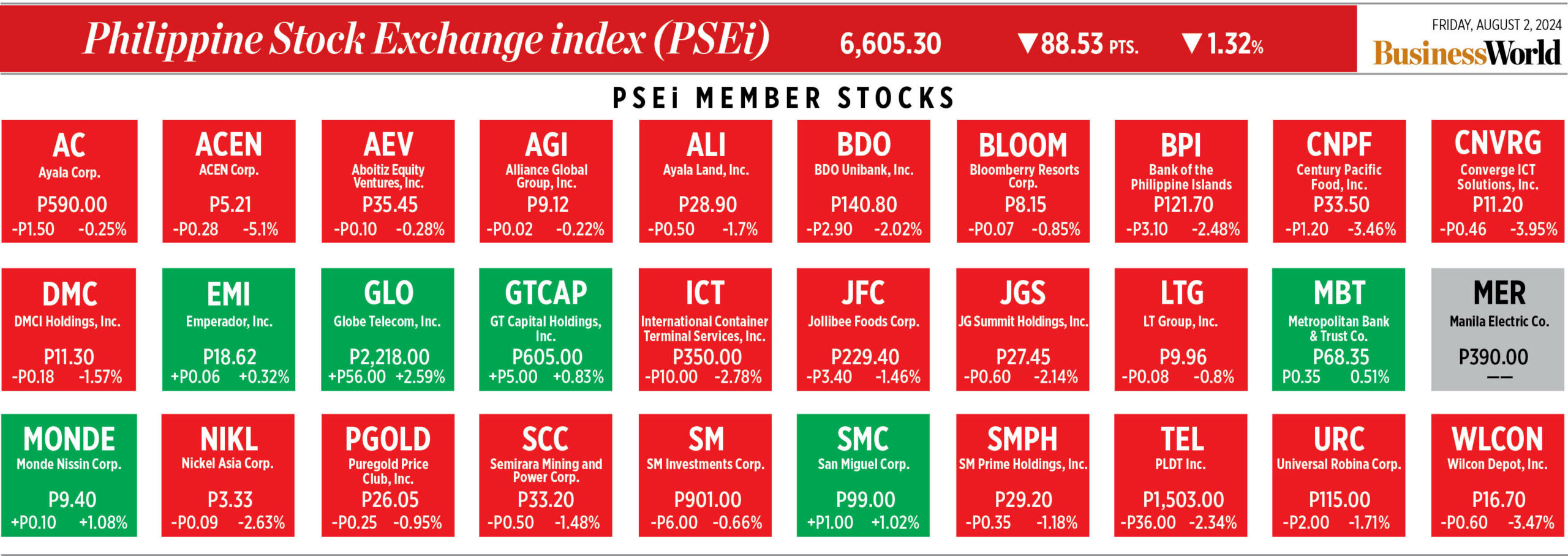
How PSEi member stocks performed — August 2, 2024

Here’s a quick glance at how PSEi stocks fared on Friday, August 2, 2024.


Peso may strengthen, return to P57 level on weak US jobs data

THE PESO may continue to strengthen and return to the P57 level against the dollar this week following a weak US jobs report and before the release of July Philippine inflation data.

The local unit ended at P58.08 per dollar on Friday, strengthening by 25.3 centavos from its P58.333 finish on Thursday, Bankers Association of the Philippines data showed.

This was the peso’s best finish in more than two months or since its P57.97-per-dollar close on May 28.

Week on week, the peso likewise strengthened by 27 centavos from its P58.35 close on July 26.

“Asian currencies strengthened against the dollar, driven by growing dovish sentiment towards the US Federal Reserve’s monetary policy. This shift in market expectations follows the release of weak US economic data, prompting investors to price in additional rate cuts from the Fed. The currency pair experienced significant selling pressure as a result,” Security Bank Corp. Chief Economist Robert Dan J. Roces said in a Viber message.

The peso was also supported by the Japanese yen’s continued appreciation against the dollar after the Bank of Japan unexpectedly hiked rates at its meeting last week, Rizal Commercial Banking Corp. Chief Economist Michael L. Ricafort said in a Viber message.

The dollar slipped on Friday as investors fretted US payrolls data could be weak after an unexpected slump in manufacturing raised concerns about a slowdown in the world’s largest economy and lifted traditional safe-haven currencies, Reuters reported.

The yen firmed, pushing the dollar down 0.2% to 149.04, building on gains in the wake of a Bank of Japan decision to raise rates and strengthening as far as 148.51 overnight for the first time since mid-March.

The dollar slipped 0.3% against a basket of other major currencies to trade at 104.06.

Released after Asian trade, Friday’s US jobs report showed job growth slowed more than expected in July and unemployment increased to 4.3%, pointing to possible weakness in the labor market and greater vulnerability to recession.

Markets were already rattled by downbeat earnings updates from Amazon and Intel and Thursday’s softer-than-expected US factory activity survey in addition to the monthly US nonfarm payrolls report, which showed job growth slumped to 114,000 new hires in July from 179,000 in June.

The data raised expectations of multiple rate cuts by the Federal Reserve this year, which just last week opted to keep rates unchanged.

The Fed has kept benchmark borrowing costs at a 23-year high of 5.25%-5.5% for a year, and some analysts believe the world’s most influential central bank may have kept monetary policy tight for too long, risking a recession.

Money markets on Friday rushed to price a 70% chance of the Fed, which was already widely expected to cut rates from September, implementing a jumbo 50 basis points cut next month to insure against a downturn.

For this week, Mr. Roces said the US jobs report will be the main driver of foreign exchange trading.

“This crucial economic indicator is likely to provide further insights into the US labor market’s health and could potentially reinforce or challenge current market expectations regarding the Fed’s future policy decisions,” he said.

The release of July Philippine inflation data will also affect the peso’s movement against the dollar this week, Mr. Ricafort added.

A BusinessWorld poll of 15 analysts last week yielded a median estimate of 4% for the consumer price index in July. This matches the lower end of the Bangko Sentral ng Pilipinas’ (BSP) forecast for the month.

If realized, July inflation would be faster than 3.7% in June but slower than 4.7% a year earlier.

It would also mark the eighth straight month that inflation settled within the BSP’s 2-4% annual target.

The Philippine Statistics Authority is set to release inflation data on Tuesday (Aug. 6).

Mr. Ricafort expects the peso to move between P57.80 and P58.30 per dollar this week. — A.M.C. Sy with Reuters

Stocks to rise as market awaits BSP, Fed easing

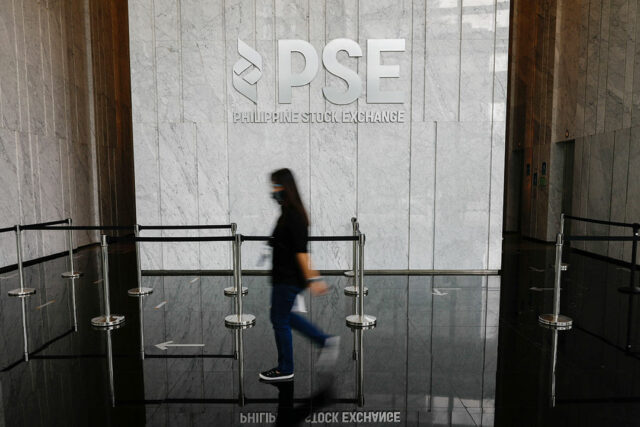
The lobby of the Philippine Stock Exchange in Taguig City, Sept. 30, 2020. — REUTERS

PHILIPPINE SHARES are expected to climb this week amid growing expectations of benchmark interest rate cuts from both the Bangko Sentral ng Pilipinas (BSP) and the US Federal Reserve.

On Friday, the bellwether Philippine Stock Exchange index (PSEi) fell by 1.32% or 88.53 points to end at 6,605.30, while the broader all shares index retreated by 0.88% or 32.28 points to finish at 3,596.90.

Week on week, the PSEi dropped by 1.79% or 120.71 points from its 6,726.01 close on July 26.

“The local market extended its decline to a second week, shedding 1.79% after failing to take its 6,700-6,800 resistance range,” Philstocks Financial, Inc. Senior Research Analyst Japhet Louis O. Tantiangco said in a Viber message.

“On a positive note, the market remains above its 50-day and 200-day exponential moving averages. Trading remains tepid, however, as many are still on the sidelines,” he added.

For this week, Philippine stocks may rise on bargain hunting amid expectations of lower borrowing costs, Mr. Tantiangco said.

“Growing hopes of monetary easing in the Philippines and the United States soon following recent dovish cues from both the BSP and the Federal Reserve may help the market climb this week,” he said. “However, the recession fears in the US, if it lingers this week, are seen as a downside risk to the local bourse.”

BSP Governor Eli M. Remolona, Jr. last week said that they could cut benchmark rates by 25 basis points (bps) at their Aug. 15 meeting, and by another 25 bps later in the year.

The BSP has kept its policy rate at a 17-year high of 6.5% since October 2023.

Meanwhile, employers added just 114,000 jobs in July, the US Labor department reported, and the unemployment rate rose to 4.3%, from 4.1% in June, marking an unexpected deterioration in a labor market that had held up surprisingly well during the US Federal Reserve’s aggressive rate-hike campaign in 2022 and 2023, Reuters reported.

The data prompted traders to pile into bets that the Fed will deliver a half-percentage-point rate cut at its Sept. 17-18 meeting, and drive borrowing costs down further from there, with the policy rate expected to end 2024 in the 4%-4.25% range.

“Investors may also take cues from our upcoming macroeconomic data including the July inflation rate, June labor force survey, and second-quarter gross domestic product. Investors are also expected to continue monitoring corporate results,” Mr. Tantiangco said.

“Philippine inflation to be released on Aug. 6 is expected to pick up in July from 3.7% in June, largely due to massive damage by Typhoon Carina, though offset by lower tariffs that effectively provided a 20% discounted on imported rice,” Rizal Commercial Banking Corp. Chief Economist Michael L. Ricafort said in an e-mail.

For its part, online brokerage 2TradeAsia.com said in a market note that the PSEi’s immediate support is at 6,600-6,650 and resistance is at 6,900. — Revin Mikhael D. Ochave with Reuters