Home Blog Page 247

FDI inflows sink to over 5-year low

US dollar banknotes are seen in this photo illustration taken Feb. 12, 2018. — REUTERS

By Katherine K. Chan

NET INFLOWS of foreign direct investments (FDI) into the Philippines plunged to their lowest monthly level in over five years in September, the Bangko Sentral ng Pilipinas (BSP) reported on Wednesday.

Based on preliminary central bank data, FDI net inflows fell by 25.8% to $320 million from $432 million a year ago.

This marked the lowest monthly FDI inflow in more than five years or since the $313.79 million recorded in April 2020.

Month on month, inflows sank by 37.7% from $514 million in August.

“Foreign direct investments into the Philippines posted net inflows of $320 million in September 2025,” the BSP said in a statement on Wednesday. “Japan was the top source of FDIs, while manufacturing was the biggest recipient of FDIs during the month.”

Investments in equity and investment fund shares rose by 27.8% to $120 million in September from $94 million in the same month in 2024.

Net investments in equity capital other than reinvestment of earnings soared to $35 million, nearly five times (378.2%) the $7 million seen a year earlier.

Broken down, equity capital placements jumped by an annual 20.8% to $99 million, while withdrawals fell by 14.4% to $64 million.

Nonresidents’ reinvestment of earnings also dipped by 2.1% to $84 million in September from $86 million last year.

Meanwhile, net investments in debt instruments dropped by 40.7% to $201 million from $338 million a year prior.

These consisted mainly of intercompany borrowing or lending between foreign direct investors and their subsidiaries or affiliates in the Philippines, according to the central bank.

Union Bank of the Philippines Chief Economist Ruben Carlo O. Asuncion said a combination of global and domestic factors dragged FDI net inflows to an over five-year low.

“Globally, investors remain cautious amid slower growth in major economies and persistent geopolitical uncertainties,” he said in a Viber message.

“Domestically, while reforms like CREATE MORE (Corporate Recovery and Tax Incentives for Enterprises to Maximize Opportunities for Reinvigorating the Economy) and infrastructure programs are positive signals, structural bottlenecks and policy clarity issues continue to weigh on investor confidence.”

Economic managers have said that the ongoing flood control controversy that linked government officials, lawmakers and private contractors to massive corruption in public infrastructure projects weighed on business and investor sentiment.

Meanwhile, Jonathan L. Ravelas, a senior adviser at Reyes Tacandong & Co., also attributed the slump in foreign investments to high borrowing costs.

“September’s FDI slump to a five-year low reflects global uncertainty, high borrowing costs, and lingering policy gaps,” he said in a Viber message.

LOWER NINE-MONTH FDI

For the first nine months of 2025, FDIs dropped by 22.2% to $5.537 billion from $7.118 billion in the same period last year.

This, as investments in equity and investment fund shares stood at $1.905 billion as of September, down by 16.8% from $2.289 billion the previous year.

Net foreign investments in equity capital, excluding reinvestment of earnings, went down by 33.3% year on year to $905 million at end-September from $1.357 billion a year ago.

Equity capital placements declined by 18.3% to $1.463 billion, while withdrawals rose by 28.7% to $558 million.

In the nine-month period, placements mostly came from Japan, the United States and Singapore, the central bank said.

“Industries that received most of these investments were manufacturing, wholesale and retail trade, and real estate,” the BSP added.

On the other hand, reinvestment of earnings climbed by 7.3% year on year to $1 billion by the end of September from $932 million previously.

BSP data also showed that nonresidents’ net investments in debt instruments of local affiliates declined by 24.8% to $3.632 billion as of September from $4.829 billion in the comparable year-ago period.

According to the central bank, the total FDI net inflows in the nine months to September accounted for 1.6% of the country’s gross domestic product.

Mr. Ravelas said meeting the BSP’s $7.5-billion FDI net inflow forecast for 2025 is “possible but tough.”

“With $5.5 billion so far, hitting BSP’s $7.5-billion target will need a strong Q4 rebound — possible but tough without fresh reforms,” he said. “[There could be] modest inflows in manufacturing and real estate if confidence improves.”

He added that the local manufacturing and real estate sectors may see modest gains in foreign investments if investor confidence rebounds.

“For businesses, now’s the time to push clarity and competitiveness to attract capital,” he said.

Meanwhile, Mr. Asuncion noted that the country’s policy implementation and investment climate will determine whether it can sustain improvements in FDI inflows.

“Looking ahead, we expect modest recovery in FDI inflows as reforms gain traction, but sustained improvement will depend on consistent policy execution and a more competitive investment environment,” he said.

ADB says PHL still likely to post second-fastest growth in Southeast Asia

People stand near a wrecked part of the Baler-Casiguran Road a day after Typhoon Fung-wong made landfall in Dipaculao, Aurora, Philippines, Nov. 10. -- REUTERS

THE ASIAN Development Bank (ADB) slashed its growth forecasts for the Philippines for this year and 2026 but it is still expected to be the second-fastest growing economy in Southeast Asia.

In its December Asian Development Outlook (ADO), the multilateral lender slashed its Philippine gross domestic product (GDP) growth forecast to 5% from 5.6% in September.

For 2026, the ADB trimmed its Philippine growth forecast to 5.3% from 5.7% previously.

These latest projections are below the government’s 5.5-6.5% target for this year, and the 6-7% growth goal for 2026 to 2028.

In its report released on Wednesday, the ADB said the lower growth prospects for the Philippines were “due to weak infrastructure spending amid investigations of publicly funded projects, and natural hazards.”

Data from the Department of Budget and Management showed that expenditure on infrastructure and other capital outlays for the January-to-September period declined by 10.7% to P877.1 billion from P982.4 billion a year ago.

Sluggish infrastructure spending, affected by adverse weather and stricter fund releases to the Department of Public Works and Highways, dragged Philippine GDP growth to a weaker‑than‑expected 4% in the third quarter. This brought the nine‑month average growth to 5%.

“Low inflation and ongoing monetary easing should sustain domestic demand, supporting stronger growth in 2026,” the ADB said.

The Bangko Sentral ng Pilipinas has so far reduced borrowing costs by a cumulative 175 basis points (bps) since it began its easing cycle in August last year, bringing the key rate to 4.75%.

“However, uncertainties arising out of investigations of publicly funded infrastructure projects and weather-related disruptions pose downside risks,” it added.

A corruption scandal involving anomalous flood control projects has already triggered protests, slowed economic activity, and shaken investor confidence in the country.

An independent commission is now investigating the allegations that government officials, lawmakers and contractors received billions of pesos in kickbacks from anomalous projects.

STILL SECOND FASTEST

Based on the latest ADO, the Philippines is still projected to be the second fastest-growing economy in Southeast Asia this year, just behind Vietnam (7.4%) and tied with Indonesia (5%). It is ahead of Malaysia (4.5%), Singapore (4.1), and Thailand (2%).

For 2026, the Philippines is still seen to post the second-fastest growth in Southeast Asia, after Vietnam’s 6.4%.

The ADB expects Philippine growth to stay above the Southeast Asian average through 2026.

For the region, the bank raised its regional GDP growth outlook to 4.5% this year from 4.3% in its September update. It also hiked its projections to 4.5% in 2026 from 4.4% previously.

This reflects stronger‑than‑expected third‑quarter results in Indonesia, Malaysia, Singapore, and Vietnam, alongside better external environment and supportive government expenditures, the ADB said.

“Several risks to the subregion’s (Southeast Asia) prospects remain, notably from global uncertainty, climate-related disruptions, and domestic political developments,” the ADB said.

Despite these risks, the lender said the Southeast Asian region remains resilient, with prospects depending on sustained policy support and flexible economic strategies.

However, the ADB’s Philippine growth forecast was slightly below the projected 5.1% growth of developing Asia for this year but exceeded the 4.6% growth forecast in 2026.

Developing Asia includes 46 Asia-Pacific countries, but excludes Japan, Australia, and New Zealand.

Meanwhile, the ADB expects Philippine headline inflation to average 1.8% this year and 3% in 2026, unchanged from its September forecast.

This is slightly higher than the Bangko Sentral ng Pilipinas’ (BSP) 1.7% average forecast for this year, but lower than the 3.3% average forecast for 2026.

Headline inflation averaged 1.6% in the first 11 months of 2025, according to the Philippine Statistics Authority.

Meanwhile, the Mastercard Economics Institute (MEI) gave a 5.6% growth forecast for the Philippines in 2026, which will make it the fastest-growing economy among the Association of Southeast Asian Nations-5 (ASEAN-5).

This is ahead of Indonesia (5%), Malaysia (4.2%), Singapore (2.2%), and Thailand (1.8%).

“In 2026, the growth trajectories of the ASEAN-5 nations are expected to diverge. GDP is projected to expand steadily in Indonesia and the Philippines, while Malaysia, Singapore, and Thailand may grow more slowly,” MEI said in its December Economic Outlook 2026.

MEI also expects Philippine inflation to settle at 2.8% next year.

“Because that is within the target range, further monetary policy easing may be possible; interest rates are expected to fall to 4.5% by the end of 2026,” it said.

MEI said strong borrowing momentum may fuel private consumption, while lower policy rates may help sustain this trend.

The report noted travel is a key economic driver, with domestic demand climbing in Malaysia and Indonesia and outbound spending rising in Singapore, Malaysia, Indonesia, and the Philippines.

MEI said Indonesia and the Philippines posted the fastest growth gains, with overseas travel spending jumping by 40% and 28%, respectively, over the period, MEI said. — Aubrey Rose A. Inosante

Jobless rate goes up to 5% in October

THE NUMBER of jobless Filipinos rose by about 570,000 to 2.54 million in October from a year earlier, even as overall employment increased by 460,000, the Philippine Statistics Authority (PSA) reported on Wednesday, underscoring persistent vulnerabilities in the labor market despite headline job gains. Read the full story.


Unemployment rate rises to 5%, highest in 3 months

JOB SEEKERS flock to a job fair at the Astrodome in Pasay City, Dec. 1. -- Philippine Star/Edd Gumban

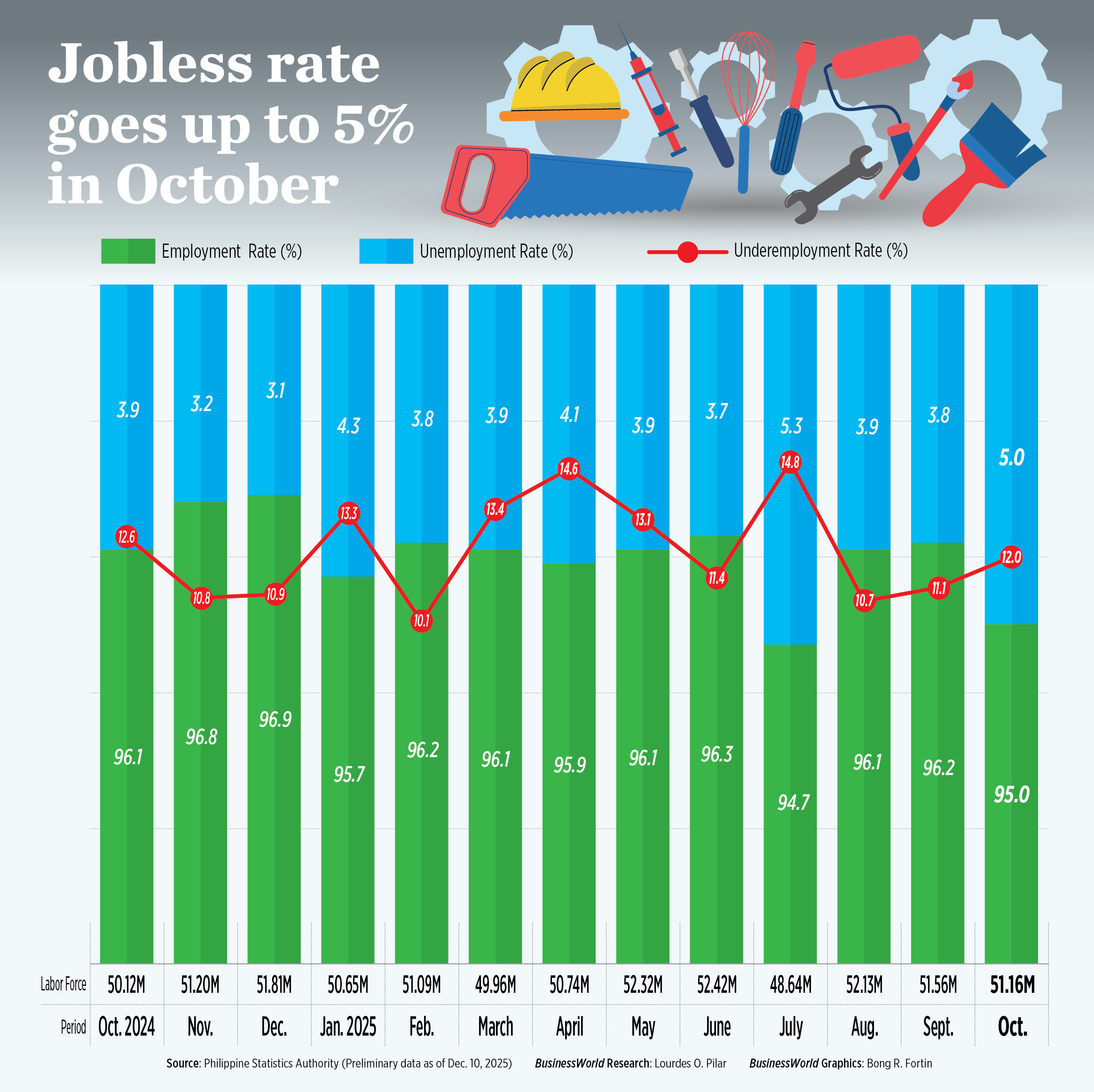
THE NUMBER of jobless Filipinos rose by about 570,000 to 2.54 million in October from a year earlier, even as overall employment increased by 460,000, the Philippine Statistics Authority (PSA) reported on Wednesday, underscoring persistent vulnerabilities in the labor market despite headline job gains.

This brought the jobless rate to 5% from 3.8% in the previous month and 3.9% a year ago. It was also the highest in three months or since the post-pandemic high of 5.3% in July.

The unemployment rate averaged 4.13% in the first 10 months from 4% in the same period a year ago.

PSA Undersecretary and National Statistician Claire Dennis S. Mapa attributed the rise in joblessness to recent typhoons and the increase in labor force participation.

The labor force participation rate (LFPR) rose to 63.6% in October from 63.3% a year earlier but fell from 64.5% in September, the statistics agency said in a statement. The estimated LFPR in October translates to 51.16 million Filipinos versus 50.12 million in the same month last year.

However, Mr. Mapa cited “good signs” such as rising employment in the agriculture sector, which added 168,000 jobs from a year ago.

“We saw an increase of 1.87 million in agriculture and forestry jobs quarter on quarter, with the biggest contributor being the growing of paddy rice, as the peak season for rice farming falls in the fourth quarter,” Mr. Mapa said during a briefing.

The PSA’s latest labor force survey showed that while many found work, a significant segment remains jobless — meaning economic improvements may not be reaching all sectors.

Still, the increase in employed people — particularly those aged 15 and over — reflects underlying demand in industries like retail, construction and services. Such gains offer hope that economic activity is picking up ahead of the holiday season.

In October, services accounted for the biggest share of total employment at 60.6%, followed by agriculture with 21.5% and industry at 17.9%.

Underemployment, which covers workers seeking more hours or better-paying jobs, eased to 12% in October from 12.6% a year earlier, but inched up from 11.1% in September. The number of unemployed Filipinos stood at 2.54 million in October, higher than 1.97 million in the same month last year.

“October’s labor market reflects continued progress in improving the quality of work available to Filipinos,” Department of Economy, Planning, and Development Secretary Arsenio M. Balisacan said in a statement.

In a note, Chinabank Research said the unemployment rate climbed in October, as not all new entrants in the labor market found jobs.

“On a positive note, there were gains recorded across industries, including challenged sectors like agriculture and manufacturing,” Chinabank said. “Looking ahead, job creation could pick up during the holiday season.”

PSA data show annual employment gains were spread across several sectors in October, including public administration (+257,000), accommodation and food services (+180,000), agriculture (+168,000), and manufacturing (+152,000).

“However, we note that the sector remains vulnerable to weather-related risks. Meanwhile, despite an uncertain global trade environment, manufacturing jobs increased (+152,000) with local factories expressing improved sentiment in the year-ahead outlook,” Chinabank said.

On the other hand, annual job losses were concentrated in services (-520,000), with notable declines in repair services, household services, and funeral-related activities.

Wholesale and retail trade also saw an annual drop (-66,000) in jobs in October.

Chinabank said this “could indicate that the softness in household consumption growth seen in the third quarter could persist this quarter.”

“Nevertheless, increased seasonal demand during the holidays could support job opportunities in the sector,” it added.

John Paolo R. Rivera, a senior research fellow at the Philippine Institute for Development Studies, said the latest numbers signal that the economy is struggling to create enough jobs.

“Yes, there are red flags. Job creation is slowing, underemployment remains high, and the sectors that usually absorb workers (retail, construction, services) are expanding weakly,” he told BusinessWorld over Viber.

“The worsening unemployment despite higher labor force participation shows that the labor market is widening, but not deepening, meaning more people are willing to work, but the economy is not generating enough stable, quality jobs to match that demand,” he added.

However, IBON Foundation Executive Director Jose Enrique “Sonny” A. Africa cautioned that these “good signs” in agricultural jobs may be overstated.

Looking at the sector historically, agricultural employment has actually fallen from an annual average of 10.8 million in 2022 to around 10 million in the first 10 months of 2025, he said.

“The only ‘good signs’ we should be looking for are steady and rapid increases in the National Government budget for farmers and fisherfolk in terms of production subsidies, extension services, and rural infrastructure,” Mr. Af-rica told BusinessWorld via Viber. — EMPS

ADB approves $400-million loan to improve ease of doing business in the Philippines

BW FILE PHOTO

THE ASIAN Development Bank (ADB) has approved a $400-million policy-based loan to support the Philippine government’s efforts to improve the ease of doing business in the country.

In a statement, the multilateral lender said it has approved the financing for the Business Environment Strengthening with Technology Program (BEST) Subprogram 1, which aims to help position the country as a leading investment hub in Asia and the Pacific.

The BEST program supports private sector development reforms to streamline and improve the transparency of regulatory requirements and processes for businesses.

“The private sector is an important engine of growth and job creation. Their role in the country’s overall economic development cannot be overstated,” ADB Country Director for the Philippines Andrew Jeffries said.

“We are committed to assisting the Philippines in finding innovative ways to create an enabling environment that would spur a more dynamic business sector — one that will help drive faster economic growth,” he added.

This comes as Philippine firms continue to grapple with regulatory bottlenecks, high energy costs and weak digital infrastructure, while investors face hurdles in navigating approvals and fragmented digital systems that raise costs and deter capital.

The Ease of Doing Business and Anti-Red Tape Advisory Council said it can take up to 75 days for local firms and more than 100 days for foreign firms just to complete registration in the Philippines, slower than its regional peers.

Mr. Jeffries said high logistics costs continue to weigh on Philippine competitiveness, citing geographical constraints. Logistics account for about 27% of the cost of goods, among the highest in the region.

The BEST program will streamline legal and regulatory frameworks to make it easier to start and operate a business, with faster permits, licensing, and approvals, the ADB said.

“It will also provide clear, updated, and reliable information via online investors’ guidebooks and a digital database of business regulations through the Philippine Business Regulations Information System launched by the Anti-Red Tape Authority (AR-TA),” the ADB said.

The BEST program builds on the ADB-Philippine partnership in pursuing reforms to strengthen public sector management systems through the Public Financial Management Reform Program, Domestic Resource Mobilization Program, Business and Employment Recovery Program, and more.

The ADB said it extended complementary technical assistance to advance reforms under the program.

This includes supporting implementing agencies such as ARTA, the Department of Trade and Industry-Board of Investments, and the Department of Information and Communications Technology in developing and implementing new systems and improved processes.

Separately, ADB President Masato Kanda met with President Ferdinand R. Marcos, Jr. on Tuesday at Malacañan Palace, where he emphasized the importance of strong cooperation.

Mr. Kanda also pledged a comprehensive package to support the Philippines as it prepares to chair the Association of Southeast Asian Nations (ASEAN) in 2026.

“ADB is committed to support the Philippines in elevating ASEAN’s ambition to become more competitive, resilient, and sustainable. I was pleased that our proposals were welcomed by President Marcos and we look forward to working together on the success of ASEAN 2026,” Mr. Kanda said in a statement.

The multilateral lender is preparing a package of support to assist the Philippines in delivering regional outcomes under the ASEAN 2026 theme of “Navigating our Future Together.”

The ADB was the second-biggest development partner of the Philippines in 2024 with 59 loans and grants worth $11.05 billion. — Aubrey Rose A. Inosante

New RE player eyes P190-B offshore wind in Camarines Sur

STOCK PHOTO | Image by FREEPIK

RENEWABLE ENERGY (RE) developer ACX3 Capital Holdings, Inc. is proposing to build a 500-megawatt (MW) offshore wind farm in San Miguel Bay, Camarines Sur, in Bicol Region, with an estimated cost of P189.5 billion.

In its filing with the Department of Environment and Natural Resources, the company said the national grid is expected to receive power from the project, which targets commercial operations by 2030.

The proposed wind farm will occupy 6,237 hectares within the municipal waters of Calabanga, Siruma and Tinambac.

ACX3 said the project is designed to deploy 60 wind turbine generators, each with a rated capacity of between 8.5 MW and 8 MW.

Construction is scheduled to begin in 2027 and run through 2029.

The estimated project cost includes P4.5 billion for pre-development activities, P85 billion for construction, and P100 billion for operations and maintenance.

The company also estimated decommissioning costs at around P7.3 billion, expected to be incurred by 2055.

Offshore wind farms generate electricity as wind turns turbine blades, which convert kinetic energy into electrical energy transmitted via export cables.

ACX3 said logistics for the project will depend on a planned port development in Barangay Pambujan, Mercedes, Camarines Norte.

The port is envisioned to serve as a marshaling and assembly base, with facilities for turbine component handling and vessel berthing.

The company described offshore wind as “a highly reliable and variable form of renewable energy” because of its ability to generate electricity at high capacity factors.

“[Offshore wind] has the potential to become a major contributor to the national grid, complementing onshore wind and solar installations,” it said.

ACX3 focuses on developing and managing renewable energy and sustainable infrastructure projects.

It is backed by Nexif Energy Philippines Pte. Ltd., a joint venture between Singapore-based Nexif Ratch Energy Investments Pte. Ltd. and Thailand-based Ratch Group.

The firm is among several developers assisted by the Department of Energy that are projected to add more than 16 gigawatts (GW) of new capacity from offshore wind projects.

The Philippines aims to generate its first kilowatts of offshore wind power by 2028 as it seeks to diversify its energy mix and reduce dependence on fossil fuels. — Sheldeen Joy Talavera

The Bistro Group, going loca(l)

THE RETURN of Krazy Garlik under The Bistro Group’s portfolio signifies Bistro’s respect for local culture and its motivation to do more in the local scene (as opposed to their forte, bringing in international franchises).

It’s a comeback concept, having first opened in 2014, patterned after a Korean concept that worshipped the flavor (albeit a bit toned down for Filipino palates), which then closed in 2018.

Lisa Ronquillo-Along, chief marketing officer for The Bistro Group, speaking to BusinessWorld during the Krazy Garlik opening at the SM Mall of Asia on Dec. 4, gave us a list of their local concepts, which is about to get longer. There’s Krazy Garlik (the SM Mall of Asia branch is their second after opening in One Ayala this year), Siklab, Las Flores, and Rumba; not to mention the restaurants by their corporate executive chef, Josh Boutwood. One of them, Helm, was the country’s first two Michelin-starred restaurant, awarded earlier this year.

Siklab is also a comeback concept, sharing the 2014 timeline with Krazy Garlik. It reopened last year in Shangri-La Plaza Mall and is set to open nine branches next year (including in Visayas and Mindanao), according to Ms. Ron-quillo-Along. Krazy Garlik might follow in the same lines, because it is “very scalable.”

We had a taste of their tangy 40 Kloves Chicken (the taste is akin to a very flavorful adobo), and the Adobomb Rice with pork adobo flakes, as well as the Hara Kiri Rice (garlic, bell pepper, shrimp, squid, bacon, red chili, teriyaki sauce, and tobiko). While we were warned that the Hara Kiri rice would be a spicy challenge, it was mostly an easy ride (for us).

“We’ve always wanted to have homegrown brands, local concepts,” said Ms. Ronquillo-Along. “We’ve tried in the past.

“There were some challenges because we were so used to these structural, corporate franchise(s),” she said. “We wanted to be everything… maraming (there was lots of) trial-and-error.”

For starters, she mentioned improving interiors and streamlining menus: “If you want to attract the new generation now, it has to resonate with them.”

She also discussed the difference between developing their international franchises and these homegrown brands. To date, The Bistro Group holds the franchises for TGI Friday’s, Olive Garden, Dave & Buster’s, Fogo de Chao, and Longhorn Steakhouse; among others. They have 30 concepts under their belt, and 218 restaurants around the Philippines. They have an upcoming Korean dessert franchise (slated to open this week, but a media tasting has been postponed).

“With franchises, we have the international (support), so we can’t really just move freely,” she said. “They’re flexible, (but) you have to work with them.

“With the homegrown brands, we’re free to make mistakes, develop something new, innovate. We’re free to do that,” she said.

Earlier this year, the Chen-led Inoza Business Holdings, Inc., an affiliate of Progeny Global Holdings (the operators of the Bounty Fresh brand) announced they had acquired a major stake in The Bistro Group (more details can be found here: https://tinyurl.com/2k5968mj). Of the new ownership, Ms. Ronquillo-Along said, “They want the homegrown brands to take lead in development — hand-in-hand with ours,” she said. “We have their support, and be-cause they’re already in the food business, they understand it.”

Krazy Garlik is located at SM Mall of Asia, Level 2, Entertainment Mall. — Joseph L. Garcia

Ovialand targets almost double profit growth

OVIALAND.COM

REAL ESTATE developer Ovialand, Inc. expects near-double growth in its net income this year, on the back of strong demand for its premium-affordable housing projects across Luzon, a company official said.

“Despite heavy rains, supply challenges, and a very active construction year, we continue to build and deliver,” Ovialand Investor Relations and Compliance Officer Monica Ann V. Mendoza said during an event on Wednesday.

The company reported a net income of P507 million last year, she said.

Across its Luzon portfolios, Ovialand constructed 770 new housing units and turned over 645 units this year.

“Right now, we’re really focusing on our existing areas in Luzon because there is still a lot of room to grow,” Ovialand President and Chief Executive Officer Pammy Olivares-Vital told reporters on the sidelines of the event.

Anara, the company’s latest project in Bulacan, will have 310 house-and-lot units, with turnover scheduled by the third quarter of 2026.

“We want to be the most trusted homebuilder in the Philippines, and trust is built on consistency, transparency, and aligning with the right people,” Ms. Vital added.

In the first half of the year, Ovialand’s consolidated net income rose 37% to P420 million, while revenues increased 20% to P1.1 billion.

Ovialand’s current housing portfolio includes Seriya and Anara in Baliwag, Bulacan; Caliya in Candelaria, Quezon; Terrazza in Santo Tomas, Batangas; and Santevi, Savana, and Sannera in San Pablo, Laguna. — Beatriz Marie D. Cruz

SM Prime reached 100-MWp rooftop solar target, DoE says

SM CITY FAIRVIEW’S ROOFTOP solar photovoltaic system. — SMPRIME.COM

SM PRIME HOLDINGS, Inc. has installed 100 megawatt-peak (MWp) of solar panels on its properties, meeting its target, the Department of Energy (DoE) said.

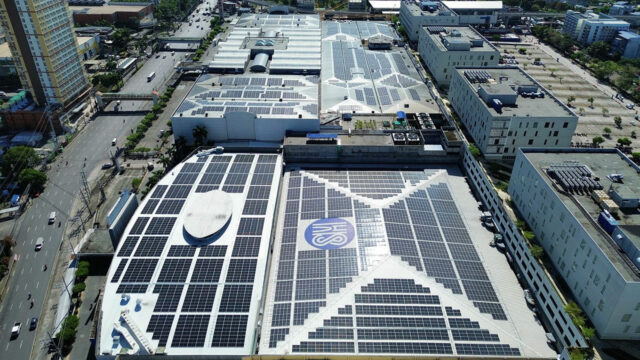
The Sy-led property developer has deployed rooftop solar photovoltaic (PV) systems in 59 of its properties, using about 200,000 solar modules across 65 hectares of rooftop area, the DoE said in a statement on Wednesday.

The Energy department said the initiative shows how private companies can support the country’s shift toward a low-carbon and climate-resilient energy system.

“Every megawatt of clean energy that comes online helps reduce our reliance on imported fuel, shields consumers from volatile energy prices, and strengthens our long-term climate commitments,” Energy Secretary Sharon S. Garin, who attended the switch-on ceremony, said.

According to the DoE, SM Prime’s rooftop solar installations help cut emissions and reduce grid consumption while improving comfort and boosting energy resilience.

“We encourage more companies to follow this example and invest in renewable energy and energy efficiency solutions,” Ms. Garin added.

In July, SM Prime switched on what the DoE described as the country’s largest rooftop solar PV system on a commercial building at SM City Fairview.

SM Prime currently operates 88 shopping malls in the Philippines and eight in China. — Sheldeen Joy Talavera

A chicken-beer alliance

WHILE Korean fried chicken is fast becoming a staple for Filipinos, we haven’t completely embraced the culture of chimaek (a portmanteau of the Korean words for “fried chicken” and “beer”), a combination that began to gain popularity in South Korea in the 1970s.

Enter Daily Beer, one of South Korea’s leading fried chicken brands which elevates the concept with craft beers, flown in from South Korea. It opened its first branch in the Philippines in Pasig’s Arcovia City on Nov. 30, with a media preview the day before on Nov. 29.

“Everywhere in the world, there’s a lot of fried chicken, and there’s a lot of beer. But most fried chicken places use commercial, mass-produced, generic beer, which is not considering the food pairing at all,” said Sang Jin Lim, the chief executive officer of Daily Beer Co., Ltd. (which first opened in 2014), speaking through Jay Lim, Business Development Division/Global Business Manager Daily Beer Co., Ltd.

“We specifically make beers for the fried chicken we have,” said Mr. Lim. “It’s perfectly tailored for our dishes.”

There are four varieties of chicken at the restaurant: Original, Red (spicy sauce), Black (sweet garlic soy sauce), and Crunch (garlic and sweet and spicy seasoning). They also have other Korean dishes: gimbap, tteokbok-ki, and the sweet-and-sour chicken gangjeong; among others. Matching the dishes are the five craft beers they have on tap: K-Red Lager, K-Seoul Weizen, K-Daily Pale Ale, K-Super Fresh Hazy IPA, and K-Ginseng Lager, which was specifically developed for the Philippines. “We have the capacity to create new beers for the local market,” said Mr. Lim.

We tried out the K-Ginseng beer (woody and with a wet, herby taste; excellent), and all the chicken flavors. We will say that the experience becomes sublime with the beer (and our beer choice was perfect with the Black flavor).

According to Daily Beer’s website, they had 402 stores as of 2024, with a bulk of them in South Korea; but they also have a presence in Bangkok, and Singapore.

“We’re the only company that’s growing two-digit numbers, every year for 12 years straight. Never any kind of decline,” said Mr. Lim. Their website said that they have enjoyed 39.4% growth from 2022 to 2024.

It was in Singapore where Kirkland Whang, chairman of Opulence Prime Ventures, Inc., which brought the concept to the Philippines, first tried Daily Beer. Opulence Prime Ventures is in real estate, online retail, and even mattresses.

“The first time we tried Daily Beer in Singapore, we immediately knew that the taste of the chicken is unique, together with the beer selection they have,” he said. “I know that our culture here will love that taste,” said Mr. Whang.

The senior Mr. Lim said that he liked the original flavor with the Red Lager, while Mr. Whang likes the original, and varies his beer choices depending on his mood. The junior Mr. Lim said, “I like the IPA personally. I don’t mind what I eat with the IPA. The fragrance, the aroma, is really strong.”

According to Mr. Whang, they’re on track to open a second branch in SM Fairview this month, and another in Makati next year. — Joseph L. Garcia

From quake to typhoons: DigiPlus Foundation mobilizes P8 million in disaster relief across the Philippines

Helping hand in Bulacan: DigiPlus Foundation’s Program Manager Paul Tamayo leads the distribution of relief goods to families in Bulacan displaced by Typhoon Uwan, ensuring aid reaches those needing to rebuild.

In the wake of the Northern Cebu earthquake and the successive onslaught of Typhoons Tino and Uwan, DigiPlus Foundation, formerly known as BingoPlus Foundation and the social development arm of DigiPlus Interactive Corp., has mobilized a total of P8 million worth of disaster relief to help nearly 70,000 Filipinos rebuild their lives across Visayas and other severely-affected provinces in Luzon through its “BayanihanPlus” Community Resilience Program.

The Foundation reached an estimated 56,000 individuals affected by the magnitude 6.9 earthquake in Northern Cebu. Relief operations covered six hard-hit locations: Bogo, Daanbantayan, Medellin, San Remigio, Tabogon, and Borbon, where families faced damaged homes, disrupted livelihoods, and recurring aftershocks.

Following the devastating earthquakes, the DigiPlus Foundation rapidly expanded its nationwide relief operations to address the severe impacts of Typhoons Tino and Uwan, which brought heavy rains, floods, and landslides to Cebu and strong winds and widespread flooding to Luzon. The Foundation quickly coordinated with local government units to deliver essential aid to an estimated 14,350 affected individuals across targeted communities in Luzon, including Hagonoy, Bulacan; Cabanatuan City, Nueva Ecija; Dumaguete City and Bacolod City in Negros Island; and San Fabian, Pangasinan, as well as several barangays in Cebu City, reinforcing its sustained commitment to immediate disaster response and fostering community resilience throughout the Philippines.

“The scale of devastation from the recent Typhoons Tino and Uwan demands an even greater collective response to deliver hope to affected communities,” said Angela Camins-Wieneke, executive director of DigiPlus Foundation. “With affected areas spanning from Cebu to Bulacan, Nueva Ecija, and Pangasinan, we call on more partners to join our efforts. Working with our BingoPlus store volunteers and partners on the ground, we have already mobilized around P8 million in relief, but to truly help communities rebuild their lives, we need more support.”

Upholding the organization’s nationwide commitment to disaster resilience, Michael Linatoc, regional manager for Luzon, emphasized the readiness of his team to mobilize for immediate rehabilitation efforts. Mr. Linatoc highlighted the inspiring dedication of the workforce in the Luzon as a benchmark for service, noting, “I witnessed the heroic efforts of our colleagues in the Visayas, and I am proud to see how our Luzon team mirrored this spirit in the areas of Pangasinan and Nueva Ecija to respond to the needs of affected communities,” and assured the public that this spirit of solidarity extends northward. He confirmed that, likewise, branches in Luzon are fully prepared and eager to support the recovery of Filipinos devastated by the calamities, standing united with the rest of the nation in the mission to rebuild lives and livelihoods.

DigiPlus Foundation will continue working with local governments, partners, and its nationwide network of BingoPlus stores to support affected communities, from immediate relief to long-term recovery and resilience, staying true to its mission to multiply the good for Filipinos across the country.


Spotlight is BusinessWorld’s sponsored section that allows advertisers to amplify their brand and connect with BusinessWorld’s audience by publishing their stories on the BusinessWorld Web site. For more information, send an email to online@bworldonline.com.

Join us on Viber at https://bit.ly/3hv6bLA to get more updates and subscribe to BusinessWorld’s titles and get exclusive content through www.bworld-x.com.

Bohol’s asin tibuok inscribed in UNESCO

Intangible Cultural Heritage list

facebook.com/boholislandgeoparkph.tif

THE BOHOLANO artisanal salt making tradition joins Philippine chants, epics, and weaving onto the Intangible Cultural Heritage (ICH) List of the United Nations Educational, Scientific, and Cultural Organization (UNESCO).

Asin tibuok was officially inscribed on Dec. 9 during the 20th Session of the Intergovernmental Committee for the Safeguarding of the Intangible Cultural Heritage in New Delhi, India.

“The UNESCO-Philippine National Commission (UNACOM) congratulates the Boholano community on the inscription of the practice of making asin tibuok, the artisanal sea salt of the Boholano of Bohol Island, Philippines to the UNESCO List of Intangible Cultural Heritage in Need of Urgent Safeguarding,” said UNACOM in a Facebook post.

Asin tibuok is the first Philippine traditional food process to be included in a UNESCO ICH list.

UNACOM further explained that “the Urgent Safeguarding List includes intangible cultural heritage elements identified by communities and States Parties as needing immediate support, enabling international cooperation and assistance to help ensure their continued survival.”

According to UNESCO, “‘intangible cultural heritage’ refers to living practices — traditions, skills, rituals, music, crafts and social customs that communities pass on from one generation to the next. “Through its lists, UNESCO works with governments and communities to promote these traditions, strengthen transmission and mobilize support to ensure their survival, particularly where they are threatened by social, economic or environmental change.”

Asin tibuok is made by family-owned workshops and enterprises in the town of Alburquerque in Bohol. Often described as a dinosaur egg, the making of asin tibuok involves a lengthy process that includes soaking gathered coconut husks in seawater, cutting the husks, drying, burning, collecting the ash-salt mixture, collecting the produced brine, and cooking it in clay pots.

Asin tibuok joins six other traditions that have been inscribed on UNESCO’s Heritage lists including the hudhud chants of the Ifugao (2008), the Darangen epic of the Meranaw people of Lake Lanao (2008), the Punnuk tugging game of the Ifugao (2015), and Aklan piña handloom weaving (2023) all of which are on the List of the Intangible Cultural Heritage of Humanity; the Subanen ritual buklog (2019) in the Urgent Safeguarding List; and the School of Living Traditions (2021) in the Register of Good Safeguarding Practices.

Also inscribed on this year’s list were: India’s festival of lights, Deepavali; the craft of Đông Hồ folk woodblock printing of Vietnam; the Mwazindika spiritual dance of the Daida community in Kenya; Pakistan’s Boreendo clay musical in-strument; Panama’s quincha mud-house construction techniques; Paraguay’s Ñai’ũpo ceramic craftsmanship; Portugal’s moliceiro wooden boats; the Kobyz string instrument of Uzbekistan; Albania’s lahuta epic singing; landships cultural traditions in Barbados; and the Negliubka textile tradition of Belarus.

Other inscriptions are the Bisht, a ceremonial men’s garment worn across several Middle Eastern countries including Qatar, Iraq, Jordan and the United Arab Emirates; Venezuela, Joropo, a lively tradition combining music, poetry and dance; Bo-livia’s Festivity of the Virgin of Guadalupe in Sucre; Argentina’s dance-music genre cuarteto; Tangail saree weaving in Bangladesh; Behzad-style miniature art associated with Afghanistan; Belgian rod marionette theater; Belize’s Christmas Bram and Sambai celebrations; Bulgarian bagpipe traditions; and Zaffa wedding procession across parts of Africa and the Middle East.