Home Blog Page 2451

Voters may judge re-electionists based on EPIRA effect

PHILIPPINE STAR/EDD GUMBAN

PHILIPPINE lawmakers running for re-election next year must provide a “convincing narrative” of how changes to the 23-year-old Electric Power Industry Reform Act (EPIRA) could lower electricity prices if they want to pitch it as a legislative achievement, political analysts said at the weekend.

“If a politician chooses to use this as a core issue during elections, then he must face the problem of being seen as a potential peddler of empty promises,” Anthony Lawrence A. Borja, a political science professor at De La Salle University in Manila, said in a Facebook Messenger chat.

“Whatever happens with the EPIRA amendments, it all boils down to the question of whether it can reduce electricity bills,” he added.

EPIRA restructured the electric power industry by privatizing the generation, transmission, distribution and supply of power in 2001. Measures seeking to amend it remain pending at the House of Representatives and Senate energy committees amid rising electricity prices.

“While one would presume that this is a vital piece of legislation, it needs to have a direct impact on people’s livelihoods to be an election issue,” Hansley A. Juliano, who teaches political science at the Ateneo de Manila University, said via Messenger chat.

“Energy is less directly seen [to have a direct impact] compared with employment and food, unless it becomes clear how energy costs and regulation impact investments and jobs,” he added.

Michael Henry Ll. Yusingco, a fellow at the Ateneo de Manila University Policy Center, expects lawmakers to pass a watered-down version of the bill.

“A total overhaul is less likely as it can lead to a lot of disruptions that may be hard to explain to voters,” he said via Messenger chat. “It will be an audacious move on the part of lawmakers if they did this before an election.”

The House of Representatives is looking to fast-track amendments to EPIRA, committing to finish power sector reforms before the Christmas break. The measure is a priority of President Ferdinand R. Marcos, Jr. 

Speaker and Leyte Rep. Ferdinand Martin G. Romualdez in July said EPIRA “is a complicated law,” describing it as a “big piece of legislation.” — Kenneth Christiane L. Basilio

Public, private aid to typhoon victims hit over P1B

PHILIPPINE STAR/MIGUEL DE GUZMAN

By Kyle Aristophere T. Atienza, Reporter

PUBLIC and private assistance for victims of two storms that hit the Philippines and its neighbors in the region this month reached over P1 billion as of Saturday, according to the presidential palace, as the number of affected Filipinos climbed to over 8 million.

In an 8 a.m. report, a Philippine disaster agency said Severe Tropical Storm Trami, locally known as Kristine, and Super Typhoon Kong-Rey (Leon) had affected 2.2 million families or 8.63 million individuals.

Over 200,000 people or 56,396 families were staying in 467 evacuation centers, it added.

The death toll was at 146, and 125 of which were still for validation.

The Presidential Communications Office said in a statement food and non-food items provided by the Department of Social Welfare and Development (DSWD), Office of the Civil Defense (OCD), Local Government Units (LGUs), and nongovernment organizations (NGOs) to storm victims have reached P1.1 billion, as of Nov. 3.

The DSWD has released 1.01 million family food packs across regions affected by Trami and Kong-rey, it added.

For their part, the Armed forces of the Philippines had conducted 58 humanitarian sorties with the help of Southeast Asian countries in Naga City in Bicol Region and Batangas province in Calabarzon via land, air, and naval assets, the palace said.

Separately, Defense Secretary Gilberto C. Teodoro, Jr. said the Malaysian government had deployed a disaster management team to the Philippines to help in typhoon response efforts, commending their “swift response to our request for assistance.”

“Your support during this critical time has been invaluable in our recovery efforts following Severe Tropical Storm Kristine, and it exemplifies our strong partnership in times of need.”

Trami, which a green group dubbed as “third highly devastating weather event to batter the country this year,” submerged parts of the Bicol in flood waters, with local authorities saying 70% of residents of Naga City, one of the region’s major economic hubs, had been affected by the storm.

The storm left 59 people dead in Batangas province, 20 of whom were buried in a landslide in the municipality of Talisay, reports from local authorities last week showed.

The National Disaster Risk Reduction and Management Council (NDRRMC) said in its report that 75 of the 96 seaports affected were already operational and had resumed trips.

Over 180,000 houses were damaged, it said. Damage to infrastructure reached P7.2 billion

Moreover, damage to agriculture hit P4.5 billion, with 106,715 farmers and fisherfolk affected.

The Philippine northernmost province of Batanes was visited by a super typhoon just as Trami left, with the OCD Region II reporting “damage to houses and various crops, as well as landslides on major roads.”

The state weather bureau said in a 10 a.m. report on Sunday a low-pressure area (LPA) spotted 1,605 kilometers east of northeastern Mindanao has a “high chance” of developing into a tropical depression within the next 24 hours.

In a 4 a.m. briefing, the Philippine Atmospheric, Geophysical and Astronomical Services Administration (PAGASA) said the LPA may not directly affect the country in 24 hours but “may have the possibility to enter PAR (Philippine area of responsibility)” over the next 48 hours.

PAGASA said wind coming from the north-east that brings mild temperatures was expected to bring isolated light rains over Batanes and Babuyan Islands.

The government has already imposed a price freeze on basic necessities in areas under a state of calamity since Trami’s onslaught, and a fisherfolk group is calling for an expansion to cover fish.

Under a Philippine price law, a 60-day freeze can be activated following the declaration of a state of calamity, covering commodities such as canned fish, instant noodles that are locally manufactured, bread, bottled water, processed milk, laundry soap, salt, among others.

Fisherfolk group Pamalakaya at the weekend cited increasing market prices of fish including round scad (galunggong), whose cost rose to P220-240 per kilo from P180-200 per kilo prior to the onslaught of the storms.

The group cited tallies from its members at markets in the provinces of Cavite and Rizal, and Quezon City.

The price of tilapia fish and milkfish (bangus) also went up to between P160 and P180 per kilo and P180 per kilo, respectively, from P120-P150 per kilo, the group said.

“The typhoons and especially the fisherfolk are not to blame for the rising market price of fish but the private traders that take advantage of calamities to manipulate prices.”

Economists said more subsidies for local producers are needed amid devastation from storms.

‘DISASTER CAPITALISM’
“Price controls are not going to affect the quantity distortions caused by typhoons. This will only cause greater distortions and shortages as retailers will limit their sales, disincentivizing producers from selling,” Leonardo A. Lanzona, who teaches economics at Ateneo de Manila University said in a Facebook Messenger chat. “The only way to deal with cartels exploiting the situation is to empower non-cartel members, the small farmers and fishermen, to sell their goods directly to the buyers.

Rizal Commercial Banking Corp. Chief Economist Michael L. Ricafort said ensuring that traders would not exploit any price controls rests on strong law enforcement.

“Presence of law enforcers cannot be reduced,” he said, as he called for “delicate balance between supply and demand.”

John Paolo R. Rivera, a senior research fellow at the Philippine Institute for Development Studies, said temporary price controls post-calamity “would be helpful for consumers as they recover.”

Beyond supply-demand dynamics, price controls “regulate temporary market disequilibrium that results in opportunistic tendencies to raise prices or what we call disaster capitalism.”

“This prioritizes recovery of everyone —— consumers are able to buy and producers are able to generate revenues,” he said. “Survival first before capitalism.”


Evacuation center bill up for signing

QUEZON CITY residents live in modular tents inside an evacuation center in the village of Bagong Silangan after floods caused by Super Typhoon Carina and the southwest monsoon forced them to flee. — PHILIPPINE STAR/MIGUEL DE GUZMAN

PRESIDENT Ferdinand R. Marcos, Jr. is expected to approve a bill mandating the construction of “disaster-ready” evacuation centers nationwide “soon” after the country was battered by Severe Tropical Storm Kristine (Trami), House of Representatives Speaker and Leyte Rep. Ferdinand Martin G. Romualdez said on Sunday.

The measure is in the process of enrollment, he said, and that it will be sent soon to the Malacañang for Mr. Marcos’ signature.

“The ‘Ligtas Pinoy Centers Act’ represents our commitment to safeguarding every Filipino in times of crisis, ensuring that each city and municipality will have a secure, fully equipped center to shelter and support evacuees,” he said in a statement, referring to the measure mandating the construction of storm and earthquake resilient structure in every city and municipality in the country.

The measure proposes that evacuation centers be built structurally strong enough to weather typhoon winds moving up to 300 kilometers per hour and withstand magnitude 8 earthquakes. — Kenneth Christiane L. Basilio

HR for health masterplan OKd

SASUN BUGHDARYAN-UNSPLASH

MALACAÑANG has approved a blueprint for the management and development of the country’s human resources in the health sector.

The National Human Resources for Health Master Plan 2020-2028 of the Department of Health (DoH) is in line with Republic Act No. 11223, the Universal Health Care (UHC) Act.

The master plan, which requires P8.3 billion for the implementation of its eight strategies, cited lack of fully functional integrated human resources for health (HRH) systems including information systems, production and deployment planning, professional development, attractive compensation packages, management and regulation, and sustainable deployment as a “core problem.”

It cited inadequate number of health workers in the health sector, inequitable distribution of HRH, lack of accurate HRH information to guide planning and policy, limited collaboration among stakeholders with multiple roles in the HRH sector, fragmented HRH governance and unclear accountabilities, and lack and poor implementation of policies.

It is also proposed to be included in the National Economic and Development Authority’s medium-term Philippine Development Plan.

Under the memorandum signed by Executive Secretary Lucas P. Bersamin on Oct. 28, the DoH will lead the master plan’s implementation.

The agency is tasked to work with the Professional Regulation Commission in establishing a national health workforce registry and promulgate guidelines for its efficient implementation. 

It shall institutionalize an HRH network and create technical working groups as necessary.

The DoH will also monitor HRH plans of the national and local governments and ensure that they are in line with the blueprint.

It is also tasked to collaborate with the private sector, civil society organizations, and other stakeholders.

The master plan’s strategic objectives include the installation of systems that will improve recruitment of HRH fit for practice and fit for work and promotion of greater HRH retention in the health sector; creation and sustenance of systems for developing HRH competencies and the careers of health workers to improve productivity and responsiveness; and raising HRH productivity and responsiveness by promoting job satisfaction and motivation at all levels and improve greater HRH retention.

The objectives also seek to strengthen information systems or data on HRH for monitoring, informing decision making, and ensuring accountability, and increase investments in HRH and align investments with current and future population health needs and of health systems

The master plan cited several elements that distinguishes it from the previous master plans, including identifying scenarios in case of public health emergencies and crises and developing assessment criteria that will facilitate the implementation and adaptation of the Masterplan strategies to reflect local situations by local government units.

It is also designed for short-term, medium-term, and long-term strategies aligned with UHC Act structures to improve primary health care delivery through health care provider networks.

The plan also incorporated a strategic communications plan, established an accountability framework between and among HRH stakeholders to ensure effective monitoring and evaluation of HRHMP implementation. — Kyle Aristophere T. Atienza

Over 68M register for 2025 polls

THE Commission on Elections (Comelec) said 68.62 million Filipinos voters have registered to participate in the May 2025 midterm elections.

Of the 68.62 million, 33.69 million were male, while 34.93 million were female, based on data shared by Comelec Chairman George Erwin M. Garcia with reporters.

The Calabarzon (Cavite, Laguna, Batangas, Rizal, Quezon) region tallied the most voters with over 9.7 million electorate.

This is followed by Central Luzon with over 7.70 balloters, while the National Capital Region has more than 7.57 million.

The Philippines will hold midterm elections next year. Filipinos will elect their congressmen, mayors, vice-mayors and members of city councils on May 12, 2025.

Twelve of the 24-member Senate will also be replaced. — Chloe Mari A. Hufana

LGUs asked to help fund classrooms

BW FILE PHOTO

A PHILIPPINE senator on Sunday pushed for local government units (LGUs) to help fund building more classrooms with the national government as the country lacks 165,443 classrooms around the country.

In a statement, Senator Sherwin T. Gatchalian proposed for LGUs to shoulder half the cost of each classroom while the national government takes care of the other half. He said the government needs about P413.6 billion to address the classroom shortage problem.

He said the “counterpart program” would pave the way for more classrooms to be built around the country.

“Due to the significant shortage of classrooms in our country and the substantial amount of funding required to address this gap, we need to find various ways to meet this challenge,” the senator, who heads the basic education committee, said in Filipino.

The Department of Budget and Management in April released P5.83 billion to help build classrooms nationwide, which covers 1,834 classrooms.

Last year, the Education department failed to meet its target of building 6,379 classrooms, having built only 3,600 classrooms.

“If we do not find creative ways to build classrooms, the shortages we face will only continue to grow,” Mr. Gatchalian said. — John Victor D. Ordoñez

SMC says 8-M tons of river waste removed across Luzon river systems

PHILSTAR FILE PHOTO

CONGLOMERATE San Miguel Corp. (SMC) said it has removed eight million tons of silt and waste from 136 kilometers of river systems in Luzon, with plans to revisit previously cleared areas following the recent heavy rains.

The cleanup initiative, launched in 2020, covered waterways such as the Tullahan, Pasig, and San Juan rivers, as well as those in Bulacan, Pampanga, and Laguna.

SMC Chairman and Chief Executive Officer Ramon S. Ang said the conglomerate’s river cleanup teams will return to the Tullahan, Pasig, and San Juan rivers after heavy rains led to renewed silt buildup and waste accumulation.

“River cleanups are a continuous effort. Heavy rains bring eroded soil, and improper disposal continues to be a challenge. Maintenance is very important to make sure these rivers continue to flow freely,”Mr. Ang said in an emailed statement over the weekend.

Meanwhile, SMC said its cleanup initiative has removed 506,616 tons of silt and waste from Pampanga River. The company has covered 8.15 kilometers of the river since August.

The river is a major source of flooding in Pampanga and Bulacan.

SMC said its teams are also cleaning rivers in Biñan, Laguna, and around the Ninoy Aquino International Airport, while also clearing its drainage system. — Revin Mikhael D. Ochave

Tech-based health recording implemented in Baguio

PHILSTAR FILE PHOTO

BAGUIO CITY— Baguio City is now implementing the Baguio Inclusive and Accessible Health Governance (BIAG) system, a pioneering technology-based health service recording and provision system.

Mayor Benjamin B. Magalong explained that BIAG system seeks to strengthen the public health recording system by providing “standardized, accessible and comprehensive health surveillance, long-term monitoring, improved continuity of care and streamlined health emergency preparedness” through a technology-based recording system.

This addresses the problem of fragmented health records that causes inaccurate patient information that compromises safety and treatment outcomes, affecting long-term health monitoring and provision of proactive interventions.

The lack of accurate data also hampers public health surveillance thereby delaying detection of disease leading to outbreaks and slowing down response, Magalong explained.

“All in all, BIAG aims to transform the health care system in the city into a more responsive technology-based structure in line with the city’s thrust to become a people-centered smart city,” the mayor said.

The system was designed and executed by the Management Information and Technology Division of the City Mayor’s Office under Francis Camarao.

Camarao said the system is named after the local word “biag” which means life and is designed to ensure inclusive, high-quality healthcare for all residents.

“By integrating a comprehensive range of health records, reducing medical errors, enhancing public health monitoring, and bolstering emergency preparedness, the system ensures continuous care from birth to later life. It’s a solution that addresses the real needs of the community while setting a new standard for healthcare governance,” he said.

Mr. Camarao said the system integrates modules to ensure efficient patient management, enhance service delivery and maintain health records for easy access by the public. — Artemio A. Dumlao

Barangay officials hurt in Cotabato City gun attack

MAX KLEINEN-UNSPLASH

COTABATO CITY — A barangay councilor and their office bookkeeper were badly hurt when gunmen attacked them while in a roadside store in Barangay Rosary Heights 9 in Cotabato City on Saturday night.

Brig Gen. Romeo J. Macapaz, director of the Police Regional Office-Bangsamoro Autonomous Region, told reporters on Sunday that Jordan S. Kalipa, 47, an incumbent barangay councilor in Rosary Heights 9, and their 33-year-old barangay bookkeeper, Virlie L. Joy Quijano, 33, sustained bullet wounds in different parts of their bodies.

They are now both confined in a hospital, guarded by policemen.

Mr. Kalipa and Ms. Quijano were at a store along a thoroughfare in Barangay Rosary Heights 9 when gunmen approached them and opened fire.

Their attackers managed to escape before responding volunteer community watchmen and barangay officials could reach the scene.

Mr. Macapaz said intelligence agents and investigators in the Cotabato City Police Office and barangay officials are cooperating in trying to identify the culprits for prosecution  — John Felix M. Unson

BoC estimates foregone revenue due to rice tariff cut at P16 billion

PHILIPPINE STAR/KRIZ JOHN ROSALES

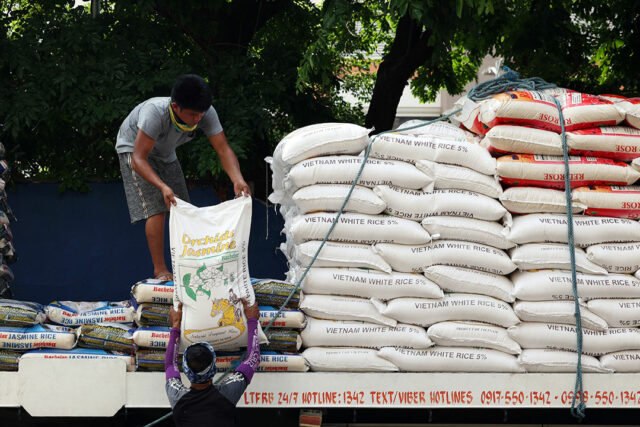
THE Bureau of Customs (BoC) said revenue foregone in the second half due to the reduced rice tariffs is estimated at P16.34 billion.

In an e-mail to BusinessWorld, Customs Commissioner Bienvenido Y. Rubio said rice tariff collections in the six months to December will fall 57.45% to P12.1 billion under the new 15% tariff on imports of the staple grain.

“The BoC was projected to collect P28.447 billion using the (original) 35% tariff rate. Applying a 15% tariff rate reduces BoC collections to P12.103 billion… resulting in a decrease of P16.344 billion,” Mr. Rubio said.

In a bid to tame rice prices, President Ferdinand R. Marcos, Jr. slashed the tariff on rice imports to 15% from 35% until 2028 via Executive Order (EO) No. 62, which took effect on July 7.

In July, collections generated by imported rice dropped 27.9% to P889.13 million.

Had the government retained the 35% import tariff on rice, the BoC would have collected P2.15 billion that month, it said.

Meanwhile, Samahang Industriya ng Agrikultura Executive Director Jayson H. Cainglet said EO 62 has not succeeded in substantially lowering rice prices.

“As what we have pointed out from the outset, savings of importers from tariff reduction will not automatically translate to cheaper rice prices. Importers and traders are pocketing the savings from the tariff reduction,” he said via Viber.

At the end of October, the price of imported regular-milled rice rose 73 centavos month on month to P45.22 per kilogram, according to Agriculture department price monitors.

On the other hand, well-milled rice at the end of October fetched P48.93 per kilo, down 38 centavos from a month earlier.

Rice import tariffs are allocated to the Rice Competitiveness Enhancement Fund (RCEF) under Republic Act No. 11203 or the Rice Tariffication Law (RTL).

Under the law, P10 billion in tariff money is to be allocated to RCEF for six years to distribute machinery, seed, credit, and fertilizer to farmers. The RCEF expired in June, but the President is due to sign amendments to the law seeking to extend its term and expand its allocation.

The decline in rice tariffs would also mean fewer subsidies for rice farmers, who are anticipating the looming effects of the La Niña weather pattern on production, Mr. Cainglet said.

“We are yet to approach peak harvest, and there is concern that the farmgate price of palay will further drop. Worse, the rice industry has been receiving significantly less from the RCEF,” he said.

In a Viber message, Federation of Free Farmers National Manager Raul Q. Montemayor said the foregone tariffs would mean farmers would receive less budgetary support under the Rice Farmer Financial Assistance Program (RFFA), one of the initiatives funded by excess tariff collections.

Under the RTL, if annual tariff revenues exceed P10 billion, extra revenues would be earmarked for the RFFA, the Expanded Crop Insurance Program on Rice, titling of agricultural rice lands, and the Crop Diversification Program.

At the end of September, BoC collections rose 4.59% to P690.7 billion, about 0.46% short of its P693.9-billion target for the nine-month period.

Customs aims to collect P939.7 billion in revenue for 2024. — Beatriz Marie D. Cruz

Green energy auction pricing to involve two-stage evaluation

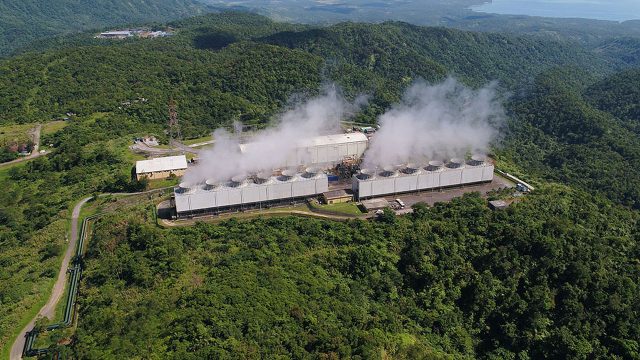
THE Energy Regulatory Commission (ERC) said the draft pricing rules for the upcoming green energy auction (GEA) round involve two sets of evaluations to assess the “reasonableness and prudency” of each price offer.

The regulator last week posted the draft price determination methodology (PDM) to seek comment from the public.

The ERC will set parameters for each type of renewable energy facility covered in the program. It is also required to establish “acceptable value ranges” to serve as thresholds for each parameter, and define the criteria for the weighted scoring system to be applied in its evaluation of price offers. 

“Bids shall first undergo evaluation for compliance with the thresholds established for each parameter and to assess the reasonableness and prudency of the price offer,” the ERC said.

Those that meet the threshold will advance to the next stage of evaluation, which will involve two “checkpoints.”

Price offers will be first evaluated to determine whether the project development cost, net capacity factor, and weighted average cost of capital components meet the minimum score requirements for the primary parameters.

Bids that pass the initial evaluation will then be scored on each of the remaining parameters.

Next, each parameter will be assigned a predetermined weight depending on its impact on the tariff, and compliant bids will earn the corresponding score for each parameter.

“A total score of 90% is required to pass the evaluation, ensuring that all critical parameters are prioritized and complied with,” the regulator said.

Qualified bidders will be required to submit supporting documents such as a written explanation, the financial model, quotations and similar documents, and audited financial statements.

The regulator will endorse the price offers that pass evaluation to the Department of Energy (DoE) for confirmation as winning bidder.

The ERC is responsible for establishing the PDM that the bidders will adopt under the GEA program. The PDM is used to evaluate the price offered by bidders.

The GEA program is designed to increase renewable energy capacity, which will help the government meet its goal of 35% renewable energy in the power mix by 2035 and 50% by 2040.

In the last two years, the DoE conducted two GEA rounds, which generated a total of 5,306 megawatts (MW) of renewable energy commitments for delivery in 2024 to 2026.

This year, the DoE plans to auction renewable energy projects with a total capacity of 4,399 MW.

The third round of GEA will cover mostly technologies not eligible for the feed-in tariff (FIT) such as geothermal, impounding hydro, and pumped storage hydro.

It will also cater to run-of-river hydro, a FIT-eligible renewable energy technology. — Sheldeen Joy Talavera

UK investors pitched on PHL gov’t bonds

REUTERS

THE Department of Finance (DoF) said it pitched British investors to increase their exposure to Philippine bonds ahead of the Philippines’ return to the JP Morgan bond index.

“The Euro market has been a vital source of financing for the Philippines, with our bond offerings consistently attracting exceptional demand. This strong appetite has enabled us to tighten pricing and trade above our credit rating,” Finance Secretary Ralph G. Recto said in a keynote speech during the Philippine Economic Briefing in London on Oct. 31.

“It certainly makes strategic sense for us to increase our financial integration, especially as we enter JP Morgan’s Bond Index soon,” Mr. Recto said.

The re-inclusion of peso-denominated government bonds in the index will help boost investor interest in Philippine government bonds, potentially lowering borrowing costs and improving market liquidity, the DoF said.

Mr. Recto has said the Philippines has been working with JP Morgan to rejoin the index. It has been removed due to declining liquidity.

The Philippines issued its first zero-coupon Euro bond in 2020.

Mr. Recto also urged British firms to invest in the Philippines, citing its young workforce, with reforms for their upskilling boding well for foreign investment.

“The competitive advantage offered by our demographic sweet spot — a young median-age population of only 25 years — strategically makes us an ideal demographic partner for the UK whose median age is 40,” he said.

“We are committed to continuously upskilling our workforce through our Artificial Intelligence Strategy Roadmap to fully harness their talents and ensure that they can power up your forward-looking industries,” he added.

Mr. Recto also said that the Philippines’ high overseas remittances, tourist receipts and business process outsourcing revenues make it “resilient” during trade wars.

He noted that the government is expected to sign amendments to the Corporate Recovery and Tax Incentives for Enterprises Act, increasing the appeal of strategic projects like the Luzon Economic Corridor.

The corridor is expected to be a “perfect nexus for British investors involved in manufacturing, semiconductor supply chains, renewable energy, and sustainable agribusiness.”

He added that declining inflation and the continuation of the central bank’s easing cycle shows the Philippines is on track to achieve upper middle-income status next year.

“Coupled with this strong potential, our commitment to prudent economic and fiscal management ensures stability for British enterprises,” he said.

As of the end of July, the Philippines’ received £585.74 million (P44.22 billion) worth of investments from the UK. — Beatriz Marie D. Cruz