Home Blog Page 244

Vietnam’s quiet ascent and the Philippines’ crisis of governance

A recent visit to Hanoi and Sa Pa with a group of retiree friends left us with an uncomfortable consensus: Vietnam appears to be overtaking the Philippines in ways that are increasingly difficult to ignore. The contrast is visible not only in infrastructure and tourism, but in a deeper sense of national direction and institutional confidence.

Consider the numbers. In 2025, the Philippines welcomed about 6.48 million international tourists. Vietnam attracted an estimated 21.1 million — more than three times as many. For two Southeast Asian countries richly endowed with natural beauty, culture, and hospitality, such a disparity is not accidental. It reflects policy choices and, more fundamentally, the quality of governance.

Vietnam’s rise is anchored in deliberate strategy. Since launching its Đổi Mới (which translates to “renovation”) reforms in 1986, Vietnamese leaders made a practical choice: preserve political continuity while liberalizing the economy. The reforms dismantled collective farming in favor of household production, legalized private enterprise, encouraged foreign direct investment, and opened Vietnam to global trade. Over the next three decades, these policies transformed Vietnam into one of Asia’s fastest-growing manufacturing and export hubs.

Crucially, Đổi Mới was not a one-time adjustment but a sustained reform trajectory. Successive governments maintained policy continuity. The lesson of Đổi Mới is that economic transformation requires both bold initial reform and the discipline to stay the course — a combination that has underpinned Vietnam’s steady rise.

Even a casual visitor notices symbols of industrial ambition. VinFast, Vietnam’s homegrown automotive brand, dominates taxi fleets in Hanoi and is now entering the Philippine market through the Green GSM brand. This is not merely commercial success; it signals confidence in domestic capability and a long-term industrial vision.

Infrastructure reinforces that message. While Vietnam’s mass transit systems are still evolving, the broader transport ecosystem — airports, highways, and urban development — suggests sustained, disciplined investment. The government’s plan to gradually shift from gasoline-powered motorcycles to electric vehicles points to forward-looking environmental and industrial policy. There is a sense that projects are executed with urgency and continuity.

Tourism policy provides another contrast. Vietnam has streamlined visa processes, expanded air connectivity, and marketed itself aggressively as a diverse destination. The Philippines, despite world-class beaches and landscapes, continues to struggle with infrastructure bottlenecks, regulatory friction, and uneven execution. These weaknesses are not technical problems alone; they are symptoms of governance deficits.

Here, the comparison becomes more uncomfortable. The Philippines today faces a visible erosion of trust in public institutions. Persistent corruption scandals, perceptions of weak leadership, and the politicization of key agencies have created uncertainty that deters investment and undermines public confidence. Infrastructure programs that begin with promise too often become mired in allegations of graft or mismanagement. Funds that should translate into roads, airports, and efficient services are suspected of leaking into private pockets. The result is not merely wasted money but damaged credibility.

Vietnam’s centralized political system has its own trade-offs, particularly in terms of political freedoms. Yet it has delivered a degree of policy continuity and execution that investors value. Long-term infrastructure and industrial plans are pursued across political cycles. In the Philippines, democratic pluralism is a strength, but when combined with patronage politics and weak accountability mechanisms, it can fragment decision-making and slow implementation. Leadership vacuums and public infighting further erode the sense of national direction.

Historical legacies are often invoked to explain divergence. Vietnam endured roughly a century of French colonial rule and the devastation of a prolonged war that ended in 1975. The Philippines experienced more than three centuries of Spanish administration followed by American influence. While these histories shaped institutions and culture, they do not predetermine present outcomes. Vietnam emerged from war impoverished, yet forged a political consensus around reconstruction and reform. Its pivot toward globalization in the late 1980s was decisive and sustained.

The Philippines, by contrast, has struggled to maintain reform momentum. Episodes of political instability and recurring corruption controversies have distracted from long-term economic transformation. When citizens perceive that institutions serve private interests rather than the public good, trust erodes. Without trust, even well-designed policies face skepticism and resistance.

None of this diminishes the Philippines’ considerable strengths: a young and talented workforce, strong cultural ties to global markets, and a dynamic services sector. But Vietnam’s trajectory highlights a central lesson: development requires more than resources and demographics. It demands credible institutions, disciplined execution, and leadership capable of inspiring confidence.

The impressions from Hanoi and Sa Pa should not provoke envy but reflection. Vietnam’s quiet overtaking of the Philippines is a warning that in a competitive region, governance quality is destiny. If the Philippines is to narrow the gap, it must confront corruption decisively, rebuild trust in institutions, and pursue infrastructure and industrial policy with consistency that survives political cycles.

The challenge is ultimately political as much as economic. Nations advance when citizens believe their institutions are fair, competent, and accountable. Restoring that belief may be the Philippines’ most urgent development task.

The views expressed herein are the author’s own and do not necessarily reflect the opinion of his office as well as FINEX.


Benel Dela Paz Lagua was previously EVP and chief development officer at the Development Bank of the Philippines.  He is an active FINEX member and an advocate of risk-based lending for SMEs. Today, he is independent director in progressive banks and in some NGOs.

Is social media addictive?

STOCK PHOTO | Image from Freepik

How it keeps you clicking and the harms it can cause

By Quynh Hoang

FOR YEARS, big tech companies have placed the burden of managing screen time squarely on individuals and parents, operating on the assumption that capturing human attention is fair game.

But the social media sands may slowly be shifting. A test-case jury trial in Los Angeles is accusing big tech companies of creating “addiction machines.” While TikTok and Snapchat have already settled with the 20-year-old plaintiff, Meta’s CEO, Mark Zuckerberg, is giving evidence in the courtroom this week.

The European Commission recently issued a preliminary ruling against TikTok, stating that the app’s design — with features such as infinite scroll and autoplay — breaches the EU Digital Services Act. One industry expert told the BBC that the problem is “no longer just about toxic content, it’s about toxic design.”

Meta and other defendants have historically argued that their platforms are communication tools, not traps, and that “addiction” is a mischaracterization of high engagement.

“I think it’s important to differentiate between clinical addiction and problematic use,” Instagram chief Adam Mosseri testified in the LA court. He noted that the field of psychology does not classify social media addiction as an official diagnosis.

Tech giants maintain that users and parents have the agency and tools to manage screen time. However, a growing body of academic research suggests features like infinite scrolling, autoplay, and push notifications are engineered to override human self-control.

A STATE OF ‘AUTOMATED ATTACHMENT’
My research with colleagues on digital consumption behavior also challenges the idea that excessive social media use is a failure of personal willpower. Through interviews with 32 self-identified excessive users and an analysis of online discussions dedicated to heavy digital use, we found that consumers frequently enter a state of “automated attachment.”

This is when connection to the device becomes purely reflexive, as conscious decision-making is effectively suspended by the platform’s design.

We found that the impulse to use these platforms sometimes occurs before the user is even fully conscious. One participant admitted: “I’m waking up, I’m not even totally conscious, and I’m already doing things on the device.”

Another described this loss of agency vividly: “I found myself mindlessly opening the [TikTok] app every time I felt even the tiniest bit bored … My thumb was reaching to its old spot on reflex, without a conscious thought.”

Social media proponents argue that “screen addiction” isn’t the same as substance abuse. However, new neurophysiological evidence suggests that frequent engagement with these algorithms alters dopamine pathways, fostering a dependency that is “analogous to substance addition.”

STRATEGIES THAT KEEP USERS ENGAGED

The argument that users should simply exercise willpower also needs to be understood in the context of the sophisticated strategies platforms employ to keep users engaged. These include:

1. Removing stopping cues. Features like infinite scroll, autoplay and push notifications create a continuous flow of content. By eliminating natural end-points, the design effectively shifts users into autopilot mode, making stopping a viewing session more difficult.

2. Variable rewards. Similar to a slot machine, algorithms deliver intermittent, unpredictable rewards such as likes and personalized videos. This unpredictability triggers the dopamine system, creating a compulsive cycle of seeking and anticipation.

3. Social pressure. Features such as notifications and time-limited story posts have been found to exploit psychological vulnerabilities, inducing anxiety that for many users can only be relieved by checking the app. Strategies employing “emotional steering” can take advantage of psychological vulnerabilities, such as people’s fear of missing out, to instill a sense of social obligation and guilt if they attempt to disconnect.

VULNERABILITY IN CHILDREN
The issue of social media addiction is of particular concern when it comes to children, whose impulse control mechanisms are still developing. The US trial’s plaintiff says she began using social media at the age of six, and that her early exposure to these platforms led to a spiral into addiction.

A growing body of research suggests that “variable reward schedules” are especially potent for developing minds, which exhibit a heightened sensitivity to rewards. Children lack the cognitive brakes to resist these dopamine loops because their emotional regulation and impulsivity controls are still developing.

Lawyers in the US trial have pointed to internal documents, known as “Project Myst,” which allegedly show that Meta knew parental controls were ineffective against these engagement loops. Meta’s attorney, Paul Schmidt, countered that the plaintiff’s struggles stemmed from pre-existing childhood trauma rather than platform design.

The company has long argued that it provides parents with “robust tools at their fingertips,” and that the primary issue is “behavioral” — because many parents fail to use them.

Our study heard from many adults (mainly in their 20s) who described the near-impossibility of controlling levels of use, despite their best efforts. If these adults cannot stop opening apps on reflex, expecting a child to exercise restraint with apps that affect human neurophysiology seems even more unrealistic.

POTENTIAL HARMS OF OVERUSE
The consequences of social media overuse can be significant. Our research and recent studies have identified a wide range of potential harms.

These include “psychological entrapment.” Participants in our study described a “feedback loop of doom and despair.” Users can turn to platforms to escape anxiety, only to find that the scrolling deepens their feelings of emptiness and isolation.

Excessive exposure to rapidly changing, highly stimulating content can fracture the user’s attention span, making it harder to focus on complex real-world tasks.

And many users describe feeling “defeated” by the technology. Social media’s erosion of autonomy can leave people unable to align their online actions — such as overlong sessions — with their intentions.

A ruling against social media companies in the LA court case, or enforced redesign of their apps in the EU, could have profound implications for the way these platforms are operated in future.

But while big tech companies have grown at dizzying rates over the past two decades, attempts to rein in their products on both sides of the Atlantic remain slow and painstaking. In this era of “use first, legislate later,” people all over the world, of all ages, are the laboratory mice.


THE CONVERSATION VIA REUTERS CONNECT

Can domestic savings cover the country’s increasing investment needs?

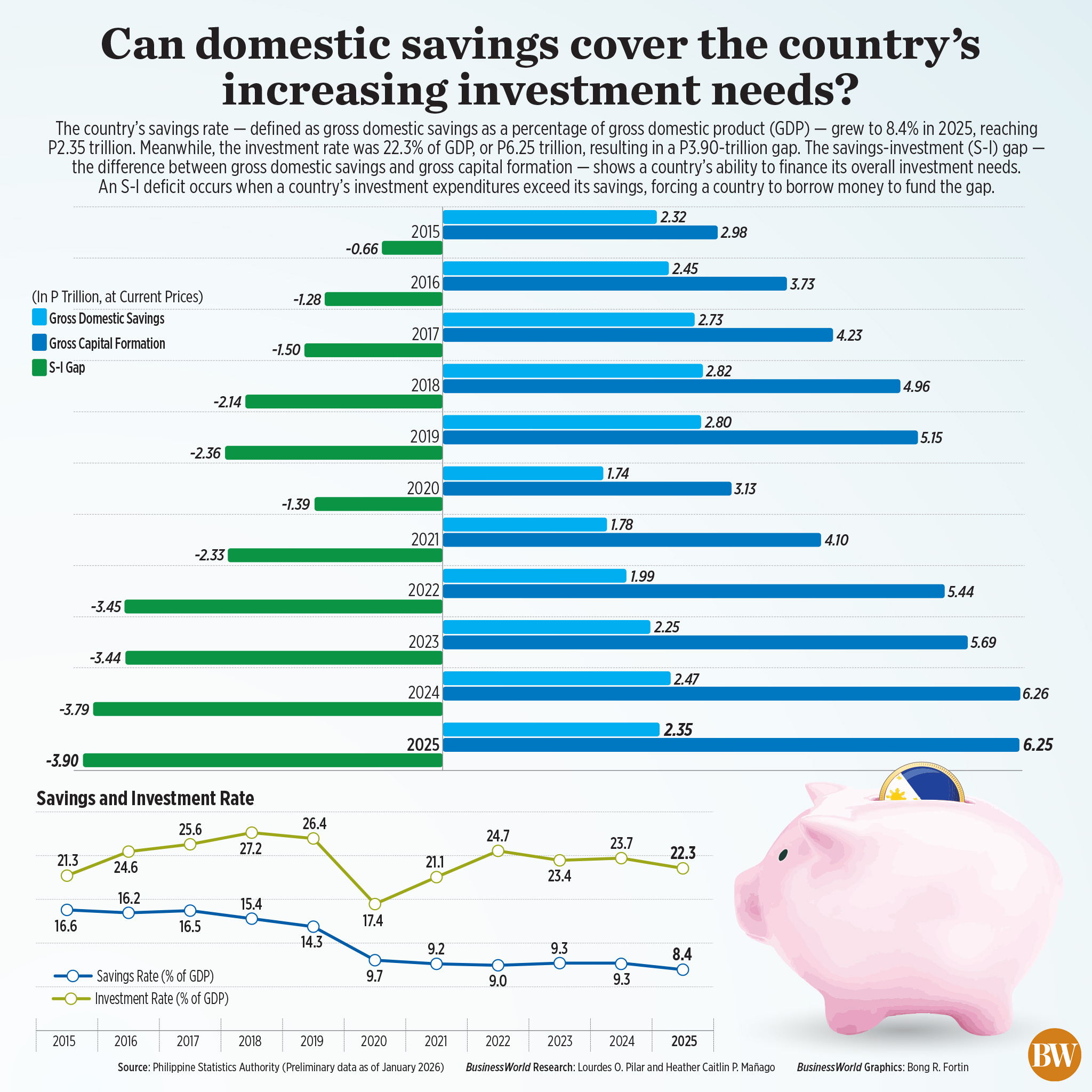
The country’s savings rate — defined as gross domestic savings as a percentage of gross domestic product (GDP) — grew to 8.4% in 2025, reaching P2.35 trillion. Meanwhile, the investment rate was 22.3% of GDP, or P6.25 trillion, resulting in a P3.90-trillion gap. The savings-investment (S-I) gap — the difference between gross domestic savings and gross capital formation — shows a country’s ability to finance its overall investment needs. An S-I deficit occurs when a country’s investment expenditures exceed its savings, forcing a country to borrow money to fund the gap.

Vitarich Corp. board approves Davao breeder farm acquisition

VITARICH.COM

LISTED poultry integrator Vitarich Corp. (VITA) said its board has approved the final terms and conditions for the P280-million acquisition of breeder farm facilities in Davao del Sur.

“Following this approval, the definitive agreement and the implementing contracts and documents of the foregoing acquisition are expected to be finalized, signed, and executed within the month of February 2026,” the company said in a disclosure on Thursday.

“The foregoing transactions are subject to customary closing conditions, such as execution of the definitive agreement and implementing contracts as well as full payment of the consideration,” it added.

The deal covers Vitarich’s acquisition of breeder farm facilities — including land, improvements, equipment; 125,000 common shares of stock; and advances of Broilers Club, Inc. (BCI) shareholders.

The total purchase price, based on third-party appraised value, was allocated as P95 million for 125,000 BCI shares, P130 million for BCI shareholders’ advances, P25 million for land owned by two BCI shareholders in the breeder farm, and P30 million to pay off BCI’s bank loan on one property.

Vitarich Corp. plans to operate the acquired breeder facilities as its own farm and make BCI a wholly owned subsidiary.

The acquisition aims to stabilize broiler chick supply and reduce production costs, with capacity projected to boost VITA’s total breeder output by up to 8%.

BCI is a private domestic corporation engaged in poultry and egg production, among others, with operations in Davao.

The Philippine Stock Exchange suspended trading of Vitarich shares on Thursday after classifying the recent board approval of the P280-million acquisition of BCI and breeder farm facilities as a substantial acquisition requiring further disclosure. — Alexandria Grace C. Magno

Ambitious TV adaptation of Allende’s House of the Spirits premieres in Berlin

ALFONSO HERRERA and Nicole Wallace in a scene from the 2026 miniseries House of the Spirits.

BERLIN — Isabel Allende’s novel The House of the Spirits, spanning several generations of women, was tough to translate to the screen, said the showrunners of an upcoming TV adaptation, but working with a Latin American cast made the challenge a joy.

“It was about time that we told the story ourselves,” Francisca Alegria told Reuters at the Berlin Film Festival, where the first three episodes were screened on Monday.

“For us, the novel, and for, I would say, all Latin America, is such an important piece of work. It talks so much about our identity, our history,” added Ms. Alegria.

“It’s just kind of like a dream come true.”

AN AMBITIOUS ADAPTATION
Ms. Alegria, along with Fernanda Urrejola and Andres Wood, are the creative trio behind the eight-part Spanish-language series that is set to stream on Amazon’s Prime Video this April.

Mr. Wood recalled that they felt a heavy responsibility to properly adapt the novel, but working on the project with a Latin American crew and cast in Chile was also a dream.

Ms. Allende, who is an executive producer, gave the team complete freedom to adapt her 1982 debut novel, they said.

The 83-year-old is one of the most widely read living writers in the Spanish language. Her books, which often blend historical events with magic and fantasy, have been translated into more than 40 languages.

A previous attempt in 1993 at a film adaptation featuring Meryl Streep and Glenn Close was a commercial flop.

AHEAD OF HER TIME
The TV series is told through granddaughter Alba’s perspective in the 1970s as she uncovers her family’s past and her country’s turbulent history through the diaries of her grandmother written half a century earlier.

Alba is played by Rochi Hernandez, who starred in the Argentine TV series La caida, while Clara is played by three actors: Francesca Turco, Nicole Wallace, and Dolores Fonzi.

Ms. Urrejola pointed out that Ms. Allende never mentioned Chile explicitly, a decision the showrunners also kept as they see the story as a universal tale of the region’s history.

Ms. Allende was ahead of her time in exploring intergenerational trauma long before it was an accepted concept, she added.

“Talking about healing generational trauma — it’s huge. And to understand how important memory is in order for us not to repeat the story. And we need that now,” said Ms. Urrejola. — Reuters

GoTyme Bank deposits hit P43 billion in 2025

GOTYME.COM.PH

GOTYME BANK’S customer deposits reached P43 billion last year, supported by higher payment volumes and usage.

The bank saw a 150% year on year increase in payment volume and reached more than eight million Visa debit card users, helping drive usage, it said in a statement on Thursday.

GoTyme Bank had the most used Visa debit card in the country, Visa said in the same statement.

It also saw the highest growth in debit payment volume, active debit cards, and contactless transactions for issuing.

“Together with Visa, we will continue delivering secure, seamless everyday experiences as we push toward our goal of becoming the largest and most loved retail bank in the Philippines,” Nathaniel C. Clarke, GoTyme Bank President and Chief Executive Officer.

“Our partnership with GoTyme is leveling up the payments experience for Filipinos, enabling innovative, safe and seamless payment experiences,” Visa Philippines Country Manager Jeffrey F. Navarro said. “This partnership also aligns with the government’s vision to build a digital-first, cash-lite society.”

GoTyme Bank, supported by Visa, will expand through enhanced card issuance programs and value-added experiences for cardholders, with specialized support in marketing, digital infrastructure, and data-driven financial services, the companies said.

The bank’s a partnership between the Gokongwei group and Singapore-based Tyme Group. It began commercial operations in October 2022 as one of the six digital banks licensed by the Bangko Sentral ng Pilipinas. — A.M.C. Sy

WNBA players lower salary cap, revenue sharing demands

REUTERS

THE Women’s National Basketball Players’ Association (WNBPA) eased its financial stance in the latest proposal it made to the Women’s National Basketball Association (WNBA) in collective bargaining, multiple media outlets reported.

The latest counterproposal came after a league proposal submitted earlier this month.

Per the reports, the union is now seeking an average of 27.5% of the league’s gross revenue, beginning at 25% in the first year of a prospective agreement.

The salary cap for the initial year would be below $9.5 million in the opening season, per the WNBPA’s reported proposal.

Previously, the union sought a 31% average of gross revenue, beginning at 28% in the first year. The opening-year salary cap was at $10.5 million in the WNBPA’s previous proposal.

A WNBA spokesperson told ESPN regarding the new union position, “The Players Association’s latest proposal remains unrealistic and would cause hundreds of millions of dollars of losses for our teams. We still need to complete two Drafts (a two-team expansion draft and college draft) and free agency before the start of training camp and are running out of time. We believe the WNBA’s proposal would result in a huge win for current players and generations to come.”

The WNBA’s latest offer features a $5.65 million salary cap. A key sticking point involves the league’s desire to peg the players’ share to net revenue rather than gross revenue. The WNBA reportedly is offering an average of more than 70% of net revenue to the players, but ESPN reported that figure would work out to less than 15% of the gross revenue.

The new union proposal reportedly seeks to retain housing for players, which the WNBA was trying to phase out from prior collective bargaining agreements.

The WNBPA is asking for housing to remain in place for the first few years of a new deal, but later players making higher salaries would be on their own to find housing.

The WNBA reportedly has offered one-bedroom apartments for players making the minimum salary and studio apartments for two developmental players per team.

The next WNBA season is currently scheduled to tip off on May 8 with three games, including the expansion Toronto Tempo playing host to the Washington Mystics. The expansion Portland Fire are due to face the visiting Chicago Sky on May 9. — Reuters

If overtime work is normal, something is abnormal

Our department manager forces people to do overtime (OT) work at an average of two hours every day. He justifies this one-year-old policy due to lack of workers. Is there a cure? — Glass Sparrow.

OT cannot be imposed as a permanent operating model without legally justification. Some exceptions include emergency situations, urgent work to prevent loss or damage, when the work is essential to the national interest, or to meet peak demand.

OT is regulated by labor laws, and while it can be required in certain situations it is not meant to be routine even if the workers voluntarily do for it for additional income.

Unfortunately, most people don’t know that regular OT is like a fever in an organization. Perpetuating is a sign of disease, most likely a dreaded one. That’s the trouble when some managers who normalize OT justify it as part of “how things get done here.” If that’s the case, then they’re not solving problems. If you’re asking me about a cure, let’s talk first about the reasons behind regular OT.

BASIC PRINCIPLES
The key word is necessary — not habitual, not managerial laziness or incompetence, and not even if it’s beneficial for the workers who want to increase their income. Even if it appears to be pro-labor, management can’t simply allow it to happen. Otherwise, it becomes a productivity issue and potentially illegal.

Since you claimed that it has been going on for one year now, your organization must immediately review the policy along the following lines:

One, absence or lack of proper planning. Ensure that your management has properly understood the importance of demand projection. You can’t simply take a number from thin air and make it the sole basis for overtime decisions, staffing levels, budget allocations, and long-term operational commitments.

Two, inefficient and wasteful processes. You may not realize it, but management could be to blame for requiring redundant approvals, performing manual tasks that could be automated, or repairing something due to quality errors. If your current system contains irrelevant and wasteful steps, OT becomes the bandage solution.

Three, poor work schedule or time management. The issues include having meetings which could have been e-mails. Or when people start their tasks late due to the tardiness of others. Most of the time, you’ll understand that it’s not the volume of work, but how the day is structured by managers.

Four, refusal to delegate or pass on the task. This happens when some managers perform staff-level work due to workers lacking the qualifications or not being sufficiently trusted. Also, it happens when managers drag their feet in making decisions. On the other hand, ordinary workers could also refuse to escalate certain issues or consult their bosses for fear of being blamed.

Five, work performance gaps. This happens due to lack of clear and actionable standards. Sometimes, people are given work assignments despite their lack of qualifications, absence of training, or failure to identify and propose solutions to problems. In certain cases, work that takes an average of three hours is dragged out to six.

Six, irrational corporate culture and tradition. Some organizations unwittingly promote a “last to leave wins” policy. That’s how and why they glorify OT work. Most of the time, they’ll tell you — “if you’re not tired, you’re not committed.” This often results in making regular OT work a “badge of honor.”

Seven, poor or lack of incentive pay. If employees rely on OT pay to boost income, they will allow inefficiencies to persist. Some incompetent managers allow it as a way to appease militant workers, even to avert the formation of a labor union, which is wrong. If the issue is incentives, then focus on rewarding outcomes, instead of hours. 

Eight, never-ending firefighting. This happens all the time when managers refuse to define and eliminate the root causes for the volume of work. That’s when the same workers solve symptoms, instead of correcting the system. This is where Kaizen and Lean thinkers would ask: Why don’t we focus on solving the recurring problems as the priority?

NOT A STAFFING ISSUE
If you fully understand all these basic principles, you’ll readily understand that a regular OT is an issue that can’t be ignored. While staffing may contribute, deeper systemic issues often sustain habitual overtime. Usually, habitual OT work is caused by one or all of the following things — process failure, leadership failure, or discipline failure. Therefore, OT should be the exception rather than the operating model.

Japanese management philosophy, popularized by the Toyota Production System, teaches us that problems should be exposed —  not concealed. Regular OT conceals them. And when management continues to allow regular OT, they’re saying they “prefer fatigue over fixing the root cause.” When normalized without root-cause correction, overtime signals leadership failure.

It happens all the time when the boss asks “who can stay late?” rather than asking “why are we late in delivering it?” There’s one major difference between the two questions. The first one builds dependency while the second builds capability.

When management pushes workers beyond their physical capacity to work, the result often leads to low productivity, quality issues, and higher overall costs. In other words, eight hours of focused work can outperform 12 hours of fatigued labor.


Join Rey Elbo’s March 27, 2026 public workshop on “Managing Difficult Workers: Practical Strategies for People Managers.” For details, e-mail operations@reyelbo.consulting or via https://reyelbo.com.

The ships that move global trade are going electric

NING YUAN DIAN KUN, an electric container ship of 740 TEUs.

By David Fickling

IN JULES VERNE’s classic Twenty Thousand Leagues Under the Sea, Captain Nemo’s futuristic submarine, the Nautilus, is battery-powered. Electric shipping has remained science fiction ever since.

That might be about to change, though. The Ning Yuan Dian Kun, an electric container ship capable of carrying 740 20-foot-equivalent units or TEUs*, was delivered earlier this month. Its 10 containerized batteries hold as much charge as 380 Tesla Model 3s, and can either be swapped at port or charged from shore-based cables.

If you follow the shipping industry, 740 TEUs might seem pretty paltry. The size record is currently held by the MSC Irina, launched in 2023 and carrying 24,346 units, almost 33 times as many as the Ning Yuan Dian Kun. Until batteries compete on that scale, they can be safely ignored.

Well, not quite. While mega-container ships are the workhorses of global trade, essential for connecting major ports such as Shanghai, Rotterdam, Long Beach, and Singapore, they’re not for every harbor. Their sheer size excludes them from the thousands of smaller docks that still take container deliveries. Much of the work of the biggest freight hubs comes not from unloading metal boxes to roads and railways, but sorting them onto smaller feeder vessels for delivery to lesser ports.

Many of these feeders are a lot more diminutive than you’d think. Just over half the global container fleet is below 3,000 units, the generally accepted upper limit for this kind of vessel. The average size of all the ships that docked at ports during 2023 is 3,618, according to the United Nations trade and development agency, UNCTAD. As with small passenger jets like the Boeing Co. 737 and Airbus SE A320, their use on short, high-frequency routes means they’re arguably more important as the backbone of the global transport network compared to glitzier, larger vessels.

That means they’re also significant contributors to marine pollution. In a typical year, about half of emissions from container shipping come from vessels carrying less than 8,000 TEUs, with about a fifth below 3,000, according to Xeneta, an intelligence platform for the freight industry.

That’s a long way above the Ning Yuan Dian Kun’s 740 units. But other shipbuilders are moving in the same direction.

Norway’s Eitzen Group last year received $19 million from a government innovation fund to build two 850-box battery vessels. The 120 TEU Yara Birkeland, operated by Norwegian fertilizer company Yara International ASA, has been plying the waters between Herøya and Brevik since 2022. Cosco Shipping Holdings Co.’s Greenwater 01, working a river route from Shanghai to Nanjing, was launched in 2024 and can carry 700 units under electric power.

One 2024 study found that reductions in battery costs plus a carbon price would be sufficient to allow such battery vessels to start undercutting combustion engines on routes of less than 1,000 kilometers or even 2,500 kilometers. Beyond that, the weight of batteries still eats too deeply into cargo space to make the numbers work.

That doesn’t mean there’s no role for batteries. Any route to decarbonizing shipping will involve multiple innovations working side-by-side. As much as 30% of ship fuel is burned to provide energy in port. Work on avoiding that pollution by plugging moored vessels into the grid is already underway in Europe, North America, and China, where the Yangtze river, a major internal freight artery, has been working to electrify its docks for several years. LNG, methanol, and ammonia are starting to displace marine fuel oil and diesel, with about half of the industry’s order book capable of running on alternative fuels.

Such initiatives are worthwhile. Shipping accounts for about 3% of global emissions, similar to all the aircraft in the sky. Despite the US government’s aggressive efforts to block or delay a global carbon price at the United Nations shipping agency, the International Maritime Organization, the industry itself wants to cut its climate footprint. Fuel accounts for about half of voyage costs, so operators have a strong incentive to adopt any technologies that can reduce it.

So far, batteries are only playing a small part in that picture — but as with trucking, a segment of the freight industry that was long thought immune to electrification is now giving way. The modular, container-housed power plants currently being trialed in China and Norway offer the perfect opportunity for companies to learn how to make that work, and scale quickly if the economics make sense.

With each passing year, batteries get cheaper, lighter, and more powerful. You’d be wrong to underestimate their potential to change the world.

BLOOMBERG OPINION

*The TEU is the standard measure in freight shipping, equivalent to half the size of a conventional container box.

Top Line opens eight new fuel stations in northern Cebu

TOP LINE BUSINESS DEVELOPMENT CORP.

CEBU-BASED fuel retailer Top Line Business Development Corp. said it has opened eight new fuel stations in Northern Cebu, expected to add up to 1 million liters in monthly sales capacity.

The openings follow the completion of renovations on its acquired fuel retail network, which has been rebranded under Light Fuels Express, the company said in a statement on Thursday.

The initiative is part of Top Line’s broader per-cluster renovation and rebranding program covering stations in Cebu, Leyte, Siquijor, and Negros Oriental.

Renovations for three more clusters are slated for completion by the end of the year. Meanwhile, stations that have yet to be rebranded continue to operate and contribute to Top Line’s revenue stream.

“The completion of our Cluster 1 renovation shows how we maintain quality in our acquisitions, reflecting our disciplined approach to optimize each station to operate at full capacity while maintaining efficiency and service quality,” Top Line Senior Vice-President and Chief Operating Officer Brigitte Carmel C. Lim said.

“This cluster-based rollout allows us to scale systematically and capture demand in high-growth markets like Northern Cebu,” she added.

According to the company, around 80% of Northern Cebu’s fuel market consists of two-wheeled vehicles, which fall within the target market of Light Fuels Express.

Last year, Top Line acquired 38 retail fuel stations, a two-million-liter depot facility, and 15 fuel tanker trucks from Total Oil & Gas Resources, Inc. and Ballston Metro Corp.

It has set aside approximately P925 million for the acquisition and renovation of stations in Cebu and new locations, accelerating the rollout of its retail arm, Light Fuels, in the Visayas.

The renovated stations are expected to serve motorcycles and light vehicles in the municipalities of Medellin, Bogo, Daanbantayan, Tabogon, Sogod, Borbon, Catmon, and Carmen.

The rebranding initiative strengthens its market presence by establishing “a consistent and recognizable Light Fuels identity across its retail network.”

Top Line started in leasing and real estate but entered the fuel industry in 2017. It is now active in commercial trading, depot operations, and retail fuel in the Visayas region. Through Light Fuels, the company introduced its first service station in Mandaue City, Cebu, in 2023. — Sheldeen Joy Talavera

Oscar contender Hamnet boosts tourism at Shakespeare heritage sites

JESSIE BUCKLEY and Joe Alwyn in a scene from Hamnet.

STRATFORD-UPON-AVON, England — On a cloudy winter’s day, visitors stream into what was once William Shakespeare’s childhood home in Stratford-upon-Avon and the nearby Anne Hathaway’s cottage, family residence of the bard’s wife.

Hathaway’s cottage is one of the settings for the BAFTA and Oscar best film contender Hamnet, and the movie’s success is drawing a new wave of tourists to Shakespeare sites in the town in central England.

Shakespeare’s Birthplace is the house the young William once lived in and where his father worked as a glove maker, while Hathaway’s cottage is where he would have visited his future wife early in their relationship.

Typically, around 250,000 visitors, from the UK, Europe, the United States, China and elsewhere, walk through the locations each year, according to the Shakespeare Birthplace Trust. The charity looks after Shakespeare heritage sites, which also include Shakespeare’s New Place, the site of the Stratford home where the bard died in 1616.

Visitors are flocking in this year thanks to Hamnet, the film based on Maggie O’Farrell’s 2020 novel, which gives a fictional account of the relationship between Shakespeare and Hathaway, also known as Agnes, and the death of their 11-year-old son Hamnet in 1596.

“Visitor numbers have increased by about 15 to 20% across all sites since the film was released back in January. I think that will only continue as we go throughout the year,” Richard Paterson, chief operating officer for the Shakespeare Birthplace Trust, said.

“They particularly want to look (at) Anne Hathaway’s cottage and the specifics around how the family engaged in the spaces and the landscape in and around the cottage… you can see why he would have been inspired.”

NEW ACCESS TO SHAKESPEARE
Hamnet has 11 nominations at Sunday’s British BAFTA awards, including best film and leading actress for Jessie Buckley, who plays Agnes. It also has eight Oscar nominations, with Ms. Buckley seen as the frontrunner to win best actress.

Hamnet is set in Stratford-upon-Avon and London although it was not filmed in Stratford.

It sees Paul Mescal’s young Shakespeare fall for Agnes while teaching Latin to pay off his father’s debts. The drama, seen mainly through Agnes’ eyes, focuses on their life together and grief over Hamnet’s death, leading Shakespeare to write Hamlet.

“Shakespeare… is notoriously enigmatic. He writes about humanity, about feeling, about emotion, about conflict, but where do we understand who he is in that story?” said Charlotte Scott, a professor of Shakespeare studies and interim director of collections, learning and research at the Shakespeare Birthplace Trust.

“And that’s driven people creative and otherwise for hundreds and hundreds of years. Where is Shakespeare’s heart? And this is what the film I think has so beautifully opened up.”

Little is known about how the couple met. Shakespeare was 18 and Hathaway 26 when they married in 1582. Daughter Susanna arrived in 1583 and twins Judith and Hamnet in 1585.

The film acknowledges the names Hamnet and Hamlet were interchangeable back then. While grief is a dominant theme, audiences also see Shakespeare in love and as a father.

“A lot of people will see this film not necessarily having… had any kind of relationship with Shakespeare,” Ms. Scott said.

“So people will come to this film, I hope, and find a new way of accessing Shakespeare that is about creativity, that is about understanding storytelling as a constant process of regeneration, but also crucially, looking at it from that kind of emotive angle.” — Reuters

GSIS net earnings reach P138 billion

PHILIPINE STAR/IRRA LISING

THE GOVERNMENT Service Insurance System (GSIS) posted a record net income of P138 billion in 2025.

This was supported by gross revenues reaching P344 billion and nonlife gross premiums hitting P11.4 billion, the state pension fund said on Thursday.

Meanwhile, total assets reached nearly P2 trillion last year.

GSIS on Thursday also launched the GSIS Ginhawa Go microloan program to replace Ginhawa Lite. The program aims to cater to government employees who rely on predatory lending for emergency funds.

“Ginhawa Go addresses financial stress early before it escalates and allows you to pay down the loan at your next monthly cycle so that you don’t have to be in debt for example, for two years. Because then all the numbers change once you’re in debt for a long period of time because interest compounds,” Finance Secretary Frederick D. Go said in a speech at the launch event on Thursday.

“My understanding is in the outside market, the borrowing rates are in the double digits. Because of processing fees, application fees, and all sorts of other fees, you might think you’re borrowing money at, say, 6% per month. But with all the fees, you’re actually paying almost double-digit numbers, which makes it very difficult for anybody to keep up this kind of practice.”

GSIS President and General Manager Jose Arnulfo “Wick” A. Veloso said at the same event that he expects loan applications under the new program to surpass those seen for Ginhawa Lite as it now offers smaller amounts.

The loan program offers different loan amounts under different tiers. For amounts from P1,000 to P4,000, payment terms are offered at one to three months. Meanwhile, the standard tier has loanable amounts of P5,000 to P50,000 with payment terms of three, six, 12, 18, or 24 months.

“That structure matters. It recognizes that not every need requires a large loan. Sometimes a member needs a small, short reach with a short runway for repayment,” Mr. Veloso said.

The annual interest rate under the program is fixed at 6% for members with more than three years of paid premiums, while special members can avail the loan at a 7% rate.

Mr. Veloso said the GSIS is studying how to offer lower interest rates under the program.

Ginhawa Go loans are available to GSIS members with at least one month of paid premium contributions. — Aaron Michael C. Sy