A Sunday entry by the Republican candidate on Truth Social showed Ms. Swift dressed in red, white and blue with a caption that said “Taylor Swift Wants You To Vote For Donald Trump.”
“I accept!” Mr. Trump wrote.
Ms. Swift has not publicly endorsed a candidate in the 2024 race but has supported Democrats in the past.
The singer backed President Joseph R. Biden and running mate Kamala Harris in 2020. Ms. Harris is set to be formally nominated as the 2024 Democratic candidate at the party’s national convention in Chicago this week. Ms. Swift also criticized Mr. Trump in a 2020 documentary.
A spokesperson for Ms. Swift did not respond to a request for comment.
Mr. Trump also posted photos of young women wearing “Swifties for Trump” shirts, and a satirical article with the headline “Swifties Turning to Trump After ISIS Foiled Taylor Swift Concert.” The article was marked “SATIRE” above the headline.
Ms. Swift canceled three shows in Vienna this month after authorities said they had foiled a planned attack. Local officials arrested a 19-year-old man who they said was inspired by Islamic State.
“Swifties for Trump is a massive movement that grows bigger every single day,” Trump campaign spokesperson Steven Cheung said in a statement when asked for comment about the fake Swift image.
Several Swift fans and watchdog groups said many of the images posted by Mr. Trump appeared to be deepfakes generated by artificial intelligence (AI).
Advocates in the music industry, Hollywood and Washington have been pushing for federal legislation and other measures to fight the explosion of fake AI images online.
Mr. Trump’s post was “yet another example of AI’s power to create misinformation,” consumer group Public Citizen said.
“The potential harm to our society that could result from such misinformation, including abuses of our elections, are wide-reaching and immensely damaging,” the group added. — Reuters
LONDON — Mike Lynch, the tech tycoon missing after his luxury yacht sank off Sicily, spent more than a decade building Britain’s biggest software company and then almost as long again fighting fraud charges related to its multi-billion pound sale.
Mr. Lynch founded Autonomy from his ground-breaking research at Cambridge University in 1996, and was lauded by shareholders, scientists and politicians when he sold it to Hewlett-Packard (HP) for $11 billion 15 years later.
But in late 2012, HP stunned Wall Street and the City of London by alleging a massive accounting scandal at the business, and writing off $8.8 billion of its value.
Mr. Lynch, known for an abrasive intellectual charm, said HP did not know what it was doing with Autonomy, which searched and organized data using patented algorithms based on a mathematics developed in the 18th Century by Reverend Thomas Bayes.
He spent the next 12 years in courts trying to clear his name, locked in some of the biggest legal battles in corporate history.
HP pursued Mr. Lynch in London’s High Court for $5 billion. It won most of its case in 2022 and is still awaiting the award of damages.
The judge found that Mr. Lynch and another colleague had fraudulently concealed a “fire sale” of hardware and engaged in convoluted reselling schemes to mask a shortfall in sales of Autonomy’s software, the business HP coveted.
US authorities filed criminal charges including wire fraud and conspiracy against Mr. Lynch and sought his extradition.
The British government came under pressure from Mr. Lynch’s supporters to block the application. If found guilty, Mr. Lynch could have faced decades in jail.
But the appeals failed, and Mr. Lynch took the stand in San Francisco in his own defense, where he denied wrongdoing and told jurors that HP had botched the integration of Autonomy.
He was acquitted on all charges and freed after a year under house arrest. Mr. Lynch said he was “elated.”
“I am looking forward to returning to the UK and getting back to what I love most: my family and innovating in my field,” he said.
VIOLENT STORM A person familiar with the rescue effort said Mr. Lynch and his wife, Angela Bacares, were on the 56-meter (184-ft) long British-registered Bayesian sailboat when it was struck by an unexpectedly violent storm and sank off the Sicilian capital Palermo early on Monday.
The yacht was owned by Mr. Lynch’s family and had 22 people on board when it sank just before sunrise.
Mr. Lynch was born in 1965 and was raised in Chelmsford near London where his mother was a nurse and his father a fireman. He said his parents instilled in him an appreciation of the value of education.
At Cambridge University, he studied physics, mathematics and biochemistry, and went on to research signal processing for his doctorate. His thesis is still one of the most widely consulted in the university’s library, reports have said.
In 1996, Mr. Lynch founded Autonomy which searched and organized complex data such as emails, phones calls and video.
Mr. Lynch, who has a herd of rare breed cattle on his estate in Suffolk, East England, used some of the proceeds of the sale of Autonomy to set up venture capital firm Invoke.
It was a major backer of Darktrace, a British cyber security company that United States firm Thoma Bravo agreed to buy for $5.32 billion in cash in April. — Reuters
A snap from last year’s AmCham 6th Annual Energy Forum from Sept. 14, 2023: (from left to right) Yukiko Tsukamoto of Bain & Company, Raymund Pascual of BlueFloat Energy, Atty. Rossan Rosero-Lee of the National Electrification Administration, Mimi Concha of HSBC, Diana Connett of Asian Development Bank, and Eric Francia of ACEN
The American Chamber of Commerce of the Philippines (AmCham Philippines) is flipping the switch on its 7th Annual Energy Forum, transforming the Marriott Hotel in Pasay City into the heart of the nation’s energy conversation on Aug. 29 from 9:00 a.m. Industry leaders, policy makers, and visionaries will gather to explore the theme “Powering an Efficient and Progressive Future in the Philippine Energy Industry.”
Expect dynamic discussions on the latest updates to the Philippine Energy Plan, where regulations, policies, and investments will be dissected, debated, and reimagined. From the complexities of the energy mix supply, including non-renewable sources, to a special session on the potential of Nuclear Energy, every corner of the industry will be under the spotlight.
AmCham is thrilled to have the support of organizations that are as committed to the future of Energy including Partner Organizations, US Agency for International Development (USAID), the Independent Electricity Market Operator (IEMOP), the Philippine Energy Efficiency Alliance, Inc. (PE2), and the Philippine Independent Power Producers Association, Inc. (PIPPA). Relationship Builders like GHD, Microsoft Philippines, Specialized Solution Services (S3), and Aboitiz Power Corp.’s Thermal Business Group are helping to forge connections that will drive the industry forward.
Supportive Partners, including Meralco, Emerson, AIG Philippines, AFRY Philippines, Inc., Quezon Power (Philippines) Ltd. Co., and San Buenaventura Power Ltd. Co.; and Event Supporters BDO and Procter & Gamble Philippines (P&G) are all plugged in to elevate the forum as the industry’s event of the year.
Spotlight is BusinessWorld’s sponsored section that allows advertisers to amplify their brand and connect with BusinessWorld’s audience by publishing their stories on the BusinessWorld Web site. For more information, send an email to online@bworldonline.com.
Join us on Viber at https://bit.ly/3hv6bLA to get more updates and subscribe to BusinessWorld’s titles and get exclusive content through www.bworld-x.com.
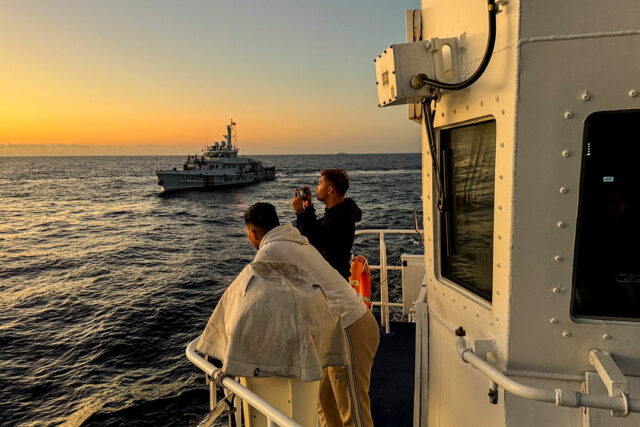
Philippine Coast Guard personnel documents a Chinese Coast Guard vessel shadowing the Philippines’ resupply mission at Second Thomas Shoal in the South China Sea, March 5, 2024. — REUTERS
MANILA – The actions by China’s coast guard against Philippine vessels near the Sabina Shoal in the South China Sea were illegal and “do not contribute to confidence building”, a Philippine maritime council official said on Tuesday.
The Philippines urges China to refrain from aggressive actions and adhere to international law, spokesperson Alexander Lopez told a briefing at the presidential palace. – Reuters
The first case of mpox (also known as monkeypox) has been confirmed in the Philippines, following its declaration as a global public health emergency on Wednesday, according to the Department of Health (DOH).
This new case is the first since the last case reported in December 2023, bringing the total to 10 laboratory-confirmed mpox cases reported to the DOH as of Sunday.
The patient is a 33-year-old male Filipino from Metro Manila with no travel history outside the country but with “close and intimate contact” prior to the onset of symptoms, accodring to the DOH.
The DOH suggested that the patient may have contracted the mpox virus locally.
“Yung virus ay nandirito sa Pilipinas. We have 9 cases in 2023, pero pakonti-konti ang nate-test natin so that means the mpox virus is among us, so hind siya imported nandidito siya (The virus is here in the Philippines. We had 9 cases in 2023, but we have been testing only a few, which means the mpox virus is present among us locally),” Teodoro J. Herbosa, Secretary of DOH said during the Media Forum on Monday.
The patient’s mpox symptoms began over a week ago with fever, followed four days later by a distinctive rash on the face, back, neck, trunk, groin, and on the palms and soles.
By testing the skin lesions collected from the patient, positive results for monkeypox viral DNA were found via a real-time polymerase chain reaction (PCR) test.
Mr. Herbosa said that the patient is currently isolated, and they are conducting contact tracing to contain the virus’s transmission.
Containing mpox virus
The DOH anticipates an increase in mpox cases as a global public health emergency declaration is still in effect, but he notes that the expected reproductive number (R0) will be significantly lower compared to COVID-19.
“Ang COVID ay airborne so kaya ang bilis. Pagkasakay mo lang sa bus, sa tren, sa jeepney pwede kang mahawaan, [COVID is airborne, so the transmission is quick; just by riding a bus, train, or jeepney, you could easily get infected], unlike (mpox) close and intimate contact,” Mr. Herbosa said.
According to the World Health Organization (WHO), mpox can be acquired through personal touch, kissing, or sex, as well as contact with contaminated sheets, clothes, or needles.
Maintaining hands clean with soap and washing contaminated items with laundry soap can help eliminate the virus.
However, if you contract the virus, Mr. Herbosa advises isolation and home quarantine, particularly for individuals without comorbidities, as the symptoms are mild, Mr. Herbosa said.
“So, the moment na meron kang symptoms or mag-positive ka, mag-isolate na [As soon as you have symptoms or test positive, you should isolate],” Mr. Herbosa said.
Patients with mpox are treated with supportive care and are expected to recover, typically 2 to 4 weeks.
“Yung sintomas po ang ginagamot kung nilalagnat sila bibigyan sila ng Paracetamol, kung may makati sa kanila ‘anti-pruritus’ or anti-kati at aalagan yung mga lesions nila [The symptoms are the ones being treated. If they have a fever, they are given paracetamol. If they have itching, they are given anti-itch medication, and their lesions are cared for],” Mr. Herbosa said.
On Monday, the DOH said that they are updating their mpox guidelines to facilitate a more convenient and dignified approach, encouraging people at risk to seek consultation and testing.
“DOH will make the testing process as convenient as possible, so that suspect cases may be identified fast and allowed to stay at home,” Mr. Herbosa said. – Edg Adrian A. Eva
By Royal Society uploader – Own work, CC BY-SA 4.0, https://commons.wikimedia.org/w/index.php?curid=34582124
PALERMO, Sicily – One man died and six people were missing, including British tech entrepreneur Mike Lynch and his daughter, after a luxury yacht was struck by an unexpectedly violent storm and sank off Sicily early on Monday.
The British-flagged “Bayesian”, a 56-meter-long (184-ft) sailboat, was carrying 22 people and was anchored just off shore near the port of Porticello when it was hit by ferocious weather, the Italian coast guard said in a statement.
Eyewitnesses said the yacht vanished quickly beneath the waves shortly before dawn. Fifteen people escaped before it went down, including Lynch’s wife, Angela Bacares, who owned the boat, and a one-year-old girl.
The names of the dead and missing were not immediately released, but a person familiar with the rescue operation confirmed that Lynch and his 18-year-old daughter, Hannah, were not accounted for.
Salvatore Cocina, head of the Civil Protection in Sicily said Jonathan Bloomer, chairman of Morgan Stanley International and Chris Morvillo, a lawyer at Clifford Chance were also among the missing people.
Italian media said the dead man was the yacht’s onboard chef.
Morgan Stanley did not immediately respond to a phone call and email seeking comment after hours. Clifford Chance did not return a request for comment.
The Italian coast guard said the missing had British, American and Canadian nationalities. Survivors said the trip had been organized by Mr. Lynch for his work colleagues.
“The wind was very strong. Bad weather was expected, but not of this magnitude,” a coast guard official in the Sicilian capital Palermo told Reuters.
The captain of a nearby boat told Reuters that when the winds surged, he had turned on the engine to keep control of his vessel and avoid a collision with the Bayesian, which had been anchored alongside him.
“We managed to keep the ship in position and after the storm was over, we noticed that the ship behind us was gone,” Karsten Borner told journalists. The other boat “went flat on the water, and then down,” he added.
He said his crew then found some of the survivors on a life raft – including a baby girl and her mother – and took them on board before the coast guard picked them up.
Mr. Lynch, aged 59, is one of Britain’s best-known tech entrepreneurs. He built the country’s largest software firm, Autonomy, from his ground-breaking research at Cambridge University, and became known as Britain’s Bill Gates.
He sold the firm to HP for $11 billion in 2011, before the deal unravelled spectacularly following the acquisition, with the US tech giant accusing him of fraud.
Once lauded by academics, scientists and politicians, Mr. Lynch spent much of the last decade in court defending his name. He was acquitted by a jury in San Francisco in June, after he spent more than a year living effectively under house arrest.
He said at the time that he was “elated” to be cleared in the criminal trial in which he denied any wrongdoing and blamed HP for botching the integration of the two companies.
DIVERS INSPECT WRECK
The coast guard said divers were inspecting the wreck of the Bayesian, which was lying at a depth of 49 meters.
Prosecutors in the nearby town of Termini Imerese have opened an investigation to look into what had gone wrong.
Storms and heavy rainfall have swept down Italy in recent days after weeks of scorching heat, which had lifted the temperature of the Mediterranean sea to record levels, raising the risk of extreme weather conditions, experts said.
“The sea surface temperature around Sicily was around 30 degrees Celsius (86 Fahrenheit), which is almost 3 degrees more than normal. This creates an enormous source of energy that contributes to these storms,” said meteorologist Luca Mercalli.
“We can’t say that this is all due to global warming but we can say that it has an amplifying effect,” he told Reuters.
The Bayesian was built by Italian shipbuilder Perini in 2008 and was last refitted in 2020. Its 75-metre mast is the tallest aluminium mast in the world, Perini said on its website.
The shipspotting.com website said the boat was owned by a firm called Revtom Limited. Lynch’s wife Bacares is named as the sole shareholder of the firm on company documents.
The yacht’s name would resonate with Lynch because his PhD thesis and the software that made his fortune was based on Bayesian theory.
The ship won a string of awards for its design and can accommodate up to 12 guests in six suites and a crew of 10, according to online specialist yacht sites.
The boat left the Sicilian port of Milazzo on Aug. 14 and was last tracked east of Palermo on Sunday evening, with a navigation status of “at anchor”, according to vessel tracking app Vesselfinder. – Reuters
PHOTO SHOWS the damage on the BRP Cape Engaño — a five-inch hole on its deck — after it collided with a Chinese Coast Guard vessel near Sabina Shoal. — PHILIPPINE COAST GUARD PHOTO
WASHINGTON – The US State Department condemned “dangerous actions” by China on Monday against Philippine vessels in the South China Sea.
Chinese ships “employed reckless maneuvers, deliberately colliding with two Philippine Coast Guard ships, causing structural damage and jeopardizing the safety of the crew onboard,” the department said in a statement. – Reuters
CHICAGO – The founder of the main outside spending group backing Kamala Harris’ presidential bid says their own opinion polling is less “rosy” than public polls suggest and warned that Democrats face much closer races in key states.
Chauncey McLean, president of Future Forward, a super political action committee, or super PAC, that has raised hundreds of millions of dollars to back Ms. Harris in the Nov. 5 election, spoke on Monday during an event hosted by the University of Chicago Institute of Politics.
“Our numbers are much less rosy than what you’re seeing in the public,” said Mr. McLean, who rarely talks publicly.
Ms. Harris enters the Democratic National Convention in Chicago riding a wave of public polls that show she has already reshaped a race that strongly favored Republican Donald Trump in the final weeks of President Joe Biden’s candidacy. Harris is leading in a compilation of national polls by FiveThirtyEight 46.6% to 43.8% for Republican Donald Trump, and has pulled ahead in several public battleground state polls.
Future Forward has created a massive polling operation that created and tested some 500 digital and television ads for Biden and some 200 for Ms. Harris. They have talked to some 375,000 Americans in the weeks after Harris became the presumptive Democratic nominee on July 22.
Mr. McLean said the group has at least $250 million left to spend, planning a wave of advertising from digital to television between Labor Day on Sept. 2 and Election Day on Nov. 5.
Super PACs can raise unlimited sums of money from corporations, unions, associations and individuals, then spend unlimited amounts to overtly advocate for or against political candidates.
Mr. McLean said the majority of Ms. Harris’ momentum in the immediate aftermath of Mr. Biden dropping out was from young voters of color, and that has opened up Sunbelt states such as Nevada, Arizona, Georgia and North Carolina, states which Democrats had largely written off in the final days of the Biden campaign.
“She has multiple paths,” with seven states in play, a complete turnaround from when Biden was on the ticket, he said. The other states include Pennsylvania, Wisconsin and Michigan.
Mr. McLean said Pennsylvania remains the most consequential state in the group’s analysis and he called the race a “coin flip” based on its polls. He says Harris must win one of three states – Pennsylvania, North Carolina or Georgia – to win the White House.
He warned that Ms. Harris has yet to fully rebuild the Biden coalition of Blacks, Hispanics and young voters that brought him the White House in 2020.
Mr. McLean said polling shows the public wants more detailed policy positions from Ms. Harris.
He says they don’t want “white papers,” but they also don’t want platitudes. He says they need more concrete examples of how she may differ from Mr. Biden and make their lives easier economically. Mr. Trump allies have called on Ms. Harris to do the same in recent days, hoping to pin her down on controversial issues.
The race is as tight as ever, Mr. McLean said.
“We have it tight as a tick, and pretty much across the board,” he said. — Reuters
WASHINGTON – The US Federal Aviation Administration said on Monday it would require inspections of Boeing Dreamliners following an incident in March when a LATAM Airlines plane went into a sudden mid-air dive that injured more than 50 passengers.
The FAA said the apparent reason for the dive was the uncommanded movement of the captain’s seat, which caused the auto-pilot to disconnect. The agency said it had received a total of five reports of similar problems with the captain and first officer seats on 787s, the most recent in June, and two remain under investigation.
The FAA’s airworthiness directive impacts 158 US-registered airplanes and 737 airplanes worldwide and requires airlines to inspect the captain’s and first officer’s seats on 787-7, 787-9, and 787-10 airplanes for missing or cracked rocker switch caps or for cracked switch cover assemblies within 30 days.
Airlines must perform any necessary corrective actions if issues are found.
The FAA said uncommanded horizontal movement of an occupied seat could result in a rapid descent of the airplane and serious injury to passengers and crew.
Boeing and LATAM Airlines did not immediately respond to requests for comment.
Separately, Boeing said Monday it had halted test flights on its 777-9 that is awaiting certification after a component between the engine and airplane structure was identified as failing to perform during a maintenance check.
The FAA said Boeing had informed it the company discovered a damaged component following a 777-9 flight test last week.
Boeing in July began certification flight testing of its long-delayed 777-9 with FAA regulators onboard after receiving Type Inspection Authorization.
Boeing added “no near-term flight tests were planned on the other flight test airplanes” and said the part is custom to the 777-9. — Reuters
US one-hundred-dollar notes are seen in this picture illustration taken in Seoul Feb. 7, 2011. — REUTERS
By Luisa Maria Jacinta C. Jocson, Reporter
THE COUNTRY’S balance of payments (BoP) position swung to a surplus in July, data from the Bangko Sentral ng Pilipinas (BSP) showed.
The $62-million surplus was a turnaround from the $53-million deficit a year ago and the $155-million deficit in June.
“The BoP surplus in July 2024 reflected inflows mainly from the net income from the BSP investments abroad and the National Government’s (NG) net foreign currency deposits with the BSP,” the central bank said in a statement.
The BoP measures the country’s transactions with the rest of the world. A surplus shows that more money entered the Philippines, while a deficit means more funds left.
At its end-July position, the BoP reflected a final gross international reserve (GIR) level of $106.7 billion, slightly higher than $105.2 billion as of end-June.
The dollar reserves were enough to cover 6.1 times the country’s short-term external debt based on original maturity and 3.8 times based on residual maturity.
It was also equivalent to 7.9 months’ worth of imports of goods and payments of services and primary income.
An ample level of foreign exchange buffers safeguards an economy from market volatility and is an assurance of the country’s capability to pay debts in the event of an economic downturn.
Rizal Commercial Banking Corp. Chief Economist Michael L. Ricafort said the BoP surplus in July was due to “continued inflows of overseas Filipino workerremittances, business process outsourcing revenues, foreign tourism receipts, foreign direct investments (FDI) and other structural US dollar inflows of the country.”
Earlier data from the BSP showed that cash remittances grew by 2.5% to a six-month high of $2.88 billion in June. This brought the January-to-June remittances to $16.25 billion, up 2.9% from a year ago.
Net inflows of FDIs climbed by 15.8% to $4.024 billion in the first five months from $3.475 billion in the year-ago period.
7-MONTH PERIOD Meanwhile, the country’s BoP position registered a $1.504-billion surplus in the January-to-July period. This was lower than the $2.207-billion surplus recorded a year ago.
“Based on preliminary data, this cumulative BoP surplus reflected mainly the narrowing trade in goods deficit alongside the continued net inflows from personal remittances, net foreign direct investment, trade in services, net foreign borrowings by the NG, and net foreign portfolio investments,” the BSP said.
In the first half of the year, the trade deficit narrowed by 9.5% to $25 billion. The country’s balance of trade in goods has been in a deficit for nine years or since the $64.95-million surplus in May 2015.
Mr. Ricafort said the BoP position in the January-July period was lower than a year ago due to the bigger proceeds from global bond sales last year.
The government raised $3 billion from its dollar bond sale in January 2023. This year, it raised $2 billion from its dual-tranche dollar bond offering in May.
“While the year-to-date surplus is lower than 2023, the country’s GIR of $106.7 billion remains ample,” Security Bank Corp. Chief Economist Robert Dan J. Roces said in a Viber message.
“A narrowing trade deficit and consistent inflows from remittances, FDI and portfolio investments contribute to a cautiously optimistic outlook for the Philippine economy,” he added.
For the coming months, Mr. Ricafort said the BoP position could further improve amid the expected foreign bond offerings for the rest of the year.
The government is eyeing to raise about $5 billion from the issuance of global bonds this year. Finance Chief Ralph G. Recto has said they might offer dollar or Samurai bonds.
For 2024, the BSP expects the country’s BoP position to end at a $1.6-billion surplus, equivalent to 0.3% of GDP.
CAR ENTHUSIASTS at the opening day of the Manila International Auto Show in Pasay City, April 4, 2024. — PHILIPPINE STAR/RYAN BALDEMOR
By Justine Irish D. Tabile, Reporter
NEW VEHICLE SALES could hit the 500,000 mark this year amid more launches and double-digit sales growth in the first half, according to the Chamber of Automotive Manufacturers of the Philippines, Inc. (CAMPI).
“For 2024, we have set a conservative target of 468,300 units in sales. However, with the excitement and momentum to make up for the Philippine International Motor Show (PIMS), we are optimistic about surpassing this goal and potentially reaching the 500,000 units mark,” said CAMPI President Rommel R. Gutierrez at a press conference on Monday.
If realized, this will be the industry’s highest annual sales to date and will represent a 16.3% increase from the 429,807 units sold in 2023.
Mr. Gutierrez said the industry had seen unexpectedly strong sales in the first half of the year.
“It’s a really good sign that the industry is really gaining momentum. So, we hope that it will really continue, at least in the second half, and give us a basis for a better projection next year,” he added.
He noted that historically, car sales pick up in the second half, especially in the months leading to December.
The latest joint report by CAMPI and the Truck Manufacturers Association showed that vehicle sales rose by 10.9% in the January-to-July period to 265,610 units from 239,501 last year.
Sales of commercial vehicles went up by 8.7% to 194,812, while passenger car sales grew by 17.3% to 70,798.
Toyota Motor Philippines (TMP), which accounted for nearly half or 46.21% of the total industry sales in the seven-month period, is confident about the industry achieving its sales target this year.
“We, as a whole, are quite confident about hitting the milestone size for the growth of the market this year,” said TMP President Masando Hashimoto.
“Maybe one of the reasons is the healthy growth of financing or the new car model introductions to the market. There are several factors there, but we are all very confident in this year’s target,” he added.
Mr. Gutierrez said sales in the provinces, especially in Region III and Region IV, have been growing. Provincial sales now make up 60% of the industry’s total sales.
“We, the distributors, understand that Metro Manila is already crowded. That is why the dealers are mostly in the provinces, because when you have a dealer there, it encourages people to buy cars,” he said.
However, Mr. Gutierrez said the industry outlook could still be affected by possible supply chain disruptions, inconsistent policies and the exchange rate.
“I think the supply has significantly improved but remains a challenge. In terms of government policies, we had some uncertainties in the legislation, and we are closely monitoring it,” he said.
The industry is monitoring the progress of a bill that includes the removal of the excise tax exemption for pickup trucks, Mr. Gutierrez said.
“This affects planning, and in fact, we have been monitoring it since last year. The uncertainty really matters negatively because even stocks are being scheduled,” he said.
The Finance department is pushing the removal of the excise tax exemption for pickup trucks under the Tax Reform for Acceleration and Inclusion law.
“Inconsistent government policies have always been an issue not only in the automotive industry but even in other industries,” Mr. Gutierrez said.
Mr. Hashimoto said the challenge is how to create a sustainable business environment that will support vehicle manufacturing in the Philippines.
“This is not a short-term challenge, but if you look at long-term industrial growth… this is really key to everyone, especially Toyota,” he said.
The bill rationalizing the mining fiscal regime is one of the priorities of the Legislative-Executive Development Advisory Council. — REUTERS
By John Victor D. Ordoñez, Reporter
THE DEPARTMENT of Finance (DoF) has lowered its yearly revenue estimates to P6.3 billion from P10.23 billion in the next four years from a proposed five-tier margin-based tax system for the mining industry amid lower metal prices.
The government is expected to earn P4.48 billion from royalty tax on miners inside mineral reservations, P1.07 billion from those outside reservations and P730 million from windfall profit tax, Finance Assistant Secretary Karlo Adriano S. Fermin told a Senate hearing on Monday.
The DoF is now proposing to impose a 1.5-5% margin-based royalty rate with five tiers for miners outside mineral reservations, as well as a 1-10% windfall profit tax with five tiers.
It still wants to keep the regime where large-scale metallic mining operations inside mineral reservations pay the government 5% of their gross output.
Under its previous four-tier proposal, the DoF had expected to generate P5.5 billion from royalties from miners operating within mineral reservations, P1.31 billion from royalties on miners outside reservations and P3.37 billion from windfall profit tax.
Mr. Fermin said the revenue projections were revised to reflect the latest data and lower prices in the world market.
“Number one, this comes from new data and number two, metallic prices have gone down,” he told BusinessWorld on the sidelines of the hearing.
Based on Aug. 15 data from the Mines and Geosciences Bureau, nickel prices dropped by 19.1% to $16,035 per metric ton (/MT) from $19,825/MT a year earlier. Gold prices stood at $2,449 per ounce, up by 28.5% from $1,906 per ounce a year ago, while copper prices rose by 8.1% to $8,906/MT from $8,242/MT.
Mr. Fermin said the five-tier system was a compromise made after consultations with mining stakeholders, who expressed fears about a higher effective tax rate for the industry.
“Of course, with more tiers, you have more rates, right?” he told BusinessWorld in Filipino. “But with fewer tiers, there are fewer rates, but the advance might be larger.”
The DoF’s latest proposal differs from House Bill No. 8937, approved in September 2023, which proposed that large-scale miners in mineral reservations pay the government only 4% of their gross output. The House version also included a margin-based royalty rate of 1.5-5% with eight tiers, and a 1-10% windfall profit tax with 10 tiers.
“We think the net effect (of the five-tier system) will be the same (compared with the four-tier system),” Chamber of Mines of the Philippines Executive (CoMP) Director Ronald S. Recidoro told BusinessWorld after the hearing.
“It’s just a simpler implementation and as the assistant secretary (Mr. Fermin) said, it will disincentivize aggressive accounting since too many tiers would encourage this.”
Mr. Recidoro said the measure would ease the uncertainty surrounding the Philippine mining sector and encourage more foreign investors to come in.
“This (measure) will really provide a good environment for foreign investors, to show that there is stability in our tax regime,” Philex Mining Corp. Senior Vice-President and Chief Financial Officer Romeo B. Bachoco told the same hearing.
The existing tax system for mining companies requires them to pay corporate income tax, excise tax, royalty, local business tax, real property tax, and fees to indigenous communities.
The DoF’s proposal also includes a provision treating mining contractors as separate taxable entities under law “with respect to each and every mineral agreement it holds or operates,” Mr. Fermin said.
“The passage of a new tax law should not only boost our nation’s revenue coffers,” CoMP Chairman Michael T. Toledo said told the Senate panel.
“Among other policy challenges that need to be addressed, it is crucial to establish a stable and predictable mining tax regime.”