Home Blog Page 2397

Green energy auction 3rd round to offer 4,475 MW of RE capacity

BW FILE PHOTO

THE Department of Energy (DoE) said it plans to offer 4,475 megawatts (MW) worth of renewable energy (RE) capacity in the third round of the green energy auction (GEA-3).

The DoE issued the notice of auction and the terms of reference for GEA-3, inviting qualified energy developers to participate in the bidding aimed at facilitating the energy transition.

“By unlocking more capacity for renewable energy, GEA-3 provides a clear pathway to meet our electricity demands in an environmentally sustainable way,” Energy Secretary Raphael P.M. Lotilla said in a statement on Thursday.

The terms of reference state that technologies ineligible for the feed-in tariff (FIT) make up the bulk of the offer, including 4,000 MW of pumped storage hydropower capacity, for delivery between 2028 and 2030.

The DoE will also offer 300 MW of impounding hydropower capacity for 2028-2030 delivery, and 100 MW of geothermal capacity for 2025-2027 delivery.

The FIT-eligible renewable energy technology projects include 75 MW of run-of-river hydro due for delivery between 2027 and 2029.

The GEA program aims to promote renewable energy as a primary source of energy, subject to competitive selection. The government is hoping to increase the share of renewable energy in the power mix to 35% by 2030 and 50% by 2040.

“These projects will play a crucial role in meeting the country’s growing electricity demand while ensuring that future power generation is increasingly sustainable,” the DoE said.

The GEA was first staged in 2022 and resulted in 1,996.93 MW worth of renewables being awarded. GEA-2 was held in 2023, with 3,440.756 MW awarded.

The Energy Regulatory Commission (ERC) will set parameters for each type of renewable energy facility covered in the GEA program via a price determination methodology (PDM).

ERC Chairperson and Chief Executive Officer Monalisa C. Dimalanta said that the commission is hoping to release the PDM early next month. — Sheldeen Joy Talavera

NGCP capex to exceed P600 billion for over 100 transmission projects

BW FILE PHOTO

THE National Grid Corp. of the Philippines (NGCP) said it is allocating more than P600 billion in capital expenditure (capex) for over 100 transmission projects in its pipeline.

“Moving forward, we want to spend over P600 billion,” NGCP Spokesperson Cynthia P. Alabanza told reporters on Thursday.

The grid projects form part of the Transmission Development Plan (TDP) 2024-2050, which are “ready for implementation.”

Major projects include the Balaoan-Laoag 500-kilovolt (kV) Transmission Line, the Western Luzon 500-kV Backbone Stage 2, the Tuy-Dasmariñas 500-kV Line and the Batangas-Mindoro Interconnection.

Visayas projects are the Cebu-Lapu-Lapu 138-kV Line, the Amlan-Dumaguete 138-kV line, the Luzon-Visayas HVDC Bipolar Operation, the Calbayog-Allen 138-kV Line, the Nabas-Caticlan-Boracay 138-kV Line, the Panay-Guimaras 138-kV Line, and the Barotac-Viejo-Unidos 230-kV Line.

The NGCP is also constructing the Laguindingan 230-kV Substation and the Kabacan 138-kV Substation in Mindanao.

The grid operator unveiled its long-term grid development plan which covers 2040-2050. The plan is designed “to address the needs of the power grid, ensuring its reliability and stability to prevent transmission-related outages.”

“Our TDP is a desktop plan that may or may not happen because things can change… It is a horizon planning exercise that will materialize during the regulatory period (RP) process,” Ms. Alabanza said.

The rate reset process is usually a forward-looking exercise that requires the regulated entity to submit forecasted expenditures and proposed projects over a five-year regulatory period for the ERC to review and adjust.

NGCP President and Chief Executive Officer Anthony L. Almeda said he is hoping for a “fair” resolution of its rate reset. 

“(We want it to be) fair for all and just follow the rules of the agreement. At the end of the day, we follow all agreements,” Mr. Almeda.

Last week, the Energy Regulatory Commission (ERC) issued the draft final determination for NGCP’s 4RP, covering the years 2016 to 2022.

In the draft, the ERC is hoping to set allowable revenue for NGCP of P310 billion, against the P522 billion sought by the NGCP.

Asked to comment, Ms. Alabanza said that the NGCP is still studying the draft final determination and is hoping to submit its comments within the month.

“The NGCP is looking at computations and drafting our position on that. We still don’t have a statement, pending the result of our assessment,” she said. — Sheldeen Joy Talavera

German chamber says PHL must deal urgently with bird flu crisis

REUTERS

THE German-Philippine Chamber of Commerce and Industry, Inc. (GPCCI) said preventive measures are urgently needed to address avian influenza (AI), which it called a threat to food security in the Philippines.

“Avian influenza remains a significant challenge for food security and the poultry industry in the Philippines,” GPCCI said in a statement dated Nov. 12.

“Recent avian influenza cases have underscored the urgent need for comprehensive preventive measures, with ongoing government surveillance and biosecurity updates,” it added.

Asked for detailed recommendations, the chamber called for the streamlining of the approval process for avian influenza vaccines “to address the urgent need for effective protection against this disease, as there is no AI vaccine yet that is registered and authorized for use,” it said.

As of Nov. 4, the Bureau of Animal Industry said seven provinces are currently affected by avian influenza.

It also cited is a single ongoing case in San Luis, Pampanga, featuring the avian influenza subtype HSN1.

On Oct. 29, the GPCCI and Boehringer Ingelheim Philippines hosted a roundtable discussion with Philippine agriculture agencies on avian influenza.

“GPCCI is honored to have created this platform for discussion, enabling the alignment of government, industry, and academic communities in addressing a critical and timely issue,” according to Christopher Zimmer, executive director of GPCCI.

“We hope to advance sustainable solutions that protect not only the poultry sector but also public health and the food security of millions,” he added.

Germany is among the Philippines’ top sources of meat, particularly beef. As of August, the Philippines imported 2.4 million kilograms of beef cuts and offal from Germany. — Justine Irish D. Tabile

Fisheries output drops 5% in Q3

PHILSTAR FILE PHOTO

FISHERIES production fell 5.1% year on year in the third quarter, with declines reported across all segments of the industry, according to the Philippine Statistics Authority (PSA).

In its quarterly fisheries report, the PSA said production declined to 965,751 metric tons (MT) during the period.

“Decreases in production were noted in all subsectors, namely, commercial, marine municipal fisheries, inland municipal fisheries, and aquaculture,” the PSA added.

It added aquaculture output fell 2.8% to 512,472 MT. The segment accounted for 53.1% of fisheries production.

Commercial fisheries production declined 8.4% year on year to 210,854 MT. It accounted for 21.8% of overall fisheries output.

Marine municipal fisheries, which accounted for 20.3% of overall output, declined 5.4% to 196,125 MT.

Inland municipal fisheries production declined 12.2% to 46,263 MT. Its output was equivalent to 4.8% of overall fisheries production.

The PSA added that of the 21 major fish species, round scad (galunggong) production fell 17.2%, big-eyed scad (matangbaka) output fell 23.0%, milkfish (bangus) output fell 6.9%, seaweed declined 1.5%, and yellowfin tuna (tambakol) fell 18.6%.

Output grew for skipjack (18.9%), P. Vannamei shrimp (19.4%), bigeye tuna (40.1%), blue crab (9.5%), and threadfin bream (7.2%). — Adrian H. Halili

Groundbreaking for MRT-4 seen as early as first quarter

PHILIPPINE STAR/MIGUEL DE GUZMAN

THE Department of Transportation (DoTr) hopes to break ground on Metro Rail Transit Line 4 (MRT-4) within the first quarter of 2025.

“The groundbreaking will be next year; we are just finalizing the project’s detailed engineering design… Hopefully by the first quarter,” Transportation Secretary Jaime J. Bautista told reporters on Thursday.

Mr. Bautista said the DoTr has obtained funding for MRT-4 from the Asian Development Bank (ADB).

“It has been arranged, the loan is approved,” he added.

The DoTr said in July that it is hoping to obtain a $1.5-billion loan for the construction of MRT-4.

In May, the ADB said it plans to approve a $1-billion loan by next year to fund the construction of the MRT-4. The Beijing-based Asian Infrastructure Investment Bank also said last year that the Philippines is seeking a loan of about $537.4 million.

The MRT-4 will run 12.7 kilometers from the Epifanio de los Santos Avenue (EDSA)-Ortigas Ave. junction to Taytay, Rizal. It will have 10 stations.

Once operational, the MRT-4 is expected to serve more than 400,000 passengers daily, the DoTr has said. — Ashley Erika O. Jose

PCCI sees CREATE MORE yielding sustained growth

President Ferdinand R. Marcos Jr. signs the Corporate Recovery and Tax Incentives for Enterprises to Maximize Opportunities for Reinvigorating the Economy (CREATE MORE) Act into law during a ceremony at Malacañan Palace, Nov. 11, 2024. — NOEL B. PABALATE/PPA POOL

THE Philippine Chamber of Commerce and Industry (PCCI) expects the latest round of tax reforms to support long-term growth of the business sector.

In a statement on Thursday, the PCCI said the Corporate Recovery and Tax Incentives for Enterprises to Maximize Opportunities for Reinvigorating the Economy (CREATE MORE) law’s business-friendly features include simplified tax administration, clearer guidelines for tax incentive applications, and refinements in the tax exemption system, adding that these features add predictability to business operations.

“These provisions significantly improve tax certainty and create a more sustainable incentive framework,” PCCI President Enunina V. Mangio said.

“Under a more favorable and predictable tax environment, businesses can better plan for long-term growth. We can likewise expect to attract more foreign direct investment,” she added.

President Ferdinand R. Marcos, Jr. on Monday signed into law the CREATE MORE Act, which further reduces the corporate income tax to 20% from 25% for registered business enterprises (RBEs).

It also allows RBEs to take a 100% deduction on power expenses in a taxable year, up from 50% allowed by the Tax Code.

“One of the major considerations for investing in energy-intensive industries such as manufacturing and data centers where our country is emerging as a preferred destination is the high cost of power,” Ms. Mangio said.

“The increased deduction on power expenses is one way of addressing such concerns,” she added.

In a statement on Wednesday, the Philippine Exporters Confederation, Inc. (Philexport) also welcomed the new law, noting that it will attract more foreign investment and support business expansion plans.

“The CREATE MORE Act is set to bring transformative benefits by attracting new foreign investors who will now enjoy a more liberalized investment policy environment while supporting local businesses in their expansion plans,” said Philexport President Sergio R. Ortiz-Luis, Jr.

“Given its investor-friendly features, it has the potential to create more jobs and stimulate economic growth through enhancements in the country’s tax incentives regime, making it more competitive and attractive to both domestic and international investors,” he added. — Justine Irish D. Tabile

PAGCOR gross gaming revenue up 37.52% driven by e-gaming growth

KAYSHA-UNSPLASH

GROSS gaming revenue (GGR) rose 37.52% to P94.61 billion in the third quarter, the Philippine Amusement and Gaming Corp. (PAGCOR) said.

In a statement on Thursday, the regulator said the growth was driven mainly by strong growth in the electronic gaming segment, which generated P35.71 billion in revenue, up from P6.32 billion a year earlier.

PAGCOR Chairman and Chief Executive Officer Alejandro H. Tengco said: “by year-end, we expect this sector to generate as much as P78 billion in license fees alone, substantially contributing to the realization of our P100-billion revenue target for 2024,” he said.

Revenue from licensed casinos declined 2.27% from last year’s record of P51.90 billion but remained the biggest contributor to third quarter GGR with P50.72 billion.

Casino Filipino gaming revenue fell 26.32% to P3.64 billion.

Bingo GGR dropped 19.43% to P4.52 billion.

Mr. Tengco said he is optimistic that e-games will continue to grow as technology increasingly becomes part of people’s lifestyles as it did for shopping and entertainment. — Aubrey Rose A. Inosante

Releases from 2024 budget hit P5.93 trillion

THE Department of Budget and Management (DBM) said on Thursday that releases from the 2024 budget hit P5.93 trillion at the end of October, exceeding programmed allocations by P164.08 billion.

In its Status of Allotment Releases report posted on Thursday, the DBM said the releases as of October were 2.84% higher than the P5.768-trillion programmed budget for 2024.

The release rate a year earlier had been 95.8% .

As of the end of October, government departments received P3.44 trillion, while P436.65 billion was released for Special Purpose Funds.

Automatic appropriations released totaled P1.66 trillion, including P70.46 billion for government agencies’ retirement and life insurance premiums, P871.38 billion for the National Tax Allotment, and P70.51 billion for the Block Grant.

The unprogrammed appropriations include the Department of Agriculture’s P17.63 billion, the Department of Public Works and Highways’ P7.42 billion, the Department of Social Welfare and Development’s  (DSWD) P11.89 billion, and the National Economic and Development Authority’s P3.63 billion.

Some P40.57 billion in unprogrammed appropriations went to strengthening assistance for government infrastructure and social programs. Support to foreign-assisted projects amounted to P123.79 billion.

Meanwhile, calamity funds amounting to P20.34 billion were also released as of Oct. 30, according to the DBM.

Among government-owned and -controlled corporations (GOCCs), P450 million was allocated to the National Irrigation Authority, P49.94 million to the National Housing Authority, and P20.2 million to the Local Water Utilities Administration.

In a separate statement, DBM had approved the release of P875 million to replenish the Quick Response Fund  of the social welfare department.

As of Oct. 31, the DSWD’s available QRF balance had dipped below the 50% replenishment threshold to 31.87%.

“The requested replenishment is particularly intended for the procurement of various Family Food Packs and Non-Food Items for the stockpiling of relief resources in DSWD warehouses and the implementation of Cash for Work for the families affected by Typhoon Julian in Region I,” the DBM said. — Aubrey Rose A. Inosante

CHED: PHL students ‘globally competitive’

FACEBOOK.COM/PUPSABLAYANBRANCH

THE Commission on Higher Education (CHED) said on Thursday that Filipino students are globally competitive, judging from the number of students placed in international institutions.

“We have students who are scholars in other countries and have been engaging with global institutions, so they are globally competitive,” Mabel A. Gutierrez of CHED’s International Affairs Service (IAS), told BusinessWorld.

Fostering World-Class Philippine Universities, a CHED project, promotes the internationalization of higher education institutions (HEIs) and raise their global competitiveness.

The commission aims to “increase the reputation of Philippine Universities by engaging them in international benchmarking activities and assessment by reputable international brands.”

According to Ms. Gutierrez, CHED also conducts mentoring sessions for HEIs to encourage such universities to engage with global ranking organizations.

“Those universities included in world rankings are being tapped as resource speakers to share with other HEIs what they have done and their journey to world rankings,” she said.

The CHED aims to create a roadmap to boost the performance of universities in international rankings.

“There should be a yearly increase in ranked universities,” Ms. Gutierrez said.

In the Quacquarelli Symonds (QS) Asia University rankings for 2025, 25 out of 900 universities in Asia were from the Philippines, highlighting the country’s visibility and competitiveness. — Almira Louise S. Martinez

Gov’t won’t block ICC if Duterte wants to be probed for drug war — Marcos

FORMER PRESIDENT RODRIGO R. DUTERTE — PHILIPPINE STAR/JESSE BUSTOS

PHILIPPINE President Ferdinand R. Marcos, Jr. on Thursday said his government would not block the International Criminal Court (ICC) if former leader Rodrigo R. Duterte wants to be investigated for alleged crimes against humanity in his deadly war on drugs.

The Philippines will not cooperate with the ICC but it has obligations with the International Criminal Police Organization (Interpol), he told reporters. “If that’s the wish of (Duterte), we will not block ICC. We will not just cooperate. But if he agrees to be investigated, it is up to him.”

His remarks follow a marathon congressional hearing on Wednesday during which Mr. Duterte, president from 2016-2022, refused to apologize for his role in the bloodshed and urged the ICC to start its investigation.

Mr. Duterte remained defiant during Wednesday’s hearing as he defended his drug crackdown, which was a key plank of his election campaign, during which he had promised thousands of drug pushers and criminals would be killed.

“I have nothing to hide. What I did, I did it for my country and for the young people. No excuses. No apologies. If I go to hell, so be it,” the 79-year-old Mr. Duterte said during the hours-long hearing, which was also attended by families of drug war victims.

“I am already old, I might die soon. You might miss the pleasure of seeing me standing before the court hearing the judgment whatever it is,” he said.

All testimony provided by Mr. Duterte would be assessed to see their legal consequences, Mr. Marcos said.

Mr. Duterte unilaterally withdrew Philippine membership in the ICC in 2019 after the court said it had started a preliminary examination into thousands of killings in his anti-narcotics campaign.

He questioned its authority to conduct an investigation, and insisted during Wednesday’s hearing it no longer has no jurisdiction over the Philippines.

Mr. Marcos, who ran in tandem with Mr. Duterte’s daughter in the 2022 elections, said the government was monitoring developments because responsibility for the extrajudicial killings had not been established. “And we had the mothers of some of the victims that were there, and up to now, they have not seen the justice for the murders of their children.”

Under Mr. Duterte, police said they killed 6,200 suspected dealers who had resisted arrest during anti-drug raids. But human rights groups say as many as 30,000 died, with thousands of users and peddlers gunned down in mysterious circumstances by unknown assailants.

Among those who died were at least 122 children, according to a report by the World Organisation Against Torture and Children’s Legal Rights and Development Center in 2020.

Authorities at the time said those were vigilante killings and drug gangs eliminating rivals. Human rights groups and some victims have accused police of systematic cover-ups and executions, which they deny.

Mr. Marcos said it is the Justice department’s job to continue examining statements, testimonies and pieces of evidence, and file charges if needed.

The ICC investigation covers crimes committed in Davao City from November 2011 to June 2016 when Mr. Duterte was its mayor, as well as cases during his presidency up until March 16, 2019, the day before the Philippines withdrew from the ICC.

“The President needs to overcome the perception that he’s not doing enough for victims of extrajudicial killings,” Michael Henry L. Yusingco, a lawyer and a fellow at the Ateneo Policy Center, said in a Facebook Messenger chat.

“And it’s not helping him at all if he’s simply content to allow Congress to outperform him in this regard. He can use the full force of the government to prosecute the perpetrators. For the moment, it just seems he’s not willing to do this,” he added.

Mr. Yusingco said if the government is serious about giving justice to the victims, “then he has to do more than just letting the Justice department form a task force.”

Mr. Marcos had said the ICC does not have jurisdiction over the Philippines given its working justice system.

The Marcos government should now work with the ICC and have Mr. Duterte investigated and tried for alleged crimes against humanity, Karapatan Secretary-General Cristina E. Palabay said in a statement. “It is the next logical step in the face of all the admissions Mr. Duterte made under oath… Mr. Duterte and his henchmen cannot be tried in Philippine courts where they can exert influence and pressure and frustrate the ends of justice.”

“There is no reason for President Marcos to continue feeling bound by Duterte’s self-serving decision to withdraw from the ICC,” she added. — Kyle Aristophere T. Atienza and Kenneth Christiane L. Basilio with Reuters


Philippines, Korea vow to deepen maritime ties

FILE PHOTO of BRP Sierra Madre taken March 29, 2014. — REUTERS

PHILIPPINE and South Korean envoys have vowed to pursue deeper maritime ties and come up with plans against illegal and unregulated fishing and push marine environment protection and maritime security, according to the Philippine Department of Foreign Affairs (DFA).

In a statement on Thursday, the DFA said Philippine Ambassador to South Korea Ma. Theresa-de Vega and other Philippine officials met with Association of Southeast Asian Nations (ASEAN) Director General Kim Dong-Bae on Nov. 11 in Incheon to discuss port infrastructure cooperation and other maritime issues.

“The Philippines and South Korea affirmed the importance of maintaining peace, stability and security in the region, including in the South China Sea,” it said. “The Philippines called for the exercise of self-restraint and pursuing peaceful means to manage differences.”

Both sides also agreed to hold next year’s maritime dialogue next year in Manila.

“Both countries reaffirmed their dedication to a future-oriented strategic partnership that will enhance maritime security, promote sustainable economic growth and protect the marine environment for present and future generations,” the DFA said.

This comes amid growing tensions between the Philippines and China over disputed areas of the South China Sea, including Scarborough Shoal, one of Asia’s most contested features.

The DFA on Wednesday summoned Chinese Ambassador Huang Xilian to deliver the Philippines’ protest over China’s drawing of baselines around the shoal on Nov. 10.

China claims almost the entire South China Sea, a conduit for more than $3 trillion of annual ship-borne commerce. The Permanent Court of Arbitration in 2016 said China’s claims had no legal basis, a ruling Beijing rejects.

The meeting was the third maritime dialogue between Seoul and Manila where the parties discussed the transfer of decommissioned Korean ships to the Philippines.

Last month, South Korean President Yoon Suk Yeol met with Philippine President Ferdinand R. Marcos, Jr. and vowed to pursue deeper cooperation between their coast guards.

Both leaders agreed to uphold an international rules-based order, including on safety of navigation in the South China Sea, with Seoul vowing to take part in the modernization program of the Philippine military.

The US and Philippine coast guards earlier this month held a technical workshop on maritime law in Bataan that also had participants from maritime law enforcement agencies from Indonesia, Malaysia, Thailand and Vietnam.

The Philippine Coast Guard has borne the brunt of Chinese intrusions into the Philippines’ exclusive economic zone in the South China Sea. 

The Philippines and China have repeatedly clashed in the waterway, accusing each other of aggressive behavior involving their ships and of damaging the marine environment.

US Defense Secretary Lloyd Austin III is set to visit the Philippines next week and to meet with his Philippine counterpart to explore deeper security ties to ensure peace in the Indo-Pacific region.

Last year, the Philippines gave the US access to four more military bases under their 2015 Enhanced Defense Cooperation Agreement.

Philippine Defense Secretary Gilberto Eduardo Gerardo “Gibo” C. Teodoro, Jr. on Tuesday said China is putting greater pressure on the Philippines to cede its sovereign rights in the South China Sea.

Meanwhile, Mr. Marcos said his government remained firm about the enforcement of two laws that affirmed the country’s rights over its maritime zones and exclusive economic zone in the South China Sea despite Chinese objections.

“Of course, we do not agree with their definition of sovereign territory,” he told reporters. “So our situation has not changed. We have the same position.”

Days after the signing of the Philippine Maritime Zones bill and Philippine Archipelagic Sea Lanes bill last week, China released geographic coordinates around Scarborough Shoal, which it has effectively controlled since 2012.  China said the move was a “natural step” in its maritime management.

Scarborough has been a source of tension in the South China Sea, with Chinese coast guard vessels backed by maritime militia ships firing water cannons at Philippine vessels and preventing Filipino fishermen’s access to the shoal.

A 2016 arbitral ruling that voided China’s expansive claims in the South China Sea said the shoal is a traditional fishing ground for Filipino, Chinese and Vietnamese fishermen. — John Victor D. Ordoñez and Kyle Aristophere T. Atienza

DepEd eyes more complex questions in science exams

PHILIPPINE STAR/ WALTER BOLLOZOS

By Chloe Mari A. Hufana, Reporter

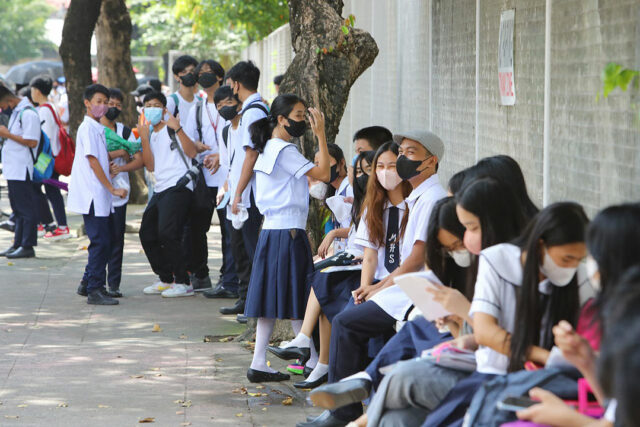
THE Department of Education (DepEd) will use more complex, real-world type of questions in its practice tests to address persistent weaknesses in science, technology, engineering, and mathematics (STEM).

“Science is our greatest weakness and next year, we’ll be doing science exams in March,” Education Secretary Juan Edgardo M. Angara told a news briefing in Makati City on Thursday. “Every week, we [will] have practice exams… We’re trying to graduate from very simple questions to more complex real-world type of questions which simulate real-world problems.”

“We emphasize analysis, critical thinking and our interdisciplinary scope, meaning like a real-world problem, meaning not just math, not just science, not just reading comprehension,” the former senator said.

He added that DepEd had learned from the dismal results of the 2022 Programme for International Student Assessment (PISA), which found Filipino students at the tail-end of the list in math, reading and science.

The last installment of the PISA study published on Wednesday showed that Filipino students aged 15 had one of the highest levels of math anxiety, which could hinder opportunities for lifelong learning.

Experts said the growing mathematics anxiety among Filipino students threatens the country’s manufacturing ambitions, which will rely heavily on engineers.

The education chief admitted that a number of Filipino graduates have difficulty finding a job especially given a skill mismatch.

“We’re still struggling with the contents of the curriculum and trying to simplify it and make it more responsive to the needs of industries,” Mr. Angara said. “We’re aiming for greater mastery also.”

At the “Day of the Future” initiative of the Embassy of Switzerland in the Philippines, Holcim Philippines Chief Sustainability Officer Samuel O. Manlosa, Jr. said the academic curriculum should foster early specialization.

“Companies worry that… while we’re very good in certain aspects, our strength in engineering, science, and manufacturing has not been at the level where we want it to be,” he said, noting that these industries aim to attract foreign investments that require long-term commitment and human development.

Mr. Angara noted that while there are demands for professional workers, universities are not producing graduates with the needed skills.

He cited the growing demand for radiographers, adding that the supply side is struggling to keep up. Industries have also flagged the lack of hard and soft skills among Filipino graduates, Mr. Angara said.

Hard skills pertain to STEM and basic foundational skills, while soft skills refer to attitude toward work, positivity and willingness to sacrifice and work under pressure.

“These are things we will be identifying when we review [our existing curriculum]. We want to roll out a new senior high school curriculum by next year,” he added.

ADVERTISEMENT
ADVERTISEMENT