Home Blog Page 2375

BSP to collaborate with French central bank on currency management

BW FILE PHOTO

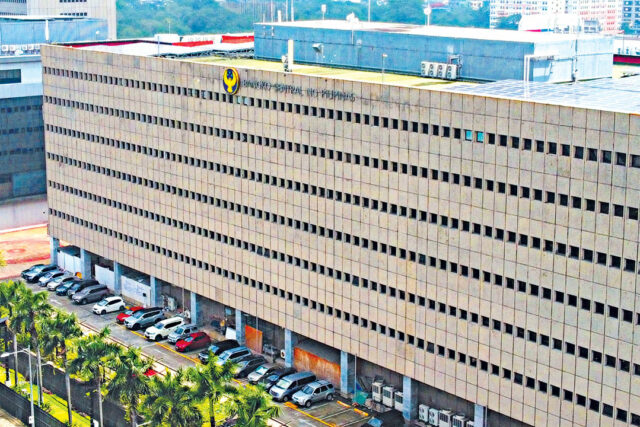
THE BANGKO SENTRAL ng Pilipinas (BSP) has partnered with the French central bank to improve currency management.

The central bank signed a memorandum of understanding (MoU) with Banque de France to share best practices and provide technical and capacity-building assistance to improve currency operations, it said in a statement on Wednesday.

“Because we take this seriously, the BSP is proud to partner with Banque de France to enhance the quality of our currency. We look forward to tapping over a century of its experience in paper-money production and many patented security features,” BSP Governor Eli M. Remolona, Jr. said.

He said issuing banknotes and coins “remains an important part of a central bank’s responsibilities” despite the shift to digital.

“Under the five-year MoU, BSP and Banque de France will collaborate on strengthening currency and security management and production; currency demand forecasting; digital payments governance; and research and development on digital payments, banknote substrates, and high durability solutions,” the BSP said.

The two central banks will also work on “improving technology exchange; information-sharing on legal aspects of central banking cooperation; staff exchange and training; and counterfeit banknote analysis and evaluation of the counterfeit resilience of new banknotes and security features,” it added. — Luisa Maria Jacinta C. Jocson

How to dine like a banker at Hong Kong’s Nobu, according to Nobu himself

NOBURESTAURANTS.COM

By Kristine Servando

FOLKS who went to Nobu at the Regent Hotel in Kowloon last week were in for a treat as celebrity chef Nobu Matsuhisa was in the city to celebrate the first anniversary of the reopening of his namesake restaurant in Hong Kong.

To mark the event, he hosted special omakase meals for two days. Though some dishes weren’t featured on the regular menu, they still evoked the Peruvian-Japanese flavors that made his sushi restaurants — now numbering 56 worldwide — a hive for the rich, famous, gluttonous, and now me.

With their boss in the room, one could sense the servers were extra spiffy. It was also nearly a full house, a rarity on a weekday night these days, I’m told.

Among the highlights of the HK$1,888 ($243) set meal included the melt-in-your-mouth A5 wagyu with mushrooms, the lobster with cream sauce, and his signature parade of sushi and sashimi. My favorite was the seaweed taco filled with hamachi (yellowtail tuna) and sea urchin — the perfect umami bomb. A handful of dishes were slightly imbalanced, like the mackerel pico de gallo with harsh red onions, but otherwise it was all tasty.

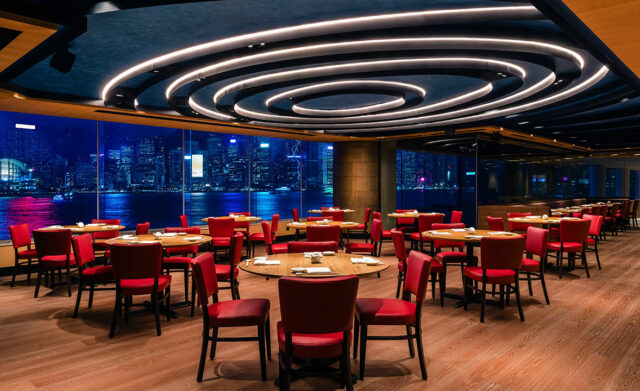
As to the decor, it resembled a wood-paneled, low-lit wing of a luxury ryokan (a traditional Japanese inn), with lovely wraparound views of Victoria Harbour. Yes, it’s good for business meetings, with enough space between tables, including semi-private circular booths, plus a 15-seat private room.

I asked Chef Nobu what bankers should order to impress clients and he recommended the classics: black cod miso (HK$380), yellowtail and jalapeño sushi maki (HK$130) and his miso salad with lobster and pear (HK$320). I would add the wagyu flambé (HK$480 per 75 grams) if you really want fireworks.

I also took the occasion to briefly interview Chef Nobu about the restaurant industry and his next steps. His comments have been lightly edited for brevity and clarity.

What brings you back to Hong Kong?

It’s a world-renowned dining destination and we are very excited to be a part of it. You cannot beat the stunning panoramic view of Victoria Harbor!

Where do you eat when you’re here?

When I visit Hong Kong, I like to spend almost all of my time at my restaurant, with my team. It’s the best way for me to pass on my teachings and connect.

How are you dealing with Hong Kong’s economic slowdown?

Yes, economic challenges have affected the way people dine out, but guests still seek out meaningful, memorable experiences. Nobu Hong Kong, like everyone, has been affected, but our focus remains on quality ingredients, exceptional service, and inspired cuisine. To position for growth, we’re focusing on unique experiences, like our omakase dinners and special collaborations.

You run hotels too. Any plans for Hong Kong?

No plans to expand into Hong Kong property right now. But in the future, anything is possible.

Your best investment ever?

The expansion into hotels was very important. One day I was talking to Bob [co-founder Robert De Niro] and he said, “Nobu, instead of opening restaurants in everyone else’s hotels, why don’t we open restaurants in our own hotels?” This has allowed Nobu to grow into a true lifestyle brand. We are able to connect with our guests in a deeper way. My dream now is to continue to grow Nobu into a global lifestyle brand and pass on my philosophies and learnings to the next generation of our team. Bloomberg

Nobu Hong Kong is located on the second floor of Regent Hong Kong hotel (formerly the InterContinental Hong Kong) at 18 Salisbury Road in Kowloon. It’s open all week from 6 to 11 p.m., and on Saturday for brunch from 11:30 a.m. to 2:30 p.m. Bookings can be made online or by phone at +852 2313-2313.


Money can buy you happiness

FREEPIK

THE IDEA that money can’t buy you happiness is one of the world’s most persistent tropes. King Midas is granted his wish that everything he touches will turn to gold only to starve to death. Jay Gatsby finds that money can’t buy him Daisy’s love. Succession proved to be so popular not just because it is so cleverly written but also because it dwells on the misery of the super-rich. The Roy children may live in a world of private planes, luxury yachts, and subdued designer clothing, but their personal lives are marinated in toxicity. Better to be a happy peasant than Kendall Roy.

But is there any real evidence for this? Or is it just a story we tell ourselves out of either resentment of the rich or a sense of social justice? We can all produce examples of rich people whose lives were ruined by horrible divorces or poor people who spend their lives doing what they love. But anecdotes are not data — and vague sentiments about just desserts are not arguments.

Over recent decades both economists and psychologists have embarked on a rigorous study of happiness (or “well-being,” as they tend to put it). Their work not only explodes the myth of happy peasants and miserable millionaires. It also suggests, more tantalizingly, that there may be no upper limit to the happiness that wealth can bring.

There is overwhelming evidence that up to a certain point greater average wealth produces greater average wellbeing. In 2007 the Nobel Prize-winning economist Angus Deaton analyzed the data on life satisfaction supplied by a Gallup Organization poll of well-being in 132 countries and discovered that average life satisfaction is strongly related to per capita national income. Each doubling of income was associated with a nearly one-point increase in life satisfaction on a scale of one to ten.

Skeptics about the wealth-happiness equation have now retreated to a different argument: that there is a plateau in the relationship between wealth and happiness. People in rich countries may well be happier than people in poorer ones because their basic needs are more likely to be met, the argument goes, but a point comes when the money effect diminishes and the real causes of happiness (a happy marriage or a compelling hobby) assert themselves.

Deaton conceded at least some of this point in subsequent work that he did with his Princeton University colleague and fellow Nobel Prize-winner, the psychologist Daniel Kahneman. In this work the Nobel duo distinguished between two sorts of well-being — evaluative well-being (how you evaluate your life in retrospect) and moment-to-moment well-being (how you evaluate your life in real time).

They discovered that while evaluative well-being continues to rise with income, experienced well-being reaches a plateau at about $75,000 a year. One possible interpretation of this discrepancy is that, after a certain point, money is just a way of keeping score. You can’t buy any more day-to-day satisfaction (indeed the pursuit of money may even prevent you from enjoying your gains) but you can at least gloat that you’re doing better than Mr. Jones.

But the latest academic work chips away at the idea that there is a plateau, just as previous academic work chipped away at the idea of happy peasants and miserable bourgeois. Matthew Killingsworth, of the University of Pennsylvania’s Wharton Business School, has amassed a sample of more than one million real-time reports of experienced well-being in the US (compiled by getting people to report their day-to-day well-being on their smartphones). In a 2021 paper he studied 33,000 people who provided such real-time evidence and discovered three things: that there is no evidence of a divergence between evaluative and real-time well-being; that real-time well-being rises linearly with income and, third, that the slope is just as steep above $80,000 a year as below. The idea of a happiness plateau is for the birds: Higher incomes are clearly associated with both feeling better on a day-to-day basis and being more satisfied with your life overall.

What about people who earn well above $80,000? In a new paper Killingsworth compares the reported life-satisfaction of his sample of 33,000 Americans with a wide variety of incomes with the reported life-satisfaction of two groups of ultra-wealthy individuals: millionaires from around the world and members of the Forbes 400 list of the richest Americans. His conclusions are well-summarized in the title of his study: “Money and Happiness: Extended Evidence against Satiation.” Truly wealthy people are significantly happier than the highest earners in the ordinary income group if you take “life satisfaction” as a meaningful measure of happiness. Moreover, the happiness gap between truly wealthy people and middle-income earners is three times as large as the happiness gap between middle and low-income groups. We not only get happier as we move from the middle-income herd to the Succession crowd, but we get a lot happier.

Killingsworth’s study is not perfect: There is such a shortage of evidence about the well-being of the truly wealthy that one of the studies he relies on, of the Forbes 400, dates from 1985 (the other is from 2018). But never has the phrase “more research is required” sounded more attractive. I’m afraid that my manager has rejected my request for an expanded expense account to explore the question of whether there is, in fact, an upper limit to the relationship between money and happiness. “Satiation” research sounds like my sort of thing. But my few experiences of life among the super-rich suggest strongly that there is no upper limit. I used to think that no happiness is greater than being upgraded from economy class to business class, given the vileness of life in the former. But in fact, First Class is significantly better than business, happiness-wise, a lift on a private jet is significantly better still, and a spell on a yacht is better than both.

The growing consensus among happiness researchers is more than an idle curiosity. It has important implications for both social policy and individual choices. The world suffers from a growing plague of anti-growth activists who argue that growth doesn’t really bring happiness. Commencement speakers routinely tell students to follow their passions rather than going for the money. In terms of personal happiness, the science suggests that this is nonsense. Anti-growth activists should take a hike. Commencement speakers should adopt a more realistic template. Don’t bother to follow your adolescent passions: You will end up as an unemployed musician or an itinerant professor moving from one miserable gig to another. Go for the money instead: That way lies not only long-term freedom but happiness as well.

BLOOMBERG OPINION

Banking, IT sectors drive ManageEngine’s Philippine revenues

PIXABAY

THE PHILIPPINES is the third largest source of revenues for information technology (IT) management provider ManageEngine in the Southeast Asian region, driven by the banking and IT sectors, its regional director said.

ManageEngine Regional Director Arun Kumar told a media briefing on Wednesday that the Philippines contributes 15% of its revenues in the Association of Southeast Asian Nations, only behind Singapore and Indonesia, which together account for 50% of revenues.

In the Philippines, sectors that drive revenues for ManageEngine include IT, IT-enabled services, business process outsourcing, government, healthcare, and education.

Philippine firms have been beefing up their digitalization efforts to protect themselves against cyberattacks.

A 2022 report by independent risk advisory firm Kroll said that three in four Philippine firms have dealt with a cyberattack.

ManageEngine’s revenues in the Philippines have been growing by around 20% to 25% in the last three to four years, Mr. Kumar said.

“We are very confident we will even grow on the higher side in the coming years,” he told BusinessWorld after the briefing.

The expected increase in ManageEngine’s revenues from the Philippine market is driven by unified product offerings for enterprises on IT management and IT security, Mr. Kumar said.

The company expects to gain more customers from mid and large enterprises.

“Our local investments in terms of hiring people locally in the Philippines will definitely add more value to us,” Mr. Kumar said. — Beatriz Marie D. Cruz

Philippine Labor Force Situation

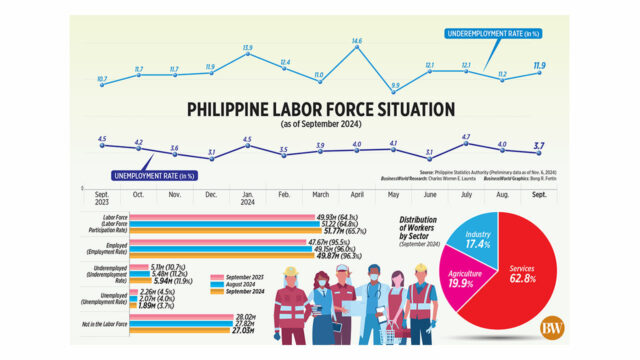
THE PHILIPPINES’ unemployment rate fell to 3.7% in September, driven in part by a growing number of female workers joining the labor force ahead of the holiday season, the statistics agency said on Wednesday. Read the full story.

Philippine Labor Force Situation

Apple set to face fine under EU’s landmark Digital Markets Act, sources say

The Apple logo hangs in a glass enclosure above the 5th Ave Apple Store in New York, Sept. 20, 2012. — REUTERS

APPLE is set to be fined by the European Union’s (EU) antitrust regulators under the bloc’s landmark rules aimed at reining in the power of Big Tech, making it the first company to be sanctioned, sources with direct knowledge of the matter said on Tuesday.

The regulators charged in June that the iPhone maker had breached the bloc’s tech rules. The charge against Apple was the first by the Commission under its Digital Markets Act (DMA).

The fine is likely to come this month although the timing could still change, the sources said.

The fine would add to Apple’s mounting antitrust troubles, as EU regulators attempt to level the playing field for smaller firms.

This comes just months after Brussels fined Apple €1.84 billion ($2.01 billion) in March for thwarting competition from music streaming rivals via restrictions on its App Store — Apple’s first ever penalty for breaching EU rules.

Apple also faces an investigation into new fees imposed on app developers. DMA violations could result in a fine of as much as 10% of a company’s global annual turnover.

The Digital Markets Act, which came into force earlier this year, requires Apple to allow users to set the default web browser of their choice on iPads, permit alternative app stores on its operating system and allow headphones and smart pens to access iPad OS features.

Apple declined to comment. The European Commission did not immediately respond to a Reuters request for comment.

Apple also lost a long-running court battle with the EU in September, resulting in the company being forced to pay €13 billion in back taxes to Ireland.

Bloomberg first reported on Apple’s imminent EU fine earlier on Tuesday.

Watchdogs are readying the penalty after Apple failed to allow app developers to steer users to cheaper deals and offers outside of the App Store, Bloomberg reported, citing people familiar with the case. Reuters

Dominion Holdings books lower Q3 earnings

DOMINION HOLDINGS, Inc. (DHI) saw its net income decline by 54.57% year on year in the third quarter due to lower interest earnings.

The company’s net income stood at P36.53 million in the three months through September, down from P80.4 million in the same period last year, its financial statement showed.

In the first nine months, the company’s net profit stood at P171.01 million, down by 16.86% from P205.69 million a year ago.

“The company paid P3.2 billion in cash dividends in May 2024, which reduced the funds available for investment, and consequently, resulted in lower income from investments,” DHI said.

The company’s interest income was at P49.24 million in the third quarter, down by 44.61% from P88.9 million a year ago

Meanwhile, its expenses stood at P2.87 million in the period.

Total assets were at P3.297 billion at end-September, down from P6.31 billion a year prior.

DHI shares inched down by one centavo or 0.61% to end at P1.64 each on Wednesday. — AMCS

Dining In/Out (11/07/24)


Dining at home with Kultura

KULTURA, inside SM Store and SM Malls, carries a full range of tablescaping accessories that are under the Green Finds label. They are made of responsibly sourced raw materials such as acacia, nito, and rattan. For example, there is an acacia plates and ramen bowl set, as well as chopsticks and a single sauce container. The line of acacia/mango wood products includes the Kuksa Mug. The rattan line has multipurpose trays that come in different sizes, a stained coaster set, a bread tray with handle, and placemats. There are also placemats in sets of six, in different colors. Another material to consider is nito, with a line of placemats in round and oval shapes, bread trays, as well as a utility holder.


McDonald’s releases reusable holiday cups

MCDONALD’S is launching its first-ever reusable cups with its Holiday Christmas Collection line. The cups are available until Nov. 15 via the McDo App, McDonald’s stores nationwide, and McDelivery. Every reusable cup is designed with McDonald’s iconography featuring bright and fun graphics. Meant for both hot or cold drinks, each reusable cup design comes with a yellow or white lid, giving customers flexibility to mix and match. McDonald’s Reusable Cups are available for P79 each with any Extra Value Meal purchase in all stores nationwide.


Dylan Patisserie and Gourmet Café’s holiday hampers

DYLAN PATISSERIE and Gourmet Café is now offering a selection of luxury gift hampers. Dylan’s Gift Hampers come packaged in themed baskets, filled with a selection of flavors that cater to every palate. These include cookies, chocolates, premium nuts, and pastries. The hamper themes include “Yuletide,” “Festive,” “Holiday,” “Holly,” “Merry,” “Season,” “Party,” “Festival,” “Prosperity,” and “Jolly.” For more information visit the website www.dylanpatisserie.com or contact 0917-877-2999.


Magnolia Chicken Timplados aims for convenience

Magnolia Chicken Timplados products come in a variety of marinades and flavors so they’re instantly and conveniently ready-to-cook and flavorful. Magnolia’s Chicken Inasal has the classic deep and smoky inasal (barbecue) flavor, marinated in a mixture of vinegar, calamansi, garlic, and spices. Cheesy Chicken Fingers are a flavorful twist on a classic favorite, and can be served with the diner’s favorite dips. Magnolia’s Oriental Wings has a blend of sweet, savory, and a touch of spice. Magnolia Chicken Timplados products are available in leading supermarkets.

Highlighting the negative

PHILIPPINE STAR/EDD GUMBAN

FIRST-TIME TRAVELERS, even to just the neighboring countries, tend to highlight the advances made by the visited destination. These usually infrequent travelers come home with stories of how things are much better in the countries visited, even when their experiences are limited to sightseeing, not at all subjected to what citizens there undergo in their daily lives.

Is it the transport system, payment methods, or facilities for the elderly? In any chosen field, there is the element of this once backward country now flourishing ahead of the curve, compared to us.

As a national pastime, putting down our own country beyond the bounds of humility has become all too common. Is it an inferiority complex that automatically compares our country unfavorably with any other? Do we dwell on the negative when it comes to home?

Self-deprecatory humor in the form of making fun of oneself and any claimed accomplishments, no matter how awesome, can be an endearing trait. (I was just there at the right time, and the right place.) Paradoxically, this form of belittling one’s status and making fun of the perks being enjoyed work best when one is already perceived as being at the top of one’s game. Winners of international competitions like beauty contests, Olympic events, and billiard tournaments credit their triumphs to luck, prayers of the nation, and the support of others, not necessarily the family.

Politicians use self-deprecation in the campaign trail to great advantage. So, the story of growing up poor and eating leftovers from fast food chains can be overused, even if such an experience probably never even happened. The rags-to-riches story has been overdone. But once in power, the language of the humble civil servant can shift into a confrontational and arrogant tone, especially in a legislative investigation.

A twisted version of self-deprecation is disguised bragging. Anyone prefacing what he is about to say with the phrase “modesty aside” is about to launch into self-aggrandizing statements, trumpeting achievements by packaging them as modest — my winning this prestigious award against other contestants from 40 other countries is testament to the ingenuity of the Filipino (ahem, you’re looking at him).

Is it only the obviously competent and unquestionably accomplished that can comfortably engage in self-deprecatory humor?

The insecure and under-qualified may feel that making fun of himself may invite ready agreement. (Oh Sir, you have every right to be modest.) For self-deprecation to work as it should, a social compact is implicitly entered into between the speaker and his audience. Poking fun at oneself is premised on the desire of avoiding envy and malice. Modesty puts people at ease who would otherwise be intimidated by the speaker’s power, intellect, or wealth — yes, I used to take the public bus to school. (It was a good way to meet girls, although I didn’t meet any who were not asking for my ticket.)

Self-deprecation has to do with humility, or, more crassly, lowering people’s expectations of what one can do. There is an invitation not to be taken seriously, even to be underrated. (Please I am not a threat to your standing in the organization.) An achievement is scaled down (I was just lucky) in order to defuse resentment which induces a desire to see a fall from grace for the high and mighty.

One problem with the tendency to stress the negative and put down one’s own country, almost as a habit to appear subservient and non-threatening, is that it is an invitation to be bullied even by neighbors. How can another country not be encouraged to be more arrogant and forceful when confronted by toadies?

As a default position, self-devaluation shifts our attention to what has held back our progress. It skips over our strong survival instincts and hospitality as a people. Sometimes, it even takes a foreigner on a blog to point out our virtues to the rest of the world.

Intentional depreciation of our character is a way to deflect the lightning from above. Anyway, if nothing else, self-deprecation pre-empts the viciousness of critics who are only too willing to put down those standing on pedestals. This is harder to do when he is already climbing down from it and laughing at himself as if to say — I am not worth the trouble of attracting envy.


Tony Samson is chairman and CEO of TOUCH xda

ar.samson@yahoo.com

Proposed natural gas law to safeguard against high electricity costs — senator

PHILSTAR FILE PHOTO

THE PROPOSED Philippine Natural Gas Industry Development Act will uphold existing market pricing provisions and consumer protection measures, according to its proponent.

“There are strict provisions on market pricing in the service contracts that the DoE (Department of Energy) and ERC (Energy Regulatory Commission) are duty-bound to uphold. They are in place… This bill (Senate Bill  [SB] 2793) essentially maintains the status quo,” Sen. Pilar Juliana “Pia” S. Cayetano said in a statement on Wednesday.

The Senate on Tuesday approved on second reading SB No. 2793, which seeks to promote the production of indigenous natural gas and liquified natural gas.

Under the proposed measure, the DoE will oversee strategies to develop the downstream natural gas industry.

The ERC, on the other hand, will keep track of the government’s share and other revenues related to the production of indigenous natural gas sold to power plants.

Ms. Cayetano said that the DoE and ERC, along with the Philippines Competition Commission, would “ensure transparent negotiations and dealings.”

She said that prioritizing the indigenous natural gas industry means “standing by it with established checks and balances,” including those set the Consumer Welfare Act.

“We encourage the shift to natural gas, whether imported or local, but prioritize indigenous sources for enhanced energy security and price stability,” Ms. Cayetano said.

“We have the potential to explore, to discover and to develop our indigenous natural gas. Why are they (investors) not coming in? Because since the ’70s, we neglected investing and encouraging promotion of indigenous natural gas. After Malampaya was discovered, wala na (nothing followed). Pinabayaan na natin (We neglected it),” she added. — Sheldeen Joy Talavera

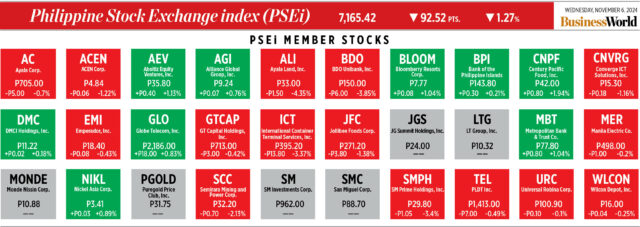
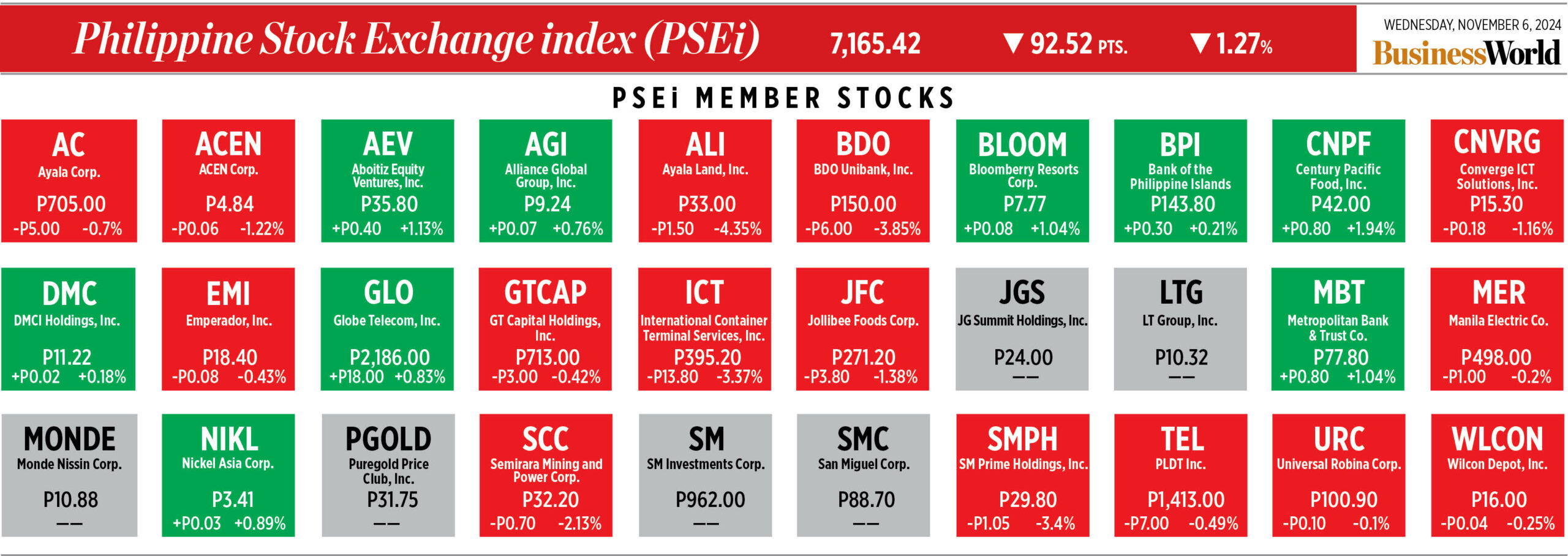
How PSEi member stocks performed — November 6, 2024

Here’s a quick glance at how PSEi stocks fared on Wednesday, November 6, 2024.


Peso tumbles to four-month low vs dollar as early election results point to Trump victory

BW FILE PHOTO

THE PESO declined to a four-month low against the dollar on Wednesday as Donald J. Trump claimed victory in the US presidential election.

The local unit closed at P58.661 per dollar on Wednesday, weakening by 34.6 centavos from its P58.315 finish on Tuesday, Bankers Association of the Philippines data showed.

This was the peso’s lowest close in more than four months or since its P58.725 per dollar finish on July 3.

The peso opened Wednesday’s session weaker at P58.50 against the dollar, which was already its intraday best. Its worst showing was at P58.77 versus the greenback.

Dollars exchanged jumped to $1.91 billion on Wednesday from $1.15 billion on Tuesday.

“The dollar-peso ended higher because of the election with Trump leading,” a trader said by phone.

“The peso weakened after the US presidential election results pointed toward a second Trump term,” another trader said in an e-mail.

Markets have already priced in a possible victory by Mr. Trump, which led to a generally stronger dollar and higher US Treasury yields, Rizal Commercial Banking Corp. Chief Economist Michael L. Ricafort likewise said in a Viber message.

Investors bought dollars, bitcoin and stocks, and sold bonds as Mr. Trump claimed victory in the US presidential election and Republicans took control of at least one chamber of Congress, Reuters reported.

US stock futures hit record highs, the dollar surged and Treasury yields jumped, while bitcoin broke $75,000 for the first time — all moves flagged by investors as likely should Trump win over Democrat Kamala Harris.

The results so far underscore how one of the most unusual presidential elections in modern US history could have far-reaching implications for tax and trade policy as well as US institutions.

The results affect assets globally and will determine the outlook for US debt, the strength of the dollar, and a host of industries that make up the backbone of corporate America.

Leading into Tuesday, polls showed a dead heat between the former president and the current vice president. But by 2 a.m. ET, Mr. Trump had won the swing states of North Carolina and Georgia and was leading in several others, according to Edison Research.

Fox News projected he had won the presidency.

Republicans also won control of the US Senate, ensuring they will dominate at least one chamber of Congress next year.

Assets whose prices could be helped by Mr. Trump’s pledges to raise tariffs, cut taxes and slash regulations shone, while dealers said cash was flowing out of emerging markets and US Treasury bonds tanked in anticipation of a ballooning deficit.

For Thursday, the first trader said the peso may continue to weaken as markets continue to react to the election results and with the US Federal Reserve set to announce its policy decision overnight. The second trader added that potentially slower Philippine gross domestic product (GDP) growth in the third quarter could weigh on the peso. The government will release GDP data on Thursday (Nov. 7).

The first trader sees the peso moving between P58.50 to P59 per dollar, while the second trader expects it to range from P56.55 to P56.80. Mr. Ricafort forecasts the peso to trade between P58.55 and P58.75. — AMCS with Reuters