Home Blog Page 235

MPower to energize Aseana City properties

IN PHOTO (L-R) are Aseana City’s Director for Property Management Ritche M. Reperuga, DMWAI President & CEO Delfin Angelo C. Wenceslao, Meralco First Vice-President and MPower Head Redel M. Domingo, and Meralco Senior Assistant Vice-President and MPower Retail Sales Head Eddie John V. Adug. — MPOWER

MPOWER, the retail electricity supplier of Manila Electric Co. (Meralco), is expanding its partnership with listed developer D.M. Wenceslao & Associates, Inc. (DMWAI) as it prepares to energize the company’s properties in Makati and Parañaque.

In a statement on Wednesday, MPower said it had signed an agreement with DMWAI subsidiary Aseana Holdings, Inc. for the transition of its commercial spaces and offices in Aseana City under the government’s retail aggregation program (RAP).

RAP allows end-users within the same franchise area to combine their electricity demand and qualify as a single contestable customer, enabling them to participate more competitively in the retail electricity market.

The move comes a year after DMWAI shifted its properties to the competitive retail electricity market, where businesses with a minimum electricity demand of 500 kilowatts can choose their preferred power supplier.

“Our relationship with Meralco and MPower has grown over the years of working closely together — from planning and building to full operations. Today’s milestone continues that strong partnership, and we are confident the Meralco & MPower team will remain by our side as we move into the next phase,” DMWAI President and Chief Executive Officer (CEO) Delfin Angelo C. Wenceslao said.

DMWAI and MPower began their partnership in 2019, when the property developer first participated in the retail market program.

“This new milestone with Aseana reflects the deep trust and shared goals that have shaped our partnership since 2019. Each collaboration — whether CREM or the recently signed RAP accounts — underscores our commitment to providing reliable energy solutions,” Meralco First Vice-President and Head of MPower Redel M. Domingo said.

MPower serves contestable customers, including large corporations within Meralco’s franchise area, and currently holds over a 30% share of the competitive retail electricity market within Meralco’s coverage.

Meralco’s controlling stakeholder, Beacon Electric Asset Holdings, Inc., is partly owned by PLDT Inc. Hastings Holdings, Inc., a unit of PLDT Beneficial Trust Fund subsidiary MediaQuest Holdings, Inc., holds an interest in BusinessWorld through the Philippine Star Group, which it controls. — Sheldeen Joy Talavera

Growing gold from malunggay — An entrepreneur’s guide

TERESA SANTIANO (L) during the interview for the RJ Ledesma Podcast. — SCREENGRAB FROM THE POD NETWORK ENTERTAINMENT

There’s a gold rush in Filipino herbal supplements. Driven by research revealing the health benefits of malunggay (moringa) first and foremost, but also cancer-fighting guyabano (soursop), lagundi (five-leaved chaste tree), and others, the world’s eyes have turned to the Philippines. It was in this environment when Teresa Santiano began her malunggay business 12 years ago. From malunggay powder to capsules to tea and coffee, Teresa’s Tropical Palm Herb Manufacturing makes it all. It is virtually an industry in itself.

For the Philippines, her entrepreneurship is a model of growth, springing from grassroots levels, supporting local farmers and championing women entrepreneurs. And for her breakthrough work, Teresa Santiano was awarded the MSME Presidential Award in 2024.

As for myself, I’ve known Tita Teresa personally since back when I was a young talent in the media industry, and she was an associate producer for RPN-9. We reconnected during the awarding ceremony of the MSME Presidential Award, and I invited her as a guest to the RJ Ledesma Podcast where we talked about the great passion of her life — entrepreneurship.

Perhaps what’s most remarkable about her entrepreneurial journey is how Tita Teresa is an every-woman. Her success could be yours or mine. And there’s so much to learn from my conversation with her. Make sure to check out the whole podcast. Meanwhile, here are some highlights:

ALWAYS SAY ‘YES’
One of my entrepreneurial mentors, Jose “Jomag” Magsaysay of Potato Corner famously said, “When people approach you with an opportunity, you say yes.”

This includes saying yes even when the true answer is, “I don’t know.”

Tita Teresa Santiano embodies this philosophy. She echoes Mr. Magsaysay’s statement and builds upon it, saying, “Don’t say no to an opportunity, kasi lagi na lang may kasagutan ’yan (because there’s always an answer to that).”

For Tita Teresa, the opportunity to begin her malunggay empire came knocking when she was tending to one of her side businesses, a pasalubong (souvenir) center. A Japanese man came up to her and asked, “Hey lady, do you have these black seeds?”

Without even knowing what the seeds were, she said yes, and the man promised to return in five days and buy 50 kilos of seeds.

Returning to the province, she learned that the black seeds were, in fact, malunggay seeds — of little value to locals and often mixed with the pig food. She secured 100 kilos, and when the Japanese man eventually returned, he bought it all for the price Tita Teresa had seen on Alibaba, P1,250 per kilo — for a cool P125,000 sale.

Moving forward with her newfound malunggay business on Alibaba, she continued to adopt this “yes” mentality.

“I don’t have a farm. I don’t have a factory,” she said of her early days. But none of that stopped her from securing her next big sale — a ton of malunggay from a German client — and eventually building her own factory to process the malunggay leaves into powder. And from there, the growth of the business knew few limits.

KEEP THE ENTREPRENEURIAL FIRE BURNING
Even when her malunggay business took off, Tita Teresa Santiano was no stranger to entrepreneurship. She recalls selling kamote (sweet potato) tops during her elementary school days. It was then that she promised herself, “This is my goal: I have to be rich by the age of 50.”

Later on in life, at the age of just 34, Tita Teresa suffered the tragic loss of her husband from lung cancer. To provide for her seven children, entrepreneurship became an even more important part of her life. It became a necessity.

“I have children to feed,” Tita Teresa explained. “Ako lang talaga ang nagtatrabaho nun eh. Hindi ko talaga ’yan makakayanan kung wala akong sideline (I was the only one working then. I really couldn’t have managed it if I didn’t have a sideline.).”

This led her to seek revenue streams wherever she could. During her time as regional director for RPN-9, she found herself traveling to the provinces regularly, so she put up four pasalubong stations.

Using her connections in the industry, she would also produce concerts in the provinces for the likes of Jolina Magdangal, Rivermaya, and the Eraserheads.

Seeing Tita Teresa’s entrepreneurial journey brings home a long-held belief of mine: that your network is your net worth.

“I have to use my connection,” Tita Teresa said. “Kasi pag lumabas ako ng (because if I left) channel 9, wala akong (I would have no) connection. So, you really have to be resourceful. ’Yung database mo, tago mo ’yan (keep your database secure). Kasi (because) that would bring you to higher ground afterwards.”

For Tita Teresa, entrepreneurship is everything — even before she had her big break with that Japanese customer looking for malunggay seeds.

Mahirap talaga magnegosyo (being in business is hard),” she says. “Mahirap at first, but if you have the passion,… ito lang talaga ’yung meron (this is what I had) burning in my heart, the passion to do what you wanted. To do, to be out of your comfort zone, you can do everything.”

GENEROUS ENTREPRENEURSHIP
Tita Teresa’s Tropical Palm Herb Manufacturing and its marketing arm, Tropical Blend International Marketing Corp., have a broad footprint in the industry. From farms to manufacturing to marketing, Teresa Santiano is there. But instead of dominating the industry with her products and brands, she employs a generous kind of entrepreneurship.

She says, “I will teach you how to have your own factory, where to go, where to do that. Ako kasi, gusto ko lahat maging negosyante. Mas maganda ’yung negosyante, hindi lang ako (because I want everyone to be a businessman. It is better if I am not the only businessman). I don’t have the crab mentality.”

With the gold rush in malunggay, Teresa Santiano has undoubtedly achieved her goal of becoming rich by the age of 50. But as she achieved that milestone, her perspectives have changed.

She says, “I am wealthy now because so many love me, my people love me, my manpower loves me. Maraming nagmamahal sa akin, alam ko (I know many people love me). And of course, marami akong nagawa para sa kanila, ’yung mga farmers ko, na kubo-kubo lang ang bahay (I have done a lot for them, for my farmers, those whose houses are just grass shacks)… When I was starting, sabi ko, yayaman tayo dito, pag magmalunggay tayo. Ngayon, ang mga bahay nila, bato na ’yan (I said, we will all get rich if we grow malunggay. Now, their houses are made of cement).”


RJ Ledesma (www.rjledesma.com) is a Hall of Fame Awardee for Best Male Host at the Aliw Awards, a multi-awarded serial entrepreneur, motivational speaker, and business mentor, podcaster, an Honorary Consul, and editor-in-chief of The Business Manual. Mr. Ledesma can be found on LinkedIn, Facebook and Instagram. The RJ Ledesma Podcast is available on Facebook, Spotify, Google and Apple Podcasts. Are there entrepreneurs you want Mr. Ledesma to interview? Let him know at ledesma.rj@gmail.com.

MPIC unit completes Franklin Baker acquisition to support coconut operations

MANUEL V. PANGILINAN — PHILSTAR FILE PHOTO

METRO PACIFIC Coconut Holdings Corp. (MPCH), a subsidiary of Metro Pacific Investments Corp. (MPIC), said it has completed its acquisition of Franklin Baker Co., a move expected to help clear export backlogs and support operations.

In a statement, MPIC said the investment will allow Franklin Baker to return to normal production levels and prepare the company for long-term growth.

“This acquisition supports key industries such as coconut processing. By bringing Franklin Baker into our portfolio, we are strengthening an important segment of the supply chain and helping ensure that thousands of Filipino farmers and communities benefit from a more efficient and stable industry,” MPIC Chairman and Chief Executive Officer (CEO) Manuel V. Pangilinan said.

Founded in 1921, Franklin Baker is one of the country’s most established coconut processors. The company operates manufacturing facilities in Laguna and Davao and exports various coconut products, including desiccated coconut, coconut water, virgin coconut oil, and coconut cream.

MPIC said it aims to drive value creation across the agricultural supply chain through investments that combine infrastructure, technology, capital, and market access. The group has identified agriculture as a strategic expansion area, with goals of improving farmer incomes, promoting sustainability, and contributing to national food security.

“With renewed operational support, we will focus on enhancing efficiencies, reinforcing sustainability initiatives, and leveraging our combined scale to support local coconut farmers,” said Jovy I. Hernandez, president and CEO of MPIC’s agribusiness arm Metro Pacific Agro Ventures.

MPIC earlier acquired Axelum Resources Corp., and together with Franklin Baker, the two firms now form the core of its coconut operations. According to the company, with the capacity to process over two million coconuts a day, the two entities account for nearly 70% of the Philippines’ food-grade coconut exports.

Jerry Lorenzo, president and CEO of Andorra Investments Corp., Franklin Baker’s outgoing investor, said MPCH’s entry is expected to boost the wider coconut sector.

“We are delighted to welcome Metro Pacific Coconut Holdings Corp. as the new investor in Franklin Baker, a move we believe will significantly enhance the future of Franklin Baker and the Philippine coconut industry,” he said.

MPIC is one of the three key Philippine units of Hong Kong-based First Pacific Co. Ltd., the others being Philex Mining Corp. and PLDT Inc. Hastings Holdings, Inc., a unit of PLDT Beneficial Trust Fund subsidiary MediaQuest Holdings, Inc., has a majority share in BusinessWorld through the Philippine Star Group, which it controls. — Vonn Andrei E. Villamiel

AI can aid creative process but can’t replace human touch, says art school dean

STOCK PHOTO | Image by Brett Jordan from Unsplash

ARTIFICIAL INTELLIGENCE (AI) can help streamline workflows for creatives, but the human touch is essential for fundamentals like design theory and conceptualization, according to the dean of a top art school.

“AI has definitely become a tool to go from point A to point B in the design process, but the final output should still be the students’ own. It can’t be taken directly from the AI and then submitted to the client or teacher,” Maria Sharon M. Arriola, dean at the School of New Media Arts at the De La Salle–College of Saint Benilde, told BusinessWorld last week.

“AI can polish and organize your thoughts, but the main idea is still yours.”

She added that AI can’t teach students key skills, like composition, color theory, and basic art principles.

“We acknowledge the presence and the direction of the creatives industry, specifically in the use of AI, because it has value in streamlining certain processes. But there is one process that it can’t skip, which is basic conceptualization and design,” Ms. Arriola said.

“[For example,] how do you translate your vision or imagination accurately into tangible form? A student has to use their own basic skills, and we (teachers) have to train them.”

The rapid development of AI technologies has affected the creatives industry and raised concerns regarding job displacement, the decline of artistic ability, and generative AI models’ unauthorized use of copyrighted content.

Ms. Arriola, who is also the chairperson of the Commission on Higher Education Technical Panel for Multimedia Arts, said educators have to recognize that AI will continue to affect the art industry.

“We acknowledge the resistance, but we don’t stop there. We don’t force the teachers [to use AI], but we have to make them understand where the industry is heading.”

Arts and design teachers must give students tasks that combine theory with more situational applications, she said. They should also train students to enable them to keep pace with industry trends.

“We make sure that our students, when they step out of the campus and apply what they learned in our programs, should also know how to adapt,” she said.

The global market size of AI in media & entertainment is projected to reach $99.48 billion (about P5.8 trillion) by 2030 from $25.98 billion in 2024, according to a study published last year by business consulting firm Grand View Research. — Beatriz Marie D. Cruz

Term deposits fetch lower yields on inflation, BSP easing bets

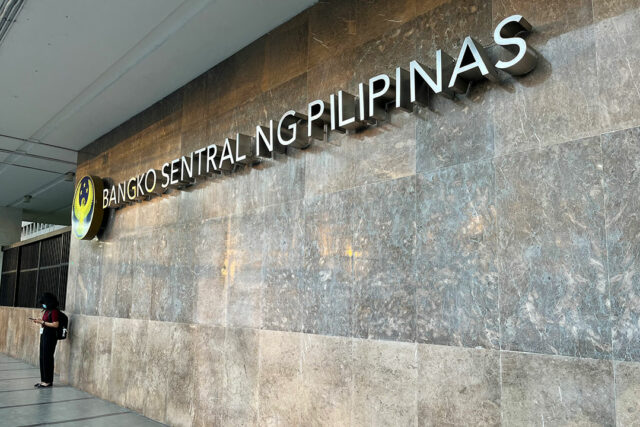
Bangko Sentral ng Pilipinas main office in Manila — BW FILE PHOTO

THE BANGKO SENTRAL ng Pilipinas’ (BSP) seven-day term deposits fetched a lower average rate on Wednesday on strong demand and expectations of benign November inflation that would lead to further monetary easing.

The central bank’s term deposit facility (TDF) attracted bids amounting to P135.643 billion, above the P80-billion offer and the P128.312 billion in tenders for the same offer volume in the previous auction. The BSP made a full award of its offer.

Accepted yields for the seven-day tenor were from 4.6% to 4.7408%, narrower than the 4.6% to 4.7497% seen last week. This caused the average rate of the one-week deposits to slip by 0.94 basis point (bp) to 4.728% from 4.7374%.

Wednesday marked the fifth week in a row that the central bank did not offer the 14-day tenor at its TDF auction.

Also, it has not auctioned off 28-day term deposits since October 2020 to give way to its weekly offerings of securities with the same tenor.

Both the TDF and BSP bills are used by the central bank to mop up excess liquidity in the financial system and better guide market rates towards the policy rate.

Rizal Commercial Banking Corp. Chief Economist Michael L. Ricafort said the weighted average accepted rate of the seven-day papers inched lower on higher demand.

Expectations that headline inflation slightly eased last month also brought yields down as this would support the case for a fifth straight rate cut at the Monetary Board’s policy meeting on Dec. 11, he said.

A BusinessWorld poll of 15 analysts yielded a median estimate of 1.6% for November inflation, within the central bank’s 1.1-1.9% forecast for the month.

If realized, last month’s inflation print would ease from the 1.7% clip in October and the 2.5% recorded a year earlier.

This would also be the slowest clip in three months or since the 1.5% seen in August and mark the ninth straight month that the consumer price index was below the central bank’s 2-4% annual target.

BSP Governor Eli M. Remolona, Jr. on Wednesday said slowing economic growth increases the chances of a rate cut at their policy meeting next week.

The central bank has slashed borrowing costs by a cumulative 175 bps since it began its easing cycle in August last year, bringing the policy rate to an over three-year low of 4.75%.

Mr. Remolona said they expect the gross domestic product (GDP) growth to be between 4% and 5% this year, well below the government’s 5.5-6.5% full-year target, as a graft scandal involving state infrastructure projects has affected economic prospects due to its impact on investor sentiment.

He added that he expects a recovery by mid-2026.

Philippine GDP growth slowed to an over four-year low of 4% in the third quarter as the corruption mess affected both public and household spending. This brought the nine-month average to 5%.

In 2024, the economy expanded by 5.7%, also falling short of the government’s 6-7% growth goal. — Katherine K. Chan

Designing cocktails

THERE’S something cool about Yun Shen Koh, whose bar Backdoor Bodega got listed as one of Asia’s 50 Best Bars in 2022 and 2024. Maybe it’s the facial piercing; maybe it’s the fact that he used to design T-shirts.

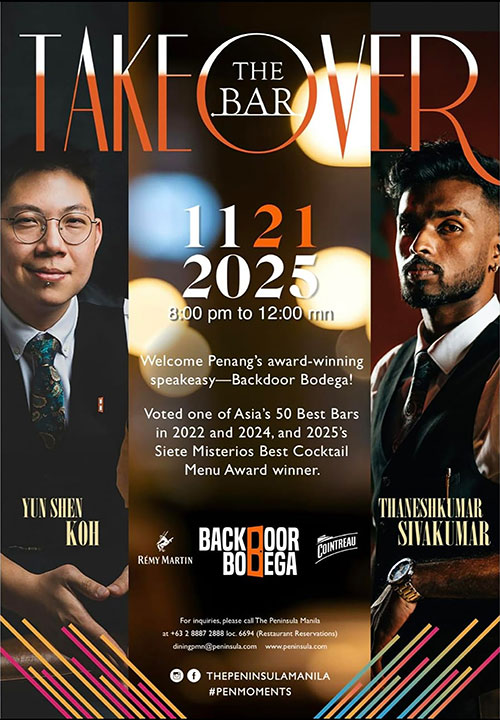
On Nov. 21, Mr. Koh, along with his colleague Thaneshkumar Sivakumar, brought Backdoor Bodega to Peninsula Manila’s The Bar for a takeover.

Drinks were made with spirits from sponsors Remy Martin and Cointreau. There were four that evening: Biggie Smalls (Remy Martin VSOP, Cymar, China-China, Dolin Dry, Luxardo Maraschino), Val d’Or (Remy Martin 1738, Antica Formula, rose apple cider — a.k.a. macopa — and gold), Spellbinder (Remy Martin VSOP, cane molasses, soy sauce, Granny Smith apple soda, rice paper crisp), and the Eugene (Cointreau, The Botanical Island Dry, Monin yuzu, lime blend, and mishti doi).

We’d gladly drink the Biggie Smalls and the Spellbinder over and over again. The first cocktail had a scent reminiscent of Tiger Balm ointment (said with affection), and the taste captures the scent, so it’s refreshing, medicinal, and surprisingly invigorating. The Spellbinder takes a dimension when one dips the rice crisp in the drink: it also calls back to home with a taste like plum juice served after Chinese meals (but you know, fun).

This year, Backdoor Bodega’s menu — The Backdoor Bodega Guide to Penang — won the Siete Misterios Best Cocktail Menu Award 2025 under Asia’s 50 Best Bars. We understood why: more than a menu, it explains ingredients and neighborhoods, and it’s a very absorbing read. It’s almost like we’re reading Mr. Koh’s palm as he makes his way through the region.

For example, his knowledge of Penang explains why his bar thrives in a country with alcohol restrictions for its Muslim-majority population. “I feel like in Penang, we have a bit more liberty. Penang has always been, I guess, the rebel child. We are similar to Singapore in many ways,” he said, pointing at the larger Chinese population in Penang, not to mention its former British ties. “It’s a very different mindset in Penang.”

Praising his bar’s ascent as one of Asia’s 50 Best Bars, he laughed it off. Asked what he did right to get on the list, he laughed and said, “I still don’t know, man.” He expressed his surprise that they first got in the list in 2022, just crawling out of the COVID-19 pandemic lockdowns. “That caught us off-guard, to be honest.”

On a serious note, he said: “It helped that we were one of the earlier bars in Penang. I guess that helped us a little.

“The pros: it was nice to be recognized,” he said. “The cons: that’s when people put a spotlight on you, and then you have so many expectations to meet.”

The bar started in 2016 after a venture in T-shirts: in fact, that’s where the name comes from. The bar is the backdoor to the former bodega (storeroom) for the T-shirts. “I only started bartending when I started the bar,” he told BusinessWorld. “I am a designer at heart,” he said, noting that aside from the T-shirts, he had been in advertising.

“I feel like making a cocktail is design,” he said. “You design the recipe, the flavors; you design how it looks,” he added. “After doing the same thing for years, which was clothing, doing the cocktails were a breath of fresh air.”

The bar’s menu talks about ingredients and inferences: ginger flower, bamboo, all sorts of native herbs and flavors. “Whatever was in the market, I would use those,” he said, though eventually, using pandan leaves and lemongrass over and over became old hat. “It’s always a challenge to try to find things that represent Penang, but not something that’s so predictable,” he said: hence the rose apple, the soy sauce. “It’s just there: the things that we take for granted.”

The Backdoor Bodega is in 37, Jalan Gurdwara, 10300 George Town, Pulau Pinang, Malaysia. For more information, visit the website at https://www.backdoorbodega.com/ or on Instagram @backdoorbodega. — Joseph L. Garcia

Same roads, shared rules, shared accountability

STOCK PHOTO | Image from Freepik

The situation on our roads has moved from confusion to outright chaos. At the center of the issue now are light electric vehicles (LEVs), the mobility savior of the poor and the marginalized but, to an extent, also the bane of public safety and traffic management.

If I recall correctly, last April authorities started restricting LEVs from major roads in Metro Manila. Then came a “grace period.” Then a suspension of some rules. Then a warning-only phase. Now we are witnessing yet another “deferral” of strict enforcement to January 2026.

The Land Transportation Office (LTO) threatens impoundment. Legislators threaten congressional probes. The Metro Manila Development Authority (MMDA) stands in the middle of a traffic jam that is as much legal as it is physical, with no clear untangling in sight.

The government insists a ban is necessary to curb what it claims is a spike in LEV-related accidents since before the pandemic. Legislators and civil society groups counter that banning e-bikes and e-trikes from national roads without first building proper infrastructure hits the poor hardest.

What makes things more difficult is our penchant for responding to issues piecemeal. One rule for tricycles. Another rule, then suspension, for e-trikes. A “warning only” period for December. Different treatment for the same vehicle as it crosses from Quezon City into Manila. The result is confusion and chaos in the streets.

The regulatory environment should not change constantly with the wind or with every administration. We need to step back and check if some basic principles still apply: If it is on the road, then it should be in the system. And if it can hurt people, then it should not be invisible to the law.

The premise is that anything used on a public, shared road should have some form of legal identity, with its user or operator having some degree of accountability. In this line, anything that uses the same road should also be covered by the same rules, or at least similar ones.

It will help if we update the Land Transportation and Traffic Code, or Republic Act 4136, which is already 61 years old. We cannot continue to referee a modern game using rules written in 1964. Its logic is too simplistic: if it is not powered by muscle, then it is a “motor vehicle.” And if it is using a public road, then it must be registered. If it is not registered, then it is illegal on the road.

From a safety perspective, this is an acceptable argument. If an e-bike or e-trike is propelled by a motor and is running on a public road, then why should it be treated differently from a motorcycle or a tricycle? In this regard, perhaps the LTO has a point, some basis, in restricting or banning LEVs from national roads.

But a newer law, the Electric Vehicle Industry Development Act (EVIDA) of 2022, promotes electric mobility by exempting certain LEVs for “exclusive private use” from LTO registration. It also requires the government to provide segregated lanes for LEVs on major and local national roads.

Unless this legal deadlock is untangled, and unless we clarify whether a later, special law repeals or modifies an older, general one, our streets will remain dangerous and the public will remain confused. How do we resolve this tug-of-war between public safety and sustainability? Is it fair to have the same rules apply to everybody?

Early on, the LTO tried to clear matters up with Administrative Order 2021-039, which classified EVs into categories based on speed and configuration. Some categories required registration and licensing, others did not. It was not perfect, but it was a starting point. However, even that order was eventually suspended.

Rather than choosing safety or inclusivity, perhaps we should consider a new, unified national framework that reconciles all existing laws and gives clear guidance to authorities and road users alike. Such a framework should not deprive the poor and the marginalized of accessible mobility options. Improving road safety should not come at the expense of people’s mobility.

The safety argument is real. Physics matters. A flimsy, open-frame e-trike moving at 20 kilometers per hour is structurally incompatible with a bus or SUV moving at 60 kph on EDSA. The speed difference alone is a recipe for catastrophe.

At the same time, since low-speed LEVs currently do not require registration or licensing, many riders, including minors, are on the road with no formal knowledge of traffic rules, signals, or right of way. Viral videos of e-trikes counter-flowing, swerving across lanes, or driving on sidewalks have fed the perception that these vehicles are dangerous and their users undisciplined.

But for thousands of Filipinos, e-bikes and e-trikes are survival tools. They fill the “mobility vacuum” left by an unwieldy public transport system. The combination of transport shortages, high fuel prices, and crowded rail lines pushes many ordinary workers into LEVs because they are cheaper and more reliable.

So, if we prohibit e-bikes or e-trikes from crossing or traversing national roads, we create what researchers call “mobility islands.” A mother living on one side of EDSA may not legally cross to the market on the other side using the only vehicle she can afford. A delivery rider using an e-bike may be forced to detour through side streets to avoid apprehension, resulting in fewer deliveries and less income.

As I have written previously, the crux of the matter is that necessity heeds no law. If policy makers ignore the economic reality that these LEVs are a lifeline for the poor, then any ban will simply be observed in breach. Obviously, enforcers cannot monitor all roads all the time, and LEVs will win the cat-and-mouse game.

We should consider a clear and concise national standard that defines what LEVs are, where they can go, how they should be equipped, and what obligations their users must meet. Local governments can then add layers to address local conditions, but they should align with a clear national baseline.

Congress has proposed a national bicycle law. But the conversation has already moved on. We now have e-scooters, pedal-assist bikes, cargo e-trikes, stand-up scooters, skateboards, and other personal mobility devices of varying speeds and weights, all on our roads alongside LEVs and other vehicles.

In this line, we urgently need a unified land transport code that reflects the world we live in now, not the world as it looked in 1964 or even 10 years ago. The central questions are still basic: Who is allowed on the road? Under what conditions? Who is responsible when something goes wrong? How do we make people accountable? How do we ensure public safety? How do we efficiently use limited road space?

For anything on the road other than pedestrians, I believe the basic expectations for public road use should be the same. If something occupies space on a public road at significant speed, it presents risk, and that risk must be managed. But can we actually apply “no training (license), no plates (registration), no insurance (CTPL), no travel” to all types of mobility options on the road?

The problem is that almost every day, motorists encounter e-trikes or e-bikes counter-flowing, swerving across lanes, squeezing between cars and sidewalks, or riding on pedestrian paths. Many of these riders are minors. Most are unlicensed. If these LEVs get hit by a registered, insured vehicle, then the vehicle owner is liable. But if LEVs cause an accident, they are often anonymous, unregistered, and uninsured.

This is not about discriminating against the poor. It is about accountability and fairness. Poor road design and hostile conditions are a given. All road users must be made accountable for behavior that endangers anyone. The reality is that an untrained rider on an unregulated vehicle in mixed traffic is a danger to themselves and to others.

When I say same roads, shared rules, this does not mean we treat an e-bike exactly like an SUV. It means anyone who uses a vehicle that can injure others should be visible to the system and should meet a basic threshold of responsibility. We need fair rules on safety and accountability.

Bicycles and LEVs should all be treated as serious vehicles. If they are given space, then they should also have rules. Users should be made responsible and accountable for how they behave on the road. And we can do this only if we have a unified, harmonized law and set of rules to govern all types of land transport.

We should also take into consideration existing laws or initiatives that mandate the government to build segregated lanes for electric vehicles, including LEVs, and bicycles on major and local roads. Government should not penalize the public for its own failure to do this, or to provide efficient mass transit systems.

Until a new land transport code is in place, perhaps a system of segregation and regularization will work. Designated roads and lanes for bicycles, LEVs, and personal mobility devices (PMDs) should be a must, with safe crossings and proper signals. The LTO can also consider a simplified, low-cost registration or tagging tier for bicycles, LEVs, and PMDs, perhaps with matching third-party liability coverage. The goal is not to burden the poor, but to bring them into the legal system so that everyone is better protected.

More than anything, cities should, first and foremost, be walkable. The rights of motorists, LEV users, cyclists, and PMD users should not take priority over those of people on foot. Pedestrians are the most vulnerable in any collision. They deserve the strongest protection in both law and design.

In the same manner, pedestrians must use crossings where available, obey signals, and avoid sudden jaywalking that puts both themselves and motorists at risk. This requires stronger local enforcement and some degree of liability on the part of jaywalkers.

I go back to what I still believe is the fairest arrangement: all types of land transportation should be subject to the same basic expectations because they all enjoy the same basic privilege, which is to use public roads. If it is on the road, it should be registered or at least recognized. And if we expect safety, we must demand responsibility and accountability from everyone, including pedestrians.

We share the same roads. It is time we also shared clear, consistent, and fair rules on how to use them.


Marvin Tort is a former managing editor of BusinessWorld, and a former chairman of the Philippine Press Council

matort@yahoo.com

SEC warns investors against Quantum Trust offers

BW FILE PHOTO

THE Securities and Exchange Commission (SEC) has issued an advisory warning against Quantum Trust, which it said is soliciting investments through a scheme claiming to offer high returns from a purported “state-funded project.”

In an advisory, the regulator said Quantum Trust is promoting the alleged project through a phishing website designed to resemble a legitimate news outlet.

“The Commission has observed a rampant rise in the use of fabricated endorsements involving celebrities, public figures, high-ranking government officials, and reputable institutions to mislead the public and create an illusion of legitimacy,” the SEC said.

The scheme reportedly runs advertisements instructing individuals to “join” and promises up to P180,000 weekly passive income for a minimum investment of P19,800, using pressure tactics such as “limited slots.”

The commission said such arrangements constitute an investment contract, which under the Securities Regulation Code (SRC) must be registered and authorized by the SEC.

The SRC defines an investment contract as a type of security arising when funds are invested in a common enterprise with the expectation of profits primarily from the efforts of others.

“Per SEC records, QUANTUM TRUST is not authorized to solicit investments and has no secondary license to offer securities to the public. Any person acting as agents, salesmen, or promoters of unauthorized investment schemes may be held administratively, civilly, and criminally liable,” the SEC said.

The SEC-provided link was unavailable, and Quantum Trust’s other contact information is not publicly available. — Alexandria Grace C. Magno

IDC sees global smartphone shipments dipping in 2026 as memory costs bite

PHILIPPINE STAR/EDD GUMBAN

GLOBAL SMARTPHONE shipments are expected to decline by 0.9% in 2026 as rising memory chip prices are pushing average selling prices to record highs, according to research firm IDC.

The drop follows a stronger 2025, when shipments are forecast to grow 1.5% to 1.25 billion units, driven by Apple’s strong performance and a rebound in China.

Apple is on track for a record year in 2025, with shipments projected to rise 6.1% to 247 million units, helped by surging demand for its iPhone 17 series.

In China, Apple’s largest market, surging demand for the iPhone 17 pushed its share above 20% in October and November, reversing earlier projections of a 1% decline and prompting a revised forecast of 3% shipment growth in the region for the year.

Globally, Apple is expected to generate over $261 billion in revenue from iPhone sales in 2025, representing 7.2% growth from a year earlier.

IDC said the 2026 downturn reflects component shortages and Apple’s decision to delay its next base iPhone model to early 2027, which will pull down iOS shipments by more than 4%.

The ongoing global memory shortage is expected to constrain supply and raise costs, hitting low-to-mid range Android devices hardest as they remain more price sensitive, IDC added.

Despite the decline in units, average selling prices are expected to climb to $465 next year, pushing the market’s total value to a record $578.9 billion.

“Next year will be a challenging time for the industry, however, IDC still believes the market could see record ASPs,” said Anthony Scarsella, research director at IDC.

With memory stocks becoming scarce and more expensive, vendors are expected to adjust portfolios toward higher-margin models to offset rising bill-of-material costs, while some will be forced to raise prices outright. — Reuters

Digital banks, fintech players to launch roadmap, other initiatives for financial health

FREEPIK

THE Digital Bank Association of the Philippines (DiBA PH) and FinTech Alliance PH will launch three new initiatives to help advance financial well-being and digital inclusion in the country.

Under the collaboration, the two industry groups that represent digital banks and financial technology (fintech) players in the country will adopt the 2028 Digital Finance Industry Roadmap as well as launch an Industry Financial Health Program and the ASEAN Financial Health Survey.

“Through this collaboration, we are aligning fintechs and digital banks around a shared vision for financial well-being. It’s a call for collective leadership toward a more financially resilient Philippines,” Angelito “Lito” M. Villanueva, FinTech Alliance PH chair and Rizal Commercial Banking Corp. executive vice-president and chief innovation and inclusion officer, said in a statement on Wednesday.

This comes as DiBA PH’s 2025 Financial Health Survey released last month showed that the national financial health index of digital bank users climbed to 62 this year from 56 in 2024.

This indicates that people have better control of their daily finances, are more resilient in the short term, and feel increasingly confident about long-term planning, the industry groups said.

“This partnership represents our collective effort to move the conversation from access to actual financial well-being,” said Angelo Madrid, president of DiBA PH and chief executive officer of Maya Bank. “The latest survey shows where Filipinos are gaining confidence and where gaps remain. Turning these insights into design, regulation, and shared accountability is how we turn inclusion into measurable, lasting impact.”

DiBA and FinTech Alliance PH said the 2028 Digital Finance Industry Roadmap will outline how digital banks and fintech companies can help in achieving the Bangko Sentral ng Pilipinas’ (BSP) target to have 80% of Filipino adults become part of the formal financial system and 80% of payments done digitally by 2028.

They said the roadmap will focus on important areas like open finance, shared credit data, cybersecurity, digital trust, and responsible innovation.

They also urged the BSP and government to support policy, regulations, and infrastructure changes.

“The Digital Finance Roadmap is a shared starting point,” DiBA PH Vice-President and GoTyme Bank Chief Executive Officer Nate D. Clarke said. “DiBA PH began this work to help the industry align on practical goals while inviting regulators and government partners to shape the direction with us. Working closely with FinTech Alliance PH allows us to expand adoption across the wider fintech ecosystem.”

“The roadmap gives us a common language for what we aim to achieve, how we can collaborate, and how we measure progress,” he added.

The two groups will likewise establish an industry financial health program that would integrate financial-health metrics and behavior-based tools into digital products.

Meanwhile, DiBA and FinTech Alliance said they plan to expand the Financial Health Survey to cover fintech associations in the Association of Southeast Asian Nations with the help of the BSP. — Katherine K. Chan

Macallan’s new look

SHERRY OAK bottles’ new look

A COLLABORATIVE dinner between Uma Nota and Macallan introduced the single malt’s new bottles (though they emphasized the liquids stay the same).

On Nov. 18, Macallan showed off its new bottles, designed to streamline the appearance of the Double Cask and the Sherry Oak bottles. Double Cask used to have dark blue details, and Sherry Oak used to have black ones. Now, Sherry Oak comes in red, and Double Cask comes in black — we understand the confusion in low lighting that the old bottles would produce.

“This now makes it a little bit clearer to differentiate our two domestic collections,” said Hans Eckstein, The Macallan PH Brand Advocate, in an interview with BusinessWorld. The bottles were designed by designer and graphic artist David Carson, who was one of the pioneers behind early 1990s grunge, and has had campaigns with Levi Strauss, Coca-Cola, and other iconic brands. He emphasized, however: “The liquid is still the same.”

Asked if the new design would create demand for the older bottles, he said, “I don’t believe it’s meant to do that. But if it does happen, it might be an unexpected eventuality. The liquid being exactly the same, I don’t think it should encourage that to happen, if ever,” said Mr. Eckstein.

“But you know how people are.”

PAIRING DINNER
Now, for the dinner: The Double Cask 12 Years Old was paired with Creamy Edamame — the pods have been pureed, and topped with cashews, furikake, and a Moqueca (a Brazilian seafood stew) cracker. The whisky’s scent was tantalizingly spicy and smoky, with a honey note that faded in and out. It was much gentler than expected; light-bodied but intensely warm. The creamy edamame tempered the heat, and the pairing gave what we called “this mush” some liveliness and spice. Meanwhile, the whisky cut through the fattiness of a Hamachi sashimi served on the side.

The Double Cask 15 Years Old had a grassy opening, a more solid, woody scent, and the taste of warm fruitcake. This complemented the smoky cheesiness of the Charcoal Pao de Alho (a Brazilian cheese bread), and brought out the spice in a Cassava Puff stuffed with smoked, shredded Wagyu.

There was a bit of confusion when it was announced that we would be pairing the Double Cask 18 Years Old with the fish course: a Seabass with a Moqueca-style broth, while it said on the menu that it would be paired with a Sherry Oak 12 Years Old. The Sherry Oak 12 smelled like vanilla cookies, and had a mild spicy flavor that spreads all over the tongue gently, then went down easily like a dessert in a drop. The Double Cask 18 had a very gentle, perfumed scent matching its taste, with some notes of mild spiciness. Paired with the seabass, it gave the fish some structure. When the confusion was cleared up and it turned out that the Double Cask 18 was meant to be paired with the Yakiniku Lamb Chop, we noted that with the lamb, the whisky made the meat taste cozier and spicier.

We missed dessert due to another engagement, therefore also missing out on the Sherry Oak 18 Years Old.

Mr. Eckstein shared some basics on pairing whisky with food, an activity previously exclusive to wine (though times are changing). “Whisky, understandably, is a little bit stronger. It’s a little bit more intense. It can stand up to stronger flavors. In order for it to still shine through, we don’t encourage people to pair with, let’s say, spicy food: something that’s very intensely flavored. There still needs to be a little bit of harmony going on.”

“There are some flavor notes that really go hand-in-hand with whisky,” he noted. “Specifically, it’s richness.

“It’s always a lot safer also to do a complementary pairing, rather than a contrast,” he noted. — Joseph L. Garcia

Internet of beings: The dream of digitizing human bodies for healthcare (and the nightmare)

A MINIATURIZED ship travels through a body in a scene from the 1966 film Fantastic Voyage.

In the 1966 film Fantastic Voyage, a spacecraft and its crew are shrunk to microscopic size and injected into the body of an injured astronaut to remove a life-threatening blood clot from his brain. The Academy Award-winning movie — later developed into a novel by Isaac Asimov — seemed like pure fantasy at the time. However, it anticipated what could be the next revolution in medicine: the idea that ever-smaller and more sophisticated sensors are about to enter our bodies, connecting human beings to the internet.

This “internet of beings” could be the third and ultimate phase of the internet’s evolution. After linking computers in the first phase and everyday objects in the second, global information systems would now connect directly to our organs. According to natural scientists, who recently met in Dubai for a conference titled Prototypes for Humanity, this scenario is becoming technically feasible. The impact on individuals, industries, and societies will be enormous.

The idea of digitizing human bodies inspires both dreams and nightmares. Some Silicon Valley billionaires fantasize about living forever, while security experts worry that the risks of hacking bodies dwarf current cybersecurity concerns. As I discuss in my forthcoming book, Internet of Beings, this technology will have at least three radical consequences.

First, permanent monitoring of health conditions will make it far easier to detect diseases before they develop. Treatment costs much more than prevention, but sophisticated tracking could replace many drugs with less invasive measures — changes in diet or more personalized exercise routines.

Millions of deaths could be prevented simply by sending alerts in time. In the US alone, 170,000 of the 805,000 heart attacks each year are “silent” because people don’t recognize the symptoms.

Second, the sensors — better called biorobots, since they’ll probably be made of gel — are becoming capable of not just monitoring the body but actively healing it. They could release doses of aspirin when detecting a blood clot, or activate vaccines when viruses attack.

The mRNA vaccines developed for COVID-19 may have opened this frontier. Advances in gene editing technologies may even lead to biorobots that can perform microsurgery with minuscule protein-made “scissors” that repair damaged DNA.

Third, and most important, medical research and drug discovery will be turned on its head. Today, scientists propose hypotheses about substances that might work against certain conditions, then test them through expensive, time-consuming trials. In the internet of beings era, the process reverses: huge databases generate patterns showing what works for a problem, and scientists work backwards to understand why. Solutions will be developed much more quickly, cheaply and precisely.

RADICAL TRANSFORMATIONS
The era of one-size-fits-all medicine is already ending, but the internet of beings will go much further. Each person could receive daily advice on medication doses tailored to micro-changes such as body temperature or sleep quality.

The organization of medical research itself will transform radically. Enormous amounts of data from bodies living natural lives might reveal that some headaches are caused by how we walk, or that brains and feet influence each other in unexpected ways.

Research currently focuses on specific diseases and organs. In future, this could shift to the use of increasingly sophisticated “digital twins” — virtual models of a person’s biology that update in real time using their health data. These simulations can be used to test treatments, predict how the body will respond, and explore disease before it appears. Such a shift would fundamentally change what we mean by life science.

The dream here isn’t to defeat ageing, as some transhumanists claim. It’s more concrete: making healthcare accessible to all Americans, saving the UK’s NHS, defeating cancers, reaching poorer countries, and helping everyone live longer without disease.

The nightmare, however, is about losing our humanity while digitizing our bodies. The internet of beings is one of the most fascinating possibilities that technology is opening up — but we need to explore it carefully. We’re resuming the voyage that humankind was travelling in those optimistic years of the 1960s, when we landed on an alien planet for the first time. Only now, the alien territory we’re exploring is ourselves.

THE CONVERSATION VIA REUTERS CONNECT

Francesco Grillo is an academic fellow at the Department of Social and Political Sciences of Bocconi University. This article was commissioned in conjunction with the Professors’ Program, part of Prototypes for Humanity, a global initiative that showcases and accelerates academic innovation to solve social and environmental challenges. The Conversation is the media partner of Prototypes for Humanity 2025. Mr. Grillo is director of Vision, The Think Tank.