Home Blog Page 230

EU can sharply cut local battery prices with ‘Made in Europe’ plan, T&E report says 

A EUROPEAN UNION’S flag flutters outside the European Commission headquarters in Brussels, Belgium, Oct. 15, 2020. — REUTERS

BRUSSELS — Scaling up production in Europe could cut the cost gap between European Union (EU)-made batteries and those coming from China to around 30% from a current 90%, transport and environment campaign group T&E said in a report on Monday, and it urged the EU to support the sector with its “Made in Europe” plans.

The EU executive is set to propose its “Industrial Accelerator Act” on Wednesday, with requirements to prioritize locally manufactured products when public money is used. It is designed to cover “key strategic sectors” including batteries, solar and wind energy, hydrogen manufacturing, nuclear power, and electric vehicles (EVs).

Some automakers have said local content requirements would make batteries prohibitively expensive and undermine their models’ competitiveness.

T&E’s report said that improved manufacturing efficiency, notably through lower scrap rates as well as labor know-how and automation, could reduce the cost gap to $14 per kilowatt-hour in 2030 from a potential $41.

This would equate to a gap for an average electric vehicle of €500 ($590, $1 = 0.8464 euros), which could be even less with public incentives or be treated as an insurance premium against the sort of export restrictions China has already placed on critical minerals and rare earths.

“Europe needs a domestic battery industry as an insurance policy against its supply chains being weaponized. Local content requirements are the only policy on the table to avoid another Northvolt. The cost of Made-in-EU rules is a sovereignty premium worth paying,” said Julia Poliscanova, T&E’s senior director for vehicles & e-mobility supply chains.

The cost gap would only narrow if EU local content requirements allowed companies such as ACC, Powerco, Verkor to scale up production.

The Made in Europe plan should spell out that public support schemes explicitly include EV tax rebates for EV owners as well as for employers and employees in corporate car schemes, T&E said. — Reuters

Britain asks parents: Should social media be banned for under-16s?

ARPAD CZAPP-UNSPLASH

LONDON — Britain is seeking the views of parents and children on whether to ban access to social media for under-16s, as well as possible restrictions on gaming platforms and artificial intelligence (AI) chatbots.

Governments worldwide are trying to limit the impact of social media and gaming on children’s mental health and sleep, with parents feeling outpaced by platforms built to maximize the time young users spend online.

Australia introduced a ban on social media for under-16s in December, and other governments, including Britain’s, are weighing similar moves.

British Prime Minister Keir Starmer has said he wants to introduce new powers to protect children, beyond those in an Online Safety Act which is only two-and-a-half years old.

The three-month consultation, starting on Monday, will look at measures ranging from a possible minimum age for social media to bans on addictive design features and overnight curfews for under-16s.

REAL-WORLD PILOTS AND NEW POWERS
“We know parents everywhere are grappling with how much screen time their children should have, when they should give them a phone, what they are seeing online, and the impact all of this is having,” technology minister Liz Kendall said in a statement.

“This is why we’re asking children and parents to take part in this landmark consultation on how young people can thrive in an age of rapid technological change.” 

The government said it would run pilots with families and teenagers to examine how potential social media restrictions could work in practice.

It will also study whether children should be able to interact with AI chatbots without limits and how age-verification rules should be strengthened.

Britain is separately preparing stricter rules to require tech companies to remove non-consensual intimate images within 48 hours or face fines of up to 10% of global revenue. — Reuters

South Korea’s Lee holds summit with Singapore’s Wong on AI, tech cooperation

SOUTH KOREA’S President Lee Jae-myung delivers a speech after taking his oath during his inauguration ceremony at the National Assembly in Seoul on June 4, 2025. — REUTERS

SEOUL — South Korean President Lee Jae Myung met Singapore’s Prime Minister Lawrence Wong on Monday for a summit aimed at expanding cooperation in fields such as artificial intelligence (AI) and nuclear energy, during a state visit to the city-state.

At a joint press conference, Mr. Lee and Mr. Wong announced the start of negotiations to upgrade the countries’ existing free trade agreement, which took effect in 2006.

The countries also signed five memoranda of understanding for cooperation in fields such as small modular reactors for nuclear power generation, AI and other scientific fields such as quantum and space satellites, South Korea’s Blue House said.

Other partnerships will include cooperation on investment between Singapore’s sovereign wealth fund Temasek and its asset management unit Seviora Group with state-run Korea Development Bank, Mr. Lee told the press conference.

“Singapore is a meaningful place where the historic US-North Korea summit was held in 2018,” Mr. Lee said. “I trust that you will continue to play a constructive role for peace on the Korean Peninsula and in the region.”

Mr. Wong and Mr. Lee exchanged views on the impact of the situation in the Middle East, including global security, energy, and supply chains, and agreed on their hope that stability and peace would be restored, Mr. Lee said. — Reuters

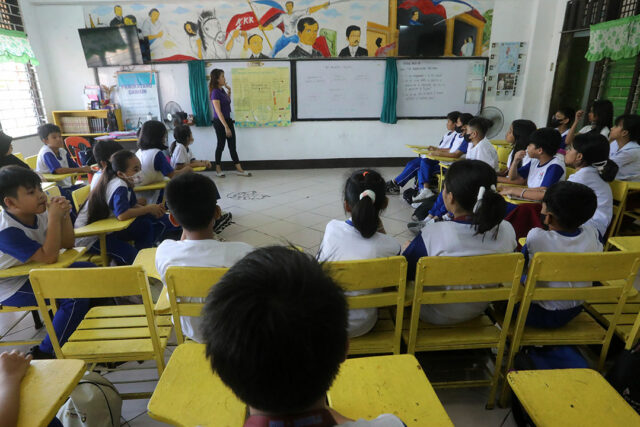
DepEd to support returning teachers from the Middle East

PHILIPPINE STAR/WALTER BOLLOZOS

The Department of Education (DepEd) said on Monday that returning Filipino teachers are welcome to join the public school system in the Philippines, as conflict in the Middle East escalates.

“To all the Filipino teachers in the Middle East and other parts of the world, the doors of our public schools are open for you,” Education Secretary Juan Edgardo “Sonny” M. Angara said in Filipino in a statement.

“If you decide to go back, the DepEd will be with you to start a new chapter of being in service,” he added.

Through the Sa Pinas, Ikaw ang Ma’am at Sir (SPIMS) Program, licensed Filipino teachers working overseas will have access to a reintegration path, allowing them to transition into the public school system in the Philippines.

Eligible applicants must be Filipino citizens or Philippine passport holders who are Licensure Examination for Teachers (LET) passers with at least one year of accumulated teaching experience within the last five years, and who have not resided in the Philippines for more than three consecutive years.

“The program ensures institutional coordination for a structured and orderly transition of returning Overseas Filipino Workers (OFWs) into the public education system,” the DepEd said in a statement.

The SPIMS Program is an initiative led by the National Reintegration Center for OFWs (DMW-NRCO) and implemented in coordination with partner agencies, including DepEd, the Commission on Higher Education (CHED), the Technical Education and Skills Development Authority (TESDA), among others.

The DepEd noted that qualified applicants may be hired and appointed as Teacher I under permanent status to help address the teacher shortage. An online refresher will also be available to those who need it to better align pedagogical competencies with the current educational standards.

“DepEd recognizes the valuable contributions of Filipino teachers abroad and remains steadfast in strengthening the country’s teacher workforce while upholding support mechanisms for educators, both at home and overseas,” it said in a statement.

Data from the Department of Migrant Workers (DMW) in October 2025 found that among 52,745 OFWs who participated in its reintegration programs, 656 were OFW teachers who secured public school positions through the SPIMS program. — Almira Louise S. Martinez

Shopee leverages AI to empower brands, shoppers

New AI-powered tools were introduced at the Shopee Brands Summit including a virtual fitting room. — EDG ADRIAN A. EVA

Shopee, one of the country’s leading e-commerce platforms, unveiled several artificial intelligence (AI) tools aimed at improving the experience of both sellers and shoppers on the platform.

During the Shopee Brands Summit held on Feb. 11, the company introduced a suite of AI-powered tools, including Brand Max, enhanced AI LiveStream features, and other innovations such as a virtual fitting room.

Jack Ng, head of commercial for Shopee Philippines, said the platform is investing in AI-enabled tools to ensure that brands grow with greater clarity and control.

“For sellers, this means making it easier to present products well and reach the right audiences,” Mr. Ng said.

“For shoppers, it translates into more accurate search results and relevant recommendations, so they can find the products they want faster.”

He added that these AI tools help brands navigate crowded markets and focus on what truly drives growth.

Shopee’s Brand Max is an AI-powered branding solution that introduces brands to potential buyers. The platform said it replaces traditional display ads with smarter audience targeting and broader placements within a single campaign.

“Brand Max uses our algorithm to target new users who have shown interest in your category but have not yet purchased from your brand,” Xiaoo Liu, head of Shopee Mall for Shopee Philippines, said during the summit.

“With this, Shopee will not just be a sales channel for you. Shopee will also help you build your brand and reach more buyers than ever,” he added.

Meanwhile, Shopee’s AI LiveStream, first launched last year, will be equipped with additional tools, rolling out across Southeast Asia, to allow brands to engage with shoppers 24/7, Janine Teotico, head of affiliate and creator marketing at Shopee Philippines, said.

These tools include an AI Script Generator, AI Comment Assistant, AI Stream Manager, and a feature that detects and highlights a product’s most persuasive details.

Other AI tools previously launched remain available, including features that generate optimized photos and titles, and an auto-reader that suggests category attributes from product images.

Shopee also announced that it will soon launch a virtual fitting room, which allows shoppers to try on clothes virtually.

The platform is strengthening its brand support through initiatives such as KOLLAB and First-to-Launch. KOLLAB connects brands with high-performing creators, while the latter provides a focused, high-impact environment for product debuts. — Edg Adrian A. Eva

Travel sector shares tumble as US-Iran conflict disrupts flights

FREEPIK

LONDON/SYDNEY/HONG KONG — Travel shares fell sharply on Monday as escalating conflict between the US, Israel and Iran disrupted flights around the globe, forced the closure of key Middle Eastern hubs and sent oil prices surging.

Middle Eastern airports including Dubai, the world’s busiest international hub, and Doha closed for a third day, stranding tens of thousands of passengers in one of the sharpest aviation shocks in recent years.

Oil prices jumped 7% to their highest in months as Iran and Israel stepped up attacks, damaging tankers and disrupting shipments from the key producing region.

Shares in TUI, Europe’s largest travel company, dropped 7% in early trade, while British Airways-owner IAG  was down 9%, and Lufthansa and Air France-KLM down 7%. Hotelier Accor, and cruise company Carnival also fell sharply.

Analysts cited rising fuel costs, cancellations, and rerouting expenses as the main pressure points for airlines, despite most having hedged their fuel.

“We believe that an active war zone, along with the resulting flight disruptions (due to closure of airspace and airports), is likely to curb travel appetite in the region,” said B Riley Securities in a note.

Asian airlines were also hit. Japan’s ANA Holdings, Air China, China Southern Airlines, China Eastern Airlines, Malaysia’s AirAsia X  and Taiwan’s China Airlines and EVA Airways all fell at least 4%.

Cathay Pacific, which fell as much as 7% before trimming losses to 2.9%, canceled all flights to the Middle East, including passenger services to Dubai and Riyadh, until further notice. “We are waiving rebooking and rerouting charges for the affected customers,” it said.

Singapore Airlines canceled flights to and from Dubai through March 7, while Japan Airlines suspended Tokyo-Doha flights.

“For (East) Asian carriers, the number of flights they have to the airports that have been shut are rather limited,” said Singapore-based independent aviation analyst Brendan Sobie. “But of course you have the potential impact of higher oil prices and the overall political/economic instability globally.”

He added that Indian carriers were particularly exposed due to heavy Middle Eastern schedules serving migrant workers and a ban on using Pakistan’s airspace on flights to and from Europe.

Air India canceled flights on Monday between India and Zurich, Copenhagen and Birmingham, as well as to the United Arab Emirates, Saudi Arabia, Israel and Qatar. It said flights to New York and Newark would refuel in Rome.

Data provider VariFlight said mainland Chinese airlines had cancelled 26.5% of flights to and from the Middle East from March 2 to March 8. The pattern pointed to “sharp near-term disruption but relatively limited revisions further out in the week, suggesting carriers are still holding back from broader schedule resets while monitoring developments,” it said.

PASSENGERS SCRAMBLE TO CHANGE FLIGHTS
The ripple effects have hit travelers worldwide. Dubai was the world’s busiest international airport in 2024 with 92 million passengers, according to Airports Council International, ahead of London’s Heathrow by 13 million. Doha ranked tenth.

Virgin Australia, which leases planes operated by partner Qatar Airways for flights to Doha, canceled eight flights on Monday and offered free booking changes.

Qatar Airways passengers in Sydney told Reuters they scrambled to rearrange travel with little information from the airline.

Ascanio Giorgetti, 16, and his mother Alessandra Giorgetti, from Italy, arrived to find their Qatar Airways flight to Milan via Doha cancelled. They secured an alternate route home via Los Angeles on another airline.

“We have no information at all, no answer on the phone from Qatar (Airways),” she said, adding the tickets had cost 4,000 euros ($4,708).

Jenni and Doug Stewart, both 78, were flying from Sydney to Scotland via Doha when their flight turned back halfway to Doha.

“We were told the airspace had closed and we were going back to Sydney,” Jenni said. “Suddenly we veered towards Perth and we didn’t know why, and then it changed again and went to Melbourne.”

They then flew back to Sydney. “It was chaotic in Melbourne, hundreds of people looking for even the vaguest of information,” Doug said. ($1 = 0.8495 euros) — Reuters

India’s economic growth slips to 7.8%, but still leads major nations

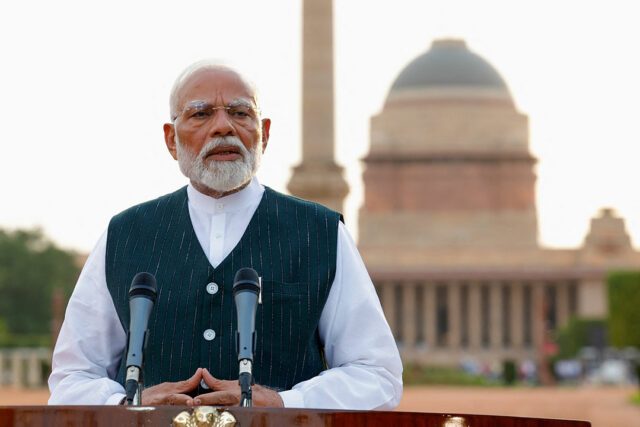
India’s Prime Minister Narendra Modi addresses the media at the Presidential Palace in New Delhi, India, June 7, 2024. — REUTERS

NEW DELHI — India’s economic growth slowed in the October-December quarter as government spending and private investment eased, but the South Asian nation remained the world’s fastest growing major economy, helped by strong consumption.

The economy grew 7.8% in October-December from a year earlier under a new data series, slowing from 8.4% expansion in the previous quarter.

The Indian government’s projections under the new data series marginally boosted growth for financial year ending March 31. The economy is estimated to grow by 7.6% in 2025/26, the National Statistics Office said on Friday. It had been forecast to grow by 7.4% under the old data series.

For financial year 2026/27, the country’s projected economic growth has been revised to 7%-7.4% under the new series, said Chief Economic Adviser V. Anantha Nageswaran after the data was released. In his annual report released last month, the economy was projected to grow at 6.8%-7.2% for 2026/27.

The South Asian nation will comfortably cross the $4 trillion mark in the next financial year, Mr. Nageswaran said.

INDIA ATTEMPTS TO OVERCOME TARIFF CHALLENGES
For much of the current financial year, India’s economy has contended with uncertainty from tariffs, which have weighed on exports.

In response, Prime Minister Narendra Modi’s administration accelerated domestic reforms, including cutting consumer taxes on hundreds of items and pushing ahead with long-delayed labour reforms.

Earlier this month, New Delhi reached an interim agreement with Washington that reduces effective tariffs to 18%, easing trade tensions, although the deal has yet to be formally signed.

The US Supreme Court’s order striking down President Donald Trump’s global tariffs may improve India’s trade position in its upcoming interim negotiations. Meanwhile, Mr. Trump has announced a temporary 10% duty on all nations, including India, and promised to raise it to 15%.

PRIVATE CONSUMPTION REMAINS STRONG
Despite those pressures, private consumption remained strong, expanding by 8.7% year-on-year in the October-December period compared with an 8% expansion in the previous quarter.

Government spending rose 4.7% year-on-year in October-December, down from a 6.6% increase the previous quarter while private investment grew 7.8%, lower than the 8.4% growth a quarter ago.

Manufacturing grew by 13.3% in the third quarter, compared with 13.2% a quarter ago. Financial services and hospitality sectors held strong.

Growth in farm output, a sector which employs more than 40% of the workforce, slowed to 1.4% in the third quarter of the current fiscal year from 2.3% a quarter ago.

“Service sector performance signals a strong lift, besides double-digit growth in manufacturing,” said Radhika Rao, economist at Singapore-headquartered DBS Bank.

“The October-December quarter also benefited from indirect tax rationalisation and festive demand, in addition to a better faring rural farm sector,” Ms. Rao said.

As India’s growth has remained strong, rating agency ICRA expects the central bank to keep rates on hold, with inflation likely to rise temporarily, its chief economist Aditi Nayar said.

The Reserve Bank of India (RBI) kept its key repo rate unchanged earlier this month.

STATISTICAL OVERHAUL
India has overhauled its statistical framework this year, first updating the consumer price index and now revising the GDP series to better reflect structural changes in the economy.

As part of the changes, the government has widened its data sources to include Goods and Services Tax (GST) filings, corporate financial returns and digital platform data to improve coverage of economic activity.

At the core of the GDP overhaul is the shift to adopting more granular price deflation to improve accuracy. Until now, it largely deflated only input prices, with heavy reliance on the wholesale price index.

The changes are expected to address concerns raised by the International Monetary Fund last year over India’s national accounts methodology, including the outdated 2011/12 base year and reliance on wholesale prices, for which it gave the framework a “C” rating. — Reuters

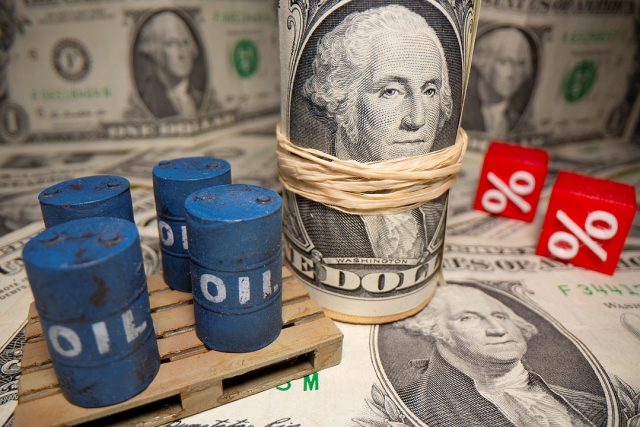
Oil surges 9% as Iran conflict disrupts Middle Eastern supply flow

REUTERS

SINGAPORE — Oil prices surged 9% on Monday after shipping in the crucial Strait of Hormuz was disrupted by retaliatory Iranian attacks following initial bombing by Israel and the United States that killed Iranian Supreme Leader Ali Khamenei.

Brent crude futures rose as much as 13% to $82.37 a barrel, the highest since January 2025, before retreating to trade up $6.91, or 9.5%, at $79.78 a barrel by 0748 GMT.

US West Texas Intermediate crude climbed to an intraday high of $75.33, up over 12% and the highest since June, though it later pared gains and was up $5.88, or 8.8%, at $72.90 per barrel.

Both benchmarks jumped as a sustained exchange of counterattacks damaged tankers and sharply disrupted shipments in the Strait of Hormuz, a waterway between Iran and Oman that connects the Gulf to the Arabian Sea.

On a typical day, ships carrying oil equal to about one-fifth of global demand from Saudi Arabia, the UAE, Iraq, Iran, and Kuwait sail through the Strait along with tankers hauling diesel and jet fuel and gasoline and other products from their refineries to major Asian markets including China and India.

A longer closure of the Strait would push oil prices higher and cause supply shortages, analysts say.

“A prolonged chokehold on oil flows risks alienating China – a key importer of Gulf crude and one of Tehran’s few major partners – while also curtailing Iran’s own export revenues. This may temper the duration of any disruption,” Sentosa Shipbrokers said on Monday.

More than 200 vessels including oil and liquefied gas tankers have dropped anchor outside the Strait, shipping data showed on Sunday. Three tankers were damaged and one seafarer was killed in attacks on Sunday in Gulf waters.

Asian economies are assessing oil stockpile availability and ways to secure alternative supply. South Korea will offer petroleum from its stockpiles to local industries if supply disruptions are prolonged, while India is exploring alternative shipping routes.

PRICES PARE GAINS
Still, prices pared gains after the steep surge in early Asian trade, which analysts attributed to buyers already factoring a risk premium into prices in anticipation of the conflict.

Brent had risen over 19% this year until Friday’s close, while WTI was trading about 17% higher.

“Markets are acknowledging the seriousness of the conflict, but are also signaling that, for now, this is a geopolitical shock, not a systemic crisis,” said Priyanka Sachdeva, senior analyst at Phillip Nova.

Amid the conflict, OPEC+ agreed on Sunday to a modest oil output boost of 206,000 barrels per day for April. Every OPEC+ producer is essentially producing at capacity except for Saudi Arabia, RBC Capital analyst Helima Croft said.

The International Energy Agency is in touch with major producers in the Middle East, director Fatih Birol said on Sunday. The energy watchdog coordinates the release of strategic petroleum reserves from developed countries during emergencies.

Globally, visible oil inventories stood at 7.827 million barrels, enough for 74 days of demand, which is near a historical median, Goldman Sachs wrote in a note.

Citi analysts expect Brent to trade between $80 and $90 a barrel this week amid the ongoing conflict.

“Our baseline view is that the Iranian leadership changes, or that the regime changes sufficiently as to stop the war within 1-2 weeks, or the US decides to de-escalate having seen a change in leadership and set back Iran’s missiles and nuclear program over the same time frame,” Citi analysts led by Max Layton wrote.

Analysts are also warning retail gasoline prices in the US, the world’s biggest fuel consumer, may break above $3 a gallon because of the conflict, a potentially risky result for President Donald Trump and his Republican Party ahead of midterm elections this November.

US gasoline futures surged by as much as 9.1% to $2.496 a gallon, their highest since July 2024, and were last at $2.408 a gallon, up 5.4%. — Reuters

On veteran rival’s turf, Nepal’s rapper-turned-leader takes a swing at power

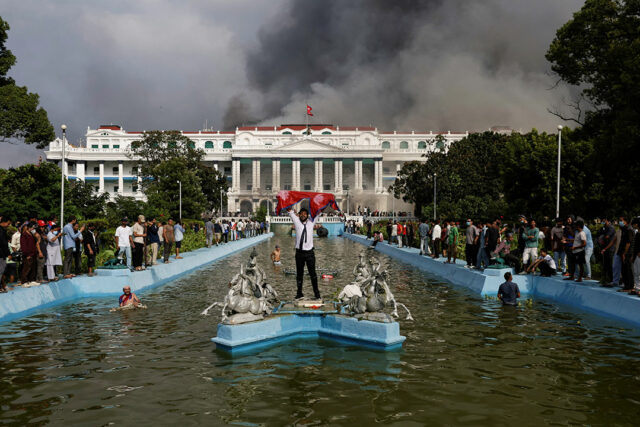
A demonstrator holding Nepal’s flag celebrates at the Singha Durbar office complex that houses the Prime Minister’s office and other ministries after storming it during a protest against Monday’s killing of 19 people after anti-corruption protests that were triggered by a social media ban, which was later lifted, during a curfew in Kathmandu, Nepal, Sept. 9, 2025. — REUTERS/NAVESH CHITRAKAR

DAMAK, Nepal – Everybody wants a photograph with Balendra Shah.

The rapper-turned-politician – better known as Balen – dominating Nepal’s electoral race was surrounded by supporters in the country’s east last week, ahead of a March 5 election that could be pivotal in the mountainous nation locked between China and India.

“I am here to see Balen, even though I have a fever,” a seven-year-old girl said, at her first sighting of the centrist Rastriya Swatantra Party’s prime ministerial candidate.

Next to her, a middle-aged woman admitted she left a heart check-up midway for a photo with Mr. Shah, a former mayor of the capital Kathmandu who was catapulted into national politics last September after historic youth-led protests swept the country.

The “Gen Z” demonstrations, fuelled by popular anger against Nepal’s ruling class over rampant corruption and unemployment, left 77 people dead and forced then Prime Minister K.P. Sharma Oli to resign.

Mr. Shah is now taking on the four-time prime minister on the latter’s home turf, the Jhapa district from where 74-year-old Mr. Oli has won six times during his long political career.

If Mr. Shah and the RSP are able to take power, it could upend the politics of the Himalayan nation, which has been long roiled by instability wrought by established parties led by Mr. Oli and his generation of veterans.

Across wide swathes of Nepal, analysts say public sentiment is one of disenchanment with established political parties that have been given multiple opportunities to govern but failed to deliver.

These include Mr. Oli’s Communist Party of Nepal (Unified Marxist–Leninist or UML), the Nepali Communist Party comprising former Maoist rebels and the centrist Nepali Congress, which have shared power between them for decades.

Still, these groups retain some influence in parts of the country, including in hill districts such as Kavrepalanchok, where 38-year-old Raju Rasaili will cast his vote.

“In my village, there are loyal supporters of both the Maoists and the CPN-UML. I don’t think people easily let go of that kind of political loyalty,” he said.

But back in Jhapa’s Damak town, Bipana Oli, who like millions of Nepalis earns a living in the Middle East, made her choice even before flying back home from Kuwait to vote in Thursday’s election.

“How long I continue working in Kuwait as a migrant worker will depend on Balen’s victory, and the policies and job opportunities he creates,” said the 25-year-old, who is unrelated to the former prime minister.

10 SECONDS EACH
Around her, the crowd of supporters swirled, each getting about 10 seconds with Mr. Shah, dressed in a trademark dark blazer and sunglasses.

Most stayed only for the photo. Some shook his hand or engaged in a brief conversation, till Mr. Shah’s official photographer firmly instructed: “Step aside, next in line.”

Since quitting as Kathmandu’s mayor and joining the RSP in January, Mr. Shah has canvassed aggressively across Nepal, covering almost 50 of the country’s 77 districts.

His campaign, however, is anything but conventional.

Often, he prefers to drive himself, pulling over spontaneously and stepping out of the car to greet shopkeepers, farmers, students, or others, taking most by surprise, according to two aides.

During one drive through Jhapa’s Kamal town, Mr. Shah abruptly stopped the car and walked into a wedding ceremony uninvited, greeting guests before moving on, said campaign team member Surendra Bajgain.

“It’s spontaneous, his actions are instinctive and not strategic,” he said, of Mr. Shah.

In another break from standard practice, Mr. Shah has largely shunned the mainstream press, instead heavily relying on social media – where he has millions of followers – to amplify his message.

“Campaigning is easy,” Mr. Shah told Reuters during a fleeting conversation.

“It was more challenging when I ran for mayor because I was alone and I did everything on my own. Now, I have a party and a team supporting me throughout.”

That team also comprises a small group that carries laptops to campaign events to document public grievances, including noting projects that previous leaders failed to complete and those that voters want the most.

These concerns are then investigated and distilled into manifesto-like “Promise Letters” that Mr. Shah’s team distributes on the campaign trail, said Subhas Basnet, one of the note-takers.

‘NEVER SAW YOU AGAIN’
But not all voters in Jhapa are entirely convinced by Mr. Shah’s strategy.

Mahesh Rai, 35, did not mince his words when suggesting to the RSP politician he follow his rival Mr. Oli’s playbook of face-to-face campaigning.

“I think you earn votes when you visit people at their home,” he told Shah, who quietly listened and nodded, before replying with a terse: “Okay.”

On the campaign trail, clouds of dust kicked up by a convoy of more than 20 cars, some fitted with flashing emergency lights, announce the arrival of Mr. Oli, a fixture in Nepali politics since the 1990s.

In Jhapa’s rural Gauriganj, a plastic table and chair are set in advance in a village square for Mr. Oli to take a seat soon after stepping out from the car. He folds his hands in salutation, a faint smile fixed on his face.

Despite being elected from his district for decades, for many voters this is the first opportunity to see Mr. Oli up close, as the former premier changes tack to keep his political career afloat after the hit from September’s revolt.

“In previous elections, I did not always have the time to meet local residents personally,” Mr. Oli told Reuters.

“This time, we have structured the campaign in a way that allows me to stay here and interact directly with people.”

Singheswar Prasad Rajbanshi, 85, is blunt in expressing his dissatisfaction with Mr. Oli, who rose from a teenage revolutionary imprisoned for 14 years to holding key ministerial roles before becoming premier.

“Many years ago, you came here seeking my vote while I was resting on my daybed. I supported you,” Mr. Rajbanshi told the former prime minister.

“But after that, I never saw you again until now.” — Reuters

Government budget utilization slows to 42% as of end-January

BW FILE PHOTO

By Justine Irish D. Tabile, Senior Reporter

Government agencies recorded a budget utilization rate of 42.2% in January, down from 78% a year earlier, the Department of Budget and Management (DBM) said.

In a Notice of Cash Allocations (NCAs) Utilization report, the Budget department said agencies used a total of P136.29 billion during the month out of the P322.67 billion worth of NCAs released during that period.

Unused NCAs amounted to P186.38 billion, as of the end of January.

NCAs are quarterly disbursement authorities issued by the DBM to agencies, allowing them to withdraw funds from the Bureau of the Treasury for their spending needs.

In January, line departments used P132.87 billion, or 62.7% of their allotments, while P79.17 billion remained unused.

The Commission on Elections posted the highest utilization rate of 97.6% at the end of January.

This was followed by the Commission on Audit (95.1%), Department of Foreign Affairs (90.9%), Department of Tourism (89.5%), and the Department of National Defense (78.7%).

The Department of Labor and Employment posted the lowest utilization rate of 20.2% at the end of January.

The other departments with the lowest utilization rates were the Office of the Ombudsman (31.6%), the Judiciary (31.9%), the Office of the Vice-President (34.8%), and the Department of Information and Communications Technology (38.3%).

Budgetary support to state-run firms, amounting to P3.36 billion, was fully utilized as of the end of January.

Allocations to the local government units (LGUs) were only 0.1% utilized, while Metropolitan Manila Development Authority had a 30% utilization rate.

Budget watchdog Social Watch Philippines (SWP) attributed the low January utilization rate to the delay in the signing of the 2026 General Appropriations Act (GAA).

“Budget utilization depends on two major factors: the absorptive and technical capacity of agencies, and the timing of allotment and cash allocation releases by the DBM,” SWP Senior Budget Analyst Alce C. Quitalig said in a Viber message.

“The delay in signing the 2026 GAA likely contributed to the low NCA utilization by end-January 2026, driven mainly by 0.1% disbursement of the allocation to the LGUs, largely from their respective National Tax Allotment (NTA),” he added.

He said that a similar event occurred in 2019, where only 0.2% of the NCA releases of allocation to LGUs were disbursed in the first month of that year.

“But allocation to LGUs typically record over 90% spending in other years. The year-on-year drop is clearly due to unspent LGU cash allocations,” he added.

Meanwhile, Mr. Quitalig said that the 62.7% utilization rate among national government agencies, which was lower than the 70% seen in January 2025 is consistent with the four-year average of 63% and the historical low utilization trend of just above 60% since 2016.

“End-January figures should be viewed in context, nonetheless, as agencies are still setting up spending systems early in the year. NCA utilization generally improves in succeeding months, as attested by the cumulative NCA utilization monthly flow trend,” Mr. Quitalig said.

“But departments and agencies with persistently low January performance must strengthen their spending, especially on regular programs, projects, and activities, to ensure timely delivery of public goods and services,” he added.

However, Mr. Quitalig raised concerns whether spending improvement schemes implemented by the government have truly strengthened agencies’ absorptive and technical capacity or have hindered their spending performance.

“Evaluating budget reforms aimed at expediting public spending is crucial. While budget utilization is understandably modest in the first month of the year, improvements should have happened post-pandemic,” he said.

“Yet the persistently low end-January NCA utilization of the departments and agencies raises doubts about the effectiveness of spending improvement schemes such as cash-based budgeting system, GAA-as-release document and early procurement policies,” he added.

Michael L. Ricafort, chief economist at Rizal Commercial Banking Corp., attributed the low utilization rate to the spillover effects of government underspending since the latter part of 2025 due to the anomalous flood-control projects.

“There is still caution on government spending to prevent risk of corruption,” he said in a Viber message, but noted that the national budget that was signed on January 5 was already based on better governance standards compared to previous years.

“Going forward, the government spending is expected to catch up, especially on infrastructure to make up for the underspending in the second half of 2025, but, more importantly, based on anti-corruption measures and better governance standards,” he added.

However, John Paolo R. Rivera, senior research fellow at the Philippine Institute for Development Studies, said that a low utilization rate in January is not unusual.

“It can be attributed to several factors such as post-holiday normalization, weaker new orders, input and cost pressures, and external uncertainty,” he said in a Viber message.

“At 42.2%, utilization is not alarming … it is a normal slowdown,” he added.

India offers local defense production to Philippines amid modernization push

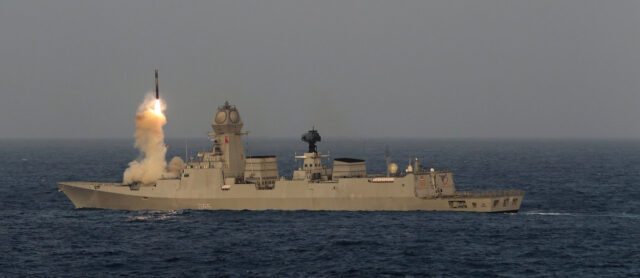
BrahMos fired from INS Chennai during TROPEX 2017. - COMMONS.WIKIMEDIA.ORG

India’s defense industry is pitching production lines in the Philippines as Manila boosts its military modernization.

Ashish Kansal, co-chairman of the Federation of Indian Chambers of Commerce and Industry’s defense committee, said Indian manufacturers are ready to sell systems used by India’s armed forces and set up local production to meet Philippine demand.

“We are more than willing to set up actual production bases within the Philippines, so it has the right surge capacity to produce products for its own demand,” he told a defense expo in Makati City on Monday. “We are… giving not just the second best, but the best we give our armed forces.”

The move comes as the Philippines earmarks roughly $35 billion (P2 trillion) over the next decade for warships, missiles and other platforms, mainly sourced from South Korea, Israel and the US, to bolster deterrence amid tensions with China in the South China Sea.

“Modernization, however, cannot stop at acquisition,” Philippine Major General Ivan DR. Papera, chief of the military’s modernization office, told the event organized by the Indian Embassy in Manila. “Modernization must be sustained, and sustainment requires industrial partnership.”

Reading a statement from military chief General Romeo S. Brawner Jr., he added: “Modernization without industrial capacity creates dependency.”

The remarks underline Manila’s push to strengthen its domestic defense industry under a 2024 law that encourages foreign suppliers to partner with local companies, building self-reliant capabilities with the help of trusted strategic partners.

Mr. Papera called India a “natural and strategic partner” in this effort, citing its experience in missile development, shipbuilding, aerospace, cyber systems and defense electronics.

The Philippines has already bought BrahMos supersonic cruise missiles from India. Three orders placed in 2022, worth $375 million, aim to boost anti-ship capabilities in response to repeated confrontations with Chinese vessels in contested waters.

Despite a 2016 United Nations-backed ruling voiding Beijing’s claims, China asserts sovereignty over the energy-rich South China Sea.

Manila has accused Chinese ships of using water cannons and aggressive maneuvers to intimidate Philippine vessels.

China insists its operations in the South China Sea comply with international law. — Kenneth Christiane L. Basilio

Philippine peso set for best start in 14 years on stock inflows, weak dollar

BW FILE PHOTO

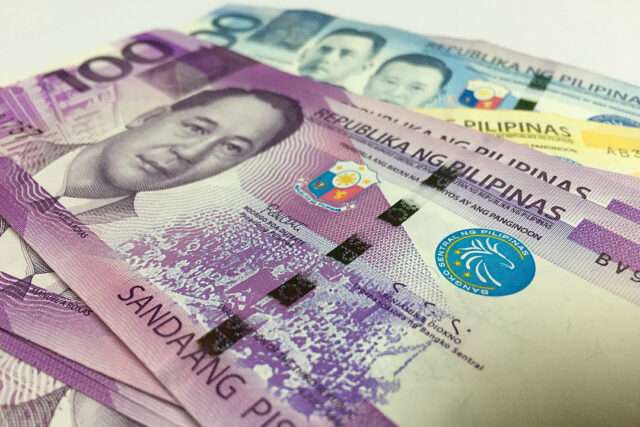
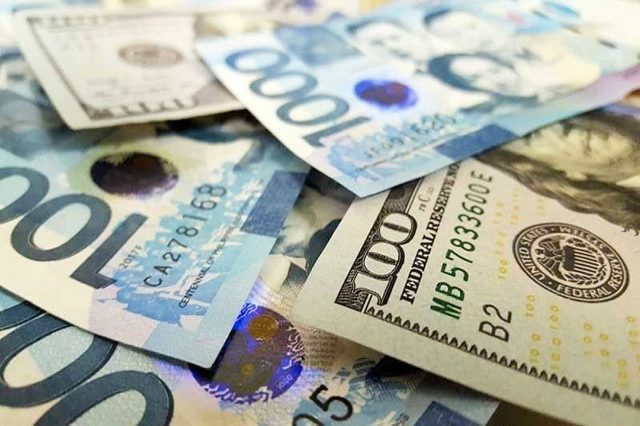
The Philippine peso is set for its best start to the year since 2012, as foreign inflows into the stock market and a weak US dollar bolster the currency.

The currency is up almost 2% this year, the most since early 2012, as the currency’s rebound from a record low in January gathers pace. Investors poured money into the local stock market for two straight months, after eight years of net outflows.

Asian currencies are advancing this year, bolstered by a stronger yuan, which acts as an anchor for the region, as well as by growing bearishness over the dollar. In the Philippines, a rebound in equities is luring foreign funds with the benchmark gauge approaching bull market territory.

The currency’s gains come with a caution, however, as some analysts see the rally fading toward the year end on the prospect of interest-rate cuts. BMI, a Fitch Solutions unit, expects the currency to fall over 3% from Friday’s level to 59.50 per dollar by the year end.

“The Philippine peso’s recent strength reflects a weaker dollar, rather than a sudden improvement in domestic fundamentals,” said Brandon Ong, country risk analyst at BMI in Singapore.

BMI expects the central bank to lower rates by another 25 basis points to 4% by end-2026, which would narrow the rate differential between the US and the Philippines and weaken the appeal of the currency.

A massive corruption scandal dragged economic growth last quarter to its slowest pace in 14 years outside the pandemic in the country. Bangko Sentral ng Pilipinas will support the economy to the extent that it won’t spur inflation, Governor Eli Remolona said this month. — Bloomberg

ADVERTISEMENT
ADVERTISEMENT