Home Blog Page 2296

Sweden interested in PHL mining, healthcare tie-ups

REUTERS

THE Swedish government has expressed interest in collaborating with the Philippines in mining, healthcare, transportation, digitalization, and defense, the Board of Investments (BoI) said.

In a statement on Tuesday, the BoI said that Trade Undersecretary and BoI Managing Head Ceferino S. Rodolfo recently met with Håkan Jevrell, Sweden’s State Secretary to the Minister for International Development Cooperation and Foreign Trade.

“The two officials discussed priority areas in trade and investments with the aim of establishing a platform for the two economies to discuss and exchange information on mutually identified priority areas through a Joint Economic Commission,” the BoI said.

During the meeting, Mr. Jevrell expressed interest in possible ventures in mining, defense, healthcare, transportation, and digitalization, citing the need for such tieups to involve sustainable practices.

“Sweden is advanced in terms of technology transfer through partnering with the local ecosystem. A Swedish company, Ericsson, is the leading innovator for connectivity,” Mr. Jevrell said.

He said the Philippines has a well-developed mining industry, but “at this stage, the relationship with the Philippines (will center on how) to do sustainable mining with appropriate solutions. Swedish companies are ready to be part of the mining journey with less impact on the environment.”

In healthcare, Mr. Jevrell cited specific interest in supporting the Philippines’ efforts in cancer care.

Mr. Rodolfo said that “the Philippines aims to have an active pharmaceutical industry.”

Meanwhile, Mr. Jevrell said that Sweden is also open to supporting the Philippines in introducing renewables into the grid.

“Companies like ABB have strong interest in working more with the Philippines in this area,” he added. — Justine Irish D. Tabile

British chamber backs passage of Konektadong Pinoy measure

THE British Chamber of Commerce Philippines (BCCP) said it supports the passage of the Open Access in Data Transmission bill, also known as the Konektadong Pinoy bill, as well as further economic liberalization.

“The British Chamber will remain at the forefront of supporting key legislation to continue opening up the economy while promoting multiple areas of cooperation,” BCCP Executive Director Chris Nelson said at a briefing on Thursday.

“This aligns with our goal of further increasing UK-Philippines trade and the overall drive to boost its competitiveness in Southeast Asia,” he added.

The chamber also sought the passage of the proposed Cybersecurity Act and the E-Governance Act.

“We have also been very concerned and advocating for cybersecurity. Cybersecurity is an issue across the world … And the UK is a known source of expertise on cybersecurity,” said Mr. Nelson.

“Cybersecurity is not only important for banks; it is going to be important for all companies and for everybody because, as we get more digitized, security is going to be more critical in the future,” he added.

He said that the proposed Cybersecurity Act will help extend the obligation to maintain secure systems across the private sector.

“Why is that important? Because once you start to extend it, it becomes everybody’s responsibility. And you can only protect yourself then when more people are aware of what guidance and what is needed,” he said.

“So we’re looking very much forward to having that bill passed, and as we said, we’d like to see a swift pass, hopefully by the beginning of the next Congress,” he added.

He said that the E-governance Act will help investors see improvements in Philippine bureaucracy.

“Things have improved, but it could be much better. And one of them is if we enact the E-Governance Act. Anything you can digitalize will make the process quicker which would encourage more companies to come,” he said.

Meanwhile, he said that the BCCP wants to also see further removal of Constitutional barriers to foreign investment.

“The Philippines is one of those countries that has what they call the ‘negative investment list’ which is actually in your Constitution,” he said.

“This obviously means foreign companies cannot invest in certain sectors, so we want to see further liberalization,” he added.

He said the Philippines has taken steps in opening some industries, such as renewable energy (RE).

The government saw an increase in RE projects after it allowed full foreign ownership in the industry. Foreign investment was previously capped at 40%.

“We have seen it in some other aspects, but we can continue to do more and further open up the economy. You are competing with other countries that may be more liberal,” he added.

In the year to June 2024, trade between the UK and the Philippines amounted to 2.9 billion pounds sterling. The Philippines is the UK’s second-largest export market for pork next to China. — Justine Irish D. Tabile

Offshore wind green energy auction set for late 2025

STOCK PHOTO | Image by Nicholas Doherty from Unsplash

THE Department of Energy (DoE) said on Thursday that it will stage the fifth round of the green energy auction (GEA-5) in the third quarter of 2025, with the auction to focus on offshore wind projects.

“As a cornerstone of the Philippine Energy Plan 2023-2050, GEA-5 exemplifies the government’s unwavering commitment to renewable energy deployment, energy security, and the energy transition agenda,” the DoE said in a statement.

GEA-5 will ensure that offshore wind developers enjoy long-term demand for their output. The timing of the auction will help keep developers on track to start generating output by 2028.

The DoE will soon release the notice of auction and terms of reference, outlining the timeline, procedures, and guidelines for GEA-5 participation.

The DoE is currently evaluating position papers from stakeholders on the design of the auction.

“The launch of GEA-5 is expected to catalyze the development of offshore wind projects, solidifying the Philippines’ position as a renewable energy leader in the region,” the DoE said.

To date, the DoE has awarded 92 offshore wind energy service contracts with a potential capacity of 68.66 gigawatts (GW).

Philippine offshore wind resources are estimated at potentially 178 GW, according to the World Bank’s 2022 Offshore Wind Roadmap for the Philippines.

The GEA program establishes the framework for facilitating investment in new and additional renewable energy capacity, to ensure adequate supply under a competitive process.

The government first held GEA in 2022 and resulted in 1,996.93 megawatts (MW) worth of renewables being awarded. The second round was staged in 2023, with 3,440.76 MW awarded.

Aside from GEA-5, the DoE is set to hold an auction which involves 4,475 MW of impounding hydro, pumped-storage hydro, run-of-river hydro, and geothermal contracts, and another for integrated renewable energy and energy storage systems. — Sheldeen Joy Talavera

MAP to hold fresh election after incoming head quits

MANAGEMENT Association of the Philippines (MAP) 2025 President-elect Emmanuel P. Bonoan has withdrawn before officially taking up his post, citing personal reasons.

In a letter to members dated Dec. 12, MAP President Rene D. Almendras said that the 2025 incoming board will reconvene to select another leader.

“I have received from Noel Bonoan, our MAP 2025 President-elect, his decision not to assume the presidency for personal and private reasons,” according to his letter.

MAP announced on Nov. 20 the selection of Mr. Bonoan, KPMG R.G. Manabat & Co. vice chairman, chief operating officer, and head of advisory.

According to Mr. Bonoan, letters alluding “to a complaint filed by his former wife and allegations she has raised in an ongoing annulment case” have been received by the MAP.

“I recognize the distress these allegations have caused among some people within and outside of MAP. With this and after careful reflection, I made my decision,” according to a letter sent by Mr. Bonoan to Mr. Almendras.

“My hope is that this will avoid distracting the organization from its mission of instilling management excellence in the Philippines,” he added.

Mr. Bonoan also served as an undersecretary to the Department of Finance and held oversight functions at the Bureau of Internal Revenue. — Justine Irish D. Tabile

H5N2 bird flu transmission pathways being investigated

REUTERS

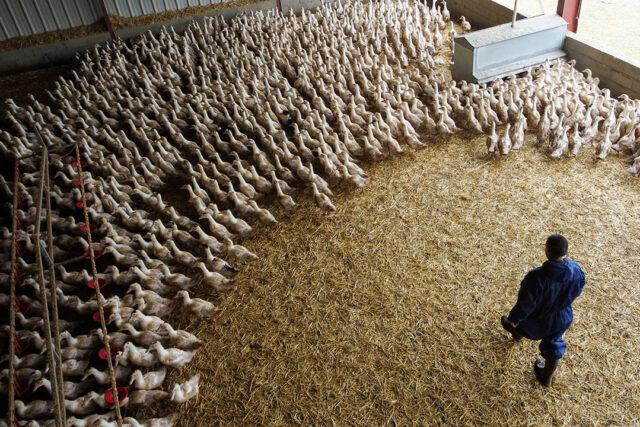
THE Department of Agriculture (DA) said on Thursday that it is investigating how Highly Pathogenic Avian Influenza (HPAI) Type A, Subtype H5N2 entered the country, after an outbreak at a Camarines Norte duck farm.

“Right now, the investigation of the Bureau of Animal Industry (BAI) is ongoing to determine how the H5N2 subtype entered, because this is the first time that this strain of HPAI reached our country,” Assistant Secretary and DA Spokesman Arnel V. de Mesa said at an online briefing.

On Wednesday, the BAI confirmed the first case of the subtype at a duck farm in Talisay, Camarines Norte. The ducks tested positive on Dec. 6.

“The most common subtype that hits us is H5N1, which is more virulent compared to H5N2,” he added.

According to a report by the World Health Organization, the Mexican government reported a fatal case of human infection with the H5N2 strain in May.

Mr. De Mesa said that the H5N2 strain is less likely to be transmitted to humans compared to the H5N1 subtype.

Bird flu infections in humans may cause mild to severe upper respiratory tract infections and can be fatal. Cases of conjunctivitis, gastrointestinal symptoms, encephalitis and encephalopathy have also been reported.

The BAI also said that it quarantined the affected farm, and had also culled and disposed of the infected birds.

The Camarines Norte outbreak makes it the second province with an active case of avian influenza, the other being Bulacan, according to a BAI report on Dec 6. Both outbreaks involved duck farms.

There is currently no approved vaccine for Avian Influenza in the Philippines. — Adrian H. Halili

PHL cyberattacks top 4,000 per week

FREEPIK

CYBERSECURITY SOLUTIONS company Check Point Software Technologies Ltd. said on Wednesday that in the last six months, organizations in the Philippines experienced an average of 4,003 attacks per week, well above the Asia-Pacific average of 2,870.

“Cyberattacks in the Philippines are escalating both in frequency and sophistication, placing immense pressure on organizations to stay ahead of evolving threats,” Teong Eng Guan, regional director of Southeast Asia & Korea at Check Point Software Technologies, said in a statement.

The report found that the exposure of sensitive data such as usernames, passwords, and encryption keys, has happened to 70% of Philippine organizations, with businesses “particularly susceptible to exploitation.”

The National Privacy Commission (NPC) said the government logged 55 instances of data breaches between January and August. In addition, 21 incidents were reported in education and financial services organizations, while 17 incidents were reported by manpower agencies.

On its website, the NPC highlighted malicious attacks, human error, and the combination of both as the top three causes of data breaches in the first eight months of the year.

According to the commission, 115 reports were classified as malicious attacks, including hacking the cloud, databases, e-mail accounts, infrastructure, and websites.

Human error cases involved undertrained staff, loss of equipment/documents, and misdelivered documents.

“As personal data breaches and security incidents come with digitalization, fortification of our cyber defenses and ensuring that our personal data and sensitive personal data is protected should be the top priority,” it said. — Almira Louise S. Martinez

Swedish firms cite regulatory, ownership concerns as hurdles to investing in PHL

REUTERS

SWEDISH FIRMS cited regulatory challenges and foreign ownership restrictions as among the obstacles they face when investing in the Philippines.

On Thursday, Business Sweden and the Swedish Embassy presented the Philippine Market Report for 2024, which is intended to point out opportunities available to Swedish firms.

The report found that Swedish firms perceive the current government as pro-business, but noted inconsistent enforcement and bureaucratic inefficiencies.

“While the Philippines has established legislative frameworks to guide industries, Swedish firms report that the enforcement of these laws is inconsistent and occasionally lenient compared to other ASEAN nations,” the report read.

It cited red tape, delays in value-added tax refunds, onerous permit approvals, and customs handling as their top concerns.

“I think what we’ve captured is that it’s hard to get a good grasp on what needs to be done, and I think who to talk to and how to navigate the whole system to obtain the relevant permits. It’s different for each sector, of course,” according to Johan Lennefalk, trade commissioner of Sweden to the Philippines.

“Foreign ownership, I guess, is one type of restriction that applies to a number of areas that can prevent companies from further investing in the country. You know, ensuring full ownership of operations,” he added.

Mr. Lennefalk said that Swedish firms are at any rate optimistic about entering the Philippine market, with at least five companies expressing interest in recent months.

“A lot of what’s done here is related to maybe assembly, testing, and manufacturing. So companies that see the Philippines as another regional hub for that, maybe importing some parts from other countries, doing the assembling and testing here, to supply the region,” he said.

“As we all know, there’s kind of a regionalization in the world, with Europe, the northern part of Asia, and then this part of Asia, to supply nearby markets. So, companies that are evaluating whether the Philippines should be one of those hubs,” he added.

According to the report, Swedish firms are being directed to explore opportunities in infrastructure, renewable energy, sustainable mining, healthcare, consumer goods, and digitalization.

“These sectors align with the Philippines’ growth priorities, offering Swedish companies a strategic advantage,” the report overview read.

For the Philippines, the areas of opportunity are infrastructure, energy, mining, healthcare, consumer goods, information technology and business process outsourcing, and manufacturing.

“Swedish companies, leveraging their expertise in sustainability, innovation, and industrial solutions, are well-positioned to contribute to and benefit from the country’s ongoing development,” it added.

More than 50 Swedish companies operate in the Philippines, including those represented by local distributors. — Justine Irish D. Tabile

Marcos orders law enforcement agencies to double efforts vs POGOs

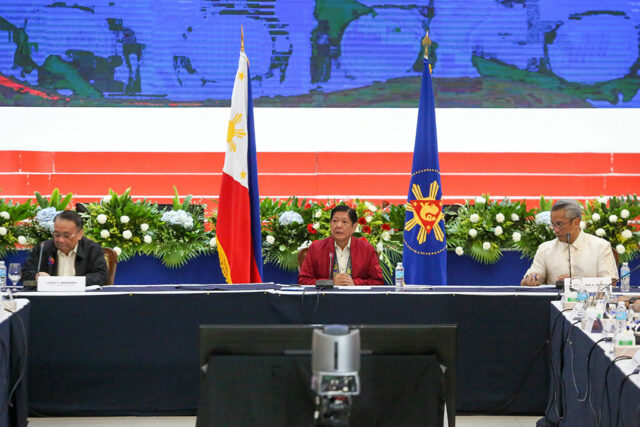
PRESIDENT Ferdinand R. Marcos, Jr. (center) led a peace council meeting at the national police headquarters at Camp Crame in Quezon City on Thursday. He was joined by Executive Secretary Lucas P. Bersamin (left) and Interior and Local Government Secretary Juanito Victo C. Remulla, Jr. — PPA POOL/NOEL B. PABALATE

PHILIPPINE President Ferdinand R. Marcos, Jr. on Thursday ordered law enforcement agencies to double their efforts in the crackdown against Philippine offshore gaming operators (POGOs) ahead of his year-end deadline.

In a statement following the 2nd Joint National Peace and Order Council-Regional Peace and Order Councils, the Presidential Communications Office (PCO) said Mr. Marcos directed the Philippine National Police (PNP) and the Philippine Anti-Organized Crime Commission (PAOCC) to carry out “smaller but multiple operations” against POGOs as his government tries to revoke all their licenses by the end of the month.

He also asked his local chief executives to work with the Department of the Interior and Local Government (DILG) and run after POGOs in their areas.

“Local government units (LGUs) have the capability to determine suspicious illegal activities in their communities, especially those concerning POGOs,” the PCO statement quoted him as saying.

Philippine Amusement and Gaming Corp. Chairman and Chief Executive Officer Alejandro H. Tengco told a Palace briefing on Wednesday that the government aims to revoke all POGO licenses by December 15.

DILG Secretary Juanito Victo C. Remulla, Jr. told the same briefing that shutting down these operations will not leave a big dent in the country’s economy, saying POGOs only account for 0.25 of 1% of the total gross domestic product.

The President earlier issued an executive order ordering the ban of POGOs due to their links to organized crime such as human trafficking and scamming, following his pronouncement during his third State of the Nation Address in July.

“Suspicious illegal activities, especially those concerning POGOs, should be monitored by the LGUs,” he said at the meeting with his law enforcement agencies.

“The DILG should step up gathering substantial intelligence from local communities.”

Citing Nov. 29 government data, the PCO said 53,700 offshore gaming employment licenses have been canceled, 18 internet gaming licenses (IGLs) voluntarily canceling their licenses and 27 IGLs in the process of winding down operations.

The Department of Labor and Employment (DoLE) reported in early December that it has completed profiling almost 28,000 direct workers of POGOs across Metro Manila, Region IV-A (Cavite, Laguna, Batangas, Rizal, Quezon) and Region VII (Central Visayas).

This only accounted for direct IGL workers, excluding indirect workers, which DoLE earlier said, could reach over 30,567 individuals.

The Department of Finance has said the government can forgo about P13 billion in tax and gaming revenues from POGOs when they get banned, saying more investments could come in if crimes linked to these outfits are cut.

Senator Sherwin T. Gatchalian earlier told BusinessWorld that the government could replace revenues from POGOs by developing the business process outsourcing industry. — John Victor D. Ordoñez

Lawmaker and groups question lack of gov’t subsidy for PhilHealth

PHILIPPINE STAR/MICHAEL VARCAS

A LAWMAKER, and more than 80 organizations, coalitions, and private individuals on Thursday sounded the alarm over the decision to cut the government subsidy for state-run Philippine Health Insurance Corp. (PhilHealth) under the 2025 budget bill, as ratified by both Houses of Congress.

Convening in a joint panel on Wednesday, senators and congressmen moved to deny PhilHealth any state subsidy for 2025 as it has accumulated about half-a-trillion worth of reserve funds, Senator Mary Grace Natividad S. Poe-Llamanzares explained during Wednesday’s plenary session after the conference committee meeting.

The proposed P6.352-trillion national budget will be signed by President Ferdinand R. Marcos, Jr. “before Christmas Day,” the Presidential Communications Office said in a statement on Thursday. 

Party-list Rep. Wilbert T. Lee said their decision to cut PhilHealth’s proposed subsidy is illegal and could affect the health benefits received by indigent Filipinos under the state health insurer.

“Clearly, this is contrary to the objectives of the Universal Healthcare Law,” he said in a statement in Filipino. “What will happen to our poor countrymen who rely on these subsidies?”

The National Government subsidizes the state health insurer to cover the premiums of its indigent members. All Filipinos are automatically covered by PhilHealth, under the Universal Healthcare Act.

The decision by lawmakers to rid PhilHealth of state subsidies came amid a controversy involving the remittance of P89.9 billion of its funds to state coffers, which prompted petitions before the Supreme Court seeking to stop the transfer.

The high court in October issued a temporary restraining order against further transfers of PhilHealth’s unused funds.

A total of P60 billion have already been transferred to the Treasury in three tranches since May, while the fourth and final tranche worth P29.9 billion was supposed to be remitted to the Treasury in November.

“PhilHealth has P600 billion in reserve funds and they should use these to address delayed reimbursements, and we will use this (funding subsidy) to fund departments that need it more,” Ms. Poe, who also heads the Senate Finance Committee, said.

Ms. Poe’s argument defending the cutting of government subsidies to PhilHealth is “deceptive,” the alliance of healthcare advocates, labor groups and individual stakeholders said in a separate statement on Thursday.

The joint statement was signed by more than 70 organizations and coalitions, including the Action for Economic Reforms, and Sentro ng mga Nagkakaisa at Progresibong Manggagawa, and 10 individuals, including healthcare advocate Anthony C. Leachon, former lawmaker Lorenzo R. Tañada III, and former Finance Undersecretary Cielo D. Magno,

They alleged the move to defund PhilHealth’s subsidies is against the 2012 Sin Tax Reform Law and the 2019 Universal Healthcare Act.

“The zero budget assaults the Sin Tax Law that earmarks funds from tobacco and sweetened beverage taxes for PhilHealth. Moreover, the zero budget strips the premiums of tens of millions of PhilHealth’s indirect contributors — the poor, the senior citizens, and persons with disabilities — and thus makes the direct contributors, many of whom are from the working class, bear the sole burden of funding PhilHealth,” they said.

“It is the government’s mandate to uphold the people’s constitutional right to health by providing the appropriations that will cover the premiums of indirect contributors or those who cannot afford to pay,” they added.

The approval of the bicameral bill would prompt the filing of petitions against the Congress’ decision to deny PhilHealth subsidies before the Supreme Court, according to the coalition. — Kenneth Christiane L. Basilio

Senate approves bill reorganizing NEDA on second reading

BW FILE PHOTO

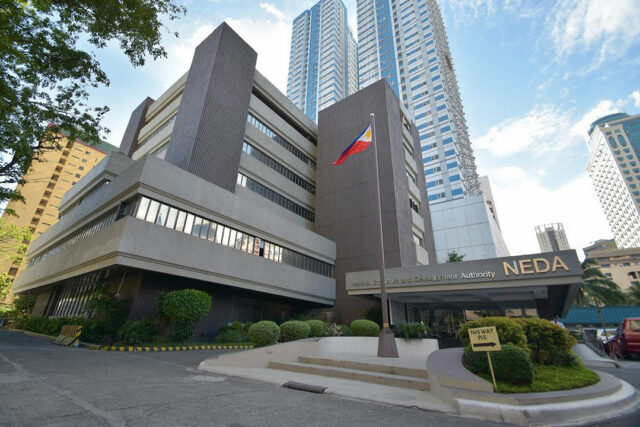
THE SENATE on late Wednesday approved on second reading a bill that will reorganize the National Economic and Development Authority (NEDA) into a “full-fledged department” with the aim to streamline the agency’s functions.

Senate Bill No.2878, the “Economy, Planning and Development Act,” which was approved with no objection, will reorganize NEDA into the Department of Economy, Planning and Development (DEPDev) to serve as the government’s primary economic and planning agency.

“This is necessary for the DEPDev to effectively align our economic planning with our policy implementation,” Senator Juan Miguel F. Zubiri, who sponsored Senate Bill No. 2878 and chaired the economic affairs committee, said in a statement on Thursday.

“With this bill, we simply want to institutionalize their expanded functions and equip them with the organizational structure that will support their mandate.”

The DEPDev, whose secretary will serve as the country’s Chief Economist, will also be tasked to formulate the long-term development framework. It will be mandated to draft the Philippine Development Plan Regional Development Plans, and Public Investment Program and Regional Development Investment Program among other reports.

Moreover, the bill reorganizes the NEDA board into the Economic Development Council (ED Council), which will be headed by the Philippine President.

The body will be composed of the executive secretary, secretaries of DEPDev, Budget and Management, Education, Energy, Finance, Health, Trade and Industry, Transportation, and Public Works among other Cabinet members.

The Council will be supported by the following committees: Development Budget Coordination Committee; Economic Development Committee; Investment Coordination Committee; Social Development Committee; Infrastructure Committee; Tariff and Related Matters Committee; National Land Use Committee; and Regional Development Committee.

It will also be required to meet regularly, at the minimum on a quarterly basis, to craft policies that promote economic development and “concerns of national importance.”

It will also continue to form part of the Development Budget Coordination Committee, alongside the Budget and Finance secretaries, as well as the Executive Secretary.

“This reorganization is not just about giving NEDA a new name or status, it’s about recognizing the critical role it plays in shaping our nation’s economic policies and plans are not just well-crafted but also effectively executed,” said Mr. Zubiri, the former Senate president.

In July, Socioeconomic Planning Secretary Arsenio M. Balisacan sought the chamber’s support to establish the DEPDev to strengthen NEDA’s capacities to plan, formulate and recommend policies as well as review and coordinate public investments.

Its counterpart measure, House Bill No. 11199 has been approved at the committee level, pending plenary action. — John Victor D. Ordoñez

NEA failure to enforce gov’t rural power program flagged

EVENING_TAO-FREEPIK

THE Commission on Audit (CoA) has flagged the National Electrification Administration (NEA) for failing to monitor the implementation of rural electrification efforts, resulting in about P992 million worth of subsidy funds still unliquidated as of end-2023, past its due implementation period.

In a December report, state auditors stated that P630 million in subsidies over a year old remain unliquidated with an additional P62 million in subsidies outstanding for two years; while P299 million in government subsidies have remained unliquidated for more than three years.

“Subsidy funds released to various [electric cooperatives] for the implementation of Rural Electrification Programs totaling P992.59 million remain unliquidated and unremitted as of December 31, 2023, due to NEA’s inadequate enforcement,” a part of the CoA report stated. “This clearly indicates that there are delays in the completion of the projects as well as in the liquidation of the subsidy funds released to the [electric cooperatives].”

Of the total amount, state auditors said that P189 million worth of funds have been liquidated by March 2024, leaving P802 million worth of subsidies outstanding.

The NEA did not immediately respond to an e-mail, text message and Facebook Messenger chat seeking comment.

The agency is responsible for overseeing the implementation of the country’s rural power program, but its implementation is mainly carried out by local electric cooperatives.

Billions worth of subsidies are provided by the National Government to the NEA to fulfill its goal of electrifying all households before President Ferdinand R. Marcos, Jr. steps down in 2028.

The Philippine Congress has earmarked P5.02 billion worth of subsidies to the NEA for its rural electrification program, more-than-doubling from the P1.82-billion initially proposed, according to a copy of the budget bill’s bicameral conference committee report.

State auditors have noted that recipients of government funds for rural electrification efforts have six months to implement their subsidized projects. Electric cooperatives should write a request for extension to the NEA if they “foresee the possibility of failing to complete the project” within the timeframe.

Requests for extension should not exceed three months, CoA stated.

“[Electric cooperatives] have a six-month timeframe to implement and complete the projects after receiving subsidy funds from NEA. If there is a concern about completing the projects within the given six months, [electric cooperatives] must submit a written extension request to NEA, with a maximum extension of three months,” the report stated.

“Additionally, [electric cooperatives] are required within three months from completion of the projects to settle or liquidate the subsidy funds,” it added.

The state auditing agency noted that NEA has the authority to “take necessary measures or actions” if electric cooperatives do not adhere to the implementation and fund liquidation policies.

“[The] NEA should conduct periodic inspection to monitor the project progress, as well as fund utilization and recommend remedial or corrective actions for any issues or problems that may arise.” — Kenneth Christiane L. Basilio

DoJ reaffirms rights commitment

PHILSTAR FILE PHOTO

THE Department of Justice (DoJ) on Thursday reaffirmed its commitment to human rights, highlighting two key goals under the Fourth Philippine Human Rights Plan (PHRP4).

Undersecretary Raul T. Vasquez, speaking on behalf of DoJ Secretary Jesus Crispin “Boying” C. Remulla, highlighted the two key goals under PHRP4: strengthening domestic accountability mechanisms to address human rights violations, including extrajudicial killings, enforced disappearances, and torture, and improving prison conditions and reformation programs for prisoners.

Mr. Remulla emphasized the government’s openness to working with civil society and the international community to achieve these objectives, reaffirming the Philippines’ commitment to human rights as a cornerstone of its governance agenda.

Last November, the DoJ formed a task force to probe extrajudicial killings during the past presidential administration.

The task force is responsible for investigating, building cases, and filing charges, if warranted, against the perpetrators and those involved in extrajudicial killings during the previous administration’s anti-illegal drug campaign.

Government data estimated 6,000 deaths during the drug war of former President Rodrigo R. Duterte, but human rights groups put the toll at up to 30,000, largely comprising small-time drug pushers and users.

The PHRP4 fulfills one of three commitments made by the Philippines to the United Nations during the 75th anniversary of the Universal Declaration of Human Rights in December 2023.

It is the second milestone achieved, alongside the creation of the Special Committee on Human Rights Coordination under Administrative Order No. 22 issued on May 8, 2024. Efforts are ongoing to meet the third pledge: establishing an independent, world-class National Forensic Institute.

The launch of the PHRP4 on Dec. 10, coincided with International Human Rights Day. — Chloe Mari A. Hufana