Home Blog Page 2263

Trump’s crypto team is taking shape, but questions remain over who will drive policy

MICHAEL FÖRTSCH-UNSPLASH

WASHINGTON — US President-elect Donald J. Trump’s crypto policy is taking shape with the announcement of a White House crypto czar and a new securities watchdog, but questions remain over who will drive policy and whether too many cooks could slow down changes.

Mr. Trump on Thursday appeared to make good on his campaign pledge to be a “crypto president,” announcing he would make former top PayPal executive and crypto evangelist David Sacks “White House A.I. & Crypto Czar.” A day earlier, Mr. Trump said he would nominate pro-crypto Washington attorney Paul Atkins to head the Securities and Exchange Commission (SEC).

While crypto executives cheered the news, saying the pair would end the Biden administration’s crypto crackdown and promote innovation, some Washington analysts said the creation of a crypto czar, a new role, sowed ambiguity over who would drive crypto policy and flagged the potential for policy clashes.

“One big question is whether the policy will be driven by Sacks himself. A czar appointed by Trump is going to want to see changes fairly quickly, but the SEC has processes and you can’t just snap your fingers at the SEC and have new rules,” Ian Katz, managing director of Capital Alpha Partners, said in an e-mail to Reuters. “Personalities will be important,” he added.

A Silicon Valley venture capitalist and friend of Mr. Trump billionaire backer Elon Musk, Mr. Sacks was an early bitcoin investor. In a 2017 CNBC interview, he said cryptocurrencies were revolutionizing the internet, but he acknowledged there were also scammers in the sector. He does not appear to have any experience writing or leading policy, according to a Reuters review of his background.

Mr. Atkins, meanwhile, is a former SEC official and respected veteran of Washington policy circles who has said he supports crypto innovation as way to boost financial services competition, and has helped crypto companies in their dealings with regulators via his consultancy Patomak Global Partners.

“Atkins is kind of a known quantity,” said Lene Powell, senior legal analyst at financial consultancy Wolters Kluwer. Mr. Sacks is from “a different sphere.”

Both have called for regulators to be more accommodating of crypto companies, but neither appear to have taken a position on whether and under what circumstances crypto tokens should be considered securities, commodities or utilities — a core issue that will ultimately decide how the industry is regulated.

“I think we’ll see more constructive regulation. Obviously, that includes some clarification around what is (a) security or not,” said Chen Arad, co-founder of Solidus Labs, a crypto compliance company.

Mr. Atkins and Mr.  Sacks did not immediately respond to requests for comment.

Bitcoin, the world’s largest cryptocurrency, surged past the $100,000 milestone for the first time after Trump announced Atkins as his pick to lead the SEC, buoyed by hopes that the new administration would usher in softer crypto policies.

Under President Joseph R.  Biden, the SEC has sued dozens of crypto companies, alleging they broke securities laws, while bank regulators discouraged lenders from dabbling in crypto and Congress failed to pass legislation that would help promote mainstream crypto adoption.

The crypto industry is pushing for an ambitious raft of policies that would promote adoption of digital assets, including the creation of a crypto regulatory framework which would address when tokens can be classified as securities or commodities.

Mr. Trump said in a Thursday post on his Truth Social platform that Mr. Sacks would “guide” crypto policy and “work on a legal framework so the Crypto industry has… clarity,” leaving it unclear whether Mr. Sacks would lead the incoming administration’s crypto policy.

It was also unclear whether Mr. Sacks will lead Mr. Trump’s crypto advisory council, which is also expected to play a key role in shaping crypto policy. Reuters previously reported the crypto czar was expected to lead that body and coordinate policy among the various regulatory agencies.

That coordination will be crucial, since a crypto legal framework would need extensive input from the SEC and the Commodity Futures Trading Commission, whose new chair has yet to be announced, and may also require congressional approval, said lawyers.

Regulations on less contentious non-crypto issues such as proprietary bank trading and capital have been snarled up for years by inter-agency squabbles, they noted.

“It definitely would be a lot of cooks,” Ms. Powell said.

In an email on Friday, a Trump transition spokesperson reiterated the President-elect’s Thursday announcement in which he said Mr. Sacks would guide crypto policy, and did not answer Reuters questions seeking more details on how the role would work.

Some consumer protection advocates have expressed concern that the Trump administration’s crypto agenda might create gaps that would leave investors at risk, a fear the industry has largely dismissed.

“I don’t think there will be under-regulation,” said Anthony Scaramucci, the founder of asset manager SkyBridge, who briefly served in Trump’s first administration. “I don’t think it will create fraud, but I think it will help the United States maintain what it should be, which is our mantle of financial services leadership.” — Reuters

The urgency of investing in proper nutrition in the ‘First 1,000 days’

PHILIPPINE STAR/MIGUEL DE GUZMAN

Proper nutrition in the first 1,000 days after conception is essential for ensuring children will grow as thriving adults. This is the period from pregnancy until the child’s second birthday when most development takes place — offering a critical window of opportunity to shape a child’s future.1 The conditions and the nutrition infants are exposed to during their first 1,000 days may either make or break a child’s potential for optimal development.

While the first 1,000 days is a great time to set our children up for success, this is also the period when they are highly vulnerable to impairments and health issues. According to the Developmental Origins of Health and Disease (DOHaD) theory, the early environment of each child within the womb, dependent on the health and nutrition of the woman during pregnancy, has the most influence on the child’s vulnerability to adult-onset diseases such as obesity, diabetes, cardiovascular disease, and certain cancers.2

In the first 270 days, if a pregnant girl or woman fails to receive the proper nutrition she needs, the growing fetus will have to adapt and compensate for the limited nutrition it gets. This lack of adequate nutrients is the root cause of suboptimal in-utero growth of organs, leading to increased risk of acquiring diseases later on in life. Thus, if the mother is unhealthy to begin with, a child will most likely be unhealthy as well.

The brain develops the fastest during these first 1,000 days. Such rapid development requires the right nutrition to facilitate neural connection and support proper cognitive functioning.3 After birth, the brain, along with the liver and the immune system, remains plastic. This means these organs retain their capability to adapt, change, and develop further depending on the child’s immediate environment.4 In the next 180 days after birth, the infant should be exclusively breastfed.

At six months of age, an infant starts having solids to complement the nutrients in breastmilk while breastfeeding continues up to two years of age or beyond. These complementary solids are preferably home-prepared from family foods, locally available and safe, and nutrient-dense but without added sugars and salt. If these recommended Infant and Young Child Feeding practices are not followed, underweight, acute undernutrition (wasting), and chronic undernutrition or stunting can ensue; development will be compromised and may lead to irreversible cognitive impairment and reduced learning capacity. Conversely, if the infant is fed unhealthy food that is high in sugar, fat, or salt, the child will likewise be affected with malnutrition, just in a different way — with overnutrition manifested by being overweight or obese.

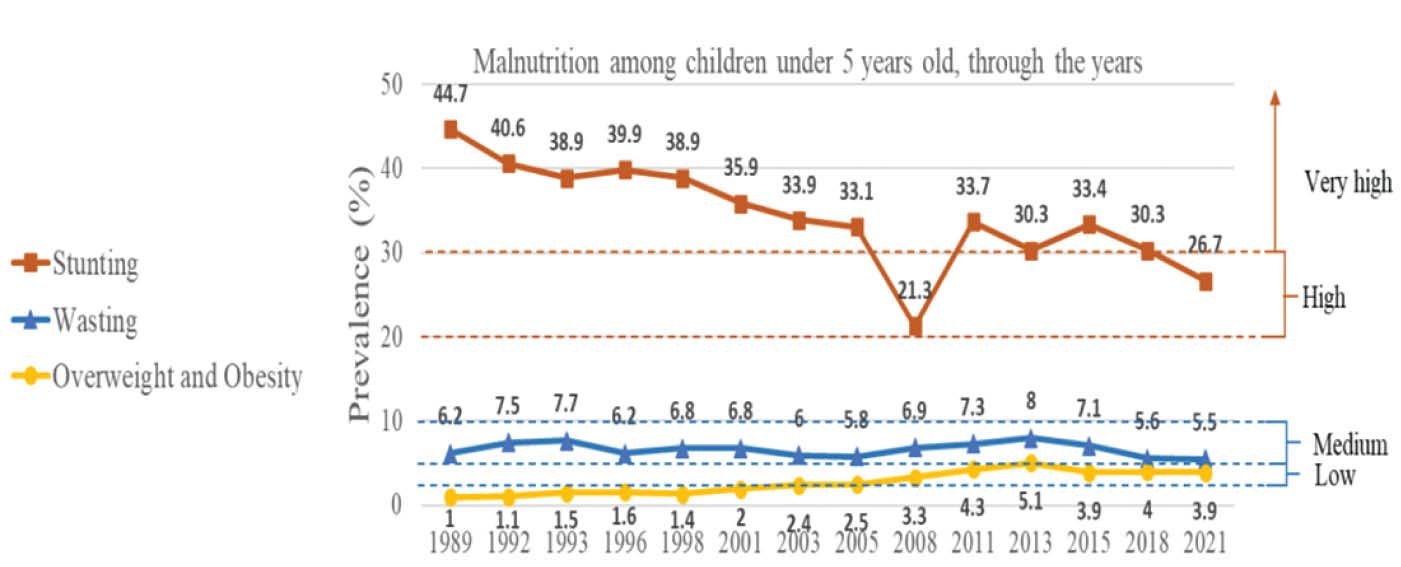
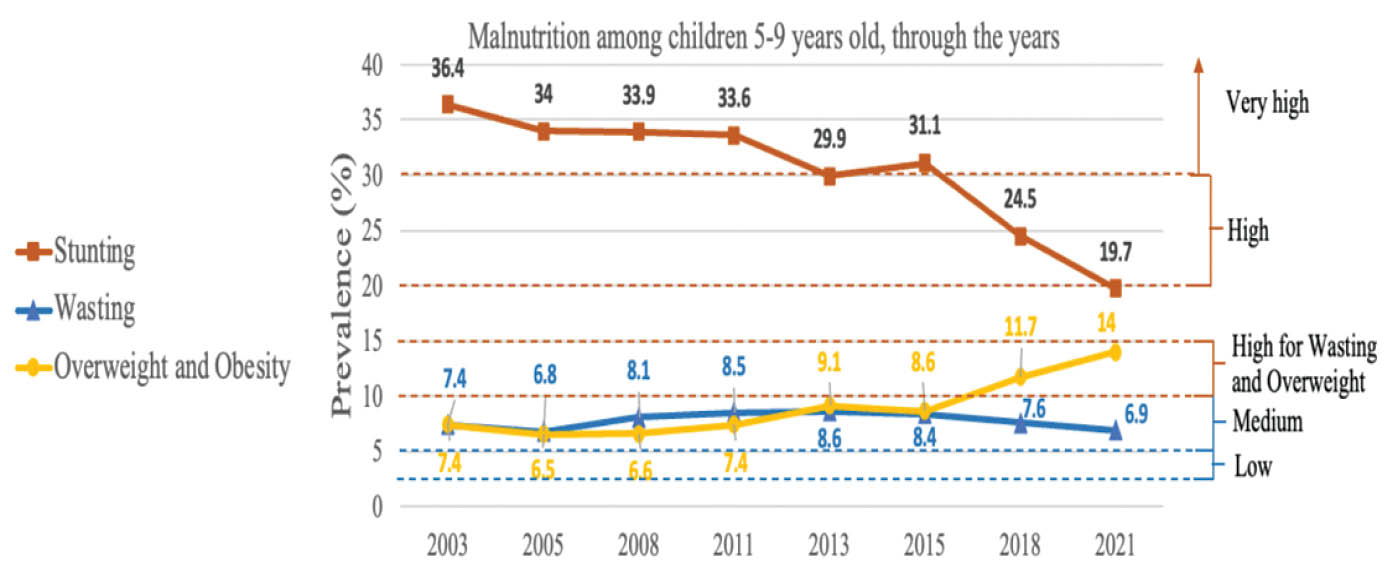
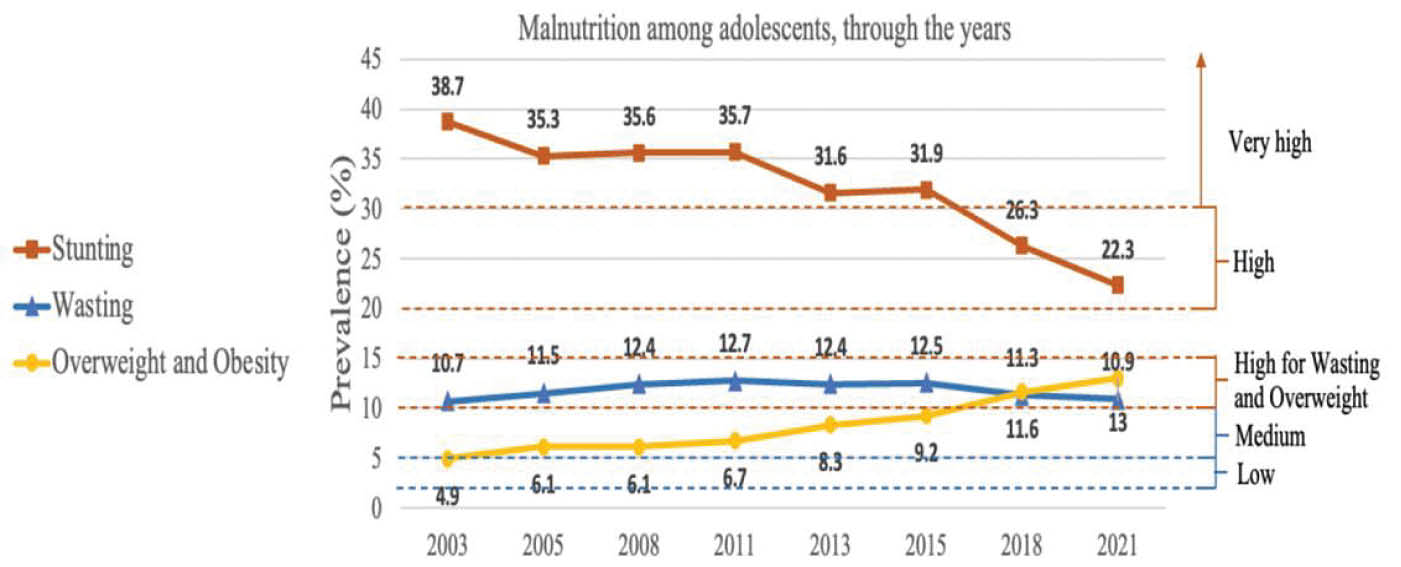
Here are three figures from the Philippine Plan of Action for Nutrition (PPAN) 2023-2028 that illustrate the trends in both under- and overnutrition among infants, young children, and adolescents.

For more than two decades now, we have failed to make meaningful progress in eradicating wasting among our under-five children. Stunting prevalence has declined but is still considered “high” by the definition of the World Health Organization. In addition, we see an alarmingly rapid rise in the prevalence of overweight and obesity among school-age children (five- to nine-year-olds), from 8.6% in 2015 to 14% in 2021. A similarly stagnant prevalence of wasting, high prevalence of stunting and rising prevalence of overweight/obesity are evident in our adolescents.

The irreversible impact of malnutrition on children and adolescents is of urgent concern. The consequences of malnutrition, particularly during the first 1,000 days of life, will continue to haunt them even through adulthood.

Undernourished young infants and children will likely grow up to be adults with difficulties in learning and forming right judgment, directly impacting their decision-making skills.

This translates to a life characterized not just by poor academic performance but also missed opportunities as these children struggle to learn income-generating skills. Hence, they grow up to be adults who are less productive than their healthier counterparts, leading to a significant decrease in their average income.

The impact of malnutrition is intergenerational. Children of poor and food insecure families grow into adolescents and adults ill-equipped to fight their way out of the oppressive chain of poverty. In turn, they may beget malnourished children who will most likely suffer the same fate. The question is, how much longer must this go on?

For the Philippines, the annual estimates of the staggering costs of inaction on stunting, anemia in children, women, and girls, low birth weight and exclusive breastfeeding have been made.5 Our children are struggling to learn basic academic skills such as reading and writing, science, and mathematics. We are the lowest ranking country in the Program for International Student Assessment (PISA) 2024, and we have always been below average since we joined the said assessment in 2018.

We suffer from $4.5 billion or about P240 billion worth of economic losses due to low productivity, morbidity, and premature deaths as a result of childhood malnutrition. Likewise, several cases of life and productivity loss in the Philippines are caused by inadequate nutrition and an unhealthy environment during childhood.

Resources allocated for the nutrition of our children must be increased to ensure adequate interventions are sustained, especially to meet the country’s performance target of hitting its 2030 Sustainable Development Goals of Zero Malnutrition. So far, the country has made little to no progress at all.

(In the next piece of this series, we will investigate what measures we might take in battling both under- and overnutrition in the First 1,000 Days more judiciously.)

11,000 Days. (Feb. 9, 2024). “Why 1,000 days.” Retrieved Dec. 4, 2024, from https://thousanddays.org/why-1000-days/

2Yale School of Public Health. (n.d.). “Developmental origin health & disease.” Yale School of Public Health. Retrieved Dec. 4, 2024, from https://ysph.yale.edu/public-health-research-and-practice/department-research/environmental-health-sciences/developmental-origin-of-health-and-disease

3Moore, T.G., Arefadib, N., Deery, A., & West, S. (2017). “The First Thousand Days: An Evidence Paper.” Parkville, Victoria; Centre for Community Child Health, Murdoch Children’s Research Institute.

4Barker, D.J.P. (2012), as cited in Moore, T.G., Arefadib, N., Deery, A., & West, S. (2017). “The First Thousand Days: An Evidence Paper.” Parkville, Victoria; Centre for Community Child Health, Murdoch Children’s Research Institute.

5Jain, S., Ahsan, S., Robb, Z., Crowley, B., & Walters, D. (2024). “The cost of inaction: a global tool to inform nutrition policy and investment decisions on global nutrition targets.” Health Policy and Planning, 39(8), 819-830. https://doi.org/10.1093/heapol/czae056


Ma. Dhelyn Dela Cruz and Rosheic Sims are researchers and communicators for the fiscal and health policy team at Action for Economic Reforms (AER). Dr. Maria Asuncion Silvestre is a World Health Assembly Laureate (2023), recipient of the United Arab Emirates Health Foundation Prize, and the founding president of Kalusugan ng Mag-Ina (KMI).

CTA orders P109-M refund for OceanaGold

OCEANAGOLD.COM

THE COURT of Tax Appeals (CTA) has partially granted a refund to OceanaGold Philippines, Inc., amounting to over P109 million, covering the four taxable quarters of 2019 and representing the portion of the company’s valid input value-added tax (VAT) linked to its substantiated zero-rated sales.

The tax court’s first division, through a ruling published on Nov. 29, ordered the Bureau of Internal Revenue (BIR) to refund P109,643,347.55 to the mining company, which originally sought P133,671,461.36.

OceanaGold argued that the P133 million was the total amount of excess and unutilized input VAT it had accumulated from its purchases of goods and services attributable to zero-rated sales for the first to fourth quarters of 2019.

The BIR initially refused to accept OceanaGold’s claim, arguing that the company had outstanding tax liabilities.

The Court ruled that this was not a valid reason to deny the claim because the outstanding tax liability was still being disputed in court and had not yet become a delinquent account.

“When the claim for refund has a clear legal basis and is sufficiently supported by evidence, as in the present case, then the Court shall not hesitate to grant the refund,” Associate Justice Jean Marie E. Bacorro-Villena penned in a 43-page ruling.

It also found that OceanaGold had properly substantiated its claim for input VAT with the required documentation.

However, the court only recognized P6,608,397,449.29 of OceanaGold’s declared zero-rated sales due to issues with supporting documentation for some of its sales.

The remaining sales lacked sufficient documentation to prove that the goods were shipped to foreign countries and paid for in acceptable foreign currency.

The company is a VAT-registered entity engaged in the sale of minerals, which are zero-rated under Philippine tax law.

In partially granting the refund, the tax court said OceanaGold had timely filed both its administrative and judicial claims.

The company filed its administrative claim with the BIR on May 11, 2021, and its judicial claim with the CTA on May 31, 2021. This was within the two-year statutory deadline for filing such claims.

Presiding Justice Roman G. Del Rosario issued a dissenting opinion, arguing that OceanaGold’s claim should have been denied entirely because the company failed to comply with the invoicing requirements for zero-rated sales.

Mr. Del Rosario said that all of OceanaGold’s invoices lacked the required phrase “zero-rated sale,” making them ineligible for a refund. — Chloe Mari A. Hufana

HMPH completes donation of 4 H-100s to DSWD

From left are Department of Social Welfare and Development (DSWD) Assistant Regional Director for Operations Bienvenido Jr. Barbosa, DSWD Assistant Regional Director for Administration Benchie Gonzales, DSWD Regional Director Atty. Michael Joseph Lorico, Hyundai Motor Philippines (HMPH) President Jiho Son, HMPH Managing Director Cecil Capacete, and HMPH Chief Finance Officer Hongshik Chin. — FROM HYUNDAI MOTOR PHILIPPINES

HYUNDAI MOTOR PHILIPPINES, INC. (HMPH) recently turned over two additional H-100 units to the Department of Social Welfare and Development (DSWD) NCR field office -— upping its total of donated units to the office to four. These are expected to help support the DSWD’s relief response operations, especially given the Philippines’ susceptibility to natural disasters. The ceremony, held at the DSWD Sanctuary Center, Mandaluyong City, is “a testament to the brand’s commitment to providing mobility solutions to all Filipinos,” said HMPH in a statement.

HMPH President Jiho Son, HMPH Managing Director Cecil Capacete, and HMPH Chief Finance Officer Hongshik Chin attended the turnover ceremony, where they entrusted the vehicles to DSWD officials led by DSWD Regional Director Atty. Michael Joseph Lorico, DSWD Assistant Regional Director for Administration Benchie Gonzales, and DSWD Assistant Regional Director for Operations Bienvenido Jr. Barbosa.

“Last year, we donated two H-100 units to support DSWD’s disaster response and management, and outreach operations. And today, we continue to show our support through the additional units we will be handing over. This donation not only fortifies our partnership, but especially Hyundai Motor’s journey towards its vision, ‘Progress for Humanity,’” said Mr. Son. “We are honored to be in partnership with DSWD which continuously aims to uplift the lives of Filipinos.”

For more information, visit https://www.hyundai.com/ph. For more news and updates, follow HyundaiMotorPhilippines on Facebook and Instagram.

US elections, rate cuts, RRR reduction rock the markets in Q3

LIVE RICHER-UNSPLASH

By Charles Worren E. Laureta

UNITED STATES presidential elections, policy rate cuts, and reserve requirement ratio’s (RRR) reduction rocked the Philippines’ financial markets in the third quarter.

The Philippine Stock Exchange Index (PSEi) – the country’s barometer for the stock market — closed at 7,272.65 in the third quarter, a 13.4% increase quarter on quarter, while the index also inched up by 15.1% from 6,321.24 finish in the third quarter last year.

On the other hand, the peso closed at P56.03 against the dollar in the third quarter, appreciating by 4.4% from the second quarter’s P58.61 to a dollar. Year on year, the local unit strengthened by 1% from P56.58 finish in the third quarter last year, according to data from Bankers Association of the Philippines.

Meanwhile, demand for Treasury bills (T-bills) auctions saw a total subscription reaching to P796.53 billion with P293 billion total offered amount in the third quarter.

Moreover, the oversubscription of P503.57 billion was higher than the P401.43 billion in the second quarter.

The demand for Treasury bonds (T-bonds) inched up to P896.18 billion from P611.84 billion in the second quarter. This demand was also higher than the aggregate offered amount of P370 billion in the third quarter.

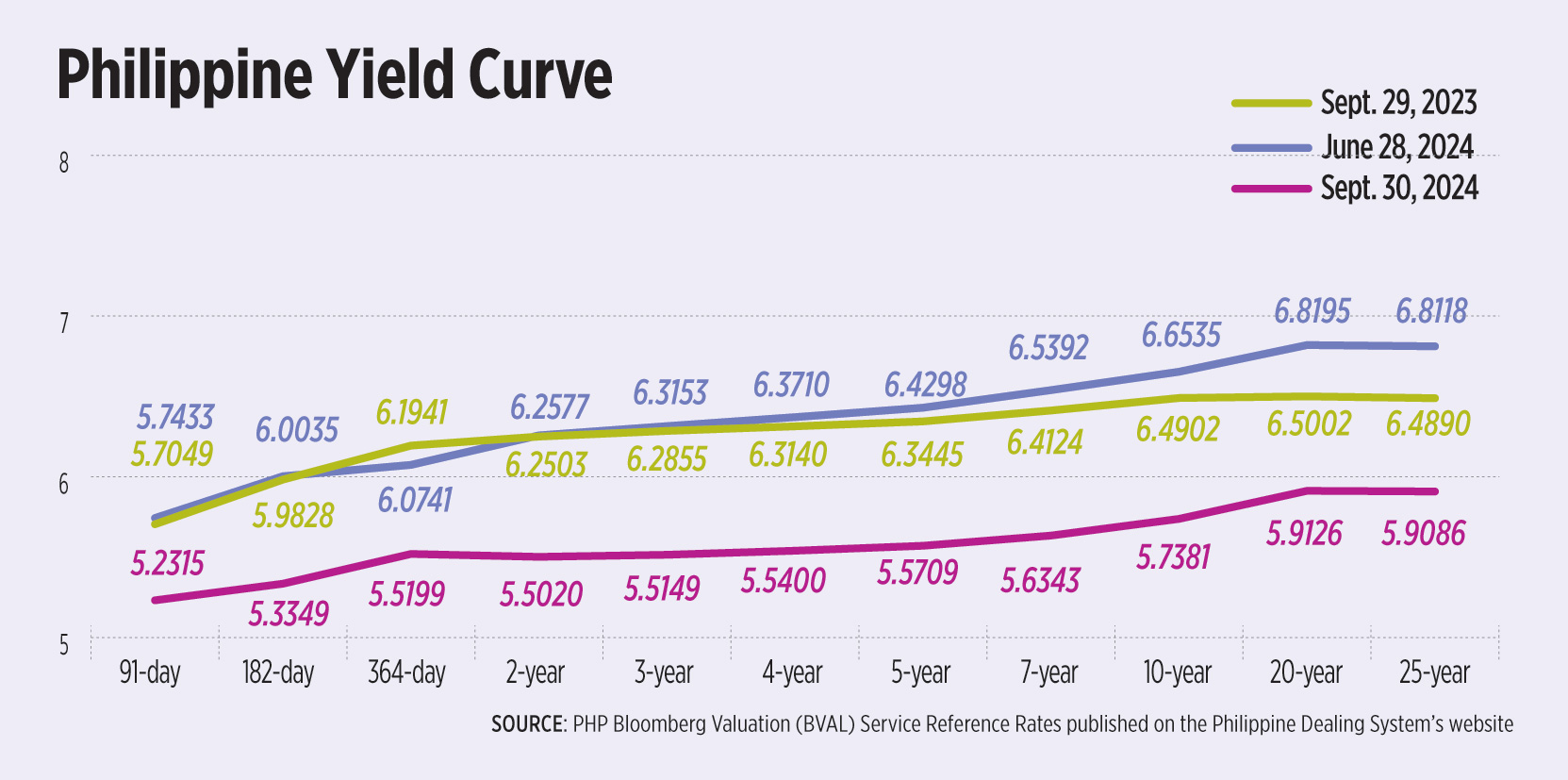
At the secondary bond market, domestic yields decreased by 78.28 basis points (bps) on a quarterly average, according to the data from the PHP Bloomberg Valuation (BVAL) Service Reference Rates on the Philippine Dealing System’s website.

The yields also inched down by 68.73 bps on a year-on-year basis.

The Bangko Sentral ng Pilipinas (BSP) said that the US Federal reserve decision to cut the policy rate by 50 bps last September affected the movement of the financial market in the third quarter.

“For third quarter 2024, local financial markets have shown signs of recovery. This recovery was underpinned by the US Federal Reserve’s decision to reduce its policy interest rate by 50 bps in September, supported by indications of moderation in US economic activity, an improving inflation environment, and easing labor market conditions,” the Philippine central bank said.

Michael L. Ricafort, chief economist at Rizal Commercial Banking Corp., said in an e-mail that the Federal Reserve cut that could be matched locally would lead to a lower financing and borrowing cost, resulting to a higher demand for loans and credit that would bring more investments, global trade, employment, and other business and economic activities, leading to a faster gross domestic product (GDP) growth.

“The BSP started lowering policy rate reducing borrowing costs by a total of 50 bps since August boosting fixed-income markets by supporting bond prices, but the rate cuts were cautious due to inflation concerns, meaning limited immediate impact on equities,” John Paolo R. Rivera, senior research fellow at Philippine Institute for Development Studies (PIDS), said in a Viber message.

Last August, BSP cut the target reverse repurchase (RRP) rate by 25 basis points (bps) to 6.25% from over 17-year high of 6.5% for the first time in four years amid improving inflation outlook.

A month later, the Federal Reserve cut interest rates by half of a percentage point, kicking off what is expected to be a steady easing of monetary policy with a larger-than-usual reduction in borrowing costs that followed growing unease about the health of the job market, according to Reuters report.

The BSP made another 25-bps interest rate cut last October, since the price pressures remains manageable, according to BSP Governor Eli M. Remolona, Jr.

Meanwhile, Nicholas Antonio T. Mapa, senior economist at Metropolitan Bank & Trust Co., said that the US elections impacted the financial market, alongside with Federal Reserve policy stance, and tension in the Middle East and North African region.

Sunny Liu, lead economist at Oxford Economics’ Macro Forecasting and Analysis, said that the US elections had significant impact on Philippine financial market.

“For example, the peso has been under pressure since October, and Trump’s victory sent the peso to near-historical lows. Also, the 10-year government bond yield increased during the same period. These movements were largely due to market expectations regarding the US rate outlook in response to Trump’s likely fiscal stimulus and tariff plans,” Ms. Liu said in an email.

US President-elect Donald J. Trump recaptured the White House with a sweeping victory as tens of millions of Americans looked past his criminal charges and divisive rhetoric to embrace a leader who, if he carries out his campaign promises, will test the limits of presidential power.

Moreover, BSP said that the uptrend in financial markets were driven by BSP’s decision to reduce the policy rate by 25 bps and the announcement of a 100- to 250-bps reduction of the banks’ RRR, effective on Oct. 25.

“Another unique positive factor for the Philippines: latest cut in banks’ RRR announced on Sept. 20, 2024, effective Oct. 25, 2024 that infused about P400 billion into the financial system that would increase banks’ loans, investments such as in bonds and fixed income instruments, equities and stocks, and other investments; there would also be more pesos in the banking system that could be used to purchase US dollar and other foreign currencies.” Mr. Ricafort said.

Last September, BSP announced that it would reduce the RRR for big banks and nonbank financial institutions with quasi-banking functions by 250 bps to 7% from 9.5% on Oct. 25.

This will also reduce the ratio for digital banks by 200 bps to 4%; thrift banks by 100 bps to 1%; and rural banks and cooperative banks by 100 bps to 0% to promote better pricing for financial services and lower intermediation costs.

INDICATORS TO WATCH FOR
BSP said that developments in the timing and pace of US monetary policy easing, results of the US presidential elections, prospects on global economic growth, and geopolitical concerns are expected to influence movements in domestic financial markets in the last quarter of 2024 and next year.

Mr. Mapa also said that investors will be trained on president-elect Trump’s economic and geopolitical impact on the world economy, after recapturing the White House.

“The Federal Reserve’s policy stance will still be in focus with the Trump win set to impact the targeted path for Federal Reserve policy,” Mr. Mapa said in an e-mail.

Mr. Ricafort said that market players should look into possible protectionist policies by Mr. Trump.

“Higher US inflation: amid possible more protectionist policies and trade war that could lead to higher tariff rates on imports from China and other countries, tighter immigration rules that could increase US labor costs,” Mr. Ricafort said.

“Of course, all eyes are on what Trump will do and how it will affect global trade in general,” Kervin Laurence Sisayan, head of research at Maybank Securities Philippines, Inc. said in an e-mail.

Last November, the Federal Reserve cut interest rates by a quarter of a percentage point as its policy makers began taking stock of what could become a more complex economic landscape when President-elect Donald Trump takes office next year, according to Reuters report.

Mr. Sisayan also said that market players should look into further rate cuts that could lead to the movement of the peso.

“I think exchange rate developments will be a key indicator for market players to watch for the rest of the year. If the peso continues to depreciate significantly, it could raise concerns for the BSP in considering future rate cuts,” Ms. Liu said.

On Nov. 21, the peso hit a record-low of P59-a-dollar level for the first time in more than two years.

This marked the first time the peso returns to the P59 level against dollar since Oct. 17, 2022, as dollar continued its rally.

RATE CUT
Mr. Mapa said that BSP will continue its rate-cutting cycle in the future with inflation expected to stay within target this year, next year, and in 2026.

“There is little in the bag to justify keeping rates at these elevated levels,” Mr. Mapa said.

For Mr. Ricafort, the BSP could still match future Federal Reserve rate cuts, provided that local inflation remains within the BSP target of 2-4%, and the US dollar and peso exchange rate remains stable.

“We still expect BSP to continue its easing cycle since we expect inflation to remain within the target range 2-4%,” Ms. Liu said.

“Although headline inflation began easing in third quarter, it remained elevated due to typhoons, high food and energy costs. Persistent inflation kept bond yields high, as investors sought compensation for inflation risk, impacting fixed-income securities,” Mr. Rivera said.

BSP said that it will continue to shift to a less restrictive monetary policy due to well-anchored inflation expectation and within-target inflation outlook.

“Given the usual lags of monetary policy transmission, we are now paying closer attention to what may happen in 2025 and 2026. We remain mindful of the upside risks to inflation,” BSP said.

The central bank also inclined to reduce the policy rate at a measured pace to facilitates a smoother transmission of monetary policy to market interest rates.

Although Mr. Remolona already signaled the possibility of another 25-bp cut at the monetary board’s last meeting for the year on Dec. 19, he said that a 50-bp cut was unlikely since it is too aggressive.

FIXED-INCOME MARKET
Mr. Ricafort: One of the biggest market catalysts for third quarter 2024 are the first rate cuts in nearly four years by the BSP (by -0.25 on Aug. 15, 2024 and another -0.25 effective Oct. 17, 2024) and also by the US central bank/Federal Reserve (by -0.50 on Sept. 18, 2024 and another -0.25 effective Oct. 17, 2024) that led to gains in the local and US/global financial markets; as Federal Reserve rate cuts that could be matched locally would lead to lower financing costs/borrowing costs that would lead to higher demand for loans/credit that, in turn, would lead to more investments, global trade, employment, and other business/economic activities, thereby leading to faster GDP/economic growth.

Mr. Mapa: [We] Should see the yield curve steepen slightly with shorter dated yields easing on projected BSP rate cuts.

EQUITIES MARKET
Mr. Ricafort: The markets recently priced in Trump US presidency with possible protectionist policies and appointments that could lead to trade wars especially with China and could slow down global trade and overall economic growth, higher tariffs on US imports from China and other countries as well as tighter immigration rules could lead to higher US inflation, thereby could lead to few Federal Reserve rate cuts; amid some cautious signals from most Federal Reserve officials recently on future Federal Reserve rate cuts; net foreign selling in the local stock market over the past three weeks.

Mr. Sisayan: We have an optimistic outlook that Philippine Equities will do well next year on a backdrop of easing inflation, declining rates and steady consumer domestic growth. It also helps that Philippine valuations are attractive at current levels.

FOREIGN EXCHANGE MARKET
Mr. Ricafort: The markets continued to price in Trump US presidency with possible protectionist policies and appointments that could lead to trade wars especially with China and could slow down global trade and overall economic growth, higher tariffs on US imports from China and other countries as well as tighter immigration rules could lead to higher US inflation, thereby could lead to few Federal Reserve rate cuts; amid some cautious signals from most Federal Reserve officials recently on future Federal Reserve rate cuts.

Mr. Mapa: Philippine peso to stay pressured during bouts of risk off episodes connected to Donald Trump’s projected tariffs. Philippine peso should also face pressure on renewed Dollar demand as private investment recovers now that the BSP has started to ease.

Ms. Liu: Regarding the foreign exchange market, we expect the peso to depreciate further against the USD, given that the dollar is expected to be supported by higher long-term yield in the US.


Seiko No. 5

IN JAPAN, the number five represents luck, harmony, and stability due to its associations with the five classical elements of East Asian culture: water, wood, metal, fire, and earth. Seiko in the Philippines is releasing its fifth Philippines-only watch, and it’s for a good cause too, possibly multiplying their luck to the power of five.

The fifth member of the Seiko Philippine Limited Edition series highlights the Whiskered Pitta, a bird residing in the Sierra Madre mountain range (though they could be found elsewhere in the country). With vivid plumage and a distinctive call (local peoples in North Luzon call it the Kungkong from the sound it makes), it’s currently listed as Near Threatened by the International Union for Conservation of Nature (IUCN) Red List.

Previous iterations of the Seiko Philippine Limited Edition series pay tribute to the Tubbataha Reefs, the Philippine Sunrise, the Philippine Eagle, and the Banaue Rice Terraces; the first one was launched in 2020.

The new watch was introduced via a dinner at Rockwell’s Balmori Tent on Dec. 2. It is powered by the 6R35 automatic movement, which offers a generous 70-hour power reserve and precise timekeeping with a daily accuracy of +25 to -15 seconds. The 39.5 millimeter stainless steel case is complemented by a sapphire crystal with an anti-reflective coating, ensuring clarity and durability, while the LumiBrite on the hands and indices enhances visibility in low-light conditions. Water-resistant up to 200 meters and featuring a rotating compass inner ring and screw-down crown, this watch is built to withstand any environment. The calfskin strap adds a refined touch, while the three-fold clasp with push-button release ensures a comfortable, secure fit.

Karl Dy, president and chief executive officer of Seiko Philippines, told BusinessWorld in an interview about the details of the watch that specifically reflect the bird and the Sierra Madre. Red and blue markers on the dial represent the bird, while the gradient brown color of the watch’s face reflects the soil of the Sierra Madre.

The Japanese parent company was “very much involved” with the design, Mr. Dy said. While the theme was selected by the parent company, Mr. Dy said, “We partnered with them, and we offered our theme, the Sierra Madre. From there, they created this watch.”

“We explained what the Sierra Madres (means) for our country. It’s our backbone. It protects our country from monsoons, from typhoons,” he said. “We also explained that the Whiskered Pitta is a bit endangered already.”

A certain portion of the proceeds from the watch (it costs P54,000) goes towards their partnership with Fostering Education & Environment for Development, Inc. (FEED). Asked about the exact amount that goes towards the non-government organization, Mr. Dy said, “Enough to plant one tree per watch: whatever that takes. I don’t have the figures right now.” This is their second time to partner with FEED, with 1,150 trees planted previously in the Sierra Madre, part of the organization’s rehabilitation and reforestation efforts in the mountain range.

There are only 1,288 of these watches in the world (available for preorder) — even the number of the pieces relates to luck. Mr. Dy said there were originally 1,300 watches slated for release, but, “88 for the Chinese symbolizes very lucky, or good health.”

To learn more about this and the other watches in the line, visit any Seiko Boutique nationwide. There are branches located at the Power Plant Mall, SM Aura, Glorietta 1, SM Megamall, SM North EDSA, SM Seaside, Mitsukoshi BGC, Ayala Malls Manila Bay, SM City Cebu, Ayala Center Cebu, Evia Lifestyle Center, and The Mall | Nustar. To shop online and for more information, head to https://shop.seikoboutique.com.ph/ or follow @SeikoPhilippines on Instagram and @official.seikophilippines on Facebook. — Joseph L. Garcia

Fed seen poised to cut interest rates this month

REUTERS

CHICAGO/PALO ALTO, California — Federal Reserve officials appear on track to cut interest rates this month after data showed the US labor market remained strong but continued to cool in November, even as debate emerged over a possible pause to rate cuts in the new year.

US employers added 227,000 jobs last month, a rebound from a hurricane-impacted slowdown in October, but the unemployment rate ticked up to 4.2%, the Labor Department’s monthly employment report showed on Friday.

Over the last half-year average monthly job gains are below 150,000, short of what some policymakers feel is needed to provide enough work to match a growing population, but nothing like the collapse Fed policymakers worried could happen when they began cutting interest rates a few months ago.

A number of Fed policymakers speaking on Friday said they saw rates continuing to come down, while injecting a note of caution on the pace.

San Francisco Fed President Mary Daly said the fresh figures show the labor market is in a good position. And while she indicated no discomfort with another rate cut this month, she said that once the policy rate is closer to where it will settle, she would take “a more thoughtful and cautious approach” on further rate cuts. Ms. Daly has previously said she views 3% as where short-term borrowing costs may need to end up.

Chicago Fed President Austan Goolsbee also said he expects that by next year “rates are going to be a fair bit lower than where they are today,” with the Fed feeling its way to a stopping point for rate cuts.

Beth Hammack, in her first major policy speech since taking the helm of the Cleveland Fed in August, said she too feels rates need to come down over time, but that given still-elevated inflation and a healthy labor market, “we are at or near the point where it makes sense to slow the pace of rate reductions.”

Traders after the jobs data put the probability of a rate cut at the Fed’s Dec. 17-18 policy meeting at 85%, up from less than 70% before the release of the report, and added to bets that short-term borrowing costs will drop another 75 basis points next year — a slower pace than Fed officials anticipated in a September set of economic projections.

Those projections will be updated at the December meeting.

A quarter-percentage-point reduction this month would bring the Fed’s policy rate to the 4.25%-4.5% range, a full percentage point below where it was in September when the central bank began its easing cycle.

“It’s not exactly a wonderful economy, but it’s also an economy that doesn’t seem to be decelerating as sharply as everyone expected a few months ago,” TD Securities analyst Gennadiy Goldberg said, citing the average payroll growth of about 150,000 jobs in recent months. “The Fed can safely deliver another rate cut in December and then maybe communicate a possible pause coming as soon as the January meeting.”

Fed Governor Christopher Waller at the start of last week said he was “leaning towards” a rate cut but would reserve final judgment to review the latest jobs numbers as well as inflation data due next week.

‘PROCEED CAUTIOUSLY’
On Wednesday, Fed Chair Jerome Powell repeated his prior comments that the central bank could be careful in managing the endgame of its roughly three-year fight against inflation.

Powell’s caution may come more into play next year, with many analysts expecting the Fed to pause the easing after delivering a cut on Dec. 18.

At least one of the Fed chief’s colleagues may prefer a nearer-term breather.

“I continue to see greater risks to the price-stability side of our mandate, especially when the labor market continues to be near full employment,” Fed Governor Michelle Bowman told the Missouri Bankers Association Executive Management Conference. “I would prefer that we proceed cautiously and gradually in lowering the policy rate, as inflation remains elevated.” — Reuters

Coconut output likely flat next year amid aging trees

MICHAEL LOUIE-UNSPLASH

By Adrian H. Halili, Reporter

PHILIPPINE COCONUT production gowth is likely to be flat next year given low yields from the country’s aging trees, an industry player said.

“We estimate coconut production to stay at the levels similar to previous years as efforts to improve productivity will take time to bear fruit,” Romeo I. Chan, Axelum Resources Corp. chairman and chief executive officer, said in an e-mailed reply to questions.

Philippine coconut output has steadily decreased in recent years as most of the country’s fruit-bearing trees are now too old. Coconut and its by-products remain the country’s top agricultural export.

The volume of coconut production hit 14.89 million metric tons (MT) in 2023, slightly lower than 14.93 million MT a year earlier, according to data from the Philippine Statistics Authority.

“At present, the most evident challenges are the low productivity of coconut trees and inadequate infrastructure support,” Mr. Chan said. “Senile trees, weather disturbances and climate change have led to declining harvest yields over the years.”

Last year, President Ferdinand R. Marcos, Jr. ordered the Philippine Coconut Authority (PCA) to draft a plan to rehabilitate the coconut industry, including planting 100 million coconut trees by 2028.

Among the agency’s rehabilitation plan seeks to address the advanced age of the nut-bearing trees. The agency is seeking to replant about 8.5 million coconut trees this year.

Under the Philippine Coconut Industry Development Plan 2024-2034, the replanting project is expected to increase coconut output by 4.7 billion nuts annually worth P33.1 billion by 2034.

In 2025, the PCA aims to replant 15.3 million trees, followed by 25.4 million yearly between 2026 and 2028.

Mr. Chan said the government’s replanting goal could be reached if the state and private sector work together.

“In addition, the absence or lack of development in coconut regions has increasingly contributed to it being one of the most marginalized sectors, with coconut farmers considered among the poorest in the country,” he added.

Mr. Chan said the struggling industry could be boosted with the appropriate use of the coco levy fund.

In 2021, Republic Act No. 11524 or the Coconut Farmers and Industry Trust Fund Act signed by then President Rodrigo R. Duterte mandated the creation of a fund that places coconut levy assets to a trust fund that will finance the rehabilitation and modernization of the industry.

“The proper utilization of the coco levy fund will be critical to help modernize the coconut industry, reinforce capabilities of smallholder farms and uplift coconut farming communities,” he said.

The law also calls on the Bureau of the Treasury to transfer P10 billion to the trust fund, another P10 billion in the second year, P15 billion in the third year, another P15 billion in the fourth year and P25 billion in the fifth year.

Axelum is a Philippine Stock Exchange-listed manufacturer and exporter of coconut products.

Megawide PCS showcases innovative construction solutions at Philconstruct 2024 

Megawide Construction Corporation (“Megawide” or the “Company”), through its Precast and Construction Solutions (“Megawide PCS” or the “Unit”) unit, made another strong impression at the Philconstruct 2024 Expo, held at the World Trade Center and SMX Convention Center from Nov. 7 to 10, 2024.

“Our participation in Philconstruct 2024 represents our mission to provide First-World construction solutions that elevate industry standards,” said Markus Hennig, Executive Vice-President for Precast and Construction Solutions. “With these innovations, we aim to address the growing demand for faster, safer, and more sustainable construction practices in the country.”

The event, attended by delegates and exhibitors, is the largest construction trade show in the Philippines and brings together industry leaders, market innovators, and key stakeholders to showcase new technologies and state-of-the-art solutions that help shape the future of construction.

The Megawide PCS Team – represented by the Unit’s Commercial and Sales team and leads of Precast, Formworks, Ready-Mixed Concrete, and Construction Equipment, Logistics and Services (CELS) – joined the four-day event for the third consecutive time and highlighted its proprietary brand of precast technology that redefines efficiency, durability, and sustainability in construction.

Specifically, the PCS booth offered product brochures and technical talks from officers on site and even invited attendees to explore and learn about the solutions they offer, emphasizing on the Company’s long-term commitment to driving engineering excellence and innovation in Philippine construction. Over 800 attendees signed up at the booth from day one to day four.

It was also an opportunity for the Megawide PCS team to share insights on the company’s expanding portfolio of large-scale infrastructure projects, including the Paranaque Integrated Terminal Exchange (PITX), Mactan-Cebu International Airport (MCIA), Malolos-Clark Railway Project (MCRP) and the Metro Manila Subway Project (MMSP) Contract Package 104 as well as supply contracts for portions of the Skyway and MRT-7 projects.


Spotlight is BusinessWorld’s sponsored section that allows advertisers to amplify their brand and connect with BusinessWorld’s audience by publishing their stories on the BusinessWorld Web site. For more information, send an email to online@bworldonline.com.

Join us on Viber at https://bit.ly/3hv6bLA to get more updates and subscribe to BusinessWorld’s titles and get exclusive content through www.bworld-x.com.

Reverse psychology marketing

PATAGONIA.COM

Can you imagine an ad for an expensive jacket, boldly telling its target buyers, “Don’t Buy This Jacket”?  Beside the handsome blue sports jacket are the admonitions: Reduce — don’t buy what you don’t need; Repair — we help you repair your old jacket; Re-use – sell or pass on your old gear; Recycle — we take back your old jackets.

Patagonia, a leading American outdoor clothing brand, launched a campaign on Black Friday in the run-up before the Christmas 2011 shopping rush, urging consumers not to buy their jacket.   Despite their “efforts” not to sell, sales increased by approximately 30% in the nine months following the ad. What gives?

The Knowledge Hub (KH of the Circle Economy group) made a business case study of this marketing phenomenon. “With this ad, the company aspired to raise consumer awareness regarding the consequences of over-consumption, especially in the textile industry… each piece of Patagonia clothing — despite being made from recycled materials — emits far more greenhouse gas (GHG) than it weighs, in addition to increased use of freshwater for production purposes.”

People were made aware that Patagonia was admittedly contributory to the environment issues but was zealously improving its products to lessen environmental damage. “Don’t buy this jacket!” Consume (buy) only what you need. This counter-intuitive move within the context of a business environment brought the company increased revenues, but only because the company is indeed acting upon its mission of being a sustainable company. Patagonia has shown its success of adherence to sustainability principles through growth levels in their top line, margins, and market share, the case study concluded.

But some observers say Patagonia used clever reverse psychology marketing to achieve its revenue goals while keeping its image of being a fierce advocate for environmental sustainability. Wizard of Ads, a marketing and advertising company that offers services to help businesses strategize, calls the Patagonia ad a “breakthrough” in bold, effective marketing.  Advertising has three primary objectives: to inform, to persuade, and to remind. That, the Patagonia ad effectively did!

“By telling you NOT to buy the jacket, Patagonia is making your resistance work in their favor. You see the ad, and now you sort of want the jacket, just due to reactance. Plus, the unexpected headline really grabs attention and ensures the ad breaks through the clutter. Even better, Patagonia gets the added bonus of demonstrating their commitment to sustainable, eco-friendly business practices.” (wizardofads.org)

It’s called “reactance.” When someone tries to tell you what to think or do — that automatic resistance you feel is called reactance by psychologists (Ibid.). “An Empirical Study on Reverse Psychology Applied in Advertising Messages,” by the Asian Journal of Empirical Research (archive.aessweb.com) showed that this technique has been applied by marketers in advertising in which a negative message or tagline (e.g., “don’t buy the product”) is used to motivate consumers to make a purchase.

“Psychological reactance theory advocates that reactance occurs when people react to restore a freedom when it is eliminated or threatened to be eliminated. The expected response to an advertising message of not doing something is to do it.

“Results suggested that the application of reverse psychology in advertising enables marketers to create awareness and raise interest of consumers. It is also interesting to find out that 40.8% of subjects were uncomfortable with the messages but showed interest in them,” the study concluded.

Doctors and healthcare professionals warn that, “While it can be seen as a way of managing another person’s behavior, reverse psychology can also be used as a form of manipulation. The idea behind reverse psychology is that by pushing for the opposite of what you want, the other person will choose to engage in the behavior that you desire. The person who is the subject of this tactic generally doesn’t realize what is happening and may not be fully aware of the other person’s true motives (verywellmind.com, April 4, 2023).

Manipulation cannot be justified because it is untrue and insincere and violates the other person. “Yet even if you didn’t know it at the time, there’s a chance that you’ve used reverse psychology to try to get someone to do something at some point in your life. The most ordinary example is that of parents using reverse psychology to get their kids to do what they want them to do. A parent might tell their child not to pick up their toys in their room in the hope that the child will actually do the opposite (Ibid.).

Yes, reverse psychology is often used on children due to their high tendency to respond with reactance, a desire to restore threatened freedom of action. It is a negative emotional reaction to being persuaded and thus choosing the option which is being advocated against. This may work especially well on a person who is resistant by nature, while direct requests work best for people who are compliant (Psychology Today. Retrieved 2018-09-22).

Marketing and sales strategies often utilize reverse psychology to encourage people to buy goods and services. “Marketers’ understanding of consumer behavior has provided particularly valuable insights into voter behavior which is an important strand in the success of political marketing. As a theory, it has come a long way and holds a key position in the coming times” (“Political Marketing: an emerging theory,” Suman Si). Of course, political leaders obviously use marketing strategies “to inform, to persuade, and to remind” the public of their platforms and directions, and the “packaging” of their personas. In her book, The Political Marketing Game (2011), author Jennifer Lees-Marshment talks of “what works in political marketing, drawing on 100 interviews with practitioners.  It also shows that authenticity, values and vision are as much a part of winning strategy as market-savvy pragmatism.”

Is the self-induced, deafening political noise distracting the country from the Sisyphean task of catching up to regional economic development, a market-savvy strategy by opposing political leaders now preparing for the critical mid-term elections in 2025? Perhaps also laying the groundwork for the presidential elections in 2028?

“The feud between the Marcos administration and the Dutertes has been making headlines, deteriorating further after Vice-President Sara Duterte disclosed that she had asked someone to kill President Marcos, First Lady Liza Marcos, and Speaker Martin Romualdez if an alleged plot to assassinate her is carried out. Law enforcement agencies have launched probes to determine the Vice-President’s possible legal liability” (The Philippine Star, Nov. 29, 2024).

Tensions rose after former president Rodrigo Duterte called on the military to “correct” what he labeled a “fractured government,” a comment that the Justice department said was “bordering on sedition” (Ibid.). Star columnist Boo Chanco described how “the House quad comm hearings have taken the nature of a Netflix miniseries. The revelations were not shocking in the sense that they did not surprise us. We suspected as much all the while but we are now getting confirmation from some of the key people involved. Good thing the UniTeam broke up or all these would have remained secrets” (The Philippine Star, Oct. 18, 2024).

Sara Duterte seems masochistic and suicidal with her open cursing of President Ferdinand Marcos, Jr., and revealing how she has contacted hired killers to get him and his family if she were assassinated for fighting him. But her stance to the Filipino people seems to be — this is what I am, take me as I am. (So much like her father, Rodrigo Duterte.)  Maybe she is employing reverse psychology on the electorate — she wants to run for President after Marcos Jr.’s six year, no-reelection term. “Don’t vote for me” means “Vote for me,” for impressionable voters who elected her father the way he was, in 2016.

“Let us not impeach Sara Duterte,” Marcos Jr. surprisingly declared, in the face of two impeachments vs. VP Sara filed in House (Rappler, Nov. 29, 2024).

Was Marcos Jr. using reverse psychology to strongly suggest that Sara should be impeached?

Like, “Do not buy this jacket.”


Amelia H. C. Ylagan is a doctor of Business Administration from the University of the Philippines.

ahcylagan@yahoo.com

2 Jetour SUVs to be raffled off at Newport World Resorts

The Jetour T2 (left) and Dashing — PHOTO BY KAP MACEDA AGUILA

THE MARRIOTT Grand Ballroom at Newport World Resorts in Pasay City will be the venue of “The Grand Countdown to 2025,” a New Year’s Eve party that will feature the performance of celebrities Angeline Quinto, Jed Madela, Bamboo, and Bini.

Jetour Auto Philippines, Inc. (JAPI), the official event partner of Newport World Resorts for this event, will cap the countdown to 2025 with a grand raffle of two brand-new Jetour vehicles for two lucky audience members. Up for grabs is a Dashing compact crossover and a T2 4×4 SUV.

The Jetour Dashing is one of the pioneering vehicles when the brand began its operations in the Philippines in March 2023, and remains one of JAPI’s best-selling models. It features an ultra-modern design, high-tech features, luxurious interior amenities, and powerful yet efficient 1.5-liter turbocharged gasoline engine. The vehicle has been a favorite choice of young, passionate, and upwardly mobile individuals who maintain active lifestyles for themselves and their families.

Meanwhile, the T2 has been earning raves as a solid SUV that’s “ready to play, and play hard in any urban and outdoor setting.” The T2’s 2.0-liter Kunpeng TGDI gasoline-powered engine mated to the Magna 7DCT third-generation wet dual-clutch transmission with intelligent execution system generates up to 254hp and 390Nm. Managing the four-wheel-drive system is the XWD Intelligent 4WD. The Jetour T2 is available in Beyond, Terrain, and Terminator variants.

As part of JAPI’s ongoing partnership with Newport World Resorts, the latest Jetour models are also currently on display at strategic locations of the Newport World Resorts complex. Visitors and guests of Newport World Resorts now have the chance to get an up-close look at Jetour models.

RL Commercial REIT focusing on CBDs to expand portfolio

BUILDINGS at the Makati central business district are seen in this file photo. — PHILIPPINE STAR/ MIGUEL DE GUZMAN

GOKONGWEI-LED RL Commercial REIT, Inc. (RCR) said it is focusing on central business districts (CBDs), emerging business districts, and key locations nationwide as potential areas to expand its property portfolio.

“RCR’s principal investment strategy is to invest on a long-term basis in a diversified portfolio of income-producing real estate assets located in major CBDs, key locations, and urban areas across the country,” the company said in a stock exchange disclosure on Friday.

“The potential property should be located in a CBD, emerging business district, or in key locations across the Philippines, typically with high-growth potential and in proximity to various modes of public transport and major roads for enhanced accessibility to tenants,” it added.

RCR is the real estate investment trust (REIT) unit of Robinsons Land Corp. (RLC).

As of end-September, RCR’s portfolio consists of 29 commercial properties, of which six are located in the Bonifacio Global City, Makati, and Ortigas CBDs.

The remaining 23 assets are situated in 15 locations across the country.

RCR said the average occupancy of its leases is at 96% as of end-September, with “manageable lease expiries until 2027.”

Some of the properties under RCR’s portfolio include the 45-storey Robinsons Equitable Tower in Pasig City, the 37-storey Robinsons Summit Center in Makati City, the 28-storey Giga Tower in Quezon City, and the 20-storey Cyber Sigma building in Taguig City.

RLC previously infused 13 commercial assets worth P33.9 billion into RCR as part of expanding the latter’s portfolio. The Securities and Exchange Commission approved the transaction on Sept. 19.

The deal brought RCR’s gross leasable area to 828,000 square meters.

For the first nine months, RCR saw a 32% increase in net income to P4.27 billion as revenue climbed by 42% to P5.84 billion due to its asset infusion and steady occupancy rates.

On Dec. 6, RCR shares dropped by 0.51% or three centavos to P5.90 apiece, while RLC stocks rose by 0.73% or 10 centavos to P13.78 each. — Revin Mikhael D. Ochave