Home Blog Page 2259

Cop dead, 6 others hurt in Maguindanao road accident

COTABATO CITY — A police corporal died, while four of his companions and two crime suspects were injured in a highway accident in Barangay Gang in Sultan Kudarat, Maguindanao del Norte late Sunday.

Lt. Col. Esmael A. Madin, chief of the Sultan Kudarat Municipal Police Station, said on Monday that Cpl. Cairodin P. Rumidas, of the Buldon Municipal Police Station in Maguindanao del Norte, succumbed to injuries in a hospital where he and his companions and the two law offenders were brought by emergency responders for treatment.

Mr. Rumidas and his companions, driver Cpl. Baseron A. Aratuc, Patrolmen Diamalodin B. Esmail and Ismael A. Tagadaya, and Staff Sgt. Musa D. Calocop, were on their way home to Buldon from the laboratory in Cotabato City of the Police Regional Forensic Unit-Bangsamoro Autonomous Region. Within their custody were two crime suspects Jehar M. Panot and Saidin S. Panot, tested for use of illegal drugs.

Mr. Madin said Mr. Aratuc lost control of the wheel when the highway in Barangay Gang in Sultan Kudarat became slippery due to a sudden heavy downpour, causing the accident.

The patrol vehicle swerved with force towards the side of the highway and hit a house, according to Mr. Madin.

Brig. Gen. Romeo J. Macapaz, director of the Police Regional Office-Bangsamoro Autonomous Region, told reporters that they will provide the family of Mr. Rumidas with financial support and help facilitate his immediate burial according to Islamic tradition of burying the dead within 24 hours after death. John Felix M. Unson

Export council to downgrade 2025 targets

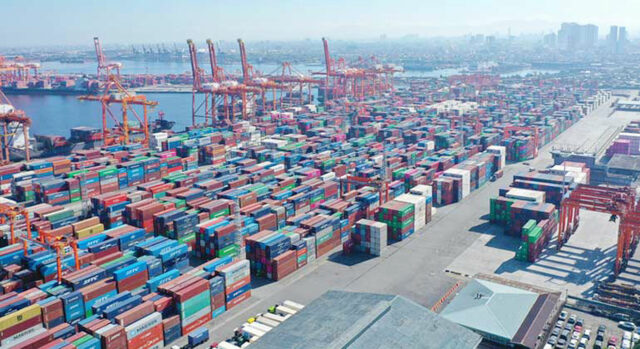
PHOTO COURTESY OF ICTSI

THE Export Development Council (EDC) said it will downgrade the export targets for 2025 and beyond contained in the Philippine Export Development Plan (PEDP).

“We are definitely revising it downward because of the many uncertainties in the global environment,” EDC Executive Director Bianca Pearl R. Sykimte told reporters on the sidelines of National Exporters Week.

“But we are quite optimistic with the Trump administration that hopefully it will provide us a window of opportunity to pursue a bilateral free trade agreement with the US,” according to Ms. Sykimte, who is also the Trade department’s Export Marketing Bureau director.

She said 2024 exports will miss the PEDP target for this year, which is $143.4 billion, but will exceed the $107 billion target set in the Philippine Development Plan (PDP).

“The PDP is the bottomline commitment of the exporting community to contribute to the overall plan,” she said.

The revised targets could be issued next year, she said.

She said electronic products could weigh on the overall performance of exports even when other products perform well.

“Coconut exports picked up, and actually a few other sectors grew significantly. But it is just that a big chunk of what we export are electronics. So whatever movement there is in that sector really defines the movement of the overall merchandise exports,” she said.

“But in services, we are still looking at double-digit growth,” she added.

Asked if the recently ratified Philippines-South Korea Free Trade Agreement (FTA) will have any bearing on export growth next year, she said, “The question is, would it be enough to pull up everything?”

“But based on the historical performance of our bilateral FTAs, right after the entry into force of the agreement, there is a trade surplus with that country,” she said.

The Philippine Statistics Authority reported exports of $55.67 billion in the nine months to September, up 1.1%.

Meanwhile, exports of services totaled $24.9 billion in the first half, up 11.4%. — Justine Irish D. Tabile

Government urged to fund crops other than rice

CHOOSEGUIMARAS FACEBOOK PAGE

THE Philippine Chamber of Agriculture and Food, Inc. (PCAFI) said that the government needs to fund more crops beyond rice, citing food sufficiency concerns.

In a briefing on Monday, PCAFI President Danilo V. Fausto said the Department of Agriculture’s (DA) budget has had too much of a focus on rice production.

“High-value crops have contributed 33% of the agricultural output in crops and rice is only 23%. Yet (we are) still pouring everything into rice,” He added.

For the DA budget of P200.19 billion, about P31.4 billion was allocated to the National Rice Program.

Funding to support rice farmers mainly comes from the Rice Competitiveness Enhancement Fund (RCEF), which is financed by tariffs collected on imported rice, as authorized by the Rice Tariffication Law of 2019 or Republic Act No. 11203.

“Pouring in money is welcome. But as we go and plant rice, and we always say we are rice-centric, we need to plant new food. We have to have new ways of planting our food and modernize,” he said.

He added that the tariffication law includes a provision that allows excess rice tariff collections to help rice farmers diversify into other crops.

“There’s so much (demand) for rice, and we cannot produce (all of it); therefore we will always be importing. We can produce high-value crops, but we have not given the budget to develop high-value crops,” Mr. Fausto said.

On Monday, President Ferdinand R. Marcos, Jr. signed Republic Act 12078 or the measure amending the Agricultural Tariffication Act, which tripled the annual allocation of RCEF to P30 billion and extended it until 2031.

Mr. Fausto said despite billions being earmarked to support rice production through RCEF, disbursement for mechanization remains slow.

“Anything additional to the budget of the DA is always welcome… The problem is in the implementation, and we need to look into that,” he added.

Meanwhile, Mr. Fausto said that irrigating rice planting areas remains a challenge due to the country’s geography.

“We are an archipelago. We cannot produce rice like India or Vietnam or Thailand. We are composed of islands and it’s difficult to irrigate,” he added.

He said that the average yield per hectare for rice remains below the yield targeted under RCEF.

Palay or unmilled rice production is expected to fall to 19.3 million MT this year due to the combined effects of the dry conditions brought by El Niño and the increased rainfall due to La Niña, according to the DA. — Adrian H. Halili

NFA Oct. palay procurement hits 123,561 MT

PHILIPPINE STAR/MIGUEL DE GUZMAN

THE National Food Authority (NFA) said on Monday that it procured 123,561 metric tons (MT) of palay, or unmilled rice, in October, equivalent to 2.47 million sacks of 50 kilograms each.

In a report, the NFA said the October procurement was 79.98% of its target of 154,497 MT.

“Increase in the procurement as compared to the preceding months can be attributed to the good harvest of the main cropping season and the implementation of the Council-approved Price Range Scheme (PRICERS) for palay procurement activity,” the NFA said.

The PRICERS program sets a buying range of palay per province at prices designed to be competitive against prices offered by traders.

The NFA had approved a price range of P23 to P25 pesos per kilogram of dry palay.

The NFA is targeting a palay inventory of 435,000 MT before the end of the year. It is required to maintain a rice reserve equivalent to about nine days’ demand.

As of Oct. 31, the NFA’s inventory of milled rice was 244,724.78 MT or 4.89 million sacks.

“It should be noted that NFA’s inventory is 9.10% of the national rice inventory,” it added.

The national rice inventory rose to 2.46 million MT in November, according to the Philippine Statistics Authority. — Adrian H. Halili

Asialink gets $115-M working capital boost backed by ADB to support SMEs

FREEPIK

THE Asian Development Bank (ADB) said it signed an agreement with Asialink Finance Corp. to help provide $115 million in working capital to support lending to small- and medium-sized enterprises (SMEs), with a focus on female-owned companies.

“The financing package consists of a $50-million loan from ADB, $50 million from HSBC through the HSBC ASEAN Growth Fund, and $15 million from Security Bank Corp.,” ADB said in a statement.

The ADB said this expected to increase Asialink’s total loans to SMEs from P8.8 billion (around $150 million) to around P13 billion, with more than half of the financing dedicated to SMEs that are women-owned.

It is expected to almost double Asialink’s female entrepreneur borrower network to at least 20,000 and introduce tailored offerings to female business owners.

“Nonbank financial institutions play a key role in providing services to unbanked SMEs. This partnership between ADB and Asialink will enhance SMEs’ access to finance, especially for women entrepreneurs who face greater challenges in obtaining capital,” ADB Vice-President for Market Solutions Bhargav Dasgupta said.

The financing gap for Philippine SMEs was estimated at around P67 billion to P180 billion, the ADB said, adding that half of the SMEs owned by men transact using bank accounts, compared to 24% of female-owned ones.

Additionally, 14% of SMEs led by men have received approval for bank loans, against 4% for female-led ones.

“This partnership with ADB marks a transformative milestone in Asialink’s mission to empower SMEs across the Philippines, especially women-owned businesses that remain underrepresented in the financial sector,” Asialink Finance Corp. Chief Executive Officer Robert B. Jordan, Jr. said.

Established in 1997, Asialink is a leading nonbank financial institution with 247 branches nationwide.

It offers secured lending to SMEs, accepting motor vehicles as collateral. SMEs account for more than half of its portfolio. — Aubrey Rose A. Inosante

Retailers see PHL attracting more visitors with VAT refund scheme

PHILIPPINE STAR/KRIZ JOHN ROSALES

THE Philippine Retailers Association (PRA) said the signing into law of the value-added tax (VAT) refund scheme for non-resident tourists will raise the Philippines’ competitiveness as a visitor market.

“We welcome the signing of the VAT Refund Scheme for Tourists. This should make us competitive in the tourism market considering we are the only Asian country not offering VAT refunds for tourists,” PRA President Roberto S. Claudio said in a statement on Monday.

He said the measure will result in improved visitor arrivals and spending.

“We would like to thank the President for recognizing this incentive to make the Philippines competitive in the tourism market, to make the retail industry more robust, and to make the Philippines a shopping destination,” he added.

President Ferdinand R. Marcos, Jr. on Monday signed into law Republic Act No. 12079, which allows tourists to claim VAT refunds on purchases worth at least P3,000 from government-accredited stores.

Previously, the House Committee on Ways and Means projected the VAT refund program to increase tourist expenditure by 29.8%.

Inbound tourist spending on shopping hit P137.4 billion last year, which is expected to be further elevated through the VAT refund scheme, the Department of Tourism (DoT) said in a statement.

“From handcrafted souvenirs to premium brands, the program will encourage tourists to invest in our unique offerings,” Tourism Secretary Ma. Esperanza Christina G. Frasco said.

“It will directly benefit micro, small and medium enterprises, create jobs, and drive economic growth,” she added.

In a separate statement, Secretary Frederick D. Go, the President’s special assistant for investment, said the VAT refund scheme is a response to a clamor from tourism organizations.

“This initiative aligns with global best practices, as many countries already offer such, making it a strategic move for the Philippines to enhance its appeal to international visitors,” according to Mr. Go, who heads the Office of the Special Assistant to the President for Investment and Economic Affairs.

“By encouraging substantial spending from tourists, we aim to drive economic growth and create more opportunities for our people,” he added.

The DoT welcomed 5.35 million visitors as of Dec. 1, up 9.53%, but far below the 7.7 million target set for 2024. — Justine Irish D. Tabile

Ayala chairman bats for global support for emerging markets

THE Philippines benefits from the free movement of capital, goods, and people, and its global partners can support emerging markets with such measures, Ayala Corp. Chairman Jaime Augusto Zobel de Ayala said.

Mr. Zobel made the call for deepening globalization in an address to the Trilateral Commission last month.

“Like many emerging markets, the Philippines benefitted from the cooperation between regions and nations that followed World War II,” Mr. Zobel told the Trilateral Commission, which met in Manila between Nov. 22 and 23.

“Global cooperation has encouraged the free movement of capital, goods, and people, which has been net positive for our country,” he added.

Key officers and senior leaders of the Ayala Group engaged with members of the Trilateral Commission during its regional meeting in Manila to discuss issues affecting the Asia-Pacific region such as climate change, energy demand, artificial intelligence, and technological competition.

The Trilateral Commission gathers senior policymakers, business leaders, and representatives of academia to propose solutions to some of the world’s most complex issues.

The Philippines, a part of the commission’s Asia-Pacific Group, has three members — Ayala Corp. President and Chief Executive Officer Cezar P. Consing, Philippine Veterans Bank Chairman Roberto F. de Ocampo, and Philippine Center for Islam and Democracy President Amina Rasul-Bernardo.

Ayala Corp. has business interests in real estate, banking, digital solutions, renewable energy, healthcare, mobility, and logistics. It also has investments in industrial technology, education, and other ventures. — Revin Mikhael D. Ochave

ING Hubs expects staffing to grow 31% in 2024

ING HUBS Philippines said staffing is expected to grow 31% to 6,000 this year, reflecting growing global demand for banking services.

“From roughly 1,900 employees in 2020, the hub now has nearly 6,000 full-time employees. This significant increase is an indicator of the hub’s ability to scale and adapt to the evolving needs of the banking sector,” ING Hubs said.

“In just one year, the workforce grew by 31%, as a result of the increasing demand for the hub’s expertise and capabilities,” it added.

ING Hubs is a shared-services organization supporting the operations of the ING banking group.

ING offers, trade finance, risk management, information technology and software development, and data management services, among others, serving over 40 countries.

“We want ING Hubs Philippines to not just be a great place to work, but the ultimate place to grow,” ING Hubs Philippines Country Manager Hazel Delos Santos said.

According to the company, the Philippines is set to become one of the largest capability hubs in the region.

“The hub’s ongoing expansion will continue to fuel ING’s global growth, contributing to the bank’s broader mission of driving economic, social, and environmental progress,” it added. — Justine Irish D. Tabile

Business permit renewal: A yearly reminder

It is that time of the year again — the season of gifts, festivities, and indulgent delicacies is reaching its peak. Many of us are eagerly preparing to dress up and shine at much-anticipated year-end events. As we bid farewell to the year and immerse ourselves in the joy of these celebrations, let us remember, “All endings are also beginnings. We just don’t know it at the time” (Mitch Albom, The Five People You Meet in Heaven). For taxpayers and business owners, the year-end celebrations also signal the beginning of the challenging business permit renewal season.

Businesses are well aware that the Local Government Code (LGC) requires them to renew their registration annually with their respective local government units (LGUs), with the exception only to selected entities. In fact, many organizations may already be planning and preparing early to avoid the last-minute rush. The renewal process typically involves paying the local business tax (LBT) along with other fees, such as the sanitary inspection fee, building permit, and fire safety inspection fee, among others. Although the process may seem straightforward, taxpayers often express that, despite ongoing improvements, the experience remains demanding and challenging. This article serves as a simple guide to help taxpayers navigate the renewal process and successfully secure their permits.

GETTING STARTED
While specific requirements may vary among LGUs, the steps for renewal are generally similar across most cities. The first step typically begins at the barangay level, where businesses need to obtain a barangay clearance. This step is usually straightforward and can often be completed within a day or even less. Businesses can use their previous year’s clearance as a reference, pay the corresponding clearance fee, and secure the document swiftly. Once the barangay clearance is secured, the applicant may then proceed with processing the business permit, most commonly known as the Mayor’s permit.

The common documents required for the renewal of the business permit are as follows. The actual documents required by the LGUs may vary:

• Barangay clearance;

• A copy of the prior year’s business permit and official receipt as proof of payment of previous year’s LBT.

• Filled-up renewal application form;

• Valid local insurance policy or Comprehensive General Liability (CGL) official receipt;

• SEC registration, articles of incorporation, or latest general information sheet;

• Cedula, sanitary permit, and fire safety insurance certificate (FSIC)

• BoI/PEZA/CDA Certificate of Registration and Certificate of Tax Exemption for registered entities enjoying exemption from local business tax, such as those enrolled under 5% GIT.

• Proof of ownership of the building, or contract of lease for the building used in the business;

• Audited financial statements

• Payment of the local business tax

When applying for a business permit renewal, ensure that all required documents are ready. The application can be submitted as early as Jan. 1 and must be completed by Jan. 20. The deadline may be extended by the respective LGUs.

Given the significant paperwork, limited timeframe, and simultaneous applications from all businesses, the process often leads to delays and long queues, making the process challenging. It is advisable to prepare and secure the necessary documents as early as possible. As stated above, some LGUs may grant extensions for valid reasons, but keep in mind that these extensions often apply only to the payment of local business taxes and not to the processing of the renewal itself. Always check the specific terms of the extensions provided by your LGU.

PAYMENT OF THE LBT AND COMMON CHALLENGES
The LBT that taxpayers must pay is calculated based on the gross sales or gross receipts from the previous year (e.g., gross sales/receipts for 2024 will be used for the January 2025 renewal). The applicable tax rate varies depending on the LGU, in line with the provisions and limitations set by the Local Government Code. These rates also differ according to the type of business activity, meaning entities with multiple business lines may be subject to varying rates for each activity.

Typically, gross sales or receipts are evidenced by financial statements or income tax/VAT returns. However, since few taxpayers have these documents ready by Jan. 20, a sworn declaration of gross sales/receipts is required as an alternative to substantiate the prior year’s figures. In some instances, LGUs may request VAT returns from Q1 to Q3 to validate the sworn declaration’s reported amounts. Additionally, local treasurers may conduct post-renewal checks by examining the taxpayer’s books and accounting records once audited financial statements are finalized. Take note that any discrepancies between the initial declared amount and the finalized figures may result in a deficiency LBT assessment.

One common issue faced by taxpayers is the arbitrary increase of the tax base without legal justification. This practice assumes that all companies consistently and gradually grow their gross sales/receipts due to their profit-driven nature. However, such assumptions have been discouraged by BLGF Memorandum Circular No. 01-001-2017. Despite this, there are still instances where the LBT is calculated using a tax base higher than what was declared in the supporting documents provided. Unfortunately, paying the LBT is mandatory for the release of the business permit, leaving taxpayers with limited immediate recourse. If a taxpayer finds the assessed tax amount unreasonable, they may opt to pay the amount determined by the LGU and dispute it afterward.

Taxpayers may choose to pay their annual LBT in full by Jan. 20 or opt for installment payments due within the first 20 days of each subsequent quarter. It is important to note that failing to meet the prescribed deadline can result in penalties, including a surcharge of up to 25% of the due taxes, fees, and charges, along with an interest rate of up to 2% per month on the unpaid amount. This interest can accrue for a maximum period of 36 months.

Additionally, failure to pay the LBT constitutes non-renewal of the business registration, which can lead to the closure of the business. These significant penalties serve as a strong incentive for taxpayers to ensure the renewal process is completed successfully and on time.

SOMETHING NEW FOR RBEs
Recent updates to tax laws aim to foster the growth of businesses in specific industries. The CREATE and CREATE MORE Laws provide tax incentives for registered business enterprises, covering both local and national taxes.

Under the CREATE MORE Act (Republic Act No. 12066), LGUs, through ordinances issued by their respective Sanggunian, may levy an RBE local tax of up to 2% of an RBE’s gross income. This applies to businesses enjoying an Income Tax Holiday (ITH) or operating under the Enhanced Deduction Regime (EDR). The RBE local tax replaces all local taxes, fees, and charges imposed by the LGU under the Local Government Code, simplifying tax payments for registered enterprises.

Meanwhile, businesses under the Special Corporate Income Tax (SCIT) rate are exempt from local business taxes since the 5% tax on gross income, of which 2% is allocated to the LGU, already substitutes for national and local taxes.

As the law does not specify the timeline or procedures for paying the RBE local tax under the new law, businesses should monitor the implementing rules and regulations, announcements, and ordinances issued by their LGUs for detailed guidelines.

Renewing a business permit is an annual task that taxpayers plan for. I hope that getting ready for this process won’t clash with the joy and festivities as the year comes to a close. All endings are also beginnings, and as we step into the new year, I’d like to share another quote, this time from Abraham Lincoln: “Give me six hours to chop down a tree, and I will spend the first four sharpening the axe.” Wishing you all a wonderful holiday season.


John Alexis S.b. Sumulong is a manager from the Tax Advisory & Compliance Practice Area at P&A Grant Thornton.

pagrantthornton@ph.gt.com

www.grantthornton.com.ph

Struggling San Miguel Beermen battle dangerous Rain or Shine

SAN MIGUEL BEERMEN — PBA.PH

Games on Tuesday
(Filoil EcoOil Centre)
5 p.m. – Blackwater vs Eastern
7:30 p.m. – San Miguel vs Rain or Shine

SAN MIGUEL BEER’S (SMB) title retention bid in the PBA Commissioner’s Cup is off to a sloppy start and with resolute challengers waiting to pounce, the Beermen better shape up fast.

Their opening act ended in a 107-104 victory over Phoenix but it was hardly impressive as the Beermen trailed by as many as 16 points and needed a strong finishing kick to escape the blushes.

Coach Jorge Gallent’s crew then dialed it up in their second game against NLEX, seizing a 19-point lead but a major meltdown amid Robert Bolick’s fourth-quarter storm turned it into a 99-104 setback instead.

So bitter was the L that Mr. Gallent and his staff holed themselves up in the locker room for an hour post-match to discuss stuff and declined to entertain media queries.

SMB, though, has the chance to quickly pick itself up and restore order today but it has to do so with tough Rain or Shine (also with 1-1) standing in the way in the 7:30 p.m. tiff at the Filoil EcoOil Centre.

The Elasto Painters have shown their capability to bring down a powerhouse with an emphatic 99-81 toppling of guest team Hong Kong (HK) Eastern last Dec. 4.

And Yeng Guiao’s troops led by Deon Thompson, Leonard Santillan, Adrian Nocum and Jhonard Clarito carry the intention of also ambushing Quincy Miller, June Mar Fajardo, CJ Perez and the rest of SMB while they’re still struggling to find their groove.

Meanwhile, Eastern (3-1) seeks solo third as it faces winless Blackwater (0-2) in the 5 p.m. curtain raiser.

George King and the determined Bossing are gunning for a breakthrough with fresher legs after their nine-day break. And they’re expected to be a handful for the HK cagers who are competing in the PBA, their domestic league back home and the East Asia Super League.

“Each game is tough, each game is a new challenge,” said coach Mensur Bajramovic, whose wards are fresh from a morale-boosting 105-84 rout of Governors’ Cup titlist TNT. “PBA teams have different styles of playing and for each game we need to make adjustments.”

Outside the X’s and O’s, Eastern learned the hard way how to adjust to Metro Manila’s traffic situations, too. Last time, the team took so long travelling from its Quezon City hotel that it had to do the players’ taping and dressing in the bus and headed straight to warm up upon arrival at the Ninoy Aquino Stadium.

For this slate in San Juan City, it would take Eastern a shorter distance and travel time, though.

Notes: NLEX guard Kevin Alas returned to the Ynares Center in Antipolo last Sunday without any apprehension about playing again in the very venue where he tore an ACL thrice before. “It’s just that the Lord allowed it to happen in my life,” said Mr. Alas, who has logged only his second gig back from a year-long layoff.  “I believe that the Lord is sovereign in my life, I know it’s probably hard to hear its my third injury. I take comfort in the fact that the Lord is in control in my life.” — Olmin Leyba

PLDT and Petro Gazz clash to keep PVL magic four placing

PLDT HIGH SPEED HITTERS — FACEBOOK.COM/PLDTHIGHSPEEDHITTERS

Games on Tuesday
(PhilSports Arena)
4 p.m. – Petro Gazz vs PLDT
6:30 p.m. – Chery Tiggo vs Akari

PLDT and Petro Gazz try to keep its place in the magic four as they collide in a marquee showdown on Tuesday in the Premier Volleyball League (PVL) All-Filipino Conference at the PhilSports Arena.

In a three-way logjam at No. 3 with 3-1 cards alongside the Chery Tiggo Crossovers and breathing down the necks of the unbeaten Cignal HD Spikers (4-0) and Creamline Cool Smashers (3-0), the High Speed Hitters and Angels clash at 4 p.m. with hopes of keeping their lofty perch.

PLDT is out to bounce back from a stinging 25-12, 25-23, 25-20, 22-25 to Chery Tiggo last week while Petro Gazz seeks to ride the crest of its 28-26, 29-27, 25-18 win over Akari  on Thursday.

The High Speed Hitters will need to provide Savi Davison some much needed help after the latter exploded for 27 hits but lacked the support that hastened their painful downfall.

The Angels, for their part, should draw strength from Brooke Van Sickle, who had a team-best 19 hits last time, and the emergence of Myla Pablo, who had a typhoon-like 15-point effort.

Chery Tiggo likewise will try to keep up with the big guns as it tangles with Akari (2-3) at 6:30 p.m. — Joey Villar

Miami’s Herro (34 points) powers Heat win vs Cavs

TYLER HERRO — REUTERS

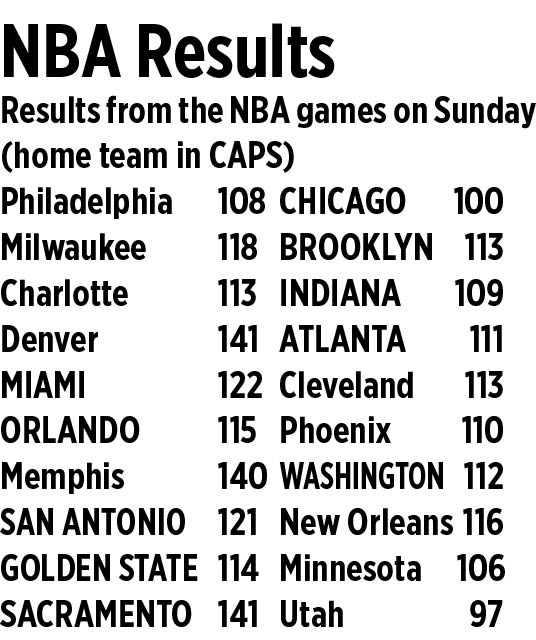
TYLER HERRO scored 19 of his game-high 34 points in the third quarter as the host Miami Heat handed the red-hot Cleveland Cavaliers a rare loss, 122-113, on Sunday night.

Cleveland (21-4) still has the best record in the NBA, but the Cavaliers had their four-game winning streak snapped.

Cavaliers star Evan Mobley — who scored 41 points against Charlotte on Saturday — did not return after reportedly suffering a sprained left ankle in the second quarter. He finished with just four points.

The Heat won their season-best third straight game to move two games over .5 for the first time (12-10).

Miami’s Jimmy Butler made the shot of the night even though it didn’t count. At the end of the first half, Butler beat the buzzer on a 55-foot heave that went in after hitting the top of the backboard and then shot clock. Officials ruled the ball out of bounds before it went through the hoop.

Butler finished with 18 points. Duncan Robinson (23 points) and Bam Adebayo (16 points, 13 rebounds) provided support for Herro, who also tallied a game-high seven assists.

Darius Garland led Cleveland with 23 points. Cavaliers star Donovan Mitchell — who entered the game ranked among the top 20 in the league in scoring at 24.2 points per game — managed just 12 on 5-for-16 shooting.

Cleveland used a 10-0 run to help build a 25-21 lead after the first quarter. The Cavaliers hit 3-of-6 three in the opening frame, while Miami made just 1 of 7 from deep.

Herro scored 11 points in the second quarter as the Heat surged into halftime with a 59-51 lead. Miami made all 17 of its free-throw attempts in the first half, including six by Herro.

Robinson sandwiched two threes around a Herro triple to push the Heat ahead 68-53 two minutes into the second half. Herro drained all four of his 3-point tries in the frame to help Miami carry a 90-80 lead into the fourth quarter.

Garland’s 3-pointer trimmed Cleveland’s deficit to 100-95 with 8:28 left, but Dru Smith answered from long range to make it an eight-point game. The Cavaliers never got closer than six the rest of the way.

Cleveland entered the game leading the NBA in scoring (121.8) but tallied its fewest points since its most recent loss, a 117-101 setback in Atlanta on Nov. 29. — Reuters