Home Blog Page 217

Iran conflict widens to Lebanon, Kuwait mistakenly downs US jets

AN EXPLOSION caused by a projectile impact after Iran launched missiles into Israel following Israel and the US launched strikes on Iran, in Tel Aviv, Israel, Feb. 28, 2026. — REUTERS/GIDEON MARKOWICZ

DUBAI/WASHINGTON — The US and Israeli air war against Iran widened on Monday, with no end in sight as Israel attacked Lebanon in response to strikes by Hezbollah and Iran kept up its attacks on Gulf states that host US military bases.

US President Donald Trump said the operation could continue for weeks and that it was unclear who was in charge in Iran after the targeted killing of Supreme Leader Ayatollah Ali Khamenei in the opening hours of the US-Israel campaign over the weekend.

The attack on Iran has pitched the Gulf into war, killed scores of civilians in Iran, Israel and Lebanon, thrown global air transport into chaos and shut down shipping through the Strait of Hormuz, where one-fifth of the world’s oil trade skirts the Iranian coast, sending oil prices surging.

Underlining the risks, Kuwait mistakenly shot down three American F-15E fighter jets during an Iranian attack, US Central Command said. All six crew members ejected and were safely recovered.

The US military said it had struck more than 1,250 targets in Iran and destroyed 11 Iranian ships. Six US service personnel have been killed so far, all in Iran’s retaliatory attacks over the weekend on Kuwait.

As night fell on Monday, Israel warned of imminent attacks on towns in Lebanon and said it had attacked the complex that houses Iran’s state broadcaster IRIB in Tehran. Explosions shook buildings across Tel Aviv as air defenses intercepted incoming Iranian missiles.

Early on Tuesday, two drones struck the US embassy in Riyadh, causing minor damage and starting a fire, Saudi Arabia’s Defense Ministry said.

For Mr. Trump, joining Israel to attack Iran amounts to the biggest US foreign policy gamble in decades and a major political risk for his Republican Party in this year’s midterm elections. Only one in four Americans support the Iran campaign, according to a weekend Reuters/Ipsos poll.

Average US retail gasoline prices rose above $3 per gallon, in part due to the conflict, as Mr. Trump faces growing discontent over bread-and-butter issues.

WAR WIDENS TO LEBANON
Mr. Trump has said the US faced an imminent threat from Iran that justified war, although he gave no specifics and some US lawmakers said he has shown no evidence to back that assessment.

Before briefing lawmakers, Secretary of State Marco Rubio told reporters on Monday the US acted preemptively because it knew of its close ally Israel’s determination and plans to strike Iran.

“We knew that that would precipitate an attack against American forces, and we knew that if we didn’t preemptively go after them before they launched those attacks, we would suffer higher casualties,” Mr. Rubio said.

In his most extensive public comments so far on the conflict, Mr. Trump on Monday said he had ordered the attack to thwart Tehran’s nuclear program and a ballistic missile program that he said was growing rapidly.

Mr. Trump gave no sign that the operation would end soon, and military officials said more US forces were being sent to the region.

“Right from the beginning, we projected four to five weeks, but we have capability to go far longer than that,” Mr. Trump said at the White House.

A new front in the war opened on Monday when the Lebanese Hezbollah militia, one of Tehran’s principal allies in the Middle East, launched missiles and drones towards Israel.

Israel responded with sweeping airstrikes on the Hezbollah-controlled southern suburbs of Beirut. The Lebanese state news agency NNA said at least 31 people had been killed and 149 injured.

STATE DEPARTMENT WARNING
The US State Department on Monday urged Americans to immediately leave more than a dozen countries in the region, including every Gulf and Levant state, although airspace closures have made doing so neither easy nor cheap.

Turkey joined Russia and China in condemning the war, which President Tayyip Erdogan called a “clear violation” of international law.

Iran denies seeking a nuclear weapon, and it said the US assault was unprovoked, occurring as Tehran negotiated a nuclear accord with Mr. Trump’s envoys. Mr. Trump withdrew from a prior international agreement curbing Iran’s nuclear program during his first term in 2018.

Ali Larijani, Iran’s top security official, said on social media that Iran would not negotiate with Mr. Trump, who had “delusional ambitions.”

Within Iran, where residents have jammed highways to flee the bombing, there was uncertainty about the future mixed with euphoria, apprehension, and rage.

Many have openly celebrated the death of Mr. Khamenei, 86, who ruled since 1989 and directed security forces that killed thousands of anti-government protesters early this year.

But the conservative clerical leaders have shown no sign of yielding power, and military experts say airstrikes without ground forces may not be enough to drive them out, a possibility Mr. Trump said he had not ruled out.

Meanwhile, scores of Iranians have been reported killed in strikes, including several that hit apparent civilian targets.

“They are killing children, they are attacking hospitals. Is this the kind of democracy Trump wants to bring us?” Morteza Sedighi, a 52-year-old teacher, said by phone from Tabriz in northwestern Iran. “Innocent people were first killed by the regime and now by Israel and the United States.”

As Washington’s allies in the Gulf came under renewed attack from Iranian missiles and drones, black smoke rose above the area around the US embassy in Kuwait. There were loud blasts in Dubai and Samha in the United Arab Emirates, and in the Qatari capital Doha.

Qatar, one of the world’s biggest exporters of liquefied natural gas, halted production, with no prospect of being able to ship safely through the chokepoint of the Strait of Hormuz.

Saudi Arabia shut its biggest refinery after drone strikes caused a fire there, one of a number of energy installations that became targets. — Reuters
Oil rises as expanding US-Israeli conflict with Iran elevates supply risks

REUTERS

OIL prices rose for a third day on Tuesday as the widening US-Israeli conflict with Iran and threats to shipping through the Strait of Hormuz heightened fears of supply disruptions from the key Middle East producing region.

Brent crude futures were at $78.83 a barrel, up $1.10, or 1.4%, by 0107 GMT. On Monday, the contract surged to as high as $82.37, its highest since January 2025, though it pared those gains to settle 6.7% higher.

US West Texas Intermediate crude  jumped 74 cents, or 1%, to $71.97 a barrel. In the previous session, the contract initially climbed to its highest since June 2025 before sliding back to still settle up 6.3%.

“With no quick de-escalation in sight, the Strait of Hormuz effectively closed and Iran showing a willingness to target energy infrastructure in the region, upside risks remain and they grow the longer the conflict drags on,” Tony Sycamore, IG market analyst, said in a note.

The US and Israeli air war against Iran widened on Monday with Israel attacking Lebanon and Iran responding with strikes against energy infrastructure in Gulf countries and against tankers in the Strait of Hormuz.

On a typical day, ships carrying crude oil equal to about one-fifth of global demand sail through the Strait of Hormuz along with tankers hauling diesel, gasoline and other fuels to major Asian markets including China and India. The waterway is also the conduit for about 20% of the world’s liquefied natural gas.

Tankers and container ships are avoiding the waterway as insurers have canceled their coverage for vessels.

The concerns about transiting the waterway are increasing as Iranian media reported on Monday an Iranian Revolutionary Guards senior official saying the Strait of Hormuz is closed and Iran will fire on any ship trying to pass.

Earlier on Monday, the Revolutionary Guards said a fuel tanker, identified as the Honduran-flagged Athe Nova, was burning in the Strait after being hit by two drones, Iranian news agencies reported.

Analysts expect oil prices to remain elevated over the coming days while markets focus on the impact of escalating Middle East conflict.

Bernstein on Monday raised its 2026 Brent oil price assumption from $65 to $80 a barrel, but sees prices reaching $120-$150 in an extreme case of prolonged conflict.

Refined product futures are also gaining as the Middle East is a key supplier of fuels and their processing facilities are at risk. On Monday, Saudi Arabia shut its biggest domestic oil refinery after a drone strike.

US ultra-low-sulfur diesel futures were up 3.1% at $2.991 after reaching a two-year high on Monday, while gasoline futures were up 1.1% after climbing 3.7% in the previous session.

European gasoil futures  gained 2.7% to $909.50 a metric ton, after climbing 18% on Monday. — Reuters

Canada’s Carney arrives in Australia for meeting of ‘middle powers’

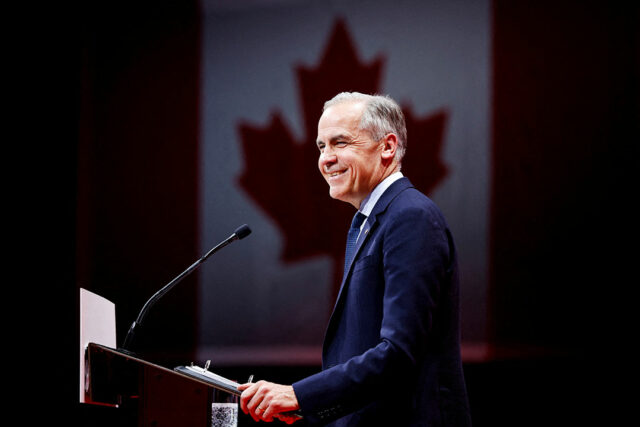
Canada’s Prime Minister Mark Carney — REUTERS

SYDNEY — Canadian Prime Minister Mark Carney arrived in Australia on Tuesday, aiming to bolster relations between the two so-called “middle powers” amid what he has called a “rupture” in world order.

The leaders of both nations, close allies of the United States, are meeting as war escalates in the Middle East, and will look to strengthen ties as top producers of critical minerals.

Mr. Carney is on a multi-leg trip across the Asia-Pacific region also taking in Japan and India, where he signed trade deals and reset relations with New Delhi after a year-long spat over Sikh separatism.

Canada and Australia have warmer ties, with the two nations expected to deepen cooperation in areas such as defense and maritime security, critical minerals, trade and artificial intelligence, Mr. Carney’s office said ahead of the visit.

Mr. Carney is set to address Australia’s parliament and meet Prime Minister Anthony Albanese, who described Canada last week as one of Australia’s “closest friends, built on generations of trust”, and urged closer ties to promote national interests.

Western nations seek to build their own stockpiles of critical minerals, key for production of semiconductors and defense applications, as China, the world’s dominant producer, tightens supply.

“There’s a lot Canada and Australia can do together on critical minerals as producer nations,” Australian Resources Minister Madeline King said on Monday, when asked about Mr. Carney’s visit.

“Middle powers” needed to work more closely together, Mr. Carney said last month in a widely publicized speech at the World Economic Forum in Davos.

“Middle powers must act together because if we’re not at the table, we’re on the menu,” he said.

In a speech on Wednesday at the Lowy Institute think tank in Sydney, Mr. Carney is expected to press his point further, outlining shifts in the global order and the opportunities they offer middle powers such as Canada and Australia. — Reuters

Philippine factory activity surges in February

Semiconductor chips are seen on a circuit board of a computer in this illustration picture. — REUTERS/FLORENCE LO/ILLUSTRATION

By Justine Irish D. Tabile, Senior Reporter

PHILIPPINE FACTORY activity in February expanded at its fastest pace in eight years amid an increase in production and new orders as well as a “surge in business confidence,” S&P Global said on Monday.

However, the US-Iran conflict may cause a spike in oil prices, which may pose a risk to the manufacturing sector in the coming months, S&P added.

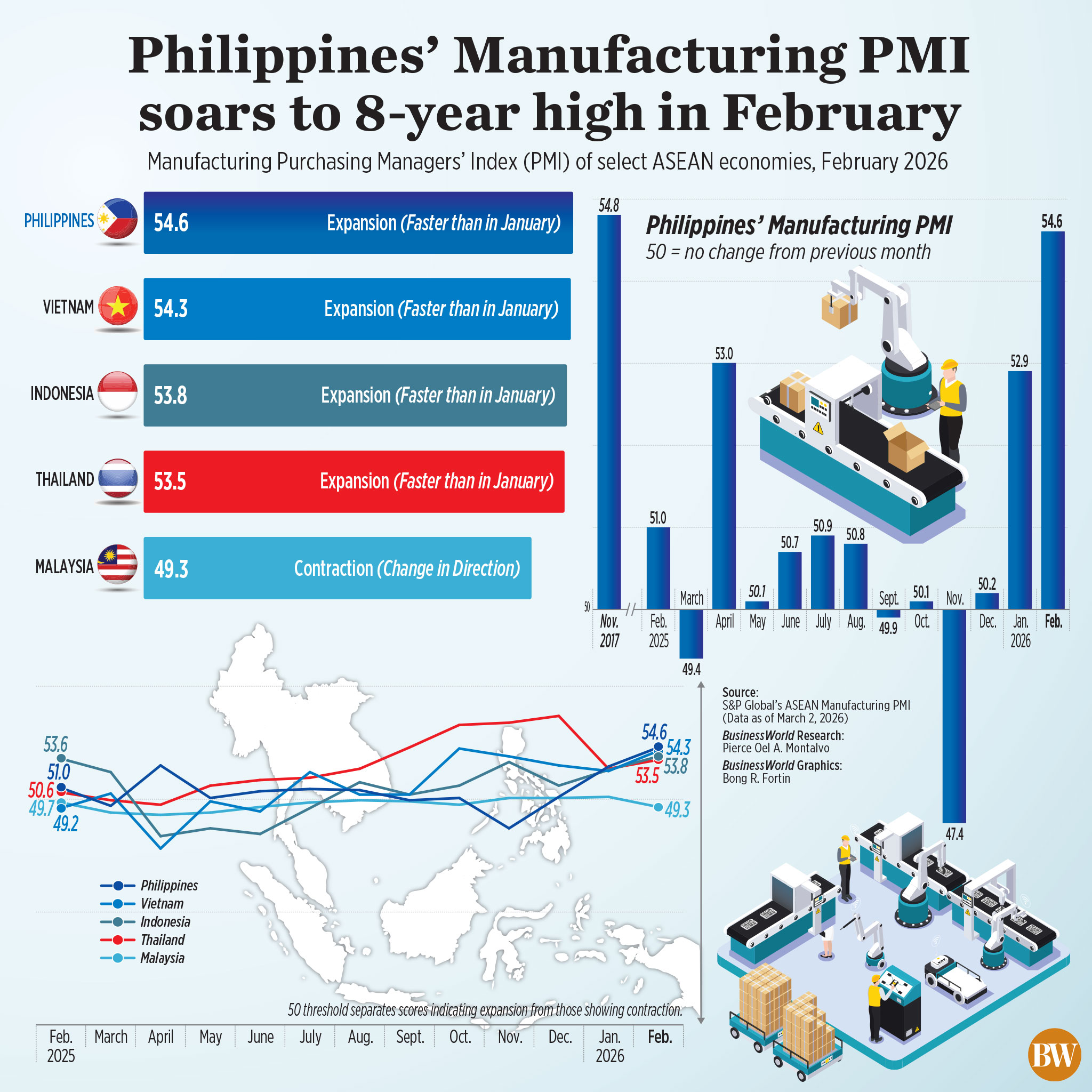
S&P Global Philippines Manufacturing Purchasing Managers’ Index (PMI) rose to 54.6 in February from 52.9 in January, the strongest improvement since November 2017 when PMI stood at 54.8.

A PMI reading above 50 denotes better operating conditions than in the preceding month, while a reading below 50 shows deterioration.

“The Philippines manufacturing sector has had a solid start to 2026, with February marking its strongest performance since late 2017,” Maryam Baluch, an economist at S&P Global Market Intelligence, said in the report.

“A sharp influx of new orders underpinned robust growth of output, and in both cases, the expansions were historically pronounced and reached multi-year highs,” she added.

The Philippines recorded the fastest expansion in manufacturing activity in the Association of Southeast Asian Nations (ASEAN) region in February.

Based on available data from S&P as of Monday, the Philippines was ahead of Vietnam (54.3), Indonesia (53.8) and Thailand (53.5). Malaysia saw a deterioration in PMI to 49.3.

“The (Philippine manufacturing) sector’s positive performance was accompanied by a surge in business confidence. Firms were hopeful that demand conditions would continue to improve and drive further expansions in production volumes,” Ms. Baluch said.

Full ASEAN PMI data, as well as Myanmar’s PMI, are expected to come out on Tuesday.

S&P Global said February marked the third straight month where operating conditions have improved in the Philippines.

It noted Philippine manufacturers posted faster rise in production volumes and new orders in February,

“The sharp expansions across these two measures were accompanied by an uplift in business confidence, which rebounded notably from the recent low recorded in the month prior,” it added.

Output had increased for a second straight month, and at the fastest pace since November 2018.

S&P Global said there was a strong rise in order book volumes in the Philippine manufacturing sector in February.

“The respective seasonally adjusted index hit the highest level in just over eight years. The acquisition of new clients and bulk buying activity among customers was said to have pushed up new sales,” it said.

S&P attributed the growth in new factory orders to improvements in domestic and international demand, amid a modest rise in new export orders.

“Foreign sales increased for the second consecutive month, though the pace of expansion held steady in February,” it added.

JOB GROWTH SUSTAINED
Meanwhile, S&P Global saw a modest growth in employment last month, which it said reflects a rise in backlogs of work following a drop in January, as the increase in new orders put pressure on Filipino manufacturers’ capacity.

“Employment growth across the Philippines’ manufacturing sector was sustained in February, with staffing numbers rising for a second straight month,” it said.

“The pace of job creation was only modest overall and therefore insufficient to prevent a fresh buildup in backlogs of work,” it added.

Ms. Baluch said that jobs growth will further increase in the coming months as manufacturers scope to increase their staffing numbers amid rising backlogs.

Philippine manufacturers also recorded an accelerated input buying rate in February, which was the strongest pace in expansion since January 2025.

However, S&P Global said that there have been more delays in February due to increased buying activity, bad weather, and port congestion.

“Average delivery times for inputs lengthened for a third successive month. The incidence of delay was sharp overall and the most pronounced in 14 months,” it added.

Meanwhile, manufacturers reported falling operating expenses in February, which in turn allowed them to reduce their own charges.

S&P Global also noted manufacturers’ outlook for the next 12 months improved in February.

“The degree of confidence lifted notably from the recent low observed at the turn of the year. Panelists that foresee growth in production volumes largely linked this to hopes of further improvements in underlying demand trends,” it said.

RISING OIL PRICES
Meanwhile, the S&P said that the US-Iran conflict could impact oil prices and thus affect operations of manufacturers in the Philippines.

“I think it is going to be something to watch if it does extend for an extended period of time,” S&P Global Market Intelligence Economics Associate Director Jingyi Pan said in an interview on Money Talks with Cathy Yang on One News on Monday.

Ms. Pan said that the impact of the war will depend on if this is just a knee-jerk reaction and “how some of the oil suppliers themselves are managing the risk altogether with their current supply.”

“In the manufacturing PMI for the Philippines, the price indicators have actually shown below 50, so just a very slight decline. But I think that could actually very well change if we do see the spike coming through and being reflected in March,” Ms. Pan said.

“But if it doesn’t turn out to be a prolonged situation, I think that is still going to help keep inflation a bit more moderated,” she added.

Oil companies on Monday announced an increase in the price of gasoline by P1.90 per liter, diesel by P1.20 per liter, and kerosene by P1.50 per liter, effective March 3.

The upward adjustments marked the 10th consecutive week of increase for diesel and kerosene, and eight straight weeks for gasoline. Since January, per-liter prices of gasoline, diesel, and kerosene rose by P6.70, P9.40, and P7.70, respectively.

Ms. Pan also said that the fresh global tariffs of Mr. Trump were not strongly felt in the February survey amid a below-50 input and output price indicators.

“I do see this as a bit of a reflection of the manufacturers themselves also keeping prices rather suppressed in February just to support the export growth [and new orders] situation as we see,” she said.

However, Ms. Pan noted that confidence remains subdued in February despite a recovery from January.

PHL central bank may pause easing amid inflation risks from oil shock

Nomura Global Markets Research said every 10% increase in global oil prices could add 0.5 percentage point (ppt) to Philippine inflation. — REUTERS/DADO RUVIC/ILLUSTRATION

By Katherine K. Chan, Reporter

FURTHER MONETARY POLICY easing may be delayed as inflation could heat up again as oil prices surge amid a widening conflict in the Middle East, analysts said.

Marco Antonio C. Agonia, an economist at the University of Asia and the Pacific, said the Bangko Sentral ng Pilipinas (BSP) may opt to stand pat before easing further to anchor its inflation expectations, considering the latest oil shock is a supply-driven issue.

“The higher inflation scenario due to these spikes could delay the BSP’s easing path, depending on the severity of the conflict,” Mr. Agonia told BusinessWorld in an e-mail.

“Being a supply-driven episode, the BSP cannot directly address this type of inflation through rate hikes,” he added. “Instead, the BSP may delay its rate cuts to anchor inflation expectations and prevent second-round inflation drivers from springing up.”

Reuters reported that oil prices surged on Monday as military conflict in the Middle East looked set to last weeks, threatening to upend a global economic recovery and perhaps reignite inflation.

Military strikes by the United States and Israel on Iran showed no sign of lessening, while Iran responded with missile barrages across the region, risking dragging its neighbors into the conflict.

All eyes were on the Strait of Hormuz where around a fifth of the world’s seaborne oil trade flows and 20% of its liquefied natural gas. While the vital waterway has not yet been blocked, marine tracking sites showed tankers piling up on either side of the strait wary of attack or maybe unable to get insurance for the voyage.

In a report dated March 1, Nomura Global Markets Research said every 10% increase in global oil prices could add 0.5 percentage point (ppt) to Philippine inflation, the largest impact, on par with India, seen in the region.

“Still the pass-through to domestic retail fuel prices will be significant and quick, exerting substantial upward pressure on headline CPI (consumer price index) inflation,” Nomura said.

“By our estimates, every 10% rise in oil prices could add about 0.5 ppt to CPI inflation, which suggests headline inflation could return to the upper end of BSP’s 2-4% target this year, instead of averaging at 2.5% as our forecasts envisage.”

The Philippines is a net importer of crude oil, making the country extremely vulnerable to global price swings.

Analysts already expect inflation to be on an uptrend this year, with costlier oil prices among the sources of inflationary pressures.

A BusinessWorld poll of 17 analysts yielded a median estimate of 2.4% for the February inflation print, faster than the 2% in January and the 2.1% seen a year ago.

If realized, this would be the fastest clip in 13 months or since the 2.9% in January 2025.

The BSP expects inflation to average 3.6% by yearend.

However, Mr. Agonia noted that inflation might not go as high as the 2022 levels when geopolitical tensions between Russia and Ukraine jolted the global oil market as well, adding that oil prices typically normalize as soon as such conflicts cease.

“However, it is unlikely that we will see inflation figures similar to the 2022 Russia-Ukraine conflict due to the (so far) relatively contained scale of the conflict,” Mr. Agonia said. “Stable food prices may also keep inflation from breaching the 4% target over a prolonged period of time.”

BSP Governor Eli M. Remolona, Jr. has noted that the policy path ahead is now less certain as they see “tentative” signs of a recovery in confidence even as inflation expectations remain “manageable.”

The central bank trimmed the key interest rate last month by 25 basis points (bps) to an over three-year low of 4.25%. Its sixth straight cut brought its total reductions to 225 bps since it began easing in August 2024.

CURRENT ACCOUNT DEFICIT
Meanwhile, think tanks warned that costlier oil also risks widening the country’s current account deficit (CAD). 

“Our analysis shows that every $10/bbl (barrel) oil price increase could decrease the current account position across Asian economies by around 0.2-0.9% of GDP, with Thailand, Singapore, Taiwan, India and the Philippines seeing bigger hits purely from a current account perspective,” MUFG Research Senior Currency Analyst Michael Wan said in a report on Monday.

The Philippines’ current account balance stood at a $12.5-billion deficit by the end of the third quarter, based on latest central bank data. This was equivalent to -3.6% of gross domestic product (GDP).

The BSP expects the current account gap to end at $15.5 billion in 2025 or -3.2% of GDP, before narrowing to $15.3 billion or -3% of GDP this year. 

Mr. Wan said the country’s current account gap could settle around 2%-3% of GDP this year “despite softer imports and domestic demand.”

Nomura analysts also noted that a wider current account deficit amid rising oil prices could weigh on the peso and reinforce a pause by the central bank. 

“The country’s relatively large net energy imports suggest an increase in oil prices could put the CAD back on a widening path, exerting currency pressures and adding to the likelihood of unchanged BSP policy rates,” they said. 

Following back-to-back record lows in January, the peso began to recover last month as it returned to the P57-a-dollar level. 

The market is anticipating further depreciation amid worries over geopolitical risks from the attacks on Iran, with the peso likely to trade between P57.40 and P58 per dollar this week. — with Reuters

Oil prices go up but bigger hikes likely next week

A motorist pays a gas attendant at a gas station on March 1, 2026. — PHILIPPINE STAR/RYAN BALDEMOR

By Sheldeen Joy Talavera, Reporter

OIL PRICES are set to further rise next week amid supply disruptions due to the escalating conflict in the Middle East, Energy Secretary Sharon S. Garin said.

This comes as fuel retailers announced pump price hikes of over P1 per liter, which were scheduled to take effect on Tuesday.

Ms. Garin said fuel prices are really expected to spike due to the US-Iran conflict.

“Prices will really go up. I will not sugarcoat that. Even if you say that oil imports are arriving, prices will still rise because of that tension. The stress in the market will push the price higher until it stabilizes. So, we need to expect that,” she said in a radio interview on DZMM on Monday morning.

Seaoil Philippines, Inc., Shell Pilipinas Corp., Petron Corp., Chevron Philippines, Inc. (Caltex), Jetti Petroleum, Inc., and PTT Philippines Corp. announced an increase in gasoline prices by P1.90 per liter, diesel by P1.20 per liter, and kerosene by P1.50 per liter, effective March 3.

PetroGazz Ventures Philippines Corp. and Cleanfuel will implement the same adjustments, except for kerosone, which they do not offer.

The upward adjustments marked the 10th consecutive week of increase for diesel and kerosene, and eight straight weeks for gasoline. Since January, per-liter prices of gasoline, diesel, and kerosene rose by P6.70, P9.40, and P7.70, respectively.

Ms. Garin said the government is monitoring the situation as supply is crucial for the Philippines since it has no domestic production.

If the war lasts for a month, she said that pump prices may spike, and the country has to ensure there is enough supply by exploring other options.

The Philippines is a net importer of oil, making it vulnerable to swings in global oil prices.

The Department of Energy (DoE) on Monday called for an emergency meeting with oil companies to assess the situation and measures that may be implemented.

Rino E. Abad, director of the DoE-Oil Industry Management Bureau, said they have to observe the trend during the five-day trading this week to assess whether to implement a staggered approach should there be a big-time price hike next week.

“Just in case there will be a big-time adjustment next week, we will then discuss the staggered implementation,” Mr. Abad told reporters partly in Filipino.

He noted that most of the oil companies have nearly two months’ worth of existing inventory.

Currently, oil companies are required to maintain at least a 30-day inventory of crude oil and a 15-day inventory of finished petroleum products.

“We’ve yet to see any clarity on where the latest developments in the Middle East will lead to and for how long. Given the current situation, we expect high volatility in oil prices in the near term,” Jetti President Leo P. Bellas said in a Viber message.

Eugene Erik C. Lim, president and chief executive officer of Top Line Business Development Corp., said the current upward pressure on oil prices is a bit higher compared with the 12-day Iran-Israel war in June 2025.

Mr. Lim said the movement in oil prices moving forward will depend on how the conflict would drag on.

“I think the important thing right now is to understand that there’s always a knee-jerk activity or a knee-jerk reaction on the onset of the conflict,” he said in an interview on Money Talks with Cathy Yang on One News on Monday.

“So, the question now is, how long is the conflict to be resolved? Or basically… it can be easier for us to discuss in terms of pricing, but I think we have to check the world market in the next few days,” he added.

US President Donald J. Trump said that the conflict with Iran could go on for the next four weeks, according to Reuters, citing the report from Daily Mail newspaper.

Mr. Lim said that the company is conducting several hedging activities, such as entering into forward contracts, to manage financial and supply risks.

FUEL SUBSIDIES
At the same time, the Philippine government is prepared to release fuel subsidies to sectors that are most vulnerable to a spike in oil prices.

Mr. Abad said that the fuel subsidy program will be implemented should the one-month average of Dubai crude breach $80 per barrel. Last week, the price averaged around $70-71, he said.

Palace Press Officer Clarissa A. Castro said the Department of Transportation (DoTr) has allotted P2.5 billion in fuel subsidies for transport workers from the 2025 national budget.

Once Dubai crude prices breach $80 per barrel, the DoTr can immediately start distribution to qualified beneficiaries, Ms. Castro said at a briefing, quoting Transportation Secretary Giovanni Z. Lopez.

The Department of Agriculture’s Office of the Secretary and the Bureau of Fisheries and Aquatic Resources have allotted P25 million each for subsidies for farmers and fisherfolk.

Meanwhile, business groups expressed grave concern over the Middle East conflict, citing its impact on oil prices and remittance inflows.

In a statement, the Philippine Chamber of Commerce and Industry (PCCI) urged the government to explore alternative sources of oil amid fears of disruption in the Strait of Hormuz, where about 20% of the world’s oil and liquefied natural gas pass through.

“We likewise urge the Department of Energy to accelerate the development of renewable energy and domestic energy alternatives as a long-term structural solution to our energy vulnerability,” PCCI said.

Federation of Philippine Industries Chairperson Elizabeth H. Lee warned that if the crisis escalates or becomes prolonged, “inventories will be replenished at higher global prices — resulting in sustained upward pressure on domestic fuel costs.”

“The Middle East crisis is not just a distant conflict — it is an inflationary shock that could affect Philippine households and industries if tensions persist,” she said in a statement.

Rising oil costs will drive up transport costs and electricity generation costs, as well as affect domestic sectors like manufacturing, aviation, food processing, and tourism.

“Further, businesses will need to tighten their belts and actively manage financial risks. Quick, low hanging reforms that ease the cost of doing business and reduce the ‘hidden taxes’ on local manufacturers and small businesses can help cushion, at least in part, the impact of global pressures,” Ms. Lee said.

Leonardo A. Lanzona, Jr., an economics professor at the Ateneo de Manila University, said that if the conflict widens to include Saudi Arabia and the United Arab Emirates, where millions of migrant Filipino workers could face safety threats or forced repatriation, remittance inflows might be affected.

“[This could] deal a severe blow to the roughly $37 billion in annual remittances that sustain household consumption and support the peso,” he said.

A prolonged crisis would also weaken the local currency through global risk-off sentiment, raise shipping costs and put the central bank in a “difficult position” of balancing growth support against inflation pressures.

The PCCI also urged the Departments of Migrant Workers, Foreign Affairs, and the Overseas Workers Welfare Administration to ensure the safety of over two million overseas Filipino workers based in the Middle East. — with Beatriz Marie D. Cruz and Chloe Mari A. Hufana

If reform isn’t enough, is it time for overhaul?

By Mon Abrea

For more than a decade, reform advocates have pushed for modernization of the country’s revenue system — digitalization, risk-based audit, faster VAT refunds, inter-agency coordination, and reduced bureaucratic discretion.

Progress has been made.

But the question remains: Is incremental reform enough?

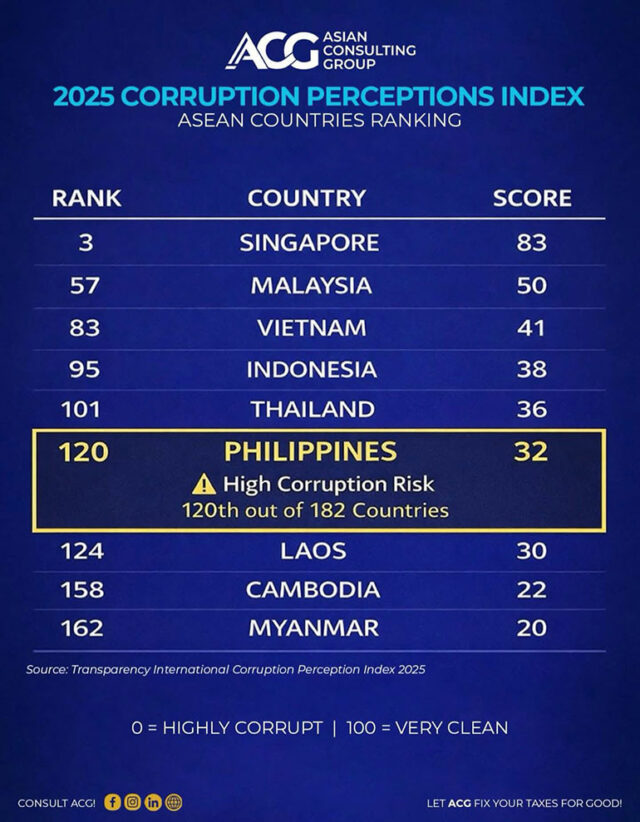
The Philippines continues to impose more than 30 national and local taxes, and numerous regulatory fees. Yet compliance remains costly, unpredictable, and stressful. Our 2025 Corruption Perceptions Index score of 32 out of 100 — 120th out of 182 economies and trailing several ASEAN peers, according to Transparency International — signals persistent governance risk.

Corruption functions as a hidden tax.

Not legislated — but paid through delays, inefficiency, and fragmented systems.

Recently, BIR Commissioner Charlie Mendoza commented on proposals to replace the BIR and Customs with a unified National Revenue Authority (NRA). He correctly noted that such proposals “reflect long-standing concerns over fragmentation and coordination in revenue administration,” and emphasized that the problem lies in “governance quality, not merely institutional form.” He added that restructuring should be “a governance reform of last resort, not a first response.”

I agree.

But after more than a decade of advocating administrative reform, digital modernization, risk-based enforcement, and simplification — are we already facing that last resort?

When inequity, inefficiency, and bureaucratic discretion persist despite reforms, the issue may not be governance alone. It may be institutional design.

Fragmented mandates, overlapping systems, and siloed data create structural vulnerabilities. When system design enables discretion, discretion enables leakage. And leakage erodes trust.

This is not a call for reckless institutional demolition. It is a call for strategic overhaul — a serious roadmap that considers structural integration, unified data architecture, and system redesign, not merely cosmetic upgrades.

Face-lifts cannot fix structural fractures.

Investors do not merely examine tax rates. They examine institutional coherence. They ask whether enforcement is predictable, whether rules are applied consistently, and whether systems are transparent.

Modernization must be comprehensive: end-to-end digital processes, AI-driven risk profiling, simplified excise structures, adoption of the OECD Global Minimum Tax, and alignment with ASEAN standards — including revisiting the region’s highest VAT rate.

Tax reform is governance reform.

If incremental change cannot resolve fragmentation and systemic inefficiencies, then institutional reform must at least be placed on the strategic table — not as political rhetoric, but as policy design.

On Feb. 26, the 2026 International Tax and Investment Roadshow across more than 30 global cities and the CREATE MORE edition of Why Invest in the Philippines? will officially be launched at the ACG Gala Night at Incanta in Quezon City. The message to global investors is simple: the Philippines is reforming.

But reform must be deep enough to restore trust.

Because in today’s economy, confidence is currency.

And confidence demands systems that work.

Mon Abrea is a tax policy expert and the founder and chief tax advisor of Asian Consulting Group, advising governments, multinational firms, and investors on tax reform and investment strategy. He holds degrees and executive training from Harvard University, Duke University, and the University of Oxford.


Spotlight is BusinessWorld’s sponsored section that allows advertisers to amplify their brand and connect with BusinessWorld’s audience by publishing their stories on the BusinessWorld Web site. For more information, send an email to online@bworldonline.com.

Join us on Viber at https://bit.ly/3hv6bLA to get more updates and subscribe to BusinessWorld’s titles and get exclusive content through www.bworld-x.com.

Globe raises P25 billion from preferred shares offer

GLOBE.COM.PH

GLOBE TELECOM, INC. has raised P25 billion from its preferred shares offering, which the company said will be used to fund capital expenditures, redeem securities, and support network investments.

“This strong reception reflects confidence in Globe’s ability to execute our strategic priorities while continuing to elevate network quality and customer experience,” Globe President Carl Raymond R. Cruz said in a stock exchange disclosure on Monday.

“We remain committed to sustaining disciplined investments and building a resilient organization focused on delivering long-term value for our stakeholders,” he added.

The Ayala-led telecommunications company raised the funds through the issuance of 12.5 million cumulative, non-voting, non-participating, non-convertible, redeemable, and re-issuable Philippine peso-denominated perpetual preferred shares. The shares were issued in two series priced at P2,000 each, with a par value of P50 per share.

Globe said the offer was 2.40 times oversubscribed relative to the P15-billion base, allowing the company to fully exercise the P10-billion oversubscription option.

Net proceeds from the offer will be used to redeem part or all of its US-denominated perpetual capital securities, the company said, adding that funds will also support expansion and upgrades of its network and digital infrastructure.

“We believe that this offer underscores the strength of Globe’s credit fundamentals and our disciplined balance sheet management. The robust demand and prudent pricing further reinforce market confidence in our capital management approach,” Globe Chief Financial Officer, Treasurer, and Chief Risk Officer Juan Carlo C. Puno said in a stock exchange disclosure on Monday.

BPI Capital Corp., BDO Capital & Investment Corp., and China Bank Capital Corp. acted as joint lead issue managers, underwriters, and bookrunners.

First Metro Investment Corp. and Security Bank Capital Investment Corp. served as underwriters and bookrunners.

For 2026, Globe expects low- to mid-single-digit revenue growth, following a decline in 2025.

The Ayala-led company reported a 4.12% drop in net income in 2025 to P23.3 billion from P24.3 billion in 2024, weighed down by higher depreciation and interest expenses and lower revenues.

Globe said it anticipates capital expenditures to remain below $1 billion, reflecting a disciplined approach to capital optimization and a focus on extracting greater returns from prior network investments while continuing network expansion.

At the local bourse, shares in Globe fell by P62, or 3.56%, to close at P1,678 apiece. — Ashley Erika O. Jose

K-pop’s BLACKPINK returns with new release after more than 3 years

SEOUL — K-pop superstars BLACKPINK released their new EP, entitled DEADLINE, on Friday, the first release from the group in more than three years since their second full-length album in 2022.

The National Museum of Korea in central Seoul was bathed in pink lights to mark the release. More than 300 fans lined up in the atrium of the museum on Friday, set up as a listening zone for the five tracks of the EP.

The four-member girl group’s global following has helped it set records. Earlier this month, BLACKPINK became the first artist in the world to surpass 100 million YouTube subscribers, according to the band’s agency YG Entertainment.

The band was also the first K-pop group to headline Coachella and the British Summer Time concerts.

“These days, even when I’m walking on the street, at a clothing store, restaurant, or café, I hear K-pop,” said Ko Seon-a, a 20-year-old Korean woman living in Japan who had come to the museum on Friday.

The five tracks on the new EP include the title track “GO” and the pre-released EDM track “JUMP.”

All four members renewed their contracts in 2023 with their agency but have also established their own agencies or signed different deals for solo activities.

They have all pursued solo projects, including member Ros’s chart-topping 2025 single “APT.” with Bruno Mars.

Some fans hoped that the global popularity of K-pop acts such as BLACKPINK also contributed to a wider enjoyment of Korean culture.

“I hope that Korean traditional culture will be known through K-pop,” said Kwon Hyeok-jae, a 30-year-old man dressed in a pink traditional hanbok. — Reuters

Villar Land faces DoJ subpoenas, vows full cooperation

BW FILE PHOTO

THE Department of Justice (DoJ) has initiated subpoenas on Villar Land Holdings Corp., its related entities, and key officers following a criminal complaint filed by the Securities and Exchange Commission (SEC) over alleged market manipulation, insider trading, and misleading disclosures.

Justice spokesperson Raphael Niccolo L. Martinez told reporters on Monday that the complaint lodged by the SEC will proceed to a preliminary probe scheduled for March 16.

“After undergoing initial evaluation, the complaint lodged by the SEC against Villar Holdings Corp. et al with the DoJ will proceed with preliminary investigation for alleged violations of the Securities Regulation Code,” he said.

“Subpoenas have been served upon the respondents,” he added, noting that “a few have not yet received [the subpoenas] and/or are still in process, but all Villars have been served.”

Manuel B. Villar, Jr., chairman of Villar Land Holdings, previously denied the allegations, saying that he and his companies have always upheld good corporate governance, complied with regulations, and will fully cooperate with any investigation.

The case stems from a complaint filed by the SEC on Jan. 30, following an announcement a day later that it was pursuing criminal charges against Villar Land Holdings, formerly Golden MV Holdings, Inc., along with related entities and officers.

The SEC said the acts cited in its complaint constituted false or misleading statements and schemes that deceived investors, in violation of Sections 24.1(d) and 26.3 of Republic Act No. 8799, or the Securities Regulation Code.

“The DoJ will determine if there is merit to the allegations by the SEC. Of course, as a matter of procedure, all respondents will be given an opportunity to present their defenses,” Mr. Martinez said.

In a statement on Monday, Villar Land said its directors are ready to respond to the allegations in the complaint and present their side in the appropriate forum.

“Villar Land and its directors welcome the opportunity to explain their side and respond to the allegations in the complaint at the proper forum,” the company said.

“The company and its directors are fully prepared to cooperate with the proper authorities and are confident that an impartial panel will find that no violation of law was committed,” it added.

On Monday, Villar Land Holdings closed unchanged at P579. — Erika Mae P. Sinaking

Songs for when too much is about to happen

By Brontë H. Lacsamana, Reporter

Album Review
Nothing’s About to Happen to Me
Mitski
Dead Oceans, Inc.

A LOT of time has passed since the late 2010s, when Japanese-American musician Mitski was an indie darling among depressed millennials grappling with the initial pangs of adulthood.

Come 2023, no one would have predicted that she’d find commercial success with her slow lounge ballad, “My Love Mine All Mine,” which introduced her to top 100 charts and was used in millions of TikTok videos. Mitski would be the last person you’d expect to have a kind of teen pop following, and her eighth and latest album reflects that.

Produced and engineered by Patrick Hyland and mastered by Bob Weston, Nothing’s About to Happen to Me is an apt continuation of her contemplative and organic-sounding 2023 album The Land Is Inhospitable and So Are We. This time, there’s more theatrical fanfare as she utilizes more ensemble and band arrangements.

Filled with thoughts on loneliness and delusion, the album is centered on the persona of a reclusive woman. In her chaotic yet liberating home, we get a peek into her solitary journey of self-discovery — the perfect avenue for Mitski to showcase her distinct, hauntingly beautiful style of music.

“I’d never live in a small town. I’ve made too many mistakes,” she begins in the album’s first track, “In a Lake.” Her forlorn voice is familiar and soft amid the gentle Americana sounds of the banjo, accordion, and double bass. Towards the end, a somewhat crazed, grandiose ending is ushered in by the horn section along with city noises (“And in a big city, you can start over / The lights all around you, the dark safe in the sight”), breaking the illusion of a romanticized, isolated life.

The next track is the album’s straightforward rock song, “Where’s My Phone?” Here, the lead single presents gritty guitars as Mitski’s frantic vocals repeat a search for her lost phone, or her lost self. The energy it gives off is akin to the punk anxiety found in her 2014 album Bury Me at Makeout Creek, which is a treat for longtime fans.

“Cats,” the third track, goes back to a steady pace. With heart-rending lyrics about her cats making up for the absence of a lover, Mitski adds the right amount of texture to the song, thanks to a subtle string arrangement complementing the thrum of the guitar and drums.

The fourth track, “If I Leave,” is a standout. It expresses dependence on a lover and the raw desolation felt without them, bringing back the emo sensibilities of her 2016 album Puberty 2. With fuzzy, heavy guitars, it’s a big, slow track that’s truly cathartic.

“Dead Women” follows with a darker, lonelier tone as Mitski sings of a woman’s morbid imagining of how loved ones would remember her after her death. Here, she is lyrically in top form: “Ransack the house for what you’ll auction, what you’ll keep / Then embalm me up ’cause you’re hosting the viewing / Saying, ‘She gave her life so we could have her in our dreams’ / ‘She gave her life so we could fuck her as we please.’”

The sixth song, “Instead of Here,” is sad and slow. It’s a simple track, but just as emotionally effective, as the lyrics express the preference of being alone rather than the pain of living with others.

A similarly mid-tempo track follows, possibly the best of the album. “I’ll Change For You,” another single, showcases equal parts desperation and restraint in Mitski’s sung love confession, supported by lush, bossa nova-style instrumentation. Here, she celebrates the allure of idling at a bar, where there are many people to be with yet no one at all. “So I’m loitering outside / Watching all the cars passing by / Like a kid waiting for my ride,” she sings.

She also gives us an upbeat anthem with “That White Cat,” bringing back her punk sound from the mid-2010s. With a thrashing guitar and angry vocals, the drama of a white cat marking her house as its own plays out with fervor and escalates.

“Gotta go to work / To pay for the cat’s house / For the red-corseted wasp / Who lives in the roof / For the family of possums / For the bugs who drink my blood / And the birds who eat those bugs,” she sings.

The second to the last song is “Charon’s Obol,” where Mitski evokes a bit of 1950s blues and country. The moody tune takes on the spirit of Charon, the ferryman to the afterlife in Greek mythology, as the lyrics detail taking care of a dead woman’s pet hounds.

“Lightning” closes the album, steady in its slow indie rock reckoning with the concept of death. Mitski’s raw voice again leaves an impact atop the rollicking instrumentation.

“I can hear the song of my death / Singing for the lightning to come / Calling to the thunder, ‘Polo,’” are the final words of the album.

The rich inner world found in Mitski’s music fills the mind as each track ends and makes way for the next. Her artistry remains as potent as ever, reflecting a world that keeps on spinning whether something big befalls us or not — ultimately, a wry admission of heartbreak as well as a true comfort.

Nothing’s About to Happen to Me is out now on all music streaming platforms.

Gov’t fully awards T-bills at higher rates on inflation fears

BW FILE PHOTO

THE GOVERNMENT made a full award of the Treasury bills (T-bills) it offered on Monday even as average rates went up week on week amid renewed inflation concerns after the United States and Israel launched attacks on Iran.

The Bureau of the Treasury (BTr) raised P27 billion as planned via the T-bills it auctioned off as the offering was almost thrice oversubscribed, with total tenders reaching P76.546 billion. However, this was below the P96.82 billion in bids recorded last week.

The Auction Committee made a full award of its offer as all tenors fetched average yields that were below the prevailing secondary market levels, the Treasury said in a statement.

Broken down, the government awarded P9 billion as planned in 91-day T-bills as demand for the tenor reached P27.666 billion. The three-month paper fetched an average rate of 4.311%, up by 7.1 basis points (bps) from 4.24% last week. Bids accepted had yields ranging from 4.26% to 4.445%.

The Treasury also borrowed the programmed P9 billion via the 182-day debt as tenders hit P30.5 billion. The average rate of the six-month T-bill was at 4.417%, rising by 6 bps from 4.357% previously. Tenders awarded carried rates from 4.389% to 4.45%.

Lastly, the BTr sold the targeted P9 billion from the 364-day securities as bids totaled P18.38 billion. The one-year paper’s average yield was at 4.564%, climbing by 6.3 bps from 4.501% last week. Accepted bids had rates from 4.5% to 4.6%.

At the secondary market before Monday’s auction, the 91-, 182-, and 364-day T-bills were quoted at 4.4312%, 4.5242%, and 4.6208%, respectively, based on PHP Bloomberg Valuation Service Reference Rates data provided by the Treasury.

T-bill yields rose after declining for seven straight weeks before the release of February inflation data, with players expecting a higher headline figure from the January print, Rizal Commercial Banking Corp. Chief Economist Michael L. Ricafort said in a Viber message.

“T-bill average auction yields also corrected slightly higher after the recent geopolitical risks related to Iran that led to higher global crude oil prices… that could lead to higher local fuel pump prices and could lead to some pick up in overall inflation,” he added.

“Demand was weak given recent developments, which may push inflation expectations in the near term that may delay rate cuts globally,” a trader likewise said in a text message. “This will warrant less rate cuts or even possible hikes if prolonged as the supply chain is affected again.”

A BusinessWorld poll of 17 analysts yielded a median forecast of 2.4% for February inflation, which would be the fastest clip in 13 months or since the 2.9% in January 2025.

This would be faster than the 2% recorded in January and the 2.1% in February 2025 and would mark the straight month that inflation settled within the Bangko Sentral ng Pilipinas’ (BSP) 2%-4% annual target.

Still, this is close to the low end of the central bank’s 2.3%-3.1% forecast for the month.

Oil prices surged by as much as 13% on Monday after shipping in the crucial Strait of Hormuz was disrupted by retaliatory Iranian attacks following initial bombing by Israel and the United States that killed Iranian Supreme Leader Ali Khamenei, Reuters reported.

Brent crude futures rose to as much as $82.37 a barrel, the highest since January 2025, before retreating to be up $5.41, or 7.4%, to $78.28 by 0605 GMT.

US West Texas Intermediate crude climbed to an intraday high of $75.33, up over 12% and the highest since June, though it later pared gains and was up $4.74, or 7.1%, at $71.76.

Both benchmarks jumped as a sustained exchange of counterattacks damaged tankers and sharply disrupted shipments in the Strait of Hormuz, a waterway between Iran and Oman that connects the Gulf to the Arabian Sea.

On a typical day, ships carrying oil equal to about one-fifth of global demand from Saudi Arabia, the UAE, Iraq, Iran, and Kuwait sail through the Strait along with tankers hauling diesel and jet fuel and gasoline and other products from their refineries to major Asian markets including China and India.

On Tuesday, the government will offer P30 billion in reissued seven-year Treasury bonds (T-bonds) with a remaining life of four years and 10 months.

The Treasury wants to raise P248 billion from the domestic market this month, or P108 billion in T-bills and P140 billion via T-bonds.

The government borrows from local and foreign sources to help fund its budget deficit, which is capped at P1.647 trillion or 5.3% of gross domestic product this year. — Aaron Michael C. Sy with Reuters