Home Blog Page 211

Chet Holmgren, OKC Thunder hold off NY Knicks

CHET HOLMGREN poured in 28 points and Shai Gilgeous-Alexander scored 26 as the Oklahoma City (OKC) Thunder held off a late charge to beat the New York (NY) Knicks, 103-100, on the road on Wednesday night.

The Thunder led by seven with just more than a minute remaining, but the Knicks had a chance to send the game to overtime in the closing seconds. OG Anunoby’s 3-pointer at the buzzer, however, bounced off the rim to give Oklahoma City the win.

Gilgeous-Alexander reached the 20-point mark early in the fourth quarter, moving him within two of Wilt Chamberlain’s NBA-record 126 consecutive games scoring 20 or more points.

The Thunder have won four consecutive games and nine of their last 11.

The Knicks, who have not beaten Oklahoma City in New York since December 2017, had their three-game winning streak snapped.

New York trailed by 10 at halftime, scoring just 40 points before the break. But the Knicks stormed back to double their point total and take the lead in the third.

With the Thunder up six with about 5 1/2 minutes remaining in the third, Gilgeous-Alexander headed to the bench.

The Knicks quickled reeled off an 11-5 stretch to tie it at 72 on Jalen Brunson’s 3-pointer more than two minutes after Gilgeous-Alexander left the game.

Moments later, Gilgeous-Alexander came back into the game, but he couldn’t do much to stem the tide, with turnovers on consecutive possessions. Mikal Bridges drained a three in the closing seconds of the third to give New York an 80-77 lead.

After going 8 of 11 from the floor in the first half, Oklahoma City’s Holmgren attempted just one shot in the third, a miss.

Gilgeous-Alexander headed to the bench again to start the fourth.

This time, the Thunder thrived with the reigning Most Valuable Player on the sidelines, starting the quarter with a 9-3 run to regain the lead.

Holmgren had two baskets and an assist during that stretch.

A pair of challenges went Oklahoma City’s way late.

Midway through the quarter, Anunoby drove for a layup that briefly cut the Thunder’s lead to three. — Reuters

Premier League: Arsenal seizes control as Manchester City slips; Chelsea thrashes Villa

BRIGHTON — Arsenal seized control of the Premier League title race as Bukayo Saka’s goal secured a priceless 1-0 win at Brighton and Hove Albion and Manchester City could only draw 2-2 at home to relegation-threatened Nottingham Forest on Wednesday.

Mikel Arteta’s side went into its south coast assignment leading the table but looking over its shoulders at City, but ended the night with a first title since 2004 glinting on the horizon after a big swing in its favor.

Saka’s deflected effort in the ninth minute proved sufficient as Arsenal kept a 14th Premier League clean sheet of the season with a gritty display that Saka described as “ugly.”

Wasteful City twice led with goals by Antoine Semenyo and Rodri but both times Forest hit back, first through Morgan Gibbs-White’s crafty backheel and then in the 76th minute through Elliot Anderson’s low drive.

City bombarded Forest’s area in the closing stages and almost scored with the last kick of the game but Savinho’s effort was cleared off the line by Murillo.

Arsenal has 67 points from 30 games to City’s 60 from 29 and is now firmly in the driving seat again, although it still has to go to City on April 19.

“It’s a really difficult place to come and win. Every team that comes here suffers but we did what we had to do to win,” Arsenal manager Arteta said.

“We’re coming back from very difficult games with a lot of intensity, with players really going through the line in every game with difficulties, not able to train and to come here and get the result that we got, it’s remarkable.”

MAN CITY DEFLATED
City dominated Forest and should have been celebrating a fifth successive league win but City looked deflated at the final whistle as two points slipped away, although manager Pep Guardiola said there was still a long way to go.

“Still many games to play, them one less,” Guardiola said of the gap to Arsenal. “Now it’s Newcastle (in the FA Cup) and I always think about what’s next.

“If we analyze, then in general it was a good performance and there were many good things. Of course we have things we can improve but in general pretty good.”

The battle for a top-five finish and qualification for the Champions League took another twist as Manchester United suffered its first defeat under interim manager Michael Carrick, losing 2-1 to 10-man Newcastle United.

William Osula came off the bench to score a superb late solo winner for Eddie Howe’s side.

Newcastle had Jacob Ramsey sent off for a second yellow card in first-half stoppage time but it then took the lead with an Anthony Gordon penalty only for Casemiro to head an equalizer in a chaotic spell before the halftime whistle.

“Newcastle deserved to win tonight, it hurts me to say that,” Carrick said. “That is how it was. We need to get back to work and be better for the next game.”

United remained in third place with 51 points while Aston Villa also has 51 in fourth place after being thrashed 4-1 at home by Chelsea, for whom Joao Pedro scored a hat-trick. Chelsea moved above Liverpool into fifth place with 48 points. — Reuters

A chance for Trae Young

If all goes according to plan, Trae Young will be making his debut with the Wizards on Friday. For all his talent and star power, opening tip will not be a sweet moment of vindication for him. It will, at best, be a reset: a chance to see if the swagger that defined his days with the Hawks can translate to success in red, white, and blue. And, per conventional wisdom, it will be more a revelation than a showcase: He’s carrying a mandate to redefine a franchise that, by its own admission, entered this season rudderless and unmoored.

The backdrop matters. The Wizards began their 2025-26 campaign in disarray, hitherto on the fringes of contention but staggered by injuries, inconsistency and strategic drift. Their decision to trade for Young was both a bet on him and an admission that the long rebuild had stalled, and that pivoting toward a proven star was the clearest path forward. The price was steep and the optics messy, but the message was clear: They want to win now.

Make no mistake. Young is far from a sure thing. His career has oscillated between brilliance and disappointment. The Hawks saw both ends of the spectrum: instances of dazzling creation and stretches where efficiency evaporates under defensive pressure. Regardless, what the Wizards want from him is accountability: a willingness to adjust his style to a set structure rather than insist on reshaping the system entirely around him. It isn’t just about skill set; it’s about temperament and fit as well.

The measure of Young’s tenure with the Wizards will not depend on one fortunate streak. It will be built on the steady accumulation of better halves, smarter decisions under pressure, and a locker room that buys into his leadership. Whether he will ultimately succeed in his reinvention is anybody’s guess. For now, it’s enough that he has a chance.


Anthony L. Cuaycong has been writing Courtside since BusinessWorld introduced a Sports section in 1994. He is a consultant on strategic planning, operations and human resources management, corporate communications, and business development.

Experts push for municipal veterinary offices bill to curb rabies cases

PHILIPPINE STAR/ MICHAEL VARCAS

The Provincial, City & Municipal Veterinarians League of the Philippines (PCMVLP) said on Thursday that a bill mandating veterinary offices in each municipality can help curb the rabies cases nationwide.

“The problem in the LGU (local government unit) code, veterinarian positions are mandatory only for provincial and city, and optional for the municipalities,” PCMVLP President Flomella A. Caguicla told BusinessWorld in an interview.

“In the Rabies Act, it says that first-class municipalities must create veterinary positions or offices, but most LGUs, or most first-class municipalities, haven’t created them yet,” she added.

The Department of Health (DoH) reported that rabies cases in the country decreased by 32% last year, while animal bite cases increased to four million.

“The LGUs are already doing a lot for rabies control and animal welfare protection; imagine if there are also no veterinarians in municipalities,” Ms. Caguicla said.

Data from the PCMVLP showed that only 3%, or 48 out of 1,493 municipalities nationwide, have a municipal veterinary office.

However, provinces and cities have 79 and 131 veterinary offices, respectively.

“They are citing lack of funds, but I think, if the local chief executive prioritizes the creation, they can do it because there are municipalities that have already created it,” Ms. Caguicla said.

In Quezon Province, only six out of 41 LGUs have veterinarians.

“Actually in Quezon, we have an additional municipal veterinary office in Mauban, while others are creating veterinary positions… but it is still not enough,” she said.

“We want to have a bill for all municipalities so that if you are second-class to fifth-class, you will still have a municipal veterinarian because animals are really a part of human life,” she added.

With the low population of veterinarians in public office, some municipalities also rely on municipal agriculturists to address the needs of pet owners and livestock raisers.

“Sometimes the municipalities will cut costs by tasking the municipal agriculturists to do the job of veterinarians,” Ms. Caguicla said. “They are good because they can do that, but they are not mandated to do that.”

“For the protection of all animals, including wildlife and companion animals, we need a veterinarian in each municipality,” she added.

In October 2025, Abra Representative Joseph Sto. Niño B. Bernos and Solid North Party-list Representative Menchie Beronilla Bernos have filed House Bill No. 5059, known as the Animal Medical Center bill.

The proposed bill aims to establish veterinary clinics in all LGUs nationwide, providing veterinary consultations, vaccinations, diagnosis, treatment, and minor surgical procedures for pets and livestock animals. — Almira Louise S. Martinez

Iran launches wave of missiles at Israel

AN EXPLOSION caused by a projectile impact after Iran launched missiles into Israel following Israel and the US launched strikes on Iran, in Tel Aviv, Israel, Feb. 28, 2026. — REUTERS/GIDEON MARKOWICZ

US Republicans block measure to halt US air campaign

DUBAI/JERUSALEM/ANKARA — Iran launched a wave of missiles at Israel early on Thursday, sending millions of residents into bomb shelters as the US-Israel war with Iran entered its sixth day and just hours after moves to halt the US air assault were blocked in Washington.

Republican senators in Washington voted against a motion aimed at stopping the air campaign and requiring that military action be authorized by Congress, leaving President Donald J. Trump’s power to direct the war largely unbound, as the conflict continues to widen across the Middle East and beyond.

The US Senate voted 53 to 47 not to advance the resolution, largely along party lines, with all but one Republican voting against the procedural motion and all but one Democrat supporting it.

The US-Iran war has widened sharply, with a US submarine sinking an Iranian warship off Sri Lanka on Wednesday, killing at least 80 people, and the North Atlantic Treaty Organization (NATO) air defenses destroying an Iranian ballistic missile fired towards Turkey.

The escalation came as the powerful son of Iran’s slain supreme leader emerged as a frontrunner to succeed him, suggesting Tehran was not about to buckle to pressure from the United States and Israel’s military campaign that has killed hundreds and convulsed global markets.

The missile incident is the first time that Turkey — which borders Iran and has NATO’s second-largest military — has been drawn into the conflict, but US Defense Secretary Pete Hegseth said there was no sense that it would trigger the Atlantic alliance’s collective-defense clause.

The war continued to paralyze shipping through the Strait of Hormuz on Thursday, choking off vital Middle East oil and gas flows. Mr. Trump has pledged to provide insurance and naval escorts for ships to contain soaring costs, with oil prices rising on Thursday. At least 200 vessels remain anchored off the coast, according to Reuters estimates.

The US Navy will escort oil tankers through the Strait of Hormuz “as soon as it can” but is focused on the conflict for now, US Energy Secretary Chris Wright said on Fox News on Wednesday.

“No, not yet… We’ll do that as soon as we can. Right now, our Navy, and of course, our military, is focused on other things, which is disarming this Iranian regime,” Mr. Wright said, when asked if any commercial vessels had requested US Navy assistance in the Gulf.

Asian shares rallied on Thursday after days of sharp losses, while US stocks closed up on Wednesday on hopes that the war might end soon. Some traders said the improved sentiment followed a New York Times report that Iranian intelligence had reached out to the CIA early in the war about a path towards ending it.

A source from the Iranian intelligence ministry rejected the article as “absolute lies and psychological warfare in the midst of war,” Iran’s semi-official news agency Tasnim reported.

International Monetary Fund Managing Director Kristalina Georgieva said the conflict was testing “global economic resilience.”

“This conflict, if proven to be prolonged, has obvious potential to affect global energy prices, market sentiments, growth and inflation. And it would place new demands on shoulders of policymakers everywhere,” she said at an event in Bangkok on Thursday.

Repatriation flights departed the Middle East on Wednesday as governments rushed to bring home tens of thousands of citizens stranded by the war. A British flight to repatriate UK nationals did not take off as scheduled from Oman and was rescheduled for later on Thursday, Sky News reported.

Commercial air traffic remained largely absent across much of the region, with major Gulf hubs including Dubai, the world’s busiest airport for international passengers, affected.

KHAMENEI’S FUNERAL POSTPONED
Plans were in doubt for a funeral for Ayatollah Ali Khamenei, 86, killed by Israeli forces on Saturday in the first assassination of a nation’s top ruler by an airstrike.

The body had been expected to lie in state in a vast Tehran mosque from Wednesday evening, but Iran announced that three days of farewell ceremonies had been indefinitely postponed, and no funeral date had been announced.

Two Iranian sources, speaking on condition of anonymity, told Reuters that Mojtaba Khamenei, son of Iran’s slain supreme leader, was not in Tehran when his father was killed.

Iran said the Assembly of Experts that will select the new leader would announce its decision soon, only the second time it has done so since the Islamic Republic’s founding in 1979.

Assembly member Ayatollah Ahmad Khatami told state TV the candidates had already been identified but did not name them.

Israel said it would hunt down whoever was chosen. Other candidates for supreme leader include Hassan Khomeini, grandson of the Islamic Republic’s founder and a champion of the reformist faction sidelined in recent decades. — Reuters

China ramps up ‘high stakes’ tech race with United States as economic imbalances deepen

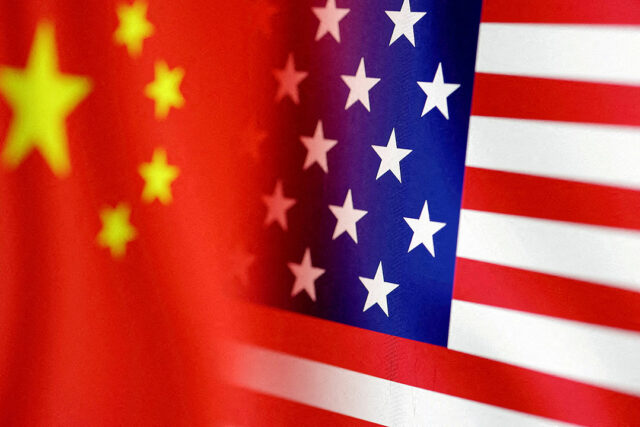
US and Chinese flags are seen in this illustration. — REUTERS

BEIJING — China on Thursday vowed to deepen investment in high-tech industries and scientific innovation, framing them as essential to bolstering national security and self-reliance amid rising geopolitical tensions and an intensifying rivalry with the US.

At the opening of the annual parliament meeting, Premier Li Qiang praised China’s ability to withstand US President Donald J. Trump’s tariff hikes, but said “multilateralism and free trade are under severe threat,” and announced 7% increases in the defense budget, as well as in research and development.

Mr. Li acknowledged an “acute” imbalance between strong supply and weak demand, subdued market expectations and ongoing risks from a persistent property sector downturn and high local government debt.

These challenges have pushed Beijing to set a slightly lower growth target of 4.5%-5% for this year, down from last year’s 5%, which was met largely through a one‑fifth surge in its trade surplus to a record $1.2 trillion.

China’s 15th five-year plan, as widely expected, pledged investments in innovation and industrial upgrading, as well as a “notable” — but unspecified — increase in household consumption as a share of economic output.

The combination of a lower growth target and higher outlays on research and strategic industries underscores Beijing’s bet that technological upgrading — not consumption — will drive its next phase of development despite growing structural pressures.

Last year’s trade punches with the Trump administration, which briefly escalated to embargo-like conditions of triple-digit tariffs, also showed the importance of its supply chain dominance as leverage.

“China’s government remains laser-focused on spurring technological breakthroughs and high-tech investment,” said Fred Neumann, chief Asia economist at HSBC. “In part, this is motivated by competition with the United States for control over the technologies of the future.”

“Many international observers may be left disappointed, therefore, by slower progress in rebalancing the economy away from investment towards consumption.”

China invests 20 percentage points of gross domestic product (GDP) more than the global average, while its households spend roughly 20 points less — a state-controlled, debt-driven development model that creates industrial overcapacity and fuels trade tensions abroad and deflationary pressures at home.

“The rebalancing challenge that China faces, and that will take years to achieve, is implicitly acknowledged by a weaker growth target for the coming year,” Mr. Neumann added.

The five-year plan aims to raise the value-added of “core digital economy industries” to 12.5% of GDP and roll out new policies for an integrated national data market and establish a system for artificial intelligence (AI) security risk prevention.

These goals reflect President Xi Jinping’s vision of developing “new productive forces” to escape the middle-income trap, counter the demographic downturn, and enhance national security by insulating China from US export controls.

China pledged support for “breakthrough” developments across a range of industries, from farm seeds and biomedicine to areas at the cutting-edge of science, such as machine-brain interfaces. State-owned enterprises were urged to create demand for made-in-China technology like semiconductors and drones.

But the five-year plan also lists new ambitions in areas China already dominates. While accounting for 85% of the electric vehicle charging stations in the world, China aims to double their number within three years.

In AI, Beijing promised to build out “hyperscale” computing clusters supported by cheap and abundant electricity.

“Beijing is trying to manage a ‘controlled glide’ in growth while building a new economy based on technology rather than property,” said Andy Ji, Asian FX & rates analyst at ITC Markets.

“It is a high stakes rebalancing where the government is betting the house on AI and advanced manufacturing.”

STEADY STIMULUS PLANS
Economists say a lower growth target allows Beijing to experiment with adjustments to industrial overcapacity, which could lead to some factory closures and job losses, but cautioned that this did not mean a departure from its production-focused growth model.

The US Supreme Court’s decision to strike down some of Mr. Trump’s tariffs and expectations that a meeting between the two countries’ presidents later in March could stabilize relations in the short term, bode well for such adjustments.

“The bigger context here is the China-US competition, but this year is the trade truce,” said Dan Wang, China director at Eurasia Group.

“It seems that China is taking advantage of this year to do some structural reform, which is the right direction for the economy in the long term, but it also means in the short term the job market pressure is way higher.”

In terms of stimulus, China plans a budget deficit of 4% of GDP and has set special debt issuance quotas at 1.3 trillion yuan ($188.5 billion, $1 = 6.8969 Chinese yuan renminbi) for the central government and 4.4 trillion yuan for local authorities — all unchanged from last year.

China pledged to raise minimum monthly pensions by 20 yuan per person and basic medical insurance subsidies for rural, non-working people by 24 yuan — marginal, rather than structural, moves. It said it wants to increase education spending, subsidize childcare and reform public hospitals, acknowledging the demographic downturn. 

Yuan Yuwei, fund manager at Trinity Synergy Investment, warned that China’s growth and policy aims for this year — prepared at the end of 2025 — do not take into account the US-Israeli attacks in Iran.

“That’s very negative to China, which counts the Strait of Hormuz as a crucial trade route,” said Mr. Yuan. — Reuters


Australia, Canada sign new deals on critical minerals

REUTERS

SYDNEY — Australia and Canada said on Thursday they had signed new agreements on critical minerals as Canadian Prime Minister Mark Carney made a landmark address to the Australian parliament, a sign of the developing bond between the “middle powers.”

Mr. Carney is on a multi-leg trip across the Asia-Pacific region also taking in Japan and India. His stop in Australia included the first address to Australia’s parliament by a Canadian leader since 2007.

“In a world of great power rivalry, middle powers have a choice: compete for favor or combine for strength,” he told lawmakers.

Introducing Mr. Carney in parliament, Australian Prime Minister Anthony Albanese said his address represented the closeness of the ties between the two nations.

“Australia and Canada are middle powers in a world that is changing. We cannot change it back, but we can back ourselves, back our citizens, and back each other,” he said.

G7 ALLIANCE
Mr. Albanese told a press conference that Australia would join Canada’s Group of Seven (G7) critical minerals production alliance.

“We have agreed to deepen our relationship across several areas, building on our joint declaration of intent on critical minerals that we signed last year,” he told a press conference.

The G7 alliance is a Canada-led initiative to diversify and secure global critical minerals production and supply.

Canada and Australia together produce about a third of global lithium and uranium, as well as more than 40% of global iron ore.

Western nations have been attempting to diversify their supply chains away from China, which still controls the majority of production and processing of critical minerals, essential for semiconductors and defense applications.

Canada believes that the best way to address the issue of concentrated supply of critical minerals is through a production alliance or a buyers’ club rather than just a price floor, Energy and Mining Minister Tim Hodgson told Reuters on Tuesday.

Australia has already allocated A$1.2 billion ($850 million, $1 = 1.4122 Australian dollars) to build a critical minerals stockpile, beginning with antimony, gallium and rare earths.

That will now be more closely aligned with Canada’s defense stockpiling regime that has a similar aim, Mr. Albanese said.

“There’s a lot Canada and Australia can do together on critical minerals as producer nations,” Australian Resources Minister Madeleine King told Reuters ahead of Mr. Carney’s visit.

Australia and Canada will also deepen cooperation in areas including defense and maritime security, trade and artificial intelligence, the two leaders said. — Reuters

Judge orders US Customs to process refunds on illegal Trump tariffs

REUTERS

WASHINGTON — A US trade court judge on Wednesday ordered the government to begin paying potentially billions of dollars in refunds to importers who paid tariffs that the Supreme Court said last month were collected illegally.

Judge Richard K. Eaton of the US Court of International Trade in Manhattan ordered the government to finalize the cost of bringing millions of shipments into the US without assessing a tariff, according to a court filing. He ordered the refunds to be made with interest.

When merchandise is brought into the United States, an importer pays an estimated amount at entry which is then finalized around 314 days later, a process known as liquidation. Mr. Eaton directed Customs and Border Protection (CBP) to finalize the entry cost on shipments without the tariff being assessed, resulting in a refund.

“Customs knows how to do this,” he told a court hearing on Wednesday, according to a recording on the court’s website. He said the agency should be able to program its system to issue refunds, which are regularly issued when an importer overpays on an estimated duty.

“They do it everyday. They liquidate entries and make refunds,” he said.

Mr. Eaton also set a hearing for Friday in which he asked for updates on CBP’s refund plans. He said in his order that the court’s chief judge indicated that Mr. Eaton is the only judge who will hear tariff refund cases.

Customs and Border Protection has said in court filings that the task of finalizing entry costs without assessing a tariff was “unprecedented” in scale and could require manual review of more than 70 million entries. The agency had said in other court filings it wanted up to four months to assess its options for paying refunds.

CBP did not respond to a request for comment.

“The language in this order strongly suggests an across-the-board approach that importers are entitled to IEEPA refunds, full stop,” Ryan Majerus, a former senior Commerce official who is now a partner with King & Spalding, said. “The government may challenge the order’s scope or, at minimum, ask for more time to enable US Customs to undertake what will undoubtedly be a monumental task here.”

The US government collected more than $130 billion in illegal tariff payments, which were central to President Donald J. Trump’s trade policy. The Supreme Court did not provide guidance for issuing refunds, creating confusion over how importers would be reimbursed.

The order by Mr. Eaton came in a case brought by Atmus Filtration, which said in court filings it paid about $11 million in the illegal tariffs.

Attorneys for Atmus did not respond to a request for comment.

Atmus’ lawsuit is among the roughly 2,000 that have been filed with the trade court seeking a refund of the tariffs imposed under IEEPA, or the International Emergency Economic Powers Act.

Mr. Eaton said he did not want to have to hear each case. “We want to work out a method by which those importers can make a claim for duties that were unlawfully applied.”

More than 300,000 importers paid the tariffs. The vast majority of importers are smaller businesses and they are hoping that Customs officials adopt a simple, low-cost system to pay reimbursements. Many told Reuters they might abandon their refund if they had to sue or go through a cumbersome Customs administrative process.

“There should be no impediment to CBP issuing refunds,” said George Tuttle, a trade attorney. — Reuters

ITB Berlin 2026 opens; Philippines sustains four-decade engagement at the world’s largest travel trade fair

Representatives of the Philippine delegation gather at the Philippine booth during the opening day of the Internationale Tourismus-Börse Berlin 2026. Led by the Tourism Promotions Board (TPB), the country’s participation brings together tourism stakeholders from across the Philippines, sustaining more than four decades of engagement with the world’s largest travel trade fair.

BERLIN, GERMANY — As ITB Berlin 2026 opened on March 3 at the International Congress Center (ICC) Berlin (formerly Messe Berlin), the Philippine booth once again welcomed international buyers. The country’s participation began in 1985 and now spans more than four decades of sustained engagement with the global travel trade. Over the years, this consistent presence at ITB Berlin has built a strong foundation for long-term partnerships and steady market development, particularly within the European outbound sector.

In the period following the pandemic, that foundation has translated into measurable results.

In 2023, sales leads generated during ITB Berlin reached P271.5 million. A year later, that figure increased by 50% to P489.1 million. By 2025, the Philippine delegation recorded P637.4 million in negotiated sales leads from 352 business meetings, a 30.31% increase from 2024, alongside the participation of 29 co-exhibitors representing a broad spectrum of the tourism sector.

This pattern of growth signals a more structured approach to international trade activity, integrating government leadership, private enterprises, and destination stakeholders within a coordinated pavilion framework. Tourism Promotions Board (TPB) Philippines Chief Operating Officer Maria Margarita Montemayor Nograles said the Philippines’ longstanding role at ITB Berlin reflects a strategic approach to market development rather than episodic visibility.

“Forty years at ITB Berlin illustrate the importance of consistency in international market outreach,” COO Nograles affirmed. “We view global trade platforms as mechanisms for partnership-building, performance assessment, and policy coherence. Our gains recorded demonstrate a more integrated tourism strategy that links national direction, private sector preparedness, and shifting international demand.”

Representatives of the Philippine delegation gather at the Philippine booth during the opening day of the Internationale Tourismus-Börse Berlin 2026. Led by the Tourism Promotions Board (TPB), the country’s participation brings together tourism stakeholders from across the Philippines, sustaining more than four decades of engagement with the world’s largest travel trade fair.

The 2026 delegation builds on that upward journey. This year, exhibitors from the Philippines represent accommodation providers, destination management companies, local government units, and tourism organizations — an expansion from the previous year and a reflection of growing confidence in the platform.

On the opening day, Philippine sellers met with international buyers with discussions spanning leisure programs, emerging regional circuits, and itineraries shaped by evolving ecotourism expectations. Dialogue increasingly reflects market interest in responsible travel practices, community-based experiences, and environmental priorities that continue to gain prominence in the global travel landscape.

In leading the delegation, TPB said this trajectory has been intentional. In recent years, promotional efforts have emphasized inclusive tourism alongside traditional destination appeal, reflecting a broader shift toward balancing growth with sustainability in international market engagement.

“Our approach to ITB Berlin today advances a more balanced narrative,” COO Nograles added. “We highlight the beauty of our destinations, and our commitment to sustainability, community participation, and long-term value creation. That alignment is central to our engagement with European partners.”

As ITB Berlin 2026 commences under challenging global circumstances, the Philippines’ presence reflects continuity and steady commitment. More than four decades of participation at the trade fair have established long-term credibility within the international travel community. This year, amid travel disruptions affecting attendance, the delegation remains focused on honoring scheduled engagements, deepening partnerships, and sustaining market conversations that support the country’s long-term tourism development. In a week that underscores the interconnected nature of global travel, the Philippines approaches its participation with professionalism, responsibility, and respect for the broader context shaping the industry.


Spotlight is BusinessWorld’s sponsored section that allows advertisers to amplify their brand and connect with BusinessWorld’s audience by publishing their stories on the BusinessWorld Web site. For more information, send an email to online@bworldonline.com.

Join us on Viber at https://bit.ly/3hv6bLA to get more updates and subscribe to BusinessWorld’s titles and get exclusive content through www.bworld-x.com.

South Africa seeks local production of Gilead’s HIV prevention drug

WHO FILE PHOTO

LONDON — South Africa is asking local drugmakers to start a process to make Gilead Sciences’ long-acting HIV prevention drug, lenacapavir, domestically, in a push to bring production to the region where it is most needed.

The government is working alongside international partners, including Unitaid and the United States Pharmacopoeia, to identify which local company could make the twice-yearly injection safely, effectively and affordably, and provide any support needed. They will then recommend that company to Gilead.

Gilead, a US pharmaceutical company, granted six voluntary licenses in 2024 to generic manufacturers across India, Egypt and Pakistan to produce and supply the drug to 120 low- and middle-income countries. These included South Africa, although there was criticism that no South African drugmakers were included.

A license for a South African company would be the seventh such deal, potentially boosting access to a drug many HIV/AIDS experts have said could help bring an end to the 44-year-old pandemic by slashing the numbers of new infections.

Gilead said it has been open to adding an additional voluntary license for local manufacturing in Sub-Saharan Africa. “Gilead will review the proposals and assess whether required quality standards can be met before any voluntary license is granted,” the company said in an email.

AFRICA REMAINS EPICENTER OF HIV PANDEMIC
Despite progress, the African region remains the epicentre of the HIV pandemic. South Africa has the highest number of people affected at 8 million – around one in five adults – living with the virus. Several companies in South Africa already make HIV treatments or sterile injectables, like Aspen Pharmacare.

Paul Mashatile, chair of the South African National AIDS Council and deputy president, said making the drug in South Africa would benefit the whole region.

“Africa can no longer rely on medicines produced elsewhere for diseases that affect us most,” said Kenyan President William Ruto, African Union lead on local manufacturing of health commodities.

ACCESS CHALLENGES
In the past, low- and middle-income countries waited years for HIV drugs available in richer nations. Lenacapavir is already available in some African countries through an initiative supported by The Global Fund to Fight AIDS, Tuberculosis and Malaria and the US government, but demand is expected to outstrip supply until the generic manufacturers start making the drug.

Those agreements also faced some criticism for excluding middle-income countries like Brazil. A South African company could try to expand access there, too, Unitaid said.

“It’s an opportunity to open the door further,” said Unitaid’s director of program, Robert Matiru, although he said a license for a South African company was the key aim. — Reuters

China’s new five-year plan calls for AI throughout its economy, tech breakthroughs

A HUMANOID ROBOT performs a dance with robot dogs dressed in lion costumes on the first day of the Lunar New Year of the Horse, at the Niangniang Temple in Beijing, China, Feb. 17, 2026. — REUTERS/MAXIM SHEMETOV

BEIJING — China’s new five-year policy blueprint laid out its ambitions to aggressively adopt artificial intelligence throughout the world’s second-biggest economy and dominate emerging technologies such as quantum computing and humanoid robots.

The country will “seize the commanding heights of science and technological development” and seek “decisive breakthroughs in key core technologies”, according to the plan released on Thursday to coincide with the opening session of the National People’s Congress.

A separate report by the country’s state-planning body also asserted that China was outpacing rivals in AI research and development as well as other key areas.

“China now leads the world in research and development and application in fields such as AI, biomedicine, robotics, and quantum technology, and new breakthroughs were made in the independent R&D of chips,” it said.

SWEEPING AI+ ACTION PLAN
The 141-page five-year blueprint, which covered a wide range of socio-economic targets and policies, mentioned AI more than 50 times and included a sweeping “AI+ action plan”.

The focus on tech reflects China’s need to grapple with its rapidly ageing workforce and looming demographic crisis, its fierce battle with the United States for supremacy in core technologies, as well as dramatic progress made by Chinese AI model developers such as DeepSeek.

Specific measures in the plan include experimenting with robots to perform jobs in sectors suffering from labor shortages and deploying AI agents that can perform tasks with minimal human guidance.

“Beijing’s goal is to use AI and robotics to boost productivity and performance in a wide range of sectors, from manufacturing and logistics to education and healthcare,” said Kyle Chan, fellow in Chinese technology at the Brookings Institution think tank.

The government also highlighted its commitment to technology – an area it calls “new quality productive forces” – in the opening paragraphs of the main government work report presented by Premier Li Qiang. That was far more prominent than last year’s report.

China’s reliance thus far on US tech such as chips and planes has been a major source of frustration as trade tensions soared. Their tech war has seen both sides place export controls on some key products and resources – advanced chips most notably in the case of Washington and rare earths and critical minerals in the case of Beijing.

HUMANOID ROBOTS, 6G AND QUANTUM
The government work report and five-year blueprint outlined plans to increase investment in quantum computing, 6G, embodied AI – the tech that powers humanoid robots – and areas at the cutting-edge of science, like machine-brain interfaces.

The five-year plan also pledged to achieve “key breakthroughs in nuclear fusion technologies”, develop a reusable heavy-load rocket, construct an integrated space-earth quantum communication network, develop scalable quantum computers, and demonstrate the feasibility of building a lunar research station.

It also emphasized China’s goal to become a world leader in frontier R&D by “accelerating breakthroughs in basic theories and foundational technologies” and investing in basic research and cultivating a world-class talent base in science and tech.

The Chinese government also promised to build out “hyper-scale” computing clusters supported by cheap and abundant electricity and also support the building of AI open-source communities.

“Open source wasn’t mentioned in previous reports, and this is also a key difference between the Chinese and American AI approaches,” said Tilly Zhang, technology, and industrial policy analyst at Gavekal Dragonomics.

“I believe China has studied this very carefully and decided to make open-source AI a flagship strategy and a competitive advantage against the United States.” — Reuters

Italy plans to send air defense aid to Gulf states after Iranian strikes, Meloni says

LEADER of Brothers of Italy Giorgia Meloni is seen at the party’s headquarters, in Rome, Italy, Sept. 26, 2022. — REUTERS

ROME — Italy is planning to send air defense aid to Gulf countries in response to Iranian air strikes, Prime Minister Giorgia Meloni said, underscoring Rome’s concern for the safety of its citizens and troops in the region as well as for energy security.

“Like the United Kingdom, France and Germany, Italy intends to send assistance to Gulf countries, specifically in the field of defense and in particular air defense,” Ms. Meloni told radio station RTL 102.5 on Thursday.

She said the move was driven not only by diplomatic ties but by the presence of Italians on the ground. Tens of thousands of Italian nationals live in the Gulf, while around 2,000 Italian troops are deployed there, she said.

“These are people we want to, and must, protect,” Ms. Meloni added, noting that the Gulf region was also vital for Italy’s and Europe’s energy supplies.

Ms. Meloni also addressed questions about the possible use of US military bases on Italian soil, saying Italy and its allies were respecting the terms of existing bilateral agreements.

“This means that what is laid down in the agreements is not being called into question, and I think that applies to everyone. The same applies to us,” Ms. Meloni said.

Italy hosts military bases used by the United States under agreements dating back to 1954, which have been updated over time. Under those accords, Ms. Meloni said, technical authorizations are in place for logistics and so‑called non‑kinetic operations, which she described as non‑bombing activities.

If requests were made for a broader use of Italian bases, Ms. Meloni said the government would have the authority to decide whether to grant them, but that such a decision would involve parliament.

“As of today, however, we have received no such requests,” she said. “We are not at war and we do not want to enter a war.” — Reuters

ADVERTISEMENT
ADVERTISEMENT