Home Blog Page 2083

PHL mortgage rates seen steady until mid-2025

A VIEW of residential condominium buildings in Mandaluyong, Metro Manila, Aug. 22, 2016 — REUTERS

MORTGAGE RATES in the Philippine residential sector are expected to remain unchanged until mid-2025 despite the recent rate cut, according to Colliers Philippines.

“We’ll probably see the full effect by mid-2025, and hopefully that results in lower mortgage rates because the average mortgage rate right now is only about 8.3%,” Joey Roi Bondoc, director for research at Colliers Philippines, told reporters a day before the policy meeting of the Bangko Sentral ng Pilipinas (BSP) on Oct. 16.

“That’s still pretty high, and that has been resulting in lower take-up of residential units, especially in Metro Manila,” he added.

The Monetary Board on Oct. 16 cut benchmark interest rates by 25 basis points (bps), as expected by 16 of 19 analysts in a BusinessWorld poll, since price pressures remain manageable. This brought its policy rate to 6%.

BSP Governor Eli M. Remolona, Jr. said another 25-bp cut to benchmark rates could be made at the December 19 meeting.

Lower mortgage rates will stimulate the market, increasing the demand for residential units, Mr. Bondoc noted.

He added that the mid-income segment is mostly affected by higher mortgage rates.

“If you look at pre-pandemic, at the time, we were looking at the take-up in the preselling condominium sector of 55,000-58,000 units. Now we’re good at what? 15,000, 20,000 units in a single year,” he said.

Mr. Bondoc said that Philippine offshore gaming operators (POGOs) were once a crucial factor in the demand for condominiums in Metro Manila.

“Because if you’re an OFW (overseas Filipino worker), the most attractive price point is the P2.5 (million) to P7 (million). So that’s affordable to lower mid-income. Given that mortgage rates are still elevated, some OFWs are still not keen on acquiring residential units,” he said.

Due to the elevated mortgage rates, OFWs are wary in terms of buying residential units despite increasing remittances, Mr. Bondoc added.

Meanwhile, economist Bernardo M. Villegas said the Philippines continues to be one of the fastest-growing economies in the Association of Southeast Asian Nations region despite global uncertainties.

“With a projected growth rate of over 6% in the coming years, we are poised to lead in economic resilience and transformation,” he said during a forum.

Mr. Villegas noted that the current administration’s efforts have established a “solid foundation” for inclusive growth, with advancements in infrastructure, investments, and the digital economy set to propel our progress further. — Aubrey Rose A. Inosante


Mitzi Gaynor, star of Hollywood musicals, 93

MITZI GAYNOR and Rossano Brazzi in a scene from the 1958 film South Pacific. — IMDB

MITZI GAYNOR, whose singing and dancing brightened Hollywood musicals throughout the 1950s, including trying unsuccessfully to “wash that man right outa my hair” as nurse Nellie Forbush in South Pacific, has died at the age of 93.

Ms. Gaynor died peacefully of natural causes, her management team said on Thursday.

“For eight decades she entertained audiences in films, on television and on the stage… Off stage she was a vibrant and extraordinary woman, a caring and loyal friend, and a warm, gracious, very funny and altogether glorious human being,” they wrote on X.

Ms. Gaynor had prominent roles in There’s No Business Like Show Business in 1954 with Ethel Merman and Marilyn Monroe and in the 1957 films Les Girls with Gene Kelly and the The Joker Is Wild with Frank Sinatra. The previous year she starred with Bing Crosby and Donald O’Connor in Anything Goes, singing Cole Porter’s title song.

Ms. Gaynor’s movie career lasted a little more than a decade, but she went on to success as a nightclub performer and put on a series of annual television variety specials in the 1960s and 1970s. She was still performing an autobiographical stage show — a mix of singing, dancing and remembrances titled Razzle Dazzle! My Life Behind the Sequins — in her ’80s.

Ms. Gaynor was born Francesca Marlene de Czanyi von Gerber in Chicago. Her mother was a dancer and her father a violinist and musical director. After a move to California she became part of the Los Angeles Civic Light Opera, adding three years to her age to make the company believe she was 16. Executives from 20th Century Fox spotted her and offered her a contract.

Actor George Jessel told her that her last name brought to mind a delicatessen or the Gerber baby food company and she followed his suggestion to change it to Gaynor.

NO LACK OF ENERGY
Her first film was the Betty Grable-Dan Dailey musical My Blue Heaven in 1950 and she would go on to make nearly 20 movies that called for a singer or dancer with lots of energy.

Ms. Gaynor, discussing her enthusiasm for performing, once said, “If there were four people waiting for the streetcar, I’d put on an entire act.”

Pianist Oscar Levant, watching Ms. Gaynor dance on the set of The I Don’t Care Girl, said of her: “There’s nothing wrong with being an exhibitionist — if you’ve got something to exhibit.”

As her career was building, Ms.Gaynor dated industrialist-studio chief Howard Hughes.

“He was dashing, handsome, rich, mysterious,” she said. “I fell madly in love with him. There were airplanes, a whirlwind courtship and, after five months, he proposed.”

She broke it off and instead married Jack Bean, who would become her manager and only husband.

Ms. Gaynor’s Hollywood highlight was the film version of Richard Rodgers’ and Oscar Hammerstein’s 1949 stage musical South Pacific, which had won 10 Tony Awards and a Pulitzer Prize for Drama. The 1958 movie had been long awaited and Ms. Gaynor was cast in the prized role that Mary Martin had played on Broadway.

She played Nellie Forbush, a naive young nurse from Arkansas stationed in the Pacific during World War Two who falls in love with Emile De Becque, a French expatriate planter played by Rossano Brazzi. Nellie turns down De Becque’s marriage proposal because he has two mixed-race children but when he goes missing during a Navy-backed mission against the Japanese, Nellie realizes her racial prejudice is misguided and grows to love the children.

The film was not a critical success but still was one of the biggest box-office draws of the 1950s. Ms. Gaynor’s performance earned her a Golden Globe nomination.

The movie soundtrack was brimming with songs that became popular standards, such as “Some Enchanted Evening,” “Bali Ha’i,” “There Is Nothing Like a Dame,” “I’m in Love With a Wonderful Guy,” and “Younger Than Springtime.” Gaynor singing the bouncy “I’m Gonna Wash That Man Right Outa My Hair” on the beach was one of the film’s standout scenes as her character tried to get over De Becque.

With the era of Hollywood musicals fading, Ms. Gaynor’s last screen role was For Love or Money, which paired her with Kirk Douglas, in 1963.

She then concentrated on live stage shows and became a regular performer in the big Las Vegas resorts. She also staged frequent television variety specials, starting in 1967, with titles such as Mitzi … A Tribute to the American Housewife, Mitzi … And a Hundred Guys, and Mitzi … What’s Hot, What’s Not.

She also appeared as a performer at the Academy Awards several times, notably singing the theme song from Georgy Girl at the 1967 ceremony when it won an Oscar for best original song.

It was during her Las Vegas run that Ms. Gaynor teamed up with a young Bob Mackie and helped him start his career as a costumer with a flair for rhinestones, sequins, beads, feathers, and tassels. Mackie also created the gowns she wore on her television specials.

Ms. Gaynor and Mr. Bean, who were married for 52 years until his 2006 death, had no children. — Reuters

BSP, BAP working to expand GS repo market

THE BANGKO SENTRAL ng Pilipinas (BSP) and Bankers Association of the Philippines (BAP) are seeking to include fund managers and trust entities in the government securities (GS) repurchase agreement (repo) market in their bid to help deepen the country’s capital markets.

The BAP on Monday said it is working with the Money Market Association of the Philippines (MART), Fund Managers Association of the Philippines, and Trust Officers Association of the Philippines on the matter.

The BSP and BAP earlier this month announced their plans to enhance the interest rate swap market and the GS repo market to improve benchmarks for a smoother yield curve and deepen the Philippines’ capital markets.

The repo market for government securities will be expanded to boost trading and provide an alternative benchmark for short-term loan rates.

The BSP is currently working to shift the current system of “tagging” securities to banks that place cash with it via the reverse repo window to instead allow for the full delivery of these securities. Banks would then be able to trade these securities.

“We need to start developing our capital markets to work hand in hand with the banking market to be able to generate capital that is needed to support all of these endeavors,” BSP Open Market Committee Chairman Paul Raymond A. Favila said at a briefing on Monday.

“Of course, you have the more developed economies, even within Asia. Obviously, one would be Singapore. And in Singapore, they do have a capital market, relatively vibrant. They have the ability to develop their capital markets well ahead of what the countries’ needs are,” he said. “In the Philippines, it’s the other way around. We need it, we need it tremendously, but in terms of development, we are nowhere near where we want to be.”

Mari Toni Bautista, president of the National Association of Securities Broker Salesmen, Inc. (NASBI), which is organized by the BAP, said that repos will help deepen liquidity in primary and secondary bond markets.

“Repos enhance market liquidity by providing a funding source for investments in government bonds and for financing dealer inventory of securities held for trading,” she said during the same briefing.

These also help facilitate price discovery and transparency of bond prices, which allows for the development of risk mitigation tools and the broadening of the investor base, she added.

“The repo market is actually open to all government securities eligible dealers (GSEDs) and we are looking to expand the participants to include non-GSEDs,” she said.

“My estimate is that we have around seven to 10 banks who can deal now in the MART GS repos, but we have a lot of banks in the pipeline, (just) working on the GMRAs with each other,” she added.

The Global Master Repurchase Agreement (GMRA) is a legal agreement for repo transactions.

The GS repo market, which is operated by MART, was launched in 2017 and only allowed GSEDs to first “test the waters,” Ms. Bautista said.

She said the development of the market took a bit of time as the GMRAs needed to be executed. The pandemic also slowed down this process, she added.

“Currently, the trust entities are speaking with the Bureau of Internal Revenue to expand Revenue Memorandum Circular No.095-17 on the MART GS repos outlining DST (documentary stamp tax) exemption for GSEDs only.” — L.M.J.C. Jocson

IABC Philippines announces Triple P Awards panel

THE INTERNATIONAL Association of Business Communicators (IABC) Philippines, along with Deloitte and the Makati Business Club, announced on Monday the evaluators for the upcoming Triple P Awards, which recognize companies for their progress in environmental, social, and governance (ESG) areas.

The panel of evaluators comprises leaders in sustainability and corporate communications.

For corporate sustainability, the evaluators include United Nations Development Programme (UNDP) Climate Action Team Outcome Lead Floradema C. Eleazar, UNDP Sustainable Development Goal (SDG) Specialist Aljo R. Quintans, and climate education and sustainability advocate Ludwig O. Federigan.

The evaluators for the corporate communications category are IABC Philippines President Belle Tiongco and SustainablePH Acting President and sustainability communication veteran Dave Jesus T. Devilles.

The evaluation process focuses on long-term impact and uses metrics tailored to the unique challenges of each sector, IABC Philippines said in a statement.

The Triple P Awards night is scheduled on Oct. 25 at the Manila Marriott Hotel in Pasay City.

IABC Philippines is an organization that represents professionals in the field of business communication in the Philippines. — Revin Mikhael D. Ochave

The energy transition is powered by — wait for it — coal

FREEPIK

IN WHAT should be one of the least surprising developments, global electricity demand is soaring everywhere as the world moves to electrify everything. Out go gasoline cars, in come electric vehicles; out go gas boilers, in come heat pumps; and so on and so forth. That’s the energy transition.

There’s a catch, however. As demand for power goes up faster than renewables can supply, the world is turning to a time-tested source to produce it: coal.

The result is twofold. First, the year when coal demand is expected to peak gets pushed further out. Second, what follows the peak now resembles more an elevated plateau that’s getting higher and higher by the year. And if history is any guide, we should expect further revisions.

One barely hears about this in glossy descriptions of the energy transition. Coal only gets mentioned when some country closes its last coal-fired power station. That was the message recently in the UK, which put an end to 142 years of coal-generated power when the country closed its last coal plant in late September in Ratcliffe-on-Soar, about 100 miles north of London. Meanwhile, Asia has been busy opening new ones.

The reality for the most polluting of all fossil fuels is record consumption and stronger-than-expected demand in the future. It’s a sign of the uneven, fits-and-starts nature of the energy transition: Record solar generation and record coal demand can coexist.

Last week, the International Energy Agency (IEA) published its annual World Energy Outlook, a comprehensive review of the likely paths that supply and demand for fossil fuels and renewable sources of energy would follow up to 2050. Buried in the 398-page report was a warning: “The outlook for coal has been revised upwards particularly for the coming decade, principally as a result of updated electricity demand projections, notably from China and India.”

It wasn’t a small revision: Coal consumption in 2030 is now estimated 6% higher than only a year ago. That may sound small, but it amounts to adding the equivalent of the consumption of Japan, the world’s fourth-largest coal burner. By 2030, the IEA now believes coal consumption will remain higher than it was back in 2010.

This was an important change in what was otherwise an upbeat report. Wind and solar continue to expand faster than many thought, including the IEA. As a result, they are increasingly growing their market share. “In energy history, we’ve witnessed the Age of Coal and the Age of Oil,” IEA Executive Director Fatih Birol said. “We’re now moving at speed into the Age of Electricity.”

Birol, an economist who has gone from cheerleading the fossil fuel industry to rebranding himself as a green champion, is not wrong. Yet, he left a lot unsaid about that new electricity age. Around the world, over a third of those electrons come from burning coal. In China, that goes up to 60%; in India it rises to almost 75%.

Coal is needed because power use is accelerating faster than renewable sources can provide. It’s also dependable: It doesn’t rely on weather conditions like hydropower, wind, and solar do. Other than coal, only nuclear power plants and gas-fired stations can provide electricity around the clock. One day, perhaps, solar and wind will be able to do so in combination with batteries. But for now, battery storage is short-lived and tiny when compared with the energy needs of even medium-sized cities.

One notable statistic: Two-thirds of the total increase in energy demand in 2023 was met by fossil fuels, according to the IEA.

Yes, clean power is the future. For now, however, fossil fuels remain the present — especially when electricity demand is accelerating this fast. Between 2023 and 2030, electricity consumption is expected to grow six times faster than total energy demand, compared with two times faster in the 2010-2023 period and 1.4 times faster in 2000-2010. According to the IEA, the equivalent of the electricity use of the world’s 10 largest cities is being added to global demand each year.

The acceleration isn’t about artificial intelligence and data centers as is often lamented. If anything, they would account for a fraction of the increase in consumption. Demand for power is coming from everywhere, notably electric vehicles, air-conditioning, and even water desalination.

The epicenter of the electricity boom is Asia, so it makes sense that the world’s two largest coal consumers, China and India, not only aren’t abandoning coal, but are still building more coal-fired power stations. The result is an energy transition that is more polluting than many had hoped.

Under former US climate envoy John Kerry, America reached a sort of détente with China about the energy transition. The unwritten deal involved China giving up coal over time. With hindsight, it feels like Beijing played Kerry, who was desperate for a deal at the COP26 climate summit in 2021 in Glasgow — the first gathering for the Biden administration, when the White House wanted to burnish its green credentials after Trump.

It’s time for a new approach. The world can’t claim it’s moving in the right direction until coal consumption has dropped meaningfully, say to the levels of 2000. On current trends, that’s unlikely to happen until well beyond 2050. Policymakers should stop pretending as if the war against coal has been won. We’re still far from it.

BLOOMBERG OPINION

Talent, infrastructure boost regional offices

DAMOSA BUSINESS DISTRICT — DAMOSALAND.COM

SKILLED talent availability and infrastructure development are driving growth in the regional office market, according to real estate services firm KMC Savills, Inc.

“[It] is labor driven, driven by the graduate pools,” Joe Curran, chief executive officer of KMC Savills said during a virtual briefing on Thursday last week.

“Some clients of providers will want them to be outside Metro Manila,” he added.

Additionally, they have business continuity requirements, ensuring that if infrastructure in Manila fails, they can quickly operate in Davao or Cebu, he noted.

Mr. Curran also said the firm still sees many captive shared services centers that would like to locate in the traditional business districts within Metro Manila due to the “comfort level” of being in the capital and having access to a mature talent pool.

Likewise, Cha Carbonell, chief operating officer of KMC Savills, noted the correlation between the number of graduates produced by certain regions and the office take-up in these areas.

The information technology and business process management sector still holds the largest market share in take-ups.

She said net take-up in Metro Cebu reached 39,000 square meters (sq.m.) in the first half of 2024, Metro Clark at 19,000 sq.m., and Davao’s office market saw a “significant” upturn with net take-up totaling 12,400 sq.m.

Meanwhile, Bacolod maintained a consistent net take-up of 3,700 sq.m. during the same period.

Ms. Carbonell said the regional markets will still see demand increasing in the next quarters, which will lower the vacancies.

Iloilo had the highest vacancy rate at 28% for the first half of 2024, followed by Metro Clark at 26% and Bacolod at 23%. Meanwhile, Metro Cebu fell to 15% and Davao at 9%.

“The Visayas office market, in particular, demonstrated strong growth, led by Iloilo’s addition of 105,200 sq.m. of office space with Cebu set to surpass this by 2025,” the firm said.

KMC said while cities like Bacolod and Davao are seeing “positive momentum,” Metro Cebu and Metro Clark faced slowdowns due to limited supply.

Cebu is expected to surpass Iloilo with an additional 143,800 sq.m. of office supply by the end of 2025, it said.

Metro Cebu is anticipated to see an increase in office space transactions due to its popularity in business expansion.

In terms of rents, KMC said Iloilo and Bacolod have experienced a decline in rental rates, while Davao, Metro Clark, and Metro Cebu saw increases. — Aubrey Rose A. Inosante

Entertainment News (10/22/24)


BenildeFilm holds horror film screenings, discussions

FOR HALLOWEEN, in-depth discussions on the landscape of Philippine horror and free public screenings of thrillers and fright films will be held in a three-day festival entitled LAGIM! Organized by BenildeFilm, the event will open with a conversation on genre filmmaking with screenwriter Wanggo Gallaga (T’yanak, 2014), film director Carlo Ledesma (Outside, 2024), and film academic and horror connoisseur Ed Cabagnot. The speakers will walk the audience through the various themes and topics which make a classic Filipino horror movie. They will share their sources of inspiration and processes, as well as several tips for navigating the industry. It is scheduled for Oct. 25, 5 p.m. onwards, with a total of 14 short films shown at the 12th Floor Screening Room of the Design + Arts Campus of the De La Salle-College of Saint Benilde. For more details on the films and schedule, visit BenildeFilm’s social media pages. Interested participants may register through: forms.gle/xueovyNjRZ5Hm5rs6. 


The Pen holds musical Christmas tree lighting ceremony

THE Peninsula Manila is signaling the start of its Christmas season with the annual Christmas Tree Lighting Ceremony on Oct. 25. Aside from the lighting itself, the event will be filled with music by The Peninsula Strings and Ateneo Chamber Singers, as well as a festive merienda buffet. The hotel’s mascot, Peter Bear, will be assisted by Make-A-Wish Philippines’ Wish Kids in lighting the 45-foot-tall tree. The merienda buffet, available from 3 to 6 p.m. on that day, costs P2,888 for adults and P1,444 for children. To reserve, contact Restaurant Reservations at 8887-2888 (extension 6694) or e-mail diningpmn@peninsula.com.


Frank Ely’s new single in playable postcard format

HONG KONG-based record label Evosound has utilized the latest in sound technology to release Frank Ely’s new single, “Maisayaw,” in a playable postcard format — a first of its kind in the Philippines. The visual treat, which doubles as a vinyl single that can be spun on any record player or turntable, redefines music packaging with a blend of technology, art, and nostalgia. Inspired by the old record postcards that were sold in the 1960s and ’70s in Europe, the revived format offers a tangible music experience complete with full-colored visuals and comparatively light plastic grooves. “I thought it was cool to be the pioneering act to have my song pressed in a format that’s never been done, at least locally. It’s interesting how music packaging can change the course of the game and offer an exciting glimpse into the future of releases. The possibilities are just endless,” said Mr. Ely. His single, “Maisayaw,” expresses romantic admiration from a distance, dedicated to his now-girlfriend and inspired by the classic kundiman.


MBNel collabs with O Side Mafia for new single

FILIPINO-American rapper MBNel is showcasing the Philippines’ rap talent before a global audience through “Ashtray,” a single featuring Filipino hip-hop trio O Side Mafia. It alternates between English and Tagalog verses in a fast, edgy, catchy, Pinoy rap. “It’s dope hearing Tagalog flow on this type of song because it’s not too far from the lane they do,” says MBNel about his collaboration with the O Side trio. “Ashtray” is out now on digital streaming platforms.


Carnival Cruise Line visits PHL for the first time

CARNIVAL Cruise Line (CCL) recently celebrated its first-ever visit to the Philippines, with the Carnival Panorama arriving at the South Harbor’s Eva Macapagal Super Terminal on Oct. 18, 6 a.m. Carnival Panorama’s Captain Luca Lazzarino, Chief Engineer Stefano Gazzolo, and Hotel Director Hector Groves led the commemoration activity along with local dignitaries and representatives of Cruise Administration Services, Inc. and Open Sea Crewing Agency, Inc. The Manila visit is part of the ship’s 25-day Transpacific Carnival Journeys cruise from Singapore to Long Beach, California. Measuring 1,055 feet in length and with a capacity of 4,000 guests and 1,450 crew members, Carnival Panorama debuted in 2019 and is based in California. After Singapore, its stops were Ho Chi Minh, Vietnam, and Kota Kinabalu, Malaysia, before arriving in Manila, Philippines. The visit saw the vessel’s crew members go ashore and spend some time with their families, who were also welcome to glimpse life on board.


Phum Viphurit releases new EP

FOLLOWING the surprising singles “The Other Side” and “Balter Baby,” Phum Viphurit has presented his new project, Paul Vibhavadi Vol. 1, in its complete form. The Bangkok-born singer-songwriter took his creativity and eccentricity to new heights through the four-song EP, which tells the fictional story of Paul Vibhavadi, the “world’s fastest moving bilingual sloth who is on a quest to find inner peace.” Said Mr. Viphurit: “For the longest time I’ve been into early 2000s house music and I always knew that I wanted to incorporate my guitar playing into that type of BPM. When I had the idea of these four tracks in mind, I immediately thought of an alter-ego,” with David Bowie’s Ziggy Stardust as one such inspiration. The EP is out now on all digital streaming platforms.

How PSEi member stocks performed — October 21, 2024

Here’s a quick glance at how PSEi stocks fared on Monday, October 21, 2024.


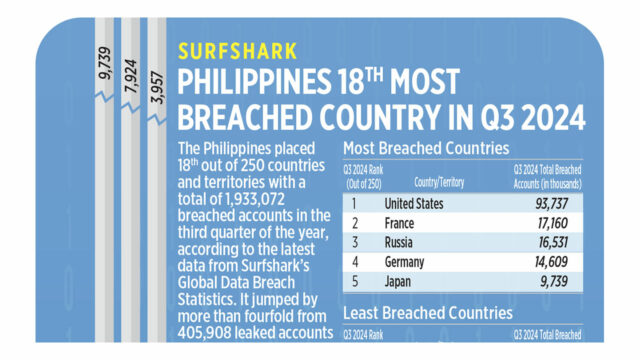
Surfshark: Philippines 18th most breached country in Q3 2024

The Philippines placed 18th out of 250 countries and territories with a total of 1,933,072 breached accounts in the third quarter of the year, according to the latest data from Surfshark’s Global Data Breach Statistics. It jumped by more than fourfold from 405,908 leaked accounts in the second quarter of 2024. The Philippines was the fourth-most breached country/territory in the region during the period.

Surfshark: Philippines 18<sup>th</sup> most breached country in Q3 2024

OSG urged to probe land titles linked to Chinese

Police raided a suspected Philippine offshore gaming operator hub in a building in Parañaque City. — PHILIPPINE STAR/EDD GUMBAN

A HOUSE of Representatives quad committee on Monday submitted to the Solicitor General documents detailing how a Chinese national fraudulently acquired Filipino citizenship so he could own land and set up businesses in the Philippines.

“These activities are in clear violation of our laws and require immediate executive action,” the House committees on dangerous drugs, public order, human rights and public accounts said in a joint letter to Solicitor General Menardo I. Guevarra.

They urged the top government lawyer to fast-track the review of the documents and start legal action including forfeiture proceedings “given the severe national security implications and the clear violations of legal processes.”

“Several Chinese personalities” bought “thousands of hectares of land,” Surigao del Norte Rep. Robert Ace S. Barbers, who heads the dangerous drugs committee, separately told a news briefing.

Some of the documents sent to the Office of the Solicitor General (OSG) included fake birth certificates, tax declarations, corporate records and land sale deeds tied to a Chinese national.

Government lawyers would review the documents submitted by the House bodies, Assistant Solicitor General Hermes L. Ocampo told the same briefing.

He said they could start legal actions such as forfeiture cases through the Anti-Money Laundering Council, the recovery of illegally acquired real estate. The 1987 Philippine Constitution bars foreigners from owning land.

Properties transferred to Filipino dummies could still be litigated, he said, noting that they could file administrative and criminal cases against the Filipinos.

“We do not have the final figure, but if we base it on the number of titles acquired, whether transferred to the name of the Chinese national or to his registered corporation, it is about 300 to 400 titles,” he said in Filipino.

“We have to expedite all issues pertaining to the properties owned by Chinese individuals pretending to be Filipinos,” Sta. Rosa City Rep. Dan S. Fernandez told the same briefing in mixed English and Filipino.

Mr. Barbers said his committee might craft a bill making the process of acquiring a birth certificate more rigorous. “The requirements for issuing a certificate of live birth need to be strict, especially for those applying under the late registration policy.”

Meanwhile, the Department of Justice (DoJ) said more than 5,000 people employed by Philippine Offshore Gaming Operators (POGO) and internet gaming licensees (IGL) have yet to downgrade their visas to comply with President Ferdinand R. Marcos’ order of a total ban.

“There are many people who have not voluntarily downgraded their visas,” Justice Secretary Jesus Crispin C. Remulla told reporters. “This presents a dilemma for us because it shows that many of them really don’t want to leave the country.”

The visa downgrade allows foreigners to revert their status from a work visa to a temporary visitor visa. In comparison, more than 12,000 foreign workers of discontinued POGOs have applied for the downgrade, the Bureau of Immigration said earlier.

They now hold temporary tourist visas for 59 days, allowing them to stay in the country while winding down their affairs, it added. The deadline for the voluntary visa downgrade was on Oct. 15.

Mr. Remulla said they are automatically downgrading the visas of the more than 5,000 delinquent workers.

The Immigration bureau noted that if a Chinese national employed by an internet gaming licensee fails to apply for a visa downgrade, he will have an “Order to Leave” stamped on his passport, which means he must leave the country immediately.

The foreigner will have a hard time returning to the Philippines.

Philippine Amusement and Gaming Corp. (PAGCOR) Assistant Vice-President Catalino B. Alano, Jr. told BusinessWorld via Viber that 38 of the 41 internet gaming licensees were still winding down their operations.

Mr. Marcos in his state of the nation address to Congress in July ordered the closure of POGOs and IGLs, which he said were linked to crimes including scams and human trafficking. — Kenneth Christiane L. Basilio and Chloe Mari A. Hufana

17 Abu Sayyaf terrorists convicted  for Sipadan resort abductions in 2000

PHILSTAR FILE PHOTO

A PHILIPPINE trial court has convicted 17 members of the Abu Sayyaf terror group for kidnapping 21 tourists from a Malaysian dive resort in April 2000.

In a 157-page decision dated Oct. 16, Taguig regional trial court Presiding Judge Mariam G. Bien found the accused guilty of 21 counts of kidnapping and serious illegal detention with ransom, sentencing each of them to a 40-year jail term for each count.

They were also ordered to pay each of the 21 victims P100,000 in civil indemnity, P100,000 in moral damages and P100,000 in exemplary damages, with a 6% annual interest.

The charges against 13 other Abu Sayyaf members who have since died were dismissed, including Galib Andang alias Commaner Robot.

“The kidnappers… acted in concert in kidnapping and detaining the hostages,” according to a copy of the court decision sent by the Department of Justice to reporters on Monday. The abduction was “a carefully laid out plan to execute the crimes charged,” it added.

Of the 21 victims at the Sipadan Diving Resort in Malaysia, 10 were foreign tourists  — three Germans, two Finnish, two South Africans, one Lebanese and two French. The rest — nine Malaysians and two Filipinos — were resort workers.

After kidnapping the victims, the rebels took them hostage in the southern Philippine province of Sulu.

Two victims were killed during the ordeal — one was beheaded and one died during a military encounter. The rest were released one by one after their families paid ransom money.

The last hostage, a Filipino, escaped in June 2003.

DoJ said two of the 17 Abu Sayyaf members were under the United Nations Security Council’s sanction list.

“The UN Security Council tagged them both in 2008 for their association with Al-Qaida, Usama bin Laden or the Taliban and for ‘participating in the financing, planning, facilitating, preparing, or perpetrating of acts or activities by, in conjunction with, under the name of, on behalf of, or in support of and recruiting for the Abu Sayyaf Group, Jemaah Islamiyah and the Rajah Solaiman Movement,” it said in a statement.

Many of the rebels were arrested and prosecuted after the incident, but they died during an attempted jailbreak in Taguig City in 2005.

Libyan dictator Muammar Gaddafi mediated the crisis, leading to the release of six hostages in mid-2000. The hostages were flown on a Libyan aircraft, first to the United Arab Emirates and then to Tripoli, the Libyan capital. — Chloe Mari A. Hufana

Marcos’ trust and satisfaction ratings up in October poll

PRESIDENT Ferdinand R. Marcos, Jr. during his third state of the nation address on July 22, 2024. — PHILIPPINE STAR /KJ ROSALES

PRESIDENT Ferdinand R. Marcos, Jr.’s the trust and satisfaction ratings rose in an October poll by Acquisition Apps, Inc. (Tangere) amid a widening rift in the camp of his predecessor.

His trust rating rose to 59.3% in the Oct. 16-19 poll from 58.8% in September. His satisfaction score also rose to 46.9% from 46.4%.

Support for Mr. Marcos was strongest in Northern and Central Luzon. He got the highest levels of satisfaction and trust among Filipinos aged 18 to 35 years.

The President received the highest dissatisfaction and distrust scores in Mindanao and among Filipinos aged 51 years and above.

On the other hand, the trust rating of Vice-President Sara Duterte-Carpio fell to 56% from 56.8% in September, while her satisfaction rating dropped to 48% from 48.7%.

Ms. Duterte-Carpio, daughter of Mr. Marcos’ predecessor Rodrigo R. Duterte, resigned as Education secretary in June, amid the widening rift between the two dynastic families.

Mr. Marcos has veered away from key policies of Mr. Duterte, standing up to China and pursuing closer security ties with western nations including the US.

An investigation led by a quad committee at the House of Representatives found that Mr. Duterte allegedly offered police cash incentives for drug-related killings during his six-year term.

The dissatisfaction rating of Ms. Duterte rose to 35.9% from 32%, while her distrust rating rose to 25% from 22%.

Senate President Jose Francis “Chiz” G. Escudero kept his position as the highest-rated government official with 52% of Filipinos expressing satisfaction with his performance.

Speaker Martin G. Romualdez’s satisfaction rating rose to 46.8% from 46.3%, while his trust rating increased to 57% from 56.4%.

Chief Justice Alexander G. Gesmundo’s satisfaction and trust ratings remained the lowest among top government officials at 39.1% and 43%, respectively.

Tangere interviewed 2,000 Filipino adults using a mobile app for the poll, which had a margin of error of ± 2.2 points. — Kyle Aristophere T. Atienza