Home Blog Page 2055

SRP guide shows price increases for 77 items
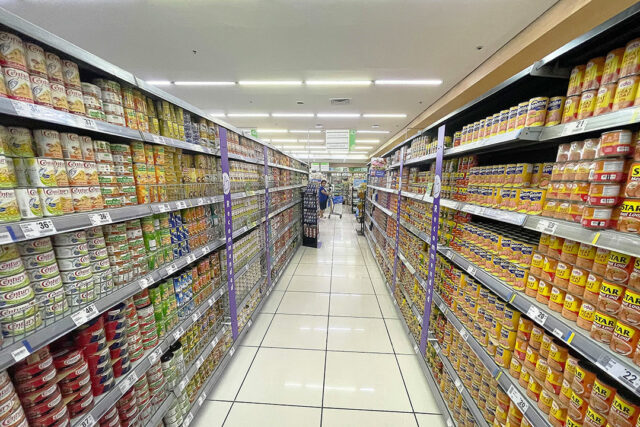
Canned goods are stocked at a supermarket in Mandaluyong City, Aug. 10, 2023. — PHILIPPINE STAR/MIGUEL DE GUZMAN

By Justine Irish D. Tabile, Reporter

PRICES of over 70 stock-keeping units (SKUs), including sardines, canned meat and coffee, have increased, according to the latest suggested retail price (SRP) bulletin released by the Department of Trade and Industry (DTI).

In the SRP bulletin dated Feb. 1, the department listed the suggested prices for 191 SKUs across 28 categories, 16 SKUs fewer than the list posted by DTI on Jan. 12, 2024.

Around 40% or 77 of the items posted price increases, while 3% or 6 had price decreases. On the other hand, the prices of 56% or 107 products were unchanged. One product did not change the price but reduced the quantity.

Of the 77 products that increased prices, 67 SKUs had no change in quantity, while nine lowered the quantity and increased prices. One item saw an increase in both quantity and price.

Seven out of 14 SKUs under the canned sardines in tomato sauce category posted price increases ranging from 90 centavos to P2.73. Two canned sardine brands lowered their prices.

Jersey Sweetened Condensed Creamer, the sole item under the condensed milk category, raised prices by P2.5. Prices of other condensada products were unchanged.

Angel Filled Milk, the sole item under the evaporated milk category, had a P4 increase. The department removed the evaporada category for the 2025 list.

Only one of the four SKUs under the powdered milk category raised the price by P6.

All five SKUs under the coffee refill category increased prices  ranging from P1 to P3.70, while three out of six coffee 3-in-1 SKUs increased prices ranging from 40 centavos to 50 centavos.

The 26-gram Nescafé Original, which is under the 3-in-1 category, increased the price but reduced the quantity.

Pinoy Pandesal and Pinoy Tasty, the only two SKUs under the bread category, posted price increases of P2.25 and P4, respectively.

Three SKUs under the instant mami category posted price increases ranging from 10 centavos to 50 centavos, while one instant mami brand retained its price.

Three rock salt products posted a price increase of 50 centavos to P2, while four rock salt SKUs retained prices.

Four out of 12 iodized salt products also posted price increases, while the rest had no price movements.

For the detergent soap category, six SKUs increased prices but lowered quantities. Six other detergent soap products maintained their prices.

Seven distilled water SKUs retained their prices, while two had price increases. Another distilled water SKU increased both quantity and price, while another lowered the price.

For purified water, two products raised prices by 60 centavos and P1.10 each, while the rest kept prices unchanged.

Three mineralized water SKUs decreased prices by up to P3, while 11 SKUs had no price movements.

The 5-Star Esperma White candles raised prices ranging from P2.83 to P12.32, while the remaining 28 candle SKUs had no price movements.

For luncheon meat, one SKU had a P2 price increase, while the other one had retained its price.

One SKU under the meatloaf category had a P1 increase, while the other four SKUs had no price movements.

Three SKUs under the corned beef category posted price increases ranging from P1 to P3, while four remained unchanged.

Five products under the beef loaf category had no price movements, while three products posted price increases of P1 to P1.75.

All products under the vinegar gin and PET bottle, vinegar doy and refill pack, soy sauce gin and PET bottle, and soy sauce doy pack categories posted price increases.

Meanwhile, prices of Lorins Patis products remained unchanged, while five patis in gin or PET bottle products posted price increases.

For toilet soaps, three products raised prices despite lowering the quantity, while four products hiked prices but retained the quantity.

In the battery category, only one product had a price increase, while the other five remained unchanged.

Consumer spending to drive growth this year — BMI

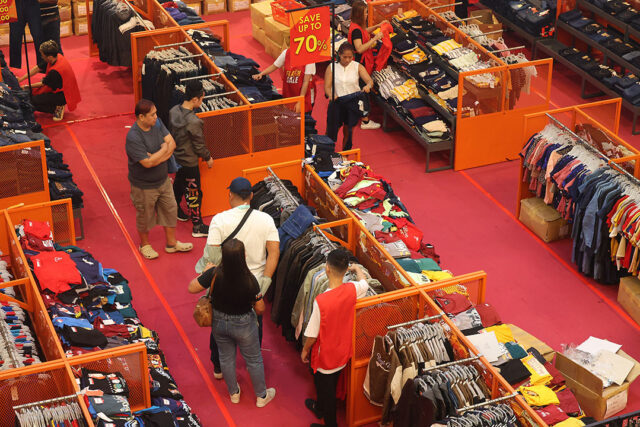
People look at racks of clothes during a sale at a mall in Ortigas, Sept. 18, 2024. — PHILIPPINE STAR/MIGUEL DE GUZMAN

ROBUST HOUSEHOLD consumption is seen to prop up the economy this year, Fitch Solutions’ unit BMI said, but warned that inflationary pressures and other risks could dampen this outlook.

“We hold a positive outlook for consumer spending in the Philippines in 2025. For 2025, we expect it to be driven mostly by strong economic growth and its feed-through into higher disposable income, as well as a stable labor market,” BMI said in a report.

BMI expects Philippine gross domestic product (GDP) to grow by 6.3% this year and 6.7% in 2026. These projections are within the government’s 6-8% target for both years.

The Philippine economy grew by 5.6% in 2024, missing the government’s 6-6.5% target. 

“A deteriorating external demand will likely be a drag on the Philippines’ GDP. However, the private final consumption expenditure will be positive,” BMI said.

Household spending is seen to accelerate to 5.3% this year, it said. Private consumption, which accounts for about three-fourths of the economy, grew by a lackluster 4.8% in 2024.

Consumer confidence has also shown “upward momentum,” amid the continued recovery from the pandemic, BMI said.

In the central bank’s latest consumer expectations survey, an improvement was seen in consumer confidence for the first quarter of this year and the next 12 months. This, amid a more upbeat outlook on higher income, additional sources of income and more available jobs.

“Easing inflationary pressures will provide relief to real household incomes and enable growth in spending,” BMI said.

“A tight labor market will support spending, as real wage growth returns to positive territory, which will support purchasing power over the year,” it added.

On the other hand, BMI noted that risks continue to weigh on private consumption, such as prolonged high inflation and weaker remittances.

“These risk factors will adversely affect household purchasing power, while geopolitical tensions have also emerged as a risk that is likely to impact inflation and interest rates.”

“Although inflationary pressures have largely eased in many markets, price levels remain high, and many households have not yet experienced real wage growth sufficient to restore purchasing power to their pre-2022-2024 inflationary shock levels.”

BMI expects inflation to average 3.3% this year, in line with the Bangko Sentral ng Pilipinas’ (BSP) own forecast. Headline inflation remained steady at 2.9% in January.

“If nominal income growth does not keep pace with inflation, the purchasing power of consumers will deteriorate, which would be a drag to their spending.”

“Prolonged inflation, particularly in relation to food, will mean that consumers will have to increasingly allocate more of their disposable income towards meeting necessities,” it added.

Meanwhile, the peso is seen to “depreciate slightly” this year and settle at P58 against the dollar.

“Despite the roughly 1.7% depreciation of the peso, this is still a relatively positive outcome compared with the depreciation of 11% seen in 2022 and the 2% seen in 2023.”

“The weaker rate in 2025 is due to the combination of a higher expected consumer price index in the Philippines as well as the US Fed’s hawkish tilt,” it added.

In 2024, the peso weakened by 4.28% to close at P57.845 versus the dollar from its end-2023 finish of P55.37. The local currency sank to the record-low P59-per-dollar level thrice last year.

“While persistent intervention by the BSP in the forex market will help to curb depreciatory pressures on the peso, earlier rate cuts by the BSP relative to the Fed will continue to weigh on the currency.”

“Nevertheless, the relatively stable rate will mean that the Philippines, which remains heavily reliant on imports to meet local demand, will see relative stability in import inflation,” BMI added.

Elevated household debt also poses a risk to consumer confidence, BMI said.

“It not only constrains future borrowing capacity but impacts current disposable income levels. This is particularly true as debt servicing costs rise in response to increases in interest rates.”

“In many markets, central banks rapidly hiked interest rates during the 2022-2023 high inflationary period, reaching levels to which most households have not been accustomed over the past decade,” it said.

From mid-2022 to late 2023, the BSP was the most aggressive central bank in the region as it hiked key rates by 450 basis points (bps) to tame inflation.

The BSP began its easing cycle in August last year, lowering borrowing costs by a total of 75 bps by end-2024. 

“While interest rates will not reach the previous historical lows of the last decade, easing monetary policy will alleviate some debt servicing cost pressures,” BMI said. — Luisa Maria Jacinta C. Jocson

Bureau of Customs’ legacy and vision for a modernized future

The Bureau of Customs-Customs Intelligence and Investigation Service (BoC-CIIS) marked the celebration of its 38th founding anniversary last Jan. 27.

For the past 123 years, the Bureau of Customs (BoC) has been the Philippines’ standard of excellence in enhancing trade facilitation, strengthening border control, and improving the collection of lawful revenues. Its milestones and history show its strong commitment to economic growth, security, and modernization, constantly evolving to keep up with global trade while staying true to its mission of serving the Filipino people.

One of the bureau’s biggest achievements is its survival from pre-colonial times up to the present. According to the BoC’s website, even before the Spanish came to the Philippines’ shores, datus or rajahs collected tributes from the people before they were allowed to engage in their trade. These were then observed and followed as the Customs Law of the Land.

Meanwhile, three key trade laws defined customs policies during Spanish rule in the Philippines: the Spanish Customs Law (1582-1828) imposing ad valorem duties, a Tariff Board setting fixed import values with a 10% duty, and the 1891 Tariff Law introducing specific duties on imports and certain exports until Spanish rule ended. Under American rule, the Spanish Tariff Code of 1891 remained until the Tariff Revision Law of 1901. Key reforms reorganized customs positions and laws, and the Philippine Customs Service evolved into what we now know as the Bureau of Customs under the Department of Finance (DoF).

From the Commonwealth era to the present, the Bureau of Customs underwent multiple reorganizations, including the separation of immigration authorities; the creation of the Tariff and Customs Code; structural changes under Martial Law; alignment with international customs standards; and modernization efforts like the establishment of the Management Information System and Technology Group (MISTG).

Through these transformations, the Bureau of Customs has achieved significant progress in revenue collection, trade facilitation, and border security that has stood the test of time and still ensures that it remains a key driver of the country’s economic stability.

The latest annual numbers from the BoC indicate that it collected a record-breaking P883.624 billion in 2023 — a 2.46% increase from the previous year. While data from 2024 is still unavailable, bureau collection from January to October of the year reached P784.54 billion, marking a robust 6% increase compared to the same period last year.

The bureau’s strong performance in 2023 and subsequently in 2024 underscores its commitment to continued effectiveness in driving revenue generation, which plays a crucial role in funding government projects and services for the Filipino people. The BoC’s revenue comes from payments collected for customs duties, indirect taxes, and other levies at ports of entry across seaports and airports in the Philippines.

In a bid to keep up with the times, the Bureau of Customs underwent a massive endeavor to modernize its customs administration to be at par with global standards through the Philippine Customs Modernization Program (PCMP) with the support provided by the World Bank Group. The PCMP aims to streamline operations and processes and support the reform agenda by upgrading BoC systems, procedures, and operational activities.

The BoC opened 2025 with its annual New Year’s Call, held on Jan. 6.

Among these initiatives is the Customs Processing System (CPS), which serves as one single and unified system that combines all the key elements and customs procedures; organizational modernization, which ensures that the institutional structure responds to new responsibilities; and the utilization of Remote Image Analysis Centers (RIAC), which allows BoC to receive and interpret radioscopic images sent from operational scanner sites in real-time.

So far, the DoF reports that the BoC has digitalized 160 out of 166 customs processes, a 96.99% digitalization rate, with one system launched for operation, two systems ready for implementation, and three systems being developed for efficient customs services.

Thanks to the BoC’s push for simpler processes and smoother trade, the Philippines made a big leap in the World Bank’s Logistics Performance Index (LPI), jumping 17 spots to rank 43rd out of 139 countries from 2022 to 2023. The LPI is a tool designed to help countries assess their trade logistics performance, spot challenges and opportunities, and find ways to improve their efficiency in moving goods.

43rd is the country’s highest ranking in the logistics report since 2007. In Southeast Asia, the Philippines’ ranking only lags behind Thailand (34th), Malaysia (26th) and Singapore (1st). In addition, the ranking showed that the country tied with Vietnam and had better logistics performance than Indonesia (61st) and Cambodia (115th), based on the LPI.

Significant milestones have also been realized by the BoC in preventing the smuggling of goods to and from the country. In 2024 alone, the bureau seized a record-breaking P85.167 billion worth of smuggled goods which highlights the BoC’s anti-smuggling efforts, continued vigilance, and commitment to safeguarding the nation’s economy and ensuring that only legitimate goods enter the market.

As the BoC continues to build on its past successes, its focus now shifts toward an even better 2025. Annually, the bureau releases its Five-Point Priority Program (5-PPP), aimed at driving efficiency, boosting revenues, and safeguarding trade. For this year, the BoC is looking to strengthen its role as a pillar of the Philippines’ economic growth and security while meeting the evolving demands of international trade.

Fully automating its systems, which, as mentioned earlier in the article, stands at 96.99%, figures to be the bureau’s top priority this year as it will enhance operational efficiency and transparency while minimizing corruption risks. The customs agency is also committed in surpassing its revenue target and has set an ambitious goal of generating P1.06 trillion in revenue in 2025.

Streamlining its processes in line with international best practices is also an area where the BoC is looking to improve as it aims to simplify procedures to facilitate legitimate trade while ensuring security. Curbing smuggling to protect the nation’s borders and economic interests, as well as dedicating significant resources to improving employee welfare and professional development, are also included in the bureau’s priority program.

As it celebrates its 123rd anniversary, the Bureau of Customs stands as a testament to resilience, transformation, and commitment to its mission. With the bureau’s constant dedication to improving its services to the Filipino people, the Philippines is slowly becoming the world-class, modernized, and credible customs administration that it aspires to be. — Jomarc Angelo M. Corpuz

Digitalization at the core of modernizing Philippine customs

vectorjuice | Freepik

Digitalization has become a crucial component in several actions toward nation-building. Even in custom operations, digital processes have been further adopted to enable a more efficient and even secure facilitation of trade across the globe.

The Philippines’ Bureau of Customs (BoC), under the Department of Finance (DoF), has been actively working to modernize custom operations in the country. This drive for innovation has positioned them as a pivotal partner for nation-building and economic prosperity.

Digitalization is at the cornerstone of the agency’s modernization journey, leveraging advanced information and communication technologies (ICT) to achieve a more efficient and effective custom operations.

“Through advanced data analytics, machine learning algorithms, and cutting-edge technologies, we will streamline our processes, improve risk assessment capabilities, and enhance fraud detection mechanisms. By leveraging AI-driven solutions, we can identify potential risks more effectively and respond to emerging threats with agility and foresight,” Ronnel B. Hombre, director of BoC’s Planning Systems and Development Service, was quoted as saying during the 32nd National Convention of the Chamber Customs and Brokers, Inc. (CCBI) last year.

“The Bureau remains steadfast in its commitment to innovation, transparency, and collaboration as we strive to enhance trade facilitation and create a world-class customs administration for the Philippines. Through ongoing modernization efforts and strong partnerships with stakeholders, the Bureau is poised to achieve even greater efficiency, security, and competitiveness in the global trade arena,” Marlon Fritz B. Broto, acting deputy commissioner for BoC’s Management Information Systems and Technology Group (MISTG), said in another statement.

As modernization changes the game for customs operations in the Philippines, the agency continues to dedicate itself in adopting digital-driven innovations and build partnerships that will strengthen its capabilities and create a strong and adaptive custom system for the Philippines.

Automated Export Declaration System

One means BoC is employing to simplify export processes and documentation is the Automated Export Declaration System (AEDS). This digital system allows exporters to easily submit documentations online and file them electronically through licensed service providers at international airports or seaports.

By using this system, the export process gets a major upgrade — from dealing with time-consuming paperwork to electronic submissions, essentially enabling the export process faster and more efficient. On top of that, AEDS also plays a significant role in expediting trade facilitation and reducing red tape activities.

Custom Auction Monitoring System

Meanwhile, the Custom Auction Monitoring (e-Auction) System enables users across all ports to manage their online registration and bidding activities digitally. Beyond simple convenience, this web-based platform significantly boosts transparency in custom auctions.

For custom agencies, a custom auction is designed to sell off goods and items that were seized, abandoned, or forfeited due to customs violations. Thus, this digital system helps the government to clear out prohibited or unclaimed items and earn revenue while still adhering to the custom regulations.

The e-Auction system promotes not only convenience to the auction process but also transparency and accountability, ensuring that the disposal of seized items or goods was handled fairly and efficiently.

Electronic Payment Portal System

Another notable development is the Electronic Payment Portal (E-Pay) System. This application allows for BoC’s online payments via authorized digital payment wallets and platforms. E-Pay covers payment collection processes and managing financial transactions and taxes.

Alongside this, the bureau has recently partnered with Maya Philippines, Inc. (Maya) to provide a payment gateway platform for BoC’s operations. This partnership allows the agency to manage bill payments, access Maya’s portable point-of-sale terminals and Smart Padala centers, and facilitate online checkouts, among others.

The E-pay System is in line with the agency’s efforts to provide a more convenient and secure payment option for its operations.

According to the BoC, technology and partnerships enables them to “advance to a more efficient, transparent, and service-oriented custom administration, demonstrating its commitment to innovation and strategic partnerships that serve the public.”

Digitalized Official Receipt System

The Digitalized Official Receipt System is a platform that tracks official receipts digitally. It helps improve the accuracy of financial records, lowers the risks of losing or damaging official receipts, and provides easy access to financial data and information.

This initiative is designed to make BoC’s financial processes smoother, while increasing transparency, accessibility, and modernizing custom operations.

In addition, this initiative is a collaborative effort with the APO Production Unit, Inc. — a key step towards paperless transactions and streamlining financial record management.

National Customs Intelligence System

Moving the digital leap further forward, the National Customs Intelligence System (NCIS) is another digital tool set to enhance intelligence efforts in the country’s customs operations. It centralizes and analyzes data, which helps the agency to strengthen its intelligence capabilities, develop smarter risks profiles, and perform in-depth analysis to combat smuggling.

Moreover, NCIS is a data-driven innovation that provides actionable insights to improve custom operations, allowing for better border protection, smuggling prevention, and legitimate international trade. This system is expected to strengthen BoC’s significant role in protecting national revenue, security, and economic interests.

NICS is an initiative by the agency’s Intelligence Group and Management Information Systems and Technology Group.

E-Travel Customs System

The e-Travel Customs System is a digital platform that streamlines passenger experiences for crews and passengers. It simplifies the baggage declaration process, letting passengers and crews skip the long lines at customs. The e-Travel Customs System collects their personal information, including the items they bring in and out of the country, enabling more convenient custom processes at airport terminals.

With this platform, custom officers can access passenger information in advance, making custom processes more efficient. It is also convenient for health monitoring, making it easier to track health risks. Overall, the e-Travel Customs System is a user-friendly platform, which helps customs in facilitating travel and trade activities, as well as enhancing border security.

Moreover, this platform is a collaborative effort between the following government agencies: the Bureau of Immigration (BI), Bangko Sentral ng Pilipinas (BSP), Anti-Money Laundering Council (AMLC), and the Department of Information and Communications Technology (DICT). — Angela Kiara S. Brillantes

Strengthening BoC’s efficiency through strategic partnership

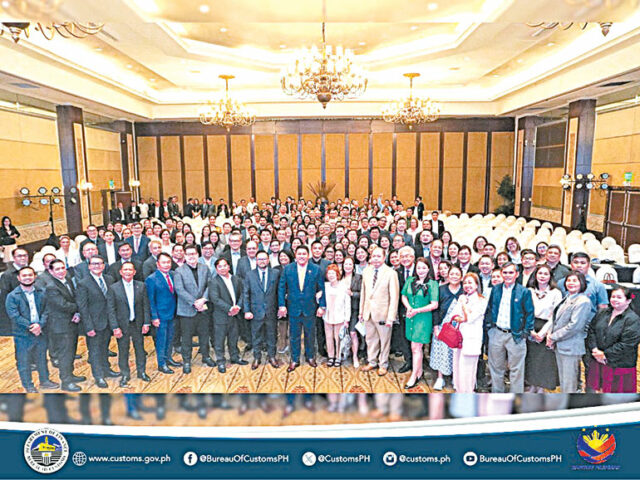
The BoC convened its 7th CICAC meeting at the Manila Hotel last Sept. 27, 2024.

Efficient transportation of goods relies on a smooth multimodal logistics network, which requires collaboration. This is why the Bureau of Customs (BoC) has strengthened its commitment to efficiency and modernization by forming strategic partnerships with various agencies, private institutions, and industry stakeholders.

These collaborations aim to streamline customs operations, enhance trade facilitation, and combat illicit activities, ultimately boosting revenue collection and improving public service delivery.

For instance, the agency launched the Customs Industry Consultative and Advisory Council (CICAC) on Feb. 2, 2024, under Customs Memorandum Order No. 02-2024. The council serves as a platform for industry players to voice concerns and contribute to customs process improvements. By June 30, the Central CICAC had 25 member organizations, while the District CICACs had 117 active members.

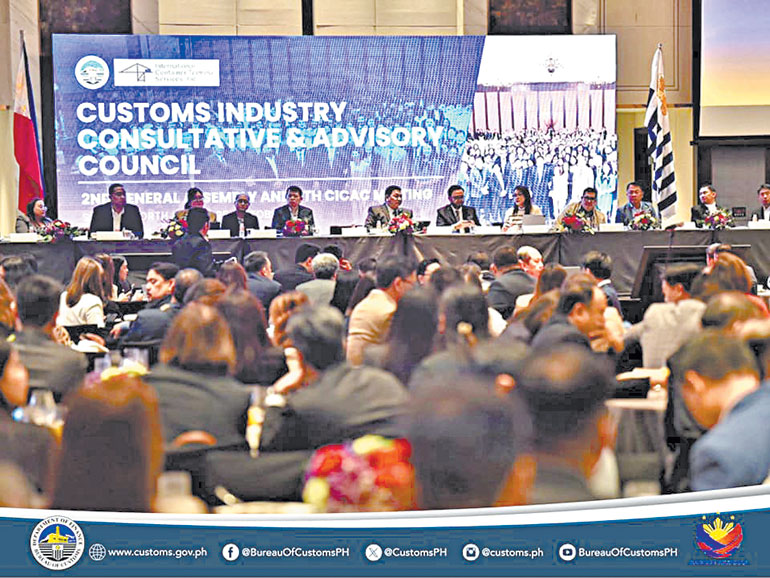
Back in October, International Container Terminal Services, Inc. hosted the second General Assembly of the CICAC. The assembly brought together over 200 representatives from importers, companies, industries, organizations, and foreign chambers in the country. The discussions covered streamlining customs clearance processes, achieving revenue targets, and addressing industry-specific challenges, among others.

The Bureau of Customs Port of Cebu recently convened with various organizations at the Cebu South Harbor Container Terminal (CSHCT) to discuss ways to improve efficiency in customs clearance and strengthen coordination between ports and stakeholders in response to President Ferdinand Marcos, Jr.’s directive to establish a 24/7 shipment process across the Philippines.

The Bureau of Customs Port of Clark and the Department of Tourism (DoT) also entered into a Memorandum of Understanding (MOU) on May 11, 2024. The agreement, signed at the Clark Freeport Zone in Pampanga, reinforces their commitment to the Filipino Brand of Service Excellence program, ensuring better customer service at tourism touchpoints nationwide.

The BoC conducted the 2nd CICAC General Assembly last Oct. 25, 2024.

Meanwhile, the agency collaborated with F2 Logistics Philippines Inc. and Mandaue Foam Philippines to support BoC’s operations in Northern Mindanao.

To integrate blockchain technology into customs clearance and processing services, the Bureau of Customs formed a partnership with MY E.G. Services Berhad (MYEG) and Cargo Data Exchange Center Inc. (CDEC). The agreement introduces Ztrade, a Web3 and Artificial Intelligence (AI)-powered platform, through MYEG’s Zetrix layer-1 blockchain to streamline and secure trade transactions, particularly benefiting the Philippines’ largest trading partner, China.

Enhancing industry collaboration

As part of its initiatives, the Bureau of Customs has partnered with the Association of International Shipping Lines (AISL) to revolutionize the way the BoC monitors container movement and manages overstaying containers. The collaboration aligns with the goals of Customs Administrative Order No. 08-2019, which focuses on generating non-traditional revenue streams by efficiently tracking and managing overstaying containers at ports.

The BoC also tapped the Land Bank of the Philippines to implement the Link.BizPortal for digital payments of miscellaneous fees. Signed on March 4, 2024, this agreement is expected to enhance operational efficiency, reduce bureaucratic delays, and simplify payment processes for stakeholders.

The agency also joined forces with the National Telecommunications Commission (NTC) to educate the public on scams involving parcels and balikbayan boxes. This initiative aims to raise awareness about fraudulent schemes and provide clear guidelines on legitimate customs procedures.

Meanwhile, BoC, in collaboration with the Philippine Drug Enforcement Agency (PDEA) and the National Bureau of Investigation (NBI), has ramped up efforts to intercept illegal drugs. By mid-2024, the agency had seized P2.277 billion worth of narcotics through 80 operations. Shabu (methamphetamine) was the most commonly confiscated drug, followed by marijuana and ecstasy. A high-profile bust occurred at the Paircargo Warehouse in Pasay City, where authorities intercepted 32 kilograms of shabu valued at P218.484 million.

Furthermore, the BoC intensified its anti-smuggling operations, conducting 868 enforcement actions in the first half of 2024, resulting in seizures worth P55.171 billion. Among these, counterfeit goods valued at over P29.738 billion were confiscated, including luxury brand imitations.

The Intellectual Property Rights Division’s crackdown on fake products culminated in a significant operation last June 2024, where P11 billion worth of counterfeit goods were seized. This enforcement effort was recognized by the Intellectual Property Office of the Philippines (IPOPHL) through an award presented to the Bureau of Customs on April 29, 2024.

Supporting national development goals

BoC’s strong enforcement and efficiency measures have translated into high revenue collection figures. From January to June 2024, the agency collected P455.518 billion, surpassing its target by 2.91% or P12.897 billion.

The agency attributes this financial success to its improved valuation techniques, diversified revenue sources, and the continued digitalization of customs systems.

Beyond revenue collection and enforcement, the Bureau of Customs has contributed to various government agencies through donations of forfeited goods. — Mhicole A. Moral

SM Prime sets P33B for new developments, upgrades

SMPRIME.COM

SY-LED SM Prime Holdings, Inc. is allocating up to P33 billion this year for the expansion and development of its commercial real estate portfolio.

Around P21 billion will be allocated to expanding the gross floor area (GFA) of the company’s malls, SM Prime said in a regulatory filing on Thursday.

“We expect moderating inflation, easing interest rates, and election-related spending to fuel our growth in 2025,” SM Prime President Jeffrey C. Lim said.

New mall developments will add 205,400 square meters (sq.m.) of GFA, while 124,488 sq.m. of existing mall space will undergo redevelopment.

SM Prime expects to have 8.08 million sq.m. of GFA for its mall portfolio by year-end. The company currently operates 87 domestic malls. 

“Election-related expenditures, a cyclical driver of economic expansion in the Philippines, are anticipated to stimulate aggregate demand and spending in various sectors, particularly retail,” the company said.

“SM Prime’s extensive network is strategically positioned to capture this surge, bolstered by strong consumer confidence and increased foot traffic,” it added.

For its hospitality and meetings, incentives, conferences, and exhibitions (MICE) businesses, SM Prime will invest about P6 billion to construct two convention facilities, renovate hotel rooms, and add new food and beverage facilities in existing hotels.

The property developer will also invest P6 billion to develop new office towers and workspaces, driven by strong demand and gains in lease take-up of existing inventory. 

One of the new projects is the two-tower Six E-Com Center office project within the Mall of Asia Complex, which will cater to technology-driven industries and business process outsourcing (BPO) companies.

“Our malls should do well, and our office, hotel, and convention centers could provide additional upside,” Mr. Lim said.

The Philippine government is targeting a 6-8% gross domestic product (GDP) growth this year, faster than the 5.6% achieved last year. 

Meanwhile, SM Prime’s parent company, SM Investments Corp. (SMIC), bagged the Philippine Capital Market Deal of the Year award from the International Financing Review Asia for its issuance of a $500-million five-year bond in July 2024.

Listed on the Singapore Exchange, the bond issuance was 3.2 times oversubscribed, with final demand reaching $1.6 billion. It was part of SMIC’s European medium-term notes program.

“This landmark transaction represents a major milestone for both SM Investments and the Philippine capital markets. The strong demand from investors reflects confidence in Philippine corporate issuers and underscores SM’s reputation as a stable and well-managed investment option,” SMIC Executive Vice-President Erwin G. Pato said.

On Thursday, SM Prime shares fell by 1.35%, or 35 centavos, to P25.65 apiece, while SMIC stocks dropped by 0.48%, or P4, to P826 per share. — Revin Mikhael D. Ochave

Clark airport operator expects passenger volume to hit 3.4M

CLARK INTERNATIONAL AIRPORT

LUZON International Premiere Airport Development (LIPAD) Corp., the operator of Clark International Airport, has revised its passenger volume projection upward for 2025, citing anticipated traffic growth after the transfer of turboprop operations from Ninoy Aquino International Airport (NAIA).

“We have some indication that there will be a shift when we revise the projections. Initially, our target for passenger volume this year was three million, but with the transfer of turboprops, we are now looking at 3.3 million to 3.4 million,” LIPAD Chief Executive Officer Noel F. Manankil told reporters on Thursday.

LIPAD is composed of Filinvest Development Corp., JG Summit Holdings, Inc., Philippine Airport Ground Support Services, Inc., and Changi Airports Philippines (I) Pte. Ltd., a wholly owned subsidiary of Changi Airports International.

The Department of Transportation (DoTr), through the Manila Slot Coordination Committee, recently issued a resolution mandating the relocation of turboprop operations from NAIA.

“We’re observing key triggers related to traffic volume, which guide us in decisions about capacity building,” Mr. Manankil said.

In 2024, Clark International Airport reported a total of 2.4 million passengers, marking a 20% increase from its 2023 passenger count.

LIPAD attributed the growth to international passengers, who accounted for 65% of the total volume, while domestic passengers comprised 35%.

Mr. Manankil said LIPAD is further evaluating capacity expansion, including potential airport fit-outs.

“If we reach a certain traffic volume threshold, it will signal the need to further increase capacity,” Mr. Manankil said.

Budget carrier Cebu Pacific will begin the gradual relocation of its turboprop operations on March 30.

By October next year, all turboprop aircraft operating at NAIA are expected to be relocated to other airports, Mr. Manankil said.

In response, LIPAD is assessing the possibility of deploying additional capacity at Clark, which currently has a built capacity of four million passengers annually.

Mr. Manankil noted that the airport’s capacity can be scaled up to eight million passengers through fit-outs.

“We are closely monitoring the turboprop situation. If sustained, we will identify the triggers for further capacity expansion,” he said.

During the peak season, Clark International Airport recorded an average of 10,000 to 12,000 passengers per day.

Currently, the daily passenger average has stabilized at 9,500. Mr. Manankil added that LIPAD expects an additional 700 daily passengers once turboprop operations are fully transitioned.

LIPAD also anticipates weekly flight movements at Clark Airport to increase to 269 from the current 237 by March 30. — Ashley Erika O. Jose

RCR says income rose 38% to P6.13 billion in 2024

Robinsons Summit Center lobby

GOKONGWEI-LED RL Commercial REIT, Inc. (RCR) reported a 38% increase in its unaudited net income for 2024, reaching P6.13 billion, driven by recent asset acquisitions and steady occupancy rates.

The company’s occupancy rates remained steady at 96%, RCR said in a regulatory filing on Thursday. 

“The infusion of the 13 assets, combined with the consistent declaration of increasing dividends quarter-on-quarter, reinforces our dedication and commitment to growing the company,” RCR President and Chief Executive Officer Jericho P. Go said. 

“RCR continues to seek potential assets for acquisition, aside from those of the sponsor,” he added.

RCR is the real estate investment trust of Robinsons Land Corp. (RLC).

In July of last year, RLC completed a transaction infusing 13 commercial assets worth P33.92 billion into RCR under a property-for-share swap deal.

The deal involved the infusion of 13 commercial assets totaling 347,329 square meters (sq.m.) of gross leasable area (GLA) into RCR in exchange for RLC’s subscription to 4.99 billion RCR primary common shares at P6.80 apiece.

As of 2024, RCR has 828,000 sq.m. of GLA, comprising 539,000 sq.m. of office spaces and 289,000 sq.m. of mall spaces.

The company owns 29 assets in total, with 17 office assets and 12 mall assets, located across 18 cities nationwide.

RCR noted that sponsor RLC owns over 1 million sq.m. of GLA, including more than 250,000 sq.m. of office GLA, more than 200,000 sq.m. of logistics GLA, and approximately 4,000 hotel room keys that may be infused into RCR in the future.

RCR has a market capitalization of P93.34 billion based on a share price of P5.94 per share as of the end of January.

Meanwhile, RCR announced that its board approved the declaration of its fourth-quarter 2024 regular cash dividend of P0.1010 per outstanding common share.

The dividends will be payable on Feb. 28 to stockholders on record as of Feb. 20.

On Thursday, RCR shares fell by 0.17% or one centavo to P6.04 per share, while RLC stocks dropped by 0.8% or ten centavos to P12.40 apiece. — Revin Mikhael D. Ochave

Alsons Power gears up for major solar power launch in Mindanao

ALSONS POWER Group, the power business unit of the Alcantara Group, is preparing to roll out its energy projects, including its first large-scale solar power project in Mindanao.

“As Alsons Power enters 2025, the company is poised for growth with the simultaneous implementation of multiple projects, including the launch of its first large-scale solar power project in Mindanao,” the company said in a media release on Thursday.

“With a focus on renewable energy, enhanced operational systems, and collaboration across the organization and its parent company — the Alcantara Group — Alsons Power is well-placed to meet its goals and contribute to addressing the rising demand for energy in the country,” it added.

Alsons Power said it plans to launch its first large-scale solar power plant in the first half of 2025.

“We are rapidly advancing our solar power initiatives and remain committed to strengthening our project pipeline,” said Alsons Power Chief Executive Officer Antonio Miguel B. Alcantara.

Adding to the pipeline of projects are the development of the 37.8-megawatt (MW) Sindangan-Zambo River Power Plant and the 53-MW Bago Hydro Power Plant, both slated for construction this year.

For conventional plants, the company said that the first phase of its 95.2-MW Bohol In-Island Diesel Power Station, located in the municipality of Ubay, is nearing completion, marking its strategic expansion outside Mindanao.

“This project will capitalize on opportunities in the Wholesale Electricity Spot Market and the ancillary reserve market over the next three to five years, until additional plants are developed to address demand-supply gaps in the region,” Mr. Alcantara said.

In 2024, the company completed its 14.5-MW Siguil Hydro Power Plant in Maasim, Sarangani—its first foray into renewable energy.

Moving forward, Alsons Power said it is focusing on “significantly expanding its market share” in the Retail Competition and Open Access market, a government program that allows customers to choose their electricity supplier.

“We are committed to strengthening our market presence and expanding our power asset portfolio,” Mr. Alcantara said.

Alsons Power, which claims to be Mindanao’s first independent power producer, has a portfolio of four power plants with a combined capacity of 468 MW. — Sheldeen Joy Talavera

One News reveals new morning shows

THE HOSTS of One News’ new morning shows: (L-R) Gretchen Ho, Cathy Yang, Angela Castro, and Angelo Castro.

Three shows focus on news and analysis

THREE news analysis morning programs will start airing on One News on Cignal TV next week: Morning Matters with Gretchen Ho, Money Talks with Cathy Yang, and News and Views with Angelo and Angela Castro. The new lineup means to deliver relevant news, insightful analysis, and engaging discussion, according to the hosts for each show.

Starting Feb. 10, viewers can tune in to these programs every morning from Monday to Friday. 

Morning Matters with Gretchen Ho kicks off the daily weekday lineup at 8 a.m. Ms. Ho will bring an energetic approach to morning television, covering the latest top headlines and trending topics and provide insights from key experts.

“What I like about morning news is that it is a mix of lightness with something serious,” she told the press at the launch of the three programs on Feb. 4.

Morning Matters will have a 15-minute news grid. Then, the spots dedicated to interviews, titled “Context,” reflect the goal to “start the day strong” in a fast-paced world that often skips context.

“People nowadays do engage with the news, but on social media. We have to dig deeper than an ordinary vlogger would, and break through the noise,” Ms. Ho said about their role as trained journalists.

“This actually comes at a very critical time —  the launch of the campaign period for the elections,” added Cathy Yang, an award-winning journalist and the host of Money Talks. “One cannot ignore politics, even in business. Magkaugnayan ’yan (They’re related),” she said.

The goal of her program is to “raise the financial literacy of people,” be it in earning, spending, or investing. It will air at 9:30 a.m.

“Think of it as your financial literacy one-stop shop, where we interview the best in business,” Ms. Yang added.

The data-driven program will be divided into four sections: “Deep Dive,” which tackles economic news such as Gross Domestic Product and inflation; “What’s Up World,” which brings in market trends of a global scale; “The Briefing,” which features experts who will explain the movements of the peso and stocks; and “Movers,” which serves as a section for thought leaders to share tips.

Finally, News and Views with Angelo and Angela Castro closes out weekday mornings for an hour starting at 10 a.m. In it, veteran journalists and quick-witted husband and wife Angelo and Angela Castro offer in-depth discussions about the day’s most important news stories.

“We try to present the news in such a way that you can see a couple eating breakfast with a newspaper and a cup of coffee — and there’s always a difference of opinion,” said Mr. Castro.

For the couple, their opposing views and natural banter can help audiences “flesh out” the news cycle by seeing the facts as well as the opinions that come into play.

Mrs. Castro said: “Gone are the days of mechanical news. We have to make it a point to include viewers in the conversation.”

Morning Matters with Gretchen Ho (8 to 9 a.m.), Money Talks with Cathy Yang (9:30 to 10 a.m.), and News and Views with Angelo and Angela Castro (10 to 11 a.m.) will air on Mondays to Fridays on One News on Cignal TV starting Feb. 10. — Brontë H. Lacsamana

URC names Anna David as president of BCF segment

ANNA MILAGROS D. DAVID

UNIVERSAL ROBINA CORP. (URC) has appointed Anna Milagros “Mian” D. David as the first president of its branded consumer foods (BCF) segment.

URC’s BCF business includes snacks, candies, chocolates, canned beans, tea, coffee, biscuits, and noodles.

Prior to her appointment, Ms. David served as managing director for URC International and chief marketing officer, the company said in an e-mail statement on Thursday.

“Over the last two years, she led URC International, driving incremental revenue and achieving double-digit operating margins,” URC added.

Ms. David joined URC in 2018 as vice president for the beverages segment, later transitioning to oversee the snack foods business.

She has 17 years of experience in sales and marketing with one of the largest multinational companies, holding both local and global roles prior to joining URC.

“We aim to drive topline growth and increase market share by staying true to our mission: to delight the people we serve,” Ms. David said.

URC also announced that it would allocate over P8 billion to its capital expenditure budget this year, prioritizing “organic capacity infrastructure growth.”

On Thursday, URC shares rose by 1.38% or 85 centavos to P62.50 apiece. — Revin Mikhael D. Ochave

The fountainhead

ADRIAN BRODY in a scene from The Brutalist.

Movie Review
The Brutalist
Directed by Brady Corbet

BRADY CORBET’S The Brutalist is his three-and-a-half hour Vistavision biopic on a fictional Hungarian-born Jewish architect who emigrates to the United States for a fresh start on life — use the word “biopic” loosely because Laszlo Toth is nominally based on Hungarian architect Marcel Breuer, only Breuer wasn’t a Holocaust survivor, didn’t scrabble too hard for his living, and didn’t fanatically insist on having every detail of his plans carried out exactly. Corbet needed spicier material to work on, hence the changes.

The film is about capitalism, antisemitism, racism (kind of), and the immigrant experience in America; it’s big in almost every sense of the word, down to the expansive 70 mm frame — an extraordinary achievement considering this was shot for a slim $9 million.

I suppose it’s perfectly permissible to pick and choose details from a real-life figure (in this case Breuer) to structure your fictional narrative; so many actual biopics have played fast and loose with historical fact, with varying results. I also suppose Corbet, co-writing with his partner fellow filmmaker Mona Fastvold, can be forgiven for recycling practically every cliché on immigrants, antisemitism, and artist-investor relations known to cinema — this is old-fashioned meat-and-potatoes storytelling, meant to evoke the ambiance of a previous age, not ride just ahead of fashionable trends.

I do have a problem with the fact that despite the title and all the critics citing the protagonist’s kind of architecture that there isn’t really a discussion of what Brutalism is, how it compares to the established style of the time, and why it’s so radical; no real discussion of why said architect’s designs are noteworthy except maybe at the end where we’re given a huge exposition dump at the 1980 Venice Biennale. And no real talk of fellow architects — Brutalism didn’t happen in a vacuum — but I suppose Corbet needs to keep his vision of a lone revolutionary intact.

Maybe the biggest problem I have with the film is inseparable from the nature of the movement it’s — championing? Exploring? Using as a prop? Brutalism emerged in the 1950s as a reaction against the neoclassicism and art deco movements in the 1930s and ’40s. The style makes it a point to use exposed raw materials (taking cue from the French phrase “beton brut” or “raw concrete”) and emphasizes functional and structural forms without any decorative designs.

The challenge to Brutalism is that with exposed building material and no decorations, it’s hard to hide flaws in design or execution — either you get everything right or your air pockets and sloppy joins and unnecessary corners are all there for everyone to see. Likewise with the film — Corbet plays into old tropes about the classic immigrant’s tale, throwing in the classic tortured relationship between an auteur — sorry, architect — and his sponsor, and if there’s anything lacking or clumsy in the telling of the tale the knots and gaps are all the more prominent.

Hence: the lack of specificity when it comes to the characters’ lives. Lazlo Toth (Adrien Brody), his osteoporotic wife Erzsebet (Felicity Jones), their niece Zsofia (Raffey Cassidy) all survived the camps, but don’t really talk about their experience there. I get that there was trauma involved — Zsofia lost the power of speech because of this — but certainly there can be some way, no matter how indirect, to convey how they feel about what happened, maybe shushing each other when some verboten detail is unintentionally mentioned. Here you get the sense that their memories of the camps are hermetically sealed off, instead of something that simmers underneath, threatening to burst out at any moment. The past here is safely past — there’s no sense that it really haunts them, beyond Zsofia’s silence, and, perhaps, an extraordinarily erotic scene where Erzsebet whispers urgently in her unresponsive husband’s ear, practically begging for sex while she reaches into his pants to grip his phallus (don’t know about you but if Felicity Jones breathed into my ear like that I’d certainly respond — I guess Adrien Brody deserves an acting award after all).

Actually, I can’t quite buy Toth’s struggles. A Bauhaus graduate who has done major commissioned works can’t find a job in Philadelphia? There would have been a network of Bauhaus graduates all over the world —  couldn’t he contact any of them? He ends up working in a furniture store, of all places, then shoveling coal — shades of Gary Cooper breaking rocks in a quarry.

Enter Harrison Lee Van Buren (Guy Pearce), your standard-issue wealthy capitalist. Van Buren is obscenely rich and claims to enjoy “intellectually stimulating” conversations but when confronted by real talent and innovation — as when his son Harry (Joe Alwyn) commissions Toth to renovate the Van Buren home library behind his father’s back — the industrialist yells that Toth ruined his private sanctuary and throws him out. It’s only years later after several news articles and complimentary photo spreads hold up Toth’s remodeling as an example of next-generation design that Van Buren reaches out to Toth and apologizes; wouldn’t do to keep the man ostracized when the press obviously admires his work.

Again Corbet hits all the requisite notes without really giving them a fresh spin; Pearce’s rich jerk is appropriately loud, Brody’s architect appropriately respectful, Alwyn’s Harry expectedly slimy (he refuses to pay for the remodeling — Harrison ends up paying Toth himself — later drops a few antisemitic remarks, and apparently has an eye for Zsofia). Brody’s Toth proves to be pigheaded and abrasive when the Van Burens try to cut a few corners by changing his design (You wonder why Harrison’s such a penny pincher when his estate is so opulent, and every other weekend seems to be throwing a party). Toth’s real-life model Beuer was more flexible and more diplomatic about arguing his case — but no, the drama has to be stark, with little nuance (throw in a little heroin addiction to give the otherwise martyrlike hero a visible flaw, and an African-American best friend named Gordon [Isaach de Bankole] for a visible virtue).

Again, the challenge with Brutalist architecture that echoes the challenge this film isn’t quite meeting: with an emphasis on function and structure there’s not a lot of ways your design can go, and the danger is a plainness that falls into banality, even boredom.

Then something startling does happen (skip the rest of this paragraph if you plan to see the film): seeking Carrera marble for the massive gym/theater/chapel Toth is building for Harrison, the two travel to the Carrera quarry to negotiate purchase. There’s a party thrown for the guests and Toth wanders off to shoot some heroin; a drunken Harrison finds him on the ground flying high; the industrialist lowers himself behind Toth and sexually assaults him, calling him “weak” and a “leech” to his ear. And I get that scene — I appreciate how Corbet had to go there, to make the industrialist rapacious in every sense of the word (adds to the unsettling nature of the assault that it echoes the earlier scene of Toth’s wife also whispering in his ear).

What I don’t quite get is the scene soon after, where a righteous Erzsebet walks up to the Van Buren estate and flings the man’s crime to his face in front of dinner guests — that hit me wrong, maybe because I can’t see what Erzsebet thought they might gain from it, maybe because neither of them discussed what happened or how they felt about it beforehand, beyond Erzsebet mentioning she knows everything, from what he had told her (they’d been shooting heroin previously). All that trouble, and she just possibly cost her husband his job? The leap from knowledge to consequent act (“He’s a rapist!” complete with accusing finger) smacks of the worst Filipino melodramas, where the scene is forced on us because it’s time to have a scene (after all we’re pushing to the three-hour mark), not because we’re prepared to the point that the scene feels inevitable.

Oh, there are good things to the film — Jones gives the single best (if underwritten) performance, Pearce is amusingly loud, Bankole quietly persuasive as the Noble Token Black Man Who Loyally Stays by Toth’s Side Till Unaccountably Dropped. Brody I thought gave a subtler performance in Roman Polanski’s The Pianist (and the much underrated Hollywoodland) but does well enough here.

The music (by Daniel Blumberg) is percussive, somehow metallic, the widescreen cinematography (by Lol Crawley) appropriately monumental, more big than imaginative except for the opening sequence where the camera flips the Statue of Liberty upside-down — a nicely disorienting image suggesting how all the promises of America will be upended and subverted.

The remodeled library is nicely minimalist; the chair Toth conceives for his furniture store cousin Attila (Alessandro Nivola) is familiar if one has seen Breuer’s designs, but Corbet manages to convey a sense of how radical it might look in a store window to 1950 eyes. The Van Buren community center, aside from the design of the cross created by the sun crossing the sky (an idea I suspect was inspired by Breuer’s St. John’s Abbey Church in Collegeville, Minnesota) looks disappointingly blocky and plain — Breuer’s actual church seems to soar into the sky while Toth’s just squats there like a molehill atop a mountain (random question: what community center sits in the middle of nowhere miles from the nearest community?); I’d expect a little more from a supposed masterwork.

Corbet does seem to square things away when Zsofia — who has somehow regained her ability to speak — talks at a major retrospective of Toth’s career explaining the significance of that forbidding blockiness, giving us a final little tidbit suggesting the possibilities of art, and how it can help us transcend the miserable circumstances of our lives — now we understand Toth’s ferocious insistence throughout construction that the skylight should extend to a specified length, not a foot shorter. Not an especially clever twist, but satisfying enough.