Home Blog Page 20

Federal Land exits Crown Central Properties

https://federalproperties.net/

Federal Land, Inc., the property arm of GT Capital Holdings, Inc., and its subsidiary Horizon Land Property Development Corp. have sold their combined 52% stake in Crown Central Properties Corp. to Crown Equities, Inc. for P73.48 million.

In a disclosure on Wednesday, Crown Equities said its board approved the transaction on Dec. 16, subject to agreed closing terms and conditions.

The deal covers 62.5 million shares from Federal Land, valued at P68.12 million, and 5 million shares from Horizon Land, valued at P5.37 million.

Crown Central Properties, a developer of residential and commercial projects, was previously a joint venture between Crown Equities and the FLI group. With the sale, Crown Equities now owns 100% of the company.Alexandria Grace C. Magno

Congress cuts rail funding in proposed 2026 budget

JICA

Philippine lawmakers cut funding for two flagship railway projects in the proposed P6.793-trillion budget for 2026, citing sluggish construction and a need to divert resources to more urgent government programs. 

The bicameral conference committee on late Tuesday slashed the allocations for the 147-kilometer North-South Commuter Railway to P30.6 billion from P57.6 billion in the appropriations bill, based on a livestreamed budget presentation. 

The joint congressional panel also pared funding for the Metro Manila Subway Project to P22.2 billion from P39.2 billion. 

The Transportation department said the reallocation is “in line with the urgent priorities of the National Government to further boost economic growth and social equity,” according to the agency’s letter sent to the Senate on Dec. 1. 

“This adjustment will ensure more efficient use of available resources and present a timely opportunity to put existing resources to work where they are needed most,” it said. 

The two railway systems are among the government’s flagship infrastructure projects that have repeatedly faced delays due to right-of-way disputes. 

The North-South rail, which broke ground in 2019, is now slated for full operations by 2032, while the Metro Manila Subway, launched the same year, will begin partial service only by 2032. 

“In the past five years, the North-South Commuter Railway, its average utilization is only 33%, and the Metro Manila Subway is only 36%,” Senator Sherwin T. Gatchalian, who heads the Senate Finance Committee, told the joint congressional panel. “Utilization remains very low for these two projects.” 

The rechanneled funds, originally earmarked as the government’s counterpart to project loans, will instead go to standby appropriations that can only be tapped if revenue collections surpass targets or if additional borrowing is secured. 

Mr. Gatchalian said that unprogrammed funding would likely be released in the second quarter of next year. 

“That can be used to fund the two projects that were mentioned,” he said. 

CASH AID
Also on Tuesday, the bicameral conference committee agreed to hike funding for the government’s cash assistance program for indigent Filipinos to P63.9 billion from P59 billion in the budget bill. 

Senator Erwin T. Tulfo, former Social Welfare secretary, said the increase was necessary as funding for the Assistance to Individuals in Crisis Situations (AICS) program typically runs short toward the end of the year. 

“The AICS program is always lacking, and there is always a request to the Budget department for a Quick Response Fund when October and November come,” he told the panel in mixed English and Filipino. 

AICS provides financial assistance to individuals in crisis, including medical, burial, transportation, and educational assistance. – Kenneth Christiane L. Basilio 

Gov’t to begin scaled-down EDSA rehabilitation on Dec. 24

PHILIPPINE STAR/WALTER BOLLOZOS

The government will begin a scaled-down rehabilitation of Epifanio de los Santos Avenue (EDSA) on Dec. 24.

The Department of Public Works and Highways (DPWH), the Metropolitan Manila Development Authority (MMDA), and the Department of Transportation (DoTr) presented the revised plan during a joint press briefing on Wednesday.

DPWH Secretary Vince B. Dizon said the DPWH will focus rehabilitation works on damaged sections of EDSA to minimize disruption to motorists and cut the project timetable to eight months from the previously planned two years.

The MMDA will keep the existing number coding scheme.

The first phase of the rehabilitation will cover the section from Roxas Boulevard to Orense and will start at 11 p.m. on Dec. 24, running until 4 a.m. on Jan. 5, 2026.

During this period, the DPWH will carry out 24/7 reblocking works and asphalt overlay of the EDSA busway lanes for both northbound and southbound directions.

From Jan. 5 to May 31, lane works will continue from 10 p.m. to 4 a.m.

The DPWH will carry out asphalt overlay lane by lane for both northbound and southbound directions from Monday to Friday, while Friday to Sunday will involve asphalt overlay and reblocking of one lane per direction.

Asphalted portions will reopen to traffic by 5 a.m. the following day. — Ashley Erika O. Jose

Frasco: Natural calamities, infrastructure problems impact travel confidence

Tourism Secretary Ma. Esperanza Christina G. Frasco at the launch of the Transit Tours and Medical Tourism Concierge in NAIA Terminal 3.— ALMIRA LOUISE S. MARTINEZ

Tourism Secretary Ma. Esperanza Christina G. Frasco said efforts are underway to strengthen travel confidence in the Philippines, as natural calamities and infrastructure project anomalies weigh on the tourism sector.

“Any negative perception of the Philippines has a tendency to affect travel confidence to the Philippines,” she told BusinessWorld on Tuesday at the sidelines of an event. “We’re here to deliver the good news and to build up that traveler confidence once again.”

Apart from infrastructure problems, Ms. Frasco noted that natural disasters also took a toll on the country’s tourism sector, affecting the livelihoods of over 43,000 tourism workers.

“The last five months have seen unprecedented calamities and difficulties for the country,” she told reporters in an interview.

“In just five months, we have already seen 31 travel alerts issued by countries around the world, which have, of course, had a negative impact on tourism,” she added.

A report from the Department of Tourism (DoT) revealed that tourist arrivals dropped by 2.16%, a drop from 5.35 million in the same period in 2024 to 5.235 million in the January-to-November period.

The bulk of tourist arrivals, or 4.918 million, were from foreign visitors, with South Korea as the largest source of tourists in the first 11 months of the year, contributing 21.66%.

While the country has received 1.134 million visitors from South Korea, this was a 21% decline from the 1.436 million Korean tourists a year ago.

Tourists from China, the country’s fifth-biggest source of tourists, declined as well by 16.55%.

“We are well aware of the difficulties that we have faced,” Ms. Frasco said. “In terms of China, with the e-visa having been resumed quite late, as well as with South Korea, with certain issues that have been brought up in terms of safety.”

“We’re working very closely with our fellow government agencies to manage these challenges…We continue to push for Philippine tourism through aggressive marketing campaigns,” she added.

Although a decline is occurring in certain markets, Ms. Frasco said that the US, Canada, Australia, and parts of Europe have experienced “robust growth” in visitors.

Transit tours and medical lounge

The first transit tours and medical tourism concierge was launched as part of the initiatives to attract more visitors and encourage transiting passengers to explore cultural heritage and leisure destinations in Manila.

The transit tour, which costs USD $50, is open to passengers with an eight-hour layover in Manila. The four-hour tour can be either in Intramuros and the National Museum, or Okada Manila and Solaire Resort.

Booking of tours can be through the LovePH mobile application, the Philippine Airlines website, partner tour operators, or walk-in registration at Transit Concierge Desks in NAIA Terminal 1 and 3.

“Even if you’re just in the Philippines for a few hours or you’re waiting for your onward flight to a domestic destination, you will get to know the cultural treasures and offerings of Metro Manila,” the Tourism Secretary said.

Meanwhile, the medical tourism concierge is a dedicated airport assistance service for medical tourism patients.

Among the services included in the project are assistance with the patient’s arrival procedures and coordination of transfers to partner hospitals and clinics.

Some of the partner medical and wellness institutions are the Medical City, St. Luke’s Medical Center, Asian Hospital and Medical Center, Makati Medical Center, and Belo Medical Group.

“We cannot deny all the headwinds and challenges that we have faced this year. It’s been an incredibly difficult year, especially for tourism,” Ms. Frasco said. “With a budget that has been slashed by 93%, we had our hands tied.”

“Notwithstanding that, we have achieved many firsts in Philippine tourism,” she added, citing the newly launched transit tours and medical tourism concierge.

The department’s branding budget in 2025 is P100 million, down from P200 million in 2024 and P1.2 billion in 2023.— Almira Louise S. Martinez

Trump adds seven countries, including Syria, to full travel ban list

REUTERS

WASHINGTON — US President Donald Trump on Tuesday expanded a list of countries subject to a full travel ban, prohibiting citizens from an additional seven countries, including Syria, from entering the United States.

The White House said in a statement that Mr. Trump signed a proclamation “expanding and strengthening entry restrictions on nationals from countries with demonstrated, persistent, and severe deficiencies in screening, vetting, and information-sharing to protect the Nation from national security and public safety threats.”

Tuesday’s move banned citizens from Burkina Faso, Mali, Niger, South Sudan, Syria and those holding Palestinian Authority-issued travel documents. The action also imposes a full ban on Laos and Sierra Leone, which had previously only been subject to partial restrictions.

The White House said the expanded ban goes into effect on January 1.

The action comes despite Mr. Trump’s vow to do everything he could to make Syria successful after landmark talks in November with Syrian President Ahmed al-Sharaa, a former al Qaeda commander who until recently was sanctioned by Washington as a foreign terrorist.

Mr. Trump has backed Mr. Sharaa, whose visit capped a stunning year for the rebel-turned-ruler who toppled longtime autocratic leader Bashar al-Assad and has since traveled the world trying to depict himself as a moderate leader who wants to unify his war-ravaged nation and end its decades of international isolation.

But in a post on his Truth Social platform on Saturday, Mr. Trump vowed “very serious retaliation” after the US military said two US Army soldiers and a civilian interpreter were killed in Syria by a suspected Islamic State attacker who targeted a convoy of American and Syrian forces before being shot dead. He described the incident in remarks to reporters as a “terrible” attack.

The White House cited visa overstay rates for Syria in its justification for the ban.

“Syria is emerging from a protracted period of civil unrest and internal strife. While the country is working to address its security challenges in close coordination with the United States, Syria still lacks an adequate central authority for issuing passports or civil documents and does not have appropriate screening and vetting measures,” the White House said.

US ADDS MORE NATIONS TO PARTIAL RESTRICTIONS LIST

Mr. Trump signed a proclamation in June banning the citizens of 12 countries from entering the United States and restricting those from seven others, saying it was needed to protect against “foreign terrorists” and other security threats. The bans apply to both immigrants and non-immigrants, such as tourists, students and business travelers.

The travel ban remains on those twelve countries, the White House said.

Mr. Trump also added partial restrictions and entry limitations on an additional 15 countries, including Nigeria, which is under scrutiny from Mr. Trump, who in early November threatened military action over the treatment of Christians in the country.

Nigeria says claims that Christians face persecution misrepresent a complex security situation and do not take into account efforts to safeguard religious freedom.

Since returning to office in January, Mr. Trump has aggressively prioritized immigration enforcement, sending federal agents to major US cities and turning away asylum seekers at the US-Mexico border.

The expansion of the countries subject to entry restrictions marks a further escalation of immigration measures the administration has taken since the shooting of two National Guard members in Washington, DC, last month.

Investigators say the shooting was carried out by an Afghan national who entered the US in 2021 through a resettlement program under which Trump administration officials have argued there was insufficient vetting.

Days after the shooting, Mr. Trump vowed to “permanently pause” migration from all “Third World Countries,” although he did not identify any by name or define the term. —  Reuters

Bondi Beach suspects travelled to Philippine region known for Islamist militancy

STOCK PHOTO | Image by Carlos Andrés Ruiz Palacio from Pixabay

MANILA – The father and son duo accused of carrying out Sunday’s Bondi Beach attack had travelled to the southern Philippines, a region long plagued by Islamist militancy, before the attack that Australian police say appeared to be inspired by Islamic State.

HOW LONG DID THE SUSPECTS SPEND IN THE PHILIPPINES?
Immigration records show they arrived on November 1 aboard a Philippine Airlines flight and landed in Davao City, about 225 km (140 miles) by road from Maguindanao and roughly 195 km (120 miles) from Lanao del Sur, known as hotspots for Islamic State-linked groups and other militant organisations such as Abu Sayyaf.

Records indicate the pair flew in on the same Philippine Airlines flight from Sydney to Manila and onward to Davao, and left on November 28 via the same route back to Sydney, around two weeks before the attack that killed 15 people. One of the alleged gunmen was also killed.

A Bureau of Immigration spokesperson said the father, an Indian national and Australian resident, travelled on an Indian passport, while his son, an Australian citizen, used an Australian passport.

Philippine authorities say they have no information yet on what the two did during their nearly month-long stay, and a spokesman for the military said that any allegations linking the suspects to any militant group or suggesting they received training in the country remain inconclusive.

WHAT IS THE HISTORY OF MILITANCY IN THE PHILIPPINES?
The southern Mindanao region, roiled for decades by Islamist separatists, communist rebels and warlords, has been fertile ground for Islamic State’s ideology. It is the only region in the largely Catholic country with a significant Muslim minority.

Its porous borders and rugged terrain made it a conducive environment for foreign fighters seeking training with groups such as Abu Sayyaf and Islamic State-linked factions.

A 2023 U.S. State Department report said the Philippines remained a destination for what it called “foreign terrorist fighters” from Indonesia, Malaysia, the Middle East, and Europe.

Armed Forces chief General Romeo Brawner Jr said in 2024 that they had not detected foreign terrorists operating in the country, crediting sustained counterterrorism operations.

But Rommel Banlaoi, an antiterrorism expert in the Philippines, said while the threat of terrorism in the country had declined, it was not disappearing.

WHAT MILITANT GROUPS OPERATE IN THE PHILIPPINES?
Despite the gains, several groups remain active, though significantly weakened, according to the Philippine military and security officials.

Abu Sayyaf, once notorious for kidnappings and bombings, has been neutralized, with most of its members having surrendered, an army spokesperson said. The Bangsamoro Islamic Freedom Fighters, a splinter of the Moro Islamic Liberation Front, still operates in Maguindanao but has been diminished by surrenders and raids, the spokesperson added.

The Maute Group, also known as Daulah Islamiyah, has been reduced to a “manageable number” and is now on the run, the same official said.

ISIS-East Asia, a loose network of groups that have pledged allegiance to Islamic State, has around 300 to 500 mostly Filipino and some foreign fighters who have carried out sporadic attacks in Mindanao. That figure was cited in a 2022 report by the U.S. Congressional Research Service.

The decades-old communist insurgency led by the Communist Party of the Philippines–New People’s Army persists in some rural areas, but its strength has dwindled to fewer than 1,000 members nationwide, according to the government’s anti-insurgency task force.

WHERE HAVE MILITANT GROUPS ATTACKED IN THE PHILIPPINES?
Some of these groups have carried out some of the deadliest attacks in Philippine history.

In December 2000, five near-simultaneous bomb blasts across Metro Manila killed 22 and injured around 100, attacks linked to Abu Sayyaf and Jemaah Islamiyah.

In February 2004, Abu Sayyaf was blamed for the bombing of a ferry near Manila Bay, killing more than 100 people, the country’s worst militant attack.

In 2017, Islamic State-inspired Maute group seized the southern city of Marawi and held it through five months of ground offensives and air strikes by the military.

In January 2019, twin bombings at a cathedral in Jolo, Sulu, killed more than 20 people, including civilians and soldiers.

Authorities say the threat of large-scale attacks has diminished, but remnants of militant groups continue to strike remote and isolated targets, keeping security forces alert. — Reuters

Manhunt for Brown University shooter stretches into fourth day, leaving residents on edge

A Brown University PhD student, stands in Providence Station while she waits for her train out of the city as the manhunt continues for the gunman, following a shooting at Brown University in Providence, Rhode Island, US.—REUTERS

THE MANHUNT for the gunman who killed two Brown University students and injured seven more in a classroom shooting stretched into a fourth day on Tuesday, leaving the campus and surrounding neighborhood on edge.

Authorities, including the FBI, released a timeline video comprised of surveillance clips from neighborhood cameras and a car’s dashcam tracking the movements of the suspected shooter on Saturday, in the hopes that someone might recognize him.

The clips, stitched together, show a man dressed in dark clothes and wearing a mask walking briskly, and at one point running, between 2 p.m. and 3 p.m. along several different streets, about a block away from the building where the attack would later take place.

The shooting occurred at 4:03 p.m., and another clip showed the same person from a distance walking from the building’s parking lot toward the street, even as police cars with flashing emergency lights pull up to the scene. The final clip shows the man walking along that street about three minutes after the shooting.

The search intensified after investigators late on Sunday released another “person of interest,” whose detention had brought some short-lived relief to anxious students and residents. Officers went door-to-door on Monday seeking any cameras that might have captured the shooter on Saturday.

The College Hill neighborhood of Providence, Rhode Island, near campus has been eerily quiet, residents said, after many Brown students hastily cleared out of Providence and many neighbors were staying inside with locked doors and drawn blinds.

Patrick Moran has been supervising his young children’s video games, Lego building, puzzle playing and ear-piercing drumming after their private school, the Wheeler School, canceled classes for the rest of the week.

“I am happy to have them home. The shooter is still out there, and so let’s take a little precaution and keep the kids home,” Mr. Moran said.

Public schools in Providence remained open on Tuesday, but the district canceled after-school activities. Providence Mayor Brett Smiley said on Monday that parents should send their children to school if they feel comfortable doing so.

Mr. Smiley has made a point of being out and about in the neighborhood and stopped for coffee at L’Artisan Cafe on Monday. The cafe is a short distance from where the shooting happened and a place uniformed police officers often stop in for coffee and to warm up. The last days they have been largely absent from the cafe amid stepped-up patrols.

ENHANCED SECURITY IN PLACE
Providence Police Chief Oscar Perez said law enforcement was trying to reassure residents by keeping a visibly high profile in the community.

“The sooner we can identify this person, the sooner we can blow this case open,” state Attorney General Peter Neronha said on Monday.

In a statement on Monday evening, Brown said it had implemented enhanced security measures since the shooting, including doubling the university department of public safety’s staffing and restricting entry to campus buildings.

The gunman on Saturday afternoon walked into an engineering and physics building with the doors left unlocked while exams were taking place, according to police. He opened fire with a 9mm gun inside a classroom and then fled, triggering a campus lockdown that left students barricaded in classrooms or hiding beneath furniture for hours.

Investigators detained a man in his 20s on Sunday but released him late in the day after concluding that he was not involved. Officials have not detailed the evidence that initially led them to take the unnamed man into custody.

Brown is one of the oldest and most prestigious universities in the United States. The Ivy League school, which has nearly 11,000 undergraduate and graduate students, canceled exams and classes for the rest of the year.

The two students killed were Ella Cook, a sophomore from Mountain Brook, Alabama, and freshman Mukhammad Aziz Umurzokov, a Uzbekistan-born Virginian.

Ms. Cook, 19, was the vice president of the school’s College Republicans and a “leading Republican voice at Brown,” according to an X post from the New York Republicans Club. In her hometown, she worked at an ice cream shop in high school, where her coworkers used to tell customers with pride that she was headed to a top-rated school.

Mr. Umurzokov, 18, had moved with his family as a child to Virginia, where he graduated Midlothian High School this spring as a top-ten student. He had planned to become a neurosurgeon.

“He always lent a helping hand to anyone in need without hesitation, and was the most kind-hearted person our family knew,” his family wrote in an online fundraising post. “Our family is incredibly devastated by this loss.”— Reuters

Sydney funerals begin for Bondi Beach Hanukkah shooting victims

People gather at the floral tribute at Bondi Beach to honor the victims of a mass shooting targeting a Hanukkah celebration on Sunday at Bondi Beach in Sydney, Australia. — REUTERS

SYDNEY — Sydney will pause in grief on Wednesday as funerals begin for some of the 15 people killed in Australia’s deadliest mass shooting in three decades — a Jewish Hanukkah celebration-turned-tragedy that shook the nation and intensified fears of rising antisemitism and violent extremism.

Police are zeroing in on the alleged father-and-son shooters, Sajid Akram, 50, and his 24-year-old son named in local media as Naveed, as they probe possible links to Islamic State. Sajid was killed in a shootout with officers at the Bondi Beach park where the attack took place on Sunday.

Investigators expect to question the son as early as Wednesday, once medication wears off and legal counsel is present, New South Wales Police Commissioner Mal Lanyon said. He remains in a Sydney hospital after emerging from a coma after being shot by police.

A funeral for Rabbi Eli Schlanger, an assistant rabbi at Chabad Bondi Synagogue and a father of five, will take place at 11 a.m. (0000 GMT).

He was known for his work for Sydney’s Jewish community through Chabad, a global organization fostering Jewish identity and connection. Mr. Schlanger would travel to prisons and meet with Jewish people living in Sydney’s public housing communities, Jewish leader Alex Ryvchin said on Monday.

ALBANESE TO ATTEND FUNERALS IF INVITED, HE SAYS
Prime Minister Anthony Albanese did not disclose whether he would attend any of the funerals.

“I would attend anything that I’m invited to; these funerals that are taking place are to farewell people’s loved ones,” Mr. Albanese told ABC Radio, suggesting he was not invited to attend.

Mr. Albanese said Ahmed al-Ahmed, 43, the man who tackled one of the shooters to disarm his rifle and suffered gunshot wounds, was due to undergo surgery on Wednesday.

Mr. Al-Ahmed’s uncle, Mohammed al-Ahmed in Syria, said his nephew left his hometown in Syria’s northwest province of Idlib nearly 20 years ago to seek work in Australia.

“We learned through social media. I called his father and he told me that it was Ahmed. Ahmed is a hero, we’re proud of him. Syria in general is proud of him,” the uncle told Reuters.

Mr. Albanese is facing criticism that his center-left government did not do enough to prevent the spread of antisemitism in Australia during the two-year Israel-Gaza war and failed to avert the mass shooting.

“We will work with the Jewish community, we want to stamp out and eradicate antisemitism from our society,” Mr. Albanese told reporters.

“We want to also stamp out the evil ideology of what would appear to be from the investigators an ISIS inspired attack. That has no place that sort of hatred.”

Opposition Jewish lawmaker Julian Leeser has said there was “white-hot anger among the community” over the attack.

Other victims included a Holocaust survivor, a husband and wife who first approached the gunmen before they started firing and a 10-year-old girl named Matilda, according to interviews, officials and media reports.

Mr. Albanese paid tribute to Boris and Sofia Gurman who were killed in the shootings.

“Boris attacked one of these terrorists as he got out of the car and that caused Mr. and Mrs. Gurman… to lose their lives,” Mr. Albanese said.

Matilda’s father told a Bondi vigil on Tuesday night he did not want his daughter’s legacy to be forgotten.

“We came here from Ukraine … and I thought that Matilda is the most Australian name that can ever exist. So just remember the name, remember her,” local media reported him as saying.

Health authorities said on Wednesday that 22 patients were receiving care in several Sydney hospitals for their injuries.

The men accused of carrying out Sunday’s Bondi Beach attack had traveled to the southern Philippines, a region long plagued by Islamist militancy, before the attack that Australian police said appeared to be inspired by Islamic State.

In Bondi on Wednesday, swimmers gathered on Sydney’s most popular beach and held a minute’s silence.

“This week has obviously been very profound, and this morning, I definitely feel a sense of the community getting together, and a sense of everyone sitting together. Everyone’s grieving, everyone’s understanding and processing it in their own way,” Archie Kalaf, a 24-year-old Bondi man told Reuters.— Reuters

TikTok on social media use among children: encouraging digital habits better than an outright ban

REUTERS

Following the passage of a social media ban for under-16 in Australia, the Philippines is better off “encouraging users to regulate digital habits” than imposing a total ban, according to TikTok on Monday.

Bea Bautista, TikTok’s head of communications for the Philippines, said the platform supports regulation over outright restriction, citing research showing that helping children build healthy digital habits is more effective than imposing blanket bans. 

“Because when you restrict people from using platforms like TikTok, they will always find a way back,” Ms. Bautista said during the launch of the platform’s new in-app Time and Digital Well-being page. 

“What we’ve found is that it’s more effective to educate users on building healthy digital habits and to support them through tools like these,” she added. 

Last week, Australia became the first country to impose a minimum age requirement for social media use. Under the law, widely used platforms such as TikTok, Facebook, and YouTube are required to restrict access for users under 16. Companies that fail to comply may face fines of up to A$49.5 million (P1.92 billion). 

The ban followed a government-commissioned study conducted earlier this year, which found that 96% of Australian children had been exposed to harmful online content. 

Several countries, particularly in Europe, have since expressed interest in adopting similar measures. 

In the Philippines, Senator Panfilo M. Lacson filed a bill earlier this year seeking to ban social media use among individuals under 18, citing the need to protect the mental and emotional well-being of children. 

The measure references a study by the United Nations Children’s Fund (UNICEF) warning that children are particularly vulnerable to cyberbullying, online harassment, and body image pressure. 

Meanwhile, psychologist and TikTok content creator Riyan Portuguez said that given the Philippines’ high social media usage and the fact that many children are digital natives, imposing outright restrictions may not be the most effective approach. 

She said it would be more beneficial to educate young users on responsible and balanced social media use, noting that children are likely to seek access to these platforms regardless of restrictions. 

“So it’s really about regulation and balance — how we can guide young people to use these platforms responsibly,” she told BusinessWorld at the sidelines of the event. 

As part of its efforts to help young users manage their social media use by helping manage their screen time and digital well-being, TikTok introduced its new Time and Digital Well-being in-app feature. 

“The Time and Well-being page is a new and innovative tool by TikTok that allows users to take control of and empower their online experience,” Peachy A. Paderna, TikTok’s public policy manager for the Philippines, told BusinessWorld. 

The page includes features such as an affirmation journal, breathing exercises, and sound generation tools designed to support users’ emotional and mental well-being. It can be accessed through TikTok’s settings and privacy options. 

Ms. Paderna said that TikTok has other digital safety initiatives, including its #ThinkTwice campaign, which encourages users to better evaluate online information. They have also collaborated with government agencies against online scams. — Edg Adrian A. Eva 

Inside the $2 billion scandal that paralyzed the Philippines

A resident makes coffee inside his submerged home in Frances, a village in the Philippines, on Dec. 6. Credit: GERIC CRUZ/BLOOMBERG

Senator Francis Pangilinan leaned into his microphone and fired off numbers in pesos: 50 million? 10 million? 100 million? “You withdrew this in cash?”

Across the hearing room sat Sally Santos, the proprietor of Syms Construction Trading and a central figure in the Philippines’ ballooning flood-control scandal. She didn’t flinch. P457 million, she said. That’s $7.8 million.

Mr. Pangilinan jerked back. “The bank manager allowed you to withdraw P457 million in cash!?”

The exchange, broadcast live across the country, shocked the nation. And the spectacle offered a glimpse into something more sinister: suitcases swollen with cash in what investigators say was just one tributary in a vast, multi-year scheme that cost the Philippines about $2 billion in public funds. The money was meant to build dikes and other defenses that should have spared villages from deluge. Instead, some of those defenses collapsed almost instantly; others were never built at all. The failures contributed to flooding, worsening the impact of storms that have left about 400 dead and more than 9.5 million people displaced this year.

“The flood-control plunder is unprecedented,” said Joy Aceron, director of Government Watch, a research organization that seeks transparency and accountability. “There is evidence that there was a total breakdown of accountability.”

Long before the rains arrived in June, people in the Philippines sensed that something was off.

They saw it first online. Daughters of contractors posing with new Hermès and Chanel bags on Instagram and YouTube. A contractor stood before local media, proudly guiding cameras through his collection of luxury vehicles as his wife – who has since been hit with graft charges – prepared to launch her campaign for mayor.

There were signs within the government, too. President Ferdinand R. Marcos Jr. vetoed hundreds of millions of dollars worth of projects for the Department of Public Works and Highways – the agency in charge of the bulk of infrastructure spending – in the 2025 national budget. Yet still, the agency’s portion in the final budget swelled by more than $1.5 billion from a year earlier, with a senator leading the investigations alleging lawmakers added allocations and the public receiving no transparency over who added what, or why.

It wasn’t until Mr. Marcos addressed the nation in July that Filipinos learned flood-defense contractors had been allegedly colluding with politicians to receive kickbacks. By September, it would become clear how much: up to 70% of government funds for flood-control projects were lost to corruption, then-finance chief Ralph G. Recto told the Senate in a hearing.

Authorities have frozen about $220 million in assets belonging to government officials and contractors so far, including more than 4,000 bank accounts, 200 cars and nearly a dozen aircraft. Mr. Marcos, the son of the late dictator Ferdinand and Imelda (infamous for their alleged pilfering from state coffers and her shoe collection), has promised that those involved in the corruption will be jailed before Christmas.

Nine people have been arrested as of Dec. 9, and seven are still at large, according to the public works department. Among those in hiding is former congressman Zaldy Co, who was on a government panel involved in the state budget process while at the same time owning a construction company that worked on several flood-control projects, local media reported. Officials say more arrests are coming.

Mr. Co has denied receiving kickbacks from flood mitigation projects. Lawyers for Mr. Co and Ms. Santos didn’t immediately respond to requests for comment.

ANGER
The promise of accountability has done little to quell anger in a country where, as the new finance secretary, Frederick Go, put it, graft has persisted “since time immemorial.” The revelations triggered large street protests that continued into last month.

For now, people in flood-prone areas mostly blame contractors and individual politicians for exploiting what they describe as a long-broken system. But beneath that is a deeper resentment toward a country where political power and private wealth blur inside a small circle of families, the Marcoses among them. President Marcos’ approval ratings have begun to slide, and if the half-built projects remain broken when the rains return, or if the investigations stall at minor arrests or reforms never move beyond promises, the blame may rise.

“Emotions are running very high,” says Rafael Ongpin, executive director of the Makati Business Club, which represents some of the Philippines’ largest companies. “The public, they want to see some heads roll, but if you want to build a strong case against these people, it’s going to take time.”

The scandal has also rippled through financial markets: growth has slumped, foreign direct investment has slowed and the stock market is among the worst performers in the world this year. For a country that’s persistently ranked one of the worst for wealth inequality in Southeast Asia, gaining the trust of investors is crucial to pull it out from an underperformance loop.

Yet the government’s political capital to push through promised fiscal reform, transparency and governance modernization “appears diminished for the remainder of Mr. Marcos’ presidential term,” said Ze Yi Ang, a portfolio manager for fixed income in Asia at Allianz Global Investors, one of the largest foreign holders of Philippine government debt.

FLOODS WON’T LEAVE
The Philippines sits in a disaster belt, absorbing about 20 typhoons a year that kill hundreds. This year’s were more destructive and more frequent. Climate change is the prime suspect, scientists say. Locals agree, but many insist the flood-mitigation projects meant to protect them made things worse.
In the villages hardest hit, people are still living with the wreckage.

Frances is a place that has lived with water for generations. The area, on the outskirts of Manila, acts like a basin: rivers cut through flat terrain where farmers grow rice and raise cattle, chicken and geese. The soil is grey, clay-like – an advantage in drought but a hindrance for drainage. Floods would come, but they always left.

Not this year. Not since the mitigation project was built.

Vast pools of stagnant muddy water cover the first floors of houses, slice across schoolyards and cut off roads. In most years, the residents said, the floods would come and go within a week. This time, the water has stayed trapped behind dikes that were meant to protect the villages but now seem to be holding the water in. Farther down the river, another promised project was never built at all. They call it “the ghost.”

The floods have impacted everyone in the area. Roadside vendors can’t operate. Small businesses have seen their takings fall. Houses are uninhabitable. Kids have missed school and parents fret about dengue. Ambulances have struggled to get through in emergencies. One farming family lost their rice harvest; they now have a single cow that can no longer graze freely and needs to be fed by hand.

Village chief Jessie Cayago, a trim man in a blue polo shirt, sits patiently in his office as people drift in with questions he can’t answer. “The people I talk to are angry at the high-level corrupt officials: congressmen, senators.”

A few blocks away, 80-year-old Estelita Pagdanganan, a slight woman with silver hair pulled back in a clip, wades through mud in oversized gumboots. Her husband Ernesto has built makeshift drains and caged their chickens for safety. The fruit trees behind the house are rotten.

“Maybe climate change has something to do with this,” she says from outside her still-wet house. “But the real ones at fault are those contractors. We are clueless about what happened.”

President Marcos came to visit Frances in August. Investigations were promised but that was about it. Cayago doubts there will be new money for flood control next year. He has begun planning for the opposite.

IMPACT BEYOND FLOODS
Back in Manila, Secretary Vince Dizon was appointed in August to clean up the public works department.
In an interview on Dec. 9, he called the network behind the fraud a criminal syndicate, an “old-boys club” operating for decades. The only way to dismantle it is to make it known that those accountable will “spend the rest of their lives in jail,” he said. “Put the fear of God in them.”

The public works budget accounts for nearly a fifth of the national budget; flood mitigation is about 20% of that. Since the corruption scandal came to light, the government paralyzed flood-control spending through 2026. The spending freeze has chilled the broader economy, helping drag growth in the third quarter down to 4% – well below the 5%-plus of previous quarters.

Finance Secretary Go says he’s confident growth will climb above 5% in 2026. Many economists, including those at the Union Bank of the Philippines and Barclays Plc, expect the drag will last into the second half of next year as construction, investment and consumer confidence recover only gradually.

The scandal “scuttled household spending, investment and government outlays” that will likely take much of 2026 to recover, said Bloomberg Economics’ Tamara Mast Henderson, who forecasts expansion of 4.5% next year, down from an estimated 4.8% in 2025 and 5.7% last year.

On paper, the Philippines has plenty going for it: a young population with a high level of English proficiency, proximity to trade routes, success in attracting electronics assembly from China, a booming business-process outsourcing industry, and a vast diaspora sending money home. Mr. Go rattles off new laws enacted in his previous role as special assistant for economic affairs that he says will simplify doing business.

And yet, investors are increasingly looking elsewhere in Southeast Asia.

“Neighboring economies, particularly in Asean, are making more significant strides in the ease of doing business, in their governance issues,” said John Paolo Rivera, a senior research fellow at the state-funded Philippine Institute for Development Studies.

According to Mr. Ongpin of the Makati Business Club, the country has long struggled to compete with Thailand and Vietnam in heavy manufacturing; electricity and labor costs are higher at home. And crucially, scandals and corruption continue to haunt the nation.

“We are really trying to build governance up to a level where we’re attracting the major institutional guys” like pension funds, state wealth funds and insurers, Mr. Ongpin said. “We’ve failed to attract them because we have too much unquantifiable risk.”

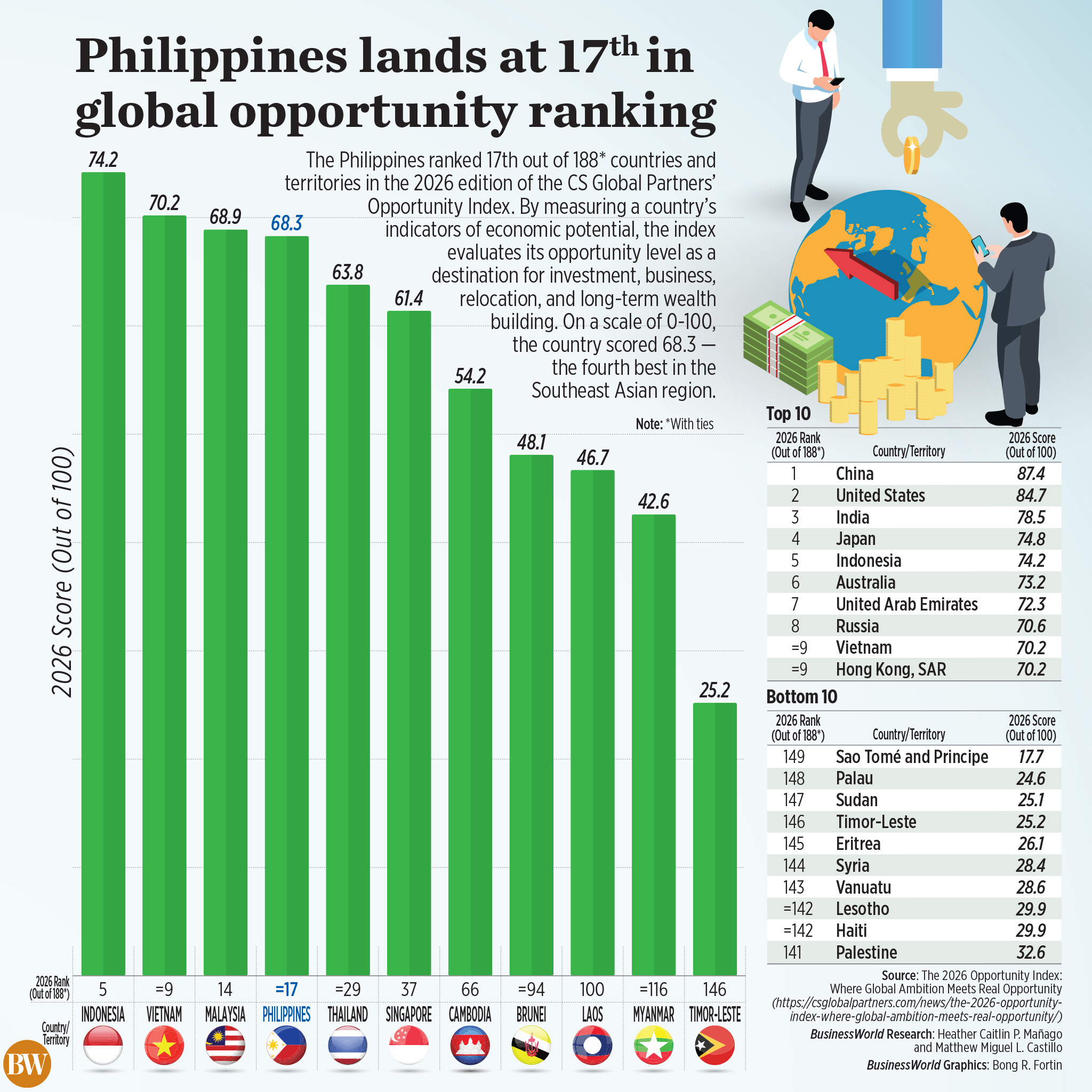
The Philippines ranked 114 on Transparency International’s corruption index of 180 countries and territories – and that was before the flood scandal broke. The country stands alongside Belarus, Panama, Sierra Leone and Laos. Mr. Marcos has formed a panel to investigate corruption and enhanced monitoring of public works projects, but more is yet to be done to tighten oversight and adopt policies to ensure scandals like these don’t happen again.

Some asset managers are reassessing government debt tied to climate and social goals, nervous they may have inadvertently financed projects now under investigation.

Peerampa Janjumratsang, a Singapore-based portfolio manager at M&G Investments, another large holder of Philippine government debt, says bonds have held up reasonably well but wants far more transparency on how funds are disbursed. “That needs to be communicated to investors better,” she says, adding that the firm has not heard directly from Philippine authorities about the scandal.

WE WANT IT FINISHED
The silence also rings loud for the villagers in Tagumpay on the island of Mindoro.

A 90-minute fast-ferry ride from Batangas province, south of Manila, the lush green area is a patchwork of fields and narrow roads. Some farmers say they were unable to harvest rice in July due to floodwater – the first time they recall that happening – and can’t plant now as the season starts again. Farmers often borrow money in planting season; no harvest means their debts compound and they need to borrow more.

Village captain Nestor Asi, tanned and lean, stands on a mound of gravel at the end of a long dike built by firms including Sunwest, the company of ex-congressman Zaldy Co. Bulldozers organized by local officials have been desilting the river from dawn to dusk to stop water from spilling into fields. The dike, completed in 2024, has already seen several sections crumble and hastily patched. An almost two-kilometer gap between two segments remains – a casualty of the corruption scandal, Mr. Asi says.

To residents, that gap has widened into a symbol of impunity. Zaldy Co, who has been charged, is yet to be found and is believed to be hiding in Portugal with a second passport, according to Interior Secretary Jonvic Remulla. So far, arrests have been limited to a handful of public works officials and the surrender of a key contractor. The most prominent figures linked to the scandal remain beyond reach.

For the farmers downstream, the consequences are immediate and measurable. Where once they earned P30,000 to 40,000 ($510 to $680) per hectare after costs, some fields now produce only stringy, unusable plants twisted in ungainly fashion. Many are waiting on government aid they say has been slow to arrive.

Casiana De Villa, a 66-year-old widow, farms with her son Manuel, 49. They haven’t planted this season. “We are worried the floodwater will destroy the crops again,” she says. “Another investment gone, another debt. We will just be buried in debt.”

Villagers say they don’t blame Mr. Marcos directly. Their anger is aimed squarely at the contractors and politicians who allegedly stole the funds.

Still, a recent WR Numero poll puts satisfaction with Marcos at just 21%, the lowest of his presidency. Depending on the pace of the probe and whether promised reforms materialize, the political damage may grow. “The longer the underlying problem of flood mismanagement persists, the greater the risk that blame will begin to travel upward, potentially implicating the presidency itself,” said Vedi Hadiz, a professor of Asian studies at the University of Melbourne.

Tagumpay farmer Danilo Divina, 57, has watched his debts mount. He has taken construction jobs to survive, including fixing the dike whose failures devastated his livelihood. Other farmers have joined him.

Mr.Divina shrugs. “We want it finished.” — Bloomberg

Corruption to weigh on Philippine growth until 2027

Photo shows the central business district in Makati City, Dec. 16. — PHILIPPINE STAR/ RYAN BALDEMOR

PHILIPPINE ECONOMIC GROWTH may continue to undershoot the government’s targets until 2027 amid the ongoing flood control corruption scandal, Capital Economics said.

In a report on Monday, the think tank said it projects gross domestic product (GDP) growth to settle at 4% this year, well below the government’s 5.5-6.5% target.

Capital Economics sees Philippine GDP to gradually pick up to 4.5% in 2026 and 5% in 2027. However, these are still below the country’s 6-7% targets.

“The corruption scandal that has engulfed the Philippines will continue to weigh on growth over the coming quarters and is likely to trigger a few more rate cuts from the BSP,” Capital Economics Senior Asia Economist Gareth Leather said in a report on Monday.   

Meanwhile, ANZ Research sees the Philippine economy expanding by 4.8% this year as the National Government continues to tighten its belt amid the ongoing probe into public infrastructure projects. 

In its ANZ Research Quarterly for Q1 2026, it trimmed its GDP growth estimates for the Philippines to 4.8% for 2025 from 4.9% previously.

“In Malaysia and the Philippines, the implied impulse for 2026 is negative,” ANZ Research Chief Economist for Southeast Asia and India Sanjay Mathur said. “In fact, our concern for the Philippines is that budgeted spending may not be realized as governance-related issues lead to greater scrutiny.”

In the third quarter, the country’s economic growth slumped to 4%, the slowest expansion seen in over four years or since the coronavirus disease 2019 (COVID-19) pandemic.

In the nine-month period, GDP growth averaged 5%, below the government’s 5.5-6.5% target.   

A wide-scale controversy linking Public Works officials, lawmakers and private contractors to multibillion-peso corruption in anomalous flood control projects dragged government spending and household consumption.

Government spending fell for a third straight month in October to P430.6 billion, down 7.76% from the P466.8-billion expenditure recorded a year ago.

Still, ANZ kept its growth forecasts for 2026 and 2027 at 5% and 5.6%, respectively.

Meanwhile, the think tank lowered its inflation forecast for 2025 to 1.6% from 1.8%.

For next year, it sees inflation accelerating back to the central bank’s 2-4% target at 2.4%, slower than its earlier projection of 3%. It also trimmed its estimate for 2027 to 3% from 3.2%.

Capital Economics likewise forecasts inflation to settle at 1.6% by yearend, before picking up to 2.3% next year and 3% in 2027.

The benign inflation outlook supports the case of further monetary policy easing.

“There is also plenty of scope for monetary policy support,” Mr. Leather said. “With inflation set to stay low, we think the central bank will deliver a couple more interest rate cuts.”

The Monetary Board last week cut the key policy rate by 25 basis points (bps) for a fifth straight meeting to 4.5%. This brought its total reductions to 200 bps since it began its easing cycle in August 2024.

Bangko Sentral ng Pilipinas (BSP) Governor Eli M. Remolona, Jr. has said they might end the current easing cycle with a final 25-bp cut next year depending on economic data.

ANZ Research expects the BSP to deliver one last 25-bp reduction next year, while Capital Economics sees a terminal rate of 4% with the first cut likely to come within the first quarter.   

The Monetary Board is scheduled to have its first meeting next year in February. — Katherine K. Chan

Maharlika plans P8-billion investment in Asian Terminals stake

ASIANTERMINALS.COM.PH

By Aubrey Rose A. Inosante and Ashley Erika O. Jose, Reporters

THE PHILIPPINES’ sovereign wealth fund plans to spend about P8 billion to buy up to 11.2% of port operator Asian Terminals, Inc. (ATI) in a “strategic” move to invest in the sector.

The transaction will lead to ATI’s voluntary delisting from the Philippine Stock Exchange (PSE).

In a statement on Tuesday, the Maharlika Investment Corp. (MIC) said it plans to buy a minority stake in the Tanco-led ATI to “secure a significant position in one of the country’s vital trade gateways.”

The potential investment amount is at least P8 billion, MIC President and Chief Executive Officer Rafael D. Consing, Jr. said in a Viber message to BusinessWorld.

“The port sector is the circulatory system of the Philippine economy. My previous tenure in global logistics has reinforced the conviction that port infrastructure is not merely a business, but a strategic national asset,” Mr. Consing said in the statement.

Mr. Consing said the fund aims to “capture value” from utilities that have “high barriers to entry and a direct correlation to the country’s GDP (gross domestic product) growth.”

“This ensures that our portfolio is resilient, cash-generative, and aligned with national progress. Our entry into ATI is a definitive move to anchor these assets within the Philippine financial ecosystem,” he said.

MIC’s investment in ATI would be its second deal this year, following the acquisition of a 20% stake in Synergy Grid & Development Phils., Inc. for P19.7 billion which gave it a “foothold” in National Grid Corp. of the Philippines.

Maharlika has about P71 billion in deployable capital for future investments.

DELISTING
The MIC is seeking to conduct a tender offer for ATI’s shares, which will run in parallel with ATI’s voluntary delisting from the PSE.

“By entering during the delisting process, MIC maximizes the efficiency of its capital deployment, securing an institutional-grade position in a mature, revenue-generating utility,” the fund said.

ATI told the stock exchange that its board of directors on Tuesday approved the company’s voluntary delisting from the main board of the PSE, after receiving MIC’s notice.

The listed port operator will also expand its share buyback program to acquire the remaining public float shares and employee-held shares, through the same tender offer. Its board also approved to increase its share buyback program to P5 billion.

ATI said MIC has expressed its intention to make a tender offer to its shareholders to acquire up to 101.19 million common shares of ATI at P36 each or around P3.64 billion.

MIC is expected to hold about 11.2% of ATI’s outstanding capital stock once the tender offer is completed, the port operator said.

“This allows ATI to advance its plans for efficiency, infrastructure modernization, and market development, aligned with its mandate to make trade flow efficiently and sustainably,” the company said.

The company also said that MIC’s tender offer bolsters its position in the industry and reflects confidence in its performance, governance and position in the logistics and ports sector.

ATI is also set to conduct a special shareholder meeting on Jan. 30, 2026 for the approval of the voluntary delisting by its stockholders.

On Tuesday, ATI requested a voluntary trading suspension which will be lifted at 9 a.m. on Dec. 17.

In a separate disclosure, ATI’s board of directors has also approved the amendment of its articles of incorporation to increase the number of directors to nine from the current eight.

“The rationale for the increase in the number of directors is to allow Maharlika Investment Corp. representation in the Board of ATI,” ATI said, adding that this is subject to MIC acquiring more than 9% of its issued and outstanding shares and the effectivity of its delisting from PSE.

For China Bank Capital Corp. Managing Director Juan Paolo E. Colet, MIC’s investment in ATI will attract more investments in domestic ports.

“Maharlika should take it a step further by leveraging its stature and network to attract quality foreign funds to co-invest in our country’s maritime infrastructure. We need more and better ports to significantly promote growth across regions,” Mr. Colet said in a Viber message.

Globalinks Securities and Stocks, Inc. Head of Sales Trading Toby Allan C. Arce said that ATI’s decision to pursue voluntary delisting from the PSE reflects its capital strategy.

“ATI’s leadership is signaling a preference for greater strategic and operational flexibility outside the listed environment particularly when a credible investor like Maharlika is willing to support the transaction and potentially take a board seat,” Mr. Arce said.

ATI manages and operates several terminals in the country including the Manila South Harbor, the Port of Batangas, Batangas Container Terminal and off-dock yards in Sta. Mesa, Manila; and Calamba, Laguna.

For the January-September period, the company saw its attributable net income jump by 34.38% to P4.26 billion.

“For the ports and logistics sector, ATI’s delisting may reduce the number of publicly traded pure-play terminals on the PSE, potentially narrowing sector representation and investor choice,” Mr. Arce said.

The planned delisting of ATI could also signal that some firms see greater advantage in private ownership structure than public listing, he said.