Home Blog Page 1965

Kristine hits almost 1M power lines

PHILSTAR FILE PHOTO

MORE than 970,000 power connections have been affected by Severe Tropical Storm “Kristine” (International Name: Trami), according to the National Electrification Administration (NEA).

At a press briefing on Wednesday, NEA director Eric B. Campoto said that 86 electric cooperatives affected that are from 52 provinces and 12 regions are “under monitoring.”

“Out of the 86 electric cooperatives, 50 are in normal operations, 29 are in partial power interruptions, six are in total power interruptions, and one is still without an updated report,” Mr. Campoto said.

Initial damage cost due to Tropical Cyclone Kristine amounted to nearly P1 million. This may still increase as the electric cooperatives are still assessing the data and the tropical cyclone has yet to make its landfall, he said.

Meanwhile, the National Grid Corp. of the Philippines (NGCP) said that several transmission lines in Luzon and Visayas have been unavailable.

Paul Michael R. Azur, NGCP’s geomatics and command center manager, said that a total of 23 69-kilovolt (kV) transmission lines has been affected, of which 16 lines were already energized while one of the two 230-kV lines that were unavailable was already online.

“The remaining 230-kV (line) has no effect on the grid, although, we are still going to assess what has happened to these transmission lines if weather permits,” he said.

The grid operator said it has mobilized its line crews and is conducting patrols. Simultaneous restoration activities were also conducted in areas already accessible.

Power distributor Manila Electric Co. (Meralco), which provides electric service in Metro Manila and nearby areas, earlier assured its customers that its personnel are ready to respond to electricity service concerns that may arise. — Sheldeen Joy Talavera


P454M released for ambulances

PHILIPPINE STAR/EDD GUMBAN

AROUND P454 million was released to purchase another batch of ambulances and other medical transport vehicles to address healthcare gaps, the Budget department said on Wednesday.

On Oct. 17, Budget Secretary Amenah F. Pangandaman greenlit the issuance of an Authority to Purchase Motor Vehicle to procure 173 units of medical vehicles.

These include 161 units of land ambulance, two units of mobile primary care facilities (mobile clinic), and four units of sea ambulance.

It also covers four units of a passenger van, a patient transport vehicle, and a mobile blood donation van.

The Department of Budget and Management previously approved the procurement of 141 units for medical vehicles on June 11.

The vehicles would be chargeable against the Health Facilities Enhancement Program under the P241.1-billion budget of the Department of Health. — Beatriz Marie D. Cruz

More health sector funds sought

PHILSTAR FILE PHOTO

THE Department of Finance (DoF) said on Wednesday it is actively seeking more funding sources to support projects in the health sector.

“This includes providing more healthcare facilities, ensuring accessible access to them through better infrastructure, ensuring food security for all through boosting our agricultural productivity, giving economic opportunities for our people to increase their incomes and capacity to buy medicines and vitamins, and lifting more Filipinos out of poverty—because this ultimately breeds hunger and disease,” Finance Secretary Ralph G. Recto said in a statement.

Mr. Recto and Health Secretary Teodoro J. Herbosa met on Sept. 30 to discuss funding requirements for the government’s health projects.

Among the projects discussed include the P14.31-billion Health Facilities Enhancement Program for infrastructure, medical equipment, and transport vehicle support to health facilities nationwide; and a P136-million project for the Department of Health’s disease surveillance mandate.

They also discussed projects on immunization, health literacy, nutrition, and access to medicines, among others.

Mr. Recto also shared the DoF has secured funding for the implementation of the Health System Resilience Project Phase I, which has a cost of P27.92 billion, while Mr. Herbosa said the Health department has identified 17 provinces for the project’s pilot run, which are mostly areas with poor healthcare access. — Beatriz Marie D. Cruz

Bill mandating BSP to oversee credit information system filed

BW FILE PHOTO

A BILL mandating the Philippine central bank to oversee Filipinos’ credit history and financial health has been filed the House of Representatives, a measure expected make credit information systems interoperable in the country.

The Bangko Sentral ng Pilipinas (BSP) will operate the country’s central credit information system under House Bill (HB) No. 10922. The bill institutionalizes the transfer of functions and responsibilities of the Credit Information Corp. (CIC) to the central bank, pursuant to a 2022 presidential order.

“The BSP is not explicitly tasked with establishing and operating a comprehensive and inclusive Credit Information Reporting System,” Cagayan de Oro Rep. Rufus B. Rodriguez said in the bill, which he filed on Sept. 17.

“This bill seeks to amend [Republic Act No.] 9510 to institutionalize the transfer of [CIC’s] oversight and supervision to the BSP consistent with the National Strategy for Financial Inclusion,” it said.

“The measure will also facilitate a seamless transition to the administration’s vision of a Bayang Digital by making credit information systems interoperable,” it added. “At the same time, it will streamline bureaucracy, while maintaining efficient operations and minimizing disruptions in the concerned government offices.”

Nonbanking financial entities, such as quasi-banks, life insurance companies, and credit card companies would be required to submit to the central bank the data of its users, according to the measure.

Data requirements include users’ personal data, net income, and assets such as cars and houses owned, among others. — Kenneth Christiane L. Basilio

Samar evacuation centers flagged

PHILIPPINE STAR/ MICHAEL VARCAS

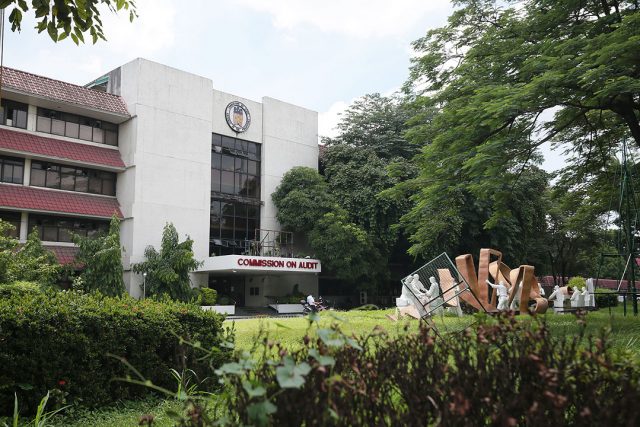
THE Commission on Audit has flagged the provincial government of Samar for constructing five multipurpose centers, intended as evacuation centers during disasters as its design exposed possible evacuees to outdoor elements.

State auditors said the multipurpose centers’ “open-air” structures worth P14 million could be ineffective in protecting the people from harsh weather conditions during disasters, which they saw as an unproductive use of the provincial government’s disaster management fund.

“These evacuation centers cum multipurpose centers are mere open-air structures with roofs and without exterior walls, which are only meant to protect or shade people from the blazing sun and rain, but not against the hazards that may be brought about by the disasters and calamities,” state auditors said in the report. 

“The lack of walls of the structures would only expose the people to the very hazards meant to be prevented by the law through the use and management of LDRRMF (Local Disaster Risk Reduction and Management Fund),” they added.

Samar’s provincial government did not immediately respond to an e-mail and Facebook Messenger chat seeking comment but stated in its letter-reply to the commission that the “multipurpose centers are all in consonance with the purpose to support disaster risk management activities.” — Kenneth Christiane L. Basilio

CTA orders release of ERS Surplus’ goods

THE Court of Tax Appeals (CTA) partially granted the petition of ERS Surplus Venture in a case involving the seizure and forfeiture of chainsaws, truck tires, and other goods, ordering the Philippine government to release the items covered by a Certificate of Authority to Import (CAI).

In a 24-page ruling promulgated on Oct. 15 but was only publicized on Oct. 21, the tax court’s First Division held that the Bureau of Customs (BoC) was correct in seizing five used chain saws and ten pieces of used tires because the petitioner, ERS, did not have the required permit from the Department of Environment and Natural Resources before importing them.

The case stemmed from a shipment that arrived in the Philippines on Aug. 30, 2021. The BoC issued an Alert Order against the shipment, and upon inspection, found five used chain saws and ten used truck tires with rims that were not declared in the import entry.

The petitioner argued that the tires were not intended for commercial sale and that their supplier included them in the shipment to protect the other goods. However, the CTA found that this did not excuse the violation of the import prohibition.

The CTA, however, ruled that the forfeiture of other imported goods that were declared is improper, prompting it to order the BoC to release the remaining goods covered by the CAI to the petitioner upon payment of the assessed customs duties, taxes, and fees.

This included a variety of used truck parts and other items, such as a mini excavator, farm tractors, bicycles, and engines. — Chloe Mari A. Hufana

Ex-cashier flees with P8M from Ilocos Sur firm

BAGUIO CITY — A former cashier of Ilocos Sur-based private firm Shellme Energy Resources Incorporated (SERI) is being hunted down after scamming her former employer with over P8 million.

The National Bureau of Investigation (NBI) also filed a total of 136 counts of violation of the Anti-Money Laundering Law against the former employee, who embezzled SERI’s funds into her personal account a total amount of P8.1 million.

As a cashier, she was responsible for preparing checks for SERI via online banking, but NBI found that she reprinted a total of 136 checks, 95 of which were encashed, while 41 checks were traced to have been deposited to her personal account.

Aside from Qualified Theft, the NBI also probed the Money Laundering aspect (of the Qualified Theft) in relation to Section 6 of R.A. 10175 (Cybercrime Prevention Act of 2012), pursuant to the directive of NBI Director Jaime B. Santiago.

A Warrant of Arrest for Qualified Theft has been issued against her with no bail recommended, while the 136 counts of violation of the Anti- Money Laundering Law filed have undergone evaluation by the Vigan City Prosecutor’s Office, the NBI said.

The case was recommended on Oct. 11 to be docketed for Preliminary Investigation by the Vigan City Prosecutor’s Office finding Arce’s scheme complete of the essential elements of money laundering. — Artemio A. Dumlao

News reporter shot dead in Zamboanga City

COTABATO CITY A gunman shot dead a 56-year-old female radio news reporter in an attack in Barangay Tumaga in Zamboanga City on Tuesday night.

In separate reports released Wednesday, the Zamboanga City Police Office and the Police Regional Office-9 stated that Maria Vilma L. Rodriguez was shot thrice with .38 caliber revolver by an attacker while seated close to the store of her mother along Comet Street in Barangay Tumaga, killing her instantly.

The killer of Ms. Rodriguez managed to escape amid the commotion triggered by the gunshots that reverberated through the area. She was declared dead on arrival by doctors in a hospital where she was brought by emergency responders for treatment.

The victim, a single mother who has four children, was a host of the Barangay Action Center program of the 105.9 E-Media radio in Zamboanga City that also has a social media online news platform.

She had worked as a volunteer reporter of a Brigada radio station in Zamboanga City before she joined the E-Media broadcast and online news entity, according to reporters covering the Police Regional Office-9 and the military’s Western Mindanao Command.

Brig. Gen. Bowenn Joey M. Masauding, director of PRO-9, told reporters on Wednesday that their intelligence units and barangay officials in Tumaga are together trying to identify her killer for prosecution. — John Felix M. Unson

BARMM, Indonesia tackle regional health services 

COTABATO CITY — The Bangsamoro government had lengthily briefed ranking officials of the Indonesian Embassy in Makati City on how it is providing health interventions to the local communities benefiting from a peace process that Indonesia is helping push forward.

Indonesia is a member of the influential Organisation of Islamic Cooperation (OIC), a bloc of more than 50 Muslim states, including petroleum-exporting countries in the Middle East and North Africa, that helped broker the separate peace compacts of the Moro National Liberation Front and the Moro Islamic Liberation Front (MILF) with Malacañang.

Radio reports in Central Mindanao on Wednesday morning stated that the physician-ophthalmologist Kadil M. Sinolinding, Jr., health minister of the Bangsamoro Autonomous Region in Muslim Mindanao (BARMM), had talked lengthily about the “good practices” of the Ministry of Health (MoH) in BARMM in extending health services to constituent Muslim, Christian and indigenous communities during the Indonesia-Philippines Health Forum last Monday.

“That activity gave us a chance to brief them on our best practices in health services that we extend to the local communities,” Mr. Sinolinding said.

The MoH-BARMM covers five provinces and three cities in Mindanao, grouped under the Bangsamoro autonomous government, established in 2019 based on the peace agreement between the MILF and the national government, forged with the support of OIC-member states.

Among the topics discussed in the Indonesia-Philippines Health Forum were the MoH-BARMM’s extensive vaccination campaigns to forestall measles outbreak and the spread in the autonomous region of other diseases preventable with vaccines.

“Our health workers involved in those very taxing missions hike far distances, cross rivers and marshlands and ride boats to cross islands in the seas and inland swamps to reach the villagers they ought to vaccinate. That, I told them in my briefing,” he said. — John Felix M. Unson

PSEi drops to 7,300 level as market stays cautious

BW FILE PHOTO

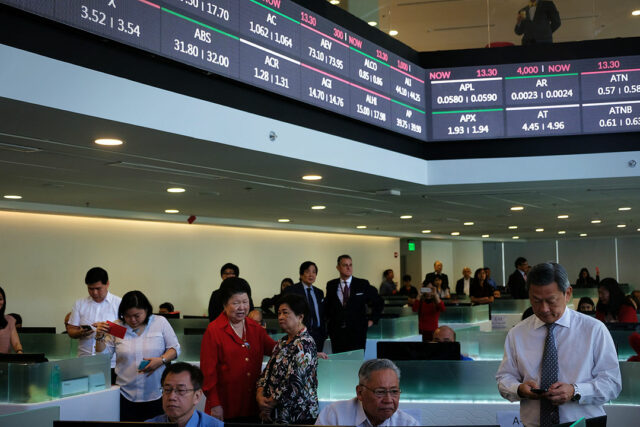
PHILIPPINE SHARES went down to the 7,300 level on Wednesday, tracking the performance of most US indices, as the market continued to look for fresh leads.

The Philippine Stock Exchange index (PSEi) fell by 0.61% or 45.50 points to close at 7,367.66 on Wednesday, while the broader all shares index declined by 0.85% or 34.74 points to end at 4,050.76.

“Philippine stocks slipped along with Wall Street, as investors grappled with ongoing concerns about rising interest rates and processed the latest earnings reports released this week,” Regina Capital Development Corp. Head of Sales Luis A. Limlingan said in a Viber message.

“Back home, value turnover remained weak as a certain number of institutions were closed over the typhoon, while others awaited more third quarter financial results and expectations of policy easing by the central bank,” he added.

Value turnover went down to P4.52 billion on Wednesday with 1.2 billion issues changing hands from P5.31 billion with 916.59 million shares traded on Tuesday.

On Wednesday, the foreign exchange market was closed as the government suspended work and classes due to Tropical Storm Trami, locally known as Kristine.

“The local market pulled back this Wednesday. Investors took a cautious stance as the local market remains without a fresh positive catalyst,” Philstocks Financial, Inc. Senior Research Analyst Japhet Louis O. Tantiangco said in a Viber message. “Net foreign selling, attributed to the peso’s weakened state and the rise in the US’ long-term treasury yields, also contributed to the decline.”

Net foreign selling increased to P159.24 million on Wednesday from P16.04 million on Tuesday.

US stocks ended little changed on Tuesday, but the Nasdaq eked out a modest gain while investors kept an eye on Treasuries yields and awaited more earnings to assess the health of American companies, Reuters reported.

In a choppy session, the Dow Jones Industrial Average fell 6.71 points or 0.02% to 42,924.89; the S&P 500 lost 2.78 points or 0.05% to 5,851.20; and the Nasdaq Composite gained 33.12 points or 0.18% to 18,573.13.

The benchmark 10-year note yields earlier reached 4.222%, the highest since July 26, as investors reassessed expectations for the US Federal Reserve’s policy trajectory. Traders are pricing in an 89.6% chance of a 25-basis-point interest rate cut in November, according to CME’s FedWatch.

Back home, majority of sectoral indices closed lower on Wednesday. Services dropped by 1.92% or 43.84 points to 2,237.76; property went down by 1.03% or 30.40 points to 2,897.61; industrials retreated by 0.23% or 24.14 points to 10,076.75; and financials declined by 0.17% or 4.23 points to 2,406.99.

Meanwhile, mining and oil rose by 0.43% or 37.49 points to 8,706.62; and holding firms climbed by 0.07% or 4.78 points to 6,190.26.

Decliners beat advancers, 128 versus 71, while 55 names were unchanged. — R.M.D. Ochave with Reuters

Trade dep’t hoping to wrap up free trade talks with EU by 2026

REUTERS

THE PHILIPPINES is hoping to conclude negotiations for a free trade agreement (FTA) with the European Union (EU) by 2026, a trade official said.

On the sidelines of the 50th Philippine Business Conference and Expo, Department of Trade and Industry (DTI) Undersecretary Allan B. Gepty said 2026 is the internal target, but President Ferdinand R. Marcos, Jr. has said that the ultimate aim is for negotiations to wrap up by 2027.

“Internally, we are targeting 2026. So we will exert all our efforts. Because the EU is our major source of investments and an FTA will definitely increase investment,” Mr. Gepty said.

“In fact, just the signal that we are working towards an FTA already has a positive effect, so we hope to sustain that momentum,” he added.

The two parties resumed negotiations in Brussels last week. Talks had been on hold since 2017.

According to Mr. Gepty, the internal 2026 target will ensure no gap in trade privileges should the Philippines lose EU concessions by graduating to upper-middle-income status.

The Philippines participates in the EU’s GSP+, a special incentive arrangement for low and lower middle-income countries. It grants the country zero duties on 6,274 made products.

“In that context, there’s a pressure for us to conclude the negotiations ASAP because we don’t have a gap in our trade with the EU as far as enjoying preferential arrangements is concerned,” Mr. Gepty said.

“Right now, exporters that currently enjoy the preferential access will lose their competitive advantage,” he added.

Mr. Gepty said that the Philippines and the EU “made good progress in the first round,” describing the talks as “very positive and constructive.”

Meanwhile, he said that the second round of negotiations is set to happen in the Philippines on Feb. 11-13.

“In February… we will try to conclude as many provisions as possible. We will see if we can tackle market access,” he said.

“And then we will have the third round in June and the fourth round in October. So basically… we want to finish as soon as possible for so many reasons,” Mr. Gepty said.

Meanwhile, he said that the negotiations for the Comprehensive Economic Partnership Agreement (CEPA) with the United Arab Emirates (UAE) could be concluded, at the latest, by the first week of November.

“This year is the 50th anniversary of our diplomatic relations with the UAE, so one of our deliverables is the conclusion of this FTA negotiation,” he said.

On plans of entering an FTA with Chile, he said that the joint study it is currently conducting is expected to be concluded this month.

“We will have a joint committee meeting in November, so I hope by that time, it will already be done,” he said. — Justine Irish D. Tabile

PCA ties up with Japanese firm to develop coconut-based sustainable aviation fuel

REUTERS

THE Philippine Coconut Authority (PCA) is exploring the production of sustainable aviation fuel (SAF) using local coconut oil as a key ingredient.

In a statement, the PCA announced the signing of a memorandum of understanding with Japan-based Manryu Co., Ltd. for the research and development phase of bringing SAF to market.

“The signing signifies a leap towards establishing the country as a key player in the global biofuel industry,” the PCA said.

The agency added that the partnership would optimize the use of local coconut oil in the production of biofuels.

“The partnership aims to leverage Manryu’s innovative proprietary Maeda Method for biodiesel and SAF manufacturing, which promises enhanced safety features and cost-efficient production,” the PCA said.

The Department of Energy has required all diesel fuel sold in the country to be a 3% blend of coco methyl ester (CME). The CME blend will further increase to 4% by Oct. 1, 2025 and to 5% a year later.

The PCA added that it will provide access to its research facilities and high-quality coconut oil, while Manryu will supply its technology and equipment in the production of SAF and biodiesel.

“Both organizations will jointly conduct research, experiments, and testing to refine the process and ensure it meets global standards for aviation fuel,” it said. — Adrian H. Halili