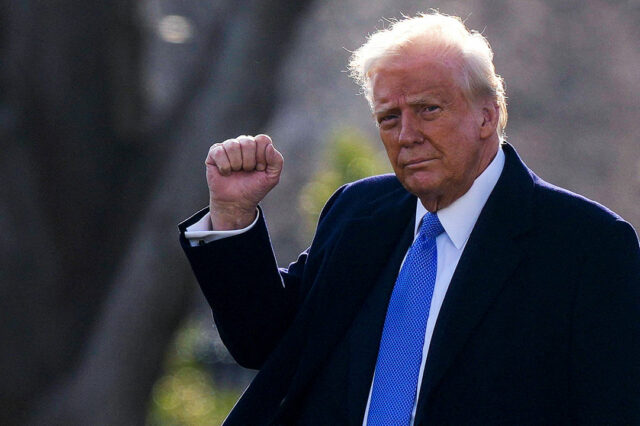
South Korea seeks exemption from Trump tariffs

SEOUL – South Korean officials have requested an exemption from U.S. reciprocal, steel and aluminum tariffs during their visit this week to Washington, the industry ministry said in a statement on Friday.
Deputy Minister Park Jong-won, who led the first major South Korean government delegation to visit Washington since U.S. President Donald Trump announced sweeping tariffs, argued that almost all tariffs between the two countries have already been eliminated under their free trade agreement.
As a major global exporter and top trading partner with the United States, South Korea has viewed Trump’s measures with increasing concern.
Mr. Park highlighted investments in the United States by South Korean companies and proposed holding high-level meetings with the Trump administration to discuss further cooperation, the ministry said.
He also met with members of Congress and pressed them to maintain incentives for South Korean companies to operate in the United States.
“In the future, the government will continue to consult at a high level on U.S. trade and trade measures, and will respond to minimize damage to Korean companies through close communication with the industry,” the ministry’s statement said.
South Korea’s Acting President Choi Sang-mok said last week the country had invested more than any other in the United States in the past two years and that should allow it to negotiate with the Trump administration on tariffs.
On Friday, Mr. Choi ordered authorities to reach out to the U.S. more actively to seek cooperation and monitor response measures being taken by others, such as the European Union, Japan and China.
Japan has asked Washington to exclude it from steel and aluminum tariffs, while China has responded to U.S. measures with retaliatory tariffs. The EU said this week it was ready to discuss trade deals and lower tariffs.
“Given their substantial role in supporting US economic objectives, we think Korea and Japan are in a strong position to seek tariff exemptions,” Standard Chartered economists said in note, citing more than 20,000 U.S. jobs South Korea contributed in 2023, more than any other country.
Seoul’s responses to the Trump administration’s moves have been complicated by a political crisis sparked when President Yoon Suk Yeol briefly imposed martial law in December.
South Korea’s industry minister on Friday met with the acting U.S. ambassador in Seoul and said policies affecting trade and investment between the two countries should remain consistent and stable.
A delegation representing 20 South Korean companies also travelled to the U.S. this week to meet policymakers.
Mr. Choi, who took over after both Mr. Yoon and the prime minister were impeached, has yet to speak directly with Mr. Trump. – Reuters
Trump pulls US out of key global climate assessment, sources say

WASHINGTON – The Trump administration has halted the participation of U.S. scientists in key U.N. climate change assessments, two sources familiar with the situation told Reuters, part of its broader withdrawal from climate change mitigation efforts and multilateral cooperation.
The stop-work order affects staff members of the U.S. Global Change Research Program and the National Oceanic and Atmospheric Administration who engage with a key working group of the Intergovernmental Panel on Climate Change.
It means the U.S. will not attend a major IPCC plenary meeting in Hangzhou, China, next week, to plan the seventh global climate assessment, said one of the sources.
The White House declined to comment and the State Department did not respond to a request for comment.
“The power of the IPCC is that governments, businesses and global institutions can operate with shared conclusions. The U.S. being completely removed from that process is concerning,” said Delta Merner of the Union of Concerned Scientists.
While American scientists will be in attendance and continue to work on climate research used by the IPCC, the absence of the U.S. in the IPCC process will be felt.
The Hangzhou meeting from 24-28 February is expected to make a few key decisions that will shape the outcomes of the next climate assessment, including around the role of carbon removal and capture technology.
China’s foreign ministry said on Thursday it was unaware of the withdrawal of U.S. participants.
The U.S. is a co-chair along with Malaysia of a working group on climate mitigation, or ways to reduce greenhouse gas emissions.
The U.S. had also pledged around $1.5 million to support the IPCC, though that money had not yet been appropriated by Congress.
Withdrawal of the U.S. from the IPCC does not come as a surprise to climate scientists, given President Donald Trump’s moves to withdraw the U.S. again from the Paris climate agreement, claw back U.S. global climate finance and sever international partnerships on climate.
“This would align with Trump’s signals around climate action,” said Kathryn Bowen, a professor at Melbourne University and a lead author on the IPCC’s sixth assessment report published last year.
She said the loss of federal support comes at a time of reduced funding for climate science globally.
“Unfortunately there has been a slow reduction of funding support for authors in the IPCC process in the last few years,” Bowen said. “High-income countries are looked upon as important sources of funding for colleagues from the Global South.” – Reuters
Deepfakes can ruin lives and livelihoods – would owning the ‘rights’ to our own faces and voices help?
by Graeme Austin, Chair of Private Law, Te Herenga Waka — Victoria University of Wellington, and Jane C Ginsburg, Professor of Literary and Artistic Property Law, Columbia University
Not that long ago, the term “deepfake” wasn’t in most people’s vocabularies. Now, it is not only commonplace, but is also the focus of intense legal scrutiny around the world.
Known in legal documents as “digital replicas”, deepfakes are created by artificial intelligence (AI) to simulate the visual and vocal appearance of real people, living or dead.
Unregulated, they can do a lot of damage, including financial fraud (already a problem in New Zealand), political disinformation, fake news, and the creation and dissemination of AI-generated pornography and child sexual abuse material.

For professional performers and entertainers, the proliferation and increasing sophistication of deepfake technology could demolish their ability to control and derive income from their images and voices.
And deepfakes might soon take away jobs: why employ a professional actor when a digital replica will do?
One possible solution to this involves giving individuals the ability to enforce intellectual property (IP) rights to their own image and voice. The United States is currently debating such a move, and New Zealand lawmakers should be watching closely.
Remedies already being discussed in New Zealand include extending prohibitions in the Harmful Digital Communications Act to cover digital replicas that do not depict a victim’s actual body.
Using (or amending) the Crimes Act, the Fair Trading Act and the Electoral Act would also be helpful.
At the same time, there will be political pressure to ensure regulation does not stymie investment in AI technologies – a concern raised in a 2024 cabinet paper.
Legislation introduced to the US Congress last year – the Nurture Originals, Foster Art, and Keep Entertainment Safe Bill – proposes a new federal intellectual property right that individual victims can use against creators and disseminators of deepfakes.
Known informally as the “No Fakes Bill”, the legislation has bipartisan and industry support, including from leading entertainment worker unions. The US Copyright Office examined the current state of US law and concluded that enforceable rights were “urgently needed”.
From the New Zealand perspective, the No Fakes Bill contains both helpful ideas and possible pitfalls. As we discuss in a forthcoming paper, its innovations include expanding IP protections to “everyday” individuals – not just celebrities.
All individuals would have the right to seek damages and injunctions against unlicensed digital replicas, whether they’re in video games, pornographic videos, TikTok posts or remakes of movies and television shows.
But these protections may prove illusory because the threshold for protection is so high. The digital replica must be “readily identifiable as the voice or visual likeness of an individual”, but it’s not clear how identifiable the individual victim of a deepfake needs to be.
Well known New Zealand actors such as Anna Paquin and Cliff Curtis would certainly qualify. But would a New Zealand version of the bill protect an everyday person, “readily identifiable” only to family, friends and workmates?
Under the US bill, the new IP rights can be licensed. The bill does not ban deepfakes altogether, but gives individuals more control over the use of their likenesses. An actor could, for example, license an advertising company to make a digital replica to appear in a television commercial.
Licenses must be in writing and signed, and the permitted uses must be specified. For living individuals, this can last only ten years.
So far, so good. But New Zealand policy analysts should look carefully at the scope of any licensing provisions. The proposed IP right is “licensable in whole or in part”. Depending on courts’ interpretation of “in whole”, individuals could unknowingly sign away all uses of their images and voice.
The No Fakes Bill is also silent on the reputational interests of individuals who license others to use their digital replicas.
Suppose a performing artist licensed their digital replica for use in AI-generated musical performances. They should not, for example, have to put up with being depicted singing a white supremacist anthem, or other unsanctioned uses that would impugn their dignity and standing.
On the other side of the ledger, the No Fakes Bill contains freedom of expression safeguards for good faith commentary, criticism, scholarship, satire and parody.
The bill also protects internet service providers (ISPs) from liability if they quickly remove “all instances” of infringing material once notified about it.
This is useful language that might be adopted in any New Zealand legislation. Also, the parody and satire defense would be an advance on New Zealand’s copyright law, which currently contains no equivalent exception.
But the US bill contains no measures empowering victims to require ISPs to block local subscribers’ access to online locations that peddle in deepfakes. Known as “site-blocking orders”, these injunctions are available in at least 50 countries, including Australia. But New Zealand and the US remain holdouts.
For individual victims of deepfakes circulating on foreign websites that are accessible in New Zealand, site-blocking orders could offer the only practical relief.
The No Fakes Bill is by no means a perfect or comprehensive solution to the deepfakes problem. Many different weapons will be needed in the legal and policy armory – including obligations to disclose when digital replicas are used.
Even so, creating an IP right could be a useful addition to a suite of measures aimed at reducing the economic, reputational and emotional harms deepfakes can inflict. – Reuters
Block’s profit misses estimate as holiday spending, bitcoin gains fall short
Block’s fourth-quarter profit fell short of estimates as spending growth during the holiday season and gains from a post-election surge in bitcoin lagged expectations, sending the payment firm’s shares down 8% in extended trading on Thursday.
While a robust labor market and steady wage growth have supported consumer spending – bolstered further by holiday travel and retail splurges – uncertainty surrounding trade policy under a new administration and the Federal Reserve’s rate cuts has kept sentiment in check.
Block’s results come on the same day that retail giant Walmart WMT.N fueled concerns over consumer spending with a sales and profit forecast for the current year that fell short of Wall Street estimates.
Block CEO Jack Dorsey, however, emphasized the payments company’s attempts to streamline operations and said investing in artificial intelligence tools was a top priority.
“Our number one initiative on our strategic roadmap … is to invest heavily in building applied AI tools to remove the toil of mechanical tasks,” he said.
The company reported a profit of 71 cents per share, excluding one-time costs. Analysts had expected a figure of 87 cents per share, according to estimates compiled by LSEG.
Its transaction-based revenue was $1.68 billion, compared with the expectations of $1.70 billion. Bitcoin revenue of $2.43 billion also missed estimates of $2.62 billion.
Block facilitates bitcoin purchases on its platform by acquiring the cryptocurrency through private broker dealers and reselling it at a small premium.
Founded in 2009 as Square before rebranding in 2021, the company is expanding into crypto mining while also deepening its presence in the buy now, pay later market. – Reuters
Trump can continue mass firings despite disruption and chaos, US judge rules
The Trump administration can continue its mass firings of federal employees for now, a federal judge ruled on Thursday, rejecting a bid by a group of labor unions to halt President Donald Trump’s dramatic downsizing of the roughly 2.3 million-strong federal workforce.
U.S. District Judge Christopher Cooper in Washington, D.C., said Mr. Trump’s onslaught of executive actions in his first month in office have caused “disruption and even chaos in widespread quarters of American society.” But he said he likely lacks the power to decide whether the firing of tens of thousands of government workers is lawful.
The unions are instead likely required to file complaints with the Federal Labor Relations Authority, which hears disputes between federal agencies and unions that represent their workers, Mr. Cooper said. Mr. Trump last week fired the Democratic chair of the three-member panel, who has filed a lawsuit seeking to be reinstated.
“Federal district judges are duty-bound to decide legal issues based on even-handed application of law and precedent — no matter the identity of the litigants or, regrettably at times, the consequences of their rulings for average people,” the judge wrote.
Mr. Cooper declined to block the mass firings while the litigation plays out, a win for the Trump administration as it seeks to purge the federal workforce and slash what it deems wasteful and fraudulent government spending.
The White House and the U.S. Department of Justice did not immediately respond to requests for comment.
Doreen Greenwald, president of the National Treasury Employees Union, called the decision a temporary setback and said the union would continue pursuing its legal challenge.
“There is no doubt that the administration’s actions are an illegal end-run on Congress, which has the sole power to create and oversee federal agencies and their important missions,” Ms. Greenwald said in a statement.
The treasury union and four others sued last week seeking to block eight agencies from firing thousands of federal workers and granting buyouts to employees who quit voluntarily. The agencies include the Department of Defense, Department of Health and Human Services, Consumer Financial Protection Bureau, and Department of Veterans Affairs.
Mr. ruling is the latest setback for unions that have turned to courts to block Mr. Trump’s sweeping and unprecedented efforts to shrink the federal bureaucracy. At least two judges have ruled that unions lacked legal standing to challenge mass firings and other Trump administration initiatives because they could not show they were directly harmed by them.
DOGE ACTIONS
Mr. Trump tapped Tesla CEO Elon Musk to lead a new Department of Government Efficiency, or DOGE, which has swept through federal agencies slashing thousands of jobs and dismantling federal programs since Mr. Trump became president last month. Mr. Trump also ordered federal agencies to work closely with DOGE to identify federal employees who could be laid off.
Terminations of workers across the federal government began last week, primarily targeting recently hired employees still on probation, at agencies such as the Internal Revenue Service, Department of Education, the Small Business Administration, the General Services Administration, and others.
The unions said in their lawsuit that White House efforts, including through DOGE, to shrink the federal workforce violate separation of powers principles by undermining Congress’ authority to fund federal agencies.
The unions said that unless the court intervenes, they will be irreparably harmed by lost revenue from dues-paying members who were either fired or retired early to take buyouts.
Most civil service employees can be fired legally only for bad performance or misconduct, and they have a host of due process and appeal rights if they are let go arbitrarily. The probationary employees let go in last week’s wave have fewer legal protections. – Reuters
Not all crises are tragedies
Unlike other businesses, Kamuning Bakery Café thrived during the pandemic, according to its owner Wilson Lee Flores.
Interview by Edg Adrian Eva
Video editing by Arjale Queral
Renewed optimism, business reinvention in 2025
By Mhicole A. Moral, Special Features and Content Writer
Business leaders around the world are heading into 2025 with confidence about economic growth but face mounting pressure to reinvent their companies for long-term survival.
According to PwC’s 28th Annual Global CEO Survey, nearly three in five chief executive officers (CEOs) anticipate global economic growth will rise over the next year — almost double last year’s figure. However, 42% of CEOs believe their companies will not remain viable beyond the next decade without significant transformation.
Macroeconomic volatility and inflation at 27% top the list of global concerns, while regional differences highlight specific threats. For instance, geopolitical conflict is the primary risk in the Middle East at 41%; whereas in Western Europe, cybersecurity at 27% edges out inflation and labor shortages.
Regulatory challenges also shape business strategy, with 42% of global CEOs citing policy shifts as the greatest threat to long-term viability. More than a third have ventured into new sectors in the past five years to diversify revenue streams, but progress is slow.
Two-thirds of companies reallocate less than 20% of their financial and human resources year-over-year, raising questions about business agility.
Meanwhile, the same report said that Philippine-based chief executives are more confident in the country’s economic growth compared to their global counterparts.
The report, which surveyed 32 Filipino CEOs out of 1,520 respondents from the Asia-Pacific region, revealed that 78% of local executives expect domestic economic growth to improve in the next 12 months. Meanwhile, 9% foresee no significant change, while 13% anticipate a decline.
In terms of confidence regarding revenue growth, 38% of respondents are highly confident in achieving growth, while another 38% are moderately confident. Meanwhile, 19% expressed only slight confidence. Looking ahead, 44% of CEOs are strongly confident in revenue expansion over the next three years.
One of the most notable findings from the report highlights early productivity gains from generative AI. Philippine CEOs are leveraging artificial intelligence to enhance efficiency and streamline operations. At the same time, investments in sustainability are yielding rising payoffs, suggesting that businesses are beginning to reap the benefits of eco-conscious strategies.
Similarly, McKinsey & Company reported that artificial intelligence continues to dominate global discussions, with generative AI offering a $4.4 trillion economic opportunity. Yet, only 11% of AI pilot projects have successfully scaled.
However, 69% of Philippine-based CEOs believe their companies will only remain economically viable for the next decade or less if they continue on their current trajectory. This figure stands in contrast to the global average, where 55% of CEOs foresee longevity beyond ten years.
Balancing growth and challenges
According to Frederic C. DyBuncio, president and chief executive officer of SM Investments Corp. (SM Investments), the country’s economic fundamentals remain strong.
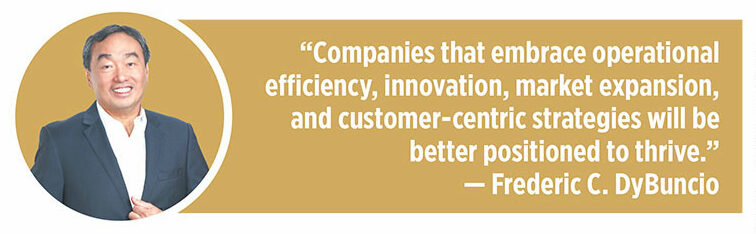
“The Philippines continues to demonstrate strong economic growth fundamentals in 2025, primarily driven by robust domestic consumption, the recovery of key sectors like tourism, and sustained remittance inflows,” Mr. DyBuncio told BusinessWorld in an e-mail.
While the economic outlook remains positive, he cautioned against looming challenges that could impact growth. Particularly, Mr. DyBuncio believes that inflation remains a primary concern, as rising costs of goods and services affect purchasing power.
Despite the challenges, the SM Investments executive sees opportunities, emphasizing that the Philippines’ demographic dividend, particularly its youthful population and growing middle class, continues to drive market demand across various sectors.
In addition, Mr. DyBuncio noted that retail, logistics, renewable energy, and digital services are expected to lead economic expansion in 2025. He said the continued expansion of the middle class, a rise in digital adoption, and enhanced infrastructure connectivity will help propel these sectors forward.
Tourism also presents a promising avenue for growth, with the hospitality sector showing strong recovery potential. As infrastructure projects improve connectivity across the archipelago, the logistics sector is expected to benefit, creating opportunities for supply chain optimization.
“Businesses can maximize these opportunities by investing in scalable technologies, enhancing customer experiences, and aligning with evolving consumer preferences,” he explained. “Companies that embrace operational efficiency, innovation, market expansion, and customer-centric strategies will be better positioned to thrive.”
Meanwhile, ride-hailing giant Grab commended the economic direction of the Philippines as Southeast Asia’s fastest-growing economy.
“This achievement underscores the resilience and potential of the nation under the Marcos administration’s leadership. The passage of transformative policies, such as the CREATE MORE Act, signals a forward-thinking approach to economic reform, further strengthening investor confidence. We remain committed to deepening our presence and investments in this dynamic and thriving market,” Grab was quoted as saying in a statement.
The CREATE MORE Act has been pivotal in enhancing investor confidence by offering tax incentives and streamlining regulatory processes for businesses to create an environment conducive to long-term economic sustainability.
Business tycoon and industry leader Manny V. Pangilinan also expressed renewed optimism for the country’s progress while emphasizing the need for strategic action.
“Another new year — with new hopes, fresh starts, and renewed optimism,” he was quoted as saying in his New Year’s message released two months ago.
This year, Mr. Pangilinan’s outlook centered on improving the lives of Filipinos through job creation and attracting more investments.
“I wish for a better Philippines — where people’s lives should be improved with more investments; where businesses can work together amongst themselves and with government in lifting the welfare of our people,” he added.
With the country facing evolving economic and geopolitical challenges, he believes a clear articulation of national economic goals is crucial. Businesses and policymakers, Mr. Pangilinan said, must work hand-in-hand to implement strategic initiatives that will drive growth and innovation.
He also highlighted the importance of cooperation between the private sector and the government in achieving long-term economic stability to define and align economic priorities for the next four years towards sustainable development.
Economic growth through digital transformation
For fintech giant GCash, this year presents an opportunity to showcase the current financial inclusion initiatives of the country through digital financial services. GCash President and CEO Martha Sazon emphasized that emerging technologies such as artificial intelligence (AI) are being leveraged to ensure accessibility and efficiency in financial transactions, benefiting Filipinos across all socio-economic backgrounds.
“We highlighted that GCash has been leveraging innovations and emerging technologies like AI to further enhance the accessibility, efficiency, and customer-centricity of our services, ensuring that no Filipino is left behind in our pursuit of financial inclusion,” Ms. Sazon said in a statement.
The increasing adoption of AI-driven financial solutions aligns with the Philippine government’s broader push toward digital transformation. GCash reaffirmed its commitment to working closely with policymakers to foster a more inclusive digital economy.
Year of opportunities for sustainability initiatives
According to AboitizPower Chief Finance Officer Sandro A. Aboitiz, the government’s target of at least 6% gross domestic product (GDP) growth this year could translate to a higher demand for electricity, necessitating new generation capacities.

“A 6% growth in GDP will require additional baseload, mid-merit, and peaking generation capacities,” he said in an interview with BusinessWorld.
With La Niña expected to impact energy consumption patterns, the country is set to energize around 6,841 megawatts (MW) of additional capacity in 2025. This includes 3,930 MW from solar, 1,320 MW from natural gas, 773 MW from wind, 500 MW from coal, 107 MW from hydro, and 104 MW from geothermal sources.
Despite these developments, Mr. Aboitiz emphasized the need for vigilance in the face of global economic uncertainties and rapid technological shifts, which could impact public policy and business costs.
The executive said that AboitizPower has embedded environmental, social, and governance (ESG) principles in its business strategy to create shared value for investors, customers, and host communities.
“In its 2024 Corporate Sustainability Assessment, S&P Global ranked AboitizPower in the 73rd percentile among its global peer group, while Sustainalytics placed the company in a Medium Risk rating category,” Mr. Aboitiz noted. The company has also received the Golden Arrow Award, a notable recognition in corporate governance, for three consecutive years.
He also mentioned the importance of innovative thinking, scenario planning, change management, and risk assessment to navigate industry disruptions. “The digital age is powered by electricity, and the role of the power sector is to provide electricity when and where it’s needed at a reasonable cost,” Mr. Aboitiz explained.
AboitizPower’s approach to balancing energy affordability, reliability, and decarbonization involves an “all-options-on-the-table” strategy. This includes utilizing dispatchable fossil fuel sources as today’s affordable baseload fuel alongside the development of alternatives like nuclear, offshore wind, and battery storage to reach scalable viability.
Call for initiatives and partnerships
Mr. DyBuncio said that companies like SM Investments are committed to navigating economic headwinds through innovation, investments, and consumer-centric strategies.
“The private sector, including the SM group, plays a critical role in harnessing these growth opportunities,” he stated. SM Investments, a conglomerate with interests in retail, banking, and property development, continues to expand its portfolio to align with evolving market demands.
Mr. DyBuncio highlighted the importance of maximizing opportunities by investing in scalable technologies, enhancing customer experiences, and aligning with evolving consumer behaviors.
“At SM, we continue to leverage these strategies alongside strong partnerships to ensure our businesses remain accessible, dynamic, and responsive to market needs,” he said. We remain committed to building businesses that not only deliver strong financial performance but also create meaningful impact for communities and stakeholders. By fostering resilience and embracing change, entrepreneurs and executives can help shape a more robust and dynamic Philippine economy.”
For AboitizPower, ensuring economic stability and fostering growth require stronger collaboration between the public and private sectors. Mr. Aboitiz said that the need for a long-term energy plan transcends political administrations, allowing businesses to invest with confidence.
“In the electric power industry, a segment that is heavily regulated and wherein upfront capital costs are high, there should be a long-term energy plan that can be passed on from one administration to the next and ensure continuity. This will allow developers to invest with confidence,” he added.
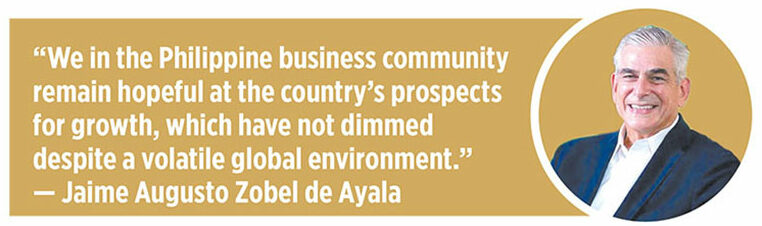
Ayala Corp. Chairman Jaime Augusto Zobel de Ayala is calling on investors to take advantage of the Philippines’ sustained economic momentum as the country enjoys resilience amid global uncertainties.
“We in the Philippine business community remain hopeful at the country’s prospects for growth, which have not dimmed despite a volatile global environment,” Mr. Zobel de Ayala was quoted as saying during a board meeting of the US-Philippines Society, where he serves as co-chair. “The country is certainly ready to accept high levels of partnerships and investments from our friends around the region, most especially the United States.”
Mr. Zobel de Ayala also stressed that the economy could reach even greater heights with stronger alignment between the public and private sectors.
“A consistent six-percent growth is certainly a respectable achievement, but imagine what more can be achieved if we hit a continuous growth rate of eight percent or more over a sustained period, which economists feel is possible if we align the government and private sectors,” he added.

January BoP gap widest in 11 years

By Luisa Maria Jacinta C. Jocson, Reporter
THE PHILIPPINES in January posted its biggest balance of payments (BoP) deficit in over a decade, preliminary data from the Bangko Sentral ng Pilipinas (BSP) showed.
The BoP deficit stood at $4.1 billion in January, ballooning from the $740-million gap in the same month a year ago.
It was also nearly triple the $1.5-billion deficit posted in December.
This marked the widest BoP deficit in 11 years or since the $4.48-billion shortfall in January 2014.
The BoP summarizes the country’s transactions with the rest of the world. A deficit means more funds left the country, while a surplus shows that more money came in.
“The BoP deficit in January 2025 reflected the BSP’s net foreign exchange operations and drawdowns by the National Government (NG) on its foreign currency deposits with the BSP to meet its external debt obligations,” the central bank said.
Latest data from the Bureau of the Treasury showed the NG’s outstanding debt hit P16.05 trillion at the end of 2024, up by 9.8% from P14.62 trillion at end-2023.
Earlier BSP data showed the country’s outstanding external debt hit a record high of $139.64 billion as of end-September. This brought the external debt-to-GDP ratio to 30.6% at the end of the third quarter.
The external debt service burden jumped by 14% to $15.735 billion in the 11-month period, according to the latest central bank data.
Michael L. Ricafort, chief economist at Rizal Commercial Banking Corp., said the wider BoP deficit was also due to the recent peso volatility.
The peso depreciated to P58.365 at end-January, weaker by 52 centavos from the P57.845 finish at end-December.
“The BoP deficit for January is primarily due to interest and debt payments, which can also be considered as foreign exchange intervention by the central bank to maintain the Philippine peso’s stability against the US dollar,” Oikonomia Advisory and Research, Inc. economist Reinielle Matt M. Erece said.
“This entails large withdrawals of the country’s cash reserves to pay its obligations and meet its targets,” he added.
At its end-January position, the BoP reflects a gross international reserve (GIR) level of $103.3 billion, down by 2.8% from $106.3 billion as of end-2024.
Mr. Ricafort said the relatively higher GIR provided “greater cushion for the peso exchange rate vs. the US dollar.”
This was supported by the “continued growth in the country’s structural US dollar inflows especially from overseas Filipino worker remittances, business process outsourcing revenues, foreign tourism receipts and foreign investments, among others.”
Despite the decline, the dollar buffer is enough to pay for 7.3 months’ worth of imports of goods and payments of services and primary income.
The reserves can also cover about 3.7 times the country’s short-term external debt based on residual maturity.
For the coming months, the BoP position could improve due to the NG’s latest global bond issuance, Mr. Ricafort said.
The Philippines raised $3.3 billion from the sale of dual-tranche US-dollar global bonds, as well as a euro sustainability bond, in late January.
In 2024, the country’s full-year BoP position stood at a surplus of $609 million, falling by 83.4% from the $3.672-billion surplus at end-2023.
This year, the BSP expects a $2.1-billion surplus position, equivalent to 0.4% of economic output.
Saudi’s Aramco returns to PHL market via 25% stake in Unioil
By Sheldeen Joy Talavera, Reporter
SAUDI ARABIA’S Aramco is returning to the Philippine market as it is set to acquire a 25% equity stake in Unioil Petroleum Philippines, Inc.
In separate statements, the Saudi oil giant and Unioil said they signed a definitive agreement, which is subject to certain conditions including regulatory approvals.
No financial details of the transaction were provided.
“This investment represents another step forward in our global strategy to expand Aramco’s retail network, and we look forward to introducing Aramco’s high-quality products and services to customers in the Philippines,” Yasser Mufti, Aramco’s executive vice-president of products and customers, said in a statement.
The deal comes 17 years after Aramco, widely considered the world’s largest oil producer, exited the Philippines after it sold its 40% stake in Petron Corp. In 1994, Aramco had invested in Petron when it was privatized by the Philippine government.
Aramco, the national oil company of Saudi Arabia, said in a statement that it aims to “capitalize on anticipated growth of the high-value fuels market in the Philippines.”
“It (the acquisition) represents further progress in Aramco’s strategic downstream expansion and growth of its global retail network, which aims to secure additional outlets for its refined products,” the company said.
Unioil, established by the Co family in 1966, is a diversified downstream fuels operator with 165 retail stations and four storage terminals in the Philippines.
“The strategic investment by Aramco is fully in line with our ambition to be the fuel retailer of choice and support our customers with top tier fuel solutions,” said Kenneth C. Pundanera, president of Unioil.
Janice Co Roxas-Chua, chief executive officer of Unioil, described the deal as “a major milestone in Unioil’s 58-year history.”
“We are confident that this will equip ourselves in accelerating our growth and development, further innovate, and strengthen our position as a leader in the wholesale and retail fuels market,” she said.
As part of the partnership, Unioil will introduce the Aramco’s brands and Valvoline-branded lubricants to Filipino consumers.
Asked to comment, Jayniel Carl S. Manuel, an equity trader at Seedbox Securities, Inc., said that Aramco’s global reputation could also elevate Unioil’s market standing, encouraging local and international confidence in its brand and potentially boosting market share.
“By securing a direct link to one of the world’s largest oil producers, Unioil may benefit from a more stable and cost-effective supply of crude and refined products, which would enhance its competitiveness in both the retail and industrial segments,” he said via Viber.
Mr. Manuel said that the “high-profile nature” of the investment signals that the Philippine downstream sector is an attractive environment for foreign investors, which may spur more international partnerships, heighten competition, and drive technological innovation.
Toby Allan C. Arce, head of sales trading at Globalinks Securities and Stocks, Inc., said Aramco’s re-entry into the Philippine retail market would likely stimulate competition, encouraging existing players to innovate and improve their services.
“The entry of a global leader like Aramco could bring more attention to the Philippines’ fuel market, indirectly benefiting local brands through heightened consumer and investor interest,” Mr. Arce said in a Viber message.
He said that the anticipated growth in infrastructure to support Aramco’s operations “may lower barriers to entry for other foreign investors, creating a ripple effect.”
Juan Paolo E. Colet, managing director at China Bank Capital Corp., said that the entry of Aramco as a strategic investor will better position Unioil for expansion and competition as a major fuel retailer.
“Aramco’s return to the local petroleum market also demonstrates optimism and conviction about the economic prospects of the country,” he said in Viber message.
He added that the move could “invite other global oil players who have no or limited domestic exposure to explore significant partnerships or investments in the Philippines.”
C-suite viewpoints on the path ahead
The Asian economy tells a compelling story — one that is resilient, transformative, and shaping the global economic landscape. Such story is carried by executives who see 2025 as another year poised for economic growth, filled with optimism and reinvention, as reflected in recent reports.
In PricewaterhouseCooper’s (PwC) 28th Annual Global CEO Survey — Asia-Pacific, about 55% of leaders expect notable progress in the economy compared to last year. This confidence is reflected in their business outlook, with 34% confident in their revenue growth projections and 46% planning to increase hiring this year.
While the region shows positive signs for economic growth, there’s also a cloud of uncertainty that could complicate its outlook. The report highlighted top concerns such as macroeconomic volatility (rising from 21% to 32%) and the low availability of workers with skills (increasing to 25%). Other risks include technological disruptions, rising trade tensions, and severe weather conditions, among others.
Business reinvention
Given such an environment, CEOs are driven to lead reinventions in businesses. According to PwC, business reinventions are “radically transforming how a company creates, delivers, and captures value. Or, put another way, it’s how a company fundamentally changes how it makes money, serves customers, or provides new products or services.” This reinvention is imperative for advancing businesses, leveraging innovation, unlocking new value and opportunities that are key to business longevity.
Many are confident about their company’s viability, with 52% believing they will last for more than 10 years, which is a substantial increase from the 34% in 2024. Mirroring the growing confidence, the last five years have seen CEOs take reinvention actions such as targeting a new consumer base, developing innovative products or services, fostering organizational collaborations, exploring new market routes, and implementing new pricing models.
By staying ahead with the curve, organizations are turning economic uncertainties into growth opportunities that create long-lasting value.
Upskilling employees
Having a strategic vision and investing in the workforce is considered as an essential driver of growth. An example of this undertaking is upskilling employees to keep pace with technological advancements.
According to Ernst & Young’s (EY) CEO Outlook Survey: Global Confidence Index, 85% of global CEOs believe that balancing human talent with new technologies can address the current skill gaps and will be crucial for business growth in the next year.
More notably, key differences in priorities among CEOs were observed: 60% were focused on improving employee and customer experiences, while 40% prioritized top-line growth and margin expansion.
“Adaptability is the ultimate advantage in today’s landscape. Organizations that embrace transformation can turn disruption into opportunity, continuously learning, pivoting and growing to shape their future with confidence. The survey reveals that the most confident CEOs are taking a long-term approach to transformation, focusing on enhancing customer and employee engagement amid macroeconomic and technological shifts, and always placing humans at the center as the best path to sustainable value creation,” an EY report noted.
Digital transformation
The push for digital transformation continues to significantly influence businesses, impacting both strategies and operations. In Asia, there’s a strong emphasis on investing in emerging technologies like artificial intelligence (AI) to reshape business models. This shift led to increased revenue and employee efficiency among businesses.
According to EY’s CEO Outlook — Asia-Pacific report, 74% of CEOs believe their companies are extremely or very proficient in leveraging technologies to enhance innovative work strategies, and 72% feel confident in their ability to rapidly adopt technologies to create new business models.
However, trust issues around AI still persist, as evidenced by the low trust levels (37%) among executives. As a result, as PwC’s report noted, many organizations are adopting a more cautious approach.
To move past AI challenges, CEOs should prioritize aligning AI with their business strategies. This involves equipping leadership teams with the necessary knowledge and tools, ensuring AI aligns with company initiatives and objectives, utilizing AI agents, redesigning operating models, and implementing responsible AI practices.
“Today you have high AI potential and a significant level of investment, but not a lot of value being unlocked. Meaningful AI value will only be realized if CEOs get personally involved, because only they can align the AI agenda to the broader enterprise agenda,” said Nicolas de Bellefonds, a managing director and senior partner at the Boston Consulting Group (BCG) in an article published on the firm’s website.
Sustainability as growth opportunity
Placing sustainability at the heart of business operations and transforming it into a valuable opportunity is another key aspect of business reinvention. An increasing number of leaders are recognizing the critical role that sustainability plays, with 39% already seeing real gains from climate-friendly investments, according to PwC.
“Climate considerations are no longer just about meeting stakeholder expectations — they’re becoming a cornerstone of investment. A substantial 87% of CEOs have initiated climate-friendly investments in the last five years,” the report pointed out.
“It appears that companies in Asia-Pacific that benefited financially from climate-friendly investments tend to be large, financially robust and strategically focused on sustainability and reinvention,” it added.
However, the reality remains unpleasantly clear; and if climate action continues to lag, the climate is likely to become more volatile and extreme. Therefore, it is only crucial to accelerate the pace of climate action.
More specifically, companies can face significant financial risks when they are impacted by extreme climate events. This risk is particularly high for sectors such as agriculture, construction, communication, and utilities.
“BCG and the World Economic Forum estimate that if global warming stays on its current trajectory, extreme weather could place up to 25% of EBITDA (earnings before interest, taxes, depreciation, and amortization) at risk within the next 25 years,” BCG’s report said.
“While physical and transition risks will vary depending on the region and industry, it is imperative that CEOs fully understand their current exposure — an area where many appear to be falling short,” it added.
“By our analysis, many companies are significantly underestimating the risks from climate change, especially as catastrophic floods, hurricanes, droughts, and wildfires continue to become more frequent and extreme.”
CEOs, then, have a bigger role to play in mitigating risks and accelerating climate action. Assessing climate scenarios and identifying the best strategies to reduce their companies’ exposure to risk is essential. Additionally, they should focus on reducing carbon footprints, especially to those in high-emission industries, and forming partnerships to drive green initiatives forward. — Angela Kiara S. Brillantes
Carmakers set 500,000 sales target for 2025
By Justine Irish D. Tabile, Reporter
PHILIPPINE AUTOMOTIVE sales are expected to reach 500,000 units in 2025, according to the Chamber of Automotive Manufacturers of the Philippines, Inc. (CAMPI).
A joint report by CAMPI and Truck Manufacturers Association (TMA) on Thursday showed vehicle sales jumped by 10.4% to 37,604 units in January from a year ago’s 34,060 units.
Month on month, sales fell by 10.6% from 42,044 units sold in December when demand is typically higher.
“With yet another good performance in January 2025 sales, CAMPI is projecting to hit 500,000-unit sales for the year,” said CAMPI President Rommel R. Gutierrez in a statement on Thursday.
“Newly rolled out models and the anticipated introduction of new models are some of the factors that will contribute to achieving this target,” he added.
The industry’s sales target of 500,000 would represent a 7% year-on-year increase from the record-high 467,252 units sold in 2024.
CAMPI-TMA data showed passenger car sales slipped by an annual 8.5% to 7,729 units in January from 8,446 units a year ago. Month on month, sales of passenger cars fell by 23.7% from 10,125 units in December.
Meanwhile, commercial vehicle sales climbed by 16.6% to 29,875 from 25,614 in the same month a year ago. This accounted for 79.5% of the industry’s total sales.
Month on month, sales of commercial vehicles declined by 6.4% from 31,919 units sold in December.
Broken down, light commercial vehicle sales went up by 17.8% to 22,350 units, while Asian utility vehicle (AUV) sales rose by 13.7% to 6,698. Sales of light commercial vehicles and AUVs declined on a month-on-month basis by 7.3% and 1.9%, respectively.
Sales of light trucks surged by 20.6% to 497 in January but dropped by 19.3% month on month. Medium truck sales were down 7.4% year on year to 261 and 5.4% down from December.
Sales of heavy trucks increased by an annual 9.5% to 69 in January but dropped by 30.3% month on month.
Electric vehicle (EV) sales stood at 1,600 units in January, which was composed of 1,445 hybrid EVs, 146 battery EVs and nine plug-in hybrid EVs.
“Car sales in January 2025 likely reflected a combination of strong consumer demand, improved supply chain conditions, and continued economic recovery,” John Paolo R. Rivera, a senior research fellow at the Philippine Institute for Development Studies, said in a Viber message.
Mr. Rivera said the industry’s 7% sales growth target is achievable but may be dampened by risks such as inflation, higher fuel costs, and trade disruptions.
“A 7% increase is within reach, but several risks could affect the projection. If inflation or interest rates unexpectedly rise, it could dampen consumer spending,” Mr. Rivera said.
“Higher fuel costs or stricter regulations through emissions standards and excise taxes could slow demand. While supply chain bottlenecks have eased, any disruptions in global trade or manufacturing could impact inventory levels,” he added.
Toby Allan C. Arce, head of sales trading at Globalinks Securities and Stocks, Inc., said that the 7% sales growth target is “achievable if the current momentum continues.”
“However, the decline in passenger car sales and potential risks from economic challenges, such as inflation or supply chain disruptions, could hinder progress,” he added.
In January, Toyota Motor Philippines Corp. remained the market leader with a 48.07% share as its sales rose by 12.3% to 18,078 units.
Mitsubishi Motors Philippines Corp. came in second with a 21.2% increase in sales to 7,374 units in January.
In third spot is Nissan Philippines, Inc. which saw a 3.9% decline in sales to 2,366 units.
Rounding out the top five were Suzuki Phils., Inc., which saw a 19.9% increase in sales to 1,781 units, and Ford Motor Company Phils., Inc. whose sales dropped 36.1% to 1,577 units.