Home Blog Page 190

Jobless rate at 3.8% in September

THE PHILIPPINES’ unemployment rate rose to 3.8% in September from a year earlier, signaling a fragile labor recovery as natural disasters disrupted hiring ahead of the holiday season, data from the Philippine Statistics Authority (PSA) showed on Thursday. Read the full story.

Jobless rate at 3.8% in September

Vivant’s COREnergy eyes 5% market share by 2030

Vivant-COREnergy-logo

CORENERGY, Inc., a subsidiary of Vivant Energy Corp., aims to capture a larger share of the retail electricity market over the next five years, especially following the government’s move to lower the consumption threshold for consumers to switch suppliers.

“By next year, we should be around 2% and by 2030, our goal is 5%,” COREnergy Head of Sales Jose Marko Anton G. Sarmiento said during a press briefing on Thursday.

While the target may seem modest, Mr. Sarmiento noted that the company already holds a 1.3% share of the market.

Established in 2016, COREnergy is a licensed retail electricity supplier that delivers retail electricity, engineering, and rooftop solar services to commercial and industrial customers.

Mr. Sarmiento said the company aims to set the benchmark in customer experience.

“Our aim is not to be the biggest. Our aim is to be the best. So best in many areas: the best partner, the best strategic advisor to be able to help companies improve their profitability,” COREnergy President Francis S. Del Val said.

Earlier this week, the Energy Regulatory Commission (ERC) approved lowering the threshold to join the Retail Competition and Open Access (RCOA) and the Retail Aggregation Program (RAP) to 100 kilowatts (kW) of average monthly peak demand, down from 500 kW previously. The new threshold will take effect on June 26, 2026.

RCOA is a customer-choice program that allows qualified consumers to select their energy supplier, while RAP enables multiple electricity users to combine their demand to meet the required threshold.

“The threshold will be reduced to 100 kW by next year. We feel that this is a major shift in the industry. Currently, it’s at 500 kW, so bringing it down to 100 kW opens up the space dramatically,” Mr. Sarmiento said.

With the lower consumption threshold, the company expects more contestable customers to enter the market and exercise their option to select a preferred electricity supplier.

Mr. Del Val said the company has helped clients save nearly P300 million over the past three years.

He added that COREnergy can offer 10-15% savings on electricity bills compared with distribution utilities.

“Our role is to make energy work for businesses. Whether it’s helping clients unlock savings, simplifying their transition to open access, or using data to guide better energy decisions, COREnergy gives customers real control over their energy consumption,” Mr. Del Val said.

Vivant Energy holds the electric power generation interests of publicly listed Cebu-based energy and water conglomerate Vivant Corp. — Sheldeen Joy Talavera

Stuff to Do (11/07/25)


Listen to carols at The Pen

The Peninsula Manila begins celebrating Christmas in November with carols as some of Manila’s finest choirs are set to grace The Lobby. Performing on Nov. 7 are the Battig Chamber Singers of St. Scholastica’s College, Manila. Next up on Nov. 14 are the Centro Escolar University Singers Manila, and on Nov. 21, it is the turn of the Servus Dei Vocal Ensemble. The carol-filled month will end with the MAPUA Cardinal Singers on Nov. 28. The performances will take place from 7 to 7:45 p.m. on those dates, with P1,500 as the minimum consumption amount for each guest who dines at The Lobby.


Enjoy Spanish guitar at Ayala Museum

NAMCYA winner Carlo Antonio B. Juan will perform a soulful and expressive Spanish guitar interlude in a busking series at Ayala Museum as part of the ongoing exhibition MEZCLA: Interwoven Cultures and the Mantón de Manila. His music, shaped by his training under world-renowned guitar masters and immersion in flamenco culture, is made possible with the support of the Embassy of Spain in the Philippines, AECID, and Instituto Cervantes. The performance dates are Nov. 8 and 22, Dec. 6, and Feb. 7, 2026. Those interested may pay for 3rd floor access to the museum priced at a regular rate of P350.


Observe ritual and pageantry at the CCP

The Cultural Center of the Philippines, in cooperation with the Goethe-Institut Philippinen, presents Magic Maids by Eisa Jocson and Venuri Perera, on Nov. 7 to 9, at the Tanghalang Ignacio Gimenez (CCP Black Box Theater). Magic Maids interweaves ritual performance, pageantry and  possession, a feral incantation that demystifies the connection of the history of European witch-hunts to the enduring extraction and exploitation of women’s labor in today’s global chain of migrant care work. Tickets to the performance cost P300 and P600.


Attend an first album experience tour

FILIPINO alternative pop band HEY JUNE! has announced their first-ever headlining concert series, Curiosity Killed The Cat: The Album Experience Tour. Named after their debut album, the tour follows the success of their single “LASIK,” which trended online after being featured on Pinoy Big Brother: Collab Edition. The shows will take place on Nov. 7, 6 p.m., at Velvet Playground in Marikina, with guest artists Dilaw and Gracenote; Nov. 8, 6 p.m., at Jess & Pat’s in Maginhawa, Quezon City, with guest artists Moonstar88 and The Vowels They Orbit; Nov. 22 at Takeover Lounge in Katipunan, Quezon City, with guest artists 6cyclemind and Better Days; and Nov. 27, 7 p.m., at Mow’s Bar in Matalino, Quezon City, with guest artists Sandwich and Shanni.


Catch ABS-CBN’s The Alibi on Prime Video

A brand-new TV series, The Alibi, produced by Dreamscape Entertainment and ABS-CBN Studios, is a Filipino psychological thriller that explores the thin line between truth and deception. With themes of love, betrayal, and survival, it stars Kim Chiu as a sex worker and Paulo Avelino as a privileged journalist, who find themselves entangled in a dark mystery. It is out now on Prime Video.


Listen to Nicole Laurel Asensio’s new single

NICOLE Laurel Asensio is back in the Philippines after a holding a successful series of shows abroad. Her latest offering, “Let Our Love,” released under Warner Music Philippines, is a team-up with producer and multi-instrumentalist Gabe Dandan. The track is subtle, sensual, and full of soul. It also draws from R‘n’B and jazz influences, with a touch of 1990s pop. “Let Our Love” is a teaser track for an upcoming EP, to be released early next year.


Watch women-led Filipino films on Netflix

TWO of CreaZion Studios’ woman-led films, Isang Himala and Flower Girl, will stream on Netflix this November. Now on the platform is Isang Himala, which won the Special Jury Prize at last year’s Metro Manila Film Festival. A reimagining of the 1982 film classic Himala in a movie musical format, it stars Aicelle Santos, Kakki Teodoro, and Bituin Escalante, under the direction of Pepe Diokno. After that, Flower Girl will join Netflix on Nov. 20. The closing film of the New York Asian Film Festival, it stars Sue Ramirez as a woman who is one day cursed to have no vagina and must go on a journey of self-discovery to get it back.

Vanke is reigniting the debate China wants to bury

VANKE.COM

By Shuli Ren

CHINA seems to find solutions to the world’s thorniest economic problems. Its exports juggernaut is marching on despite President Donald Trump’s tariffs. The domestic AI industry is booming without Nvidia Corp.’s high-end chips.

But once in a while, a dormant zombie comes back to haunt it, serving as a reminder to global investors that the government hasn’t dealt with its most pressing economic issues even as the stock market rallies.

Shenzhen-based China Vanke Co., one of the nation’s biggest developers, is this zombie. Shenzhen Metro Group Co., a state-owned enterprise that is its largest shareholder with a 27% stake, seems to have had a change of heart lately on how much financial support it’s willing to give.

The urban rail operator, owned by the city government, is asking Vanke to retroactively pledge collateral for existing unsecured loans worth 20.4 billion yuan ($2.9 billion). It’s also setting a cap on the loan facilities it will provide.

This came as a shock. Throughout the year, Shenzhen Metro has been seen as the entity the city government will use to rescue Vanke. As of Oct. 30, roughly 70% of its loans were unsecured, in what investors perceive as the most concrete sign of an informal bailout.

The burning question now is who will be responsible for Vanke’s bills. The company needs to repay 5.7 billion yuan of public bonds in December, and another 7.7 billion yuan in the first half of 2026. As of June, the developer’s cash pile was only able to cover 44% of its short-term debt, the lowest since data became available in 1992.

It’s understandable why Shenzhen Metro is balking. Vanke is growing into an ever-expanding black hole. Contracted sales are at risk of falling by 40% this year, creating a cash shortfall north of 100 billion yuan, according to Bloomberg Intelligence. Without the Shenzhen government’s support, Vanke may not be able to survive, and its bondholders could be staring at debt restructuring — or even worse, default.

Five years into a property downturn, Beijing has been using partial, unofficial bailouts to diffuse potential financial crisis caused by developer blowups. Shenzhen Metro, for instance, is widely seen as the lender of last resort to Vanke, even though its stake could classify the SOE as a passive investor.

Until recently, this half-baked effort has worked reasonably well. The pace of corporate delinquencies has slowed. Meanwhile, the biggest developers that defaulted have largely hobbled toward the end of their restructuring, as creditors accept more onerous terms.

Beijing, in turn, is more than happy to declare mission accomplished. In recent policy meetings, the property recovery was put on the back burner, while technology and innovation took the center stage. Unlike last year, the government no longer pledges to “halt the real estate market decline.”

But this big headache won’t go away on its own. New-home sales extended a slump in October, falling 42% from a year earlier, according to data compiled by Bloomberg. In other words, Vanke is the norm, not an exception.

Meanwhile, the latest kerfuffle is reigniting a debate over how Beijing plans to diffuse the developer time bomb. Some believe there’s no too-big-to-fail in China, and that the likes of Vanke will eventually ask to extend their borrowings or spiral into a default. Others have more political stability in mind. In their view, the government doesn’t want to rock the boat any further and will find another SOE to come in as a liquidity provider.

Either way, Shenzhen’s reluctance to give unconditional love to Vanke shows that China’s real estate woes are deepening. Beijing can’t just turn the page yet.

BLOOMBERG OPINION 

Soliciting donations for a grieving colleague

This is my first time to work as a human resources (HR) manager for a company managed by foreign nationals. Yesterday, the spouse of one worker died, and some workers initiated an abuloy collection drive. I am worried how this cultural practice might come across to some of the foreign managers. — Drama Mama.

In many Filipino private and public organizations, extending financial help to a bereaved colleague is almost automatic. It’s not about the money but showing that you and other employees’ care.

It’s common to see an envelope quietly being passed around to collect abuloy. It’s not compulsory, but serves as a demonstration of pakikisama (camaraderie). At any rate, colleagues are not expected to give a large amount of money.

In many foreign-managed work environments, however, especially those influenced by Western management practices, the workplace is expected to be free of any form of solicitation, regardless of its purpose and the amount of money involved.

What’s understood as pakikisama may, in some foreign culture, be seen as a policy violation, an ethical gray area, or even an HR compliance risk. That’s because what feels like generosity for Filipinos can feel like pressure to foreigners, regardless of the collection’s voluntary nature.

Western ethics are guided by fairness and neutrality. No one should feel coerced, even subtly, to contribute to a cause they might not personally support. This difference in mindset often creates an awkward tension: employees want to show sympathy, but foreign managers may not like it.

Should they allow the donation drive, or risk appearing cold-hearted by saying no?

Welcome to the globalized workplace, where good intentions need management approval.

GLOBAL RULES, LOCAL HEARTS
No company policy manual can capture the full spectrum of human emotion. When a colleague’s family member dies, the corporate playbook rarely tells us what to do beyond granting bereavement leave. Yet, in human terms, the question isn’t just about policy — it’s about decency.

In some cases, multinational firms operating in the Philippines eventually learn to adapt. They recognize that local culture values community support. Therefore, HR should take a proactive approach by doing the following:

One, review precedents and previous cases. Since you’re new to the organization, it’s best to check with people who know better. If solicitation was allowed before, review the reasons and under what conditions. It’s best to be prepared for any eventuality if you decide not to perpetuate such precedents.

Two, allow voluntary participation. There should be no pressure, no guilt trips. However, this is more difficult than it seems. People would rather give something not out of compassion, but to address the invisible pressure they feel. Imagine a situation where an abuloy collector waits in front of your work station for your share.

Three, require discreet coordination. Use personal channels instead of official company platforms. That means, people may not be able to use company e-mails, even company time or similar approaches to carry out a solicitation campaign. Rather, encourage them to give their abuloy directly to the bereaved worker.

Four, prepare an official management expression of sympathy. The organization could send flowers, a mass card, and a token amount. It’s the right balance between empathy and professionalism that should not weigh on the workers’ shoulders.

Five, lead by example. Sometimes, a personal note or visit from management and its representatives means more than any amount of money. The real goal isn’t to raise funds, but to raise morale.

LEADING WITH EMPATHY
Compassion doesn’t have to clash with compliance. In fact, culturally intelligent HR departments can use these moments to strengthen the organization’s emotional intelligence. That means showing genuine concern through culturally attuned actions.

When leaders acknowledge grief and allow space for compassion, they’re not just being kind; they’re reinforcing trust and engagement.

I once talked to a Japanese executive who had been living in the Philippines for more than 35 years, who proposed to manage the situation by taking the best of both cultures: “In Japan, we follow rules. In the Philippines, we follow relationships. The best leaders learn to do both.”

COMPASSION AS A KPI
In management terms, kindness doesn’t appear on the balance sheet, but it does reflect in employee retention, morale, and engagement. A company that balances rules with respect for human emotions earns something more valuable than compliance — loyalty.

So, is it appropriate to solicit donations for a grieving employee’s family in a foreign-owned company? Yes, but only if done with discretion, sensitivity, and consent. Compassion is universal, but it must pass through the right HR channel. There’s nothing wrong with passing the hat — as long as you’re not passing the buck.

In a globalized workplace, empathy must come with etiquette. The most admired leaders know that policy keeps order, but compassion keeps people. The best organizations don’t just manage resources — they manage relationships.


Have a free consultation of your workplace issues with Rey Elbo. E-mail elbonomics@gmail.com or DM Facebook, X, LinkedIn or via https://reyelbo.com. Anonymity is guaranteed.

How PSEi member stocks performed — November 6, 2025

Here’s a quick glance at how PSEi stocks fared on Thursday, November 6, 2025.


Stocks end higher on bargain hunting before GDP

BW FILE PHOTO

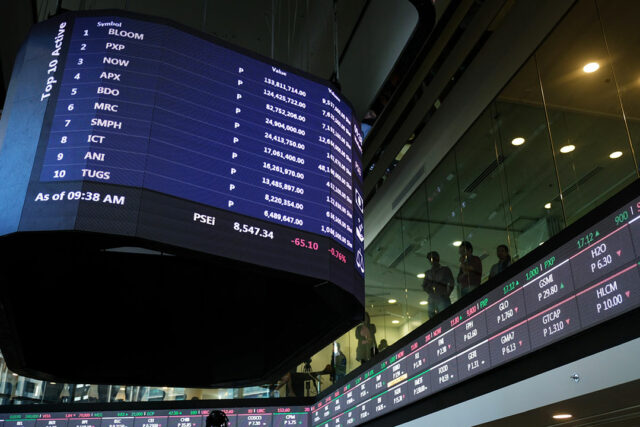
PHILIPPINE STOCKS rebounded on Thursday as bargain hunters took advantage of lower prices after the index plunged to a three-year low the prior session, but sentiment stayed cautious before the release of third-quarter gross domestic product (GDP) data.

The bellwether Philippine Stock Exchange index (PSEi) rose by 0.3% or 17.53 points to close at 5,835.59, while the broader all shares index increased by 0.25% or 9.05 points to end at 3,543.43.

“The local market bounced back as investors hunted for bargains after the preceding day’s decline,” Philstocks Financial, Inc. Research Manager Japhet Louis O. Tantiangco said in a Viber message. “Trading remained tepid, however, amid investors’ cautiousness while waiting for the Q3 GDP data.”

“Philippine equities crept higher ahead of tomorrow’s GDP report, although value turnover remained tepid at a little over P5 billion as most investors remain on the sideline,” AP Securities, Inc. said in a market note.

Value turnover went up to P5.42 billion on Thursday with 891.42 million shares traded from the P4.72 billion with 406.27 million issues exchanged on Wednesday.

A BusinessWorld poll of 18 economists and analysts yielded a median estimate of 5.3% GDP growth in the third quarter. If realized, this would be slower than the 5.5% expansion in the second quarter but slightly faster than the 5.2% expansion in the third quarter of 2024.

Economy Secretary Arsenio M. Balisacan earlier said that growth could have slowed in the period amid a corruption probe, slow public disbursements, global uncertainties and adverse weather conditions.

“Positive cues from Wall Street driven by the US Supreme Court’s skepticism over President Donald Trump’s tariff policies also helped in today’s session,” Mr. Tantiangco added.

US Supreme Court justices raised doubts on Wednesday over the legality of Mr. Trump’s sweeping tariffs in a case with implications for the global economy that marks a major test of Mr. Trump’s powers, Reuters reported.

Conservative and liberal justices alike sharply questioned the lawyer representing Mr. Trump’s administration about whether a 1977 law meant for use during national emergencies gave Mr. Trump the power he claimed to impose tariffs or whether the Republican president had intruded on the powers of Congress.

The majority of sectoral indices closed higher on Thursday. Mining and oil jumped by 4.46% or 530.4 points to 12,421.40; financials rose by 1.03% or 19.85 points to 1,945.83; holding firms increased by 0.28% or 13.41 points to 4,703.16; services went up by 0.15% or 3.49 points to 2,258.56; and property climbed by 0.15% or 3.36 points to 2,146.10.

Meanwhile, industrials went down by 0.16% or 13.86 points to 8,574.55.

Advancers beat decliners, 98 to 68, while 72 names were unchanged.

Net foreign buying dropped to P211.43 million on Thursday from P339.58 million on Wednesday. — Alexandria Grace C. Magno with Reuters

Philippines declares national calamity as Typhoon Tino kills more than 100

DEBRIS from damage caused by Typhoon Kalmaegi, locally called Tino, covers the ground in Talisay, Cebu. — REUTERS/ELOISA LOPEZ

THE PHILIPPINES declared a state of national calamity after Typhoon Kalmaegi (locally known as Tino) left more than 100 people dead and widespread destruction across the Visayas and Mindanao, with another powerful storm expected to hit within days.

President Ferdinand R. Marcos, Jr. said the measure would fast-track the release of emergency funds and ease procurement rules to speed up aid delivery.

“Several regions — almost 10 to 12 — have been or will be affected,” he said at a situation briefing in Quezon City. “With that scale and scope, it’s clear that this is a national calamity.”

The National Disaster Risk Reduction and Management Council recommended the declaration as Typhoon Tino unleashed torrential rains and strong winds that triggered landslides, floods and power failures, displacing thousands of families.

Authorities are now bracing for Typhoon Uwan, forecast to intensify into a super typhoon by Friday, threatening areas still reeling from Tino’s destruction.

The death toll from Typhoon Tino rose to 114, with about 127 people still missing, the disaster agency said, as the storm that devastated the country’s central regions regained strength as it headed towards Vietnam.

Tino battered large parts of central and southern Philippines this week, inundating towns, submerging villages and triggering landslides that left scores dead and thousands displaced.

In Vietnam’s Gia Lai province, some 350,000 people were expected to have been evacuated by the middle of the day as authorities warned of heavy rains and damaging winds that could cause flooding in low-lying areas and disrupt agricultural activity.

In the Philippines’ hardest-hit province of Cebu, the scale of the destruction became clearer as floodwaters receded to reveal flattened homes, overturned vehicles and streets choked with debris.

More than 200,000 people were evacuated in the Philippines ahead of Tino hitting on Tuesday. Some have returned to find their homes destroyed, while others have begun the arduous cleanup, scraping mud from their houses and streets.

“The challenge now is debris clearing… These need to be cleared immediately, not only to account for the missing who may be among the debris or may have reached safe areas, but also to allow relief operations to move forward,” Raffy Alejandro, a senior civil defense official, told DZBB radio.

ANOTHER STORM DEVELOPS
Even as Typhoon Kalmaegi exited the Philippine monitoring zone, weather forecasters were tracking a brewing storm east of Mindanao that could strengthen into a typhoon, raising concerns for potential impacts early next week.

The devastation from Kalmaegi, the 20th storm to hit the Philippines this year, comes just over a month after a magnitude 6.9 earthquake struck northern Cebu, killing dozens and displacing thousands.

As Kalmaegi moved over the South China Sea ahead of its landfall in Vietnam, it was regaining strength. It was forecast to affect several central provinces, including key coffee-growing areas, where the harvest season is under way.

Authorities were mobilizing thousands of soldiers to help with potential evacuations, rescue operations and recovery efforts.

Vietnam’s aviation authorities said operations at eight airports, including the international airport in Da Nang, were likely to be affected. Airlines and local authorities have been urged to closely monitor the storm’s progress to ensure passenger safety.

Mr. Marcos said the full extent of the damage was still being validated but described the casualty count as “very high.”

“We are continuing our relief and support for those hit by Typhoon Tino, but we are also doing everything that we can to anticipate and prepare for Typhoon Uwan,” Mr. Marcos said.

The President said government responders deployed in the Visayas might be reassigned to areas expected to be affected by the second storm, depending on how quickly relief operations stabilize in Cebu and nearby provinces.

After the devastation caused by Typhoon Tino, the Office of the President released P760 million in financial assistance to affected local governments across the country.

The provinces of Cebu, Capiz, Surigao del Norte, Iloilo, Bohol and Negros Occidental each got P50 million, while Eastern Samar, Surigao del Sur, Southern Leyte, Antique and Aklan were given P40 million each.

Leyte and Masbate each received P30 million; Guimaras, Agusan del Norte and Dinagat Islands, P20 million each; and Biliran, Camarines Sur, Sorsogon, Misamis Oriental, Negros Oriental and Palawan, P10 million each.

Smaller allocations of P5 million were extended to Albay, Romblon, Batangas, Northern Samar, Siquijor, Quezon, Samar, Agusan del Sur, Laguna, Zamboanga City, the City of Manila for stranded passengers, Camiguin, Occidental Mindoro, Camarines Norte, Zamboanga del Norte and Iligan City.

The Philippines, a country located in the Pacific Ring of Fire, is battered by about 20 typhoons annually. — Chloe Mari A. Hufana with Reuters


Scarborough buoys not for reclamation — NMC

FACEBOOK.COM/NAVALINSTITUTE

By Kenneth Christiane L. Basilio, Reporter

THE PHILIPPINES does not see China’s buoy placements at Scarborough Shoal as a precursor to island-building, but has prepared a flurry of responses if such activities happen, its maritime council spokesman said on Thursday.

National Maritime Council (NMC) spokesman Alexander S. Lopez said authorities were monitoring developments in the hotly contested feature on a “day-to-day basis,” adding that there would be no letup in efforts to prevent reclamation activities.

“There’s no reclamation activity and we are closely monitoring it,” he told BusinessWorld on the sidelines of a security forum in Manila. “If ever there will be, we will come up with the appropriate actions to it.”

“But definitely, we will go through peaceful means,” he added, saying the government prefers to handle tensions at the shoal and other features in the South China Sea diplomatically but is not shying away from responding militarily. He did not elaborate.

Scarborough, named Panatag by Manila and called Huangyan Dao by China, has been at the center of renewed tensions between the countries that lay competing claims over features in the South China Sea, where trillions of dollars worth of trade passes through annually.

The shoal is a vast fishing lagoon that lies within the Philippines’ 200-nautical-mile (370 kilometers) exclusive economic zone and was seized by China in 2012 after a standoff with Philippine forces.

In September, China approved the creation of a 3,500-hectare reserve at the northeast rim of the shoal, which it said is intended to preserve the ecological diversity of one of the most contested areas in the strategic waterway.

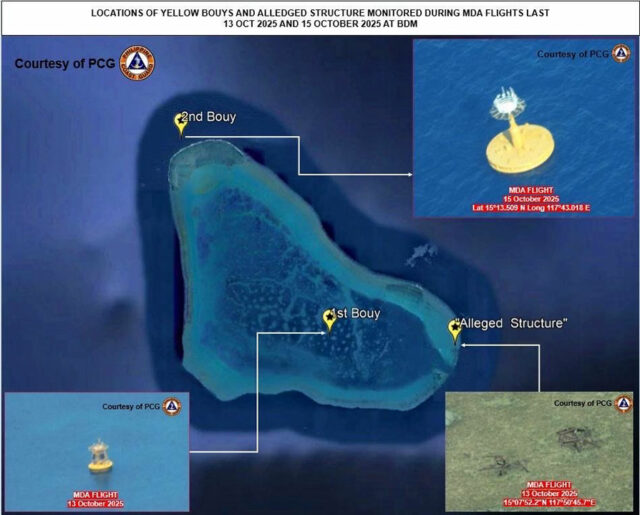
A Philippine maritime surveillance mission last month spotted buoys at the center and northern tip of the maritime feature, saying their findings could indicate “ongoing activities.”

“The two buoys installed at Scarborough are of different sizes and designs,” the Asia Maritime Transparency Initiative (AMTI) said in a report on Wednesday, noting that the buoy north of the feature is larger and resembles those found in the Yellow Sea by the South Korean Navy in June.

Satellite imagery showed that the northern buoy looks like a “standardized” 10-meter ocean environment monitoring buoy, AMTI said. “This design is among the ‘most widely used, oldest, most technologically mature’ types of buoys used in China’s coastal waters.”

It added that the buoy spotted in Scarborough’s center resembles 3-meter Chinese weather and sea monitoring buoys.

“Each type of buoy seen at Scarborough is produced by multiple manufacturers in China and can be outfitted with instruments for collecting a wide variety of marine data,” AMTI said, noting that the deployed buoys could be used to monitor waves, air pressure, temperature, wind speed and humidity.

Mr. Lopez acknowledged the Chinese buoys could have military purposes. “They can be for dual use,” he said, but noted they could help guide ships through the shoal’s rocky underwater terrain.

AMTI said China’s deployment of buoys at the feature could be part of efforts “to formalize Chinese control over the feature.” “More worryingly, it is a step toward physically occupying Scarborough.”

The Chinese Embassy in Manila did not immediately reply to a Viber message seeking comment.

“We don’t see the presence of the buoys as a prelude to any reclamation,” Mr. Lopez said. “The buoys are aids to navigation.”

Security experts earlier told BusinessWorld China might be preparing for island-building at Scarborough, warning that the spotted buoys and Beijing’s nature reserve plan could be used as cover for land reclamation.

“With regard to reclamation, I think that there’s no basis for it yet,” Mr. Lopez said.

Also on Thursday, Manila’s Defense department said Defense Secretary Gilberto C. Teodoro, Jr. met with US General John Daniel Caine on Wednesday at the Philippine military’s headquarters, where they discussed ways to enhance military engagements.

Mr. Caine, chairman of the US Joint Chiefs of Staff, and Mr. Teodoro “discussed the progress of alliance initiatives and explored ways to further operationalize bilateral and multilateral defense cooperation,” the agency said in a statement.

The Philippines and the US are close allies, with their partnership anchored on a 1950s treaty binding both to defend one another in case of an armed attack. Their alliance has flourished in recent years, with joint military drills becoming more complex and involving advanced weapon systems.

“Discussions covered expanding interoperability between the Armed Forces of the Philippines and US military forces, strengthening information-sharing mechanisms and enhancing joint humanitarian assistance and disaster response operations,” the Defense department said.

Philippine infrastructure watchdog flags P95-M ‘ghost’ flood project in Bulacan

PHILIPPINE STAR/MIGUEL DE GUZMAN

By Erika Mae P. Sinaking and Aubrey Rose A. Inosante, Reporter

THE INDEPENDENT Commission for Infrastructure (ICI) on Thursday urged the ombudsman to file criminal charges over another flood control project in Bulacan that was fully paid for but never built.

The agency said the P95-million Bocaue flood management project — later adjusted to almost P99 million — showed no signs of construction despite records claiming it was completed in January 2025.

The project, implemented by the Department of Public Works and Highways (DPWH) Bulacan First District Engineering Office through Topnotch Catalyst Builders, Inc. and Beam Team Developer Specialist, Inc. was found to be entirely fictitious, the commission said in a report to the Office of the Ombudsman.

A technical inspection by the Commission on Audit (CoA) confirmed no slope protection or waterway improvements were built, contradicting documents that certified completion.

Payments had been made based on falsified statements of work accomplished, which claimed the project was 51% done in mid-2024 and fully completed by early 2025.

The ICI recommended graft, malversation and falsification charges against several DPWH officials, including former Public Works Secretary Manuel M. Bonoan, former undersecretaries Roberto R. Bernardo and Maria Catalina E. Cabral, and district engineers Henry C. Alcantara and Brice Ericson D. Hernandez.

“It appears that several DPWH public officials were grossly negligent, if not remiss, in ensuring that the project was properly implemented and that government funds were lawfully disbursed,” the ICI said in its report.

Mr. Bonoan was also named in a separate referral earlier this week involving a similar “ghost” project in Plaridel, Bulacan. The commission said his repeated inclusion reflected his central role in project oversight and fund releases.

“Public trust was reposed on Secretary Bonoan to exercise control of DPWH as its secretary,” it said. “He miserably failed to exercise simple diligence tantamount to fraud in ensuring the judicious use of public funds.”

The commission added that the scheme might have gone unchecked if not for President Ferdinand R. Marcos, Jr.’s state of the nation address in July that triggered broader scrutiny of public infrastructure spending.

Mr. Bonoan has denied any wrongdoing, saying project execution lies with local engineering offices. He earlier said he does not tolerate corruption and had suspended those implicated in the ghost project.

Also on Thursday, the Bureau of Internal Revenue (BIR) filed criminal complaints against three former DPWH officials linked to the multibillion-peso ghost flood control projects in Bulacan, citing P1.6 billion in unpaid taxes.

BIR Commissioner Romeo D. Lumagui, Jr. told reporters the agency filed separate tax evasion cases before the Department of Justice against Mr. Alcantara, Mr. Hernandez and Jaypee de Leon Mendoza, covering tax deficiencies from 2020 to 2024.

He said lifestyle checks and asset reviews showed that the officials’ declared income did not match their spending patterns or reported assets.

“The statement of assets, liabilities and net worth (SALN) and tax returns of Alcantara, Hernandez and Mendoza cannot justify their lavish lifestyle,” he said in a separate statement. “Their casino records, properties, financial transactions and business interests are grossly disproportionate to their declared sources of income.”

Mr. Alcantara had the highest tax liability at P903.68 million, followed by Mr. Hernandez with P593.78 million and Mr. Mendoza with P180.64 million, according to BIR data.

The BIR said the officials earned “proponent shares” or kickbacks from the fake flood control projects and laundered the money through casino gaming. Investigators said the men exchanged large sums of cash for casino chips “grossly disproportionate” to their reported income.

Mr. Lumagui said the agency would pursue the recovery of assets to cover the unpaid taxes and coordinate with casino operators for future probes.

This marks the second batch of tax evasion complaints filed in connection with the DPWH ghost project scandal. Earlier, the BIR filed a P7.1-billion case against building contractors Cezarah Rowena C. Discaya and Pacifico F. Discaya.

The BIR has now filed 10 criminal cases covering P8.86 billion in tax liabilities as part of its broader crackdown on corruption-linked tax evasion.

“We will compel them to pay and will pursue all their assets to ensure it gets paid,” Mr. Lumagui said, adding that more than 200 other people are under investigation for similar tax discrepancies.

Bill seeks 30% discount for senior PWDs

PHILIPPINE STAR/MIGUEL DE GUZMAN

A BILL that seeks to raise the discount for senior citizens but only for those with disabilities was filed at the House of Representatives last month.

Elderly Filipinos with disabilities will be entitled to a 30% discount on medicines, healthcare services, transportation, accommodation and funeral costs under House Bill No. 5189 filed by Party-list Rep. Rodolfo M. Ordanes.

Filipino senior citizens get a 20% discount under a law designed to enhance their access to healthcare and social services, with the goal of improving their overall quality of life.

“However, there exists a distinct sector composed of individuals who are both senior citizens and persons with disabilities (PWD),” Mr. Ordanes said in the bill’s explanatory note.

He said the discount hike is “necessary,” noting that elderly PWDs find it doubly hard to meet their needs, and that inflation has eroded their purchasing power.

He added that the proposal would not hurt businesses since the discounts they grant could be deducted from their income tax.

“The 30% discount for senior PWDs is not a loss for businesses,” Mr. Ordanes said in a separate statement on Thursday. “It actually lowers the taxable income of businesses.”

“So, I urge businesses and their employees not to look at seniors as bad for business or burdens because of their discounts,” he added, noting that elderly Filipinos often come with their families when dining in or renting an accommodation. “They also buy for their families.”

Any person or establishment that fails to grant the mandated discounts to elderly PWDs could face imprisonment of two to six years, along with fines ranging from P100,000 to P200,000 for repeated violations, according to the bill.

Those who abuse the privileges granted under the House bill could face a minimum of six months’ imprisonment and a fine of as much as P100,000, it added. — Kenneth Christiane L. Basilio

PHL, Bangladesh deepen labor ties

THE PHILIPPINES and Bangladesh are looking to sign a memorandum to improve labor ties, the Department of Migrant Workers (DMW) said, following a meeting between officials from the two countries.

“The meeting centered on the proposed Philippines-Bangladesh Memorandum of Understanding (MoU) on labor migration management, highlighting cooperation on ethical recruitment, skills development, digitalization, and reintegration,” the agency said in a statement on Thursday.

The DMW said that Migrant Workers Secretary Hans Leo J. Cacdac had met with Bangladeshi Foreign Secretary Mohammad Nazrul Islam and his delegation on Nov. 3.

“Secretaries Cacdac and Islam reaffirmed their shared dedication to protecting migrant workers and promoting decent work,” the statement said.

The agency added that the meeting also discussed potential reforms in fair salary standards and incentives.

“Both parties also provided updates on their partnership with the International Organization for Migration (IOM) and discussed reforms, such as fair salary standards and incentives for compliant employers,” it said.

The DMW said that Manila and Dhaka remain aligned in promoting transparent recruitment practices, stronger protection systems, and improved welfare for all migrant workers. — Adrian H. Halili