Home Blog Page 1872

Peso rebounds as US slowdown fears hit dollar

BW FILE PHOTO

THE PESO rebounded against the dollar on Tuesday as recession fears in the United States weighed on the greenback.

The local unit closed at P57.225 per dollar on Tuesday, strengthening by 18.5 centavos from its P57.41 finish on Monday, Bankers Association of the Philippines data showed.

The peso opened Tuesday’s session weaker at P57.45 against the dollar, dropping to as low as P57.50 intraday, reflecting market volatility. Meanwhile, its intraday best was at P57.20 versus the greenback.

Dollars exchanged rose to $1.38 billion from $815.69 million on Monday.

“The peso closed higher as the market reacted to concerns over the US economy due to softer US data recently and the appreciation of European currencies,” a trader said in a phone interview.

The yen was investors’ safe harbor of choice on Tuesday and it touched a five-month high as fears about a tariff-driven slowdown in US economic growth have rattled US stocks and the dollar, Reuters reported.

The Nasdaq fell 4% overnight and the S&P 500 slid 2.7% as equities caught up with what bonds and currencies have been saying for weeks: US growth is going to slow down.

The yen made a five-month peak of 146.55 per dollar before steadying around 147.24. China’s yuan also rose, ticking 0.2% higher to 7.2426 per dollar.

Other moves in the foreign exchange market were more muted, and analysts noted that a lot of the shifts in currencies had already happened. The dollar is down more than 7% from a six-month high it hit in January versus the yen and the greenback’s apparently dulled luster as a safe-haven coincides with a big rally in the euro and a broader re-think of how tariffs and a trade war play out in foreign exchange markets.

The risk-sensitive Australian dollar was a modest loser on Monday and loitered around its 50-day moving average at $0.6266 on Tuesday. Sterling was holding on above its 200-day moving average at $1.2875 and the euro was steady just above $1.08.

The Canadian dollar and Mexican peso are actually stronger since US President Donald J. Trump hit the two countries with 25% tariffs. Europe’s common currency is riding high on German plans to borrow and spend on defense and infrastructure.

The turmoil in equities was triggered by a Trump Fox News interview, in which the president talked about a “period of transition,” dashing investor bets he would back away from his aggressive policies.

The dollar index, however, had a hard time rallying and was mostly flat as small rises against the Aussie and sterling were offset by losses on the yen, leaving it at 103.8.

Meanwhile, the peso was also supported by the recent decline in global crude prices, Rizal Commercial Banking Corp. Chief Economist Michael L. Ricafort said in a Viber message.

Oil prices fell for a second day on Tuesday on worries that US tariffs would slow economies around the world and hurt energy demand while OPEC+ ramps up its supply, Reuters reported.

Brent futures fell 0.65% to $68.83 a barrel, while US West Texas Intermediate crude futures lost 0.82% to $65.49 a barrel.

For Wednesday, the trader expects the peso to move between P57.10 and P57.50 per dollar, while Mr. Ricafort sees it ranging from P57.10 and P57.30. — AMCS with Reuters
PSEi snaps winning run amid US recession fears

BW FILE PHOTO

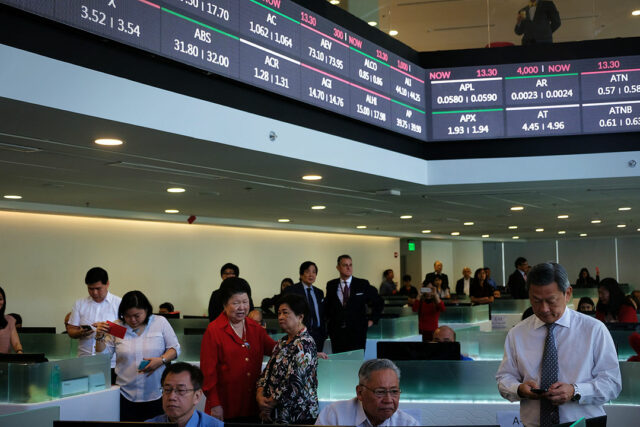
PHILIPPINE STOCKS snapped their six-day winning streak on Tuesday, joining the decline in global markets, amid recession fears in the United States.

The Philippine Stock Exchange Index (PSEi) dropped by 2.42% or 154.22 points to close at 6,206.55 on Tuesday, while the broader all shares index fell by 1.71% or 64.33 points to 3,684.59.

“The local bourse broke its six-day rally, weighed by negative spillovers from Wall Street. This comes amid recession fears in the US driven by their tariff policies,” Philstocks Financial, Inc. Senior Research Analyst Japhet Louis O. Tantiangco said in a Viber message.

“Philippine shares were sold down, fueled by investor worries that uncertainty surrounding tariff policies could lead the global economy into a recession. Concerns about the US have been escalating over the past month and was amplified by recent comments from the White House,” Regina Capital Development Corp. Head of Sales Luis A. Limlingan said in a Viber message.

Emerging market (EM) stocks remained under pressure on Tuesday, as concerns over a US economic slowdown which could lead to a recession weighed on equities, Reuters reported.

MSCI’s index for EM stocks was down 0.4% by 0832 GMT, with South Korean shares closing more than 1% lower, though a higher close in China and Hong Kong helped offset some losses.

Wall Street sold off sharply overnight, with the S&P 500 closing down 8.6% from its Feb. 19 record high, shedding over $4 trillion in market value since then and nearing a 10% decline that would represent a correction for the index.

US President Donald J. Trump’s tariff plans have stoked market volatility after the president late last week suspended the 25% tariffs on Canadian and Mexican goods which had come into effect on March 4. He had initially announced tariffs earlier this year and then postponed them by a month to early March.

Over the weekend, Mr. Trump declined to predict whether the US could face a recession, spurring a selloff in risk assets worldwide.

All sectoral indices closed in the red on Tuesday. Property sank by 4.45% or 102.72 points to 2,203.89; services retreated by 3.33% or 70.03 points to 2,031.68; industrials dropped by 2.13% or 189.30 points to 8,692.13; holding firms decreased by 1.77% or 94.02 points to 5,198.99; mining and oil went down by 1.75% or 156.03 points to 8,739.41; and financials declined by 0.78% or 18.63 points to 2,360.10.

“Only three index members closed with gains this Tuesday, led by Bank of the Philippine Islands, climbing 0.68% to P132.80,” Mr. Tantiangco said.

Value turnover rose to P7.71 billion on Tuesday with 753.65 million shares traded from the P6.41 billion with 627.42 million issues exchanged on Monday.

Decliners overwhelmed advancers, 157 versus 58, while 41 names closed unchanged.

Net foreign selling stood at P350.28 million on Tuesday versus the P1.41 billion in net buying seen on Monday. — R.M.D. Ochave with Reuters

NEDA opens Negros Island office

BW FILE PHOTO

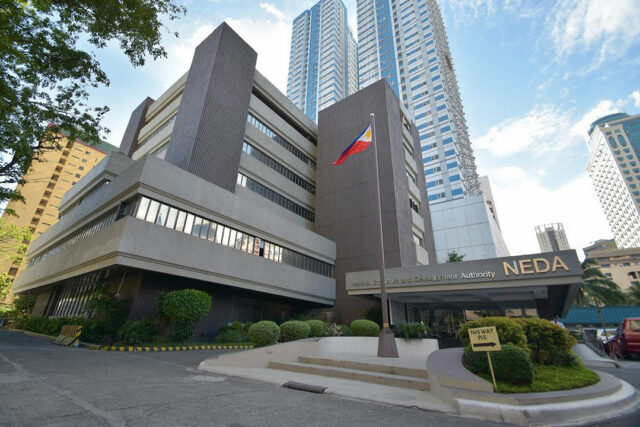
THE National Economic and Development Authority (NEDA) has inaugurated its new office in the Negros Island Region (NIR) on March 10.

“As an island region, the NIR holds distinct opportunities and needs. The NEDA-NIR office will play a pivotal role in crafting the region’s first Regional Development Plan (RDP) — a blueprint to harness growth, foster resilience, and ensure no community is left behind,” NEDA Secretary Arsenio M. Balisacan said in a statement on Tuesday.

NEDA noted this will be the agency’s 16th regional office.

NEDA will also facilitate the creation of a Regional Development Council following the May elections “to enable a more coordinated approach to policymaking and investment programming in NIR.”

The Republic Act No. 12000, the Negros Island Act, provided for the establishment of the NEDA-NIR Regional Office to ensure effective public service delivery in the region.

The same law consolidated the provinces of Negros Occidental, Negros Oriental, and Siquijor into one administrative region. — Aubrey Rose A. Inosante

P3.5-M drugs seized in Pangasinan

PHILSTAR FILE PHOTO

BAGUIO CITY — Authorities seized P3.57 million worth of crystal meth (shabu) and a .45 caliber pistol from a 57-year-old drug trader, early Tuesday in Urdaneta City, Pangasinan.

Operatives from Philippine Drug Enforcement Agency-Pangasinan and Philippine National Police Drug Enforcement Group Special Operations 1 (PDEG-SOU 1) caught “Odi” at around 2:35 a.m. on Tuesday for selling six pieces of knot-tied plastic, containing suspected shabu weighing more or less 525 grams. A pistol with inside holster, a magazine assembly, seven live ammunitions, mobile phones, several drug paraphernalia, and five bundles of unused plastic sachets were also confiscated from the suspect.

Operatives also seized an identification card and P2,0000 worth of cash in different denominations among other non-drug evidence.

According to PDEA-Region 1 Director Joel B. Plaza, the drug trader, who was taken to the PDEA-Pangasinan provincial office jail facility, will be facing charges for violation of Section 5 (Sale of Dangerous Drugs), Section 12 (Possession of Drug Paraphernalia), Article II of Republic Act No. 9165, the Comprehensive Dangerous Drugs Act of 2002, and RA 10591, the Comprehensive Firearms and Ammunition Regulation Act. — Artemio A. Dumlao

Maguindanao del Sur houses torched

COTABATO CITY — Gunmen burned down on Monday a health center and seven houses in Barangay Malingao in Shariff Aguak, Maguindanao del Sur whose occupants had earlier fled due to a shooting incident.

Municipal officials and barangay leaders told reporters on Tuesday that more than 200 villagers in Barangay Malingao were forced to relocate to safer areas two days before the fire after the same group shot their houses with M16 and M14 assault rifles.

Police investigators and traditional Moro leaders said the arson attack was meant to embarrass re-electionist Mayor Akmad A. Ampatuan, Sr., who is chairman of the multi-sector Shariff Aguak Municipal Peace and Order Council.

Army and police officials said they are investigating the assertions by displaced villagers that their mayor’s bid for a second term is being contested by a candidate who has armed followers that do not belong to either the Moro National Liberation Front, or the Moro Islamic Liberation Front (MILF).

Both fronts have separate peace agreements with the national government.

“Actually, the villagers affected by these troubles are identified with the MILF,” the vice-mayor of Shariff Aguak, Marop B. Ampatuan, said.

Brig. Gen. Romeo J. Macapaz, director of the Police Regional Office-Bangsamoro Autonomous Region, told reporters that intelligence agents from the Maguindanao del Sur Provincial Police Office and personnel of the Shariff Aguak Municipal Police Station are cooperating in identifying the gunmen behind the atrocities for prosecution. John Felix M. Unson

What is in the ICC warrant against ex-Philippines president Duterte

PCOO.GOV.PH

 – A 15-page International Criminal Court arrest warrant for Rodrigo Duterte, seen by Reuters and authenticated by an ICC source, outlines the accusations against the former Philippines president over killings in his war on drugs.

Mr. Duterte has long insisted he instructed police to kill only in self-defense and has defended the crackdown.

Here are some key elements in the warrant:

  • The warrant was issued on March 7. It charges Mr. Duterte with murder as a crime against humanity.
  • The document says the judges are satisfied that there are reasonable grounds to conclude the ex-president was at the head of the so-called Davao Death Squad (DDS) and later oversaw Philippines’ law enforcement while in office as president.
  • It says those bodies launched a widespread and systematic attack on the civilian population of the Philippines, targeting alleged criminals especially those thought to be involved in drug trafficking.
  • The warrant says: “The attack took place over a period of several years, and thousands of people appear to have been killed.”
  • The judges said the killings shared common features including the locations, and the methods of killing as well as the profiles of victims and perpetrators.
  • According to the judges there are reasonable grounds to conclude Duterte could be held criminally responsible for the killings of at least 19 alleged drug dealers or thieves by the DDS in Davao city and at least 24 other alleged criminals killed by or under the supervision of members of the Philippines’ law enforcement.
  • The warrant says Mr. Duterte contributed to the crimes by designing the overall project to target alleged criminals, overseeing the DDS and providing them with weapons and ammunition.
  • He is also alleged to have offered financial incentives and promotions to police officers and “hitmen” to kill the suspects, promised immunity to perpetrators and shielded them from investigation and prosecution, the warrant says.
  • The judges also conclude that while the Philippines officially withdrew from the ICC in 2019, the alleged crimes in the warrant took place while Manila was still a member, so the court has jurisdiction over them.

Reuters

First pharma service project registers with BoI

REUTERS

THE Philippine unit of Germany’s Glenwood GmbH has opened a new facility in Taguig City, making it the first pharmaceutical services project registered with the Board of Investments (BoI).

“Aimed at supporting pharmaceutical companies globally, Glenwood Services Philippines, Inc. (GSPI) has registered with the BoI as the first pharmaceutical services project in the country,” the BoI said in a statement on Tuesday.

The Taguig facility will offer quality, regulatory affairs, and pharmacovigilance services aimed at helping domestic pharmaceutical companies with safety, risk management, and compliance issues.

According to the BoI, GSPI has generated high-value jobs in the Philippines, including pharmacists, chemists, and medical science graduates.

“We are amazed by the incredible talent in the Philippines. The education, skills, and training here are impressive. We look forward to expanding our Pharmaceutical Services project and growing our presence in the Philippines,” Glenwood General Manager Ferdinand Matz said.

Glenwood also distributes niche pharmaceutical products worldwide.

Pharmaceutical manufacturers are among the beneficiaries of the Corporate Recovery and Tax Incentives for Enterprises to Maximize Opportunities for Reinvigorating the Economy (CREATE MORE) Act.

“The law provides significant tax incentives, not only for large but also for micro, small and medium enterprises (MSMEs), enabling smaller pharmaceutical companies and suppliers to scale up their operations,” the BoI said.

“Businesses engaged in health-related activities and addressing supply chain gaps could receive better incentives, further promoting sustainable and responsible pharmaceutical manufacturing in the country,” it added.

Separately, the BoI said it signed a memorandum of understanding in developing critical and foundational skills in engineering and technology with DevConnect Philippines, Inc.

“We are dedicated to working with DEVCON to implement strategic initiatives that will ignite interest in science and technology among our future workforce, thereby addressing the decline of enrollees in engineering and other related fields,” BoI Managing Head and Trade Undersecretary Ceferino S. Rodolfo said.

“Ultimately, this will expand our local capabilities and secure the Philippines’ position as a leading investment hub in the region for these in-demand industries,” he added.

In particular, the partnership aims to empower Philippine information technology, semiconductors and electronics, and other priority industries in need of job-ready graduates. — Justine Irish D. Tabile

PHL rice production shortfall seen at 6.1 MMT by 2028/29

PHILIPPINE STAR/MICHAEL VARCAS

THE shortfall in domestic rice production could grow to 6.1 million metric tons (MMT) by 2028/29 due to unfavorable weather in the face of growing demand, putting the Philippines at the mercy of volatile international grain markets, Fitch Solutions BMI reported.

The Philippines is facing a “growing production deficit,” estimated at 3.5 MMT in 2024/25 before expanding further to 6.1 million MT by 2028. It 2014/15, the shortfall had been 1.4 MMT, it said on Thursday.

BMI said “structural challenges” faced by the Philippines include limited availability of arable land, exposure to typhoons and the growing population, making it difficult to achieve self-sufficiency in grains.

Self-sufficiency in rice has decreased “significantly” over the past decade, to 69.7% in 2024/25 from 91.6% in 2014/15, BMI said.

“This is due to limited growth in production combined with strong growth in consumption,” it noted.

BMI said it estimates the five-year average annual growth rate in the period ending 2024/25 at 3.6% for rice consumption and 0.2% for production.

“Through our forecast period between 2025/26 and 2028/29, we expect the average annual growth rate for production to be 2.0%. For consumption we expect this to be 2.5%,” it added.

The Philippines has lowered tariffs and declared an emergency that triggers the release of state rice stocks in response to elevated rice prices.

Philippine inflation eased to 2.1% in February from 2.9% in January as rice inflation dropped to 4.9%, the sharpest decline since April 2020.

Rice growers are currently facing low farmgate prices as traders opt to deal in imported rice. The farmgate price was P15-16 per kilo for freshly harvested grain, according to industry reports last week.

The report also noted that labor productivity in the Philippines is low compared to Thailand and Vietnam due to “manual transplanting being more common and lower levels of mechanization.”

It noted that rice yields in the Philippines are lower than those in Vietnam but are very close to those in the largest exporter, India, and higher than those in Thailand.

BMI said it’s a “significant concern” that the Philippines is now the largest importer of rice globally, accounting for 9.7% of global rice imports in 2024/25 based on US Department of Agriculture forecasts, given that 19.5% of the population had insufficient food consumption as of September 2024.

“We also highlight that the Philippines relies entirely on imports for wheat, a further risk for food security,” it flagged. 

BMI said demographic trends will result in continued strong demand for rice in the medium to long term, noting that spending on rice will grow at a faster rate than food spending overall in 2029. — Kyle Aristophere T. Atienza

Subic-Clark railway right-of-way deals signed with 212 landowners

JOHANNES PLENIO-UNSPLASH

THE Bases Conversion and Development Authority (BCDA) said it completed negotiations with 212 landowners affected by the Pampanga section of the Subic-Clark-Manila-Batangas (SCMB) Railway Project.

“The BCDA has successfully completed negotiations with 212 lot owners, 163 of whom have already received either partial or full compensation,” BCDA said in a statement on Tuesday.

The SCMB railway project runs for 26.9 kilometers in Porac and Floridablanca, Pampanga, affecting 519 lots.

On March 4, the BCDA said it distributed another 36 transfer certificates of title (TCTs) to landowners affected by the project. The initial distribution involved 68 certificates in November.

“The SCMB Railway Project would not succeed without the support of the landowners who yielded to the railway’s requirements,” BCDA Vice-President and Subic-Clark Railway Project Director Jocelyn L. Caniones said.

“This development emphasizes affected landowners’ important role in the realization of the Luzon Economic Corridor vision,” she added.

Citing Republic Act 10752, or the Right-of-Way Act, BCDA said that the owner of properties affected by a project and the implementing agency are to “execute a deed of absolute sale, with the implementing agency facilitating the annotation of the deed of absolute sale on the TCTs.”

“TCTs are legal documents that serve as evidence of ownership of registered land,” BCDA said.

The SCMB railway project is one of the flagship projects of the Luzon Economic Corridor, which aims to provide connectivity and freight transport services between the Port of Subic, Clark International Airport, the Port of Manila, and the Port of Batangas.

Collectively, the four ports handle about 80% of the country’s port traffic.

“The BCDA continues to facilitate the right-of-way acquisition for the project, as the National Government remains optimistic about the project’s implementation,” the BCDA said. 

“The feasibility study for the project will be jointly undertaken by the US, Sweden, and the Asian Development Bank,” it added.

The Luzon Economic Corridor is being undertaken via a trilateral agreement entered into by the Philippines, the US, and Japan.

Part of a broader collaboration supported by the G7 Partnership for Global Infrastructure and Investment, it aims to strengthen connectivity in Metro Manila, Batangas, Subic, and Clark. — Justine Irish D. Tabile

PEZA, BCDA agree on regulatory arrangements for New Clark City

NEW CLARK CITY

THE Philippine Economic Zone Authority (PEZA) and the Bases Conversion and Development Authority (BCDA) have adopted an interim arrangement that will define their regulation of New Clark City.

“Under this setup, BCDA will register and regulate new developer or operator projects in New Clark City, while PEZA will oversee locator projects,” PEZA said in a Facebook post on Tuesday.

“This approach leverages BCDA’s expertise in property development and estate management alongside PEZA’s renowned one-stop shop services for locators,” it added.

PEZA Director General Tereso O. Panga said the arrangement will apply to projects in Clark Green City and will be implemented through a memorandum of agreement.

“This partnership between PEZA and BCDA not only prevents jurisdictional overlaps between the two investment promotion agencies but also capitalizes on our core competencies to attract more investors to the Philippines, particularly along the Luzon Economic Corridor,” Mr. Panga said.

Under the arrangement, BCDA will implement its overall estate planning strategy, with locators able to tap PEZA’s one-stop shop functions.

“Eventually, through our joint capacity building, we hope that BCDA will take on those same one-stop shop functions,” Mr. Panga said.

“We aim to capacitate BCDA so that in five years, they will be able to register and administer incentives according to PEZA’s model. This will also include PEZA being granted the authority to issue building permits within these zones,” he added.

PEZA also committed to assist BCDA in project registration and fiscal and non-fiscal incentive administration.

BCDA President and Chief Executive Officer Joshua M. Bingcang said that the tieup combines the two organizations’ “strengths in infrastructure development and public-private partnerships with investment facilitation.”

At the Money Talks with Cathy Yang program on One News Channel on Monday, Mr. Bingcang said two big contracts have been signed to fast-track the development of New Clark City.

“We started in January with the expansion of a 100-hectare industrial park with a Filipino-Japanese consortium. They are already in the south, and they are expanding in Clark,” he said.

“So this investment commitment is expected to generate tens of thousands of jobs. We are ready to turn over the property to them,” he added.

He added that an agreement for the first 3,000 housing units in New Clark City was also signed with South Korean partners, including the South Korean government. — Justine Irish D. Tabile

Weak chicken farmgate prices offset supply concerns arising from US ban

REUTERS

THE farmgate price of chicken is declining, offsetting any potential upward pressure resulting from a temporary ban on poultry imports from several US states, industry groups said.

The United Broiler Raisers Association (UBRA) told BusinessWorld that the current farmgate prices of live weight regular sized chicken was P126-P129 per kilo, from P135 a week earlier.

The farmgate prices for day-old chickens, meanwhile, was between P52 and P54. 

“It does not follow when there is such a ban that there will be price increases,” UBRA President Elias Jose M. Inciong said via Viber.

Citing bird flu outbreaks, the Department of Agriculture (DA) temporarily banned imports of poultry products such as poultry meat, day-old chicks, eggs, and semen from Indiana, New York, Pennsylvania, Illinois, Minnesota, Ohio, Wisconsin, South Dakota, Maryland, and Missouri.

The US accounts for 33% or 158,159 metric tons (MT) of the Philippines’ 472,211 MT chicken imports in 2024, making it the Philippines’ second-largest chicken supplier.

Meat Importers and Traders Association President Jesus C. Cham told BusinessWorld that chicken prices in the Philippines may still rise due to the temporary import ban. 

Philippine importers are still grappling with the delay in the allocation of the minimum access volume (MAV) quota on poultry imports, he said via Viber.

He described the current poultry supply situation as “tight.”

Meat traders have been calling on the DA to issue the MAV allocation for 2025 as soon as possible to avoid supply disruptions. MAV quotas should have been released in the first week of January, they said. — Kyle Aristophere T. Atienza

Japan leisure company studying PHL entry

PEXELS-PIXABAY

JAPAN’s Koshidaka Holdings Co., Ltd. is exploring entering the Philippines with entertainment centers and hot spring facilities, the Department of Trade and Industry (DTI) said.

“This is a very big entertainment and leisure company in Japan that wants to do business here in the Philippines,” Trade Secretary Ma. Cristina A. Roque said in a briefing on Tuesday. 

“I have told them that I will introduce them to the presidents of the malls and also other areas where they can really expand, not just in Metro Manila but nationwide,” she added.

Koshidaka is among the 13 Japanese companies and business federations the DTI met with in Japan last week.

The meeting with Koshidaka yielded a P2.5-billion investment pledge.

“The company plans to open its first store in Metro Manila by the end of 2025, with plans to expand to 30 locations and eventually to 100,” the DTI said.

Koshidaka has 671 stores in Japan. It controls the Karaoke Manekineko, One Kara, and Maneki no Yu brands.

“They are also very much interested in really growing their other businesses. Aside from entertainment, they also want to open a gym that’s focused on women and Japanese onsen (hot springs baths),” Ms. Roque said.

“They are coming to explore locations where they can open,” she added.

Ms. Roque said that it will introduce Koshidaka to business officials where the Japanese company can expand.

“Our 115 million population is of interest to them as well as our love for karaoke,” she added.

During the Japan trip, Ms. Roque obtained P23.5 billion in investment pledges from Koshidaka, the Sumitomo group, Nidec, and Fujifilm.

Ms. Roque said that she also met with six companies during her US trip last week, including Starlink, which is currently working with local partners to expand in the Philippines.

“They’re still in talks now, and definitely it is for connectivity and what else we can generate from Starlink. But connectivity is really actually number one,” she said.

“I am not sure if they will really announce it in the first quarter, but they are aggressive. They are in serious talks,” she added.

Converge Information and Communications Technology Solutions, Inc. was identified as among Starlink’s five local partners.

“Due to the surging demand for additional capacity in the Philippines, Starlink Philippines intends to construct and operate satellite earth stations or ground stations (gateways) to address the demand,” the DTI said.

Starlink Philippines has initiated the process of obtaining a Congressional franchise, but bills are still pending.

Senate Resolution No. 3 and House Resolution No. 298 have been issued urging the National Telecommunications Commission to issue provisional authority to Starlink to allow the construction and operation of earth stations, the DTI said.

However, a notice of deficiency was issued to Starlink on Feb. 6, listing the required technical submissions before a temporary license can be issued.

“Starlink Philippines has yet to submit the required documents. The NTC met with Starlink Philippines on March 10 to discuss the required technical submissions,” the DTI said.

According to the DTI, Starlink is planning to put up earth stations in 14 locations.

Aside from Starlink, Ms. Roque also met with Birns & Sawyer, Boeing, Oliver Tolentino Atelier, Seafood City, Prime Videos, and Relativity Media. — Justine Irish D. Tabile