Home Blog Page 1868

China monitored Philippine supply run to grounded warship on disputed shoal

BRP SIERRA MADRE, a marooned transport ship which Philippine Marines live in as a military outpost, sits on the disputed Second Thomas Shoal, part of the Spratly Islands in the South China Sea. — REUTERS

 – The Chinese coast guard on Wednesday said it monitored a Philippine civilian boat delivering daily provisions to the “illegally grounded” warship at the disputed Second Thomas Shoal on Tuesday.

China and the Philippines claim the territory and frequently clash in its surrounding waters.

The resupply missions for soldiers aboard the grounded naval vessel were previously a significant cause of tension between the two countries until they reached a provisional agreement in July on such missions, signaling a de-escalation of tensions.

In January, they also agreed to seek common ground and find ways to cooperate despite their territorial disagreements.

China urges the Philippines to honor its commitments, stop hyping up incidents in the area and work with China to manage the maritime situation, the coast guard said in a statement on Wednesday.

The Philippines armed forces said it completed a routine troop rotation and resupply mission to the BRP Sierra Madre warship stationed at the shoal, “in resolute commitment to maintaining its presence and operational readiness in the West Philippine Sea”.

The armed forces carried out the mission with the Philippine coast guard which was “completed with no untoward incident”.

China has expansive territorial claims in the South China Sea that overlap with the exclusive economic zones of Brunei, Indonesia, Malaysia, the Philippines and Vietnam.

In 2016, an international arbitral tribunal ruled China’s claims, backed by its historical maps, have no basis under international law – a ruling China does not recognize. – Reuters

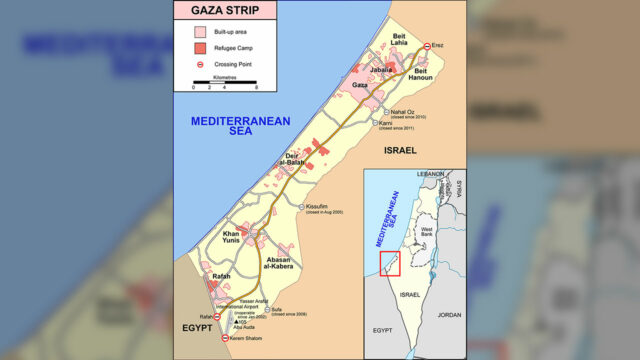
Arab states adopt Egyptian alternative to Trump’s ‘Gaza Riviera’

WIKIMEDIA.ORG

 – Arab leaders adopted an Egyptian reconstruction plan for Gaza on Tuesday that would cost $53 billion and avoid displacing Palestinians from the enclave, in contrast to U.S. President Donald Trump’s “Middle East Riviera” vision.

The White House said the plan adopted by Arab states did not address Gaza’s reality and that Trump stood by his proposal.

Mr. Trump’s plan to displace Palestinians in a U.S. takeover of the enclave received global condemnation last month and echoed long-standing Palestinian fears of being permanently driven from their homes.

Egyptian President Abdel Fattah al-Sisi said the Egyptian proposal, welcomed in subsequent statements by Hamas and criticized by Israel and the U.S., had been accepted at the closing of a summit in Cairo.

Sisi said at the summit that he was certain Mr. Trump would be able to achieve peace as the Gaza Strip has been left devastated by Israel’s military assault.

The major questions that need to be answered about Gaza’s future are who will run the enclave and which countries will provide the billions of dollars needed for reconstruction.

Sisi said Egypt had worked in cooperation with Palestinians on creating an administrative committee of independent, professional Palestinian technocrats entrusted with the governance of Gaza after the end of the Israel-Gaza war.

The committee would be responsible for the oversight of humanitarian aid and managing the Strip’s affairs for a temporary period, in preparation for the return of the Palestinian Authority (PA), he said.

The other critical issue is the fate of the Palestinian militant group Hamas, the PA’s rival, whose October 7, 2023, attack on Israel killed 1,200 people with more than 250 taken as hostages, according to Israeli tallies.

The attack was followed by Israel’s military assault on Gaza that has killed more than 48,000 Palestinians, according to the local health ministry. The assault has also displaced nearly Gaza’s entire population and led to accusations of genocide and war crimes that Israel denies.

The Islamist faction that has run Gaza since 2007 said in a statement it agrees to the Egyptian committee proposal.

Hamas has agreed it will not field candidates to the Cairo-proposed committee but it would have to give its consent to the tasks, members and the agenda of the committee that would work under the PA’s supervision.

Egyptian Foreign Minister Badr Abdelatty said late on Tuesday the names for the individuals participating in the committee had been decided.

Palestinian President Mahmoud Abbas, who heads the PA, said he welcomed the Egyptian idea and urged Trump to support such a plan that would not involve displacing Palestinian residents.

Mr. Abbas, in power since 2005, also said he was ready to hold presidential and parliamentary elections if circumstances allowed, adding his PA was the only legitimate governing and military force in the Palestinian Territories.

Hamas said it welcomed the elections.

Abbas has seen his legitimacy steadily undermined by Israeli settlement building in the occupied West Bank, which he oversees. Many Palestinians now regard his administration as corrupt, undemocratic and out of touch.

The Israeli foreign ministry in a statement called the plan “rooted in outdated perspectives” and rejected the reliance on the PA while complaining that Hamas was left in power by the plan. Washington also voiced its disapproval.

“The current proposal does not address the reality that Gaza is currently uninhabitable and residents cannot humanely live in a territory covered in debris and unexploded ordnance,” White House spokesman Brian Hughes said when asked whether Trump would support the Arab leaders’ plan.

“President Trump stands by his vision to rebuild Gaza free from Hamas,” he said.


RECONSTRUCTION WOULD NEED GULF STATES

Any reconstruction funding would require heavy buy-in from oil-rich Gulf Arab states such as the United Arab Emirates and Saudi Arabia, which have the billions of dollars needed.

Palestinian Prime Minister Mohammed Mustafa said the reconstruction fund would seek international financing as well as oversight and likely be located in the World Bank.

The UAE, which sees Hamas and other Islamists as an existential threat, wants an immediate and complete disarmament of the group, while other Arab countries advocate a gradual approach, a source close to the matter said.

A source close to Saudi Arabia’s royal court says the continued armed presence of Hamas in Gaza was a stumbling block because of strong objections from the United States and Israel, which would need to sign off on any plan.

In a speech at the summit, Saudi Foreign Minister Prince Faisal bin Farhan said international guarantees were needed that the current temporary ceasefire would remain in place, and supported the PA’s role in governing the strip.

Leaders of the UAE and Qatar did not speak during open sessions of the summit.

Hamas was founded in 1987 by Egypt’s Muslim Brotherhood during the first Palestinian Intifada, or uprising.

Senior Hamas official Sami Abu Zuhri on Tuesday rejected Israeli and U.S. calls for the group to disarm, saying its right to resist was not negotiable.

Mr. Abu Zuhri told Reuters the group would not accept any attempt to impose projects, or any form of non-Palestinian administration or the presence of foreign forces.

Since Hamas drove the Palestinian Authority out of Gaza after a brief civil war in 2007, it has crushed all opposition there.


ALTERNATIVE TO TRUMP PLAN

Egypt, Jordan and Gulf Arab states have for almost a month been consulting over an alternative to Trump’s ambition for an exodus of Palestinians and a U.S. takeover of Gaza, which they fear would destabilize the entire region.

A draft final communique from the summit seen earlier by Reuters rejected the mass displacement of Palestinians from Gaza.

Egypt’s Reconstruction Plan for Gaza is a 112-page document that includes maps of how its land would be re-developed and dozens of colourful AI-generated images of housing developments, gardens and community centers. The plan includes a commercial harbor, a technology hub, beach hotels and an airport.

Israel was unlikely to oppose an Arab entity taking responsibility for Gaza’s government if Hamas was off the scene, said a source familiar with the matter.

But an Israeli official told Reuters that Israel’s war aims from the beginning have been to destroy Hamas’ military and governing capabilities.

“Therefore, if they are going to get Hamas to agree to demilitarize, it needs to be immediately. Nothing else will be acceptable,” the official said.

Sources familiar with Hamas said the group had only lost a few thousand fighters in the Gaza war.

Israeli officials say around 20,000 Hamas fighters have been killed and the group has been destroyed as an organized military formation. – Reuters

Trump addresses Congress for first time since returning to power

REUTERS

 – President Donald Trump took a victory lap in a speech to Congress on Tuesday, exulting in a series of dramatic actions that have upended U.S. foreign policy, ignited a trade war with close allies and slashed the federal workforce since he took office six weeks ago.

“To my fellow citizens, America is back,” Mr. Trump began to a standing ovation from fellow Republicans. “Our country is on the verge of a comeback the likes of which the world has never witnessed, and perhaps will never witness again.”

The primetime speech, his first to Congress since taking office on January 20, capped a second day of market turmoil after he imposed sweeping new tariffs against Mexico, Canada and China.

Mr. Trump spoke in the House of Representatives, where lawmakers huddled in fear for their lives a little over four years ago while a mob of Trump supporters ransacked the Capitol in an unsuccessful effort to overturn Democrat Joe Biden’s 2020 victory over the then-incumbent Mr. Trump.

The president intends to boast about his first month in office, calling it “the most successful” first month of any U.S. presidency in history, according to excerpts released by the White House ahead of the speech.

He will also defend his tariff campaign, despite concerns that it could raise consumer prices and slow economic growth.

“Whatever they tariff us, we tariff them. Whatever they tax us, we tax them,” Mr. Trump is expected to say. “If they do non-monetary tariffs to keep us out of their market, then we do non-monetary barriers to keep them out of our market.”

World leaders were watching Mr. Trump’s speech closely, a day after he paused all military aid to Ukraine. The suspension followed an Oval Office blowup in which Mr. Trump angrily upbraided Ukrainian President Volodymyr Zelenskiy in front of TV cameras.

The pause in aid threatened Kyiv’s efforts to defend against Russia, which launched a full-scale invasion three years ago, and further rattled European leaders worried that Trump is moving the U.S. too far toward Moscow.

While Mr. Trump has appeared to fault Ukraine for starting the war, a new Reuters/Ipsos poll found 70% of Americans – including two-thirds of Republicans – say Russia was more to blame.

Mr. Trump’s 25% tariffs on Mexico and Canada, two of the country’s closest allies, and an additional 10% on Chinese imports deepened investor concerns about the economy. The Nasdaq Composite is down more than 9% from its record closing high on December 16.

Just one in three Americans approve of Mr. Trump’s handling of the cost of living, according to the Reuters/Ipsos poll, a potential danger sign amid worries his tariffs could increase inflation.


EXECUTIVE POWER

A senior White House official said the theme of Mr. Trump’s speech is the “renewal of the American dream.” The speech is akin to a State of the Union address but not called that in a president’s inaugural year.

The official said Mr. Trump’s topics will include laying out his plans to end the Ukraine war and gain the release of hostages abducted from Israel by Hamas militants and held in Gaza.

Mr. Trump is expected to laud his rapid-fire efforts to slash the federal bureaucracy, reduce the flow of migrants over the U.S.-Mexico border and use tariffs to force other nations to bow to his demands.

On the domestic front, Mr. Trump is likely to make a case for extending his 2017 tax cuts. Congressional Republicans have advanced a sweeping $4.5 trillion plan that would extend the cuts, tighten border security and fund a huge increase in deportations.

The proposal calls for $2 trillion in spending reductions over a decade, with possible cuts to education, healthcare and other social services.

Mr. Trump has asserted an unprecedented level of executive power, working with Elon Musk – the world’s richest person – to jettison more than 100,000 workers across the government despite dozens of lawsuits.

Mr. Musk’s Department of Government Efficiency, or DOGE, has dismantled agencies such as the Consumer Financial Protection Bureau and canceled billions of dollars in foreign aid, including lifesaving medicine and food, that had been authorized by Congress.

Mr. Musk was in attendance on Tuesday.

Democrats plan to underscore the harm they say Mr. Trump’s policies have caused everyday Americans by inviting civil servants hit by DOGE firings or funding freezes to Tuesday’s speech.

Senator Elissa Slotkin of Michigan, a former CIA agent, will deliver the Democratic Party’s rebuttal.

First lady Melania Trump was joined at the address by selected guests, including the family of Corey Comperatore, a firefighter killed by the gunman who grazed Trump with a bullet during a campaign rally in Butler, Pennsylvania, last July.

Others include Marc Fogel, a history teacher freed from detention in Russia in February. – Reuters

Trump’s second term already more disruptive than his first, Australia’s foreign minister says

RAWPIXEL.COM
Australian Foreign Minister Penny Wong | Source: https://www.foreignminister.gov.au/minister/penny-wong

 – Donald Trump’s second presidency is already more disruptive than his first, Australia’s foreign minister said on Wednesday, although she held hopes the country might still get an exemption when it comes to tariffs.

Foreign Minister Penny Wong said there was “no doubt” from Mr. Trump’s flurry of executive orders since taking office just over six weeks ago that Australia was dealing with a “very different American administration”.

“President Trump and his administration envisage a very different America in the world,” she said at the Australian Financial Review Business Summit in Sydney.

“We saw that in the first Trump administration, but I think it’s clear that the scale of change in this administration, the second term of the Trump administration is even more so.”

Ms. Wong said tariffs had been a major focus for Mr. Trump and that Australia was still pushing for an exemption with 25% tariffs on steel and aluminum set to start next week.

“I wouldn’t concede that (we will not get a tariff exemption) … we are still, putting our case very clearly and our case, I think is a strong case,” she said.

She added that the U.S. was Australia’s most important strategic partner and that alliance had endured people, administrations and governments of all political persuasions.

“There will be areas where our position and the U.S. position might differ. That’s always been the case. We have to navigate that sensibly. We have to remember the value of the alliance,” she said. – Reuters

China maintains defense spending increase at 7.2% amid roiling geopolitical tensions

RAWPIXEL.COM

 – China will boost its defense spending by 7.2% this year, maintaining a steady growth rate as Beijing faces headwinds from three years of sluggish economic expansion amid mounting geopolitical challenges from Taiwan to Ukraine.

The increase, announced on Wednesday in a government report due to be released in parliament, matches last year’s figure.

It remains well above China’s economic growth target for this year of roughly 5% – which analysts say was expected and reflected Beijing’s ambitions for continued military modernization amid roiling geopolitical challenges.

Since Xi became president and commander-in-chief more than a decade ago, the defense budget has ballooned to 1.78 trillion yuan ($245.65 billion) this year from 720 billion yuan in 2013.

Xi aims to complete full military modernization by 2035, with China’s military developing new missiles, ships, submarines and surveillance technologies.

At the same time, the military is trying to improve combat readiness through more rigorous training and drills, according to official reports – many of which involve Taiwan scenarios.

The London-based International Institute for Strategic Studies noted in a survey in February of the world’s militaries that given China’s wider economic constraints, “authorities face increasingly sharp questions about which areas to prioritize”.

The military budget increase comes despite numerous corruption scandals affecting the People’s Liberation Army (PLA) in the past two years that have felled two former defense ministers and a Central Military Commission member.

China remains the world’s second-biggest military spender behind the United States, whose proposed military budget for 2025 is $850 billion. – Reuters

China targets US soybeans, lumber in stepped-up response to Trump tariffs

REUTERS

 – China suspended on Tuesday the soybean import licenses of three U.S. firms and halted imports of U.S. logs, stepping up its retaliation for additional U.S. tariffs on Chinese goods.

Earlier in the day, China also imposed import levies covering $21 billion worth of U.S. agricultural and food products including soybeans, wheat, meat and cotton.

The three U.S companies affected by the license suspensions are farmer-owned cooperative CHS Inc, global grains exporter Louis Dreyfus Company Grains Merchandising LLC and export grain terminal operator EGT, China’s customs department said in a statement.

Customs said it detected ergot and seed coating agent in imported U.S. soybeans, while the suspension of U.S. log imports was due to the detection of worms, aspergillus and other pests.

Media representatives for Louis Dreyfus, CHS and Bunge Global BG.N, which partially owns EGT, did not immediately respond to requests for comment.

Beijing is retaliating against U.S. President Donald Trump’s decision to impose an extra 10% duty on China, effective Tuesday, resulting in a cumulative 20% tariff in response to what the White House considers Chinese inaction over drug flows.

About half of U.S. soybean exports are shipped to China, totaling nearly $12.8 billion in trade in 2024, according to the U.S. Census Bureau.

The suspension of U.S. logs was a direct response to Trump’s move on March 1 to order a trade investigation on imported lumber. Trump had earlier told reporters that he was thinking about imposing a 25% tariff rate on lumber and forest products.

“The announcement of import restrictions on U.S lumber and soybeans linked with phytosanitary issues follows a long history of similar measures by Beijing,” said Even Pay, agriculture analyst at Trivium China.

The bulk import volumes and natural origin of soybeans and lumber make them susceptible to issues with plant health and pests, creating a convenient target for trade retaliation, Pay said.

China is one of the world’s largest importers of wood products and the third-largest destination for U.S. forest products. It imported around $850 million worth of logs and other rough wood products from the U.S. in 2024, according to Chinese customs data.


PUNISHING FARMERS

Additional levies imposed by China earlier on Tuesday comprised a 15% tariff on U.S. chicken, wheat, corn and cotton and an extra levy of 10% on U.S. soybeans, sorghum, pork, beef, aquatic products, fruits and vegetables and dairy imports, effective from March 10.

The suspension on the three soybean exporters on top of higher import tariffs will further restrict imports of the oilseed into China.

Beijing’s concerted efforts in recent years to greatly reduce its dependence on U.S supplies has put it in a stronger position to target U.S farm goods with less impact to its food security and greater harm to U.S farmers compared to a 2018 trade war during Trump’s first administration.

China has turned to South American producers, boosted agriculture cooperation with allies and raised domestic production through expanded planting and the use of technology. – Reuters

China will work to ‘firmly advance’ reunification with Taiwan – premier

CHINESE AND TAIWANESE flags are seen in this illustration, Aug. 6, 2022. — REUTERS

 – Chinese Premier Li Qiang said on Wednesday China would “firmly advance” the push for reunification with Taiwan while opposing external interference, and strive to work with regular Taiwanese to realize the rejuvenation of the Chinese nation.

“We will firmly advance the cause of China’s reunification and work with our fellow Chinese in Taiwan to realize the glorious cause of the rejuvenation of the Chinese nation,” Mr. Li wrote in his annual work report to China’s parliament.

China claims democratically governed Taiwan as its own territory, despite the objection of the government in Taipei, and has ramped up its military pressure against the island in recent years, including holding several rounds of major war games. – Reuters

LOOKING AHEAD: PHILIPPINES 2025 — How geopolitics will affect business

The escalating complexities of the global geopolitical landscape are casting a long shadow over the future of business, both domestically and internationally. To navigate this uncertain terrain and equip businesses with the insights and strategies they need to thrive, Leverage International (Consultants), Inc. is proud to announce the “LOOKING AHEAD: PHILIPPINES 2025 Thought Leaders Business Forum” on March 7, 2025, at the New World Makati Hotel in Metro Manila.
 
This exclusive forum will bring together distinguished leaders and visionaries from the business and government sectors in the Philippines to engage in thought-provoking discussions and share valuable perspectives on how geopolitics will shape the business landscape in the coming years.
 
The forum will commence with a session titled “Business in a Fractured World of Geopolitics and Uncertainty.” Esteemed speakers, including Special Assistant Winston Dean S. Almeda from the Department of Foreign Affairs; and Charlie Villaseñor, CEO and President of the Procurement and Supply Institute of Asia (PASIA), will delve into the intricacies of conducting business amidst rising tensions between major global powers, the evolving geopolitical dimensions of the digital economy, and the potential disruptions to food security and global supply chains.
 
The heart of the forum lies in its panel discussions, which will span a wide array of critical sectors:
 
Manufacturing and Trade:
This panel will examine the impact of geopolitical tensions on manufacturing and trade, and explore strategies for maintaining competitiveness and agility in the face of global uncertainty.
 
Tourism:
Given the tourism sector’s vulnerability to geopolitical risks, this panel will address strategies for resilience and sustainable growth amidst global disruptions.
 
Construction and Real Estate:
This session will assess the readiness and competitiveness of the local construction industry to meet both domestic and international demands in a volatile environment.
 
E-commerce and Retail:
This panel will analyze the effects of geopolitical tensions on supply chains, currency fluctuations, and shifts in consumer behavior — key factors that are essential for maintaining business sustainability during times of crisis.
 
IT-BPO:
The IT-BPO sector’s opportunities and challenges in the context of geopolitical shifts will be discussed in this panel.
 
SMEs:
This panel will explore strategies for small and medium-sized enterprises to thrive by leveraging adaptability, efficiency, and innovation in their supply chains.
 
The forum will culminate in a keynote address by Dr. Roberto F. de Ocampo, OBE, Chairman of Philippine Veterans Bank and Former Finance Secretary. Dr. de Ocampo will share his profound insights and visionary perspective on the future of business in the Philippines, offering attendees a glimpse into the possibilities and challenges that lie ahead.
 
The “LOOKING AHEAD: PHILIPPINES 2025” forum is an indispensable event for business leaders, policy makers, and visionaries who are eager to understand the geopolitical forces shaping the business landscape and chart a course for success in these turbulent times. For more information and to secure your place at this pivotal event, please contact the Secretariat at leverage@leverageinternational.com.


Spotlight is BusinessWorld’s sponsored section that allows advertisers to amplify their brand and connect with BusinessWorld’s audience by publishing their stories on the BusinessWorld Web site. For more information, send an email to online@bworldonline.com.

Join us on Viber at https://bit.ly/3hv6bLA to get more updates and subscribe to BusinessWorld’s titles and get exclusive content through www.bworld-x.com.

NG debt rises to new high of P16.3T

REUTERS

THE NATIONAL Government’s (NG) outstanding debt hit a fresh high of P16.31 trillion at the end of January as it ramped up borrowings, the Bureau of the Treasury (BTr) said on Tuesday.

Preliminary data from the BTr showed that outstanding debt jumped by 1.63% or P261.47 billion to P16.31 trillion from P16.05 trillion at end-2024.

“The month-over-month rise in debt stock was due to the net incurrence of new domestic and external debt, as well as the impact of peso depreciation against the US dollar from P57.847 at the end of 2024 to P58.375 at the end of January 2025,” the Treasury said in a statement.

National Government outstanding debtThe debt stock rose by 10.29% from P14.79 trillion at end-January 2024.

“This level remains manageable and in line with the government’s target to support economic development while ensuring fiscal sustainability,” the BTr said.

NG debt is the total amount owed by the Philippine government to creditors such as international financial institutions, development partner-countries, banks, global bond holders and other investors.

BTr data showed the bulk or 67.9% of total outstanding debt was from domestic sources, while 32.1% was from foreign creditors.

Domestic debt increased by 1.41% or P153.68 billion to P11.08 trillion as of January from P10.93 trillion in December. Year on year, it rose by 9.07% from P10.16 trillion recorded at end-January 2024.

“This was mainly due to the net issuance of government securities of P152.17 billion as gross issuances of P270.01 billion exceeded repayments of P117.84 billion to partly finance the projected deficit for the quarter,” the BTr said.

The valuation effect of the peso depreciation against the US dollar increased domestic debt by P1.51 billion in January.

Meanwhile, external debt went up by 2.1% to P5.23 trillion as of end-January from P5.12 trillion at end-2024.

Year on year, external debt climbed by 12.98% from P4.63 trillion.

“This was driven by net availment of foreign loans amounting to P59.3 billion, as well as the upward revaluation caused by unfavorable US and third currency movements amounting to P46.74 billion and P1.75 billion, respectively,” the Treasury said.

External debt consisted of P2.7 trillion in global bonds and P2.52 trillion in loans, the BTr said.

NG-guaranteed obligations slipped by 0.11% to P346.27 billion as of end-January from the end-December level of P346.66 billion.

Year on year, guaranteed obligations fell by 0.69% from P348.66 billion.

As of end-January, the net repayment of domestic guarantees stood at P1.55 billion, while external guarantees amounted to P250 million.

“The redemption of matured guarantees more than offset the currency valuation adjustments on US dollar and third-currency denominated guarantees amounting to P0.83 billion and P0.58 billion, respectively,” the BTr said.

Rizal Commercial Banking Corp. Chief Economist Michael L. Ricafort said the increase in outstanding debt reflected the continued budget deficit in recent months that “fundamentally required additional borrowings” by the government.

The NG posted a budget deficit of P1.506 trillion in 2024, narrowing by 0.38% year on year. However, it overshot the P1.48-trillion deficit ceiling set by the Development Budget Coordination Committee (DBCC) by 1.48%.

Mr. Ricafort also said the weaker peso against the US dollar in January increased the peso value of external debt.

He expects the NG debt to set new records as the government ramped up borrowings in the early part of 2025.

“(There is also) the need to hedge both local and foreign borrowings of the National Government given the Trump factor that caused volatility in the global financial markets,” he said.

Oikonomia Advisory and Research, Inc. economist Reinielle Matt M. Erece said debt is expected to further increase.

“I would expect debt to rise this year as a result of both expansionary fiscal policy to promote growth and an election year, which usually results in higher government spending. Financing this spending is difficult to achieve with a tight fiscal space and borrowing might be needed,” he said.

Mr. Erece said the debt is still manageable “as long as the government improves its revenue generation and minimizes corruption.”

At end-December, the country’s debt as a share of gross domestic product (GDP) inched up to 60.7% from 60.1% a year earlier. This is slightly higher than the 60% threshold considered manageable by multilateral lenders for developing economies.

The Philippines’ debt-to-GDP ratio of 60.7% positions it “competitively” with its Southeast Asian peers, according to the BTr. It is higher than Thailand’s 56.6% and Indonesia’s 36.8%, but below Malaysia’s 64.6% and Singapore’s 173.1%.

The government aims to bring down the debt-to-GDP ratio to 60.4% this year, 60.2% in 2026 and 56.3% in 2028.

The National Government plans to borrow P2.55 trillion this year — P2.04 trillion from the domestic market and P507.41 billion from external sources. — Aubrey Rose A. Inosante

Philippine homeownership dreams stifled by rising costs and stagnant wages

CENTRAL BANK data showed that the prices of condominium units fell 9.4% in the third quarter from a year earlier, reversing 10.6% growth in the previous quarter and 8.3% a year ago. — PHILIPPINE STAR/ MIGUEL DE GUZMAN

By Luisa Maria Jacinta C. Jocson, Reporter

MICHAEL JOSEPH D. SERVER, a 28-year-old Filipino entrepreneur, has been renting a condominium unit in Quezon City near the Philippine capital for two years now and doesn’t plan to buy his own house soon.

“Owning a home is one of the biggest financial decisions you can make,” he told BusinessWorld. “Outside of saving for a downpayment, there are a number of factors I’d need to take into consideration before making a concrete decision.”

A study by PhilhealthCare, Inc. (PhilCare), a health maintenance organization, found that 39% of Generation Z (Gen Z) people — those born in the late 1990s to early 2000s — cited homeownership as one of their top worries.

“For a young working professional, it can be challenging to acquire a property right away, especially with the rising prices,” Roy Amado L. Golez, Jr., director of research and consultancy at Leechiu Property Consultants, said in an e-mailed reply to questions.

“If their only source of income is their salary, they need to set aside enough funds for a downpayment and make sure they’re able to sustain installment payments,” he added.

Buying a house today has changed drastically from just a few decades earlier.

“Housing availability was already a major issue even decades ago,” Mr. Golez said. “There were not enough homes for the general population, and this caused terrible traffic even then.”

“During the time of our parents, buying a home in Metro Manila meant buying a house and lot or townhouse with a lot of space. Land prices in general were still affordable relative to household income,” he pointed out. 

Alyssa C. Uy, an account director and freelancer, owns a condo unit where she lives in some days, but for the most part, she still lives in her parents’ house.

“Given the current market and landscape for homeownership, it’s quite difficult to own and eventually maintain the fees for a home, whether it’s land tax or other association fees,” she said in an Instagram message.

While she has multiple income sources to help her sustain the ownership, she said she needs more to live comfortably especially once a family comes into the picture.

Owning a condo unit was much easier a few years ago, when financing for one that costs P2 million to P3 million was effortless, Joey Roi H. Bondoc, a director and head of research at Colliers Philippines, said by telephone.

“The required monthly income for you to be able to get a bank approval was much easier at that time,” he said. “But because of the increase in prices, the hurdles also got higher. That has eventually resulted in young people having a difficult time buying these condominium units.”

The average appraised value of new housing units in the Philippines stood at P86,417 per square meter in the third quarter of 2024, 31% higher than in 2020, according to data from the Philippine central bank.

Jet Yu, founder and chief executive officer at PRIME Philippines, said the property market has undergone a “significant transformation” in the past decades, with more people living in urban areas.

“This shift has driven increased demand for housing in metropolitan areas, pushing property prices higher and reshaping homeownership trends,” he said in an e-mailed reply to questions.

Data from property developer DMCI Homes, Inc. showed that inquiries for rental and rent-to-own properties as well as units for purchase have been increasing steadily over the years.

“As thousands of new households are created each year, the need for housing, whether for lease or purchase, therefore remains strong,” Januel O. Venturanza, DMCI Homes vice-president for marketing, told BusinessWorld.

“The challenge is finding the right home and arrangement — whether for rent, rent-to-own or purchase — that suit the customer’s lifestyle and budget,” he said in an e-mailed response.

Mr. Yu said the interest in homeownership is prevalent among the younger generation.

“More financially independent and willing to take risks, many Millennials view condo ownership as a symbol of success,” he said, referring to people born between the 1980s and the late 1990s. “Similarly, Gen Z — also known as Zoomers — are entering the workforce, bringing with them a preference for condo living.”

Both Millennials and Gen Z — people born from 1997 to 2012 — are “shaping residential condo demand,” Mr. Yu said.

He noted that in recent years, there has been a noticeable shift toward renting, particularly among young professionals and small families. “The increasing popularity of rent-to-own schemes has provided flexibility for those not yet ready to commit to full ownership.”

Central bank data showed that the prices of condominium units fell 9.4% in the third quarter from a year earlier, reversing 10.6% growth in the previous quarter and 8.3% a year ago.

Filipinos preferred single-detached homes and land ownership a few decades ago, Mr. Yu said, but with rising land prices, horizontal residential developments have become scarce, particularly in Metro Manila. 

“As a result, vertical living — primarily through condominiums — has become the norm in major commercial business districts and is now widely accepted in key cities across the country,” he said. “With the median age of Filipinos at 25.34 years, a significant portion of the population will continue to drive condo sales and rentals in the coming years.”

Property developers have been cutting the sizes of units to a studio or one-bedroom type to cater to younger buyers, Mr. Yu said.

“Due to affordability issues, renting of homes by families has always been the practice,” Mr. Golez said. “This is especially true for single or starter families. Of course, owning your own home has always been the dream of every Filipino.”

But elevated real estate prices are the main barrier to homeownership.

“In general, the cost of construction, land and financing has grown faster than the salary levels of the population,” Mr. Golez said.

The House of Representatives in February approved on second reading a bill that seeks to give minimum wage workers a P200 daily increase. The Senate approved a counterpart proposal for a P100 daily wage increase for private-sector workers in February last year.

Labor groups have said these proposed increases are not enough amid spiraling prices especially of food.

Mr. Golez said inflation’s effect on building materials, labor, construction and financing costs, as well as the growing scarcity of land in Metro Manila would continue to push up property prices.

“There are potential buyers that have been commenting on how they find primary unit property prices are on the high side,” he said. “However, we don’t see a high possibility for developers to lower prices.”

Mr. Yu said elevated property prices are driven by sustained urbanization and steady demand for residential properties, particularly in key cities.

“A young population with a strong motivation to invest in condominiums continues to fuel this demand,” he added.

Condominium prices had been rising more than 10% annually before the COVID-19 pandemic, he pointed out.

“However, in the past year, there were quarters where condo prices slightly dipped,” he said. “Moving forward, price increases are expected to remain moderate, likely within the single-digit percentage range.”

Central bank data showed housing prices nationwide declined 2.3% in the third quarter, the first contraction in more than three years.

‘BUYER’S MARKET’
Analysts said homeownership prospects are possible for young professionals despite these hurdles.

“If there is one phrase to describe this market, it’s a buyer’s market at this point, meaning they can really haggle prices,” Mr. Bondoc said.

Colliers data showed that the vacancy in Metro Manila’s secondary market rose to an all-time high of 23.9% in 2024 as Chinese workers left the Philippines after a ban on Philippine offshore gaming operations.

“Now it’s a buyer’s market, and the market dynamics are shifting toward the preferences of young buyers, whether in terms of amenities, in terms of pricing, and even in terms of foreign exchange,” Mr. Bondoc added.

The Bangko Sentral ng Pilipinas (BSP) said real estate loans rose 7.9% in the third quarter of 2024 from 7.2% a quarter earlier and 5% a year ago.

“This shows sustained demand for real estate loans,” it said in an e-mailed statement. “Against this backdrop, property analysts remain positive about the strong demand for real estate loans in the country.”

It expects the continued supply of residential condominiums as developers offer more appealing payment terms for pre-selling and ready-for-occupancy projects.

It added that the industry growth would continue to be driven by urbanization, e-commerce, tourism recovery and evolving work models.

While owning a home may seem like an impossible goal, it is still achievable with the right financial habits, Mr. Venturanza said.

“Start preparing as early as possible, define and tenaciously pursue long-term goals, and do your research,” he said. “Look at developer track records, compare properties and identify which ones offer truly superior overall value.”

Mr. Golez said young professionals should start saving and investing as soon as they can.

“Create an emergency fund of six to 12 months of personal overhead. Do your research on the property you want to purchase and look at other options available to you,” he said.

“The more information you have, the better armed you will be in deciding on your housing investment. Always have the habit of setting aside a portion of what you earn today. You’ll eventually have enough to start buying your own home,” he added.

Mr. Venturanza said a good portion of DMCI customers are below 35 years old.

“Property prices continue to increase, so developers are trying to find ways to address this issue of affordability,” he said.

He added that they are looking to offer flexible and friendlier payment terms.

“Young professionals and families are a significant part of our target market, and we recognize their evolving needs when it comes to housing,” he said.

For example, DMCI Homes offers amenities that cater to younger buyers, such as coworking spaces and fitness facilities.

“Developers need to be more creative and implement out-of-the-box strategies to really attract the young market at this point,” Mr. Bondoc said.

Daisy Isabel Crichton-Stuart, a 23-year-old web developer and entrepreneur based in Manila, sees the opportunities of owning a home even if it’s not an easy task.

“It’s the best time in history to acquire wealth,” she told BusinessWorld. “Everybody has a shot at building their own wealth through many platforms and spaces of opportunity. This can be done through resourcefulness and skill, in addition to plain grit.”

“I have been looking into owning a home recently, but it likely won’t be tomorrow,” she added.

Philippines to be well-insulated from Trump’s ‘tit-for-tat’ tariffs, analysts say

A “tariff” sign is displayed on a laptop screen and an American flag displayed on a phone screen are seen in this illustration photo taken in Krakow, Poland on Feb. 1, 2025. — JAKUB PORZYCKI/NURPHOTO VIA REUTERS CONNECT

THE PHILIPPINES is seen to be well-insulated from tit-for-tat retaliatory tariffs, analysts said, as its trade balance and currency are not likely to be significantly affected compared with its regional neighbors.

“Here in the Philippines, we are the ones importing more rather than exporting. That’s why we think we’re kind of insulated in terms of tariffs,” Sun Life Investment Management and Trust Corp. Chief Investment Officer Ritchie Ryan G. Teo said.

US President Donald J. Trump’s new 25% tariffs on imports from Mexico and Canada took effect on Tuesday, along with a doubling of duties on Chinese goods to 20%, Reuters reported. (Read related story: Trade wars erupt as Trump tariffs take effect)

Mr. Trump has also pledged to impose reciprocal tariffs on every country taxing US exports.

Standard Chartered Chief Economist and Head of FX for ASEAN and South Asia Edward Lee said there is “increasing uncertainty” coming from the United States’ policies.

“The uncertainties are essentially driven by Trump’s policy. It’s not just the tariff policies, it’s also his immigration policies,” he said.

He said the US is seeking to impose tariffs on a “broader and deeper scale” compared with Mr. Trump’s first administration.

“If it was just on China, as we have seen in Trump 1.0, some of our Southeast Asian economies benefited from reallocation of exports, and from reshoring of production capacity.”

“In the medium term, I think ASEAN (Association of Southeast Asian Nations) will still receive a lot of foreign direct investment (FDI), but in the short run, because probably now that the tariffs are a lot broader, and deeper, this could pose downside risks to global growth.”

Mr. Lee said these policies could result in a “divergent effect.” “It’s about sequencing. Which of the effects of these policies could come first?”

“There’s a 10% tariff already effective for China but the rest is sort of March or April, potentially later. On the immigration side, we don’t have data yet on the employment authorization documents so we shall see.”

Standard Chartered Bank economist and FX (foreign exchange) analyst Jonathan Koh Tien Wei said the Philippines is more insulated than most of its neighbors.

“For the Philippines, 75% of the economy is driven domestically, versus the likes of Singapore, which is 60% is driven externally. So, very clearly, (the Philippines) is a lot more insulated.”

Sun Life Investment Management and Trust Corp. economist Patrick M. Ella said that the Philippines’ trade channels would not be hampered.

“Trade policy might not be impacted that much. We are definitely a consumer-heavy type of gross domestic product (GDP),” he said.

The US will also likely direct its tariffs to economies with significant trade surpluses, Mr. Koh Tien Wei said.

“If you look at who the US is targeting — Canada, Mexico, China, the EU (European Union) — those are basically the top few countries with the most trade surplus with the US,” he said.

The United States is the top destination for Philippine-made goods. In 2024, exports to the US were valued at $12.12 billion or 16.6% of the total.

On the other hand, the value of imports from the US stood at $8.17 billion or 6.4% of total imports.

“Even if you tax 100% tariffs, it’s only going to get $4 billion. It is nothing in the scheme of things,” Mr. Koh Tien Wei said.

“Within ASEAN, for the Philippines, there’s no need to basically look at it as much because you’re just not going to get so much revenue from it. So, that’s a bit more insulated from that perspective.”

The Philippines not being a primary target for tariffs could also work in its favor and attract the reallocation of investments.

“What I’m hearing anecdotally is a lot of companies from Korea and Taiwan are actually looking at the Philippines as an alternative destination,” Mr. Koh Tien Wei said.

“You also benefit a bit from the FDI inflows as well just because it is probably safer here. You will not get hit by tariffs. So those things actually help the peso to potentially outperform in this kind of environment.”

Latest data from the central bank showed that FDI net inflows rose by 4.4% to $8.6 billion in the January-to-November period. About 10% of investments came from the US.

Meanwhile, the peso is also not expected to be as affected by trade jitters.

“In terms of the peso, in the strong Trump trade environment, which is basically a stronger dollar environment, we think the peso actually outperforms the rest of the region,” Mr. Koh Tien Wei said.

“Now, outperformance doesn’t mean that it appreciates against the dollar, but it depreciates less than other regional currencies. The reason for that is the peso is still a high yielder versus the rest of the region.”

The Development Budget Coordination Committee expects the peso to average from P56 to P58 against the dollar this year.

“When you think in terms of the Trump trade, it’s a strong dollar. But every time he delays, since the start of the year actually, you see, the dollar can soften like that also. The Trump trade will be a very volatile factor this year,” Mr. Lee said. — Luisa Maria Jacinta C. Jocson

SM Prime aims for upscale residential market after record 2024 performance

MOA Complex in Pasay

SM Prime Holdings, Inc. (SM Prime) is setting its sights on the premium residential market after posting a record-breaking financial performance in 2024.

SM Prime recently announced a historic net income of P45.6 billion, up 14% from the previous year, as consolidated revenues climbed 10% to an all-time high of P140.4 billion. The residential segment contributed 34% of SM Prime’s record revenues, demonstrating resilient performance despite challenges from elevated inflation and interest rates.

“Our strong performance in 2024 provides a solid foundation for future growth,” said SM Prime President Jeffrey C. Lim. “With several key projects in development, we are well-positioned to build on this momentum.”

One of these key projects in development is a new premium brand under its SM Residences business line. In November, SM Prime revealed plans to expand its residential portfolio to include high-end horizontal and vertical principal homes, complementing its existing economic, mid-range and leisure residential offerings.

Set to launch this year, the premium brand’s first upscale primary residential project is a master-planned subdivision designed with a strong focus on sustainability, convenience and community.

Jose Juan Jugo, Executive Vice-President and Head for the coming premium residential line under the SM Residences portfolio

“We’re creating spaces that embody refined living — designed for distinction, built for generations and masterfully planned for everyday ease,” shared Jose Juan Jugo, Executive Vice-President and head for the coming premium residential line under the SM Residences portfolio.

This vision is shaped by SM Prime’s deep understanding of the Philippine property market, honed through decades of experience across various business segments. With 87 malls, 22 office towers and more than 185,000 residential units launched, SM Prime has consistently anticipated and met the evolving needs of Filipino consumers.

S Maison in Pasay

Building on the success of its high-end commercial developments such as SM Aura, S Maison, The Podium, Mega Tower and Conrad Hotel — SM Prime is well-positioned to expand its product offering to the upscale market through its premium residences.

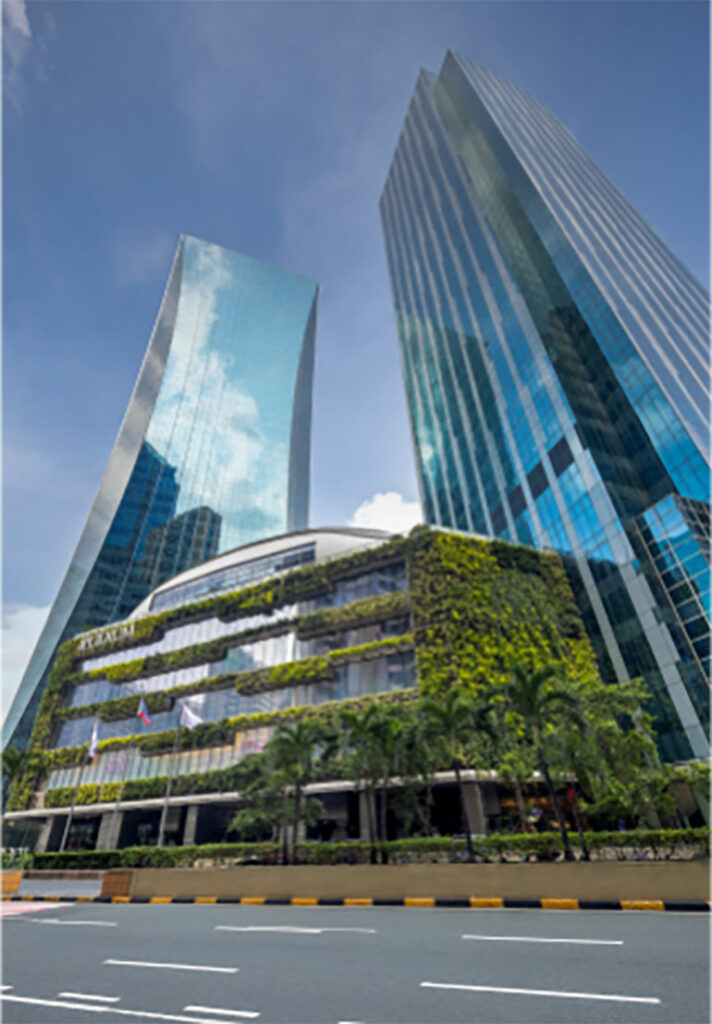
The Podium in Mandaluyong

SM Prime’s upscale primary homes aim to blend timeless architectural design with modern innovation, creating elegant and enduring spaces. The company’s commitment to quality craftsmanship, attention to detail and customer service ensures that each residence meets the highest standards of high-end living.

This strategy aligns with insights from Colliers Philippines, which identifies opportunities in the pre-selling market, particularly in the upscale and luxury segments. The firm also notes that horizontal projects, including house-and-lot and lot-only developments, remain attractive. Colliers advises developers to prioritize these segments, where demand remains relatively stable despite broader market challenges.


Spotlight is BusinessWorld’s sponsored section that allows advertisers to amplify their brand and connect with BusinessWorld’s audience by publishing their stories on the BusinessWorld Web site. For more information, send an email to online@bworldonline.com.

Join us on Viber at https://bit.ly/3hv6bLA to get more updates and subscribe to BusinessWorld’s titles and get exclusive content through www.bworld-x.com.