Home Blog Page 1839

The Philippine Housing Roadmap, 2025 to 2040

PHILSTAR FILE PHOTO

(Part 1)

Next to food security, the most serious challenge to the present Administration in the economic realm is to provide decent housing to the lowest income groups among our more than 22 million households.

I am proud of the fact that the private research group, the Center for Research and Communication (CRC), to which I have belonged since 1967, has been one of the most active in helping the Philippine government and the private business sector to formulate housing roadmaps. Led by one of the leading experts on the economics of housing in the Philippines, Dr. Winston Padojinog, the Philippine Housing Roadmap for 2025 to 2040 was recently completed, in partnership with the four housing and real estate associations, i.e., the Subdivision and Housing Developers Association (SHDA), the Organization of Socialized and Economic Housing Developers of the Philippines (OSHDP), the National Real Estate Association (NREA), and the Chamber of Real Estate and Builders’ Association (CREBA).

I am presenting in this series of articles a summary of the results of the study for the guidance of all sectors of Philippine society committed to providing decent housing, especially to the low-income households which can constitute as much as 60% of the entire population of some 120 million Filipinos.

Since the last housing roadmaps formulated in 2012 and 2016, the housing sector has achieved significant milestones, including the establishment of the Department of Human Settlements and Urban Development (DHSUD) and the provision of incentives for socialized housing. Despites these achievements, however, the Philippines still suffers from serious shortages in housing for low-income households as housing production continues to fall short of the goals. Of the one million units targeted by DHSUD to produce annually over the six-year period under the present Administration of Ferdinand Marcos, Jr., less than 100,000 units have been constructed annually. The increasing gap between housing demand and supply, compounded by increasing construction costs and the growing number of marginalized households, underscores the urgent need to adopt a more coordinated approach between the public and private sectors. The availability of housing, whether owned or rented, for the masses is one of the most stabilizing factors any society.

While recent adjustments to socialized housing price ceilings, VAT exemptions, and housing subsidies and incentives offer some relief, fiscal support, and collaboration among the key stakeholders, such as government agencies, developers, housing associations and financing associations continue to be grossly insufficient. The Roadmap prepared by the team of Dr. Padojinog for the period 2025 to 2040 aims to coordinate the efforts of all housing sector stakeholders to address the serious backlogs effectively, which by 2023 was already estimated at 12.4 million and projected to balloon to 16.6 million by 2040 if present trends are not reversed.

The vision that guided the four participating real estate and housing associations is as follows:

“Every family has the right to equal access to a decent, affordable, safe, resilient and sustainable home and community regardless of economic status. The housing industry stakeholders, both public and private sectors, envision to collaborate in providing housing solutions to eliminate the backlog by the year 2040.”

To realize this vision, the four associations — in close cooperation with the Government — aim to achieve the following goals: 1.) Increase the production of decent, safe, affordable and sustainable housing according to targeted needs and market segment beneficiaries in each region; 2.) Mobilize funding for public and socialized housing and encourage investments in affordable housing; 3.) Bridge end-user financing and affordability gaps; 4.) Improve housing’s regulatory environment; 5.) Encourage the establishment of decent, safe, resilient, sustainable, and affordable housing units and housing communities.

Given these mission and vision statements for the entire Philippine housing industry, the Roadmap focused on addressing the current weaknesses of and threats to the industry. These include: 1.) Unclear respective roles of the government and private sector in the provision of public and socialized housing that often result in overlaps and confusion; 2.) Price ceiling adjustments that often are not responsive to the ever-changing conditions of the housing sector; 3.) Lack of diversity and flexibility in the development approach to socialized housing; 4.) Lack of assurance on the provision of income tax holidays to providers of economic and low-cost housing units, which lack often inhibits long-term investment decisions related to housing; 5.) Absence of a regulatory framework and standards to promote “green” or sustainable housing, including the provision of tax breaks and incentives to developers that adopt them; 6.) Affordability gaps that limit the capacity of the marginalized and socialized housing segments to afford renting or owning a housing unit; 7.) Overdependence on domestic capital and traditional bank financing, exacerbated by the limited amount of available guaranty funds for housing development and the absence of asset securitization for affordable housing segments; 8.) Limited government budgetary allocations to the housing agency and to key shelter agencies targeting marginalized and low-wage earners; and, 9.) Bureaucratic delays in the approval process that increase costs and discourage the production of housing units.

In response to these industry gaps and limitations, certain strategic initiatives were recommended to reduce the backlog and to improve affordability. First on the list is to have a clear delineation of roles between the government and private developers. It is recommended that the government prioritize public and socialized housing for lower-income households and informal settlers, while private developers focus on mid- to upper-income market segments and explore alternative development approaches such as horizontal housing. It is crucial to emphasize the need to allocate funds for socialized housing and to address affordability gaps. Additionally, expanding incentives for economic and low-cost housing developers, including tax holidays and aligning thresholds with updated regulations, can stimulate production.

To bridge affordability and access gaps, the government should enhance public housing options through long-term leases and interest expense subsidies. There is need to improve access to developmental funding for both socialized and economic housing by liberalizing interest rates, attracting foreign direct investments, and exploring housing and real estate investment trusts (REITS). Affordable end-user financing should likewise be supported through subsidized rates and extended payment terms. On the other hand, regular and increased budget allocations for public and socialized housing, including real estate management, alongside regulatory improvements and sustainability measures, will be critical. Lastly, establishing a supportive regulatory environment and encouraging green building practices will further enhance housing development efforts.

Some more specific programs which can achieve the goals and implement the strategies were also recommended. For example, to increase housing production, a co-production model is being suggested in which the government focuses on public housing for informal settlers and the lower 30% of the socialized housing market, while the private sector focuses on the upper income socialized housing, economic housing, and low-cost housing segments. Like in the 4PH model, the government can provide the land while the private sector constructs the housing units. Other housing development approaches besides vertical structures could also be adopted while focusing on areas with the largest housing needs and backlogs. Lastly, other modes of balanced housing compliances could be considered, and the housing escrow fund should be tapped for socialized housing production.

Finally, there is need to improve the regulatory environment, making it as investment friendly as possible for the private sector. Efforts to streamline the permitting and licensing process including the improvement of the housing one-stop processing centers; rationalizing professional accreditation of real estate practitioners; and reviewing land conversion processing initiatives will go a long way in lowering costs and accelerating housing production.

Lastly, to encourage sustainable housing, there should be an emphasis on developing a regulatory framework for green, resilient, and affordable housing, supported by incentives and partnerships for skill training and domestic industry growth. The roadmap to achieve the strategic vision by 2040, the year when the Philippine economy can reasonably aspire to be a First World Economy, concludes with a reinforcement of production targets, an estimate of public funding as well as private capital requirements, and the project economic impact of the housing sector on the national economy.

(To be continued.)


Bernardo M. Villegas has a Ph.D. in Economics from Harvard, is professor emeritus at the University of Asia and the Pacific, and a visiting professor at the IESE Business School in Barcelona, Spain. He was a member of the 1986 Constitutional Commission.


bernardo.villegas@uap.asia

Ayala’s ACTIVE Fund to invest in Featherless.AI

AYALA Corporate Technology Innovation Venture (ACTIVE) Fund, which is managed by Kickstart Ventures, is investing in artificial intelligence (AI) platform Featherless.AI to help bridge the AI adoption gap among Philippine organizations.

“One of the ACTIVE Fund’s core investment theses around the future of work is that technologies like AI can augment human productivity,” Kickstart Ventures General Partner Joan Yao said in a statement on Tuesday.

“We believe in [Featherless.AI’s] mission of democratizing access to AI [by] making it cheaper for both enterprises and individuals to run the latest open-source models through technology that optimizes GPU utilization costs and lowering inference costs,” she added.

Philippine businesses are hard pressed to integrate AI in their operations to boost productivity and sales. However, many struggle with high investment costs and language barriers.

Featherless.AI enables businesses to scale AI use without unexpected charges or rate limits. It offers a flat capacity pricing model and AI workload scaling that ensures cost predictability and scalability.

Co-founded by Eugene Cheah and Harrison Vanderbyl, Featherless.AI provides instant and affordable access to the world’s largest collection of open-source AI models.

The startup has more than 4,000 AI models including popular options like DeepSeek and LLama and is onboarding new models weekly.

With the latest funding, the company seeks to support all major AI modalities including embedding, vision and speech.

Casual AI users can access a wide range of the latest open-source models without the need for expensive high-end GPUs (graphics processing units) for as low as $10 (P573) a month.

Under its new funding, Featherless.AI will also advance research into next-generation AI architectures that can dramatically lower inference costs. This would help make AI deployment possible on lower cost hardware instead of requiring high-end GPUs.

“I don’t want a future where AI is controlled by the few,” Mr. Cheah, who also serves as the startup’s chief executive officer, said in the statement. “I want to empower individuals globally.”

The Philippine economy could generate more than P2 trillion each year if businesses in the country adopt AI, the National Economic and Development Authority said last year. — Beatriz Marie D. Cruz

ACEN infuses P660M into BCHC to secure land for future projects

ACENRENEWABLES.COM

ACEN CORP., the listed energy platform of the Ayala Group, plans to increase its investment in subsidiary Buendia Christiana Holdings Corp. (BCHC) by subscribing to additional shares worth P660 million.

ACEN signed a subscription agreement with BCHC for 660,000 common shares and 5.94 million redeemable preferred shares, priced at P100 per share, the company told the local bourse on Tuesday. 

The shares represent 13% of ACEN’s total outstanding shares in BCHC.

The transaction is subject to regulatory approval from the Securities and Exchange Commission for the increase in BCHC’s authorized capital stock.

“The additional capital will be used by BCHC to purchase real property required for various potential power projects,” ACEN said. 

BCHC, a subsidiary of ACEN, is a special-purpose vehicle that will hold land for the energy firm’s development projects.

BCHC previously executed an asset-for-share swap with Ayala-led real estate investment trust company AREIT, Inc., in a transaction valued at approximately P6.77 billion. 

The deal involved AREIT issuing about 199.1 million primary common shares to BCHC in exchange for 276 hectares of industrial land in Palauig, Zambales. — Sheldeen Joy Talavera

West End beats Broadway in theater revival. What’s the secret?

VECTEEZY.COM

LONDON — London’s West End theaters are enjoying record ticket sales and drawing millions of pounds of investment as a pandemic-era tax break that will become permanent next month persuades some producers to choose Britain over Broadway.

A record 17.1 million people attended West End shows in 2023, and a similar number in 2024, according to the Society of London Theater (SOLT). That compares to 15.3 million in 2019, before COVID-19 shut entertainment venues globally.

Audiences in New York are meanwhile down by nearly a fifth from pre-pandemic levels, figures from the Broadway League show.

Producers cite lower costs in London than on Broadway, which has a comparable but less generous tax scheme, as well as the attraction of one of the world’s richest theater traditions.

“I will absolutely say, and I say this both with knowledge and with love, the UK is the best place in the world to make and to see theater,” SOLT board member Patrick Gracey said.

Mr. Gracey, who has produced West End and Broadway shows, led efforts to persuade Britain’s Labour government to maintain the scheme introduced by its Conservative predecessor, which offers tax relief for touring shows of up to 45% of production costs.

Finance Minister Rachel Reeves confirmed in October the tax break would stay rather than progressively decrease from April.

“The costs themselves are lower (in London), but the tax incentive makes it a no-brainer,” said New York-based accountant and theatre specialist Scott Bartolf, who works with producers in both cities.

GREATER VARIETY AND BIGGER PRODUCTIONS
Theatre industry bodies elsewhere are calling for similar initiatives, including in Mr. Gracey’s native Australia.

“(The tax scheme) has been widely recognized as a game-changer for the UK theater industry,” Live Performance Australia said in an e-mail statement. “It has made the UK a much more compelling proposition for investors in theater.”

Henny Finch, joint chief executive officer of London’s Donmar Warehouse, said the tax break was a lifeline without which the theater would have to reduce the size and number of new productions.

And because it applies to touring productions, theaters outside the British capital, many of which have seen their funding dwindle with public spending cuts, also get a boost.

Steve Mannix of the Mercury Theater in Colchester, southeast England, said the tax break helped provide “an essential source of income for regional theaters.”

New York’s tax incentives, in place since 2021, allow Broadway theater companies to claim tax credits for up to 25% of production expenses, capped at $3 million per production.

The scheme, worth a total $300 million, is due to expire in September, but under New York budget proposals could be extended for two years with a top-up of $100 million.

Even so, producing a musical on Broadway costs three to five times as much as in the West End, according to an analysis by Gordon Cox, contributing theater editor for Variety.

The Broadway League has more than 700 members, including producers, theater owners and operators. It estimates 12.3 million admissions in the 2023-2024 season, which ended in May last year, 16.8% less than the record hit in 2018-2019.

That partly reflects the slower return of audiences from the outskirts of New York, said the League’s President Jason Laks. Ticket prices are also far higher than in London.

Mr. Laks also saw Britain’s tax scheme as a lure.

“Our Broadway theaters can’t move, but the productions can, and I get that, and so a producer may choose to produce or open a show in the UK because of the favorable economic tax credits that they have over there,” he said.

ECONOMIC RATIONALE
Britain’s creative industries are among those identified by Ms. Reeves as potential motors for economic growth, and the £126-billion sector has shown a faster recovery from the pandemic compared to the wider economy.

Research by SOLT has found that for every pound spent on a theater ticket, £1.40 is spent in the local area, including in bars and restaurants.

Harder to measure is the West End’s contribution to Britain’s soft power: it attracts tens of thousands of visitors each day to its 39 theaters in the heart of London. Broadway has 41 theaters.

Arts Minister Chris Bryant told Reuters via e-mail that the tax relief would help to ensure “top quality productions” across the country and especially in London.

“London is the world’s premier destination for theatergoers, drawing in hundreds of thousands of people every year, and making a significant contribution to the capital’s economy,” he said.

LOCAL VERSUS NATIONAL
Data obtained by Reuters via a freedom of information request show London productions received £42 million of £66 million paid in theater tax relief in the financial year 2021-22. The rest of the southeast received £6 million, and other regions between £1 million and £2 million apiece.

But provincial theaters have also benefited.

Producer Jamie Wilson said the tax scheme had influenced his decision to trial musical The Devil Wears Prada on audiences in Plymouth, southwest England, before its London opening.

Leeds Playhouse, whose In Dreams premiered in the northern English city then moved to Toronto, said the tax break “has enabled us to continue to co-produce shows… which otherwise would have been threatened by the current economic pressures.”

Regional theaters nevertheless “desperately need more money to support the infrastructure,” Mr. Wilson said. A SOLT report published in July 2024 found 40% of 65 theater venues surveyed across the UK would become too unsafe to use within five years without a capital injection.

With producers saying there are not enough West End venues to meet demand, those theaters could get a boost if more Broadway productions head to Britain.

“They won’t be able to find a West End theater, so they will be looking for a regional theater to open those musicals, which is great… for the regions,” Mr. Wilson said. — Reuters

PHL financial system’s resources grow to P33.66 trillion as of January

BW FILE PHOTO

By Luisa Maria Jacinta C. Jocson, Reporter

THE TOTAL RESOURCES of the Philippine financial system rose by 7.9% as of January, preliminary data from the Bangko Sentral ng Pilipinas (BSP) showed.

The resources of banks and nonbank financial institutions increased to P33.66 trillion as of January from P31.18 trillion in the same period a year ago. Month on month, however, this slipped by 0.9% from P33.96 trillion as of December.

Financial institutions’ resources include funds and assets such as deposits, capital, as well as bonds or debt securities.

Broken down, the banking system’s resources jumped by 9.1% to P27.95 trillion as of January from P25.62 trillion in the same period in 2024, BSP data showed.

Universal and commercial banks accounted for the bulk or 77.7% of total resources, rising by 8.9% year on year to P26.14 trillion from P24 trillion a year prior.

Resources held by thrift banks amounted to P1.16 trillion, up by 7.4% from P1.08 trillion in the year-ago period.

Digital banks’ resources surged by 44% to P133.3 billion as of January from P92.6 billion in the previous year. The BSP began consolidating data from digital banks starting March 2023.

Lastly, total resources of rural and cooperative banks stood at P527.1 billion, climbing by 18.1% from P446.5 billion.

Meanwhile, nonbanks’ resources went up by 2.6% to P5.7 trillion as of end-June 2024 from P5.56 trillion a year prior, based on the latest available data.

Nonbanks include investment houses, finance companies, security dealers, pawnshops and lending companies.

Institutions such as nonstock savings and loan associations, credit card companies, private insurance firms, the Social Security System and the Government Service Insurance System are also considered nonbank financial institutions.

Rizal Commercial Banking Corp. Chief Economist Michael L. Ricafort said the growth in the financial system’s total resources was mainly driven by increased lending.

“This largely reflects the faster growth in bank loans amid the total BSP rate cuts since August,” Mr. Ricafort said in a Viber message.

Bank lending jumped by 12.8% to P13.02 trillion in January, its fastest pace in over two years, earlier central bank data showed.

This was also in line with the cut in banks’ reserve requirements, Mr. Ricafort said.

The BSP in October began lowering banks’ reserve requirement ratios (RRR).

Big banks’ RRR was reduced by 250 basis points (bps). Rural and cooperative banks’ RRR was also slashed by 100 bps to 0%.

This “reduced intermediation costs, thereby increasing the demand for loans and allowed banks to use more funding for lending activities.”

“Faster loan demand enabled banks to sustain continued growth in deposits as part of the intermediation business that led to interest income,” Mr. Ricafort said.

“As a result, banks have become one of the most profitable industries that further boosted capital, on top of capital infusion from strategic foreign and local investors in recent years, thereby contributing also to banks’ faster asset growth.”

The net profit of the country’s banking industry rose by 9.76% year on year to P391.28 billion in 2024.

For the coming months, the BSP’s latest RRR cut could also boost the financial system’s total resources, Mr. Ricafort said.

By March 28, the RRR of universal and commercial banks and nonbank financial institutions with quasi-banking functions will be reduced further by 200 bps to 5% from the current 7%.

The RRR for digital banks will also be lowered by 150 bps to 2.5%, while the ratio for thrift lenders will be cut by 100 bps to 0%.

Kickstarting the PHL’s Comprehensive Archipelagic Defense Concept: The role of the PHL-Aussie strategic partnership

PRESIDENT Ferdinand R. Marcos, Jr. together with Australian Prime Minister Anthony Albanese signed the Joint Declaration on Strategic Partnership between Philippines and Australia at Malacañan Palace on Sept. 8, 2023. — YUMMIE DINGDING/ PPA POOL

In January 2024, Secretary of National Defense Gilberto Teodoro announced a new defense concept, the Comprehensive Archipelagic Defense Concept (CADC). The CADC is premised on the assumption that as an archipelagic country, the Philippines’ land mass is limited while its population is increasing, causing the need for resources to expand exponentially.

Since 2011, Manila has explored the prospect of surveying and exploiting the natural gas and oil deposits on Reed or Recto Bank, which is inside the country’s exclusive economic zone (EEZ). However, Mr. Teodoro observed: “The country’s resources in its maritime territory are illegally and unilaterally encroached upon by a country using a distorted nine-10-dash line, which nobody in the world accepts or recognizes since this would open a rewriting of international law. This is because China claims almost 90% of the South China Sea.”

The CADC requires the Philippine government to project the Armed Forces of the Philippines’ (AFP) capabilities in the Philippines’ EEZ and develop its strategic depth to enhance the defense of its archipelagic territory. This aims to address the Philippines’ strategic vulnerabilities and enhance the AFP’s capability to protect national interests through specific long-term plans. The AFP’s primary limitation is the inadequate naval and aerial assets of the Philippine Navy and Philippine Air Force. This strategic limitation can be attributed to the AFP’s continuous and protracted counterinsurgency campaigns that have shaped its trilateral structure, such as the Philippine Army, which has reconfigured itself to neutralize several insurgent groups since the late 1940s. The AFP urgently needs to develop its Maritime and Air Defense (MAD) capabilities to focus on the Philippines’ maritime and air domain, where the country has sovereign rights to explore, extract, and preserve the aquamarine environment and resources according to international law. An adequate, credible, and effective Philippine MAD is expected to protect, defend, and secure against foreign intrusion, extraction, and exploitation and to support law enforcement operations against transnational crimes within the country’s 200 nautical mile EEZ and 350 nautical mile continental shelf.

However, the implementation of the CADC faces two major obstacles: First, the prospective financial cost of this defense concept and the Filipino nation’s inclination to shoulder the enormous bill for the country’s expected increase in defense spending. Second, the willingness and capability of the US and its other treaty allies to assist the Philippines in jumpstarting and supporting the CADC, both technically and financially.

THE PHL-AUSSIE SECURITY PARTNERSHIP
Although an Indo-Pacific power, Australia is not directly involved in the South China Sea dispute. However, it has strategic interests in maintaining stability and order in the disputed waters. Canberra views Beijing’s expansion in this important strategic waterway as one of the dangerous flashpoints in the Indo-Pacific region. Canberra has voiced its grave concern over China’s construction and militarization of the artificial islands in the maritime domain, which the arbitral tribunal ruled as located within the Philippine EEZ. Australia has openly expressed that Chinese expansion and coercive actions against other claimant states in the South China Sea are grave threats to the freedom of navigation and the rules-based regional order.

This accounted for the dramatic improvement in Philippine-Australian security relations during the Duterte Administration. This improvement in the two countries’ security partnership was reflected in the following bilateral defense arrangements.: 1.) Australian Embassy Note 482/17 on Defense Cooperation between the AFP and the Australian Defense Force; 2.) Operation Augury – Philippines, 2017; 3.) the September 2018 Terms of Reference on Cooperation between the major services of the Philippines and Australian armed forces; and, 4.) the 2021 Philippine Australia Mutual Logistic Support Arrangement.

Under President Ferdinand Marcos, Jr., the Philippine-Australia security partnership has improved even more, with the administration adopting a firmer stance on the country’s maritime claims and doing much to publicize Chinese intrusion and coercive actions against the Philippines to the outside world.

In May 2023, Australian Foreign Minister and Senator Penny Wong’s four-day visit to the Philippines provided the impetus for developing the Philippine-Australian security partnership. She met Foreign Affairs Secretary Enrique Manalo to discuss issues of mutual interest, such as defense, security partnerships, development cooperation, trade and investment, and people-to-people ties. She announced initiatives to enhance maritime cooperation and more considerable official development assistance to the Philippines in 2023 and 2024. She said that maritime cooperation initiatives include technical assistance and capacity building for the Philippine Coast Guard; equipment, skills, and technology transfer to improve maritime domain awareness and marine protection; and assistance to mitigate the oil spill’s environmental impact off Mindoro.

On Sept. 8, 2023, President Marcos and visiting Australian Prime Minister Anthony Albanese signed a Joint Declaration on a Strategic Partnership between the Philippines and Australia in Manila. The new agreement effectively elevated the two countries’ security partnership from comprehensive to strategic. Several economic measures accompanied the upgrade of bilateral relations between the two countries. However, the security component drew the most attention, with the two US allies agreeing to convene an annual meeting of their defense ministers, and Australia confirming its commitment to hold joint naval patrols with the Philippines through the South China Sea.

All these developments point to Australia’s growing importance as one of the Philippines’ strategic partners, which is helping the AFP jumpstart the implementation of the CADC.


Dr. Renato Cruz De Castro is a trustee and convenor of the National Security and East Asian Affairs Program of the Stratbase ADR Institute.

Philippine F&B companies told to fast-track automation

FREEPIK

THE PHILIPPINE food and beverage (F&B) industry should quicken their automation push to boost efficiency and scale operations, according to a Malaysian software firm.

“The Philippines has a very mature food and beverage business environment,” Benny Chan, business development director at Codemax Pte Ltd., told BusinessWorld on the sidelines of Thaifex Horec Asia 2025 in Bangkok.

“The problem is that they are very much still dependent on labor and they have very much room to improve their efficiency and have a very big potential to grow,” he added.

Codemax, which provides automation and software solutions to the F&B sector, is interested in working with Philippine companies, Mr. Chan said.

He said they see the Philippines as a “huge market” and are in talks with a “Philippine representative” for their expansion plan.

He added that big companies and conglomerates in the Philippines are still very “backward,” relying on manual labor and processes, which could hinder operations.

The National Economic and Development Authority earlier said the economy could gain P2.6 trillion annually if domestic businesses adopt AI solutions.

The International Monetary Fund has cited data showing the Philippines’ share in the global outsourcing market at 15%. In 2024, it ranked 56th out of 188 countries in the Government Artificial Intelligence Readiness Index. 

“The purpose of having automation is to make things standardized, streamlined and consistent,” Mr. Chan said. “The biggest problem faced by [F&B companies] is that they have an issue maintaining the consistency across different locations, especially when they scale.” — J.V.D. Ordoñez

PXP raises stake in Forum Energy to 97.88%

PXPENERGY.COM.PH

PANGILINAN-LED upstream oil and gas firm PXP Energy Corp. has increased its stake in subsidiary Forum Energy Ltd. through a share swap with Hong Kong-based Tidemark Holdings Ltd., listed mining firm Atok-Big Wedge Co., Inc. (AB) said on Tuesday.

Under the transaction, PXP issued 430.24 million common shares valued at P1.56 billion to Tidemark in exchange for 24.13 million Forum Energy shares, AB disclosed to the stock exchange on Tuesday.

The shares were issued at P3.62 each.

Tidemark, a wholly owned subsidiary of AB, and PXP were both shareholders of Forum Energy, a company incorporated in the United Kingdom.

Forum Energy, through its wholly owned subsidiary Forum (GSEC 101) Ltd., is the operator of Service Contract (SC) 72 with a 70% participating interest. 

SC 72 covers the Recto Bank basin in the West Philippine Sea.

The Securities and Exchange Commission approved the transaction last month.

Following the share issuance, PXP’s effective ownership in Forum Energy rose to 97.88% from 77.88%, while Tidemark fully exited its direct stake in the company. PXP’s effective interest in SC 72 also increased to 68.5% from 54.5%. 

Tidemark now holds an 18% stake in PXP’s total issued and outstanding capital stock.

PXP and Forum Energy said last month that they remain committed to SC 72 and SC 75, an exploration block in Northwest Palawan, despite the extended force majeure imposed on both contracts. — Sheldeen Joy Talavera

Two rural banks merge

THE BANGKO SENTRAL ng Pilipinas (BSP) has announced the approval of the merger of Zambales Rural Bank, Inc. and Bridgeway Rural Banking Corp., with the former being the surviving entity.

In a circular letter signed by Deputy Governor Chuchi G. Fonacier, the BSP said the Securities and Exchange Commission (SEC) approved the articles and plan of merger of the two banks on Feb. 18.

Their amendments were also executed in April and August last year, respectively, by and between, Zambales Rural Bank, Inc., the surviving bank, and Bridgeway Rural Banking Corp., the absorbed bank.

The assets and liabilities of Bridgeway will be transferred to and absorbed by Zambales Rural Bank, the BSP added.

“The merger took effect on Feb. 18, 2025. Zambales Rural Bank, Inc. commenced operations as merged bank on Feb. 21, 2025.”

Zambales Rural Bank was established in 1974 as a domestic rural banking corporation. It offers savings, demand and time deposit products, as well as short-term and long-term loans to rural clients covering commercial, agricultural and housing needs, among others.

The bank operates in Zambales, Bataan, Pampanga and Baguio. It currently has 12 branches, according to the latest available data on its website.

The BSP has been encouraging rural banks to consolidate as part of its Rural Bank Strengthening Program (RBSP) that was launched in 2022.

The RBSP features five time-bound tracks that aim to strengthen the capital position of rural banks: merger/consolidation, acquisition/third-party investment, voluntary exit/upgrade of banking license, capital buildup program, and supervisory intervention.

In September 2022, the BSP raised the minimum capital requirement for rural banks with a head office and as many as five branches to P50 million, while those with six to 10 branches must have a minimum capital of P120 million. Those with more than 10 branches must have a capital of at least P200 million. Rural banks have until 2027 to comply with the new rules.

Rural banks booked a combined net income of P11.56 billion in 2024, rising from P8.22 billion in 2023, latest central bank data showed.

There were 382 rural banks in the Philippines at end-February, down from 388 a year prior, BSP data showed. — Luisa Maria Jacinta C. Jocson

Dulaang UP takes on the climate crisis

THE SECOND offering of Dulaang Unibersidad ng Pilipinas’ (Dulaang UP) 47th season is tackling pressing issues on the climate crisis through a twin bill: one play exploring local mythological creatures’ perspective of a disrupted balance, and the other depicting the experiences of everyday Filipinos who attempt to address the crisis.

Mga Anak ng Unos, which runs from March 28 to April 13, combines these two brand-new plays to “deepen our understanding of climate realities.”

“It looks at critical convergences in theater-making, nature, and the human condition,” said Dulaang UP artistic director Issa Manalo Lopez during a March 8 press visit for the forthcoming twin bill.

“These performances explore how human ways of living shape and dictate ecological conditions driving destruction and endangering the existence of all life forms. They arise from the urgent need to respond to the global climate emergency as the earth’s temperature surpasses the 1.5-°C critical threshold, an escalation marked by catastrophic weather that disproportionately intensifies climate change effects and impacts on developing nations,” Ms. Lopez said.

Mga Anak ng Unos is the first of Dulaang UP’s offerings under “DUP INNOVATE,” a lab dedicated to the creation of new, developing, and original works from Filipino theater practitioners.

GODS AND CREATURES
The first play is Sa Gitna ng Digmaan ng mga Mahiwagang Nilalang Laban sa Sangkatauhan, written by Joshua Lim So (who is in the Carlos Palanca Award for Literature Hall of Fame), under the direction of José Estrella. As the title hints at, the play shows bathalas (gods) and mythological creatures in the middle of a war against the sangkatauhan (humanity).

As the battle between the gods and humanity unfolds on stage, audience members are compelled to ask if we are indeed at war and if there is still time to change the course of the conflict.

“The worldbuilding in the script is from actual folk tales. We have gods who sustain themselves through humans, alliances of a military nature in their war on mankind, and many more,” Popo Amascual, the play’s assistant director, told BusinessWorld.

From makeup to tattoos, we try to keep it all grounded in the original lore. The flavor we add are how these creatures could be strategic in their missions under this overarching war related to the climate crisis,” she added.

The dramaturgy team said that Mr. So, as the playwright, had a few sources for the script. One was permaculture farms, which are characterized by self-sustaining agricultural zones or ecosystems, inspiring the various planes of existence of the mythological creatures; the other was Edgar Samar’s book Mga Nilalang na Kagila-gilalas, which is basically a compendium of mythological creatures based on folklore from all over the archipelago.

“This play has dialogues between these creatures and interactions with humans who have been abusive towards the earth. It all stems from local folklore. We have bathalas, aswangs, diwatas,” explained Ms. Amascual.

Their differences in language, being from different regions in the Philippines, make up “an intriguing aspect of the play that other folklore-based tales haven’t really tackled,” she added.

Other members of the artistic team include dramaturgs Anril Tiatco and Jem Javier, dramaturg-in-training Gaby Asanza, set designer Mark Dalacat, costume designer Carlos Siongco, lights designer Barbie Tan-Tiongco, and sound designer Jack Alvero.

The cast of the ensemble piece, in alphabetical order, are: Raymond Aguilar, Tristan Bite, Kris Caaya, Jasper Cabra, Exequiel Camporedondo, Sheryll Villamor Ceasico, Kenneth Charles Famy, Belle Francisco, Lee Lim, Sarina Sasaki, Jigger Sementilla, Genalyn Suelto, and Ingrid Villamarin.

HUMAN RESPONSES
Climate in Crazies, the second play in the twin bill, looks at the expanse of global experience and “zooms in on the local and more personal experience of the global climate emergency.” It is directed by Issa Manalo Lopez and Tess Jamias and is based on Australian playwright David Finnigan’s Scenes from the Climate Era.

The ensemble transposed the original text into the Filipino understanding of the crisis and everyday problems, solutions, attitudes, and actions addressing it. This means it was written through the process of devising, which refers to a collaborative method of forming a script.

“In adapting the text, it wasn’t enough that we translate. It was part of our decision-making to either let go of sentiments that were too foreign or to try to make them more local,” co-director Ms. Jamias told BusinessWorld.

Ms. Lopez, also a director of the play, added that Mr. Finnegan’s script was already a combination of different conversations — with his father who is a climate scientist, and even with her as she told him about her experience in Tacloban with Typhoon Yolanda.

“Our aim is to make it accessible. We don’t want the audiences to passively absorb information. We want them to relate with the characters who are trying to segregate, doing their part, and also expressing doubts about their real impact,” she explained.

As hinted by the title, Climate in Crazies, a pun on the word “crisis,” the goal is to tackle the serious issue with “humor, levity, and playfulness.” While Mr. Finnegan meant for the text to be transposed to different countries, Dulaang UP’s version will mark the first from the perspective from a developing country, not from the global north.

Ms. Jamias said that in the process of developing the play, the artistic team and ensemble have been on a journey themselves. “We’re all trying to understand the climate crisis. What we want to do is to bring the audience on that journey.”

Other members of the artistic team include dramaturg Nikka De Torres, set designer Mark Dalacat, costume designer Carlos Siongco, sound designers Jose Buencamino and Sage Ilagan, and video designer Tofie Falcon.

The cast is composed of actor-devisers Delphine Buencamino, Bong Cabrera, Herbie Go, and Ethan King.

Mga Anak ng Unos will run at the IBG-KAL Theater, University of the Philippines Diliman, Quezon City from March 28 to April 13. Persons with disabilities and senior citizens may enjoy a discounted rate of P800, while regular tickets are available for P1,000, via Ticket2Me or bit.ly/MgaAnakNgUnosTickets. — Brontë H. Lacsamana

How to make billions selling $1 lemonade

A WINNING BUSINESS MODEL. — NA BIAN/BLOOMBERG

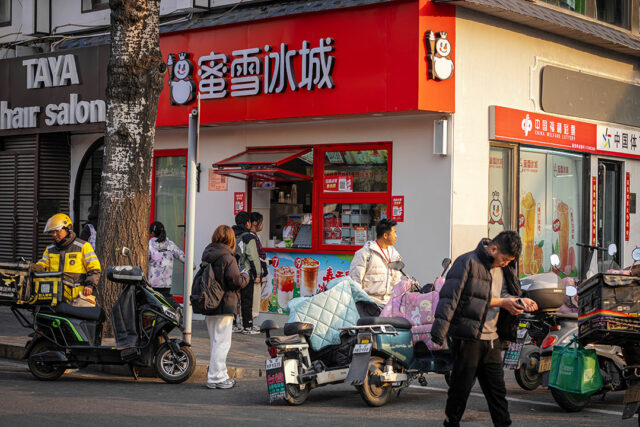
ONE CAN BECOME a billionaire selling ice cream, lemonade, and fruit smoothies — all for less than $1. Zhang Hongchao and Zhang Hongfu, two brothers who founded China’s largest freshly made drinks chain, are making a fortune by taking advantage of China’s fast-shifting labor dynamics.

Mixue Group’s blockbuster HK$3.5 billion ($444 million) public listing is a marvel for a difficult food and beverage industry where even the likes of Starbucks Corp. and McDonald’s Corp. are revamping their operations. With its share price surging, the Zhang brothers are now richer than Starbucks’ founder Howard Schultz.

Fast-growing cash cows are hard to find in this uncertain world. By number of stores, Mixue has become bigger than McDonald’s. It has over 45,000 outlets after more than doubling its locations in just three years. There’s no cash burn either. In the first nine months of 2024, revenue grew 21% to 18.7 billion yuan ($2.6 billion), while net profit came in at 3.5 billion yuan, a 42% year-on-year gain.

Behind Mixue’s growth is an army of franchisees. The company barely manages any stores itself. Rather, almost all of its revenue came from selling store supplies, including syrup, milk, and fruit, as well as equipment such as refrigerators and ice-cream makers, to its franchises.

Faced with weak job prospects, many Chinese might find Mixue’s business proposition palatable. The initial investment for opening a shop is only about 210,000 yuan.

One doesn’t need much expertise to run a business either. Mixue’s corporate headquarters have standardized everything, including advertising campaigns. For an aspiring entrepreneur, the only trick is spotting a site that can break even quickly.

Mixue is expanding just when China’s labor market is changing shape. Because of automation, even the world’s largest factory can’t provide so many manufacturing jobs. In 2023, wholesale and retail sectors employed 135 million people, 12 million more than manufacturing, according to the latest census. Many Chinese choose to be self-employed or work for family members, as larger companies lay off people and cut salaries. Ultimately, Mixue is not selling $1 lemonade, but an entrepreneurship dream.

But online complaints are growing louder, with many claiming that Mixue is making money at the expense of franchisees, that the company is shifting operational risks to small business owners.

By now, Mixue’s stores are peppered across China. Even in small towns, one street can have multiple outlets — some only 200 meters away from each other — competing for the same customers. There’s already a hint of cannibalization in the company’s financials: In the first nine months of 2024, the latest data available, the average daily gross merchandise value per store fell by 5% to 4,184 yuan.

In its franchise agreements, Mixue doesn’t require newly opened stores to keep a minimum distance from existing ones. Increasingly, for franchisees, it is hard work mixed with financial anxiety. On average, each store can expect to make 367 orders a day, or every two minutes for 12-hour days. But operators dare not slack off. It would take some shops two to three years to break even, much higher than what some company employees suggested, according to local media.

So far, Mixue is opening outlets a lot faster than it closes them, and people are only disgruntled online. Unfortunately, in a weak economy, small businesses have no power and the platform holds all the cards. But Mixue’s capital market success is exacerbating an economy driven by hyper competition, and portends the burnout that will eventually follow.

BLOOMBERG OPINION

Philippines climbs in Economic Freedom Index

THE Philippines went up six notches to 82nd out of 176 countries and is now considered “moderately free,” according to a global index on economic freedom by The Heritage Foundation. Read the full story.

Philippines climbs in Economic Freedom Index

ADVERTISEMENT
ADVERTISEMENT