Home Blog Page 1816

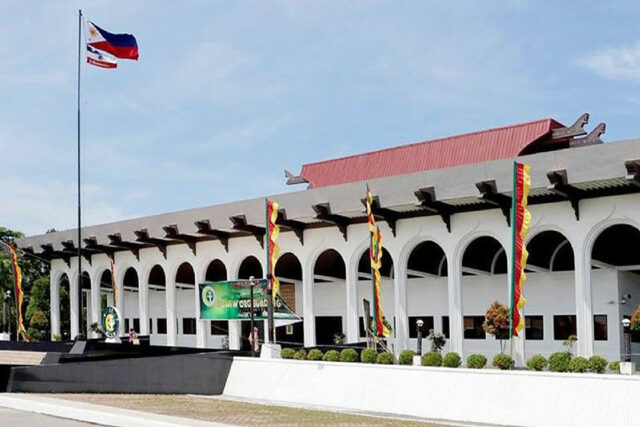
Grant expected by Jan. for Bangsamoro child learning

PHILSTAR FILE PHOTO

THE World Bank said a P2.75-million project to improving learning outcomes for out-of-school children (OOSC) in Bangsamoro is on track for grant disbursement next month.

The No Bangsamoro Child Left Behind in the Bangsamoro Autonomous Region in Muslim Mindanao project obtained $2.75 million in funding from the Japan Social Development Fund.

It sought to “improve learning outcomes of re-enrolled OOSC and retained at-risk children in pilot elementary schools in project-supported divisions.”

In a document uploaded to its website, the World Bank said the second implementation support mission was conducted between in October.

“The training on sub-grants proposal making and financial management for school representatives is currently ongoing and school grants are expected to be disbursed in January 2025,” it added.

The bank also rated the project “moderately satisfactory” in terms of meeting its development objective, with a similar rating for overall implementation progress.

Currently, $2.5 million has yet to be disbursed.

The project was approved in May 2023 and is set to close by June 30, 2026.

According to the loan document, the project aims to re-enroll 30% of OOSC by the end of the project , or 6,700 over three years, of which 60% are female.

It also seeks to retain 50% of at-risk children annually or 2,600 over three years. — Aubrey Rose A. Inosante

NCR retail price growth picks up in November

A supermarket is seen in Quezon City, March 4 2022. — PHILIPPINE STAR/MICHAEL VARCAS

RETAIL PRICE growth of general goods in the National Capital Region (NCR) accelerated in November, the Philippine Statistics Authority (PSA) said in a report.

Citing preliminary data, the PSA said price growth in Metro Manila as measured by the general retail price index (GRPI) was 1.4% year-on-year in November, against 1.3% in October.

The November reading slowed from 2.9% a year earlier.

The November indicator was the strongest price growth since the 1.9% in July and was level with the pace set in August.

Year to date, GRPI growth averaged 1.8%, significantly lower than the 4.6% growth in the same period in 2023.

Diwa C. Guinigundo, country analyst for the Philippines of GlobalSource Partners, noted general easing from the early October highs in global oil prices, as market participants pondered supply risk concerns, with the health of the global economy weakening oil demand and increasing inventory levels.

Mr. Guinigundo said that as a result, despite the uptick, the increase in prices was muted.

“Retail prices are closer to the experience of our consumers. But one thing we cannot deny is that retail price levels continue to be elevated, pushing people to buy less for every peso of their income,” he said via Viber.

Additionally, he said that while annual percentage changes in consumer or retail prices may look modest,the underlying price levels continue to be unaffordable for many consumers.

Headline inflation in November accelerated to 2.5% year on year from 2.3% in October, though price growth was significantly weaker than the 4.1% posted a year earlier.

Still, the inflation reading for the month settled within the central bank’s 2.2%-3% forecast for November.

The PSA attributed the acceleration in retail prices to the slower decline in the index for mineral fuels, lubricants, and related materials, which fell 3% in November from a 6.4 contraction a month earlier.

Meanwhile, the index of crude materials, inedible except fuels, picked up to 1.1% in November from 1% in October.

Growth in the heavily weighted food index was flat at 2%.

Other commodity groups that remained steady were beverages and tobacco (3.6%), manufactured goods classified chiefly by materials (1.3%), and miscellaneous manufactured articles (1.5%).

Mr. Guinigundo said the government must address the lack of infrastructure and improve supply conditions, while the central bank should focus on demand management.

According to the PSA, the GRPI is used to monitor the condition of retail trade. It is also used as a deflator in the National Accounts, particularly in the retail trade sector, and serves as a basis for forecasting. — Abigail Marie Pelea Yraola

Shares inch up on rate cut hopes, bargain hunting

PHILIPPINE STAR/KRIZ JOHN ROSALES

PHILIPPINE SHARES closed higher on the penultimate trading day of 2024 amid hopes for another interest cut to start 2025 and as investors picked up bargains.

The benchmark Philippine Stock Exchange index (PSEi) inched up by 0.06% or 4.11 points to close at 6,539.02 on Thursday, while the broader all shares index increased by 0.12% or 4.55 points to 3,731.78.

Philippine financial markets were closed on Dec. 24 and 25 for the Christmas holidays.

“The local market managed to close a little above the flat line on the back of last-minute bargain hunting. Hopes of an early 2025 rate cut by the Bangko Sentral ng Pilipinas (BSP) helped in lifting the market,” Philstocks Financial, Inc. Senior Research Analyst Japhet Louis O. Tantiangco said in a Viber message.

BSP Governor Eli M. Remolona, Jr. told Bloomberg last week that the central bank is open to delivering another rate cut at their first review next year. He said the BSP remains in an easing cycle and is “neither more dovish nor less dovish.”

“Adding to this are the strengthening of the local currency and the positive cues from Wall Street,” Mr. Tantiangco said.

On Thursday, the peso jumped by 48 centavos to close at a near three-week high of P57.97 per dollar.

Meanwhile, Asia shares rose slightly in holiday-thinned trade on Thursday, extending gains from earlier in the week with little news or data in the way to alter their direction of travel, Reuters reported.

MSCI’s broadest index of Asia-Pacific shares outside Japan ticked up 0.04% and was headed for a weekly rise of nearly 2%, taking a cue from its counterparts on Wall Street earlier in the week.

S&P 500 futures edged 0.02% higher, while Nasdaq futures advanced 0.13%.

“The local bourse edged higher as investors positioned themselves ahead of the final trading session of the year,” Regina Capital Development Corp. Head of Sales Luis A. Limlingan added in a Viber message.

Majority of sectoral indices closed higher on Thursday. Property climbed by 0.86% or 20.51 points to 2,388.62; financials went up by 0.4% or 8.82 points to 2,188.68; industrials rose by 0.08% or 7.32 points to 9,158.10; and mining and oil increased by 0.05% or 3.97 points to 7,530.26.

Meanwhile, services inched down by 0.43% or 9 points to 2,086.10 and holding firms retreated by 0.4% or 22.68 points to 5,611.25.

Value turnover shrank to P2.8 billion on Thursday with 445.79 million shares traded from the P4.2 billion with 713.21 million issues exchanged on Monday.

Market breadth was positive as advancers overwhelmed decliners, 122 versus 57, while 53 names closed unchanged.

Net foreign buying dropped to P73.098 million on Thursday from P255.38 million on Monday. — Revin Mikhael D. Ochave with Reuters

Peso surges to P57 level on remittances

REUTERS

THE PESO surged against the dollar on Thursday to return to the P57 level for the first time in nearly three weeks, supported by remittance inflows amid the holidays.

The local unit closed at P57.97 per dollar on Thursday, jumping by 48 centavos from its P58.45 finish on Monday, Bankers Association of the Philippines data showed.

This was the peso’s strongest finish since its P57.735-per-dollar close on Dec. 6.

The peso opened Thursday’s session stronger at P58.35 against the dollar, which was already its weakest showing. Meanwhile, it closed at its intraday best of P57.97 versus the greenback.

Dollars exchanged jumped to $1.76 billion on Thursday from $1.18 billion on Monday.

Philippine financial markets were closed on Dec. 24 and 25 for the Christmas holidays.

“The peso continued to appreciate away from its record lows due to foreign currency inflows amid holiday remittances from abroad,” a trader said in a Viber message.

Rizal Commercial Banking Corp. Chief Economist Michael L. Ricafort likewise said that the local unit was supported by the “seasonal surge in overseas Filipino workers’ remittances and conversion to pesos for Christmas holiday-related spending.”

He said this could continue as 2024 comes to a close.

The peso rose as the Philippine stock market also posted gains on Thursday, Mr. Ricafort added.

The benchmark Philippine Stock Exchange index edged up by 0.06% or 4.11 points to close at 6,539.02 on Thursday, while the broader all shares index rose by 0.12% or 4.55 points to end at 3,731.78.

For Friday, which is the last trading day of 2024, the trader said the peso could continue to strengthen amid the market’s currency requirements for year-end transactions and remittance flows.

The trader sees the peso moving between P57.80 and P58.05 versus the dollar, while Mr. Ricafort expects it to range from P57.75 to P58.05.

STRONG DOLLAR
Meanwhile, the dollar rose alongside US Treasury yields on Thursday, Reuters reported.

As the year-end approaches, trading volumes have begun thinning out and the main focus for investors remains that of the Federal Reserve’s rate outlook. Markets in Hong Kong, Australia and New Zealand were closed for a holiday on Thursday.

Since Fed Chair Jerome H. Powell primed markets for fewer rate cuts next year at the central bank’s last policy meeting of the year, traders are now pricing in just about 35 basis points worth of easing for 2025.

That has in turn lifted US Treasury yields and the dollar, with the greenback’s renewed strength a burden for commodities and gold.

The benchmark 10-year yield ticked up 2.6 basis points (bps) to 4.613% and is up roughly 40 bps for the month thus far. The two-year yield similarly firmed to 4.3489%.

In currencies, the dollar was perched near a two-year high against a basket of currencies at 108.15 and was on track for a monthly gain of more than 2%. — Luisa Maria Jacinta C. Jocson with Reuters

Palace still reviewing 2025 national budget bill

PCO

PRESIDENT Ferdinand R. Marcos, Jr. and his Cabinet officials were ensuring that the Congress-approved budget for 2025 is in line with the Constitution, Malacañang said on Thursday, adding that prudence is highly observed amid the country’s limited fiscal space.

Executive Secretary Lucas P. Bersamin made the statement four days before the expected signing of the proposed P6.352-trillion 2025 national budget on Dec. 30.

“The President and the Cabinet are right now (with or without the calls) thoroughly reviewing the various items of the GAA (General Appropriations Act) to make them conform to the Constitution,” he said.

He said the President and Cabinet officials also ensure that the proposed budget “prioritizes the main legacy thrusts of the administration.”

The Presidential Palace last week said the President is expected to veto some items in the budget bill, amid backlash triggered by cuts in the budgets for social services including education and the removal of state subsidy for the Philippine Health Insurance Corporation (PhilHealth).

Mr. Marcos earlier vowed to restore the Department of Education’s (DepEd) proposed budget, particularly the P10-billion funding for its computerization program for 2025. The President, however, justified defunding PhilHealth despite concerns over its fiscal health, citing its reserves.

“The President has been most prudent in programming and spending of our limited fiscal resources,” Mr. Bersamin said in the Thursday statement.

Senator Juan Miguel F. Zubiri, who served as Senate President in the early years of the Marcos administration, on Wednesday urged the Marcos administration to look into the alleged contentious provisions of the budget bill.

He cited concerns over the cut for DepEd’s computerization program, the possible unconstitutionality of the education sector no longer being the priority of the spending plan, and the defunding of PhilHealth.

On Dec. 19, Mr. Marcos said he and Cabinet officials would remold the proposed national budget to the “same shape” submitted by the Executive branch in July.

The President said they may also “assess” items included in the budget via “insertion.”

DepEd reported an obligation rate of 41.9% as of August, ranking 11th among government agencies in terms of budget utilization. Still, the rate is higher than that of Congress, which had the lowest obligation rate at 8.8% but has gotten a P16.35-billion increase in the bicameral conference committee’s version.

The Department of Public Works and Highways’ allocation in the Congress-approved budget rose by P288 billion to P1.1-trillion funding. And as the agency responsible for most of the government’s flagship infrastructure projects became a net gainer, agencies responsible for key social services faced massive cuts.

In the bicam-version of the spending plan, the budget of the Department of Social Welfare and Development declined by P95 billion to P217.3-billion funding, while that of the Department of Health fell by P25.7 billion to P247 billion.

Mr. Marcos last week said the country does not have a considerable amount of savings, “so we need to be careful about where we spend it.”

The P6.352-trillion national budget is equivalent to 22.1% of the country’s gross domestic product, and 10.1% higher than the P5.768-trillion budget this year.

The government seeks to bring its debt-to-gross domestic product ratio down to 60.6% by the end of 2024, and below 60% by 2028.

The ratio stood at 61.3% at the end of September, higher than 60.2% a year earlier but was still below the 60% threshold deemed by multilateral lenders as manageable for developing economies. — Kyle Aristophere T. Atienza

Direct add’l infra funds to flagship projects for economic gains, gov’t told

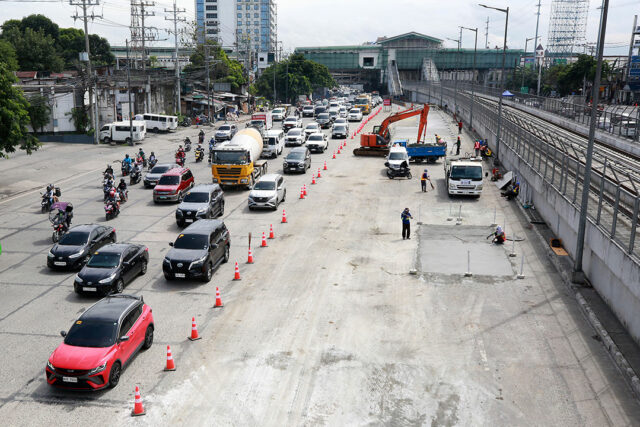
Men are at work on a segment of Commonwealth Avenue in Quezon City, July 13, 2024. — PHILIPPINE STAR/MIGUEL DE GUZMAN

By John Victor D. Ordoñez, Reporter

THE PHILIPPINE government must ensure that the P1.11-trillion budget for the Department of Public Works and Highways (DPWH) will not just be allocated to small-scale local projects and corruption-laden flood control projects, analysts said, saying these projects won’t spur economic growth.

“Infrastructure projects supposedly have high economic multiplier effects but not when projects are questionable and (involve) corruption-laden flood control or road re-blocking activities,” Enrico P. Villanueva, a senior lecturer at the University of the Philippines Los Baños Economics department, said in an X message.

“For these projects, government should resort to public-private partnerships and foreign aid funded projects.”

He said these modes of funding will need less outright cash from the government and will be less prone to corruption.

Senator Maria Imelda R. Marcos had earlier urged her brother President Ferdinand R. Marcos, Jr. to cut at least P188 billion from the DPWH’s budget to ensure that the spending plan does not violate the Constitution, which mandates that the Education sector gets the highest funding.

The President postponed the signing of the 2025 national budget into law on Dec. 30 from the initial Dec. 20 schedule after criticisms over lawmakers’ decision to cut the Philippine Health Insurance Corp.’s P74-billion subsidy next year and reduce the budget of the Department of Education (DepEd), according to Executive Secretary Lucas P. Bersamin.

Under the bicameral conference committee report of the P6.352-trillion national budget next year, lawmakers added more than P284 billion to the DPWH budget to P1.11 trillion from P825.12 billion initially proposed by the House of Representatives.

Philippine lawmakers had cut about P12 billion from the DepEd’s 2025 budget meant for computers and gadgets for public school use, which civic groups have criticized for being illegal and will likely hurt efforts to solve the country’s learning crisis.

“While infrastructure development is essential for economic growth and job creation, allocating P1.11 trillion to DPWH raises questions about prioritization and accountability,” Philippine Institute for Development Studies Senior Research Fellow John Paolo R. Rivera said in a Viber message.

Senator and finance committee chairperson Mary Grace Natividad S. Poe-Llamanazares has said the DPWH still sees right-of-way issues, delays in securing local government unit (LGU) permits as roadblocks in implementing flood control projects.

Based on data from the Philippine Atmospheric, Geophysical and Astronomical Services Administration, a total 11 tropical cyclones entered the Philippine Area of Responsibility last year.

Congress has been scrutinizing state flood-control projects after houses and people mostly in Metro Manila and nearby provinces were swept away by raging flood waters by tropical storms this year.

“It is doubtful that the additional funds of DPWH were channeled to strategic infrastructure projects that would spur economic growth. Time and again, legislators allocate funds for hyperlocal projects,” Zy-za Nadine M. Suzara, a public budget analyst and former executive director of policy think tank Institute for Leadership, Empowerment and Democracy, said in a Viber message.

Missile plans pose risks to nat’l security — ex-lawmaker

PIXABAY

By Chloe Mari A. Hufana, Reporter

A FORMER congressman criticized the Armed Forces of the Philippines’ (AFP) plan to procure the United States’ Typhon missile system, warning that such a move risks further entangling the Philippines in dangerous military alliances that threaten national security.

“We denounce the Marcos Jr. administration’s US-satellite-like foreign policy, which has contributed to bringing the world to the brink of a renewed nuclear arms race, instead of amity, goodwill and peace among nations,” Former Bayan Muna Rep. Carlos Isagani T. Zarate said in a statement on Thursday.

“This vassal-like subservience to foreign powers, particularly the US, gravely puts our country’s interests and security at risk.”

He argued that acquiring the missile systems would make the Philippines a “potential target in conflicts not of its own making.”

“The Filipino people should rightfully and strongly condemn both the Marcos Jr. administration and the US for turning the country into a target for nuclear warheads from nations that are not necessarily enemies of the Philippines and its people,” he added in Filipino.

He further criticized the defense spending involved, highlighting its potential impact on the country’s already strained budget.

Josue Raphael J. Cortez, a lecturer at the School of Diplomacy and Governance of De La Salle-College of St. Benilde, said the acquisition of missiles does not necessarily steer the country away from pursuing an independent foreign policy.

“This is because there is a global trend today, particularly for developing countries, to launch initiatives to further bolster their military capabilities,” he told BusinessWorld in a Facebook Messenger chat.

“In light of the circumstances we face today, and the fact that whether we like it or not, our region is where the 21st century Great Game of sorts may unfold, we must also be prepared — and one of the most effective ways to do so is by ensuring that our military capability is fortified enough,” he added.

He noted that an initiative from the AFP can serve as a deterrent to further militarization of the disputed territories.

The Chinese Embassy in Manila criticized Defense Secretary Gilberto C. Teodoro, Jr. earlier this week for his recent statements defending the Philippines’ plan to acquire mid-range missile systems from the United States.

It accused Mr. Teodoro of unjustly attacking China and the Communist Party of China, labeling his remarks as ideologically biased and reflective of a Cold War mentality.

This diplomatic friction follows Mr. Teodoro’s assertion that the Philippines, as a sovereign nation, has the right to procure defense assets without foreign interference.

Philippine Army chief Roy M. Galido on Monday said the Philippines would acquire a mid-range missile system that was deployed by the US Army to its territory in April this year for annual joint military exercises, citing the “the interest of protecting our sovereignty.”

The US Army Pacific in April called the deployment “a significant step in our partnership with the Philippines, our oldest treaty ally in the region,” citing “opportunities for our bilateral training and readiness.”

Mr. Teodoro emphasized that the planned acquisition of the American Typhon missile system aligns with the country’s national interest and independent foreign policy.

China’s Foreign Ministry has labeled the Philippines’ plan to introduce a mid-range missile system as “provocative and dangerous,” suggesting it could incite regional tensions.

The Ministry on Thursday called on the Philippines to return to “peaceful development,” reiterating Manila’s decision to deploy a US medium-range missile system in military exercises would only bring the risks of an arms race in the region.

China will never sit idly by if its security interests were to be threatened, Mao Ning, a spokesperson at the foreign ministry, said at a regular news conference.

The Philippine embassy in Beijing did not immediately respond to a Reuters request for comment. — with Reuters


Admin bets top poll for 2025 senatorial election

SENATORIAL aspirants endorsed by Philippine President Ferdinand R. Marcos, Jr. emerged as the most preferred candidates of Filipinos for the 2025 midterm elections, dominating ten out of 12 spots in the Social Weather Station’s (SWS) December survey.

In the SWS poll, conducted in partnership with think tank Stratbase ADR, House Deputy Majority Leader Erwin T. Tulfo kept the top spot with 45% of Filipino respondents saying they would vote for him if the elections were held between Dec. 12-18. This was lower than the 54% he got in a September SWS survey.

Senator Ramon B. Revilla, Jr. ranked second with a 33% voter preference, followed by Senator Pilar Julianna S. Cayetano, who tied with Senator Christopher Lawrence T. Go at ranks 3-4 with 32%, former Senate President Vicente Sotto III (31%), and broadcaster Bienvenido T. Tulfo (30%).

The Top 12 also included former Senators Panfilo M. Lacson (27%) and Emmanuel D. Pacquiao (27%), comedian Willie Revillame (26%), Makati Mayor Mar-len Abigail S. Binay (25%), Senator Manuel M. Lapid (23%), and Las Piñas Rep. Camille A. Villar, Senators Ronald M. dela Rosa and Maria Imelda Josefa R. Marcos, who tied at 12-14 with 21%.

Administration bets who failed to make it to the top 12 were Interior and Local Government Secretary Benjamin de Castro Abalos, Jr., who got 17% (16-17th spot) and Senate Majority Floor Leader Francis N. Tolentino who got 14% (19-20th spot).

In a statement, SWS said they asked respondents to choose 12 out of 70 names. The pollster interviewed 3,097 registered voters across the country from Dec. 12 to 18 and an error margin of ±2.1%.

On the opposition side, former Senator Francis Pancratius N. Pangilinan, who represents the Liberal Party, placed 15th in the survey as 20% of respondents said they will vote for him next year.

Former Senator Paolo Benigno A. Aquino IV of the Katipunan ng Nagkakaisang Pilipino party shared the 16th and 17th spot with Mr. Abalos with a voter preference of 17%. — John Victor D. Ordoñez

Firecracker-related injuries rise to almost 70 in less than a week

IAN SCHNEIDER-UNSPLASH

FIRECRACKER-RELATED injuries in the Philippines have risen to nearly 70 in less than a week, the Department of Health (DoH) said on Thursday.

Data from 62 sentinel sites, under DoH monitoring, showed that 26 injuries were registered today, bringing the total number of cases to 69 between Dec. 22 to 26.

Of this, 58 involved individuals aged 19 and below, while the rest were aged 20 and above, the DoH said in a statement.

Most of the users and victims of firecrackers were children and minors, the Health department said.

It said 86% of the victims used illegal firecrackers such as boga or a PVC cannon.

Moreover, DoH reported 65 patients with firecracker injuries were male while four were female.

Using firecrackers could lead to amputation of body parts, hearing loss, blindness, poisoning, burns, permanent lung damage, and even death from severe injuries, according to the health agency.

DoH noted that boga, 5-Star, and piccolo were the leading causes of fireworks-related injuries. — Kyle Aristophere T. Atienza

BCDA builds ethnobotanical center

BCDA.GOV.PH

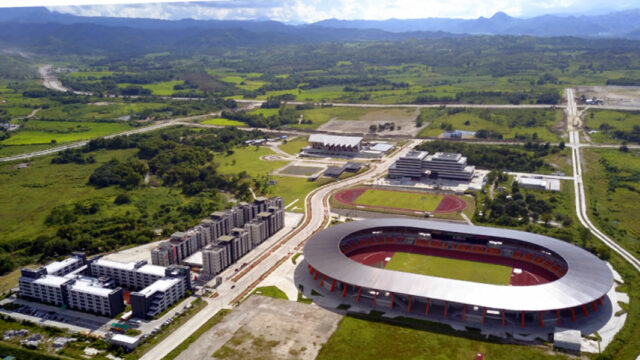
AN ETHNOBOTANICAL learning facility is expected to rise in New Clark City to help capacitate Aeta communities in Pampanga and Tarlac, the Bases Conversion and Development Authority (BCDA) said.

In a statement on Thursday, the BCDA said it signed memoranda of agreement with the Department of Agriculture (DA) Regional Field Office III and the Pampanga State Agricultural University for the establishment of a 10-hectare ethnobotanical learning facility.

Under the agreement, BCDA will allocate a 10-hectare piece of land in New Clark City for the Ayta Ethno Botanical Center, while the university will manage, supervise, and monitor the learning facility’s activities.

Meanwhile, the DA Regional Field Office allocated P4.8 million for a training project in the enrichment of the agriculture, food, and non-food-based indigenous practices of the Aetas at Ayta Ethno Botanical Center.

“The Ayta Ethno Botanical Center is envisioned to become a model for food forests — a system in which edible, harvestable crops are produced in a multi-story setting — which can be replicated around the green areas of New Clark City,” BCDA said.

“The presence of an ethnobotanical learning facility in New Clark City also provides BCDA an opportunity to develop adjoining protected and forest reserve areas into an ecotourism spot,” it added.

It also said that it has been coordinating with firms from the government and the private sector to assist in the planning and implementation of the appropriate projects to be implemented within the 10-hectare area. — Justine Irish D. Tabile

Cordillera gets P1.4M for healthcare

FREEPIK

BAGUIO CITY — Hedcor Group (Hedcor), the renewable energy asset manager of AboitizPower, and Aboitiz Foundation, Inc. said it has invested over P1.4 million to improve healthcare in its host communities in the highland Cordillera.

Through medical and dental missions, as well as essential medicines and supplies, these efforts seek to enhance access to care in Benguet, Mountain Province, and Ilocos Sur—areas where travel costs and distance often make medical services hard to reach, said Hedcor’s Corporate Communications chief Pamela Geminiano.

Under the Community Health Empowerment Program (CHEP), Hedcor and its partners
allocated P650,000 to deliver dental and medical services, including comprehensive check-ups, cleanings, fluoride treatments, and oral hygiene education.

This support reached multiple host communities, benefiting 125 patients in Barangay Bineng and 165 patients from the La Trinidad Indigenous Peoples Organization. It also covered 172 patients in Barangays Otucan Sur and Otucan Norte in Bauko, Mountain
Province.

Hedcor and Aboitiz Foundation also invested P800,000 in medicines and hygiene kits, benefiting thousands of residents. Maintenance medicines for conditions,
like diabetes and hypertension, as well as essential vitamins and dental supplies, were also made available.

These resources reached 395 elementary students in Barangay Alno, La
Trinidad, Benguet, and households in Barangays Alapang, Sabangan, Bakun, and Alilem.

Hedcor President and Chief Operating Officer Rolando G. Pacquiao emphasizing the importance of these initiatives said, “in the Cordillera region, limited access to healthcare is a critical issue. By
bringing vital medical services and supplies closer to our host communities, we help
address this gap, ultimately improving well-being and fostering resilience.”
— Artemio A. Dumlao

P3.4-M drugs seized in Sultan Kudarat

PHILSTAR FILE PHOTO

COTABATO CITY — Policemen and local officials seized P3.4 million worth of crystal meth (shabu) from a dealer entrapped in Barangay Kabuntalan in Sultan Kudarat, Maguindanao del Norte on Wednesday afternoon.

Brig. Gen. Romeo J. Macapaz, director of the Police Regional Office-Bangsamoro Autonomous Region (PRO-BAR), told reporters on Thursday that the suspect, Loloh Sakilan Ali, is now locked in a detention facility, to be prosecuted for violation of the Comprehensive Dangerous Drugs Act of 2002.

Mr. Ali, a resident of Barangay Tugal in Talitay town in Maguindanao del Norte, was immediately detained by personnel of the Sultan Kudarat Municipal Police Station, led by Lt. Col. Esmael A. Madin, after selling half a kilo of shabu during a tradeoff at a secluded area in the barangay.

Mr. Macapaz said personnel of the Sultan Kudarat municipal police and operatives of different units under PRO-BAR also impounded Ali’s Suzuki Raider motorcycle that he used in transporting shabu to contacts in different towns in Maguindanao del Norte and in nearby barangays in Cotabato City. — John Felix M. Unson