Home Blog Page 1733

South Korean consortium to pursue PHL urban dev’t projects

FACEBOOK.COM/SEJONGCITYINFO

A CONSORTIUM consisting of 23 South Korean public institutions and private companies has been formed to support members pursuing urban development projects in the Philippines.

In a statement on Monday, South Korea’s National Agency for Administrative City Construction (NAACC) announced the formation of “Team Korea to the Philippines.”

NAACC said that the consortium will promote the use of advanced urban development expertise and technology.

“By sharing the successful experience and technology accumulated through the construction of Korea’s Administrative City Sejong, we aim to actively support Korean companies in their global ventures, particularly in the rapidly developing Philippine market,” NAACC Administrator Hyeong Ryeol Kim said.

The formation of the consortium follows the memorandum of understanding (MoU) the NAACC signed with the Bases Conversion and Development Authority (BCDA) last year.

Signed in September, the MoU covers knowledge sharing and collaboration in urban planning, smart cities development, green energy, and smart administrative systems for New Clark City.

“The BCDA oversees major urban development projects, including New Clark City and has expressed strong interest in attracting Korean companies to participate in building urban infrastructure and developing smart cities,” NAACC said.

“In response, the NAACC launched ‘Team Korea to the Philippines’ to connect BCDA with Korean firms interested in entering the Philippine market, providing opportunities for project bids and collaborative ventures,” it added.

Following the launch, the NAACC plans to hold regular meetings with BCDA and participating companies to “explore detailed collaborative projects and secure tangible outcomes, including contract awards and joint urban development initiatives.”

“Through these efforts, the NAACC aims to enhance Korea’s presence in the global urban development arena while fostering mutually beneficial relationships with international partners like the BCDA,” NAACC said.

BCDA President and Chief Executive Officer Joshua M. Bingcang said that the consortium will help make business interactions between South Korea and the Philippines more seamless.

“We are confident that with Team Korea, we will be able to strengthen our alliance with partners who can help us transform the whole of Clark into Asia’s next investment and tourism destination,” Mr. Bingcang said.

Aside from NAACC, BCDA has also partnered with Korea Overseas Infrastructure and Urban Development Corp., Korean Water Resources Corp., RMS Platform, and Fine TME. — Justine Irish D. Tabile

PUM tapped to develop coco fiber products

THE Department of Trade and Industry (DTI) has partnered with Dutch organization PUM Netherlands to develop high-value products from coconut husk in Davao.

In a statement on Monday, DTI said that PUM Netherlands has helped 25 coconut-based enterprises and coconut farmers in the region.

“Composed of volunteer senior business advisors, PUM Netherlands has been facilitating several capacity-building and product development initiatives,” the DTI said.

“Their expertise has already benefited around 25 DTI Coconut Farmers Industry Development Plan (CFIDP)-assisted coconut-based enterprises and coconut farmers in the Davao Region,” it added.

According to DTI Regional Director Romeo L. Castañaga, the partnership with the Dutch organization has led to the development of new products such as substrate and growing media out of coconut husk.

These new products, said Mr. Castañaga, are in significant demand in Europe.

The Davao Region is among the top producers of coconut, ranking fourth in terms of areas planted to coconut. It accounts for 13% of national output.

The DTI said that the coconut industry still faces challenges, including low income, low productivity, inadequate technology, low utilization of coconuts and by-products, and lack of new and high-value products.

“We have noted several challenges when venturing into producing and promoting coconut products for horticultural purposes. These range from market access and expansion to technology and innovation and laboratory facilities,” Mr. Castañaga said.

DTI Region 11 has assisted 800 coconut farmers through the CFIDP.

“DTI will focus its support on services related to research, marketing, and market promotion,” it said.

“For this new year, DTI Davao will conduct coconut husk mapping in the region to assess supply. This effort will also include an industry study to identify potential markets for these husk-derived products,” it added. — Justine Irish D. Tabile

Budget consultations start with Cabinet Secretaries 

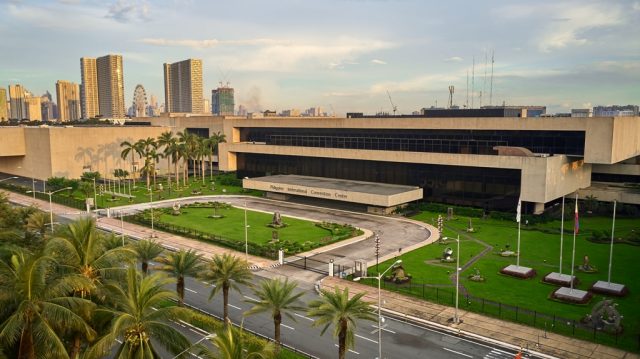
The iconic façade of the Philippine International Convention Center.

THE Department of Budget and Management (DBM) has started consulting with heads of government agencies in conducting the budget call forum for 2026.

The forum, held at the Philippine International Convention Center in Pasay City, kicks off the preparatory stage for drafting the National Expenditure Program, the DBM said in a statement on Monday.

“The budget call and preparation stage is now officially open. So I hope, you will, in your own departments and agencies, find time to sit down with your technical staff and make sure that once you propose (your budgets)… to have the corresponding submissions and requirements,” Budget Secretary Amenah F. Pangandaman said.

The budget call contains the parameters and procedures that guide agencies in preparing their proposed budgets, the DBM said.

The DBM will also implement the Program Convergence Budgeting (PCB) approach in the preparation of the proposed national budget for 2026.

PCB aims to focus government resources on key programs and projects coordinated across departments.

“It’s quite an addition because it will also be part of our budget process. Dati po, hindi ‘yan inuupuan, nagsa-submit lang and then inililista — para lang po s’yang wishlist (It never used to be discussed, just submitted like a wishlist). But now, it will be part of the budget process,” she said.

National Economic and Development Authority (NEDA) Secretary Arsenio M. Balisacan said this approach will promote the effective allocation of fiscal resources.

He said about 5,000 programs, activities, projects (PAPs) are registered each year in the NEDA Public Investment Program (PIP) system.

“Given the sheer number of PAPs that are prepared by various agencies, as well as coordination and information constraints that all agencies confront, it is inevitable that there will be overlaps, duplication, or gaps, even as each agency aligns their proposals with the PDP (Philippine Development Plan) objectives. The PCB approach seeks to mitigate this.” — Aubrey Rose A. Inosante

Vape taxes hit P1.35 billion in first 11 months 

PHILIPPINE STAR/MIGUEL DE GUZMAN

TAX COLLECTIONS from vapor products totaled P1.35 billion in the 11 months to November, according to the Office of the Special Assistant to the President for Investment and Economic Affairs (OSAPIEA).

OSAPIEA Undersecretary Jose Edwiniel C. Guilas speaking on behalf of Secretary Frederick D. Go, said tax collections from vapes surged last year.

“(That is) more than triple the total collections of P361.6 million for the entire year of 2023,” Mr. Guilas said.

“Similarly, heated tobacco products (HTPs) have generated P590.1 million for the same period, also exceeding the collections of P459 million for 2023,” he added.

He noted the shift towards HTPs and vapes over the years has not been accompanied by appropriate regulation and tax measures.

“The government is taking various steps to address these concerns. This matter has been brought to the Cabinet’s attention to ensure prompt and responsive action,” he said.

“Efforts are focused on properly registering industry players, prioritizing compliance with health standards, and ensuring accurate tax payments in accordance with laws and regulations, ultimately boosting collection,” he added. — Justine Irish D. Tabile

Tobacco industry backs pause in raising excise tax rates

BW FILE PHOTO

THE tobacco industry said it supports a pause in excise tax rate hikes and called for more efficient utilization of local governments’ national tax allotments (NTA).

“If they think this moratorium will help the industry, I think it’s worth trying if it works in other countries. Anyway, we’re losing income. Why don’t we try it here?,” National Tobacco Administration (NTA) Administrator and Chief Executive Officer Belinda S. Sanchez told BusinessWorld on Monday on the sidelines of the 2nd International Tobacco Agricultural Summit

She was referring to House Bill 11279, which proposes to suspend the annual 5% increase in tobacco until 2026, replacing it with 6% adjustments every two years starting in 2027. The bill also aims to deter smuggling.

Asked about the likelihood of the bill passing, Ms. Sanchez said: “I don’t know. A lot of people are blocking it. Hopefully, it will continue.”

In a speech at the summit, she said that the continuing proliferation of illegal tobacco is causing a decline in government revenue.

“This reduction in funds limits the resources available for essential public services, particularly universal healthcare. Moreover, proceeds from illegal tobacco sales are often linked to organized crime, further threatening national security,” Ms. Sanchez said.

“We need to have a pause and then because we’re not making the Filipino safer because they’re still smoking, except they’re smoking cheaper and more harmful products,” Winston Uy, president of Universal Leaf Philippines, Inc. said at a forum during the summit.

Mr. Uy said higher tax rates could encourage the resort to illegal tobacco products, leading to lower tax collection to fund health services.

Bienvenido S. Oplas Jr., president of the Minimal Government Thinkers, said the Laffer curve applies to tobacco, to the effect that higher tax rates lower overall revenue.

He also said that the optimal tax rate based on the tobacco excise tax is P50 per pack.

“Reliance on alcohol-tobacco taxation to fund the Universal Health Care is wrong. It is doublespeak to ask people to avoid alcohol-tobacco then (raising billions) from smokers and drinkers to fund the health establishment,” he said.

He called for “zero earmarking of ‘sin taxes’ for universal healthcare,” he added.

Nestor Casela, Deputy Administrator for Operations at the National Tobacco Administration, called on the Bureau of Internal Revenue, Bureau of Customs, and Philippine Economic Zone Authority to harmonize guidelines for the economic zone locators trading in agricultural and tobacco products.

He also called on the Department of Budget and Management to regularize the release of funds for technical and marketing support.

Meanwhile, the advocacy group Sin Tax Coalition urged Finance Secretary Ralph G. Recto “to fulfill his mandate of efficiently managing the government’s financial resources by rejecting the proposal to lower tobacco taxes.”

The group estimated that the National Government will potentially lose P27.5 billion in revenue between 2026 and 2030. — Aubrey Rose A. Inosante

Prefab home maker Hive Modular expanding to enable future exports

HIVE MODULAR

By Justine Irish D. Tabile, Reporter

US STARTUP Hive Modular, a maker of sustainable pre-fabricated homes, said its capacity expansion plans are intended to scale up its Philippine operation to make exports viable and to tap opportunities presented by the skills of the available workforce.

“We always saw the Philippines as the place where we wanted to set up a manufacturing base,” Hive Modular Founder and Chief Executive Officer John Avrett told BusinessWorld.

Prior to starting the company, Mr. Avrett worked as the head of the US Embassy’s Trade and Investment unit. He was a diplomat for three years.

“In my role as an economic officer, I got to visit multiple factories and kind of see behind the scenes of the Philippine economy. And I saw that there was a massive opportunity to do something like this here,” he said.

“The Philippines is a world leader in shipbuilding. The Philippines has some great manufacturing that you might not hear about, and so I chose the Philippines because I knew that we could find the right skills, the right people to do this job on a scale that we wanted to achieve,” he added.

He said that the plan is to expand the capacity of the company’s factory within the year, particularly after its next fundraising round.

“(That funding round) will move us into a bigger factory in an economic zone and hopefully help us set up an export operation. So that we can sell locally but also sell to the global market as well,” he added.

“Once we close this next fundraising round, the goal is to move into a bigger space,” he said.

“Our ability to build these houses is only limited by the factory space that we have access to. Now that we’ve proven that we can build it here in the Philippines, it’s now a matter of doing it at scale,” it added.

At around 2,000 square meters (sq.m.), the Hive Modular factory in Cavite has the capacity to produce 50 modular houses a year.

“Our goal is to set up a truly large operation here in the Philippines. What that means is tens of thousands of workers. That’s kind of the vision that we’re heading for,” Mr. Avrett added.

For this year, he said that the company is hoping to increase its workforce and capacity by about 10 times.

Currently, the company employs 30 workers, including factory workers, he said.

He said that 80% of the materials are locally sourced, with some imports from China, Vietnam, and Taiwan.

“One of those (imported materials) is folded aluminum metal. And actually, doors and windows are hard to source here. But everything else is locally available. We made a conscious effort to use as much local materials as we could, including reclaimed floors from old Philippine houses,” he said.

“We’re trying to play on this idea of old and new. We have this new technology, but we’re salvaging or breathing life into new old materials,” he added.

On Jan. 23, Hive Modular launched a pop-up installation for its Casita One45 model at One Bonifacio High Street, Taguig.

With a base price of P7.5 million pesos, the Casita One45 is a 45-sq.m. modular one-bedroom home with bath, kitchen, and deck.

“The target market for this product is someone with land that wants to develop a resort, Airbnb, or a guest house on. The target demographic is someone who already has land,” he said.

So far, he said that most of the company’s commercial interest is from the surfing resort island of Siargao and parts of the Visayas.

“Even though we’re launching with a premium product, the goal eventually is to drive down our costs and to offer other products at various price points,” he said.

“So, in the future, we want to be able to offer more economical products. The vision really is similar to an automotive company, where you have a standard chassis, and on top of that chassis, you build various models of cars. That’s kind of what we’re doing here,” he added.

Within the year, he said the company hopes to launch Casita One60 and Casita Two75, which are 60 sq.m. and 75 sq.m. respectively.

“We have a couple of models that we are planning to launch soon. The goal is to offer larger products because we know Filipino families are big,” he added.

BEPS Pillar 2: What now in ASEAN and what’s next for the Philippines

Digitalization in the 21st century brought with it several challenges to the rules for taxing international business income, which gave rise to base erosion and profit shifting (BEPS), in which multinational entities (MNEs) shift profits to locations with minimal or no tax to pay a reduced amount of taxes globally. BEPS practices undermine the fairness and integrity of tax systems because businesses that operate in various jurisdictions may use BEPS and gain a competitive advantage over entities operating domestically.

To address the challenges to the tax system brought about by globalization, the Organisation for Economic Cooperation and Development (OECD) and the G20 countries created the OECD/G20 Inclusive Framework on BEPS. In October 2021, over 135 Inclusive Framework Members joined a two-pillar solution to reform the international tax system, ensuring that MNEs pay their fair share of tax regardless of the tax jurisdiction where they generate revenue.

OVERVIEW OF BEPS PILLAR 2
The BEPS Pillar 2 or the Global Anti-Base Erosion Rules (GloBE Rules), introduces a Global Minimum Tax (GMT) of 15%. To apply, if a qualified MNE’s effective tax rate (ETR) in a particular jurisdiction is less than the 15% GMT, the MNE should pay the top-up tax (the difference between the 15% GMT and ETR) to meet the GMT. However, the GloBE rules do not apply to all MNEs. Only MNEs with consolidated group revenue of 750 million euros in at least two out of the last four years are required to pay the top-up tax.

The top-up tax may be collected in three ways. The first is the Income Inclusion Rule (IIR), which imposes a top-up tax on the ultimate parent entity (UPE) based on the earnings of foreign subsidiaries with ETRs below the GMT. UPE will pay the top-up tax to the taxing jurisdiction where it is situated. The second is the Undertaxed Profit Rule (UTPR), which “sweeps” whatever is not collected by the IIR. UTPR enables the taxing jurisdictions where the subsidiaries are operating to collect the top-up tax yet to be collected through the IIR by way of denial of a deduction for otherwise deductible expenses (or be subject to an equivalent adjustment under domestic law in an amount sufficient to result in the MNE located in the UTPR jurisdiction having an additional tax expense equal to the UTPR top-up tax allocated to that jurisdiction). The third is the Qualified Domestic Minimum Top-Up Tax (QDMTT), where the taxing authority that has jurisdiction over the entity will have the primary rights to the top-up tax.

WHAT NOW IN THE ASEAN MEMBER COUNTRIES
Based on the Tax Challenges Arising from the Digitalization of the Economy – Administrative Guidance on the Global Anti-Base Erosion Model Rules – Central Record, OECD/G20 Inclusive Framework on BEPS, which was published by OECD on Jan. 15, starting Jan. 1, 27 countries had transitional qualified status for IIR, while 28 countries had transitional qualified status for QDMTT worldwide.

In the region, only Vietnam has been granted a transitional qualified status for both IIR and QDMTT. Indonesia, Malaysia, Singapore, Thailand, and Hong Kong have adopted BEPS Pillar 2 starting Jan. 1.

Indonesia issued Government Regulation No. 55 of 2022 on Dec. 20, 2022, which implemented amendments to the Income Tax Law. Government Regulation No. 55 serves as a legal basis to adopt the GloBE rules. Further, Indonesia’s Ministry of Finance issued Regulation No. 136 of 2024, which provides for the implementation of the Pillar 2 GMT rules in Indonesia. This includes the IIR and QDMTT, which will apply starting Jan. 1, 2025, and the UTPR, which will apply starting Jan. 1, 2026.

Malaysia published the Finance Act (No. 2) 2023 in its Official Gazette on Dec. 29, 2023. The Finance Act will implement the Domestic Top-up Tax and the Multinational Top-up Tax. On Dec. 2, 2024, the Malaysian Inland Revenue Board (MIRB) issued guidelines on the implementation of GMT in Malaysia. This law took effect on Jan. 1.

Singapore President Tharman Shanmugaratnam approved the Multinational Enterprise (Minimum Tax) Act 2024 on Nov. 8, 2024. The new law seeks to implement two new top-up taxes —Domestic Top-up Tax and the Multinational Enterprise Top-up Tax — under the OECD’s BEPS. On Dec. 30, the Singapore Ministry of Finance published the Multinational Enterprise (Minimum Tax) Regulations 2024 in support of the new legislation. The new tax legislation took effect on Jan. 1.

Thailand also issued Emergency Decree on Top-up Tax on Dec. 26, which took effect on Jan. 1. Thailand’s new legislation adopts QDMTT, IIR, and UTPR.

Brunei Darussalam, Cambodia, Lao PDR, Myanmar, and the Philippines, which constitute half of the ASEAN member countries, have not yet passed laws implementing the GloBE Rules.

WHERE IS THE PHILIPPINES NOW?
The Philippines joined as a member of the OECD/G20 Inclusive Framework on Nov. 8, 2023. This move reconfirms our government’s commitment to a fair system of taxation, protecting the country’s tax base against aggressive tax avoidance schemes, and promoting international tax cooperation. Despite joining the OECD/G20 Inclusive Framework, the Philippines has not yet pass a tax law to implement the GloBE Rules.

Philippine entities of MNEs may be subject to the regular corporate income tax (RCIT) of 20% or 25%. On the other hand, companies that are registered business enterprises have preferential income tax rates such as income tax holiday (ITH) or the 5% Special Corporate Income Tax (SCIT). Therefore, the GloBE Rules may most likely apply to these registered business enterprises enjoying the preferential income tax rates since they may have an ETR lower than the 15% GMT.

IMPACT OF GLOBE RULES IN THE PHILIPPINES
Republic Act No. 12066, otherwise known as the CREATE MORE Act, was signed in November. The CREATE MORE Act makes the Philippines’ tax incentives regime more globally competitive and investment-friendly, with the goal being to promote the Philippines as a prime investment destination.

Developing countries like the Philippines rely mostly on foreign investment to generate revenue. However, with the eventual implementation of GloBE Rules, investing in the Philippines may be less appealing to MNEs because they can no longer take advantage of the preferential tax rates, since they would be required to pay a GMT of 15% regardless of where they invest.

If the Philippines adopts the GloBE Rules, our Congress should pass a law amending the Tax Code to implement at least the QDMTT to maximize tax collection. The adoption of the QDMTT will give priority to the Bureau of Internal Revenue (BIR) to collect the top-up tax of those qualified MNEs with low ETRs. The implementation of the IIR may only have a minimal increment on our tax revenues since we do not have that many UPEs situated here. Likewise, UTPR will not have a huge increment on tax revenue, unlike the QDMTT. Congress, however, should weigh the possible benefits and consequences of adopting the GloBE Rules.  While the Philippines will benefit from the GloBE rules, resulting in additional tax revenue, a possible consequence is that it could drive away foreign investors.

I believe that BEPS Pillar 2 is still in the experimental stage. On the one hand, developed countries will surely benefit from this as they may earn back the tax revenues lost through MNEs investing in a low- or no-tax jurisdiction. On the other hand, developing countries, like the Philippines, may be adversely affected by it since it might drive away foreign investors who prefer to do business in developing countries offering lower tax rates.

In 2023, the OECD published sets of administrative guidance on BEPS Pillar 2, which provides new tax credits such as the marketable transferable tax credits (MTTCs) and non-MTTCs. MTTCs are tax credits that can be used by the holder of the credit to reduce its tax liability and are transferable upon satisfaction of certain conditions. Non-MTTCs, on the other hand, are still transferable but no longer marketable once transferred. To mitigate the effects of the adoption of GloBE Rules to the attractiveness of the Philippines as an investment hub, Congress should pass amendments to the Tax Code, specifically on tax incentives that can be provided to MNEs qualified to pay the GMT.

In the Philippines, investors are assured of a quality workforce. The depth and quality of our human resources make the Philippines an attractive place for doing business. Filipinos are known for diligence, hard work, and English proficiency. According to the latest Pearson Global English Proficiency Report 2024, Filipinos rank above the global average in Business English Proficiency scoring 63 compared to the global average of 57. This, together with the government’s continuous dedication to ease of doing business, should be bolstered to attract potential investors.

The government must find new ways to attract foreign investors to the Philippines. To gain new investors, the government should consider adding fiscal incentives and devising and improving non-fiscal incentives. Several countries are already implementing the GloBE Rules, and it is only a matter of time before our current fiscal incentives will be rendered irrelevant because of the payment of the GMT.

Let’s Talk TP is an offshoot of Let’s Talk Tax, a weekly newspaper column of P&A Grant Thornton that aims to keep the public informed of various developments in taxation. This article is not intended to be a substitute for competent professional advice.


Runell Alvyn V. Sarmiento is a manager from the Tax Advisory & Compliance division of P&A Grant Thornton, the Philippine member firm of Grant Thornton International Ltd. pagrantthornton@ph.gt.com


PSEi sinks to seven-month low before GDP data

PHILIPPINE STAR/KRIZ JOHN ROSALES

THE MAIN INDEX sank to the 6,100 level on Monday, hitting a seven-month low, as investors were cautious before the release of Philippine gross domestic product (GDP) data and the US Federal Reserve’s policy meeting.

The Philippine Stock Exchange index (PSEi) fell by 1.57% or 99.32 points to close at 6,196.88 on Monday, while the broader all shares index slumped by 1.12% or 41.49 points to end at 3,639.85.

This was the PSEi’s lowest close and first time to end at the 6,100 level in more than seven months or since its 6,158.48 finish on June 21, 2024.

“The local market declined as investors took a cautious stance while waiting for the Philippines’ 2024 GDP data and the Fed’s policy meeting, both of which are set this week,” Philstocks Financial, Inc. Senior Research Analyst Japhet Louis O. Tantiangco said in a Viber message. “Expectations that the local economy was unable to hit the government’s growth target last year weighed on the market.”

The Philippine Statistics Authority will release fourth-quarter and full-year 2024 GDP data on Jan. 30 (Thursday).

A BusinessWorld poll of 18 economists and analysts yielded a median estimate of 5.8% for fourth-quarter GDP growth, faster than 5.2% in the third quarter and matching the 5.8% expansion in the same quarter in 2023.

The poll also yielded a median growth forecast of 5.7% for full-year 2024, below the government’s revised 6-6.5% goal. Still, this would be faster than the 5.5% economic expansion logged in 2023.

Philippine GDP growth averaged 5.8% in the first nine months of 2024. National Economic and Development Authority Secretary Arsenio M. Balisacan last week said that economic growth in 2024 may have fallen short of the government’s target due to the typhoons that hit the country in the fourth quarter.

Meanwhile, the Fed will hold its first policy meeting for the year on Jan. 28-29, where it is widely expected to keep rates unchanged for the first time since September amid renewed inflation concerns.

“Philippine shares fell below the 6,200 level as the market braces for a shortened trading week with more key economic indicators ahead,” Regina Capital Development Corp. Head of Sales Luis A. Limlingan said in a Viber message. Philippine markets are closed on Jan. 29 (Wednesday) for the Lunar New Year.

All sectoral indices closed in the red on Monday. Industrials sank by 2.07% or 183.42 points to 8,679.54; holding firms dropped by 1.98% or 105.90 points to 5,235.02; mining and oil decreased by 1.62% or 126.78 points to 7,686.99; services retreated by 1.49% or 30.71 points to 2,029.68; property went down by 1.29% or 29.88 points to 2,277.76; and financials slumped by 1.18% or 25.59 points to 2,140.19.

Value turnover rose to P5.44 billion on Monday with 1.14 billion shares traded from the P4.74 billion with 1.14 billion issues exchanged on Friday. Decliners outnumbered advancers, 118 versus 68, while 48 names were unchanged.

Net foreign selling declined to P322.39 million on Monday from P1.12 billion on Friday. — Revin Mikhael D. Ochave

Peso drops versus the dollar on renewed Trump tariff concerns

BW FILE PHOTO

THE PESO weakened anew on Monday as the dollar rose after US President Donald J. Trump threatened to impose tariffs on Colombia.

The local unit closed at P58.435 per dollar on Monday, weakening by 12.50 centavos from its P58.31 finish on Friday, Bankers Association of the Philippines data showed.

The peso opened Monday’s session slightly weaker at P58.35 against the dollar. Its intraday best was at P58.27, while its worst showing was at P58.46 versus the greenback.

Dollars exchanged inched down to $1.53 billion on Monday from $1.57 billion on Friday.

The peso declined against the dollar on Monday amid souring risk sentiment after Mr. Trump threatened tariffs on Colombia, a trader said by phone.

Concerns over Mr. Trump’s threats on US import tariff hikes, the latest of which on Colombia, after the agreement on the return of undocumented immigrants, boosted safe-haven demand for the greenback, Rizal Commercial Banking Corp. Chief Economist Michael L. Ricafort said in a Viber message.

For Tuesday, the trader expects the peso to move between P58.20 and P58.50 per dollar, while Mr. Ricafort sees the local unit ranging from P58.30 to P58.50.

The US dollar edged up versus the euro but dropped against the yen on Monday as concerns about US tariffs returned and investors braced for a raft of central bank policy meetings and economic data later this week, Reuters reported.

Last week was the dollar’s weakest in more than a year on expectations that tariffs enacted by Mr. Trump will be lower than previously feared. But concerns have resurfaced as the US and Colombia pulled back from the brink of a trade war.

Monetary policy decisions later this week and inflation data on Friday suggest the focus may shift, at least temporarily, from tariff risks to interest rate differentials, some analysts say.

No change in rates from the US Federal Reserve and 25-basis-point cuts from the European Central Bank, the Bank of Canada and Riksbank are priced in, but markets will closely watch any clues on the outlook.

The dollar index, which measures the currency against six others, rose 0.1% to 107.58, still close to the one-month low it touched last week. The index has risen nearly 4% since the US elections in early November.

The prospect of high US tariffs on goods from countries including China, Canada and Mexico, as well as the euro zone, has stoked concerns about a renewed bout of inflation, boosting Treasury yields and the greenback in recent months.

The Japanese yen changed hands at 155.88 per dollar after the Bank of Japan (BoJ) pushed its policy rate to the highest level since the global financial crisis and revised up its inflation forecasts.

Some analysts said that tariffs could also affect BoJ monetary policy. — A.M.C. Sy with Reuters

Marcos told not to be overly reliant on US amid rising China tensions

FACEBOOK.COM/USEMBASSYPH

By John Victor D. Ordoñez, Reporter

THE PHILIPPINES should not rely heavily on the US to build its defense capabilities in the face of its sea dispute with China, political analysts said, citing the expected “transactional” approach to bilateral ties under a second Trump presidency.

“President Trump has not been shy saying that everything the US does in the international field has a price,” Michael Henry Ll. Yusingco, a fellow at the Ateneo de Manila University Policy Center, said in a Facebook Messenger chat. 

“The Marcos administration should not be naïve to think that the US will act in the name of world peace or international law. It would be better to anticipate that the America First Policy may be applied in the literal sense by Trump,” he added.

Last week, US Secretary of State Marco Rubio talked about China’s “dangerous and destabilizing actions in the South China Sea” with Philippine Foreign Affairs Secretary Enrique A. Manalo and underscored the “ironclad” US defense commitment to Manila.

The US is the Philippines’ major security partner, with a 1951 Mutual Defense Treaty compelling both nations to defend each other in case of an armed attack. 

The Philippines has been embroiled in wrangles at sea with China in the past two years and the two countries have faced off regularly around disputed features in the South China Sea that fall within Manila’s exclusive economic zone. 

China claims almost the entire South China Sea, a conduit for more than $3 trillion of annual ship-borne commerce, including parts claimed by the Philippines, Vietnam, Indonesia, Malaysia and Brunei. The Permanent Court of Arbitration in the Hague ruled in 2016 that China’s claims had no legal basis, a ruling Beijing rejects.

“He (Mr. Rubio) merely reiterates and reaffirms the official policy of the US towards the Philippines,” Rommel C. Banlaoi, president of the Philippine Society for International Security Studies, said in a Viber message.

“What we need to see is how the Trump administration will implement this policy amidst persistent conflicts in the South China Sea.”

The US military has moved its Typhon launchers, which can fire multipurpose missiles up to thousands of kilometers, from Laoag airfield to another location on the island of Luzon, a senior Philippine government source said on Jan. 23, according to Reuters.

The Tomahawk cruise missiles in the launchers can hit targets in both China and Russia from the Philippines. The SM-6 missiles it also carries can strike air or sea targets more than 200 km away.

China’s Foreign Ministry accused the Philippines on Jan. 23 of creating tension and confrontation in the region, and urged it to “correct its wrong practices.”

The deployment of the missile system is “extremely irresponsible” for regional security, Ministry spokesperson Mao Ning told a news briefing last week.

Typhons are relatively easy to produce — drawing on large stockpiles and designs that have been around for a decade or more — and could help the US and its allies catch up quickly in an Indo-Pacific missile race in which China has a big lead.

Security engagements between the allies have soared under Philippine President Ferdinand R. Marcos, Jr., who has moved closer to Washington and allowed the expansion of military bases that American forces could access, including facilities facing the democratically governed island of Taiwan, which China claims as its own.

“I believe that we are off to a good start, but then again, it would depend on how well we are able to elevate our agency in the eyes of Washington as well, so we have to do more in that regard so it’s safe to say that the Philippine-US alliance remains intact,” Don McClain Gill, who teaches foreign relations at De La Salle University, said in a Facebook Messenger chat.

US AID PAUSE
Meanwhile, Senate Minority Floor Leader Aquilino Martin “Koko” D. Pimentel said the government should not be fazed by the Trump government’s decision to freeze new funding foreign assistance programs for 90-days.

“We should learn to live with this decision,” he told reporters in a Viber message. “The Philippines should not be dependent on foreign aid, although we should be welcoming of all aid without strings and conditions that are extended to us.” 

The US Department of State on Jan. 20 issued an executive order that froze foreign funding, with exceptions for emergency food programs and military aid to Israel and Egypt.

US President Donald J. Trump ordered the 90-day pause in foreign development assistance pending a review of these programs in relation to his administration’s foreign policy.

Washington provided foreign aid worth $60 billion in 2023 or about 1% of the US budget.

“The United States foreign aid industry and bureaucracy are not aligned with American interests and in many cases antithetical to American values,” according to a copy of the order published on the US Department of State website.

“They serve to destabilize world peace by promoting ideas in foreign countries that are directly inverse to harmonious and stable relations internal to and among countries.”

“[Pausing foreign aid] is not a good indicator especially considering there were previous promises from US Foreign Affairs officials that our working relationship and projects will not change,” Hansley A. Juliano, who teaches political science at the Ateneo de Manila University, said in a Facebook Messenger chat. 

“It potentially belies the assumption of the security sector that the US will remain a reliable Philippine security partner.”

The Southeast Asian nation, one of the weakest in the world in terms of military capability, is important to Washington’s efforts to push back against China, which claims the South China Sea almost in its entirety.

ICC likely to proceed with Philippine drug war probe despite US sanction threat

PHILIPPINE STAR/MICHAEL VARCAS

By Chloe Mari A. Hufana, Reporter

POSSIBLE US sanctions against the International Criminal Court (ICC) are unlikely to quash the tribunal’s interest in investigating the Philippines’ deadly war on drugs, which has drawn international scrutiny over human rights violations, political analysts said on Monday.

The Philippines should still push the ICC probe of ex-President Rodrigo R. Duterte’s anti-illegal drug campaign even if Washington undermines the ICC “if we are to remain adamant about promoting and adhering to democratic norms and the rule of law,” Josue Raphael J. Cortez, a diplomacy instructor at the De La Salle-College of St. Benilde’s School of Diplomacy and Governance, said in a Facebook Messenger chat on Monday.

“This is something that we want in line with our campaign for a nonpermanent seat in the United Nations Security Council by 2027,” he added.

Mr. Cortez noted that if the Philippine government chooses to collaborate with the ICC and the International Police (Interpol) once the court orders the arrest of key actors in the drug war, the US decision to penalize the ICC would have a minimal impact on such efforts.

Manila would likely feel pressured to align its actions with Washington’s stance on the ICC due to US President Donald J. Trump’s “drastic” orders, he added.

“In terms of strengthening our alliance, furthering our economic partnership, and ensuring the welfare of Filipino migrants in the US, our decision to support Washington on the matter may be some sort of appeasement towards Washington’s new regime,” he said.

The ICC might assert its independence and continue probing the bloody drug war, National Union of Peoples’ Lawyers (NUPL) President Ephraim B. Cortez said.

“We have to wait and see how the ICC would respond to the threat of sanctions from the US,” he said in a Viber message. “Of prime consideration is whether the US will consider the Philippines a US ally within the context of the proposed US bill.”

The US House of Representatives earlier this month approved a bill that seeks to sanction the ICC in protest of its arrest warrants for Israeli Prime Minister Benjamin Netanyahu and his former defense minister over Israel’s military campaign in Gaza.

The vote was 243 to 140 in favor of the Illegitimate Court Counteraction Act, which would sanction any foreigner who investigates, arrests, detains, or prosecutes US citizens or those of an allied country, including Israel, who are not members of the ICC, Reuters reported on Jan. 11.

The ICC is a permanent court that can prosecute people for war crimes, crimes against humanity, genocide and the crime of aggression in member states or by their nationals.

“Although the US is not a major financial contributor to the ICC, the sanctions proposed under the bill will affect US companies like Microsoft, financial and banking institutions that have dealings with the ICC,” NUPL’s Mr. Cortez said. “This may also move some US allies who are major contributors to the ICC, like Germany and the UK, to follow suit.”

“Financially, the immediate effect of a US sanction would be the cessation of US financial assistance to the ICC’s victims’ fund,” he added.

American sanctions could also affect the tribunal’s legitimacy, making more countries hesitant to work with it in the future, Benilde’s Mr. Cortez said.

“The US, by promulgating such decisions, is clearly undermining the ICC’s mandate and influence,” he said. “This will certainly debilitate the ICC’s capacity to help out in addressing certain crimes that are deemed perilous to the global order.”

The ICC started its preliminary examination of the Philippines’ war on drugs in February 2018, focusing on allegations of crimes against humanity committed under Mr. Duterte’s anti-narcotics campaign.

The probe examined reports of extrajudicial killings and widespread human rights violations, which resulted in thousands of deaths, including those of minors and civilians.

In March 2019, Mr. Duterte withdrew the Philippines from the ICC, citing “unwarranted attacks” against his government.

In September 2021, the ICC authorized a full investigation of the drug war, but the probe was suspended two months later after the Philippine government requested a deferral, claiming it was conducting its own probe.

The ICC resumed its investigation in early 2023, citing insufficient evidence of genuine efforts by Philippine authorities to prosecute offenders.

Philippine President Ferdinand R. Marcos, Jr. earlier said the country would not lift a finger in the probe, but Executive Secretary Lucas P. Bersamin said the country would respond favorably if the ICC seeks Interpol’s help.

Justice Secretary Jesus Crispin C. Remulla has signaled a softer stance on the ICC probe, Reuters reported on Jan. 23.

“We will talk to them soon in a very well-defined manner, in the spirit of comity,” he told Reuters. “Some people are trying to bridge the divide to bring us together, so we can sit at one table. There are certain areas where we can cooperate… Lines have to be drawn properly.”

Smaller Philippine Coast Guard ship keeps China vessel from Zambales coast

PHILIPPINE COAST GUARD PHOTO

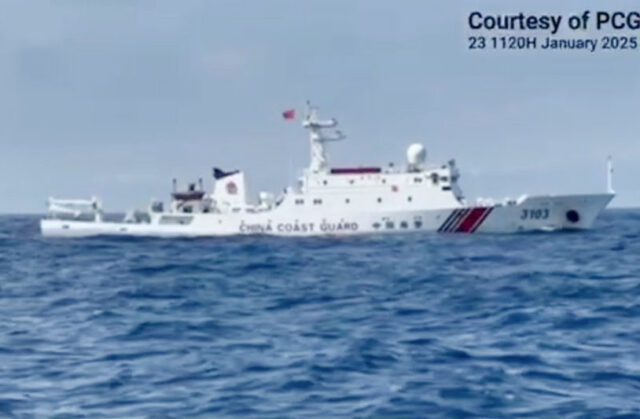
THE Philippine Coast Guard (PCG) said its 44-meter vessel BRP Cabra had managed to prevent a bigger Chinese ship from getting closer to the coastline of Zambales province.

BRP Cabra, despite its smaller size [than] the China Coast Guard (CCG) vessel 3103, has been successful in preventing [it]] from advancing closer to the coast of Zambales,” it said in a statement on Sunday night.

It added that the ship had kept CCG 3103 at a distance of 185.2 kilometers from the Philippines’ exclusive economic zone (EEZ).

While BRP Cabra is only 44 meters in length, the China Coast Guard deployed another vessel at a distance, “appearing to serve as a supporting vessel for CCG 3103,” the PCG said. “Additionally, CCG 5901 was also spotted a few nautical miles away from CCG 3103.”

The Philippine Coast Guard vowed not to allow China to alter the order in the South China Sea by encroaching closer to the Zambales coastline in northern Philippines.

“Despite these developments, the PCG remains committed to challenging the illegal presence of Chinese Coast Guard vessels,” it said.

“Our continued presence serves as a clear demonstration of our commitment to upholding our sovereign rights and a steadfast stance against any violations of international law, all while prioritizing a peaceful approach,” it added.

The PCG at the weekend accused CCG 3103 of using a long-range acoustic device against its vessel near the Zambales, weeks since it started monitoring the area after Beijing deployed its biggest coast guard ship in the Philippine EEZ.

The PCG said CCG 3103 had replaced another vessel deployed near the Zambales and “appears to be escorted by CCG 5901 or the “Chinese monster ship.”

The Philippines has accused China of intimidating Filipino fishermen near Scarborough Shoal and normalizing its “illegal presence” after Beijing sent the monster ship, the world’s biggest coast guard vessel, into the Philippine EEZ on Jan. 4.

A United Nations-backed court in the Hague voided China’s expansive claim in the South China Sea in 2016, as it ruled the shoal is a traditional fishing ground for Filipino, Chinese and Vietnamese fishermen. — Kyle Aristophere T. Atienza