Home Blog Page 1645

Israeli military tightens media rules over war crimes prosecution concern

TAYLOR BRANDON-UNSPLASH

 – The Israeli military placed new restrictions on media coverage of soldiers on active combat duty amid growing concern at the risk of legal action against reservists travelling abroad over allegations of involvement in war crimes in Gaza.

The move came after an Israeli reservist vacationing in Brazil left the country abruptly when a Brazilian judge ordered federal police to open an investigation following allegations from a pro-Palestinian group that he had committed war crimes while serving in Gaza.

Under the new rules, media interviewing soldiers of the rank of colonel and under will not be able to display their full names or faces, similar to the rules that already exist for pilots and members of special forces units, Lieutenant Colonel Nadav Shoshani, an Israeli military spokesperson told reporters.

The interviewees must not be linked to a specific combat event they participated in.

“This is our new guideline to protect our soldiers and to make sure they are safe from these types of incident hosted by anti-Israel activists around the world,” Shoshani said.

He said that under existing military rules, soldiers were already not supposed to post videos and other images from war zones on social media “even though that’s never perfect and we have a large army.” There were also long-standing rules and guidelines for soldiers travelling abroad, he said.

Shoshani said activist groups, such as the Belgium-based Hind Rajab Foundation, which pushed for the action in Brazil, were “connecting the dots” between soldiers who posted material from Gaza and then posted other photos and videos of themselves while on holiday abroad.

Last year, the International Criminal Court issued arrest warrants against Israeli Prime Minister Benjamin Netanyahu and former Defense Minister Yoav Gallant, as well as a Hamas leader, Ibrahim Al-Masri, over alleged war crimes in Gaza, drawing outrage in Israel.

Shoshani said there had been “a handful” of cases where reservists travelling abroad had been targeted, in addition to the case in Brazil, all of which had been started by activist groups pushing authorities for an investigation.

“They didn’t open an investigation, they didn’t press charges or anything like that,” he said. – Reuters

US warns North Korea becoming better prepared for war, fighting against Ukraine

REUTERS

 – The United States warned on Wednesday that North Korea is benefiting from its troops fighting alongside Russia against Ukraine, gaining experience that makes Pyongyang “more capable of waging war against its neighbors.”

Russia has forged closer diplomatic and military ties with North Korea since Moscow invaded Ukraine in February 2022.

More than 12,000 North Korean troops are in Russia and last month began fighting against Ukrainian forces in Russia’s Kursk region, Deputy U.S. Ambassador to the U.N. Dorothy Camille Shea told the United Nations Security Council.

“The DPRK is significantly benefiting from receiving Russian military equipment, technology and experience, rendering it more capable of waging war against its neighbors,” Shea told the 15-member council, which met over what Pyongyang said was a test of a new intermediate-range hypersonic ballistic missile on Monday.

“In turn, the DPRK will likely be eager to leverage these improvements to promote weapons sales and military training contracts globally,” she said, using the acronym for North Korea’s formal name – the Democratic People’s Republic of Korea.

North Korea’s U.N. Ambassador Kim Song justified Monday’s missile test as part of a plan to enhance the country’s defense capabilities. He accused the United States of double standards.

“When the civilian death toll exceeded 45,000 in Gaza, United States embellished Israel’s nefarious mass killing atrocity as the right to self defense … Meanwhile, it takes issue with legitimate exercise of the right to self-defense of the DPRK,” Kim told the Security Council.

Russia’s U.N. Ambassador Vassily Nebenzia repeated Moscow’s longstanding accusation that the U.S., South Korea and Japan provoke North Korea with military exercises. He also rejected as “wholly unsubstantiated” a U.S. allegation that Russia intends to share satellite and space technology with Pyongyang.

“Such statements are the latest example of baseless conjecture which is geared towards smearing bilateral cooperation between the Russian Federation and the friendly nation of the DPRK,” said Mr. Nebenzia, who also congratulated North Korean leader Kim Jong Un on his birthday on Wednesday.

South Korea’s U.N. Ambassador Joonkook Hwang told the council that North Korea’s soldiers were “essentially slaves to Kim Jong Un, brainwashed to sacrifice their lives on faraway battlefields to raise money for his regime and secure advanced military technology from Russia.”

North Korea has been under U.N. sanctions since 2006, and the measures have been steadily strengthened over the years with the aim of halting Pyongyang’s development of nuclear weapons and ballistic missiles. Russia has veto power on the 15-member body, so any further council action is unlikely. – Reuters

Philippines’ Black Nazarene procession draws hundreds of thousands of devotees

Hundreds of thousands of devotees of the Black Nazarene are currently participating in the Traslación, Jan. 9. (Photo by Ryan Baldemor, The Philippine Star

MANILA – Hundreds of thousands of barefoot devotees joined an annual procession in the Philippines of a centuries-old statue of Jesus Christ on Thursday in one of the world’s grandest displays of Catholic devotion and expression of faith.

Filipinos turned the streets of Manila to a sea of maroon and gold and swarmed the “Black Nazarene”, a life-sized image of Jesus Christ bearing down a cross, as devotees jostled for a chance to pull the thick rope towing the carriage across the Philippine capital.

The procession’s organizers have estimated about 220,000 people attended mass before the procession, while 94,500 were in the march as of 8 a.m. (0000 GMT). That number is expected to swell as it moves along its 5.8 km (3.6 mile) route.

Other devotees threw white towels at the image as marshals wiped them of its surface, believing that touching the statue would bless them and heal their illnesses.
Nearly 80% of Filipinos identify as Roman Catholic, a key legacy of Spanish colonization in the Philippine archipelago for more than 300 years.

The late Filipino priest and theologian Sabino Vengco said in 2019 the statue’s revered black color was due to the mesquite wood used in constructing the image, debunking a longstanding myth its blackened image was due to a fire that erupted on the ship that carried it to the Philippines from Mexico in the early 17th century.

The procession, called the “traslacion”, or translation, commemorates the transfer of the Black Nazarene from a church inside the old Spanish capital of Intramuros to its present location in Quiapo church.

Cardinal Jose Advincula, Manila’s archbishop, told devotees on Thursday to turn away from evil, greed and vices and follow the teachings of Jesus Christ.

“Let us live up to his commandments, embrace his teachings and follow his example. It is better to follow the Beloved Lord,” Mr. Advincula said in his homily ahead of the procession. – Reuters

LTFRB holds dialogue with 19 ride-hailing platforms, ensures compliance with special passenger discounts

LTFRB Chairman Atty. Teofilo Guadiz III

The Land Transportation Franchising and Regulatory Board (LTFRB) on Wednesday convened a dialogue with 19 Transport Network Vehicle Service (TNVS) platforms operating in the country as part of efforts to ensure compliance with fare discount mandates for senior citizens, persons with disabilities (PWDs) and students.

The initiative follows reports of noncompliance with the Expanded Senior Citizens Act and the Magna Carta for Disabled Persons, which entitle seniors and PWDs to 20% fare discounts, as well as reported violations of similar guidelines for students.

During the dialogue, Grab Philippines reiterated the steps it has undertaken to comply with the said laws, and highlighted the systems it has put in place within its app to ensure that discounts are accessible to passengers entitled to them.

Meanwhile Russian-founded ride-hailing service inDrive, which resumed operations in the Philippines in June 2024, provided updates on its compliance initiatives, including the official launch of discounts for qualified passengers on its platform starting Dec. 18, 2024.

In a statement, the Coalition of Filipino Commuters (CFC) emphasized the need for the LTFRB to “enforce a uniform application of government-mandated discounts for students, senior citizens, and persons with disabilities across all digital ride-hailing platforms.” The group underscored the importance of such discounts, citing accessibility and inclusivity as key benefits for vulnerable sectors of society.

The LTFRB has earlier reminded drivers and operators of public utility vehicles (PUVs), as well as TNVS firms to fully comply with laws that extend 20% discounts to senior citizens, PWDs and students.

Last December, LTFRB Chairman Atty. Teofilo Guadiz III lamented that “despite the clear guidelines, reports of non-compliance have prompted the agency to take action.”

Mr. Guadiz stressed that refusal to honor the government-mandated discounts “go against the law and are a disservice to commuters.”

He likewise reminded PUV and TNVS operators that violations of the special passenger discount guidelines carry fines and penalties, including suspension or revocation of franchises for repeat offenders.


Spotlight is BusinessWorld’s sponsored section that allows advertisers to amplify their brand and connect with BusinessWorld’s audience by publishing their stories on the BusinessWorld Web site. For more information, send an email to online@bworldonline.com.

Join us on Viber at https://bit.ly/3hv6bLA to get more updates and subscribe to BusinessWorld’s titles and get exclusive content through www.bworld-x.com.

Jobless rate drops to 5-month low

Job seekers attend a job fair at SMX Convention Center in Pasay City, Sept. 19, 2024. — PHILIPPINE STAR/EDD GUMBAN

By Chloe Mari A. Hufana, Reporter

THE UNEMPLOYMENT RATE in November dropped to its lowest in five months as businesses ramped up hiring ahead of the holiday season, the statistics agency said on Wednesday.

Preliminary data from the Philippine Statistics Authority’s (PSA) Labor Force Survey showed the jobless rate fell to 3.2% in November, lower than the 3.9% in October and the 3.6% in the same month last year.

This translated to 1.66 million unemployed Filipinos in November, lower than the 1.97 million in October and 1.83 million a year prior.
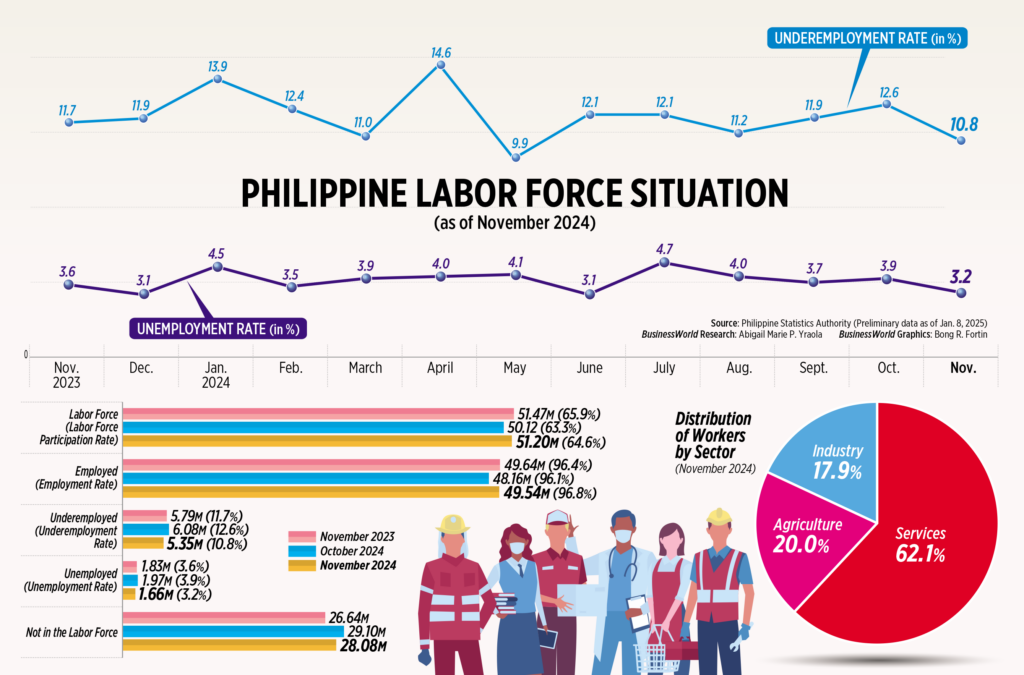
The 3.2% was the lowest unemployment rate since June 2024 when it slid to 3.1%.

For the first 11 months of the year, the jobless rate averaged 3.9%, easing from 4.5% a year ago.

Meanwhile, job quality also improved as the underemployment rate declined to 10.8% in November, the lowest since the 9.9% seen in May.  It was also lower than the 12.6% in October and 11.7% in the same month in 2023.

The number of underemployed Filipinos — those who want longer work hours or an additional job — decreased by 728,000 month on month to 5.35 million in November. Year on year, the number fell by 432,000 from 5.79 million.

The underemployment rate averaged 12% in the January-to-November period, falling from 12.4% a year ago.

“Our labor market remains robust, with consistently high employment rates and reduced underemployment. The next step is to expand business and employment opportunities to enable more Filipinos to actively and productively contribute to the economy,” National Economic and Development (NEDA) Secretary Arsenio M. Balisacan said in a statement.

PSA data also showed the employment rate rose to 96.8% in November from 96.1% in October and 96.4% in November 2023.

This is equivalent to 49.54 million employed Filipinos, higher than October’s 48.16 million but a tad lower than 49.64 million in November 2023.

Undersecretary and National Statistician Claire Dennis S. Mapa attributed the job gains in November to the holiday season when businesses hired more workers.

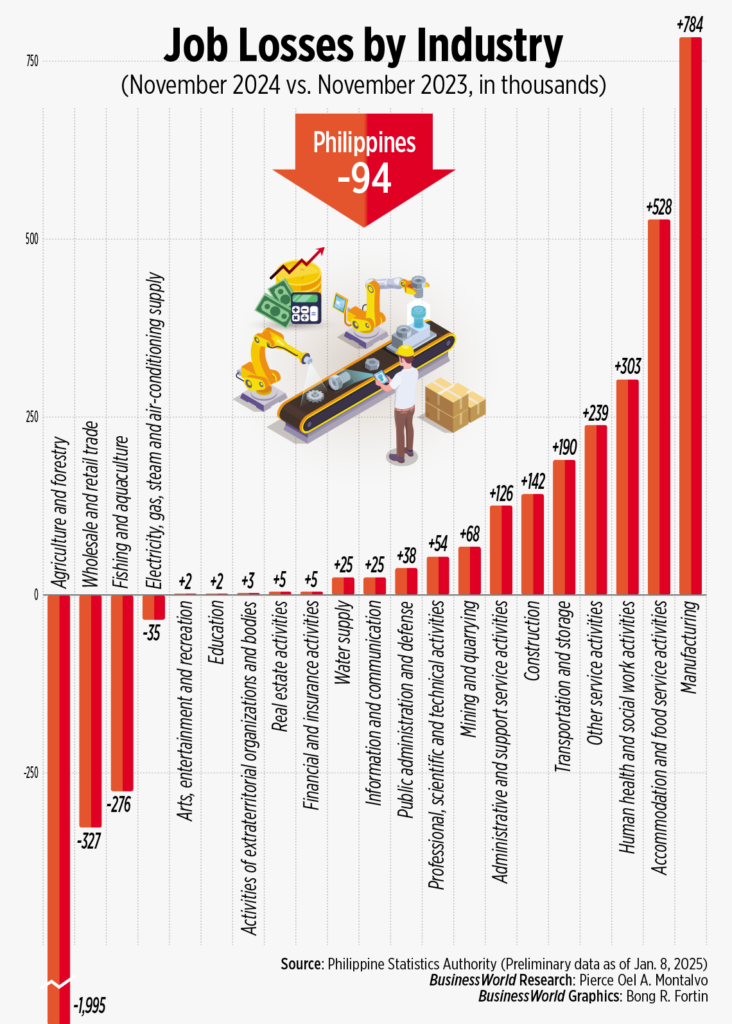
The manufacturing sector saw an annual increase of 784,000 workers to 3.71 million in November, with the majority working on consumer goods, he added.
Of the total, the manufactured bakery products sub-sector added 117,000 workers, while manufacturing of other food products, such as spices and condiments, hired 98,000 more.

On the other hand, accommodation and food service activities gained 528,000 workers to bring the total to 2.9 million in November. This included restaurants and other mobile service activities, which added 310,000 and short-term accommodation services, which hired 97,000 more.

“As expected, during the last quarter — those three months — we typically see growth in accommodation services, restaurants, and, of course, key inputs like food products,” Mr. Mapa said.

Other sectors that posted the most job gains annually were human health and social work activities (303,000); other service activities (239,000); and transportation and storage (190,000).

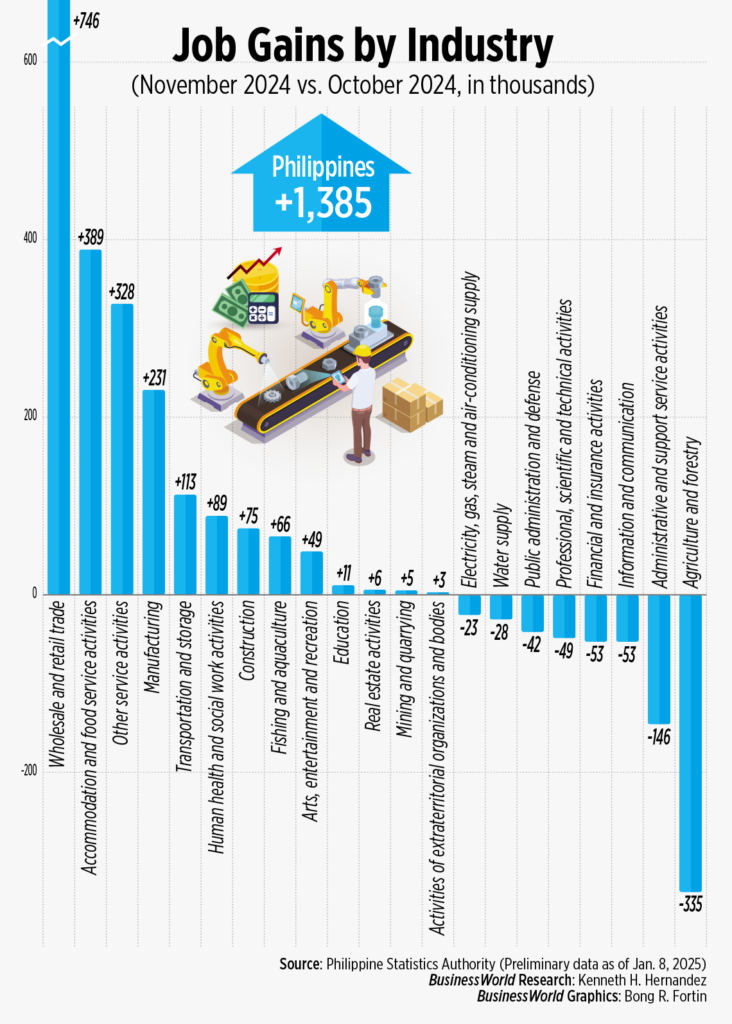
Month on month, the top five sub-sectors with the biggest job increases were wholesale and retail trade; repair of motor vehicles and motorcycles (746,000); accommodation and food service activities (389,000); other service activities (328,000); manufacturing (231,000); and transportation and storage (113,000).

AGRI JOBS
However, PSA data showed the agriculture sector shed 1.99 million jobs in November, due to several typhoons that hit the country. This brought the number of people employed in the agriculture sector to 8.71 million in November.

“During the month of November, when the labor force survey was conducted, we experienced [several] typhoons entering the country from Nov. 1 to Nov. 18. These significantly impacted our farmers and fisherfolk,” Mr. Mapa said.

“These are the two sectors that experienced a substantial year-on-year decline in the number of jobs or businesses,” he added.

Mr. Mapa noted corn farmers were “significantly affected” with 400,000 in job losses, while banana farmers lost 312,000 jobs.

Year on year, 213,000 paddy rice farmers lost their jobs in November. There were 298,000 jobs lost in planting, transplanting and other related activities, and 122,000 jobs lost in harvesting and other related activities, Mr. Mapa said.

For the fishing and aquaculture sector, marine fishing jobs fell by 286,000.

According to the PSA, the Labor Force Participation Rate (LFPR) — the economically active population, either employed or unemployed — rose to 64.6% in November from 63.3% in October but lower than 65.9% a year prior.

“While statistically, this drop is not significant (year on year), it still reflects a reduction in absolute numbers,” Mr. Mapa said.

The largest drop in the LFPR was in the 15-24 age group, which fell by 409,000, he added. The 35-44 age group saw an increase of 70,000.

When it comes to gender, the decline was more pronounced among females, with a year-on-year reduction of 239,000.

“This indicates mixed trends, with some age groups contributing to increases while others saw declines,” Mr. Mapa said.

Mr. Balisacan said the government must adopt alternative work arrangements to account for workers’ evolving preferences while considering organizations’ demands.

“We will encourage business upgrading and skills training programs to ensure that these jobs offer competitive wages as our workers raise their productivity by developing their human capital,” he said.
Finance Secretary Ralph G. Recto said the Philippine labor market continues to improve and strengthen due to the decline in inflation and faster economic growth.

“We can expect even more job opportunities to open up for our fellow Filipinos,” he said.

Labor Secretary Bienvenido E. Laguesma said he expects the jobs data to continue to improve in the coming months.

“We look forward and hope that increase in the employment rate will continue and be sustained, unemployment and underemployment rates to be on the downtrend,” he told BusinessWorld in a Viber chat.

Meanwhile, the passenger land transport sub-sector largely contributed to the decline of underemployment in November 2024 as demand increased during the holiday season.

“There was a reduction of approximately 144,000 in the number of underemployed individuals, with passenger land transport being a major contributor to this decrease. This sector also contributed to the earlier reported increase in employed persons, largely driven by activities related to the holiday season, such as transportation and storage,” he said in Filipino.

Another factor in the drop in underemployment was the “other personal service activities” sector, which added 239,000 jobs year on year.

“Many individuals in this sector appear to have transitioned to full-time employment,” Mr. Mapa noted.

“The decline in underemployment year on year was largely driven by transportation and storage, wholesale and retail trade, and domestic services,” he added.

University of the Philippines School of Labor and Industrial Relations Assistant Professor Benjamin B. Velasco said the drop in unemployment was due to the seasonal increase in economic activity in the run-up to the holidays.

He said the positive trend may continue up to the first few months of 2025 as the midterm elections spur an increase in “project-based” employment for ward leaders, election volunteers and political campaigners.

“The problem of course with such seasonal rise in employment (due to holidays or elections) is that it is temporary and part time. It does not respond to the structural constraints in the labor market which results in 4-5% unemployment and low LFPR, especially for women,” he said in a Facebook Messenger chat.

“One sign of the structural limits is the persistent bleak figures of youth employment, shown in the November LFS,” he added.


Inflation could ease to around 2% this year

VEGETABLES are on sale at a market in Tandang Sora, Quezon City, Jan. 2, 2025. — PHILIPPINE STAR/MIGUEL DE GUZMAN

By Luisa Maria Jacinta C. Jocson, Reporter

HEADLINE INFLATION could fall to around the 2% range this year amid easing price pressures, analysts said, which would be well below the projection of the Bangko Sentral ng Pilipinas (BSP).

“We maintain our forecast for consumer price index (CPI) inflation to average 2.7% in 2025 which is lower than the 3.2% in 2024, and below BSP’s baseline forecast of 3.3%,” Nomura Global Markets Research analysts Euben Paracuelles and Nabila Amani said in a commentary.

Inflation accelerated to 2.9% year on year in December from 2.5% in November.

This brought the full-year print to 3.2%, matching the Bangko Sentral ng Pilipinas’ (BSP) forecast for 2024. It also marked the first time that full-year inflation fell within the central bank’s 2-4% target since 2021, when inflation averaged 3.9%.

This year, the BSP expects inflation to average 3.3%. Accounting for risks, inflation could hit 3.4%.

HSBC economist for ASEAN Aris D. Dacanay said he expects inflation to average 2.5% in 2025, citing the continued drop in rice prices.

“Nonetheless, we think the acceleration in inflation may be short-lived, as downside risks to global oil prices persist while retail rice prices fall,” he said.

In December, rice inflation sharply slowed to 0.8% from 5.1% in November and 19.6% a year prior.

Rice is one of the biggest factors driving faster inflation, but prices have been declining since the government in July slashed tariffs on rice imports to 15% from 35% previously. This tariff regime is set to be implemented through 2028.

The Philippine Statistics Authority (PSA) has also noted the possibility for rice inflation to turn negative this month.

“Importantly, the output gap remains negative, and we continue to assume that the impact of lower rice import tariffs on food inflation will continue to play out in coming months,” Nomura said.

Nomura said inflation pressures are seen to be “well-contained” amid the government’s continued supply-side measures and its oil price assumptions.

“You also have the deflationary impulse from Chinese goods as trade gets rerouted. And at the same time, risks to global energy prices are tilted to the downside,” Mr. Dacanay said.

“Because if Fed rates are high while mainland China growth is weaker than before, the demand for global energy or at least oil, will actually get reduced, bringing down energy prices and bringing down inflation,” he added.

Meanwhile, Citi economist for the Philippines Nalin Chutchotitham projects inflation to average 3.1% this year, still below the BSP’s forecast.

She said inflation this year will continue to be “well-within policy target” despite upside risks from electricity rate increases.

“We revised up 2025 inflation from 2.8% to 3.1% on the back of planned increases in electricity rates during the first half, noting also potential further adjustments in the remainder of the year, although this may be partly offset by potentially lower oil prices,” Ms. Chutchotitham added.

With inflation expected to remain manageable, the BSP has room to continue its easing cycle.

“We see limited implications for our BSP forecasts because of the still-favorable inflation outlook, which is the main policy driver for BSP despite a more hawkish Fed,” Nomura said.

The BSP kickstarted its rate-cutting cycle in August last year, delivering a total of 75 bps for 2024. This brought the benchmark rate to 5.75% by yearend.

“We still have one more CPI print before the next BSP meeting, and unless we see another sharp pickup in headline inflation to well above 3%, we see no reason for BSP to pause,” Nomura added.

Nomura expects the BSP to deliver 75 bps worth of cuts this year in its first three meetings.

“Despite currency weakness, BSP may continue to cut rates and decouple from the Fed or regional peers, given its assessment of well-anchored inflation expectations and a limited FX (foreign exchange) pass-through,” it added.

The peso fell to the record-low P59-per-dollar level thrice last year, twice in November and once in December.

Meanwhile, Mr. Dacanay sees up to 75 bps of rate cuts by the third quarter, in increments of 25 bps.

“We updated our policy rate forecast and expect a more gradual easing cycle, wherein the BSP — mindful of Fed moves and FX volatility — will cut in alternate rate-setting meetings until the policy rate reaches 5% by the third quarter,” he said.

“However, we do not think the upside surprise in headline inflation derails the policy rate outlook altogether. Looking under the hood, the inflationary pressures seem to be short-lived in nature,” he added.

BSP Governor Eli M. Remolona, Jr. has said the central bank prefers to reduce rates in “baby steps.”

“The current policy rate remains relatively high, and given the time lag in monetary policy, we expect the BSP to continue with its gradual 25-bp rate cuts in February, the second quarter and third quarter,” Ms. Chutchotitham said.

The BSP trimmed the number of Monetary Board meetings to six this year from seven previously, citing the need for more in-depth analysis of data.

“We expect 50 bps more likely to follow in 2026 if inflation stays close to the target midpoint, thus bringing real policy rate closer to historical level and continue to support economic growth,” Ms. Chutchotitham added.

LRT-1 operator seeks to increase train fares

Commuters are seen at the Light Rail Transit (LRT) Line 1 station in this file photo taken on Aug. 2, 2023. — PHILIPPINE STAR/EDD GUMBAN

By Ashley Erika O. Jose, Reporter

COMMUTERS using the Light Rail Transit Line 1 (LRT-1) are facing higher fares as its private operator, Light Rail Manila Corp. (LRMC), is seeking another round of fare hikes.

“We are confirming that we submitted a petition as part of the periodic fare adjustments process,” LRMC Spokesperson Jacqueline S. Gorospe said in a Viber message on Wednesday.

The Department of Transportation (DoTr) is set to hold a public hearing on the fare increase petition of LRMC on Jan. 9.

LRMC filed a petition for a fare increase before the DoTr’s railway regulatory unit on May 30, 2024. In 2023, the Transportation department approved petitions to increase ticket prices at the LRT-1 and LRT-2.

“Our current fare is approved in 2023. This public hearing is for the 2024 fare application (we submitted last year) which is based on an increase from 2022 fare application submission (different from what was approved in 2023),” Ms. Gorospe said.

The current base fare for the LRT-1 is P13.29 for boarding and P1.21 per kilometer for distance.

A copy of the petition obtained by BusinessWorld showed LRMC’s request would raise the total fare for an end-to-end trip on the LRT-1 to P60 for a single-journey ticket. This is P15 more than the current fare of P45 from FPJ Station (formerly Roosevelt) in Quezon City to Baclaran Station in Pasay, including the last station of the Cavite extension Phase 1.

For users of stored value cards, the maximum fare would go up to P58 from the current P43 for end-to-end trips.

To justify the fare hike petition, LRMC said they have made substantial operational improvements and system upgrades “at a cost of P24 billion” since it took over the LRT-1 in September 2015.

“While it is aware that an increase may be significant for some of its passengers, however, petitioner believes that passengers understand and accept fare increase in exchange for improvements in the system and service,” LRMC said.

In the petition, LRMC said the average fare increase would be P7.48 for LRT-1 passengers who travel an average distance of 7.16 kilometers.

Mid-distance passengers that travel more than five kilometers to 16 kilometers would pay an average of P6.02 more, while short-distance passengers would see their fares increase by P8.65.

“An average increase of only P12.50 for long-distance passengers, which are passengers that travel more than 16 kilometers on the existing system. Only 1.88% are long-distance passengers,” LRMC said.

Renato M. Reyes, Jr., secretary general of Bagong Alyansang Makabayan (Bayan), said they are opposing the proposed LRT fare hike, the second under the Marcos administration.

“We call on commuters to make their voices heard and to register their strong opposition to the fare hike. The Marcos regime is ultimately liable for the looming fare increase,” he said.

Transportation Assistant Secretary for railways Jorjette B. Aquino told BusinessWorld the DoTr will take into account the comments from the public before deciding on LRMC’s petition.

Ms. Aquino said the DoTr is expected to come up with a decision a month after the public hearing.

“As per the Rail Regulatory Unit Rules and Regulations, a maximum of 30 days from the day of public hearing. It is part of our job and commitment to do proper review and evaluation of their petition,” Ms. Aquino said.

Terry L. Ridon, a public investment analyst and convenor of think tank InfraWatch PH, said the DoTr must properly evaluate the fare adjustment petition filed by the LRMC.

“The DoTr must determine whether LRMC had already delivered on its prior commitments to build new infrastructure and adequately maintain the rail system,” Mr. Ridon said.

LRMC is the joint venture of Ayala Corp., Metro Pacific Light Rail Corp., and Macquarie Infrastructure Holdings (Philippines) Pte. Ltd. Metro Pacific Light Rail is a unit of Metro Pacific Investments Corp., which is one of three Philippine subsidiaries of Hong Kong’s First Pacific Co. Ltd., the others being PLDT Inc. and Philex Mining Corp.

Hastings Holdings, Inc., a unit of PLDT Beneficial Trust Fund subsidiary MediaQuest Holdings, Inc., maintains interest in BusinessWorld through the Philippine Star Group, which it controls.

PHL most insulated to Trump tariffs among ASEAN — HSBC

US PRESIDENT-ELECT Donald J. Trump is set to assume office on Jan. 20, 2025. — REUTERS

By Luisa Maria Jacinta C. Jocson, Reporter

THE PHILIPPINES is the most insulated from US President-elect Donald J. Trump’s planned restrictive policies among Association of Southeast Asian Nations (ASEAN) economies, HSBC said.

“Across ASEAN, the Philippines is the most resilient country amidst these tariff risks,” HSBC economist for ASEAN Aris D. Dacanay said at a media briefing on Wednesday.

“Vietnam, Thailand, these are the countries exposed to the risk of US tariff rates. But for the Philippines, we are very insulated from that risk.”

The President of the world’s most powerful economy is seeking to implement stricter tariffs and tighter immigration measures, among other policies.

Mr. Trump, who is set to assume the US presidency on Jan. 20, has pledged to impose a 10% universal tariff as well as a 60% tariff on Chinese goods.

Mr. Dacanay flagged the inflationary pressures that could stem from these policies but noted that the impact may be more “watered down” than initially expected.

“We don’t think that these policies will be enacted in full, but they will be enacted to a certain extent. To what extent remains to be uncertain. The good news is, ASEAN is a good place to be.”

For the Philippines in particular, Mr. Dacanay cited the country’s minimal goods export exposure to the US. 

“One, our trade surplus or the US trade deficit with the Philippines is negligible. Putting a tariff rate on the Philippines will not really lead to so much,” Mr. Dacanay said.

On the other hand, he noted the Philippines’ services exports exposure to the US is the highest in ASEAN.

“Why is that good? Because you cannot put a tariff on services. You cannot put a tariff on the internet. You cannot put a tariff on digitalization. The name of the game today is artificial intelligence. And that’s where the Philippines is in the position to rise and shine.”

Earlier data from the central bank showed the Philippines booked $37.4 billion worth of services exports in the first nine months, up 6.25% from a year earlier.

“These are services exports that are not taxed, that have zero risk of tariffs. As we speak, services foreign direct investments (FDI), greenfield FDI in services is exceeding manufacturing. That’s the name of the game in the next four years.”

Meanwhile, Mr. Dacanay also cited the Philippines’ robust fiscal space, which will help it cushion any challenges.

“Tax revenue-to-gross domestic product (GDP) is falling everywhere else in ASEAN. It is only in the Philippines where the tax revenue-to-GDP ratio is actually rising,” he said.

“Because of that, we do have a space to invest in our long-term goals. You cannot put a tariff rate on these public infrastructure investments. The spending that we spend on public infrastructure is our load. It is not dependent.”

The Marcos administration plans to spend 5-6% of GDP on infrastructure annually.

“The growth drivers in public services, infrastructure spending, consumption, these are not exposed to tariff risks. And it is for this reason why I think growth in 2025 will average at around 6.3%,” he added.

While the Philippines is the most insulated compared to its neighbors, Mr. Dacanay said it still faces some risks.

“These tariff risks go through one part of our economy, and that is monetary policy. Markets are now pricing in higher interest rates in the US.”

“Of course, this matters for the Philippines because we cannot cut below the Fed. Cutting too much ahead of the Fed will introduce risks, currency, volatility, which of course as we saw in October 2022 when the peso hit P59 the first time, there were financial risks that occurred during that time.”

Last year, the peso fell to the record-low P59-per-dollar level thrice as the dollar surged on bets of slower rate cuts by the US Federal Reserve amid inflation concerns.

“HSBC expects the BSP to cut in step with the US central bank to mitigate these risks. We do have a view that the BSP will follow the Fed one-to-one in its easing cycle,” he said.

The Fed in December projected just two rate cuts for 2025, lower than the four it had earlier predicted. Markets are currently pricing in even less than that at 38 basis points, with the first cut fully priced in for July, Reuters reported.

Mr. Dacanay said they now think the BSP will continue to ease, bringing the policy rate of 5% by the third quarter, not the second quarter as earlier projected.

“We’re pushing this back to the third quarter of 2025, mainly because to be able to manage the higher interest rates in the US, the BSP will need to follow the Fed and gradually cut interest rates as well to keep the peso stable.”

However, this outlook may change if Mr. Trump’s proposals come into full force.

“If our call is wrong and that these policies do happen in the second half of 2025 in full, the Fed may need to keep interest rates higher. It may even jack up interest rates if inflation does go up significantly. And that would mean for the Philippines, the BSP may delay its easing cycle.”

The BSP has delivered a cumulative 75 basis points (bps) worth of rate cuts last year since it began it easing cycle in August. This brought the key rate to 5.75%.

Mr. Dacanay said the current policy rate is still restrictive.  “We are not at neutral. If interest rates are higher, that is a slowdown for investment. The biggest risk for the Philippines is if the Fed does increase rates again.”

Meanwhile, HSBC expects the peso to sink to beyond the record-low P59 but not past P60.

“We do have to take it into context, all Asian currencies will depreciate across the board but the Philippines will be among the most resilient ones,” Mr. Dacanay said,.

He also noted that the BSP has more reserves compared to other central banks in the region, and is active  in managing volatility.

“The US dollar will strengthen but the Philippines will depreciate to a lesser extent and it will come in the second quarter when favorable seasonality diminishes.”

ABS-CBN shares jump 27.47% on franchise bill filing

“AT THIS POINT, trading is mostly speculative as there is a lot of uncertainty around the fate of the proposed measure” — China Bank Capital Corp. Managing Director Juan Paolo E. Colet. — BW FILE PHOTO

SHARES of listed ABS-CBN Corp. surged a day after a fifth bill seeking to grant the media giant a 25-year franchise was filed in the House of Representatives.

On Wednesday, ABS-CBN Corp. shares rose 27.47% or P1.39 to P6.45 apiece. The company’s shares traded as high as P7.46 per share intraday.

ABS-CBN Holdings Corp. Philippine Deposit Receipts likewise climbed by 33.33% or P1.50 to P6 per share. It reached an intraday high of P6.75 apiece.

In a stock exchange disclosure, ABS-CBN Holdings said it has “no undisclosed information” that could have triggered the surge in share price.

China Bank Capital Corp. Managing Director Juan Paolo E. Colet said in a Viber message that the price surge in ABS-CBN shares showed the market’s reaction to the filing of the House bill.

He said the trading of ABS-CBN stocks is currently speculative amid uncertainties, with a sustained rise dependent on the bill’s progress.

“At this point, trading is mostly speculative as there is a lot of uncertainty around the fate of the proposed measure,” Mr. Colet noted.

“The next several weeks and months might see opportunistic speculation in the stock as some investors bet that this bill has a serious chance given current political dynamics. Whether this becomes a sustainable rally depends on positive developments in the legislative process,” he added.

On Tuesday, Albay Rep. Jose Ma. Clemente S. Salceda filed House Bill No. 11252, over four years after lawmakers denied ABS-CBN’s initial franchise renewal application.

In May 2020, ABS-CBN was forced to stop broadcast operations after the allies of former President Rodrigo R. Duterte in Congress denied the media company’s franchise renewal application, citing franchise violations such as tax issues.

“It’s definitely a reaction to the bill filed by Mr. Salceda to reinstate ABS-CBN’s franchise, and we’ll likely continue to see the market pricing in the prospect of the company getting a congressional franchise again,” AP Securities, Inc. Research Head Alfred Benjamin R. Garcia said in a Viber message.

“The caveat here is that we need to see the bill progress, unlike the three other bills pending at the committee level,” he added.

Meanwhile, COL Financial Group, Inc. Chief Equity Strategist April Lynn Lee-Tan said in a Viber message that the franchise renewal would provide a boost to ABS-CBN’s revenue.

“It would be good if ABS-CBN gets its franchise renewed as it got bulk of the revenue from advertisements, historically,” she said.

For the first nine months of 2024, ABS-CBN saw a 22% decline in its consolidated net loss to P2.59 billion, led by the lower net loss in its content production and distribution segment.

ABS-CBN recorded a 10.4% drop in consolidated revenue for the period to P12.12 billion due to lower cable TV and broadband revenues.

In a separate statement, ABS-CBN expressed gratitude to Mr. Salceda.

“While we were not aware of Mr. Salceda’s filing of a bill to grant a broadcast franchise to ABS-CBN…, we are deeply grateful for his support and belief in ABS-CBN’s contributions and mission to serve the Filipino public,” the media company said.

“We would also like to express our sincerest thanks to Reps. Gabriel H. Bordado, Jr., Arlene D. Brosas, France L. Castro, Raoul Danniel A. Manuel, Johnny T. Pimentel, and Rufus B. Rodriguez, who have previously filed similar bills,” it added. — Revin Mikhael D. Ochave

Cebu Pacific’s new loan to fund green initiatives, fleet growth

SILVER RINGVEE–UNSPLASH

CEBU PACIFIC, operated by Cebu Air, Inc., has secured a sustainability-linked loan to help fund its decarbonization efforts and fleet expansion plans.

“Cebu Pacific’s first sustainability-linked aircraft financing is a milestone in our decarbonization journey, as the transaction supports the core element of our program—the modernization of our fleet towards more advanced and fuel-efficient aircraft,” Cebu Pacific Chief Financial Officer Mark Julius V. Cezar said in a media release on Wednesday.

The airline said the terms and amount of the loan remain confidential.

“The financing has been structured to align with Cebu Pacific’s strategic goals and fleet expansion plans,” it noted.

The airline said the sustainability-linked loan is the first of its kind in Southeast Asia for low-cost carriers.

“This landmark deal highlights CEB’s commitment to decarbonizing its operations and reinforces its leadership in sustainable air travel within the region,” it added.

It said the loan was arranged by Crédit Agricole CIB and was structured under a Japanese Operating Lease with Call Option.

Sustainability-linked loans are corporate loans aimed at facilitating environmentally and socially sustainable initiatives.

As part of the sustainability-linked loan agreement, Cebu Pacific has committed to achieving its goal of reducing the carbon emission intensity of its aircraft fleet.

“Meeting these targets will result in financial incentives for the airline under the loan,” Cebu Pacific said.

“With this deal, we want to emphasize that access to financing for sustainability initiatives is available and that Cebu Pacific is taking full advantage of such opportunities in our pursuit of being the decarbonization leader in the region,” Mr. Cezar said.

The loan has helped fund the acquisition of a brand-new Airbus A321 new engine option (NEO) aircraft, which it received in December last year.

Airbus’ NEO aircraft is known for its enhanced fuel efficiency, representing the latest generation of Airbus planes designed to be highly compatible with sustainable aviation fuel (SAF).

Cebu Pacific has set a target to fully shift to an all-NEO fleet by 2028.

“The SLL represents a critical step in CEB’s broader efforts to integrate sustainability into its financial and operational strategies. As the airline enters 2025, it aims to maintain its leadership in the domestic aviation sector, set a benchmark for the industry, and champion sustainable air travel,” Cebu Pacific said.

Cebu Air shares closed 0.17% higher at P29.40 apiece on Wednesday. — Ashley Erika O. Jose

New on the menu at The Farm

IT WAS really just a Beef Consommé, a Caesar Salad, and a Beef Tenderloin for dinner on Dec. 11. The thing is, all these dishes were served at the eco-luxury wellness resort The Farm at San Benito, and that made all the difference. The Farm, after all, is best known for its raw food and vegan-vegetarian orientation. That meat is now a focus on the menu, and is a seismic change.

The Farm at San Benito welcomed guests last month for a tasting at their new dining outlets, namely Souffle De Vie, a French fine-dining restaurant, and The Upperdeck, a Mediterranean wholefood, farm-fresh, heart-healthy restaurant. These join the resort’s roster of restaurants, rounding it out to five: Halal-certified Alive! Vegan Restaurant offering whole, plant-based living food gourmet cuisine; Prana, an Indian-vegetarian restaurant inspired by Ayurveda; and PESCE, a pescetarian restaurant.

“We realized that there’s actually a lot to offer with the right ingredients, the right organic cuisine,” said Rajan Uttamchandani, director of The Farm at San Benito, at a press conference. “We have something for every guest, every person… we want to have something for everyone in the family.”

Preet Singh, general manager of The Farm at San Benito added, “(Not) everybody’s on a vegan diet or organical(ly) supervised programs.” Some of their guests, after all, are just there to accompany people undergoing The Farm’s detox and wellness programs.

Mr. Uttamchandani said, “Our detox programs are still all available. Our wellness programs are still all available. The menus for these programs,” he said, “are very strict.”

“But if you’re here as an accompanying guest to someone doing the detox program, you shouldn’t be subjected to the same cuisine.”

Even if they’re serving meat now, it still keeps the essence of the wellness component at The Farm. “Guests can expect dishes crafted with fresh, organic, seasonal, and locally sourced ingredients, many of which are harvested directly from The Farm’s on-site vegetable and herb gardens.

“When The Farm first opened, its focus was exclusively on vegan raw living foods to support detoxification and natural healing. Over time, the menu evolved to include sustainably sourced meat, reflecting The Farm’s mission to encourage a gradual and accessible journey toward healthier eating habits. Pasture-raised chicken, wild-caught seafood, and grass-fed meat were introduced — all free from hormones and antibiotics,” he said in a statement.

“We have gardens here, we grow all our seasonal fruits and vegetables, which serve an organic farm-to-table concept to us,” he said during the press conference.

At the tasting, there was an appetizer of Scallops with Fennel-Beetroot Puree — wild-caught, they said, so it had a clean and sweet flavor with just a touch of the ocean. The Beef Consommé was a bit cleaner than usual, and a bit of a liver aftertaste. The salad was fresh (but nothing to write home about), but the beef, well: it had a mild, almost buttery flavor, and we pronounce it cleaner-tasting than what we can find in the city.

OTHER THINGS ON THE MENU
Before dinner, we were taken to a new section of The Farm, where we were shown their 15 new Acacial Wellness Residences — villas, 80% of which are spoken for. It’s luxury all the way: the four-bedroom homes have stunning views of the mountains surrounding the resort. These residences offer a 99-year lease long-term investment, and when they’re not in use, they can be included in the rental program. A villa is available for a 99-year lease for about P100 million according to a resort employee, while a unit can be rented for about P150,000 to P180,000 a night.

And that is not all. “It was announced in the media that Megaworld is exploring a partnership with us,” said Mr. Uttamchandani, specifically on a 25-hectare property adjacent to The Farm. “They’ll have access to The Farm, of course, and also embrace the wellness community lifestyle.”

In a statement, he said, “Through our partnership with Megaworld Corp., we are turning our vision of a holistic wellness community into reality with the San Benito Private Estate, a 25-hectare active wellness township adjacent to The Farm at San Benito. This groundbreaking project will redefine health-oriented living, seamlessly integrating the world-class wellness facilities of The Farm with a nature-inspired lifestyle. San Benito Private Estate is purposefully designed as a sanctuary for residents, blending wellness, community, and modern conveniences in an eco-sustainable environment. The township will feature residential village lots, low-rise condominiums, community gardens, a sports and leisure hub, commercial shops, and nature walk trails, all nestled in a lush, green landscape.”

Mr. Singh said, “As we grow, it’s also not just food. I think it’s as a whole place, as we grow. We’re going in different countries, we’re going in different places. We might even grow more in the Philippines. We are going to replicate all of this, perfect this, and go out.” — Joseph L. Garcia

PHINMA completes P431.8-M acquisition of Cavite school

STJUDE.EDU.PH

PHINMA CORP. said its subsidiary PHINMA Education Holdings, Inc. has completed the acquisition of St. Jude College (SJC) Dasmariñas Cavite, Inc.

The purchase of SJC Dasmariñas Cavite, Inc. was completed on Jan. 7 after closing the acquisition of land and buildings and payment of debt with a combined value of P344 million, PHINMA Corp. said in a stock exchange disclosure on Wednesday.

PHINMA Education announced its acquisition of SJC Dasmariñas Cavite, Inc. for P431.8 million in December.

The share and asset purchase agreement signed between the two groups involved two closings, with the first one being the acquisition of controlling shares of SJC Dasmariñas Cavite for P85 million.

The acquisition brought PHINMA Education’s total student network to 167,000 and marked the company’s entry into the Cavite market.

SJC Dasmariñas Cavite is PHINMA Education’s tenth school in the country and twelfth in its regional network.

Established in 1968, SJC Dasmariñas Cavite offers a variety of tertiary and graduate programs such as Nursing, Radiologic Technology, Psychology, Hospitality Management, and Computer Science.

Other schools within the PHINMA Education network include PHINMA Araullo University in Nueva Ecija, PHINMA Cagayan de Oro College, PHINMA University of Iloilo, PHINMA University of Pangasinan, PHINMA Saint Jude College Manila, PHINMA Saint Jude College Quezon City, PHINMA Rizal College of Laguna, PHINMA Union College of Laguna, and Southwestern University PHINMA.

The company also has a presence in Indonesia through Horizon Karawang.

PHINMA Corp. shares fell by 2.7% or 50 centavos to P18 apiece on Wednesday. — Revin Mikhael D. Ochave