Home Blog Page 1636

Villar-led Vista Land’s 2024 profit climbs 11% to P9.36B

Allegria, General Trias, Cavite — VISTAESTATES.VISTALAND.COM.PH

VILLAR-LED property developer Vista Land & Lifescapes, Inc. reported an 11% increase in core net income to P9.36 billion in 2024 from P8.45 billion in 2023, driven by higher revenues from real estate sales.

In a regulatory filing, the Villar-led property developer said total consolidated revenues rose by 5% to P36.96 billion from P35.16 billion the previous year.

Real estate sales revenue increased by 9% to P16.63 billion, attributed to a higher overall completion rate of sold inventories across some business units, and the recognition of a significant financing component.

Rental income grew by 4% to P16.61 billion due to higher rental rates.

Meanwhile, revenue from parking, hotel, mall administrative and processing fees, and other income declined by 20% to P1.69 billion, following lower forfeitures.

Interest income rose by 12% to P2.03 billion amid higher returns from investments.

Operating expenses fell by 8% to P10.69 billion, mainly due to reduced provisions for impairment losses and lower repairs and maintenance costs.

As of end-2024, the company’s total assets rose by 11% to P380.51 billion, while total liabilities increased by 16% to P243.22 billion, following higher accounts and other payables, and the recognition of deferred tax liabilities.

The value of real estate inventories fell by 9% to P58.16 billion due to project launches in the previous year and the reversal of capitalized interest.

Earlier this week, Vista Land’s offshore subsidiary, VLL International, Inc. (VLLI), secured a $150-million syndicated term loan facility from Sumitomo Mitsui Banking Corp., with an interest rate of 6.40509% per annum.

Proceeds from the facility will be used to finance, refinance, or reimburse working capital and general corporate purposes of the Vista Land Group.

VLLI’s obligations under the loan are guaranteed by Vista Land and its subsidiaries, including Brittany Corp., Crown Asia Properties, Inc., Camella Homes, Inc., Communities Philippines, Inc., Vistamalls, Inc., and Vista Residences, Inc.

Vista Land shares declined by 1.83% or three centavos to close at P1.61 apiece on Thursday. — Revin Mikhael D. Ochave

Aussiewood to Mel Gibson: Save us from Trump’s movie tariffs

COMMONS.WIKIMEDIA.ORG

SYDNEY/GOLD COAST, Australia — Australia’s film industry wants actor Mel Gibson to do what he does in his action-hero movies and save the day, by convincing US President Donald J. Trump to drop his film tariffs which could devastate its A$1 billion ($650 million) Hollywood business.

This as the UK says discussions are underway with US officials, and one of the world’s biggest movie-making centers, Bollywood, frets over the news.

Australian industry leaders said the tariffs would cause a large number of job losses in the local film production sector, drive up ticket prices, and called for US-born Mr. Gibson, who launched his career in Australia, to use his role as a Trump adviser to urge the president to reconsider.

In January, Mr. Trump hired Mr. Gibson as a “special ambassador” to Hollywood although he didn’t elaborate on his role.

“Hopefully Mel Gibson, as one of Trump’s advisers in this space, is telling the President that this is a dumb idea,” Kate Carnell, chair of industry body Screen Producers Australia, said in an interview.

Mr. Gibson plans to shoot a movie in Italy this year, according to industry media, which could be impacted by the US tariffs.

“For Mel Gibson to make his movie in Italy and then to have a 100% tariff for it to be shown in America is just nonsensical,” said Ms. Carnell.

Mr. Trump on Sunday announced a 100% tariff on movies produced outside the US, saying the American movie industry was dying a “very fast death” due to the incentives that other countries were offering to lure filmmakers.

Mr. Trump’s latest tariff announcement bewildered studio executives who for decades have overseen productions across several continents and could not understand how it would work. It also sent shockwaves through film industries abroad where Hollywood shoots movies for cheaper production costs.

AUSTRALIAN FILM INDUSTRY AT RISK
Since the first Star Wars prequels and Matrix sequels were shot in Sydney in the early 2000s with the Australian dollar near a record-low against the US dollar, Australia’s film industry has become enmeshed with Hollywood.

International spending on film and television productions in Australia was about half the industry’s total A$1.7 billion expenditure in 2024, says Screen Australia, a government body, which noted the overall figure fell 29% since the prior year partly due to a Hollywood writers’ strike.

“One hundred percent tariffs would be devastating for the Australian film industry… we’re talking about a lot of jobs (lost), hard to put a number on them,” Ms. Carnell said, adding Australia’s US film business was worth around A$1 billion. “People are saying, ‘how could they do this? It’s so stupid.’”

Ms. Carnell said if Hollywood studios spent more shooting all movies in the US, “their costs would go up, and so the costs to consumers, to people who see movies, would go up as well.”

Kate Marks, chief executive officer (CEO) of Ausfilm, which connects international studios with Australia, said the US had a “long and mutually beneficial history” of collaborating on films with Australia.

“We are closely monitoring the situation and awaiting further details and will continue to work with our industry and government partners,” she said.

In the state of Queensland, home to Village Roadshow Studios where Marvel’s Thor: Ragnarok and Warner Bros’ Aquaman were shot, the state’s screen agency said the industry was “globally connected” and involved collaboration with national and international partners.

“The proposed US film tariff has caused widespread global uncertainty and we’re closely monitoring this evolving situation,” CEO Jacqui Feeney said.

A government spokesperson for the state of Victoria, where Docklands Studios Melbourne is based, said the state would always back local screen and production workers.

“Victoria’s world-class crews, state-of-the-art studios and award-winning digital and post-production capabilities means Victoria is a destination of choice for global productions,” the spokesperson said.

UK IN TALKS WITH US OFFICIALS
Britain is in “active discussions” with top US officials over the 100% tariff, as it aims to protect one of its biggest creative industries.

“We are already in active discussions with the top of the US administration on this subject. We are working hard to establish what might be proposed, if anything, and to make sure our world-beating creative industries are protected,” creative industries minister Chris Bryant told parliament on Wednesday.

Mr. Bryant noted that Mr. Trump had not given any details about his proposal, adding that it was not clear how tariffs could be applied to the film industry, with productions often created and developed across different locations and countries.

Britain has a leading film and TV production industry, centered on studios located close to London.

Production spending on films in Britain in 2024 totaled $5.91 billion, according to ProdPro, compared with $14.54 billion in the United States.

INDIA’S FILMMAKERS ALARMED
Meanwhile, India’s film industry, which earns roughly 40% of its overseas revenue from the United States, sounded the alarm this week about higher costs.

Filmmakers, producers, and distributors in one of the world’s largest film industries by output struggled to weigh the likely impact of such a tariff as Mr. Trump provided scant details, stirring more questions than answers.

“The real question is how the term ‘foreign produced’ will be defined, and until that’s clear, it’s hard to say anything,” said filmmaker Anubhav Sinha, known for his Netflix streaming series, IC 814: The Kandahar Hijack.

“It’s not yet clear whether services like post-production will be affected.”

India’s film industry employs 272,000 people, with overseas box office takings of about 20 billion rupees ($237 million) in fiscal 2024, or a tenth of total earnings, Deloitte and studio grouping the Motion Picture Association said in a report.

Key Hollywood films with India scenes are Oscar-winners such as the rags-to-riches tale Slumdog Millionaire, and the Osama bin Laden manhunt thriller, Zero Dark Thirty, along with rom-com Eat, Pray Love, and Batman outing The Dark Knight Rises.

In the absence of details on the planned levy, film producers worry it could double the cost of exporting their films to the United States, where people of Indian descent are estimated to number 5.2 million.

“The United States is one of the most important overseas markets for Indian cinema, largely due to the substantial diaspora,” said producer Madhu Bhojwani, responsible for hits such as Airlift, on workers evacuated from Kuwait during the Gulf War.

“Any increase in ticket prices resulting from these tariffs would directly affect audience turnout, compounding the challenges posed by evolving consumer behavior and broader industry headwinds.”

The cost-effective South Asian nation has also grown in stature as Hollywood’s preferred hub for on-ground production and post-production services, especially in visual effects, since it offers a skilled talent pool.

“Almost 10 to 15 (foreign) movies are shot in India every year, and our movie industry will be impacted very badly,” said film trade analyst Komal Nahta.

LIKELY HIT TO REVENUE
Prominent Indian actor and producer Prakash Raj called Mr. Trump’s move “tariff terrorism.”

If the tariff covers post-production services, the consequences will be bigger, added Bhojwani, the co-founder of Emmay Entertainment and Motion Pictures. “We can expect a potential decline in outsourced work from US studios to Indian vendors, which could have notable implications for the Indian media services sector,” she said.

“If revenue from the US drops, it could affect budget planning and profitability for Indian production houses,” said Pradeep Dwivedi, chief executive of Eros International Media. “Big-budget films counting on overseas revenue could be restructured or scaled back.”

The move will also hurt smaller releases in the United States.

“Even a 30% drop in revenue for such mid-scale movies would be a significant dent,” said Raj Kandukuri, producer of a well-regarded film, Pelli Choopulu, in India’s southern language of Telugu. “There are a sizeable number of students in the United States who watch movies, they will not spend high on ticket prices.”

The planned levy might also drive a broader shift to digital platforms.

“US distributors might be less inclined to pick up Indian titles due to the increased cost,” Mr. Dwivedi said. “This could result in fewer screens, smaller releases, and a shift toward digital platforms instead of theatrical. The tariff would likely accelerate a move toward direct-to-digital releases on platforms like ErosNow, Netflix, Amazon Prime, and Hulu.” Reuters

Nickel Asia Q1 profit jumps to P501.03M on higher ore prices, CBNC stake sale

NICKELASIA.COM

NICKEL ASIA Corp. (NAC) reported a 148% increase in its first-quarter (Q1) net income to P501.03 million, driven by stronger ore prices and a one-time gain from the sale of its stake in Coral Bay Nickel Corp. (CBNC).

In a disclosure on Thursday, NAC said the earnings boost included an P800-million gain from the sale of its 15.625% equity interest in CBNC to Sumitomo Metal Mining Co. Ltd. (SMM) in February. SMM previously held the remaining 84.375% stake in the Palawan-based hydrometallurgical processing plant.

Revenues from saprolite and limonite ore sales rose by 16% to P2.36 billion from P2.03 billion in the same period last year, lifted by higher prices.

The company’s weighted average sales price for nickel ore increased by 18% to $16.40 per wet metric ton (WMT) from $13.84 per WMT a year earlier. It also realized an average foreign exchange rate of P57.85 per US dollar, up from P56.13 last year.

Average export prices for saprolite ore, totaling 0.66 million WMT, surged by 43% year on year to $36.60 per WMT from $25.57 per WMT.

“Moreover, the company delivered 1.82 million WMT of limonite ore to the CBNC and Taganito HPAL plants, the price of which is linked to the London Metal Exchange,” NAC said.

Earnings before interest, taxes, depreciation, and amortization (EBITDA) fell to P969.63 million from P1.05 billion.

NAC also said that ore deliveries from the Taganito mine were affected by plant maintenance at the Taganito HPAL Nickel Corp.(THPAL) facility in March. THPAL is a CBNC subsidiary that processes limonite ore into mixed nickel-cobalt sulfide.

The company recognized P91.91 million in losses from its equity share in the THPAL project, narrowing the loss by 53% from P193.9 million in the same period last year following the divestment from CBNC.

EQUITY INFUSION
NAC has also approved a P2.53-billion equity infusion into its renewable energy subsidiary Emerging Power, Inc. (EPI), the company said in a separate disclosure on Thursday.

The investment, approved during the board meeting held on May 8, consists of a subscription to 1,333,684,211 EPI common shares at P1.90 per share. The transaction will be executed upon approval of the increase in EPI’s authorized capital stock.

The latest move follows NAC’s disclosure on Feb. 27 regarding its plan to inject additional capital into EPI, which develops and operates renewable energy projects.

NAC has been diversifying into clean energy as part of its long-term strategy to reduce dependence on mining revenues. — Kyle Aristophere T. Atienza

Catch them while they are young

Minsan Fest to bring live OPM to students, young fans

ORIGINAL PILIPINO MUSIC (OPM) acts The Itchyworms, Mayonnaise, TONEEJAY, SUD, Ebe Dancel, The Ridleys, Zild, Autotelic, Reese Lansangan, Clara Benin, Minaw, and thesunmanager are the 12 headliners gracing the inaugural Minsan Fest stage this May.

Independent events production company Minsan Studio told BusinessWorld in a Zoom interview that the festival is “a culmination of many pay-what-you-can shows and gigs over the past few years,” which targeted the younger crowd.

“We decided to scale up, so that’s why the venue is the Quezon Memorial Circle,” said Minsan Studio head Jason Conanan. “Most elder millennials have the buying power to go to a concert, but they’re not the ones actively posting or talking about the bands. It’s the youth, it’s the kids. This is our way of giving back.”

The summer outdoor festival is scheduled for May 17 from 3 p.m. onwards at the Quezon Memorial Circle in Quezon City. It aims to provide “an affordable and inclusive live music experience, designed specifically to be accessible for students and young fans.”

Tickets to the festival come in the form of the minsan pass, an eco-friendly scannable pass that can be either a lanyard or a bag tag, priced at P349 for attendees aged 24 and below and P699 for those aged 25 and above.

Mr. Conanan explained this pricing: “Once these young ones enter the workforce, they’ll continue to support their favorites throughout their careers. This event that allows them to experience a festival of this scale without having to ask their parents for extra money.”

The minsan pass will also serve as a digital contact card that will not only grant entry to the Minsan Fest, but also provide early access to information about the production outfit’s future events, ranging from gigs and podcasts to music training workshops.

Another thing that sets Minsan Fest apart from other music festivals is its egalitarian approach to artist billing. All 12 of the headliners are equals, “recognizing each artist’s unique fanbase and presence.”

Mr. Conanan, who has worked as a sound engineer and editor for various musicians, said that Minsan Studio’s gigs come from the income of their adjacent events production and documentation company, Livecatch.

“Using the resources from that, we buy our own cameras and lights. Then we’re able to do music-related projects like gigs,” he explained. “We can produce them at a low price point because we own a lot of the equipment, and every time we make money, we reinvest.

“We’re on track to make a Minsan Fest feasible, to repeat it year after year,” he added.

Their line of work in documentation also guarantees that performances are recorded in high quality, to be used as a valuable marketing tool for bands to expand their reach.

The Quezon City local government is a partner organizer of Minsan Fest, hence the venue and the eco-friendly passes. Festivalgoers can also expect to find food and beverage vendors at the Circle.

As a music fan himself, Mr. Conanan said that the long-term vision for Minsan Studio is to “start a movement of experience-building centered on the youth.”

“I think the future is bright. There are different festivals out there, but I know and understand the market that I want to give back to. It’s the kid who can’t afford a P3,000 or P5,000 music festival,” he said.

“We can give them an affordable lifelong experience and build up the local music fanbase. Hopefully more people will catch on.”

Tickets to Minsan Fest are available via minsan.studio/festival. — Brontë H. Lacsamana

IMTAP & PSMEX 2025 kick off with a grand opening ceremony at World Trade Center Manila

The 2nd International Machinery, Tools & Accessories Philippines (IMTAP 2025) and 3rd Philippine Subcon & Manufacturers Exhibition (PSMEX 2025) officially opened on May 8, 2025, with a well-attended and high-energy ceremony at the Lobby of Hall A, World Trade Center Metro Manila.

The event welcomed hundreds of industry leaders, government officials, exhibitors, and professionals from the manufacturing and subcontracting sectors.The program commenced at 10:00 a.m. with the Invocation, Colors performed by the University of Perpetual Help System-DALTA, followed by the National Anthem.

Hermie O. Flores, president of the Aerospace Industries Association of the Philippines (AIAP); and Angelica Andrea P. Barrios, marketing director of MAI Events Management, delivered the welcome remarks, acknowledging sponsors, partners, and special guests.

Keynote messages were delivered by:

  • Engr. Robert O. Dizon, executive director of the Metals Industry Research and Development Center (DoST-MIRDC), for IMTAP 2025
  • Tereso O. Panga, director-general of the Philippine Economic Zone Authority (PEZA), for PSMEX 2025

Dennis Y. Chan, chairman of AIAP, delivered the official Exhibit Opening Message, followed by the Ribbon-Cutting Ceremony at 11:00 a.m., signaling the official launch of the exhibitions.

Attendees then participated in a photo session and exhibition tour which showcased the latest in tools, machinery, subcontracting services, and advanced manufacturing technology.

The ceremony was hosted by DJ Samantha of 96.3 Easy Rock, who brought energy and warmth to the proceedings.


Visitors are welcome to attend IMTAP & PSMEX 2025 free of charge. The event also features a series of technical seminars led by industry experts, offering valuable insights on the latest trends in manufacturing, automation, innovation, and supply chain development. These sessions are open to all attendees and present a great opportunity to learn, connect, and grow within the industry.

With the successful launch of IMTAP and PSMEX 2025, the event continues through May 10, offering a premier platform for networking, business development, and knowledge-sharing among global and local industry players.


Spotlight is BusinessWorld’s sponsored section that allows advertisers to amplify their brand and connect with BusinessWorld’s audience by publishing their stories on the BusinessWorld Web site. For more information, send an email to online@bworldonline.com.

Join us on Viber at https://bit.ly/3hv6bLA to get more updates and subscribe to BusinessWorld’s titles and get exclusive content through www.bworld-x.com.

OceanaGold PHL Q1 profit falls 36% on lower gold sales

The Didipio Mine, located in the host community of Barangay Didipio, Nueva Vizcaya, operates in approximately 334 hectares of land, representing 34% of its partial declaration of mining feasibility (PDMF) area. — DIDIPIOMINE.COM.PH

LISTED OceanaGold Philippines, Inc. (OGP) saw its net income for the first three months drop by 36% to $7.4 million, as revenue decreased primarily due to lower gold sales.

The company’s revenue fell by 14% to $79.3 million from $92.1 million a year earlier.

“For the first quarter, the company sold 17,800 ounces (oz) of gold, with an average price received of $2,858 per ounce, compared to 31,800 ounces of gold, with an average price received of $2,136 per ounce for the prior corresponding quarter,” the company said in its first-quarter (Q1) financial report released on Thursday.

OGP’s gold production fell to 20,600 ounces during the period, from 26,300 ounces in the same period in 2024.

Its copper production, on the other hand, rose by 13% to 3,400 metric tons from 3,000 metric tons.

“During the first quarter, we safely produced gold and copper in line with our guidance,” said Joan Adaci-Cattiling, president of OceanaGold Philippines.

“We expect to increase our mining rates in the coming quarters and remain focused on safely and responsibly delivering on our guidance for the year, capitalizing on record-high metal prices and continuing to generate strong returns for our shareholders.”

Gold has been hitting record-high prices in the global market amid strong demand from central banks, a weaker dollar, and geopolitical uncertainties.

A Reuters report on Wednesday said the price of spot gold rose 2.4% to $3,413.29 per ounce, its highest since April 22, “when it hit a record high of $3,500.05/oz.”

OGP and the Philippine central bank recently renewed for another three years their gold-buying agreement first executed in May 2022. 

Under the agreement running until March 2028, OGP is required to offer for purchase no less than 25% of its annual gold doré production — an alloy or solid mixture of gold and other metals such as silver — to the Bangko Sentral ng Pilipinas.

In 2024, OGP sold a total of 6,628 ounces of gold doré    or 29% of its gold doré output — to the central bank.

The company operates the 7,750-hectare mine straddling the northern Philippine provinces of Nueva Vizcaya and Quirino. — Kyle Aristophere T. Atienza

Masked Singer Pilipinas returns for Season 3

MASKED SINGER PILIPINAS Season 3 host Billy Crawford and judges Pops Fernandez, Janno Gibbs, and Arthur Nery.

This time it’s before a live audience

SIXTEEN singers whose identities are concealed by heavy masks and costumes will be putting on a mystery music spectacle for TV5’s Masked Singer Pilipinas. The third season of the show premieres on May 17.

Originating from the South Korean franchise The Masked Singer, the reality singing show had its first two seasons in 2020 and 2022. The celebrities sing covers of famous songs while concealing their identities behind mascot costumes, The grand prize winners were singer Daryl Ong, dressed as “2-2-B,” in the first season and singer Kris Lawrence, “Panda,” in the second season.

For the third season, the process of elimination will be the same, with the contestants divided into groups which perform each week. Audience members and panelists get to vote for their favorite contestants, until only three remain for the sing-off for the grand champion title.

This edition will be the first to have a live audience, said Masked Singer Pilipinas’ returning host, Billy Crawford.

“Now that we have a live audience, we get to interact with them. The masked singers come alive more, especially the judges and myself,” he said at a press conference on April 29. “It doesn’t even feel like work. It’s like I’m just playing.”

Arthur Nery, who was the third placer in season two (his character was “Jeepie”), said that he was nervous about returning, this time as a judge. “At first, kabado ako pero winelcome talaga nila ako. Iba yung feeling noong contestant ako kasi bawal kami magsalita (I was nervous at first, but they all welcomed me. It felt very different from when I was a contestant because we weren’t allowed to speak then),” he said.

His fellow judges, singers Pops Fernandez and Janno Gibbs, expressed their excitement over watching the performances and guessing who were the celebrities behind the costumes. Ms. Fernandez said that it was “challenging” for her to put names to what seemed to be familiar voices.

One small spoiler for the upcoming season is that actress-singer and first-time judge on the show, Nadine Lustre, was able to guess the identity of one contestant — Foxtastic Samurai.

“All of his performances were different, from the arrangements to the materials. I was blown away every time he performed, so he’s my bias. The person was exactly who I thought it would be. He’s my favorite because he’s the only one I guessed right,” Ms. Lustre said.

The 16 characters this season are Aeroboy, Astigre, Fantasa, Foxtastic Samurai, Frog Sinatra, Gagambini, Jelly Babe, Kunewho, Meowy, Monkeylabot, Monster Showman, Mr. T, Plantita Turner, Puppy Love, Rats to Riches, and Susie TV.

Talagang masasabi ko na isato sa pinaka-memorable na project na nagawa ko ever (I can truly say that this is one of the most memorable projects I’ve ever done),” Ms. Lustre added.

Mr. Crawford teased that there are a wide variety of personalities on the show this season, from veteran singers to comedians, of varying ages.

“Expect the unexpected,” he said.

The Masked Singer Pilipinas Season 3 premieres on May 17, 7:45 p.m. on TV5 and Sari Sari Channel. — Brontë H. Lacsamana

After May 12: Sitting on our blisters

PHILIPPINE STAR/EDD GUMBAN

Those colorful advisories we often read in social media do make sense when we should consider some guideposts on May 12. For instance, we are given the names of those senators who agreed to defund PhilHealth. Not all of them are running for reelection except for one, the other is giving up her throne in favor of a seat in the Lower House. She has served in the Senate for a maximum of two terms or 12 years. Defunding PhilHealth assaults the very heart of universal healthcare, the only hope of poor Filipinos, in fact even those in the middle class, to receive some feeble medical care. If you wish to keep PhilHealth toothless, vote for these candidates who do not possess even a hint of social conscience.

This is the process of elimination.

Another advisory warned us against those senators who actually voted in favor of the POGO Law. POGO is Philippine Offshore Gaming Operators who are authorized under RA 11590. While they are taxed in the context of regulating all forms of legal gambling, the law sounds defensive: it “shall not be construed as a favorable state endorsement of such activity.” But we are wiser now. Everyone, some grudgingly we suppose, changed heart against POGO when then Bamban, Tarlac’s Mayor Alice Guo, was arrested for human trafficking and financial and cybercrimes fronted by elaborate POGO operations just behind her own municipal office in Tarlac. Billions of dollars were swindled from around the world in that sleepy town of Tarlac. Beware of senators who now pose as crusaders against illegal gambling. The social media advisory listed eight candidates for senator, one of whom used to be a congressman from one city in Metro Manila. At best, these are hypocrites and great pretenders. More elimination.

And finally, we are also advised of the names of six senators seeking reelection who refused to sign the Blue Ribbon Committee of former Senator Richard Gordon. All but two are in the magic 12 of the Pulse Asia survey of April 2025. Notwithstanding all the damning evidence that Pharmally Pharmaceutical Corp. had an impossibly weak paid-up capital of P625,000, it was awarded nine contracts worth P8.68 billion, and some more. The contracts involved the supply to Government of personal protective equipment, surgical masks, face shields, and RT-PCR test kits. What is so unconscionable is that most of the deliveries were “deformed, soiled and substandard.” Voting for any one or all of these six means we desire a repeat of plunder in government, or gross dishonesty among private business dealing in public projects. Six more should be eliminated.

To advise our church members on how to choose the best candidates on May 12, we convened a town hall meeting at the Fullness of Christ International Ministries in Mandaluyong last Sunday. We explained the standard criteria in selecting candidates, particularly on the national level, such as integrity and honesty, competence, experience and track record, positions on national issues involving justice and righteousness (mass killing and POGO operations), and nationalism (West Philippine Sea). One interesting comment of one of our elders is to follow a very simple formula. “I would not vote anyone from the tickets of the two biggest clans.” That simplifies our choices. That is genius.

Which seems to be validated by another post in social media. Out of curiosity, ChatGPT was asked who it would select from over 60 candidates for senator based on a good and clean public record, a pro-people platform, not a human rights violator or corrupt. And, yes, no one from both parties made it to the magic 12. But two former senators from the opposition topped the list, four former cause-oriented party-list representatives including one former party-list representative who did not run for senator but for party-list representation, three labor leaders, a Moro activist and peace advocate, and, finally, the fiery former commissioner of audit who ran on the platform of transparency, anti-corruption, and good governance.

ChatGPT selected these candidates by adhering closely with those pre-defined criteria, rather than on the basis of winnability or popularity. With an expected long memory like an elephant’s, ChatGPT asserted that all its 12 choices “have no history of corruption, plunder, abuse of power, or human rights violations.” Driven by Generative Pre-Trained Transformer that uses specialized algorithms that establish patterns within data sequences, it was quick to establish that its choices enjoy independence from dynasties or political machineries.

Do we need to explain that these anchors are good for the Philippines?

With or without ChatGPT, it is easily understood that the candidates’ clean public record distinguishes them from many candidates often associated with entitlement or impunity. Pro-people and sectoral advocacy is the receipt of these candidates that the interests of farmers, laborers, teachers, women, indigenous people, and the poor are paramount in their priority. Many of them, at some point in their professional life, fought against tyranny, impunity, red tagging, and human rights violations. They don’t just talk, they act.

Only 12 out of 24 senators, ChatGPT’s choices are expected to help shift power away from entrenched and covetous political dynasties, and also away from make-believe characters from the movies and talk shows. Their serious concerns could restore focus on policy and not on populist gimmickry and cash dole-outs. They could change the dynamics of the Philippine Senate — it could become a true instrument for check and balance, that principled politics still and could exist. Bottomline according to ChatGPT: this group of 12 “would raise the level of discourse, lawmaking and accountability in the Senate.”

But ChatGPT’s list is not what some would call a “winning coalition.”

Let’s get this straight.

Alastair Smith and Bruce Bueno de Mesquita in The Dictator’s Handbook (2011) argue that, one, politics is about getting and keeping political power; two, political survival is best assured by depending on a few people to attain and retain office; three, discretion and tax policy (in the Philippines, it’s budget) enable kleptocracy and that means a longer tenure in office; and, four, dependence on a small coalition allows leaders to tax at high rates, although this could foment an uprising especially when the press is free.

On that basis, tyrants (yes, in the Philippines we have a lot of political tyrants) survive if it is clear to them that there are people who matter in theory, that is, the general electorate — those who cast their vote that they need to win. They are the “nominal selectorate.”

There are also people who actually matter, the group that leaders are required to control. This is the group that actually determines who stays in power. In the US, some would argue that it is the electoral college. In the Philippines, we dare say it’s the political dynasties and the business tycoons. One can also add those public officials who have something to do with the conduct of the election. This group is the “real selectorate.” They have political control, they have the funds, and they manage the election.

And finally, the so-called “winning coalition.” The key here is determining who among the political dynasties continue to wield real strategic power, who among the business tycoons are politically motivated, and who among the election officials are open to discussion. To them, it’s not ChatGPT.

In the Philippines, there is also something about those incumbents, both in the national and local levels, that could truly help them get even more entrenched. This is their access to public money.

There are three financial assistance programs that Congress established ostensibly to win elections: the P26-billion Ayuda Para sa Kapos ang Kita Program (AKAP), the P45-billion Assistance to Individuals in Crisis Situation (AICS), and the P18-billion Tulong Panghanapbuhay sa Ating Disadvantaged /Displaced Workers Program (Tupad), or a total of P89 billion. Congress put these programs at the disposal of incumbent members of the Lower House. Effectively, these funds ensure their reelection or those of their anointed successors, candidates for governors, mayors and other local officials. True, these programs are technically implemented by relevant government agencies, but they can only be spent upon orders. Congressmen identify the beneficiaries and distribute the cash dole-outs to the recipients. In the case of Medical Assistance to Indigent and Financially Incapacitated Patients (MAIFIP), incumbents issue guarantee letters to hospitals.

Why would the nominal selectorate not vote for these candidates who dispense money as if it’s their own?

This is not to mention the enormous commissions public officials extract from public works that they could use on May 12 to buy additional votes.

There is also financial gravitas in the campaign kitty courtesy of politically motivated business tycoons. To new candidates, this is like puppet strings. To political veterans, this is gravy that they don’t have to spend but will definitely pad their bank balance.

In short, as Smith and De Mesquita would quip about dictators, “bad behavior is almost always good politics.”

But our people should know that even as the nominal selectorate — and they are not the real selectorate and winning alliances — they can bypass those sweeteners from their own taxes and vote for those candidates of merit. If the election process is sabotaged, public outrage in the parliament of the street is the next best option.

Otherwise, as Abraham Lincoln once upon a time said, “Elections belong to the people. It’s their decision. If they decide to turn their backs on the fire and burn their behind, then they will just have to be prepared to sit on their blisters.”


Diwa C. Guinigundo is the former deputy governor for the Monetary and Economics Sector, the Bangko Sentral ng Pilipinas (BSP). He served the BSP for 41 years. In 2001-2003, he was alternate executive director at the International Monetary Fund in Washington, DC. He is the senior pastor of the Fullness of Christ International Ministries in Mandaluyong.

Cebu Pacific sees stronger 2025 after 68% drop in 2024 profit

PHILSTAR FILE PHOTO

CEBU PACIFIC, operated by Cebu Air, Inc., is optimistic about posting strong results this year, driven by its fleet and network expansion in 2024.

“Our work over the past couple of years has positioned Cebu Pacific to take advantage of the Philippine growth story, and we are confident that our airline will continue to reach new highs — thanks to the outstanding work of the organization, other stakeholders, and, of course, your unwavering support,” Cebu Air Chairman Lance Y. Gokongwei said in a media release on Thursday.

Cebu Pacific Chief Executive Officer Michael B. Szücs also expressed confidence in growth for 2025, noting that the market is already absorbing its additional capacity and network expansion.

While the airline posted higher revenues in 2024, its net income dropped 68.3% to P2.64 billion from P8.34 billion in 2023, as rising costs outpaced revenue growth.

Total revenues grew 15.4% to P98.19 billion from P85.09 billion in 2023, according to Cebu Air.

Passenger revenue increased 13.5% to P65.15 billion from P57.4 billion, while cargo revenue rose to P5.54 billion. Ancillary revenue expanded to P27.51 billion from P23.69 billion. However, total expenses surged to P89.84 billion from P77.72 billion, weighing on profitability.

In October 2024, Cebu Pacific finalized a P1.4-trillion ($24 billion) aircraft order with Airbus SE for up to 152 aircraft.

The budget airline received 17 aircraft deliveries in 2024, which facilitated the development and expansion of its hubs across the country. In March 2025, the airline received its first aircraft delivery for the year and expects a total of seven deliveries by yearend.

Currently, Cebu Pacific operates 37 domestic and 26 international destinations across Asia, Australia, and the Middle East.

At the stock exchange on Thursday, Cebu Air shares closed 14% lower at P35.05 per share. — Ashley Erika O. Jose

Stuff to Do (05/09/25)


Go to a toy convention

THE TOYCON Pop Life Celebration Launch Event will be held on May 11, Sunday, at Eton Centris, EDSA corner Quezon Ave., Quezon City. This free event serves as a sneak peek at what’s in store at the Toycon Pop Life Celebration on June 13-15 at SMX Manila. This Sunday’s event is held in partnership with Eton Properties, which will also be staging its Eton Centris Hobbies Expo at the same time as the Toycon Launch in the Centris Elements events venue. The whole day event will feature an exhibition and sale of collectibles, toys, and premium pop culture merchandise; trading card game tournaments organized by Mana Underground; the Toycon Coskon Qualifiers Final Round for the official Toycon Cosplay competition; and Pet Cosplay sponsored by Xkins. It will also serve as the reveal by Toycon PH of its line-up of guests, toy exclusives, new partners, and event highlights for the Toycon Pop Life Celebration in June.


Celebrate Mother’s Day

VARIOUS events will be held at Araneta City’s many venues in celebration of Mothers Day. There is a pop-up market at Ali Mall called “Para Kay Nanay: POP QC Mother’s Day Market,” ongoing until May 11 at the mall’s MacArthur Activity Area. On May 10 and 11, social enterprise FHMoms will hold the Ultra Mom Fest at the Farmers Plaza Activity Area, with stalls and activities for moms. It will move to Gateway Mall 1 on May 11, where mallgoers can meet celebrity mom Grace Tanfelix. These events are all organized by Araneta City, in Quezon City.


Visit a flower festival

IN CELEBRATION of Mother’s Day this weekend, Robinsons Department Store will have a flower installation by florist Tiger Lim to launch the new look of the Atrium in Robinsons Galleria in the Ortigas Center. There will also be many stalls selling flowers for those who want to give their mothers a gift.  The flower installation will be up until May 11.


Mark Mother’s Day with exhibits and yoga

THIS MOTHER’S DAY, Shangri-La Plaza honors these incredible women with “Strokes of Love,” a special celebration running until May 11. The mall partners with Mommy Mundo, a leading parent resource and community in the Philippines, for The MOMentous Fair from May 10 to 11 at the Grand Atrium, featuring bonding activities, shopping, new experiences, and inspiration for the entire family. There will be talks by TV host Iya Villania-Arellano and child and family psychologist Dr. Honey Carandang, as well as creative workshops on fashion styling, floral arrangements, painting, and journaling. There will be a yoga session for mothers and children with certified yoga instructor Kate Concepcion, and a breathwork guide with mindful living advocate Andie Reloza. Photographer Stanley Ong will present the MOMentous: The Photo Exhibit featuring profiles of mothers such as musician-podcaster and Puddy Rock co-founder Saab Magalona-Bacarro, Bangko Sentral ng Pilipinas Assistant Governor and Chief Sustainability Officer Pia Roman-Tayag, and Stores Specialists, Inc. Head of Marketing Communications Ina Arabia-Garcia. For a more intimate affair on Mother’s Day weekend, head over to Mom’s Nook at the Mid 2/3 Level, East Atrium where there is a cozy corner dedicated to connection and creation from May 10 to 11. Another partnership with Mommy Mundo, the nookk features family bonding activities like Draw My Mom by Puddy Rock and Kidpentry by Taty Mnl. For some relaxation, there’s a hand message Corner by I Do Nails and an aromatherapy station by Young Living. Have an inspiring cap off with Her Love, Her Masterpiece photo station by INCY. Cap the celebration with a bouquet of blooms from the Painted in Petals fair which is ongoing until May 11 at Level 1, Main Wing. For updates and inquiries, follow Shangri-La Plaza on Facebook at www.facebook.com/shangrilaplazaofficial and on Instagram @shangrilaplazaofficial.


Go to a Mother’s Day wellness talk

LAC Philippines is inviting to public to“Radiant & Resilient: A Mother’s Day Wellness Talk,” a virtual session dedicated to celebrating the strength, beauty, and resilience of motherhood. Hosted by Michelle Fangon and Ciara Tan, this talk aims to empower moms to discuss wellness and staying radiant through motherhood. The event will also explore how the right supplements can support women’s health. It is scheduled for May 15, 7 p.m., to be held via Facebook Live. A link can be found on the LAC Philippines page.


Go to an art exhibit

ARTIST Pete Velasquez, Jr. is putting up his 15th solo show at Gateway Gallery, Quezon City. His works reflect Philippine nationalism across various mediums, which he has been exploring since the 1980s. The exhibition, titled Miniatures, features 71 artworks that are comparatively smaller than his average works. It will run until May 16 at the Gateway Gallery Studio, at the Gateway Mall’s Gateway Gallery in Quezon City.


Listen to Sakurazaka46’s new album

AN IDOL GROUP from Japan, Sakurazaka46 has dropped their second album, Addiction. It contains 24 songs, including the title track and a remix song “I want tomorrow to come -Naeleck Remix,” made by French DJ, Naeleck. The album is out now on all digital music streaming platforms.


Listen to Peaceful Gemini, Waiian’s collaboration

FILIPINO rapper and songwriter Peaceful Gemini has teamed up with artist Waiian on the meditative new single “We Need 2 Talk” under Sony Music Entertainment. The track transforms pain and struggle into a purposeful message, confronting difficult truths about family dysfunction, rape culture, systemic corruption, and social inequality. Produced by Mesklun and built on a Billy Cobham sample, “We Need 2 Talk” delivers a statement from two promising voices in Filipino hip-hop. It is out now on all digital music streaming platforms.

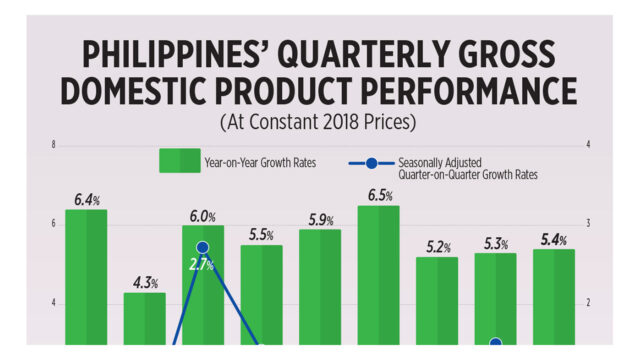
Philippines’ Quarterly Gross Domestic Product Performance

THE PHILIPPINE ECONOMY grew by a weaker-than-expected 5.4% in the first quarter, reflecting heightened uncertainty arising from the Trump administration’s tariffs. Read the full story.

Lending growth slows in March

REUTERS

BANK LENDING expanded at its slowest pace in four months in March as loan growth for both production activities and consumers eased, preliminary data from the Bangko Sentral ng Pilipinas (BSP) showed.

Outstanding loans of universal and commercial banks, net of reverse repurchase (RRP) placements with the central bank, rose by 11.8% year on year to P13.19 trillion from P11.795 trillion.

This eased from the 12.2% expansion in February and was the slowest since the 11.1% growth seen in November 2024. Still, this was faster than the 9.44% annual increase logged in March 2024.

On a seasonally adjusted basis, big banks’ outstanding loans inched up by 0.9% month on month.

Outstanding loans to residents increased by 12.3% year on year to P12.87 trillion in March, slower than the 12.6% growth in February. Meanwhile, loans to nonresidents decreased by 5.6% to P324.82 billion in March from the 3.2% decline seen in the previous month.

Loans for production activities expanded by 10.9% to P11.23 trillion in March, slower than the 11.2% growth in February.

“Loan growth eased due to the slower expansion in lending to key industries such as real estate activities (9.6 %); wholesale and retail trade, repair of motor vehicles and motorcycles (11.6%); information and communication (8.9%); construction (1.8%); arts, entertainment and recreation (12.6%); water supply, sewerage, waste management and remediation activities (12.9%); and accommodation and food service activities (19.3%),” the central bank said.

Consumer loans to residents rose by 23.6% in March to P1.64 trillion, also slower than the 24.1% increase seen in the previous month.

Credit card loans rose by 28.8% year on year to P959.43 billion, BSP data showed, while loans for motor vehicles grew by 18.8% to P477.79 billion in March. Salary-based general purpose consumption loans also increased by 8.9% to P158.71 billion.

“Lending remains robust but could benefit from additional rounds of easing. First-quarter GDP (gross domestic product) showed capital formation up a modest 4%,” Metropolitan Bank & Trust Co. Chief Economist Nicholas Antonio T. Mapa said in a Viber message.

“Further BSP cuts could support lending activity and overall GDP amidst the Trump tariffs,” Mr. Mapa added.

The Philippine economy expanded by 5.4% year on year in the first quarter, faster than the 5.3% growth seen in the fourth quarter but below the government’s 6-8% target for the year.

This was also well below the 5.8% median forecast of 15 economists in a BusinessWorld poll and the revised 5.9% GDP growth recorded in the same quarter last year.

On Wednesday, BSP Governor Eli M. Remolona, Jr. told Bloomberg that the central bank is open to cutting key rates by 75 basis points (bps) more this year following as inflation continues to ease.

The Monetary Board last month resumed its easing cycle after an unexpected pause in February, cutting benchmark rates by 25 bps to bring the policy rate to 5.5%. Its next meeting is on June 19.

MONEY SUPPLY
Meanwhile, domestic liquidity grew by 6.1% year on year in March, slightly slower than the 6.3% expansion in February, the BSP reported separately.

M3 — which is considered as the broadest measure of liquidity in an economy — increased to P18.24 trillion in March from P17.199 trillion a year earlier. Month on month on a seasonally adjusted basis, M3 inched up by 0.7%.

“Liquidity growth remained positive as economic growth stayed robust. The slowdown may be traced to the moderating in bank lending activity, but we expect a rebound in the coming months as BSP is likely to provide monetary support,” Mr. Mapa said.

Domestic claims increased by 10.4% in March, slightly faster than the 10.1% increase in February, the central bank said.

“Claims on the private sector grew by 11.5% in March from 12.3% in the previous month with the sustained expansion in bank lending to nonfinancial private corporations and households,” the BSP said.

Net claims on the central government grew by a faster 8% in March from 5.9% in the previous month amid higher National Government borrowings.

Meanwhile, the growth in net foreign assets (NFA) in peso terms slowed to 2.5% in March from 5.8% in February.

“The BSP’s NFA expanded by 4.5%, reflecting the increase in gross international reserves relative to a year ago. Meanwhile, the NFA of banks declined largely on account of higher foreign currency-denominated bills payable,” the central bank said.

“The BSP will continue to ensure that domestic liquidity conditions remain consistent with the prevailing stance of monetary policy, in line with its price and financial stability objectives.” — A.M.C. Sy