Home Blog Page 1599

OKC rallies in 4th, knots series with Denver at 2-2

SHAI GILGEOUS-ALEXANDER scored 25 points as the visiting Oklahoma City Thunder (OKC) rallied from eight down in the fourth quarter to beat the Denver Nuggets 92-87 in Game 4 on Sunday to even the Western Conference semifinal series.

Oklahoma City regained home-court advantage in the best-of-seven series and will host Game 5 on Tuesday night.

Despite 27 points and 13 rebounds from Nikola Jokic, Denver missed an opportunity to put a stranglehold on the series. Christian Braun and Jamal Murray had 17 points each and Aaron Gordon finished with 15 points and 16 rebounds for the Nuggets.

“This isn’t a funeral,” Murray said. “It’s 2-2. It’s a three-game series.”

Aaron Wiggins and Cason Wallace scored 11 each, Alex Caruso and Jaylen Williams scored 10 apiece, Isaiah Hartenstein had 14 rebounds and Chet Holmgren grabbed 13 boards for the Thunder.

“Kind of lost our way defensively, especially in the third, but did a great job of course-correcting to start the fourth,” said Thunder coach Mark Daigneault.

“That group to start the fourth was huge to give us a lead, and then the defense down the stretch was really, really good.”

Oklahoma City trailed 71-63 early in the fourth, but hit a trio of 3-pointers during a 14-3 run that gave them a 77-73 lead. Denver missed eight straight shots before Murray hit a 19-foot fadeaway jumper with 6:17 left.

Down 84-80, Jokic missed a pair of free throws and Williams and Gilgeous-Alexander made layups to stretch the advantage to 88-81. Jokic cut it to five with 1:25 left and the Nuggets had a chance to make it a one-possession game, but Michael Porter Jr. missed an 11-footer.

Murray airballed a 3-pointer with 23 seconds left and the Thunder closed it out.

“Give their team credit,” said Nuggets interim coach David Adelman. “In a disgusting basketball game, they did enough to win.”

Sunday’s game tipped off approximately 38 hours after Denver’s Game 3 overtime win. The collective fatigue showed early when the teams combined to shoot 18.2% in the first quarter.

Oklahoma City led 17-8 to match the lowest combined score in the opening period of a playoff game. Portland (14) and Utah (11) did it May 20, 1999, and Detroit and Toronto also managed just 25 points on April 21, 2002.

Both teams were 3-for-22 from 3-point range in the first half. Denver found its offense in the third quarter, hitting seven of its 11 shots from deep and turning a six-point halftime deficit into a 69-63 lead heading into the fourth.

The Nuggets outscored Oklahoma City 61-40 after falling behind 23-8 early in the second quarter. — Reuters

Pacers hammer Cavs, grab 3-1 series lead

PASCAL SIAKAM scored 21 points and Myles Turner and Obi Toppin each added 20, lifting the Indiana Pacers to a 129-109 rout of the Cleveland Cavaliers in Game 4 of their Eastern Conference semifinal series on Sunday in Indianapolis.

The fourth-seeded Pacers hold a 3-1 lead over the top-seeded Cavaliers in the best-of-seven series. Indiana can punch its ticket to its second straight conference final with a victory in Game 5 on Tuesday in Cleveland.

To add injury to insult for the Cavaliers, Donovan Mitchell sat out the second half with a left ankle injury. The six-time All-Star finished with 12 points on 3-of-11 shooting from the floor.

Turner, Siakam and Toppin combined to make 25 of 37 shots from the floor and 7 of 10 from 3-point range for the Pacers, who rebounded from a 22-point loss in Game 3.

Indiana outscored the Cavaliers by a 42-16 margin in the second quarter to take an 80-39 lead at halftime. The Pacers set a franchise-playoff record for points in a half and an NBA postseason record for assists in a half (25) in the play-by-play era (1998).

Ben Sheppard scored 14 points, T.J. McConnell added 13 and Aaron Nesmith had 12 for the Pacers.

Indiana shot a robust 52.7% from the floor and enjoyed a 58-32 advantage in points in the paint.

Darius Garland scored 21 points for the Cavaliers, who committed 22 turnovers.

Indiana’s Bennedict Mathurin was assessed a flagrant-2 foul and ejected with 4:32 left in the opening period after he ignited an altercation with De’Andre Hunter. The former hit the latter in the chest, prompting Hunter to shove Mathurin in response. Turner was also assessed a technical foul.

The Pacers connected on five of their first six attempts from 3-point range to seize a 33-14 lead early in the first quarter.

Siakam drained a pair from beyond the arc and set up Toppin for an emphatic dunk as Indiana scored the first 10 points of the second quarter to boost its advantage to 48-23.

Turner sank a trio of 3-pointers during the final two minutes of the second quarter and Nesmith made a basket at the buzzer to stake Indiana to an 80-39 lead at halftime.

The outcome was not in doubt the rest of the way. — Reuters

S. Korea’s presidential campaigns kick off, with focus on ailing economy

SOUTH KOREAN soldiers salute in front of a huge national flag in Pohang, South Korea, Sept. 30, 2021. — LEE JIN-MAN/POOL VIA REUTERS

SEOUL — Contenders for South Korea’s presidency kicked off their campaigns on Monday, vowing to unify a deeply polarized society and spur economic growth while navigating trade negotiations with the United States.

Asia’s fourth-largest economy will hold a snap presidential election on June 3 to choose Yoon Suk Yeol’s successor after the conservative leader was ousted over his shock martial law order that plunged the country into a political crisis.

Surrounded by a huge crowd of supporters dressed in blue, frontrunner Lee Jae-myung from the liberal Democratic Party rallied in the center of capital Seoul.

Some supporters danced to campaign songs while others chanted “Lee Jae-myung, President!”

“Will you join the journey to a new start, a new path to hope?” Mr. Lee told the crowd, changing into a pair of sneakers onstage to signal his hard work during the race.

Mr. Lee, who lost the previous presidential polls to Mr. Yoon, is now riding a wave of popular support after overcoming a knife attack, standing up to the martial law order and contesting criminal charges that have threatened to disqualify him from the race.

His ongoing trials on matters ranging from bribery to charges mostly linked to a $1-billion property development scandal have been pushed back to after the polls.

Mr. Lee, wearing a bulletproof vest due to threats to his safety, promised to become the leader of unity and weather a trade crisis triggered by trade tariffs imposed by the administration of US President Donald J. Trump.

His party’s major policy proposals involve growing the economy with a focus on artificial intelligence and K-pop culture industries.

If elected, Mr. Lee would seek to restore soured relations with North Korea, which is technically at war with the South, while expanding the country’s diplomatic sphere into Europe, according to the party’s policy pledges.

Kim Moon-soo, Mr. Lee’s conservative rival, began his campaign at a public wholesale market in Seoul, eating a Korean sausage soup with merchants and promising to revive small businesses in the slowing economy.

After a tumultuous week that required merging his campaign with a former prime minister who was also scheduled to run, the former labor minister has officially become the presidential candidate from the major right-wing People Power Party (PPP).

Mr. Yoon publicly endorsed Mr. Kim on Sunday to fight “the giant opposition party,” but his support has garnered criticism from some PPP members who want the party to kick out the ousted leader.

Job creation and a business-friendly environment are  Mr. Kim’s key policy proposals. If elected, he has proposed an immediate summit meeting with Trump to negotiate tariffs.

Mr. Kim said he would focus on strengthening the security alliance with the United States but also seek a path for the country to potentially pursue nuclear armament by securing the right to reprocess nuclear fuel, a major step toward building atomic weapons. — Reuters

This US-owned factory in China made toys bound for Walmart. Tariffs put it on life support.

REUTERS

THE E-MAILS started pouring in on April 9, the day US President Donald J. Trump’s 145% tariff on Chinese imports took effect. Clients were canceling orders for toys from Huntar Company Inc.’s factory in Guangdong Province, China.

But Huntar Chief Executive Officer (CEO) Jason Cheung, 45, had already halted production at the 600,000-square-foot facility in Shaoguan. He saw the tariff for what it was: an existential threat to his company, which manufactures educational toys bound for the shelves of Walmart and Target, like Learning Resources, Inc.’s Numberblocks, which help teach kids math.

“I needed to start saving money as soon as possible,” Mr. Cheung said. In the four weeks since, he has cut production by 60% to 70%, laid off a third of the factory’s 400 Chinese workers, and reduced hours and wages to those still employed.

Now, he’s pursuing a frantic, long-shot effort to move his operation to Vietnam before the company his dad founded 42 years ago runs out of money.

He figures he has about a month.

Huntar’s plight typifies a crisis facing countless factories in China, where about 80% of toys sold in the US are manufactured, according to trade group The Toy Association. New orders have fallen sharply amid a brutal trade war with the United States that threatens to devastate the sector in both countries.

Huntar is also unique in one key way: based in the US, it straddles both sides of the trade war.

On paper, Mr. Cheung is Mr. Trump’s bogeyman, the Chinese factory owner taking American jobs. But he’s also the US small business owner tariffs were meant to protect. He’s the American son of a Chinese immigrant, running a second-generation family-owned business that employs 15 people in the US — people who would lose their jobs if Huntar falters.

Mr. Trump has said tariffs will incentivize companies to reshore manufacturing, or, at least, drive it out of China.

Huntar illustrates why economists say that’s unlikely: a dearth of facilities and workers with toy making expertise in other countries; heavy equipment that’s hard to move and would cost millions of dollars to replace; and, most acutely, no time to solve those hurdles before coffers run dry.

More likely, factories like Mr. Cheung’s will simply shut down, a prospect that drove Beijing to the negotiating table with US officials in Geneva over the weekend, three sources familiar with the Chinese government’s thinking told Reuters.

Realistically, China cannot replace US market demand for product categories like toys, furniture, and textiles, which are already feeling the impact of tariffs, one of the officials said. As trade talks began, Mr. Trump signaled he was open to cutting China tariffs to 80%.

That wouldn’t help Huntar, Mr. Cheung says, noting that any tariff rate over about 50% will make survival difficult. On a practical level, there’s no difference between 80% and the 145% tariffs he’s currently facing.

Crises have hit Huntar before, Mr. Cheung says, but not like this. The 2008 recession brought a steady slowdown, one he could plan around. And the COVID pandemic dealt a blow, but his volume of production remained high enough to keep him afloat through a temporary slump.

This time, he says, “our manufacturing business essentially halted overnight.” Mr. Cheung is starting to feel like his only hope is just that — hope.

“I refresh my ‘tariff’ Google search five or six times a day, hoping something’s changed,” he says.

A DREAM AND A LUCKY DESK
Huntar manufactures toys for US, Canadian and European sellers, like Learning Resources, Inc. and Play-a-Maze, which distribute them to retailers or sell directly to consumers.

It also makes its own educational toys under its Popular Playthings brand, which it has had to stop shipping to the US, costing the company hundreds of thousands of dollars so far, Mr. Cheung estimates.

American-owned factories in China are uncommon, as Chinese law makes it difficult and costly for foreign entities to own them, says attorney Dan Harris, a partner at Harris Sliwoski who focuses on international manufacturing law.

But Huntar has roots in a business Mr. Cheung’s father set up in 1983, a few years after escaping communist China and settling in California’s Bay Area.

Mr. Cheung grew up in San Francisco’s Inner Richmond district, he says, in a small house whose broken door you could simply kick open. His father would sell clothes and furniture at a flea market to augment his janitor’s wages, with Mr. Cheung tagging along, bored to tears.

As the operation matured, Mr. Cheung’s father set up a factory in China, to exert more control over quality. Mr. Cheung, who joined the company in 2004, still uses the desk his father set up in their living room decades ago.

“We think maybe it’s lucky or something,” he says.

The last few weeks have been anything but lucky. The factory is sitting on $750,000 in canceled shipments -— value Mr. Cheung couldn’t fully recover even if the trade war ended, because his shipping costs would surely spike as factories raced to clear backlogs. That’s what happened after COVID, Mr. Cheung recalls, when shipping costs ballooned from $2,000 per container to more than $20,000.

“They don’t deserve this,” said Rick Woldenberg, CEO of toy company Learning Resources, and a client of Mr. Cheung’s since his father was in charge more than 20 years ago.

Mr. Woldenberg has canceled future production in China, saying his annual tariffs would jump from $2 million to $100 million. “It’s not who we want to be,” Mr. Woldenberg said, “but they know we have no choice.”

According to an April survey by the Toy Association, more than 45% of small and mid-sized toy companies in the US say China tariffs will put them out of business within weeks or months.

Learning Resources, which employs 500 people in the US and manufactures 60% of its products in China, has sued the US government, asking a federal judge to stop tariffs from taking effect.

“If nothing changes, we’ll be crippled,” Mr. Woldenberg said.

‘CANNIBALIZE MYSELF’
Mr. Cheung has been scouring his contact list, calling factories in Vietnam in hopes of finding a new home for Huntar.

Moving to the US is out of the question. Wages here are so high that manufacturing stateside would be even more expensive than staying in China and absorbing the tariffs, Mr. Cheung says.

Even in Vietnam, financial and logistical hurdles are proving too tall.

Few factories have enough space to handle his operation, and competition is high among others looking to move. Even if he found a good spot, Mr. Cheung would have to train a new staff and run safety and quality control checks that could easily take months.

There’s also the question of infrastructure. Mr. Cheung’s factory is solar-powered, helping ensure profitability in a thin-margin business. It has specific HVAC and wastewater systems designed to negate the environmental risks of spray paint and chemicals used to decorate toys. And it owns more than 30 injection machines, each weighing several tons, which craft toys by pumping molten plastic to steel casings. These likely can’t be moved, and Mr. Cheung says he’s not sure where he’d find the money — well over $1 million — to buy new ones.

A more realistic move would be to outsource certain operations and shutter others. Mr. Cheung could cut losses by finding a Vietnamese factory to take Huntar’s Popular Playthings proprietary line, while ditching the business of manufacturing toys for third party clients.

Going all-in — that is, keeping his factory intact in China in hopes the trade war is resolved — is a higher-risk, higher-reward gambit. If tariffs came down quickly, his company would survive, but if they didn’t, he’d lose everything. The costs of keeping a large factory running, and paying employees, while producing just a fraction of his normal output, would sink him within several weeks, he says.

“I’m approaching this moment where I have to choose basically to cannibalize myself,” he says.

It’s hard to pare down a business that once embodied the American dream. Mr. Cheung’s father came to the US in 1978, after escaping China by swimming across the Shenzhen River into Hong Kong — all for a shot at freedom. He “wanted to see this business continue through me and hopefully his grandkids,” Cheung says.

His dad, he says, is feeling hopeless these days. Though grateful for the life he built here, America’s sheen as a land of milk and honey has worn off. “His idea of the US has definitely changed,” Cheung says. — Reuters


Zelensky tells Putin to come to Turkey if he wants talks, after Trump intervention

Ukrainian President Volodymyr Zelensky, June 2, 2024. — REUTERS

KYIV — Ukrainian President Volodymyr Zelensky said he was ready to meet Vladimir Putin in Turkey on Thursday after US President Donald J. Trump told him publicly to immediately accept the Kremlin leader’s proposal of direct talks.

Mr. Zelensky’s suggestion of a meeting with Mr. Putin capped a dramatic 48 hours in which European leaders joined Mr. Zelensky in demanding a 30-day ceasefire from Monday, only for Mr. Putin to make a counter-proposal to instead hold the first direct Ukraine-Russia talks since the early months of the 2022 invasion.

It was far from clear, however, that Mr. Putin meant he would attend in person. Mr. Putin and Mr. Zelensky have not met since December 2019 and make no secret of their contempt for each other.

“I will be waiting for Putin in Türkiye on Thursday. Personally,” Mr. Zelensky wrote on X. “I hope that this time the Russians will not look for excuses.”

On Telegram, his chief of staff, Andriy Yermak, added: “What about Putin? Is he afraid? We’ll see.”

The Ukrainian leader had responded guardedly earlier on Sunday after the Russian president, in a night-time televised statement that coincided with prime time in the US, proposed direct talks in Istanbul next Thursday, May 15.

Mr. Putin’s suggestion came hours after major European powers demanded on Saturday in Kyiv that he agree to an unconditional 30-day ceasefire or face “massive” new sanctions, a position that Mr. Trump’s Ukraine envoy Keith Kellogg endorsed.

TRUMP DEMANDS TALKS BEGIN
Mr. Zelensky too had said Ukraine was ready for talks, if Moscow agreed to the 30-day ceasefire.

Yet Mr. Trump, who has the power to continue or sever Washington’s crucial supply of arms to Ukraine, took a different line.

“President Putin of Russia doesn’t want to have a Cease Fire Agreement with Ukraine, but rather wants to meet on Thursday, in Turkey, to negotiate a possible end to the BLOODBATH. Ukraine should agree to this, IMMEDIATELY,” Mr. Trump wrote on Truth Social.

“At least they will be able to determine whether or not a deal is possible, and if it is not, European leaders, and the US, will know where everything stands, and can proceed accordingly!”

Russia and Ukraine have both courted Mr. Trump.

Kyiv is desperate to unlock more of the US military backing it received from his predecessor, Joe Biden. Moscow senses an opportunity to get relief from a barrage of economic sanctions and engage with the world’s biggest economy.

Mr. Putin sent Russia’s armed forces into Ukraine in February 2022, unleashing a conflict that has killed hundreds of thousands of soldiers and triggered the gravest confrontation between Russia and the West since the 1962 Cuban Missile Crisis.

But with Russian forces grinding forward, the Kremlin chief has offered few, if any, concessions so far.

In his overnight address, he proposed what he said would be “direct negotiations without any preconditions.”

But almost immediately, senior Kremlin aide Yuri Ushakov told reporters the talks must take into account both an abandoned 2022 draft peace framework and the current situation on the ground.

This language is shorthand for Kyiv agreeing to permanent neutrality in return for a security guarantee and accepting that Russia controls swathes of Ukraine.

Ukraine says agreeing to the terms of the 2022 draft would be tantamount to capitulation.

PUTIN REJECTS ‘ULTIMATUMS’
Mr. Putin dismissed what he said was an attempt to lay down “ultimatums” in the form of Western European and Ukrainian demands for a ceasefire starting on Monday. His foreign ministry spelled out that talks about the root causes of the conflict must precede discussions of a ceasefire.

Mr. Trump, who says he wants to be remembered as a peacemaker and has repeatedly promised to end the war, earlier responded to Mr. Putin’s address by saying that this could be “A potentially great day for Russia and Ukraine!”

Though Russia did not commit to it, Mr. Zelensky said Ukraine’s ceasefire plan for Monday still stood.

“We await a full and lasting ceasefire, starting from tomorrow, to provide the necessary basis for diplomacy,” he wrote on X.

Speaking in his nightly address, Mr. Zelensky said he was still waiting for a response from the Russian side — and that Ukrainian forces would respond in kind if Russian troops did not observe a truce.

The US embassy in Kyiv issued a warning on Friday of a “potentially significant” Russian air attack in the coming days. — Reuters

At Sunday Mass in New York, Americans celebrate their new pope

REUTERS

NEW YORK — Excitement rippled through New York City’s St. Patrick’s Cathedral on Sunday morning, the first since an American was picked to lead the Roman Catholic Church in a selection that surprised and delighted many of his countrymen and women.

At Sunday Mass, the landmark, Gothic-style church — the focal point of Catholicism in the most populous US city — was brimming with worshippers eager to celebrate the unexpected achievement of Chicago native Robert Prevost, now known as Pope Leo XIV.

Many were happy to share their thoughts on the new pontiff and the variety of ways they could relate to him personally.

On the steps leading to the cathedral gates, Patrick Sheridan, who came to the Mass from New Jersey, stood alongside his wife Mary. The couple were elated to learn that the new pope was a graduate of Philadelphia’s Villanova University, the same school many of their family members attended.

“We were extremely excited when we heard about it,” Mr. Sheridan said.

Cardinal Timothy Dolan, the archbishop of New York, was still in Rome on Sunday after the pope’s selection, Monsignor Joseph LaMorte, the archdiocese’s vicar general, told parishioners during Mass.

LaMorte, who is Dolan’s deputy, said he was keen to meet with the cardinal when he returns to New York.

“We can’t wait to hear some of the stories that he’s allowed to talk about,” LaMorte said. “You know the secrecy of the conclave is very, very serious.”

Jason Graham, speaking outside the cathedral, said having an American Pope could help improve the image of the United States abroad.

“Our country’s not looking so great, especially with the current administration,” Mr. Graham said, referring to President Donald J. Trump’s tariffs and other policies that are unpopular in other countries.

“But I think that (the new pope) is a positive influence for America, and I think he’s going to have a positive impact on how other people in the world will see America,” he said.

For Lucero De Paz, a Hispanic American from Texas, the most appealing aspect of Leo XIV’s background was his missionary and humanitarian work in Peru, where the new pope spent decades and was granted a second citizenship.

“I felt a lot better, I think, about where he stands as far as immigration issues that are happening today,” Mr. De Paz said. “Well-being of all Latinos is a huge issue to me, not just as a Christian and Catholic, but also culturally.”

Mr. Trump has taken a series of aggressive measures aimed at cracking down on illegal immigrants, many of them from Latin America, since he took office in January.

Sadie Murlaney, who hails from Scotland, came to New York to celebrate her birthday and stopped by St. Patrick’s for the Mass. She said she was happy to learn that the new pope took the same name as her first grandson Leo.

Ms. Murlaney said she would pray for the pope to help restore peace in the world.

“With all the wars going on, it’s not a nice place just now,” she said. “We hopefully pray for him to help any way we can.” — Reuters

Trump to sign executive order to cut prices of medicine to match other countries

PHILSTAR FILE PHOTO

 – U.S. President Donald Trump said on Sunday he would sign an executive order to cut prescription prices to the level paid by other high-income countries, an amount he put at 30% to 80% less.

In a post on Truth Social, Trump said he would sign the executive order on Monday morning to pursue what is known as “most favored nation” pricing or international reference pricing.

The U.S. pays the most in the world for many prescription drugs, often nearly triple that of other developed nations. Trump has said he wants to close that spread, but has not publicly specified how and did not provide details in his post.

“They will rise throughout the World in order to equalize and, for the first time in many years, bring FAIRNESS TO AMERICA!” he said.

“I will be instituting a MOST FAVORED NATION’S POLICY whereby the United States will pay the same price as the Nation that pays the lowest price anywhere in the World,” Trump added.

Drugmakers have been expecting an order that would focus on the Medicare health insurance program, according to four drug industry lobbyists who said they had been briefed by the White House. Reuters previously reported such a policy was under consideration.

The drugmakers expect the order to apply to a universe of drugs beyond those currently subject to negotiation under former President Joe Biden’s Inflation Reduction Act.

Because of that law, Medicare has negotiated prices for 10 drugs, with those prices due to be put in place next year. More medicines were set to be negotiated later this year.

“Government price setting in any form is bad for American patients,” Alex Schriver, a spokesperson for the top U.S. drug company lobbying group, the Pharmaceutical Research and Manufacturers of America, said in a statement when asked about Trump’s planned executive order.

This is not the first time President Trump has tried to tie drug prices to what other countries pay. During Trump’s first term, a court blocked a proposed international reference pricing program.

That proposal five years ago was projected by his administration to save taxpayers more than $85 billion over seven years, cutting into U.S. annual spending of more than $400 billion on drugs. – Reuters

Philippines votes in high-stakes midterms amid Marcos-Duterte showdown

Voters line up at a voting precinct in Barangay Bagong Silang, Caloocan City. — BW FILE PHOTO

MANILA – Voting was underway in the Philippines on Monday for a normally low-key midterm election that is showcasing an emotionally charged proxy battle between President Ferdinand Marcos Jr and ally-turned-foe, Vice President Sara Duterte.

Ms. Duterte and Mr. Marcos are not on the ballot for more than 18,000 positions but have been campaigning aggressively for their slates of candidates, as their bitter rivalry dominates a contest that could influence the future dynamic of power in the country of 110 million people.

At stake for Mr. Marcos is his policy agenda, his legacy and influence over his succession in 2028, while Ms. Duterte’s political survival could ride on the vote, with an impeachment trial looming that could kill any future hopes of becoming president and following in the footsteps of father Rodrigo Duterte.

While posts for mayors, governors and lower house lawmakers are up for grabs, the tussle for Mr. Marcos and Ms. Duterte is over a dozen coveted seats in the 24-member Senate, a chamber with sweeping legislative influence and political clout that can shape public opinion and sink presidential ambitions.

“This election is more than an informal referendum on the Marcos administration,” said Aries Arugay, a political science professor at the University of the Philippines.

“The Senate race is the key proxy battle … Marcos needs to retain a majority, or supermajority, to push forward his legislative and economic agenda.”


ACRIMONIOUS FEUD

The election has a new significance after the collapse of the once formidable alliance between the Marcos and Duterte dynasties and the dramatic fall from grace of the popular Duterte family, which has accused the president of orchestrating a campaign to destroy the biggest challengers to his power.

What began as a united front that swept the 2022 election unraveled into an acrimonious feud, marked by a torrent of personal accusations and a bid to impeach Ms. Duterte on allegations she misused funds, amassed unexplained wealth and threatened the lives of the president, first lady and the house speaker.

The Senate race is critical, with its members to become jurors if an impeachment trial goes ahead, where Ms. Duterte faces removal from office and a lifetime ban. At least 16 votes – a two-thirds majority – is needed to convict her.

“That alone makes this more than just a typical midterm, so a lot is at stake,” Mr. Arugay said.

Fueling the flames of an already charged race was Rodrigo Duterte’s arrest by Philippine police in March at the request of the International Criminal Court in The Hague, where he is currently detained over a “war on drugs” during which thousands were killed.

Despite his incarceration, he is on Monday’s ballot for mayor in his hometown.

Both Dutertes have denied wrongdoing and have challenged the cases against them.

Mr. Marcos has distanced himself from the impeachment and rejects allegations of a vendetta against the Duterte family.

Mr. Marcos has touted economic gains and his defense of sovereignty, campaigning on his tough stand against Beijing’s conduct in the South China Sea, with China emerging as a political lightning rod in the election.

Sara Duterte, for her part, has accused Mr. Marcos of selling out sovereignty in giving up a former president to a foreign court.

“Who truly stands to benefit if the Duterte family is erased from this world?” she said while campaigning. “Not the Filipinos.” – Reuters

Investors welcome news of progress in US-China trade talks; US stock futures rise

FREEPIK

Investors welcomed the conciliatory tone at U.S.-China trade talks this weekend aimed at cooling a trade war between the world’s two largest economies and dispelling some of the uncertainty clouding financial markets, though few expect a major breakthrough just yet.

In a sign of investor relief that the worst of a U.S.-China trade war might be averted, U.S. stock futures rose on Sunday evening. The S&P 500 E-minis ESc1 rose 1.3%, while Nasdaq futures NQc1 added 1.6%.

Both sides declined to elaborate on negotiations, saying that further details will be released on Monday, though U.S. Treasury Secretary Scott Bessent and Trade Representative Jamieson Greer on Sunday said a deal had been reached with China to cut the U.S. trade deficit.

Chinese Vice Premier He Lifeng, who met his U.S. counterparts in Geneva, described the meeting as “candid” and an important first step.

“This is a step in the right direction, showing that both sides are interested in coming to a constructive conclusion and develop a better trade relationship,” said Eric Kuby, the chief investment officer at North Star Investment Management Corp in Chicago.

“The details are quite sketchy, but I think the direction sounds to be more cooperative rather than combative, and I think that we have to view that as a positive.”

The meeting in Switzerland could mark one of the biggest developments since U.S. President Donald Trump launched sweeping tariffs on April 2, which threw the global trade landscape into chaos and set off extreme market volatility.

Recently, investors have expressed optimism that the worst-case trade scenarios would not come to pass, and pointed to signs of de-escalation between the U.S. and China as a reason behind a rebound in equities.

“Markets may be encouraged by some agreement on a deal, but it will remain contingent on further details being released,” said Gennadiy Goldberg, head of U.S. rates strategy at TD Securities in New York.

“Recent price action suggests some optimism around a trade deal. If that turns out to be the case, pricing will have been justified. The risk is if the deal is less substantial than expected. Then the market might come away disappointed.”

Indeed, despite comments by President Donald Trump ahead of the talks suggesting a lower level of Chinese tariffs and a trade deal announced on Thursday between the U.S. and Britain, many market participants said they were not expecting major breakthroughs.

“I’m not sure I would hit the ‘buy’ button on what we have heard today, but if we can make substantive progress with China I think the market will like it,” said Jack Ablin, founding partner and chief investment officer at Cresset Capital in Chicago.


IMMEDIATE PACT SEEN AS UNLIKELY

Both the U.S. and China may want, or even need, to reach a deal, said Liqian Ren, director of Modern Alpha at WisdomTree Asset Management. At this early stage, however, there seems to be little incentive to do so rapidly, she added.

“Each still wants to see how the other side copes with negative headwinds,” Ren said.

“Right now, the market is maybe a little bit too optimistic in terms of what China and the U.S. can achieve and how fast events will move.”

Trade tensions between the two nations escalated last month, when the U.S. boosted tariffs on all Chinese imports to a whopping 145%, and China retaliated by raising levies on U.S. imports to 125%.

On Friday, comments by Trump that an 80% tariff on Chinese goods “seems right” – in his first suggestion of a specific alternative to the 145% levies – created some hope of progress toward resolving the dispute.

The benchmark S&P 500 stock index .SPXhas already erased the steep losses seen in the immediate aftermath of the tariffs announcement on April 2, although businesses continue to warn investors of their impact and the uncertainty they create.

The S&P 500 remains down about 8% from its February all-time high and roughly 4% for the year.

Amid the tariff chaos, weak consumer sentiment surveys and other “soft data” have raised concerns about U.S. growth, although most economic data has indicated resilience in the economy.


EYEING MARKET VOLATILITY

Volatility remains. The Cboe Volatility Index, the options-based measure of investor anxiety, hovered around 22 late on Friday – well below its recent closing high of 52.33 in early April, but above its longer-term median of 17.6.

One of the factors curbing the volatility has been the high cost of establishing short positions betting on future market declines, said WisdomTree’s Ren.

“When a single (social media post) from the president can make the market move 10%, it becomes very costly” to establish those positions, Ren said. Equities soared on April 9 after Trump paused many of the heftiest tariffs for 90 days.

Still, markets were poised for more volatility ahead, said Matt Gertken, head of geopolitical strategy at BCA, a macroeconomic investment research firm.

Gertken said the firm’s best advice was to “sell on strength.”

Any signs of progress in the initial discussions would be welcome and would allow China to devote more energy to its domestic economic problems, said Andrew Mattock, a portfolio manager at Matthews Asia.

“To talk about any other scenario, you end up with a lose-lose outcome,” he warned. – Reuters

UK’s Starmer, under pressure from Farage, tightens migration rules

BRITAIN’S PRIME MINISTER KEIR STARMER — POOL VIA REUTERS

 – Prime Minister Keir Starmer announced a new salvo of measures to toughen up Britain’s migration system on Sunday, saying many immigrants would have to wait longer before getting the status they need to claim welfare.

Mr. Starmer’s government – which is due to publish plans for new legislation to reduce immigration on Monday – is under pressure to counter the rise in popularity of Nigel Farage’s right-wing, anti-immigration Reform UK party.

Over the weekend, interior minister Yvette Cooper announced plans to restrict skilled worker visas to graduate-level applicants, prevent care sector firms from recruiting abroad and require businesses to increase training for local workers.

“Every area of the immigration system, including work, family and study, will be tightened up so we have more control,” Mr. Starmer said in a statement. “Enforcement will be tougher than ever and migration numbers will fall.”

Under the changes, automatic settlement and citizenship for people who move to Britain will apply after 10 years, up from five years now, although highly skilled workers – such as nurses, doctors, engineers and AI experts – would be fast-tracked.

Migrants who are in the UK on visas are typically ineligible for welfare benefits and social housing.

The government also said it plans to raise English language requirements to include all adult dependents who will have to show a basic understanding of English. It said the change would help integration and reduce the risks of exploitation.

“This is a clean break from the past and will ensure settlement in this country is a privilege that must be earned, not a right,” Mr. Starmer said.

“And when people come to our country, they should also commit to integration and to learning our language,” he said.

The number of European Union migrants to Britain fell sharply after Brexit but new visa rules, a rise in people arriving from Ukraine and Hong Kong and higher net numbers of foreign students led to an overall surge in recent years.

Net migration – the number of people coming to Britain minus the number leaving – hit a record 906,000 in the year to June 2023, up from 184,000 who arrived in the same period during 2019, when Britain was still in the EU.

Employers’ groups are worried that tightening the rules on foreign workers will make it harder for companies to fill vacancies.

“This major intervention in the labor market will leave many employers fearful that in tackling concerns about immigration, government goes after the wrong target,” Neil Carberry, chief executive of the Recruitment and Employment Confederation (REC), said.

Being open to skilled workers was essential for Britain “but so is a controlled, affordable and responsive immigration system that keeps investment flowing to the UK,” Mr. Carberry said. – Reuters

Trump set to accept luxury 747 from Qatar to use as Air Force One, ABC News says

REUTERS

The Trump administration intends to accept a Boeing BA.N 747-8 plane as a gift from the Qatari royal family that would then be outfitted to serve as Air Force One, ABC News reported on Sunday, citing unnamed sources familiar with the matter.

The luxury plane, which would be one of the most valuable gifts ever received by the U.S. government, would eventually be donated to Donald Trump’s presidential library after he leaves office, ABC said. A new commercial 747-8 costs approximately $400 million.

Democrats and good government advocates condemned the reported plan, saying it raised massive ethical and legal concerns.

“Nothing says ‘America First’ like Air Force One, brought to you by Qatar,” Senate Democratic Leader Chuck Schumer wrote on X. “It’s not just bribery, it’s premium foreign influence with extra legroom.”

The White House did not immediately respond to a request for comment on the report.

A Qatari spokesperson, Ali Al-Ansari, told the New York Times that news reports about the gift were “inaccurate” because the possible transfer of the aircraft was still under consideration and “no decision has been made,” the newspaper reported.

Mr. Trump has expressed frustration at the delays in delivering two new 747-8 aircraft to serve as an updated Air Force One. During his first term, Trump had reached a deal with Boeing to deliver the jets in 2024. A U.S. Air Force official told Congress last week that Boeing had proposed finishing the planes by 2027.

Mr. Trump toured the Qatari-owned 747-8 in February when it was parked at Palm Beach International Airport in Florida, near Trump’s Mar-a-Lago resort. At the time, the White House said the president did so to get a better understanding of how the updated Air Force One planes would be configured.

In a statement, a spokesman for Citizens for Responsibility and Ethics, a good government organization based in Washington, questioned whether the transfer might violate the Constitution’s ban on U.S. officials accepting gifts from foreign governments absent congressional approval.

“This sure looks like a foreign country that the president has personal business dealings in giving the president a $400 million gift right before he meets with their head of state,” the spokesman, Jordan Libowitz, said.

Mr. Trump is set to visit Qatar during a trip to the Middle East this week.

ABC reported, citing sources, that lawyers for the White House counsel’s office and the Department of Justice had prepared an analysis concluding that it would be legal and constitutional for the Defense Department to accept the plane as a gift and later transfer it to Trump’s presidential library. – Reuters

US, China hail ‘constructive’ Geneva trade talks, details due Monday

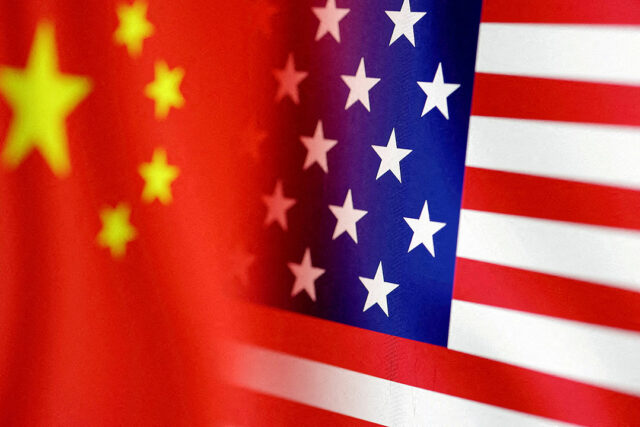
US and Chinese flags are seen in this illustration. — REUTERS

 – The U.S. and China ended high-stakes trade talks on a positive note on Sunday, with U.S. officials touting a “deal” to reduce the U.S. trade deficit, while Chinese officials said the sides had reached “important consensus” and agreed to launch another new economic dialogue forum.

Neither side released details after they wrapped up two days of talks in Switzerland. Chinese Vice Premier He Lifeng said a joint statement would be released in Geneva on Monday. Vice Commerce Minister Li Chenggang said it would contain “good news for the world.”

U.S. Treasury Secretary Scott Bessent and Trade Representative Jamieson Greer described “substantial progress” and also said details would be announced on Monday.

In separate briefings with reporters, neither side mentioned any agreement to cut U.S. tariffs of 145% on Chinese goods and China’s 125% tariffs on U.S. goods.

Mr. Greer and Mr. Bessent took no questions from reporters. The U.S. Treasury chief has said previously that these duties amount to a trade embargo between the world’s two largest economies and need to be “de-escalated.”

Financial markets have been on edge for signs of a thaw in a bitter U.S.-China trade war that has already begun to disrupt supply chains, prompt layoffs and raise wholesale prices.

Mr. Greer described the Geneva meetings’ conclusion as “a deal we struck with our Chinese partners” that will help reduce the $1.2 trillion U.S. global goods trade deficit.

“And this was, as the secretary pointed out, a very constructive two days,” Mr. Greer said.

“It’s important to understand how quickly we were able to come to agreement, which reflects that perhaps the differences were not so large as maybe thought,” Mr. Greer said.

The U.S. trade chief called He, Li and Vice Finance Minister Liao Min “tough negotiators.”

Vice Premier He, speaking to reporters at China’s mission to World Trade Organization, described the talks as “candid, in-depth and constructive” on issues of concern to both countries.

“The meeting achieved substantial progress, and reached important consensus,” He said, drawing applause from a large audience of Chinese officials present at the WTO office.

He also met with WTO Director General Ngozi Okonjo-Iweala, who said she was “pleased with the positive outcome” of the talks and urged the two countries to build on momentum to mitigate trade tensions.

The WTO has ruled against Mr. Trump’s past tariffs on Chinese goods, but the cases have been stalled in the WTO’s paralyzed appellate body due to the U.S. blocking judge appointments.


NEW CONSULTATION PLATFORM

The U.S. and China agreed to establish a new consultation mechanism for trade and economic issues, with relevant details to be finalized as soon as possible, He added.

China and the U.S. have convened numerous consultation bodies to try to resolve trade and economic differences in recent decades, including the Economic Working Group that former president Joe Biden’s Treasury secretary, Janet Yellen, established with Vice Premier He in 2023.

These dialogues have provided forums for airing bilateral grievances, but have done little to advance Washington’s longstanding goal to shift China’s state dominated, export-driven economic model toward one driven by consumer spending.


FIRST MEETING

The meeting was the first face-to-face interaction between senior U.S. and Chinese economic officials since Trump took office and launched a global tariff blitz, declaring a national emergency over the U.S. fentanyl crisis and imposing a 20% tariff on Chinese goods in February.

Mr. Trump followed with a 34% “reciprocal” duty on Chinese imports in April, and subsequent rounds pushed the rates into triple digits, bringing nearly $600 billion in two-way trade to a standstill.

China had insisted that tariffs be lowered in any talks. Trump said on Friday that an 80% tariff on Chinese goods “seems right,” suggesting for the first time a specific reduction target.

Mr. Greer said there was a lot of groundwork done before the Geneva meetings on Saturday and Sunday, and that the result would address the national emergency that Trump declared over growing U.S. trade deficits.

“We’re confident that the deal we struck with our Chinese partners will help us to work toward resolving that national emergency,” Mr. Greer said.

A White House press release that simply repeated Mr. Bessent’s and Mr. Greer’s brief comments with no details ran the headline: “U.S. announces China trade deal in Geneva.”


MORE TARIFF DEALS

Earlier on Sunday, White House economic adviser Kevin Hassett said the Chinese were “very, very eager” to engage in discussions and rebalance trade relations with the U.S.

Mr. Hassett also told Fox News’ Sunday Morning Futures program that more foreign trade deals could be coming with other countries as soon as this week. Last week’s limited trade deal with Britain left 10% U.S. duties in place on many UK products.

Mr. Hassett said he had been briefed by U.S. Commerce Secretary Howard Lutnick on two dozen pending deals in development with USTR Greer.

“They all look a little bit like the UK deal but each one is bespoke,” Mr. Hassett said.

Overnight, Mr. Trump gave a positive reading of the talks, saying on his Truth Social media platform that the two sides had negotiated “a total reset… in a friendly, but constructive, manner.”


GATED VILLA

The teams met at the gated villa of Switzerland’s U.N. ambassador, overlooking Lake Geneva in the leafy suburb of Cologny. Black Mercedes vans with sirens shuttled to and from the venue, bathed in bright sunshine.

Neutral Switzerland was chosen as the venue following approaches by Swiss politicians on recent visits to China and the U.S.

Washington is seeking to reduce its $295 billion goods trade deficit with Beijing and persuade China to renounce what Washington calls a mercantilist economic model, a shift that would require politically sensitive domestic reforms. – Reuters

ADVERTISEMENT
ADVERTISEMENT