Home Blog Page 1546

SkinStation wins Gold Award for Profhilo Excellence at Neoasia Gala 2025

SkinStation proudly received the prestigious Gold Award for outstanding performance in delivering Profhilo skin booster treatments during the Neoasia Gala Awards held at Shangri-La The Fort, BGC.

The recognition highlights SkinStation’s unwavering commitment to innovation, excellence, and client satisfaction in the field of advanced skin care. Profhilo, known for its powerful skin hydration and bio-remodeling benefits, is one of the most sought-after anti-aging treatments, and SkinStation’s expertise in administering this procedure has now earned national acclaim.

Discover what award-winning skin care feels like. Trust SkinStation for expert solutions backed by science, driven by passion, and proven by results.

To know more about SkinStation, visit their online platforms:

Website www.skinstation.ph

SkinStation Facebook page SkinStation

SkinStation Instagram page SkinStationPH


Spotlight is BusinessWorld’s sponsored section that allows advertisers to amplify their brand and connect with BusinessWorld’s audience by publishing their stories on the BusinessWorld Web site. For more information, send an email to online@bworldonline.com.

Join us on Viber at https://bit.ly/3hv6bLA to get more updates and subscribe to BusinessWorld’s titles and get exclusive content through www.bworld-x.com.

Globe unveils ‘Globe of Good’ as unified sustainability platform

Globe has formally launched Globe of Good as its new sustainability masterbrand that brings together all of the company’s environmental and social impact programs under a single, cohesive platform.

Long woven into Globe’s DNA, sustainability has guided its initiatives across digital inclusion, climate-conscious operations, and community upliftment.

With Globe of Good, the mobile network leader seeks to make its sustainability message more accessible and engaging to the general public—helping customers, employees, and partners recognize and participate in its efforts to create lasting, positive change.

(L–R): Ai dela Cruz, Team Globe of Good ambassador; Mark Pasaylo, Globe Platinum Head; Yoly Crisanto, Globe Chief Sustainability and Corporate Communications Officer; Givielle Florida, Globe Prepaid Head; Eric Tanbauco, Globe Consumer Mobile Business Head; and Luigi Tan, Globe Media and Performance Manager.

“This initiative is our commitment to embed sustainability in everything we do, in the way we operate, serve, and lead. We want to make sustainability more relatable and easier for every Filipino to take part in,” said Yoly Crisanto, Globe’s Chief Sustainability and Corporate Communications Officer.

The launch also highlighted two business-led programs that exemplify this principle in action: Globe Prepaid’s GoGIVE and Globe Platinum’s Gastronome Giving Series.

Globe Platinum’s Gastronome Giving Series, developed in partnership with Fine Dining Club Philippines, celebrates Filipino culinary excellence while helping raise funds for Globe’s Hapag Movement.

“Gastronome Giving allows us to connect fine dining with purposeful action,” said Mark Pasaylo, Head of Globe Platinum. “It demonstrates how different sectors can work together to help address involuntary hunger affecting millions of Filipinos.”

Globe Platinum customers may book tables at participating Gastronome Giving Series restaurants, including Roots (Siargao), Anzani (Cebu), Mrs. Saldo’s (Silang, Cavite), Taupe Dining (BGC), Goxo (Salcedo – Makati), and Kasa Palma (Poblacion – Makati). For added convenience, reservations may also be made via THEA, Globe Platinum’s 24/7 digital assistant, accessible anytime and anywhere.

Meanwhile, GoGIVE is a digital-first platform built into the GlobeOne app that turns everyday data use into real-world support. Customers earn and donate “hearts” to their chosen non-government organizations by simply using data.

Team Globe of Good ambassadors (L–R) Gian Magdangal, Ai dela Cruz, Adrian Insigne, Samantha Lo, and Gillian Vicencio express their commitment to GoGIVE beneficiaries: World Vision, PAWS, Project Pearls, PGH Foundation, and the Philippine Eagle Foundation.

“Through GoGIVE, we are transforming data into a force for good. This platform offers a fresh and convenient way to give back to the community, especially for digital natives,” said Givielle Florida, Head of Globe Prepaid.

Globe’s dedication to sustainability was affirmed by research firm Standard Insights, which recently named it Most Sustainable Mobile Network and Most Active Mobile Network for the Environment in the Philippines. The recognition proves Globe’s leadership in embedding responsible practices into its operations and underscores its position as a sustainability leader both locally and globally.

Jun Godornes, World Vision Philippines Resource Development Director shares Globe’s commitment to supporting World Vision’s mission.

“Globe has steadily built a track record of care-driven business practices. For those who value a network that operates responsibly and embraces advocacy and sustainability, the choice is clear—keep it Globe,” said Eric Tanbauco, Head of Consumer Mobile Business.

Globe Prepaid users may join the Globe of Good movement by opting in to GoGIVE and participating in the #GoGIVEYourHeart challenge on TikTok.

To learn more about Globe, visit https://www.globe.com.ph/.


Spotlight is BusinessWorld’s sponsored section that allows advertisers to amplify their brand and connect with BusinessWorld’s audience by publishing their stories on the BusinessWorld Web site. For more information, send an email to online@bworldonline.com.

Join us on Viber at https://bit.ly/3hv6bLA to get more updates and subscribe to BusinessWorld’s titles and get exclusive content through www.bworld-x.com.

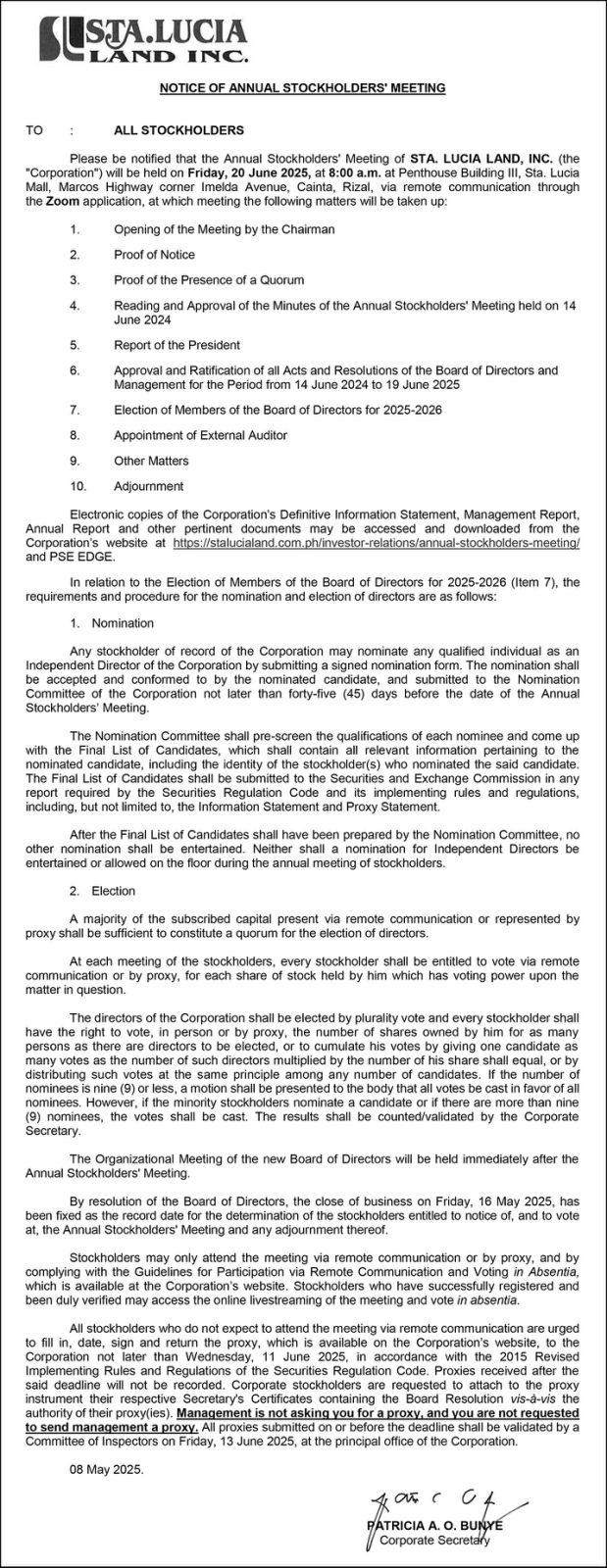
Sta. Lucia Land, Inc. to 2025 Annual Stockholders’ Meeting on June 20


Spotlight is BusinessWorld’s sponsored section that allows advertisers to amplify their brand and connect with BusinessWorld’s audience by publishing their stories on the BusinessWorld Web site. For more information, send an email to online@bworldonline.com.

Join us on Viber at https://bit.ly/3hv6bLA to get more updates and subscribe to BusinessWorld’s titles and get exclusive content through www.bworld-x.com.

Marcos orders GOCC heads to quit

President Ferdinand R. Marcos, Jr. has ordered the heads of state-owned companies to file their courtesy resignations. — PHILIPPINE STAR/KJ ROSALES

PRESIDENT Ferdinand R. Marcos, Jr. has ordered the heads of state-owned companies to quit, a week after a similar order on his Cabinet secretaries that some see as an attempt to salvage whatever political capital he has left during the second half of his single six-year term.

In a May 26 notice posted on its website, the Governance Commission for Government-Owned or -Controlled Corporations (GCG) under the Office of the President said state companies are covered by the Palace order on courtesy resignations dated May 21.

This is in line with “the President’s announced intention to recalibrate and realign his administration’s policies and priorities with the people’s expectations,” GCG Chairman Marius P. Corpus said in the notice.

All non ex-officio chairpersons, chief executive officers (CEO) and appointive directors/trustees/members of GOCC governing boards have been ordered to submit their courtesy resignations.

“This directive is intended to allow the President to assess the performance of key officials in all government agencies, including GOCCs, and realign government priorities in response to evolving expectations of the Filipino people and ensure that the administration remains dynamic, accountable and responsive,” he said.

In an addendum dated May 28, GCG said that CEOs of GOCCs must address their resignations to the President and submitted through the Office of the Executive Secretary.

For appointive directors, trustees, and members of GOCC governing boards, the resignation letter should be sent directly to the GCG, instead of the Office of the Executive Secretary.

However, the GCG said all GOCC heads should still report for work until the President accepts or rejects their resignation.

“The affected officers are reminded that until any action is taken by the Office of the President on such courtesy resignations, they shall continue to report for work and perform their usual duties and functions subject to any further directives that the Office of the President may deem proper,” Mr. Corpus said.

Last week, Mr. Marcos told all Cabinet members to submit their courtesy resignations.

Since then, he has retained members of the economic team — Finance Secretary Ralph G. Recto, Trade Secretary Cristina Aldeguer-Roque, Department of Planning, Economy, and Development Secretary Arsenio M. Balisacan, Budget Secretary Amenah F. Pangandaman and Special Assistant to the President for Investment and Economic Affairs Frederick D. Go. — Norman P. Aquino with inputs from ARAI

Marcos concerned over impact of US tariffs

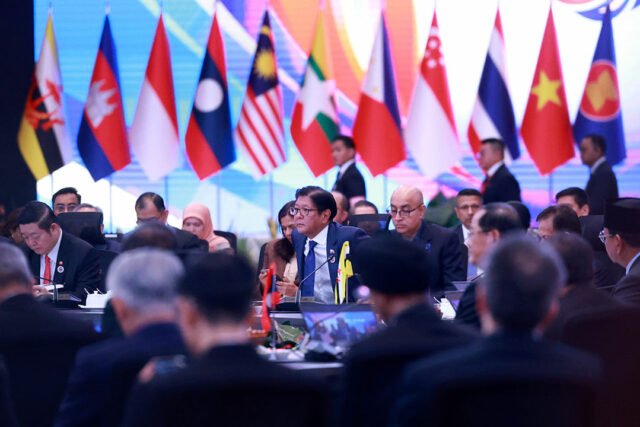
PRESIDENT Ferdinand R. Marcos, Jr. attends the 2nd ASEAN-Gulf Cooperation Council Summit during the 46th Association of Southeast Asian Nations Summit in Kuala Lumpur, May 27. — MARK BALMORES/PPA POOL

PHILIPPINE President Ferdinand R. Marcos, Jr. expressed concern over the impact of the US tariffs on the global economy, warning of possible “shrinkage in economic activity.”

Speaking at a press conference following the 46th ASEAN Summit in Kuala Lumpur on Tuesday evening, Mr. Marcos said the US tariffs imposed on Association of Southeast Asian Nations (ASEAN) members will have a significant impact on the region’s economies.

“If the tariff regime is unilaterally imposed, there will be a real collapse. It has a global effect, and it is not going to be a good one. There will be, I believe, a shrinkage in economic activity. I hope not. I hope I’m wrong,” he said.

Southeast Asia is bracing for the impact of the US reciprocal tariffs, which have been paused until July. Six ASEAN countries are facing tariffs of 32% to 49%, while the Philippines has been slapped with a 17% tariff, the second lowest in the region.

Even if the tariff is rolled back, Mr. Marcos said there is already a permanent effect on the economy that cannot be undone.

Southeast Asian leaders on Tuesday evening issued a statement expressing “deep concern” over the Trump administration’s tariff policies.

“We express deep concern over the recent announcement by the United States to impose unilateral tariffs and their potential impact on our economies,” according to a statement by the chairman of the ASEAN on Tuesday evening.

“The uncertainties arising from these tariffs and potential retaliation could heighten volatility in both capital flows and exchange rates.”

However, Southeast Asian leaders said they will continue their dialogue with the US, “and commit not to impose any retaliatory measures in response to US tariffs.”

“We also emphasized the urgency of diversifying trade beyond traditional markets,” according to the statement.

Meanwhile, Mr. Marcos said uncertainty remains as countries are awaiting developments in their negotiations with the US.

“We don’t know what will happen between now and July when the 90 days run out,” he said.

Mr. Marcos also called for stronger regional coordination and deeper economic integration within ASEAN.

“If we cannot sell to these markets anymore, then let’s sell to each other’s markets. The best, most solid way forward is to be a reliable partner for each other in ASEAN,” he said.

The Philippine president said he chatted with Chinese Premier Li Qiang during the ASEAN Summit on the issue of US tariffs.

“I asked him, ‘Premier, what do you think?’ He says, “Well, we do not want any of this.” They don’t want this (trade) war. And I said, ‘We’re very worried because China is the biggest economic driver in the region,’” Mr. Marcos said.

The US and China earlier this month agreed to temporarily cut the reciprocal tariffs for 90 days. The US slashed the extra tariffs it imposed on Chinese imports to 30% from 145%, while China’s levies on US imports will be reduced to 10% from 125%.

NEGOTIATIONS
Meanwhile, Southeast Asian leaders reached an understanding on Tuesday that any bilateral agreements they might strike with the United States on trade tariffs would not harm the economies of fellow members, Malaysia’s premier Anwar Ibrahim said.

Mr. Anwar, the current chair of the ASEAN, said there was consensus during the ASEAN Summit that any deals negotiated with Washington would ensure the interests of the region as a whole were protected.

The ASEAN meeting came at a time of global market volatility and slowing economic growth, and amid uncertainty over a trade war that has ensued since US President Donald J. Trump’s announcement of sweeping “Liberation Day” tariffs.

“While proceeding with bilateral negotiations…, the consensus rose to have some sort of understanding with ASEAN that decisions should not be at the expense of any other country,” said Mr. Anwar, who on Monday said he had written to Mr. Trump requesting an ASEAN-US meeting on the tariffs.

“So, we will have to protect the turf of 650 or 660 million people,” he said of ASEAN.

ASEAN, a region with a combined gross domestic product of more than $3.8 trillion, is in a precarious position in relation to the United States, which is the biggest market for the region’s exports, which are key drivers of its growth.

The 10-member bloc on Tuesday released a five-year strategic plan to better integrate its economies, citing challenges that meant “carrying on business as usual will not suffice.”

Tuesday’s meetings also included an economic gathering of leaders of the ASEAN, Gulf countries and China.

At a dinner event late on Tuesday, China’s Mr. Li urged Gulf and ASEAN countries to remove trade barriers and expand liberalization in the face of rising protectionism and unilateralism.

“We all need to firmly maintain the multilateral trading system with the World Trade Organization as the core and promote the creation of a stable and orderly international market environment,” he said. — CMAH and Reuters

Amendments to AMLA sought

REUTERS

By Luisa Maria Jacinta C. Jocson, Senior Reporter

THE ANTI-MONEY Laundering Council (AMLC) is pushing amendments to the Anti-Money Laundering Act as part of its next steps to ensure the country stays out of the Financial Action Task Force’s (FATF) “gray list.”

These amendments aim to align the Philippines’ law with international standards, such as the enhanced monitoring of virtual asset service providers (VASP).

“As part of the preparations for the forthcoming mutual evaluation, the AMLC is currently undertaking a review of the Anti-Money Laundering Act of 2001 (AMLA), as amended,” it said in an e-mail to BusinessWorld.

“With the country’s recent exit from the FATF gray list, this initiative is essential in ensuring sustained compliance with international standards and preventing any potential relisting.”

In February, the FATF removed the Philippines from its list of jurisdictions under increased monitoring for “dirty money” after over three years or since June 2021.

The next assessment is slated for 2027, when the FATF will verify if the anti-money laundering measures are being sustained and still in place.

“As part of this initiative, a set of proposed amendments has been formulated to enhance the provisions of the AMLA,” the AMLC said.

The proposed tweaks to the AMLA would “address the technical compliance requirements arising from the updated FATF standards.”

These include the authority to temporarily suspend transactions and the designation of VASP as covered persons under the revised international standards and FATF recommendations, it added.

The FATF said in its latest recommendations that countries must ensure VASPs are regulated for AML/CFT (countering the financing of terrorism) purposes. These providers must also be licensed or registered, as well as subject to effective systems for monitoring.

Virtual assets, also called crypto assets, refer to “any digital representation of value that can be digitally traded, transferred or used for payment.” However, these do not include digital representation of fiat currencies.

“Without proper regulation, virtual assets also risk becoming a safe haven for the financial transactions of criminals and terrorists,” the FATF earlier said.

The proposed amendments also aim to “ensure its continued effectiveness in addressing emerging threats.”

It will also ensure the alignment with international standards on its AML/CFT/CPF (countering proliferation financing) regime, as well as address gaps identified in previous FATF reports.

While AMLC gave no timeline for the proposed amendments to the AMLA, this is likely to be tackled by the 20th Congress, which will formally open in late July. 

In 2002, the FATF blacklisted the Philippines for having no legal anti-money laundering framework. It was removed from the blacklist a year later after the passage of the AMLA.

The AMLA criminalizes money laundering, relaxes tight bank deposit secrecy laws, imposes requirements to better track transactions, and provides for international cooperation, among others.

RISK ASSESSEMENT
Meanwhile, the AMLC is currently conducting a National Risk Assessment (NRA), with a draft expected to be completed within the year.

“The NRA aims to evaluate potential money laundering threats and vulnerabilities affecting our country,” it said.

“Through the NRA, we will be able to adopt measures to address determined risks. This will ensure the sustainability of our country’s AML/CFT/CPF regime.”

The AMLC said the results of the risk assessment aim to guide government agencies in their preparations for the forthcoming mutual evaluation.

Aside from the ongoing NRA and proposed AMLA amendments, the AMLC said it is working on other initiatives after the Philippines’ exit from the gray list.

“Systems have been institutionalized to prevent another FATF gray-listing,” it said.

Malacañang last year issued an executive order mandating all government offices to adopt the National Anti-Money Laundering, Counter-Terrorism Financing, and Counter-Proliferation Financing Strategy 2023-2027.

“Likewise, the AMLC is consistently coordinating with relevant government agencies to ensure that the improvements made in our AML/CFT/CPF framework are continuously implemented and sustained.”

Filomeno S. Sta. Ana III, coordinator of Action for Economic Reforms, said that even with the gray list exit, money laundering risks still exist.

“The truth is money laundering is alive and well in the Philippines despite our exit from the gray list. It’s also an open secret that banks tolerate it,” he said via Messenger.

Mr. Sta. Ana said that the “shadow economy” in the Philippines accounts for about one-fourth or one-third of gross domestic product (GDP).

“That’s pretty high and that means money laundering is prevalent. I think the most effective solution is to lift the Bank Secrecy Act,” he added.

Earlier data from Moody’s Investors Service showed that from 2018 to 2023, the Philippines was among the top five countries in Southeast Asia with money laundering activity events added over the five-year period. The number of money laundering events added in the Philippines jumped by 45% from 2022 to 2023.

Banks told to monitor negative news on clients

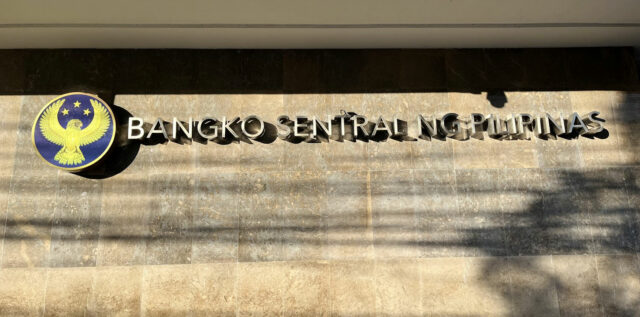
The main office of the Bangko Sentral ng Pilipinas in Manila. — BW FILE PHOTO

THE BANGKO SENTRAL ng Pilipinas (BSP) is reminding its supervised institutions to monitor negative media reports as part of customer due diligence, in an effort to check for potential money laundering risks.

“All BSP-supervised financial institutions (BSFI) are reminded to incorporate Negative Media Report (NMR) screening as an integral procedure in the conduct of customer due diligence,” it said in a memorandum, adding this would complement ongoing transaction monitoring system and processes.

The central bank defines NMR as “published or televised adverse news, advisories, and/or reports on certain individuals and entities.”

“NMR related to possible money laundering predicate offenses, terrorist financing, and proliferation financing risks may trigger further review or look back on customers’ transactions and activities, particularly those subject of such NMRs.”

The BSP said that BSFIs must adopt policies and procedures to screen these negative news, including updating their institutional risk assessment.

Covered financial institutions should update their institutional risk assessment on newly identified financial crime threats and emerging trends that could have an impact on their products and operations, as well as other developments that could affect their operations, the BSP said.

BSFIs must consider all relevant risk factors, such as the institutional level of exposure to the subjects of negative information or reports and those who may be involved in illegal activities, it added.

They must also keep an updated list of sources of negative media reports, such as news articles, public registers, court/congressional/Senate records, as well as publicized hearings and deliberations.

A database of persons and entities that are the subject of these negative media reports should also be maintained, the BSP said.

“A BSFI shall develop means or measures to reasonably assess the credibility of these NMR sources and use the same for the conduct of ongoing monitoring,” it added.

Meanwhile, the BSP also noted customer due diligence and transaction monitoring processes must integrate NMR screening and scrubbing.

“To ensure holistic investigation, screening and scrubbing shall extend to ultimate beneficial owners and authorized signatories of juridical customers, as well as related parties/interests and counterparties involving material and significant transactions.”

BSFIs shall develop an NMR handling framework that is consistent with the board’s risk appetite and strategies.

It must also clearly define “material and significant” transactions considering risk factors, such as materiality of outstanding exposures; historical transactions; the relevance and magnitude of the NMR; and the presence of other attendant suspicious circumstances.

If warranted, a BSFI may conduct enhanced monitoring and transaction review for possible risk reassessment, risk-based account management, and suspicious transaction and risk event reporting depending on the results of the NMR investigation.

“A BSFI shall identify the action that may be triggered by the results of the NMR investigation, whose range shall be calibrated based on the severity of the results,” it said.

These include flagging the customer’s account for ongoing monitoring and periodic enhanced due diligence, account restriction, or termination of the relationship.

“A BSFI shall analyze the significance of NMRs and assess the impact of the possible operational, compliance, legal, concentration and reputational risks brought by clients subject of NMRs,” the central bank said.

Institutions must escalate and report significant risks, including Anti-Money Laundering Council inquiries or freeze orders, to their board of directors and senior management, it added. 

Rizal Commercial Banking Corp. Chief Economist Michael L. Ricafort said this effort shows proactive and dynamic monitoring by the BSP against potential “dirty money” risks.

“Thus, also minimizing the risk of asymmetric information and better due diligence and being more anticipatory in the management of these risks,” he added.

In February, the Financial Action Task Force removed the Philippines from the “gray list” or jurisdictions under increased monitoring for dirty money risks. — Luisa Maria Jacinta C. Jocson

Ayala Corp. secures SEC nod for P20-billion share offer

GARDENCOURT RESIDENCES is a development within Ayala Land’s 74-hectare ARCA South estate in Taguig. — AYALALAND.COM

THE Securities and Exchange Commission (SEC) has approved Ayala Corp.’s preferred share offering of up to P20 billion.

In a meeting held on May 27, the Commission En Banc rendered effective the registration statement of Ayala Corp., the corporate regulator said in an e-mail statement on Wednesday.

The offering consists of the re-issuance of 5 million preferred B shares, with an overallotment option of up to 5 million additional shares, both priced at P2,000 per share.

Ayala Corp. expects to raise up to P19.86 billion in net proceeds if the overallotment option is fully subscribed.

Proceeds from the offer will be used to repay short-term bank loans, and for general corporate purposes and capital expenditures.

The latest draft prospectus dated May 20 showed that the initial dividend rate setting date is Wednesday, May 28, while the offer period is scheduled from June 2 to June 6.

The preferred shares will be re-issued and listed on the main board of the Philippine Stock Exchange on June 18. Trading is expected to commence on the same date.

Ayala Corp. engaged BPI Capital Corp., BDO Capital and Investment Corp., Chinabank Capital Corp., First Metro Investment Corp., PNB Capital and Investment Corp., RCBC Capital Corp., and Security Bank Capital Investment Corp. as joint lead underwriters and bookrunners for the offer.

“For sure, there is demand for this because it is Ayala Corp. But of course, investors want a competitive yield,” DragonFi Securities, Inc. Equity Research Analyst Jarrod Leighton M. Tin said in a Viber message.

“Ayala is a sterling name in the capital markets, so we expect this offering to be well received by institutional and retail investors. This is an opportunity for investors to deploy cash in high quality preferred shares ahead of potential Bangko Sentral ng Pilipinas rate cuts in the next several months,” China Bank Capital Corp. Managing Director Juan Paolo E. Colet said in a Viber message.

For the first quarter of 2025, Ayala Corp. reported a 4% decline in net income to P12.6 billion, primarily due to weaker contributions from its power and telecommunications units. Ayala Corp. shares fell by 1.46% or P8.50 to close at P575.50 apiece on Wednesday. — Revin Mikhael D. Ochave

SM City Laoag to open as SM Prime’s 88th mall

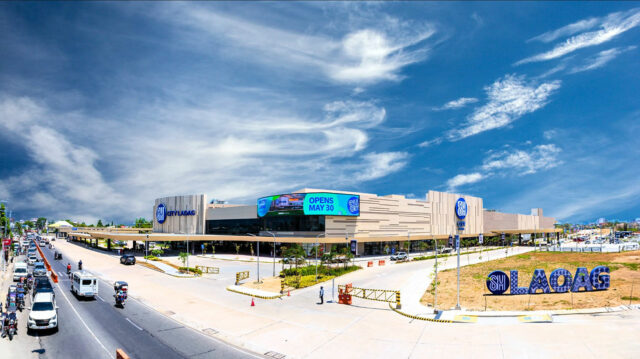
LISTED SM Prime Holdings, Inc. will open SM City Laoag in Ilocos Norte on May 30, marking the real estate developer’s 88th mall in the country.

Located near Laoag International Airport, the three-level SM City Laoag has more than 51,000 square meters of gross leasable space, SM Prime said in a statement on Wednesday. It is the first SM mall in Ilocos Norte.

SM Prime said SM City Laoag is opening with 90% of its space already awarded to lessees.

The mall is projected to generate about 4,000 local jobs across retail, operations, and support services.

SM City Laoag features tenants such as SM Store, SM Supermarket, SM Cinema, Ace Hardware, Pet Express, Miniso, and BDO. It also includes retail and lifestyle brands like Levi’s, Columbia, Adidas, Watsons, and Parfois.

The mall will also host global and local dining concepts such as TGI Fridays, Vikings, Marugame Udon, Café Amian, and Milk Pot.

SM City Laoag also has a central open-air park called “Dap-ayan,” named after the Ilocano word for gathering place. It will serve as a community space for events and leisure.

“The opening of SM City Laoag reinforces our commitment to bring modern, accessible and community-oriented retail experiences to underserved but fast-growing areas,” SM Prime President Jeffrey C. Lim said.

“We’re excited to support the region’s economic momentum,” he added.

Meanwhile, SM Prime said it is studying a complementary hotel development in Laoag City to capitalize on the area’s growing tourism and meetings, incentives, conferences, and exhibitions potential, expanding its footprint beyond retail in Northern Luzon.

SM Prime earmarked P100 billion in capital expenditure (capex) this year.

Of the total capex, P67 billion will fund SM Residences and integrated property developments, P21 billion will support the expansion of SM malls’ gross floor area, and P12 billion will be allocated to the office, hospitality, and meetings, incentives, conferences, and exhibitions businesses.

By the end of the year, the company expects its mall portfolio’s gross floor area to surpass 8 million square meters.

SM Prime shares dropped by 0.22% or five centavos to P22.95 apiece on Wednesday. — Revin Mikhael D. Ochave

Cebu Pacific to lease aircraft to Saudi carrier Flyadeal

CEBU PACIFIC AIRBUS A320 — WIKIMEDIA.ORG

BUDGET AIRLINE Cebu Pacific will lease two of its aircraft to Saudi Arabia’s low-cost carrier Flyadeal as part of a new partnership between the two companies.

“With Cebu Pacific’s growing fleet, we seek to maximize the potential of our increased capacity through all months of the year. The utilization of our capacity by other carriers during our lean season is a way of achieving that,” Cebu Pacific Chief Executive Officer Michael B. Szucs said during a media briefing on Wednesday.

Under the arrangement, the Gokongwei-led carrier will lease two Airbus A320 aircraft to Flyadeal during its peak season from June to August, which coincides with Cebu Pacific’s lean period.

Cebu Pacific is also assessing the possibility of wet-leasing Flyadeal’s A320s during the high-demand winter season in Southeast Asia toward the end of the year.

“Cebu Pacific’s lean season is our peak season. Their low season is really our high, so that is the original premise [of this agreement],” Flyadeal Chief Executive Officer Steven Greenway said.

Mr. Szucs said the initial flights under the arrangement will begin in June and run until August, after which the aircraft will be returned to Cebu Pacific.

“This was the starting point for wide-ranging commercial discussions covering a broad range of areas including more immediate needs of wet-leasing aircraft for Flyadeal’s busy upcoming summer season,” Mr. Greenway said.

In addition to the aircraft, Cebu Pacific will also deploy its pilots, cabin crew, and maintenance personnel as part of the agreement.

“We have to operate it with the cabin crew. Our crew will be operating throughout,” Mr. Szucs said.

In October 2024, Cebu Pacific finalized a P1.4-trillion ($24 billion) order with Airbus SE for up to 152 aircraft.

The airline received 17 aircraft deliveries in 2024, enabling the expansion and development of its domestic hubs.

Cebu Pacific expects seven more deliveries this year, after receiving its first aircraft for 2025 in March. The carrier is projected to operate a fleet of 100 aircraft by yearend.

As of May, Cebu Pacific flies to 37 domestic and 26 international destinations across Asia, Australia, and the Middle East. — Ashley Erika O. Jose

Dinner and a show(room)

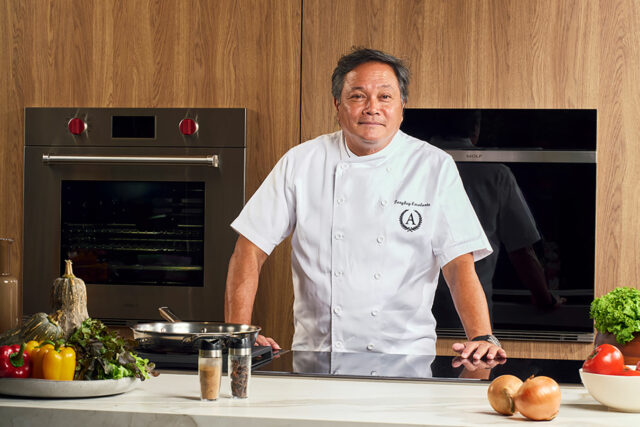
MULTI-AWARDED chef Tony Boy Escalante of Antonio’s.

IT’S NOT every day that one gets to eat at Antonio’s in Tagaytay, nor is it an everyday occasion to be surrounded by the fridges and ovens of Sub-Zero and Wolf. The three come together in a pop-up at Sub-Zero and Wolf’s Greenbelt showroom called The Table, running from May 26 to June 10.

On May 27, BusinessWorld and a host of media and VIP guests got a taste of the experience. The venue was reassuring Antonio’s founder, Antonio “Tony Boy” Escalante, and his team chopped, seared, and flambéed surrounded by some of the world’s most trusted kitchen appliance brands.

THE MEAL
The meal began with a lacy shrimp cracker, like a tuile, with a strong flavor of Parmigiano Reggiano, sprinkled with crunchy shrimp bits — the salty flavor jolted the tongue awake, but Marie de Moy NV Brut Champagne massaged the tongue again to calm it down. This was served next to a Pão de queijo, a Brazilian cheese roll that was crispy on the outside, and flaky and pillow soft on the inside — we’d have asked for more, but several other guests wanted some too. The next course was a series of amuse-bouches: Smoked Herring on a Smoked Herring Mousse topped with ikura, a Foie Gras Cornet with Raspberry Pearls, and Emulsified Oysters with seaweed and caviar from Nomad Caviar. The herring mousse creates an illusion of being solid and due to its very forward taste, an illusion broken by the pops of the salmon roe. The foie gras cornet, unfortunately, paled next to the seafood offerings — the herring’s effect was replicated in the oysters (with a texture like mayonnaise). We might pronounce the effect of the oysters to be too rich — however, we did have two servings, and that’s probably our fault for having more than a taste.

The next course was a Tartar of Maya Maya with a veil of Benguet Passionfruit-Tamarillo; then coconut, sweet peppers, and coriander oil. Visually stunning in yellow and green, we did pick off the fruity veil to enjoy what amounted to a very fancy kilawin (fish “cooked” in acid) — it is a mark of its excellence that we finished the whole plate despite our aversion to coconut, the sharp onion and chili in the fish defeating what we think was the cloying and too-rich flavor of coconut milk. The wine pairing, a Jurtschitsch Löss Grüner Veltliner 2023 from Austria, made the fish shimmer with notes of peach and pear.

Flame-torched Toro (fatty tuna) followed this, with a relish of Kalamata olives, sun-dried tomato, fregola, tuna roe, and Parmesan foam. The toro, usually a delicate delicacy, gained muscle with its garnish, taking on the flavors of the Mediterranean. The wine pairing, a Chateau De Chamirey, Mercurey, en Pierrelet, 2022, proved to be the best in the series, with a smell like frankincense and a mild flavor akin to sweetcorn — unfortunately, the strong tastes and the rich textures in the fish rendered it invisible.

A palate cleanser introduced us to a new treat: a Berry Granita made with Taogtog from Benguet. The berry grows wild there, and curse the day somebody successfully cultivates it: the berries taste exactly like cola, and we’re afraid we’ll waste away popping one after the other.

We may have expressed some reservations about the other courses, but there’s one thing Mr. Escalante will always get right: beef. The final savory course was a Tajima Striploin with a pumpkin and potato gratin, peas and beans, and a tasteful amount of pepper sauce. The beef was a hybrid of Kobe and Australian Wagyu cows: this resulted in the perfect balance of meat and fat marbling, not to mention a stronger flavor. This was paired with a Chateau La Nerthe, Châteauneuf-du-Pape Rouge, 2020, with a refined, woody scent and a slightly savory taste. With the perfectly seared striploin, a drop was just the perfect garnish.

We didn’t think that Mr. Escalante could top this, but he gave us a choice from four ice creams: whisky with dates and pecans, dark chocolate, roasted strawberries, and panna. We took all of them. We made the mistake of eating the whisky ice cream first — in all its rich indulgence with a sharp aftertaste from the liquor — so the rest of the flavors paled in comparison. Not that they didn’t try: the panna ice cream was topped with olive oil and salt; and we didn’t think strawberry ice cream could still be improved with a good roasting.

BIRTHDAYS
At the end of the dinner, the Sy family which distributes Sub-Zero and Wolf in the Philippines sang a “Happy Birthday” to the chef, who turned 59 on Wednesday.

Mr. Escalante’s Antonio’s in Tagaytay, which he started in 2002, became the first restaurant in the Philippines to make it to the Asia’s 50 Best Restaurants list in 2015. Since then, the Philippines has been a regular on the list. The Tagaytay fine dining scene he pioneered has seen multiple restaurants of increasingly high caliber open in the resort town. He says, quite humbly however, “I never told my people that ‘every year we have to win.’ We just have to work harder and harder and maintain. But if it comes, it comes.”

The chef started out studying dentistry, then shifting to a career as a flight attendant, then opening the restaurant in the 2000s, to much acclaim. In recent years, the chef, once reluctant to leave Tagaytay, has opened multiple outlets down in the big city. His café, Breakfast at Antonio’s, has a branch in Robinsons Magnolia; while Azela by Balay Dako has a city pied-à-terre in Robinsons in Ermita. Meanwhile, Antonio’s main city home is in the car showroom of PGA Cars along EDSA. He’s planning another Balay Dako up another hill, in Antipolo.

“I don’t know why I love Manila now,” he says, with a tone that suggested he surprised even himself. “My happiest place now is Manila. Before, I told myself, I’ll never, never. But I don’t know what happened,” he said.

“If I go to Tagaytay, after I work, even if it’s 12 o’clock, I’ll go down (to Manila). I don’t even sleep in my house — my beautiful house there. I’m here 90% (of the time),” he said in a group interview.

He has also since opened Pedro the Grocer, a retail food outlet. He recalls that when he first started, his mentors would ask him why he made his own bacon and other meat products. “What will I do? Buy? And now, it’s another business.”

Asked about Sub-Zero and Wolf equipment, he says he likes his oven with a steamer function. However, he speaks more fondly about his fridge and wine cabinet: how the fridge prolongs the life of his girlfriend’s bouquets, for example. Or how the wine cabinet holds his favorite red wines, or the fridge, again, storing his favorite guilty pleasure: butter. “I love butter. I have different butters,” he said. “I don’t spread my butter. I just cut, and eat it like cheese.”

A year closer to 60, he does reflect on an eventual retirement: “I just want more time to myself.” Someone pointed out that despite this, he has been opening new restaurants left and right. To that, he said, “It’s more of developing people, and the way you develop people is to trust them.”

Reservations for Antonio’s pop-up can be made through Antonio’s by contacting 0939-752-3291. For full booking details, you may visit thetable.subzero-wolf.com.ph. — Joseph L. Garcia


Strong AI governance may drive value creation for PHL businesses

STOCK PHOTO | Image by DC Studio from Freepik/THIS RESOURCE WAS GENERATED WITH AI

By Beatriz Marie D. Cruz, Reporter

PHILIPPINE COMPANIES must prioritize crafting governance frameworks for artificial intelligence (AI) use to effectively reap these technologies’ benefits while managing potential risks, according to the country’s telecommunication giants.

“[AI] governance is often treated like a side dish. It’s an afterthought because we can’t attach revenue to governance,” Derick Ohmar Adil, senior director for AI Data Governance at Globe Telecom, Inc., said during a panel discussion at the BusinessWorld Economic Forum last week.

Mr. Adil said strong AI governance is like “good parenting” as it ensures that employees responsibly exercise the freedom to use AI in their work.

“Your governance [policies] will make sure that your AI is not a liability, but more of a force multiplier.”

Patricio S. Pineda III, PLDT Inc. senior vice-president and head of Enterprise Business Group, said an effective governance policy can help ensure that AI adds value to a company.

“The truth of the matter is, your employees are already using AI whether you’re paying for it or not,” Mr. Pineda said.

When coming up with AI use policies, firms must ensure that there is a balance of voices, he said. “You’ve got to have the business and innovation [sections] pushing for new products to market because that’s what customers demand, but at the same time, you’ve got to have knowledgeable people on the governance and risk side.”

The Philippines improved by nine places to 56th of out 188 countries in the 2024 Government AI Readiness Index published by Oxford Insights.

AI adoption remains varied across Philippine industries, with data-intensive sectors like telcos and banking leading the way.

Meanwhile, analysts have said there is massive untapped potential for AI in the agriculture, healthcare, and logistics sectors.

Mr. Adil said small and medium enterprises also remain unsure where or how to start their AI journey.

“I think that’s what’s lacking with Philippines right now. What we need to do is put together a national strategy to know where we’re heading [in terms of AI adoption],” he said. citing countries like Singapore and Vietnam that have invested heavily in AI talent and innovation.

Mr. Pineda added that the rise of AI and cloud computing technologies has pushed companies like PLDT to cater to the demand for data centers and internet connectivity with stronger capacity.

“A lot of the data that we will be working with will probably be coming from abroad, and a lot of our own data is being hosted with hyperscalers abroad,” he said.

PLDT’s construction of the Philippine link of the Asia Direct Cable aims to facilitate seamless data transfer to key hubs like Singapore, Hong Kong, Japan, Vietnam, Thailand and China. This is expected to increase PLDT’s international capacity by over 100 Terabits per second.

“It’s a lot of investment, but we believe we’re building ahead,” Mr. Pineda said.

Meanwhile, Mr. Adil also emphasized the need to embed security and privacy in companies’ AI adoption.

Around 85% of Philippine organizations reported AI-related security incidents last year, technology company Cisco said in its 2025 Cybersecurity Readiness Index report.

“AI [adoption] plus that ‘shift to the left’ mindset will make functions like security and privacy not a backend IT (information technology) function, but more of a design decision,” Mr. Adil said.

“I think with this AI era, trust is the new currency. Regardless of how good your AI solution is, if no one will trust it, no one will use it.”

Philippine companies should be more deliberate in their AI goals and consider their contribution to the broader economy, Mr. Adil added.

“We need to be able to invest in smarter, more grounded, local AI solutions that can help solve real issues like food security and education.”

Mr. Pineda said companies must work to understand AI to help unlock opportunities, drive productivity, and generate jobs.

“We can’t decide about what AI can do for companies or for the country if we don’t dig into it ourselves.”