Home Blog Page 1511

Advanced treatments for prostate cancer with Mount Elizabeth Hospital’s Dr. Poh Beow Kiong

When cancer cells enter the male reproductive system, the prostate gland is in serious trouble. Nonetheless, advancements have significantly improved treatment, allowing for easier recovery among patients. Urologist Dr. Poh Beow Kiong of Gleneagles and Mount Elizabeth Hospitals discusses these minimally invasive and holistic treatments.

For inquiries, please contact Mount Elizabeth Hospital’s patient assistance center, IHH Healthcare Singapore – Philippine Office, located at G/F-B, Marco Polo Hotel, Meralco Avenue and Sapphire Street, Ortigas Center, Pasig City 1600, e-mail manila.ph@ihhhealthcare.com or call 0917-526-7576.


Spotlight is BusinessWorld’s sponsored section that allows advertisers to amplify their brand and connect with BusinessWorld’s audience by publishing their stories on the BusinessWorld Web site. For more information, send an email to online@bworldonline.com.

Join us on Viber at https://bit.ly/3hv6bLA to get more updates and subscribe to BusinessWorld’s titles and get exclusive content through www.bworld-x.com.

SMIC eyes long-term growth via consumption-driven strategy

SMSUPERMALLS.COM

SY-LED SM Investments Corp. (SMIC) said consumption will drive the conglomerate’s long-term growth plans, led by its core businesses in the property, banking, and retail sectors.

“The Philippine economy remains consumption-driven, and SMIC is well-positioned to support and capture this demand. Our strong ecosystem — spanning retail, banking, and property — enables us to navigate challenges while delivering long-term value,” SMIC President and Chief Executive Officer Frederic C. DyBuncio said in an e-mail statement on Tuesday.

Citing a report by equity research firm CLSA, SMIC said its retail segment is poised to benefit from minimum wage increases, sustained remittances, and consumer spending resilience despite macroeconomic uncertainties.

CLSA also said that wage adjustments and higher remittances are projected to support household spending, particularly in essential categories.

“We anticipate spending behavior to continue to favor staples (essential items) over discretionary, with minimarts still driving growth,” it said.

SMIC said its minimart chain Alfamart aims to sustain expansion this year. Since its first store in 4, Alfamart increased its store count to 2,100, mainly in Luzon and Metro Manila.

“We continue to see strong demand for essentials, with minimarts playing an essential role in serving everyday consumer needs,” Mr. DyBuncio said.

CLSA also noted SMIC’s synergies across its portfolio, particularly the earnings and mall network of real estate unit SM Prime Holdings, Inc. and the financial services of BDO Unibank, Inc.

“Our businesses complement each other — our expanding retail footprint enhances mall traffic, while BDO provides financial solutions that fuel both consumption and enterprise growth. These synergies allow us to build resilience and create shared value for our stakeholders,” Mr. DyBuncio said.

SM Prime currently has 87 malls in the Philippines, with planned expansion towards the provinces to meet demand in Northern Luzon, Visayas, and the progressive cities in Mindanao.

Last week, SM Prime announced that it is allocating up to P33 billion this year for the expansion and development of its commercial real estate portfolio, with some P21 billion to increase the gross floor area of the malls business.

SMIC shares rose by 0.13% or P1 to P794 apiece on Tuesday. — Revin Mikhael D. Ochave

EVOxCharge eyes more EV charging stations in PHL

PLUGSHARE.COM

By Beatriz Marie D. Cruz, Reporter

ELECTRIC VEHICLE (EV) solution startup EVOxCharge, Inc. expects to increase its charging stations and users in the Philippines as more brands enter the EV market.

“It is our vision to establish 1,000 charging stations in the next five years either through partnership with establishments or through our own charging stations,” EVOxCharge Vice-President and General Manager Derrick John Tolentino said in an e-mailed reply to questions.

EVOxCharge, a unit of logistics company Transnational Diversified Group, Inc. set up in 2022, supplies, operates and maintains an EV charging infrastructure.

EVOxCharge has 25 commercial charging stations to date and is looking to establish 100 more locations by yearend, Mr. Tolentino said. It also expects its users to double to 500 this year, with an annual growth of at least 50% in the next couple of years.

EVOxCharge expects the adoption of both EVs and its infrastructure to increase in the next two years.

“This will be spurred by the arrival of established brands that are positioning themselves aggressively in the market, and as the Electric Vehicle Industry Development Act is implemented, the guidelines for implementing the key rules will be stricter and well established,” he said.

The company is bullish that demand for its EV charging infrastructure, driven by the increasing adoption of EVs and the need for accessible and reliable charging solutions.

“Beyond providing a basic utility, there is growing interest in turning the charging infrastructure into a revenue-generating asset through features like dynamic pricing, subscription models and partnerships with commercial establishments,” Mr. Tolentino said.

With increasing demand, businesses are also expected to provide user-friendly mobile applications to support users’ charging experience and improve the management of charging stations.

Recognizing that EV adoption is still in its early stages, EVOxCharge plans to focus on market penetration over achieving significant revenue growth, Mr. Tolentino said.

“To fuel our expansion, we are actively exploring funding opportunities from various sources including clean energy funds from various institutions,” he added.

EvoXCharge has a mobile app and web platform that allows seamless digital payments, charger operation and real-time location services.

To ensure the efficient and reliable operation of its charging stations, the app also serves as a back-end system for monitoring, support and data analysis.

“The core vision of EVOxCharge is to enable EV owners to easily locate and operate chargers without human intervention,” Mr. Tolentino said.

Witnesses describe wordless knife attack on Salman Rushdie, The Satanic Verses author

SALMAN RUSHDIE — COMMONS.WIKIMEDIA.ORG

MAYVILLE, New York — Jurors heard on Monday how an attacker stabbed novelist Salman Rushdie more than a dozen times in a matter of seconds at a New York lecture, during the trial of the man accused of trying to murder the author.

A poet introducing the 2022 talk, on the subject of keeping writers safe from harm, was barely into his second sentence when defendant Hadi Matar bounded onto the Chautauqua Institution open-air stage and made about 10 running steps towards a seated Rushdie, Chautauqua District Attorney Jason Schmidt told the jury.

“Without hesitation, upon reaching Mr. Rushdie, he very deliberately and forcefully and efficiently at speed plunged the knife into Mr. Rushdie over and over and over and over and over again,” Mr. Schmidt said. Eyewitnesses who testified on Monday said they heard no words from the assailant, and that Mr. Rushdie was quickly soaked in blood.

The trial ended for the day and is due to continue on Tuesday.

Mr. Rushdie, who spent most of the 1990s in hiding in the UK after receiving death threats over his 1988 novel The Satanic Verses, was stabbed about 15 times: in the head, neck, torso, and left hand, blinding his right eye and damaging his liver and intestines.

Mr. Rushdie, 77, is due to testify about his injuries at the Chautauqua County Court in Mayville, New York, a few miles north of the Chautauqua Institution, a rural arts haven.

Mr. Matar, 26, has pleaded not guilty to a charge of second-degree attempted murder and second-degree assault. The latter charge is for wounding Henry Reese, the co-founder of Pittsburgh’s City of Asylum, a non-profit group that helps exiled writers, who was conducting the talk with Mr. Rushdie that morning. Mr. Reese is also due to testify.

Jurors will see videos of the attack, which some 1,000 audience members witnessed, and Mr. Matar’s arrest, and will hear from the Erie trauma surgeon who treated Mr. Rushdie after he had lost catastrophic volumes of blood, Mr. Schmidt said.

Mr. Matar said “Free Palestine, free Palestine,” as he walked past the public gallery after entering the courtroom, dressed in a blue shirt and dark pants, before the jury was brought in.

His lead defense lawyer, Nathaniel Barone, has been hospitalized with an illness, Mr. Barone’s colleagues told the court, but Judge David Foley denied their request to delay proceedings.

Lynn Schaffer, a public defender representing Mr. Matar, told the jury in her opening statement that the prosecution would fail to prove the necessary element of intent beyond reasonable doubt. She told them that none of the evidence Mr. Schmidt would present would show why Mr. Rushdie was attacked that day.

She referred to some evidence that Mr. Schmidt had cited: the pass Mr. Matar had bought to enter the Chautauqua Institution on Aug. 12, 2022, the morning of Mr. Rushdie’s appearance.

“Those gate passes are reflective of an intent to come in and watch a lecture, to watch a show,” Ms. Schaffer said.

FATWA AGAINST RUSHDIE
Mr. Rushdie was born into a Muslim Kashmiri family in India and is now a US citizen. In 1989, he went into hiding under the protection of British police after Ayatollah Ruhollah Khomeini, then Iran’s supreme leader, pronounced The Satanic Verses to be blasphemous.

Khomeini’s fatwa, or religious edict, called upon Muslims to kill the novelist and anyone involved in the book’s publication, leading to a multi-million-dollar bounty and the 1991 murder of Rushdie’s Japanese translator, Hitoshi Igarashi.

The jury has heard no mention of the fatwa or the threats against Mr. Rushdie. Mr. Schmidt, the district attorney, has said it is irrelevant to proving the crime of attempted murder took place.

The Iranian government said in 1998 it would no longer back the fatwa, and Mr. Rushdie ended his years as a recluse, becoming a fixture of literary gatherings in New York City, where he lives.

After the attack, Matar told the New York Post he had traveled from his home in New Jersey after seeing the Rushdie event advertised because he disliked the novelist, saying Rushdie had attacked Islam. Matar, a dual citizen of his native US and Lebanon, said in the interview he was surprised that Rushdie survived, the Post reported.

On Monday, two employees of the Chautauqua Institution who were at the amphitheater that morning testified about the attack. Deborah Sunya Moore, the institution’s chief program officer, recalled being handed the knife after it had been taken from Mr. Rushdie’s assailant by audience members who rushed on stage.

On Monday, it was inside a cardboard box on the prosecutors’ table.

If convicted of attempted murder, Matar faces a maximum sentence of 25 years in prison.

Matar also faces federal charges brought by prosecutors in the US attorney’s office in western New York, accusing him of attempting to murder Mr. Rushdie as an act of terrorism and of providing material support to the armed group Hezbollah in Lebanon, which the US has designated as a terrorist organization.

Mr. Matar is due to face those charges at a separate trial in Buffalo. — Reuters

Fed to wait on next rate cut as tariffs risk inflation flare-up

US Federal Reserve Chair Jerome H. Powell — REUTERS

BENGALURU — Faced with the threat of rising inflation, the US Federal Reserve will wait until next quarter before cutting rates again, according to a majority of economists in a Reuters poll who previously expected a March cut.

Economists have raised their inflation forecasts since US President Donald J. Trump was elected, based on concerns his policies, particularly on tariffs, could re-ignite price pressures in the economy.

After cutting rates by a cumulative 100 basis points between September and December, Fed officials, including Chair Jerome H. Powell, have recently said they are “not in a hurry” to lower rates further.

With a strong job market and still solid consumer spending, many economists see the world’s largest economy in a sweet spot, with little need for lower rates.

So far, there have been new tariff announcements every week.

Mr. Trump said on Sunday he would impose new 25% tariffs on all steel and aluminium imports. The White House delayed its plan to increase trade barriers on Mexico and Canada until March 1 but has levied an additional 10% tariff on imports from China.

“The tariffs are inflationary and could be quite negative for economic growth as well. That uncertainty just means the Fed is sort of left waiting and wanting to see what actually does happen,” said James Knightley, chief international economist at ING.

“There’s lots and lots of moving parts to the policy thrust of Donald Trump, and some of them are somewhat contradictory. It’s very, very challenging, and so confidence in any of our forecasts around the US economy, and by extension global economic activity, is pretty low right now.”

While a near-60% majority of economists in a January poll had expected the central bank to reduce rates in March, they were divided in the Feb. 4-10 poll on when the Fed will cut next.

A two-thirds majority of forecasters, 67 of 101, expected at least one rate cut by end-June with 22 saying March and 45 in the second quarter.

Only 17 of 99 economists with end-2025 forecasts said the next cut will come in the second half of the year, and 16 expected no cuts this year.

Interest rate futures are pricing in just over a 50% probability of one rate cut by mid-2025.

Although poll medians predict the Fed will lower rates twice this year, reaching 3.75%-4% by end-2025, the range of forecasts is wide, from a low of 3%-3.25% and a high of 4.5%-4.75%. There is no majority view.

But economists were more certain about inflation pressures.

Over 90% of common contributors between the October survey — conducted just before the US presidential election — and the latest poll raised their 2025 annual inflation forecast, by around 40 basis points on average.

Nearly 60% of respondents, 27 of 46, who answered an additional question said US inflation risks from tariffs have gone up recently. A further 17 said no change, with only two saying they had gone down.

“The uncertainty is likely enough to keep Fed officials on the sidelines over the coming months, and if high tariffs are ultimately imposed then the subsequent rise in inflation will prevent further easing over the remainder of 2025,” noted Neil Shearing, group chief economist at Capital Economics. 

After growing an annualized 2.3% last quarter, the US economy will expand 2.2% this year and 2.0% in 2026, faster than what Fed officials currently see as the non-inflationary growth rate of 1.8% over coming years, poll medians found.

The unemployment rate, which ticked down to 4% last month, was forecast at 4.2% this year and 4.1% next. — Reuters

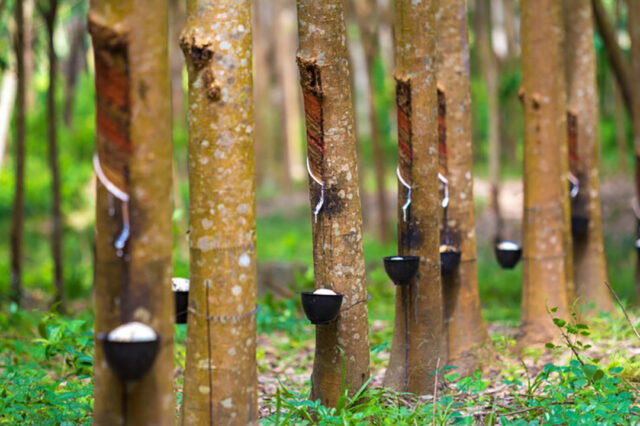
The hot money in commodities is betting on the tropics

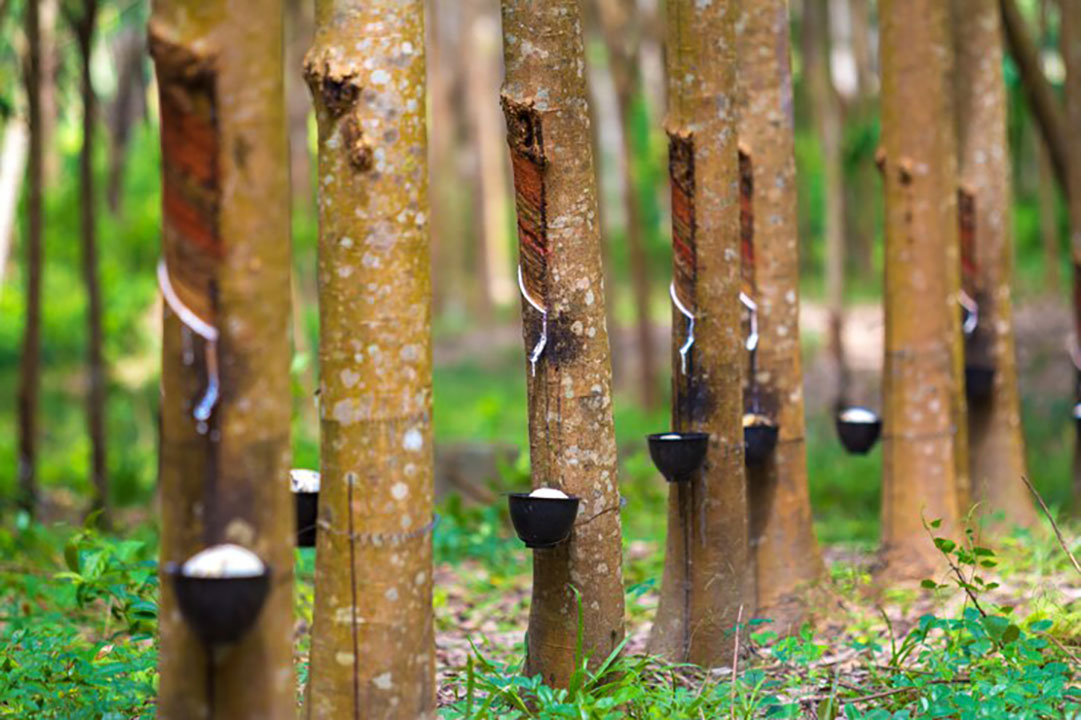
RUBBER — FREEPIK

LOOKING for an investment idea that’s paid off handsomely in commodities markets over the past six months? Try betting on the tropics.

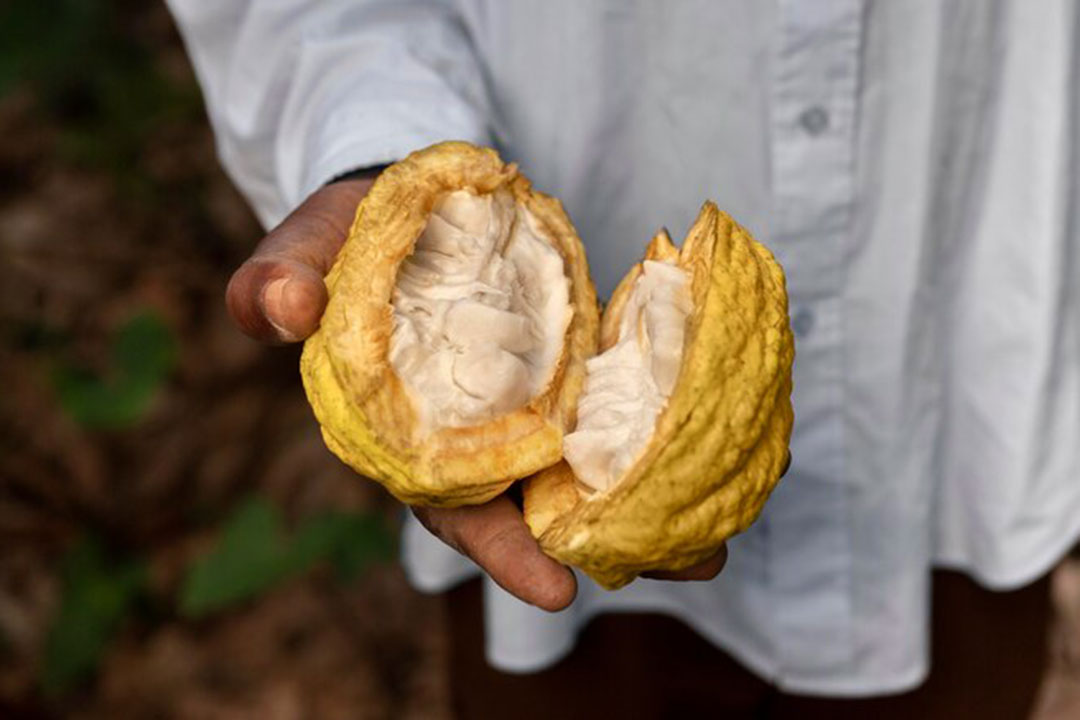
Tropical forest crops constitute four of the best performers among major commodity futures since early August. Coffee (in both its more flavorsome arabica and basic robusta varieties) has more than doubled in price, as my colleague Javier Blas has written. Rubber, cocoa, and palm oil are all up by more than 20% over the same period. Coconut oil, though not widely traded, is also doing well: Spot prices in Amsterdam are up about 27%.

That’s no reason to celebrate. Uniquely vulnerable to the vagaries of the weather, tropical forest crops are like canaries in the coalmine of global warming. The money being made by commodity traders right now is the flipside of the losses being shouldered by wildfire-hit homeowners in the US — a harbinger of the financial damage that climate change will wreak across the world as the century wears on.

For all that production of these crops straddles three continents, they’re largely produced in a handful of places. Just six countries — Brazil, Indonesia, Ivory Coast, Malaysia, Thailand, and Vietnam — account for 87% of the world’s palm oil, 71% of rubber, 59% of cocoa beans, and 55% of coffee.

With such a concentration of supply, bad weather in one region can be enough to knock the whole global market off balance. In Brazil, the worst drought in four decades has hindered the flowering of coffee plants, as well as burning rainforest and sugarcane fields, and drying up of the dams that provide two-thirds of the country’s electricity.

Downpours and floods in West Africa’s cacao country and Southeast Asia’s rubber and oil palm plantations have had a similar effect, killing off buds, causing fruit to rot on the trees, and preventing farmers getting to their plantations to harvest the crop.

Those disastrous conditions across three continents are connected, and growing more so as a warming climate causes regional weather systems to link up. The La Niña cycle that has predominated for most of the past five years tends to bring dry conditions to southeastern Brazil and wet weather to West Africa and Southeast Asia, as moisture in the South Atlantic and Indian Oceans is driven eastwards.

Some of this comes with the territory of tropical agriculture. Plants in temperate latitudes and the subtropics tend to be more resilient to bad growing conditions, because they evolved to cope with seasonal swings in temperature and rainfall far more dramatic than you’ll find in the tropical rainforest belt closest to the equator.

Tropical plants, however, are far more fragile. Make the weather a degree or so hotter, and photosynthesis weakens, pests proliferate, and yields decline. One 2020 study found that 41 of 190 tropical species studied will be experiencing temperatures so warm by 2070 that their seeds will be unable to grow. Climate change represents an “existential threat” to production of tropical fruits such as bananas, mangoes, and papaya, according to another study last year.

Making matters worse, all the four commodities currently experiencing surging prices are produced by trees. A Brazilian soybean farmer has some scope to factor in whether El Niño or La Niña is approaching when deciding how many hectares to sow each year, helping mitigate the impacts of the weather and rebalance the market. Tree plantations are decade-long projects, however, so there’s hardly any ability to compensate by adjusting plantings. Crops that are also grown in subtropical and temperate regions, as well as the rainforest belt (such as corn, soybeans, tea, and sugar), are similarly less exposed, and have seen little evidence of price spikes of late.

The final piece of the puzzle comes from looking at the financial conditions of the people producing them. Supply of all four is dominated by smallholders, who typically farm only a few hectares and use the commodities they grow as cash crops to supplement a meager subsistence livelihood.

As the impacts of a warming planet intensify, “climate adaptation” has become a key concept for farmers in rich countries — investing in new seed strains, better nutrients, or more sophisticated methods of water management, harvesting, and crop rotation to offset the damage being wreaked by the weather.

That all costs money, however, and there’s few people in the entire global agriculture industry with less to spare than the farmers of tropical forest crops. Smallholder farmers, after all, make up the biggest share of the 700 million worldwide living in extreme poverty of less than $2.15 per day.

Higher prices like those we’re seeing now typically spur such investment. But tropical smallholders are notoriously bad at capturing the value from their supply chains, with most of the benefit flowing to processors, traders, and the handful of global companies that sit on top.

That suggests relief is far off. If you’re hoping to take your mind off the darkening reality of climate change with snack foods, a latte, a chocolate bar or a drive in the country, you’ll be paying more for the privilege for a good while yet.

BLOOMBERG OPINION

CREIT says credit rating sustained

PHILSTAR FILE PHOTO

SAAVEDRA-LED Citicore Energy REIT Corp. (CREIT) has sustained its PRS Aa+ credit rating with a “stable” outlook from credit rating agency Philippine Rating Services Corp. (PhilRatings).

The company also maintained the same rating for its ASEAN Green Bonds, it said in a media release on Tuesday.

Citing a statement from PhilRatings, CREIT said the rating was based on its fully occupied portfolio of green assets, reputable shareholders, strong profitability with high margins, sound financial position, and more-than-satisfactory liquidity.

“Sustaining the PRS Aa+ credit rating from PhilRatings, for both the company as an issuer and the company’s maiden ASEAN Green Bond, is a testament to the company’s strong financial position and profitability…,” said CREIT President and Chief Executive Officer Oliver Tan.

“We intend to continue as a platform that empowers investments, ensuring that our debt instruments are trusted by creditors and investors,” he added.

According to PhilRatings, the issuer credit rating signifies the “overall creditworthiness of a company, evaluating its ability to meet all its financial obligations within a time horizon of one year,” with the stable outlook indicating that the rating is expected to remain unchanged over the next 12 months.

Issue credit ratings of PRS Aa, meanwhile, are of high quality and subject to very low credit risk, with the obligor’s capacity to meet financial commitments deemed very strong.

In February 2023, CREIT listed its oversubscribed maiden ASEAN Green Bond offering amounting to P4.5 billion.

The proceeds were used to acquire value-accretive properties, expanding the company’s green asset portfolio to its current 7.1 million square meters.

CREIT said its current land parcels form part of the expansion pipeline of its sponsor, Citicore Renewable Energy Corp., which aims to achieve a five-gigawatt capacity within five years.

CREIT is the Philippines’ first real estate investment trust focused on renewable energy. It specializes in owning sustainable infrastructure projects, including income-generating renewable energy properties across the country.

At the local bourse on Tuesday, shares in the company closed unchanged at P3.20. — Sheldeen Joy Talavera

VRITIMES helps startups, SMEs through press release service

FREEPIK

VRITIMES, a press release distribution provider, is helping startups and small and medium enterprises (SMEs) gain more brand awareness through press releases.

The Japanese startup was founded in Indonesia in 2022 to address the lack of dedicated press release distribution provider in Southeast Asia and later expanded to the Philippines in 2023.

“At that time, we were having difficulties finding this kind of distribution service,” Ferry Bayu, co-founder and chief executive officer at VRITIMES, said in an interview. “We had to go one by one to the media, and it was very expensive.”

“So, we decided to create a service that is much cheaper, especially for startups and SMEs,” he added.

VRITIMES promises affordable pricing for its services, with single press releases starting at P1,490 and subscription packages at P4,490.

Each press release has guaranteed publication in 50 small and medium local media outlets and is also sent to major local media companies for coverage.

Four working days after the press release is published, executive summary reports will be made available including social media engagements, media publications and LinkedIn impressions.

VRITIMES serves more than 2,500 customers across Southeast Asia including notable companies in the Philippines such as BDO Unibank, Inc. and Jollibee Corp.

Mr. Bayu noted that press releases help companies, particularly startups and SMEs, convey their brand messaging and eventually gain customer trust.

“A press release is something continuous,” he told BusinessWorld. “So, if your company information is covered in the media, like BusinessWorld Online, people’s trust will be higher. When they see it in the media, it will, in turn, help boost your brand awareness.”

Despite being a young company in the Philippines, VRITIMES plans to expand operations in the country. “We will have more people in the Philippines, incorporate more companies, host more events and approach more media,” Mr. Bayu said.

In February, VRITIMES expanded its operations to key Asian countries including China, South Korea and Taiwan. — Edg Adrian A. Eva

Police in India pull the plug on British singer Ed Sheeran’s impromptu street concert

INSTAGRAM.COM/TEDDYSPHOTOS

A STREET performance by Ed Sheeran in India’s tech capital of Bengaluru was stopped abruptly by police on Sunday, outraging fans and prompting the British singer to issue a clarification.

Mr. Sheeran, dressed in a white T-shirt and shorts was seen singing and playing his guitar on a pavement in the center of Bengaluru ahead of his concert on Sunday night.

Local channels showed a policeman walking up to Mr. Sheeran as he was singing the hit single “Shape of You” and unplugging the microphone, as onlookers jeered. Mr. Sheeran left soon after.

Police said event organizers had been refused permission for the street performance, which was on one of the city’s busiest streets.

“I refused to give permission because Church Street gets very crowded. That is the reason he was asked to vacate the place,” Bengaluru police official Shekar T. Tekkannanavar was quoted as saying by news agency ANI.

Mr. Sheeran, who began his career as a busker in the UK, said later on his Instagram account that he did have permission to perform.

“It wasn’t just us randomly turning up. All good though,” he wrote.

Mr. Sheeran is in India for a series of concerts, and performed in front of thousands of people at an open ground in the city later that night, accompanied by Indian singer Shilpa Rao. — Reuters

Online lending platform JuanHand’s loan disbursements hit over P45 billion to date

ONLINE LENDING platform JuanHand, which is operated by WeFund Lending Corp., has released over P45 billion in loans through more than 20 million disbursements to date as it marked its sixth year in the Philippines.

Loan disbursements were supported by repeat users as the company saw an average repeat rate of 90%, JuanHand Chief Executive Officer Francisco Mauricio said in a statement on Tuesday.

“At JuanHand, our mission has always been to extend a helping hand to underserved Filipinos, bridging financial gaps so they can achieve their goals. A key pillar of our success lies in our commitment to fair and regulatory-compliant debt collection practices, providing borrowers the flexibility they need to repay their loans responsibly,” Mr. Mauricio added.

The company’s simplified borrowing procedures to allow for quick access to funds, such as requiring just one valid ID to avail of loans worth up to P50,000 with a nine-month payment plan, also helped drive loan disbursements.

“This approach appeals to the growing population of digital-savvy Filipinos who prioritize convenience and efficiency,” JuanHand said.

The company has partnered with government agencies such as Cybercrime Investigation and Coordinating Center, National Privacy Commission, and the Anti-Money Laundering Council as part of its efforts to gain customer trust.

JuanHand also recently partnered with financial literacy social enterprise FEd Center to launch WAGI, an app-based financial literacy platform.

“Looking ahead, JuanHand aims to stay a trusted partner helping millions of Filipinos take control of their financial future,” it said. — Aaron Michael C. Sy

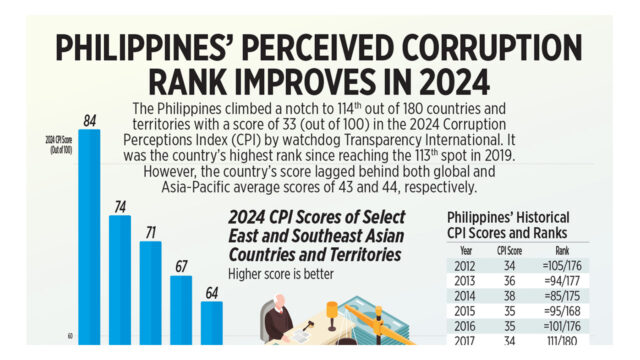
Philippines’ Perceived Corruption Rank Improves In 2024

THE PHILIPPINES saw a slight improvement in its ranking in a global corruption perceptions index by Transparency International, although its score remained well below the global average. Read the full story.

Philippines' Perceived Corruption Rank Improves In 2024

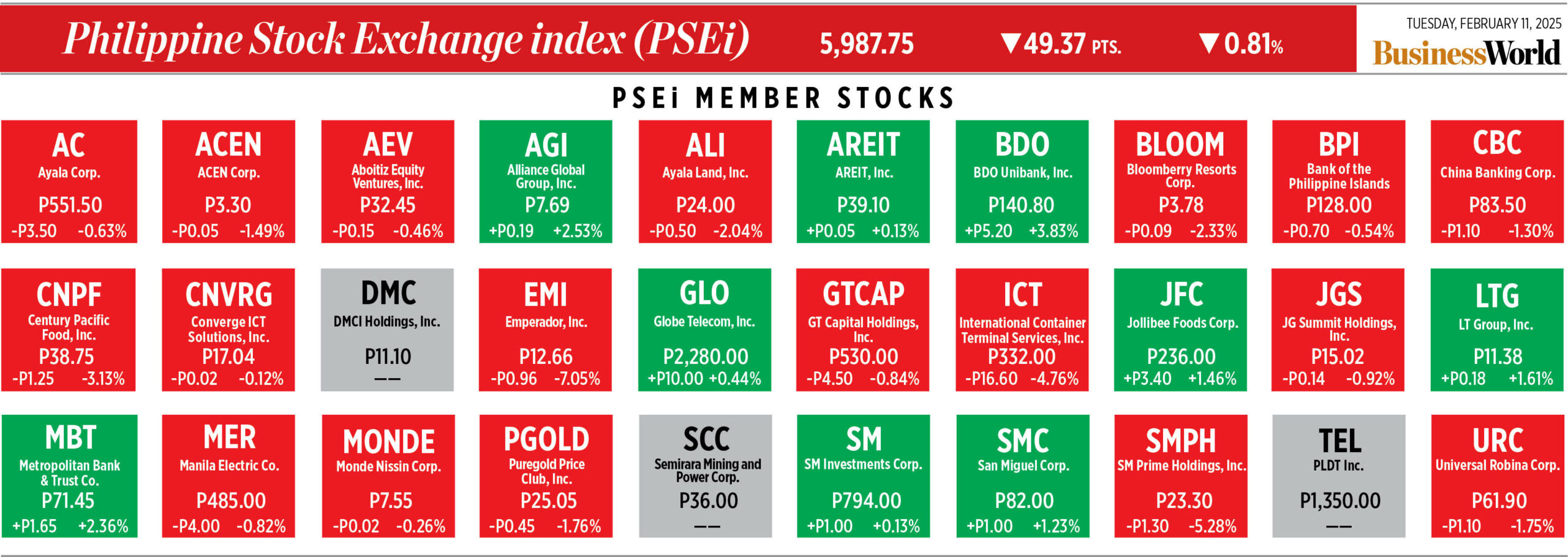
How PSEi member stocks performed — February 11, 2025

Here’s a quick glance at how PSEi stocks fared on Tuesday, February 11, 2025.