Home Blog Page 15

Philippine economy likely to expand by 5.3% in 2026 — AMRO

Visitors browse locally made products on display at a trade fair in Mandaluyong City, Oct. 26, 2025. — PHILIPPINE STAR/NOEL B. PABALATE

By Aubrey Rose A. Inosante, Reporter

THE Philippine economy is likely to grow by 5.3% this year, driven by robust domestic demand, although private investment risks persist amid the graft scandal, the ASEAN+3 Macroeconomic Research Office (AMRO) said on Wednesday.

In its latest Regional Economic Outlook quarterly update, AMRO sees Philippine gross domestic product (GDP) expanding by 5.3% in 2026, unchanged from its annual consultation report released in November.

This is still within the government’s revised 5-6% GDP growth target for 2026.

“The picture for the Philippine economy is that it has been quite steady, but there are some headwinds against (this outlook) on the investment side,” AMRO Chief Economist Dong He said in a virtual news briefing on Wednesday.

“Private investment of course, needs to be supported by investor confidence, and the public investment had been affected by some of the, for example, flood control controversy,” Mr. He said.

If realized, the Philippines is expected to be the second fastest-growing economy in Southeast Asia this year, after Vietnam’s 7.6%.

The country’s growth will likely outpace Cambodia (5.1%), Indonesia (5%), Laos (4.6%), Malaysia (4.4%), Singapore (3%), Myanmar (2.5%), Thailand (1.7%), and Brunei (1.6%).

The Philippines’ GDP growth would also be above the region’s average growth of 4.6% for 2026.

For 2025, AMRO said the Philippine economy likely grew by 5.2%, falling short of the government’s 5.5-6.5% target.

Mr. He also noted that the “fairly weak” third-quarter growth in 2025 prompted a downgrade in forecasts from the October update.

A flood control corruption scandal has weighed on growth, investor confidence and consumption.

In the third quarter, GDP grew by 4%, the weakest growth in over four years, bringing the nine-month average to 5%.

Fourth-quarter and full-year 2025 GDP data will be released on Jan. 29.

Mr. He said private consumption, which accounts for over 70% of the economy, will continue to remain firm, but the corruption scandal hit the investment side, he added.

Meanwhile, AMRO kept its headline inflation forecast for the Philippines at 3.2% this year, matching the Bangko Sentral ng Pilipinas’ (BSP) full-year projection.

Inflation settled at 1.7% in 2025, the slowest pace in nine years or since 2016.

MAIN RISKS
Meanwhile, AMRO said climate-related risks and artificial intelligence (AI), which put pressure on the country’s service exports sector, are the two main risks for the Philippine economy.

Mr. He also said that while the economy has expanded “steadily,” growth remains below its pre-pandemic trajectory.

“What’s important is really to strengthen governance, strengthen investor confidence, and prioritize investments or prioritize public spending so the economy will become more resilient (against the main risks),” he said.

Last week, the government unveiled “big bold reforms” before the private sector to counter the slide in investor confidence amid a corruption scandal.

Mr. He said these risks highlight the need to upgrade human capacity and human capital to suit the AI age, as well as strengthen infrastructure to make it resilient amid natural disasters.

“In order to maintain resilience and even aim higher to go back to earlier trajectory of growth, we think that the public policies should really focus on strengthening resilience, particularly in light of the two main risks facing the Philippines in the longer term,” he added.

AMRO added that in the near term, authorities have room to ease monetary policy and deploy fiscal support to help the economy.

“I think in terms of policies, of course, in the short term if there are shocks that hit the economy, monetary policy and fiscal policy would be the first policy instruments that the government can use,” he said.

The BSP has reduced its benchmark rate by a total of 200 basis points since August 2024, bringing the policy rate to a more than three-year low of 4.5%.

REGIONAL GROWTH TO MODERATE
Meanwhile, the ASEAN+3 region is projected to grow by 4% this year, moderating from the regional growth forecast of 4.3% in 2025 amid softer external demand.

ASEAN+3 includes the 10 Association of Southeast Asian Nations (ASEAN) member states plus China, Hong Kong, Japan and South Korea.

ASEAN is forecast to expand by 4.6% this year, slightly slower than 4.8% estimate in 2025.

“While domestic demand is projected to remain firm and continue supporting growth, higher US tariffs and persistent policy uncertainty are expected to weigh on external demand, leading to more moderate growth in 2026,” AMRO said.

The US began imposing a 19% reciprocal tariff on many goods from the Philippines, Cambodia, Malaysia, Thailand, and Indonesia in August 2025.

The think tank noted that overall risks to the regional outlook have become “more balanced,” though downside risks persist and uncertainty continues to rise.

AMRO also flagged five downside risks that could weigh on the region’s baseline forecast for 2025 to 2026, including heightened protectionist measures and a potential slowdown in technology demand.

It also warned that further escalation of US trade measures may dampen regional activity, amid concerns that tariffs will be imposed on sectors currently exempted, such as semiconductors.

Other factors that could undermine regional growth in the near term include potential slowdowns in major economies, surging global commodity prices, and increased financial market volatility.

AMRO said long-term risks include geoeconomic confrontation and policy uncertainty from geopolitical tensions, failure of climate change mitigation and adaptation, natural disasters, and extreme weather events.

It added that cyber insecurity, frontier technology risks, weak preparedness for infectious disease outbreaks, and inadequate planning for an aging population could further weigh on the region in the long run.

Despite these risks, the AMRO noted potential upside, such as strong global semiconductor demand and sustained foreign direct investment (FDI) commitments.

“Strong technology demand and robust FDI inflows into emerging sectors, including advanced electronics, electric vehicles, and digital services, have helped cushion growth despite ongoing tariff headwinds,” Mr. He said.

CPBRD says slashing VAT rate to 10% is ‘advisable’ despite revenue loss concerns

Canned goods are on display at a supermarket in Quezon City, Dec. 30, 2022. — PHILIPPINE STAR/MIGUEL DE GUZMAN

By Kenneth Christiane L. Basilio, Reporter

LOWERING the value-added tax (VAT) rate to 10% from 12% is fiscally viable despite projected revenue losses, a congressional think tank said, adding that the reduction is even “advisable” despite opposition from the Finance department.

The Congressional Policy and Budget Research Department (CPBRD) said in a January report that revenue losses from a proposal seeking to slash the VAT rate would likely be offset by a boost in consumption spending and capital inflows.

“The proposed VAT reduction is fiscally manageable and likely to yield positive economic effects,” CPBRD said in a 12-page report, which was authored by David Joseph Emmanuel Barua Yap, Jr., Edrei Y. Udaundo and Jubels C. Santos. “A reduction in the VAT rate, in particular, would result in lower market prices and greater consumer demand across the board.”

Since 1988, the Philippines has imposed VAT on most goods and services, including essentials like food and fuel. Raised to 12% from 10% in 2005, VAT has become a key revenue source, though critics have argued it disproportionately burdens working-class Filipinos.

Batangas Rep. Leandro Antonio L. Leviste last year filed House Bill (HB) No. 4302 seeking to lower the VAT rate to 10%, arguing the current tax system is “regressive” and should be reduced to make taxation more progressive.

The proposal also allows authorities to hike the VAT rate back to 12% for a year if the projected deficit is expected to exceed the programmed deficit.

“Despite its simplicity, the passage of the proposal will be immensely consequential to the fiscal position of the National Government and, more importantly, Filipino consumers,” the think tank said.

The CPBRD said a cut in the VAT would make business operations more viable, boosting production and supply, creating jobs for Filipinos and accelerating economic growth.

“All these, in turn, would increase the number of transactions that can ultimately be taxed by the government,” the CPBRD said.

Marikina Rep. Miro S. Quimbo said the House Ways and Means Committee, which he heads, is open to discussing the proposal, but would need careful scrutiny given the Department of Finance’s (DoF) opposition to the measure.

“This is something we are absolutely looking at, but we are trying to tread very carefully,” he told a media briefing. “We will evaluate. If there’s room to reduce VAT, we will do so.”

The DoF had expressed “strong reservations” to Mr. Leviste’s proposal, warning it could cost the government more than P1 trillion in foregone revenues through 2030 and jeopardize its fiscal consolidation drive.

The DoF earlier said the government could lose an average of P339 billion in revenue collections yearly from the proposal.

However, the CPBRD countered the projected shortfall could be “less than P200 billion.”

“The seemingly small VAT rate reduction will provide all Filipino families significant savings as the reduction would apply to a wide variety of goods and services,” the think tank said, noting it could potentially add P8,000 in annual disposable income for an average household.

“Filipinos can expect to reap the benefits from the emergence of more viable businesses, the increase in the availability of jobs, and the intensification of economic activity,” it added.

John Paolo R. Rivera, a senior research fellow at the Philippine Institute for Development Studies, said there could be merit in the CPBRD’s assessment that a VAT cut might boost the economy enough to offset revenue losses, but stressed it should be paired with other governance measures.

“Sure, a VAT cut can boost consumption and improve purchasing power, which may partly recover revenues through higher volumes and better compliance… however, it depends on timing, targeting and credibility,” he said in a Viber message.

“Without strong growth, efficient spending and safeguards against leakages, short-term revenue loss is real and could widen the deficit… It must be paired with spending discipline and complementary reforms to be fiscally sustainable,” he added.

The CPBRD said the government should consider “right-sizing” to rein in bloated expenses when considering the VAT cut, noting that salaries accounted for one-fourth of the national budget.

“A 5% reduction of personnel and their accompanying costs would reduce government expenditures by P80 billion… [while] a 10% reduction could reduce government expenditure by P160 billion,” it said.

President Ferdinand R. Marcos, Jr. last year signed into law Republic Act No. 12231, also known as the Government Optimization Act, which grants him the authority to reorganize and streamline agencies under the Executive branch to remove redundancies.

The think tank said budget planners should temper the annual increase in the national budget to ensure projected revenues keep pace with rising expenditures.

“Potential revenue loss from lowering the VAT rate can also be substantially minimized through strategic base broadening measures,” it added, recommending that lawmakers consider amending VAT-exempted goods and services when discussing HB No. 4302. “The simplification of the tax system through reduced exemptions would lower compliance and administrative costs.”

‘CRITICAL FIRST STEP’
The CPBRD said cutting the VAT rate would be an important step toward restoring public trust, as the Marcos administration grapples with a multibillion-peso graft scandal.

“[It] can serve as a critical first step in restoring trust in government institutions in light of recent controversies involving the Department of Public Works and Highways,” it said.

Several officials, politicians and private contractors have been accused of pocketing funds meant for public works projects in the flood-prone nation.

Leonardo A. Lanzona, an economics professor at the Ateneo de Manila University, said maintaining the current VAT rate could be misguided amid widespread corruption allegations surrounding government spending.

“Given the corruption, it may be wrong to keep the current tax rates,” he said in a Facebook Messenger chat.

But the VAT rate reduction, he said, could weaken the government’s capacity to fund social protection programs aimed at building human capital.

“If the government had been more efficient and more effective in delivering public services, the taxes could have been a crucial mechanism for promoting inclusive growth,” said Mr. Lanzona.

Trump’s remittance tax pushes Filipino workers toward digital transfers

US dollars are exchanged for pesos at a money changer in Quezon City. — PHILIPPINE STAR/MIGUEL DE GUZMAN

By Katherine K. Chan, Reporter

NERISSA ENRIQUEZ, 55, used to squeeze in a stop at a remittance shop near her Florida hospital after long nursing shifts, wiring small amounts several times a month to relatives in the Philippines.

These days, most of her money goes home through her phone — and she says she’s unlikely to go back to cash counters.

A 1% US tax on certain remittances, which took effect on Jan. 1 under President Donald J. Trump, is pushing overseas Filipinos like Ms. Enriquez further toward digital channels and away from cash-based transfers that fall under the levy.

The change is modest on paper, but for workers who send money frequently, it adds another cost to an already tight budget.

“I’ll probably have to cut back on the amount because of the tax,” said Ms. Enriquez, who has worked in the US for almost two decades. “I need to adjust it based on my income because that’s all I can afford.”

The tax applies to cash-based transfers such as cash payments, money orders and cashier’s checks, regardless of the sender’s citizenship. It is charged on top of the amount sent. Transfers made through US banks, US-issued debit and credit cards, electronic wallets and even hand-carrying physical cash are exempt — a carve-out that is shaping how migrants respond.

While the charge amounts to just $1 for every $100 sent, Ms. Enriquez said the added cost still stings, especially as prices of imported goods in the US remain elevated following Mr. Trump’s tariff push. If forced to rely on traditional channels, she said she may trim what she sends just to keep her usual schedule.

“They will probably end up receiving less,” she said of her family back home. “I feel sorry for them, but that’s all I can do.”

The Philippines is one of the world’s biggest recipients of remittances, with money sent by overseas Filipinos serving as a steady source of household income and a buffer for the economy during global slowdowns. Any policy that touches these flows tends to ripple quickly from migrants’ wallets to grocery bills and school fees back home.

Economists say the US tax is unlikely to derail overall remittance inflows but could shave off some spending power for Filipino households and accelerate a shift that was already under way: the move to digital transfers.

The levy could translate to about P8 billion to P9 billion in foregone spending in the Philippines each year, though the broader effect would be limited, Michael L. Ricafort, chief economist at Rizal Commercial Banking Corp., said.

“It could be a drag, though negligible, on remittance growth and on the local economy,” he said via Viber.

Filipinos sent home $2.91 billion in November — the lowest in two months —bringing cash remittances to $32.11 billion in the first 11 months of the year, according to the Bangko Sentral ng Pilipinas. The US remained the biggest source, accounting for 40% of inflows in 11 months.

The central bank’s forecast of a 3% rise in remittances to $36.6 billion this year remains within reach, Ruben Carlo Asuncion, chief economist at Union Bank of the Philippines, told BusinessWorld. The tax’s narrow scope, he added, limits its bite.

“(The tax’s) macroeconomic impact is likely minimal, as it applies only to cash-based transfers, while digital and bank channels remain exempt,” Mr. Asuncion said in a Viber message.

Still, the policy could change how money is sent, nudging overseas Filipinos toward formal digital platforms and away from informal channels, he pointed out.

That shift is already visible. Digital wallets, banking apps and online money-transfer services have gained ground over the past decade, helped by lower fees, faster settlement and wider smartphone use. The tax exemption gives those platforms another edge.

Analysts at the Asian Development Bank said migrants might simply reroute funds through US financial institutions or cards to avoid the charge, while money-transfer firms could absorb part of the cost to stay competitive.

“Because the law exempts transfers via the banking system, many migrants may bypass the fee entirely,” ADB economists Jules Hugot and Ed Kieran Reyes said in a commentary. “Given this, providers are likely to adjust pricing to keep customers.”

‘TIGHTER BUDGETS’
For some families, however, even small frictions matter.

Reinielle Matt M. Erece, an economist at Oikonomia Advisory & Research, said the tax might discourage frequent transfers, especially among workers who remit in small amounts.

“Taxes are meant to discourage sending income generated in the US outside the country,” he said in a Viber message. “Lower remittances mean tighter budgets for Filipino families.”

He added that reduced household income could weigh on consumer spending and savings, and for families carrying debt, make repayments harder. Over time, that could show up in bank loan performance, though he noted the effects would likely be gradual.

The tax comes at a time when many overseas Filipinos are already adjusting to higher living costs abroad. In the US, food, housing and transport expenses remain well above pre-pandemic levels, while interest rates have stayed high. For workers like Ms. Enriquez, who sends money at least five times a month, every extra fee adds up quickly.

“A 1% tax is still a lot,” she said. “If you’re remitting $1,000 or $2,000, imagine how much that is. How much more if it goes higher?”

Despite the added burden, most economists don’t expect a sharp pullback in remittances. Demand for Filipino workers remains steady across healthcare, shipping, construction and services, and labor conditions in key host countries have improved since the pandemic.

Mr. Asuncion said overall inflows should remain broadly stable, even if some households adjust how often they send money or consolidate transfers to manage costs.

Remittances tend to be resilient because they support basic needs — families depend on them.

For Ms. Enriquez, the decision is less about macroeconomic forecasts and more about day-to-day convenience.

She said physical remittance centers take too much time — commuting after work, filling out forms, waiting in line. Digital platforms fit better with her schedule and feel safer.

“Online is easier,” she said. “We already know how to use it and it’s secure.”

Her experience mirrors a wider trend among overseas Filipinos, many of whom adopted digital transfers during the pandemic and never fully returned to cash counters. The US tax may simply lock in that behavior.

For the Philippines, that could bring side benefits. More money flowing through banks and licensed digital platforms improves transparency and strengthens the formal financial system. It can also make it easier for recipients to save, pay bills or access credit.

Still, the policy underscores how decisions made thousands of miles away can filter down to kitchen tables in Manila, Cebu or Davao. For families that rely on money sent from abroad, even small changes matter.

Ms. Enriquez said she would keep sending what she can, tax or no tax. But the margin for adjustment is thin.

As overseas Filipinos adapt, the dollars will keep flowing — perhaps through different channels, perhaps in slightly smaller amounts — but with the same purpose: keeping households afloat back home, one transfer at a time.

MacroAsia unit cleared to develop Palawan nickel project

PHILSTAR FILE PHOTO

MACROASIA CORP.’S wholly owned subsidiary MacroAsia Mining Corp. (MMC) can now proceed with the development and operation of its Infanta Nickel Project in Brooke’s Point, Palawan, following regulatory clearance from the Mines and Geosciences Bureau (MGB) of the Department of Environment and Natural Resources (DENR).

In a disclosure to the Philippine Stock Exchange on Wednesday, the Tan-led company said the approval authorizes MMC and its operator, Calmia Nickel, Inc. (CNI), to move forward with the project, subject to compliance with conditions set by the MGB.

The Infanta Nickel Project, covered by Mineral Production Sharing Agreement (MPSA) No. 220-2005-IVB, involves the extraction and commercial disposition of nickel and other associated mineral deposits within a 1,113.98-hectare area in Brooke’s Point, Palawan, with an annual extraction rate of 1,000,000 metric tons.

An Environmental Compliance Certificate for the project was issued in December 2023 after the DENR-Mimaropa certified that the MPSA area lies outside the Mt. Mantalingahan Protected Landscape.

According to an environmental impact statement prepared by Prism Express Consulting, Inc. and posted on the Environmental Management Bureau website, the project is expected to create 57 regular jobs, with total employment reaching up to 1,000 once contractual laborers and third-party service providers are included.

The estimated project cost is around P646 million ($12.9 million).

In July 2021, MMC signed a memorandum of agreement with CNI for the exploration and eventual mining operations of the Infanta Nickel Project, the company said in an earlier disclosure.

At the Philippine Stock Exchange on Wednesday, MacroAsia shares rose by 2%, or nine centavos, to close at P4.59 apiece. — Vonn Andrei E. Villamiel

Regulator eyes lifting ban on new online lenders

UNSPLASH

By Alexandria Grace C. Magno

THE SECURITIES and Exchange Commission (SEC) is studying a possible lifting of the moratorium on registering new online lending platforms.

“The moratorium is already long — it’s already long, so I said it’s about time to study [whether] to lift it,” SEC Chairperson Francisco Ed. Lim told reporters on the sidelines of an event on Monday.

In November 2021, the SEC imposed a moratorium on the registration of new online lending platforms run by financing and lending companies as it worked on rules to curb predatory lending and abusive debt collection practices.

“We want to open up the moratorium — to lift the moratorium to enable bigger companies to come,” Mr. Lim added.

According to a 2025 report by leading global digital payments firm Visa, the Philippines faces a $206-billion (around 12.2 trillion) funding gap for small and medium enterprises (SMEs), the second largest in the Asia-Pacific, due to financial barriers hindering their growth.

The corporate regulator said it is reviewing the P1-million minimum capital requirement for online lenders, and noted that it may be increased. “It can be P5 million, or it can be P10 million,” Mr. Lim said.

He said lenders were drawn to high effective interest rates, prompting them to aggressively lend out limited funds. If payments faltered, they sometimes resorted to aggressive or abusive debt collection tactics. “We want to weed out those companies,” Mr. Lim noted.

He added that the SEC targets releasing draft rules by the first quarter of 2026. “Liberalizing the rules. That’s my focus this year,” Mr. Lim said.

From January to Sept. 15 last year, the SEC handled 5,415 public complaints involving financing and lending companies and their online platforms. Of these, 3,570 complaints, or 66%, involved unfair debt collection practices or collection harassment. Among them, 3,315 complaints were filed against unregistered financing companies, lending companies, and online lending platforms (OLPs), while 435 complaints targeted unregistered entities or unrecorded OLPs.

The commission has said that unregistered online platforms are among the key concerns that need to be addressed by law enforcement agencies.

Financial sector experts welcomed the SEC’s move to expand online lending platforms, citing the potential for greater competition, innovation, and improved credit access — particularly for underserved MSMEs and individual borrowers — through better pricing, data-driven risk assessment, and consumer-friendly products.

Philippine Institute for Development Studies senior research fellow John Paolo R. Rivera, however, cautioned about risks such as a resurgence of abusive practices, including hidden fees, harassment, and weak data privacy, if licensing, supervision, and enforcement lag behind market entry.

“Any reopening should be phased and conditional, with tighter fit-and-proper rules, caps on abusive fees, real-time reporting, and strong coordination with the Bangko Sentral ng Pilipinas, National Privacy Commission, and law enforcement to ensure consumer protection keeps pace with growth,” Mr. Rivera said.

Juan Paolo E. Colet, managing director at China Bank Capital Corp., stressed the need to issue licenses only to well-capitalized companies that uphold ethical business practices.

“The regulatory goal should be to not only expand the credit market, but to also make it equitable for all stakeholders,” he said.

Last year, the SEC issued Memorandum Circular No. 14, which imposed recalibrated ceilings on interest rates and fees for small consumer loans by financing and lending companies.

It set a 6% per month cap on nominal interest rates and a 12% monthly cap on effective interest rates for loans up to P10,000 with terms of up to four months, down from the previous 15% monthly effective rate cap allowed by the Monetary Board and SEC.

Dinner and a show (a magic one)

The Alchemy of the Sea

IF YOU’VE EVER harbored fantasies of performing magic, perhaps the Grand Hyatt Manila’s The Magic Table is for you.

In September, the hotel announced the arrival of The Magic Table, a performance conjured up with the video company 2Spicy Entertainment GmbH (the same one which concocted another dining experience, Le Petit Chef) and America’s Got Talent finalists Thommy Ten and Amélie van Tass, the magicians and mentalists better known as The Clairvoyants. Grand Hyatt Manila’s Food And Beverage Director Mark Hagan said during one such performance on Jan. 16 that it is one of several Hyatt hotel in Asia to have the experience, counting Hong Kong, Bangkok, Singapore, and we were one step ahead of Kuala Lumpur (the project was launched in Germany in autumn last year).

We won’t discuss all of the magic tricks the guests at the Jan. 16 dinner performed at the table (as guided by the voices and images of The Clairvoyants), but we’ll discuss at length about the dishes served to pair with the magic tricks. The first course was called A Spell of the Forest, a forest and porcini mushroom pâté with hazelnut soil, fig, lemon, pistachio, and Manuka honey. This was a little log stuffed with mushrooms, served under a mushroom (creating the illusion of one intact): this tasted pleasantly earthy, and the illusion intensified the taste and smell, as if it were just picked outside.

The second dish was called the Enchanted Shell, featuring butter-poached Hokkaido scallop with herb crust, sun-dried tomato and crustacean bisque; the rich taste of the sun-dried tomato provided a contrast to the delicate scallop.

The projections above the table then played a short film about escape artist Harry Houdini, and to rescue him from underwater, locked boxes were provided, and clues were flashed on the table to get the numerical code to unlock the boxes. The boxes contained a mother-of-pearl spoon with which to consume the next course, The Alchemy of the Sea, featuring a brandade of crab meat, codfish, sake-marinated salmon roe, and avocado (in place of the usual potato). Subtle (maybe a bit too subtle), but wonderfully creamy, the salmon roe provided a touch of luxury.

For the next trick, a zoetrope showed different types of magicians, and we had to do a counting game to figure out what kind we were. This was accompanied by The Order of Fire — Mulwarra tenderloin beef Wellington with bone marrow and café de Paris butter jus. Cozy and hefty, the crust was lined with mushroom, ham, and cheese in three separate layers, appearing almost magical. Our companion at the table, an official at Hyatt, also pointed out another magic trick: the plates were made from recycled broken china and glass from the hotel.

Another card and counting game signaled the end of the dinner with dessert, which was a chocolate and hazelnut sphere with espresso, chocolate brownie, cherry sorbet, and bourbon sac. We were initially served black bowls filled with black chocolate, but a server poured piping-hot chocolate over it, melting the black chocolate and allowing the pieces to fall into the real dessert underneath it. As someone who might have gotten blasé over performance dinners over the year, the dessert made us clap.

This is the second dinner-video experience being offered at the Grand Hyatt Manila, the first one being Le Petit Chef downstairs. Comparing the two, we’d say that The Magic Table is more interactive. “You can hear the audience is really engaged,” said Mr. Hagan in an interview with BusinessWorld. “I can hear you shouting.”

Asked if there’s any danger of one superseding the other, he said, “You tell me.”

“The two of them are very different, as you can see,” he said of the dinner-shows. We note that the animations in Le Petit Chef might be more appropriate for children, though The Magic Table has an advantage of being engaging for both adults and their tots, of every age. Mr. Hagan added that due to the nature of the video flashed at Le Petit Chef, the first course is always made with one ingredient (in this showing, it’s tomato). “This gave the chef a little bit more freedom,” he noted about The Magic Show. “Make it as magical as possible; make it an experience,” was the brief, he noted. He added, “The two of them deserve a place in Manila.”

The Grand Hyatt Manila is fast becoming a destination not only for dining, but dining with a little bit of a show: “If you’re looking for an experience in Manila, I don’t really think there’s anything like this,” he said (though we might argue that their buffet at The Grand Kitchen might fill the gap left by the defunct Sofitel’s much lamented Spiral). “It is the way of dining, I believe in the future. A little less formal — all these little plates of food and 20-course tasting menus. Here, you’re with your friends, and you have a glass of wine, and enjoy things.”

Prices for The Magic Table range from P4,000 for a children’s set menu, P7,500 for the vegetarian menu, P8,500 for the regular menu, and P9,500 for a deluxe version (the main course will have foie gras and truffle on top of it). The Magic Table has 40 seats per show and runs for approximately two hours, with the option to book the 6 or 8:30 p.m. seatings. Tables are arranged in groups of four or eight, and smart casual attire is required. — Joseph L. Garcia

Local company seeks entry into internet service market — DICT

STOCK PHOTO | Image by Alin Andersen from Unsplash

THE DEPARTMENT of Information and Communications Technology (DICT) said one local company has formally applied to offer internet services following the enactment of the Konektadong Pinoy Act.

“We are reviewing the application,” ICT Secretary Henry Rhoel R. Aguda said during a media briefing on Wednesday.

He declined to disclose the company’s name but confirmed it seeks to operate as an internet service provider.

In 2025, the DICT said that seven foreign firms showed interest in entering the Philippine telecommunications market, offering services such as mobile, fiber, and satellite.

“These companies are studying the final IRR (implementing rules and regulations) but what’s good about it is that we are encouraging foreign firms to explore partnership with existing players,” Mr. Aguda said, citing Globe Telecom, Inc.’s partnership with Elon Musk’s Starlink for direct-to-cell satellite services.

The Konektadong Pinoy Act, also known as the Open Access in Data Transmission Act, lapsed into law in August last year.

The law streamlines the licensing process for new entrants, boosting competition in data transmission.

Separately, the National Privacy Commission (NPC) has ordered all public telecommunications entities to disclose SIM registration data to disrupt financial scams and mule accounts.

Through a joint memorandum circular with the National Telecommunications Commission, DICT, and the Cybercrime Investigation and Coordinating Center (CICC), the NPC ordered public telecommunications entities to share certain personal information of end-users connected to financial scams with the CICC, while safeguarding data privacy and security. — Ashley Erika O. Jose

Purity, integrity, and joy: Inside La Conseillante with Marielle Cazaux

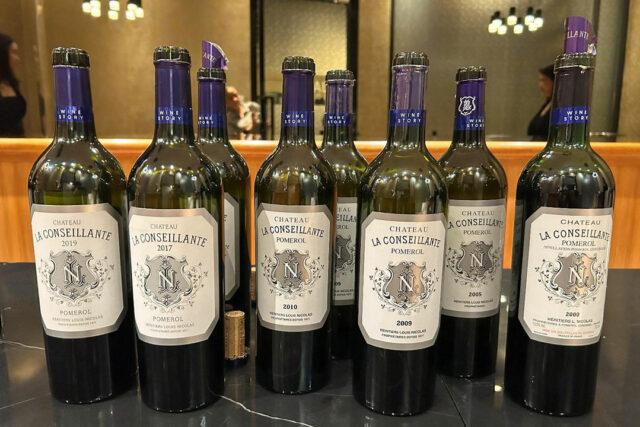
THE Chateau La Conseillante Wine Dinner Lineup (L-R): vintages 2019, 2017, 2010, 2009, 2005 and 2000. — SHERWIN A. LAO

AT A RECENT wine dinner hosted by Wine Story in Bonifacio Global City (BGC), I had the privilege of sitting down with Marielle Cazaux, managing director of Chateau La Conseillante, one of Pomerol’s most celebrated estates.

What made this even more special for me is that I have not tasted enough of Pomerol to be able to appraise the wine as I would, say, St.-Emilion, Pauillac, Margaux or even Hermitage, Champagne, and Alsace. I have had the privilege of tasting the most iconic wine of them all, Petrus, and even Le Pin, but just a few times, less than a handful, in my lifetime. I have had more of Chateau Nenin, Vieu Certan, and even Chateau Clinet, but never once a taste of La Conseillante. This was one interview and tasting I would not miss.

Once more, thanks to Wine Story big boss Romy Sia, I got to finally not only taste La Conseillante, but also had an extensive chat with the managing director.

Because of the December traffic I was late for my interview, but fortunately the hardworking Wine Story Manager Carla Santos was still able to manage my private interview during a short break. By the time I got to speak with Ms. Cazaux, the La Conseillante wines from the different vintages I sampled had already made a great impression on me. What followed was a candid and inspiring conversation about terroir, vintages, pricing philosophy, and the human side of winemaking.

THE TERROIR AND THE BLEND
In our short tête-à-tête, Ms. Cazaux began by describing the unique soils of La Conseillante. Pebbly plots and sandy parcels provide the foundation for wines that balance richness with elegance.

The estate’s flagship wine is typically a blend of 80% merlot and 20% cabernet franc, with merlot bringing depth and silkiness, while cabernet franc adds freshness and spice. Annual production averages in the 40,000-bottle range, with a small library stock reserved for the family and collectors.

La Conseillante also produces a second wine, Duo de Conseillante, a second label that was first created in 2007. Made in lighter sandy soils, it is 90% merlot and 10% cabernet franc, aged in a mix of new and used oak. Ms. Cazaux described Duo as “easy-drinking, refined, and spicy” — a wine for everyday enjoyment, and even suggested that the wine can go with some fish dishes.

THE PURSUIT OF PURITY
Since taking the helm in 2015, Ms. Cazaux has overseen a string of highly acclaimed vintages, including several that earned the chateau the coveted 100-point scores from critics. I mentioned this incredible fact at our table during the wine dinner, and Ms. Cazaux humbly deflected the compliment to her team. At the same time, during the interview, she insisted that her proudest achievement was not the accolades, but the team she has built.

“My greatest achievement is to bring together the team I have today. They are my dream team. Like in basketball, everyone shares the same goal, the same energy, and even my craziest ideas. That’s what makes the difference.”

Due to a string of perfect and near perfect scores, I asked Ms. Cazaux what the hallmark of a perfect La Conseillante vintage is. She responded with pride: “Purity — wines that combine power and softness, balance and precision, with no ‘flawed artifacts.’ Clean, transparent winemaking is our guiding principle.”

PRICING WITH INTEGRITY

The conversation turned to the sensitive subject of wine pricing. During the challenging economic climate of 2020-2021, La Conseillante lowered its release prices, even as quality remained exceptional. Ms. Cazaux explained that pricing decisions are made with both economic realities and customer margins in mind.

“We want La Conseillante to be about drinking, not collecting. My boss hates seeing bottles priced five times higher in restaurants. Wine should be enjoyed, not locked away. This philosophy has strengthened loyalty among négociants and consumers alike, ensuring that even in difficult vintages, La Conseillante remains accessible while preserving its prestige.”

CLASSIFICATION, REPUTATION, AND THE FUTURE
When asked about whether Pomerol should adopt a formal classification system like Saint-Émilion or Médoc, Ms. Cazaux was firm: “Forget that. It’s more problem than value. In Pomerol, we put good wine on the table, and customers choose. Reputation and quality speak louder than classifications.”

Despite economic cycles and market fluctuations, Ms. Cazaux remains optimistic. With vintages like the 2019, 2020, and 2022 already showing both drinkability and longevity, La Conseillante continues to embody the elegance and purity of Pomerol. For Ms. Cazaux, the journey is not about chasing points or wealth, but about building a legacy of teamwork, integrity, and wines that inspire joy.

With Marielle Cazaux in charge since 2015, Chateau La Conseillante has a great future ahead, and if the 2019 vintage that I loved so much is any indication, it should be no surprise to expect more hedonistic wines to come from this chateau. Why I hadn’t paid attention and tasted La Conseillante till this wine dinner will remain a mystery to me.

THE WINES
I was totally spoiled in this tasting as we had not one or two La Conseillante to try, but six select vintages.

Below are my customary tasting notes in order of serving:

La Conseillante 2019: “Very elegant nose with subtle and sophisticated flavors from red cherries, violets, minerals to white pepper; on the palate, flavors are delicate and refined but with underlying fruit power that augurs well for long-haul cellaring; perfectly balanced, silky texture and licorice notes at the end.” This exemplifies what an elegant wine should smell and taste like.

La Conseillante 2017: “The nose is more complex with mocha and ripe berries; very delectable on the palate with grainy texture and bitter-sweet tannins; long and deep, shows a lot of youth, but can be appreciated now with decent decanting time.”

La Conseillante 2010: “A voluminous rustic wine with nose of stewed berries and cinnamon bark, full-bodied, powerful with chewy tannins, and a long-lingering finish.” Easily the most full-bodied wine among the six vintages tasted at this event.

La Conseillante 2009: “A more typical Pomerol nose with earthiness, grass, and cassis before its fruit aromas and oak bouquet manifest itself; the wine shows the purity of the region, medium-bodied, nice acid balance, and a flinty finish.”

La Conseillante 2005: “On the nose this wine shows a lot of power and fragrance, still fresh because of its nice acid balance, not indicative of its 20-year-old status; richly flavorful with luscious cherries, herbs and spices; full-bodied and a lingering finish with seductive violet floral notes.” This is as good of a fruit-bomb Pomerol you can get if you are into this Le Pin style.

La Conseillante 2000: “Nose is quite subtle, showing faint fruits and nice spices; tannins are soft, supple and developed; the wine is quite delicate, medium bodied, and more elegant, pure and clean compared to the other younger vintages, probably except for the 2019 vintage.” This is for me a “drink now” type of wine.

For Chateau La Conseillante, and other equally amazing wines of the highest stature, visit Wine Story at Shangri-La Plaza, Mandaluyong City or at One Uptown Residence, BGC, Taguig City. Or check out their website at www.winestory.com.ph.


Sherwin A. Lao is the first Filipino wine writer member of both the Bordeaux-based Federation Internationale des Journalists et Ecrivains du Vin et des Spiritueux (FIJEV) and the UK-based Circle of Wine Writers (CWW). For comments, inquiries, wine event coverage, wine consultancy and other wine-related concerns, e-mail the author at wineprotege@gmail.com, or check his wine training website https://thewinetrainingcamp.wordpress.com/services/. Also check out his YouTube Channel www.youtube.com/@winecrazy.

Raslag to spend up to P3 billion on Nueva Ecija project this year

RASLAG.COM.PH

RASLAG CORP. is allocating up to P3 billion in capital expenditures (capex) this year, mainly for the development of its 140-megawatt (MW) solar and 100-megawatt-hour battery energy storage project in Liwayway, Nueva Ecija.

“At the moment, it can be around P2 billion to P3 billion, depending on the flow with the permits,” Raslag Chief Finance Officer Karl Geo D. Origeneza told reporters on the sidelines of Energyear Philippines 2026 on Wednesday.

He said this year’s capex will cover the importation of solar panels and land conversion costs, a significant increase from last year’s P500-million budget, which was mostly spent on land acquisition.

Raslag aims to roll out the Liwayway project and reach its testing and commissioning phase by the fourth quarter of 2027, Mr. Origeneza said.

The company is also exploring expansion beyond Luzon, Raslag President and Chief Executive Officer Robert B. Nepomuceno said. “We’re also looking at expanding outside Luzon,” he added.

Raslag develops, owns, and operates utility-scale solar power plants and currently has a total installed capacity of 77.844 MW from four facilities in Pampanga.

The company targets a renewable energy portfolio of at least 1,000 MW by 2035. — Sheldeen Joy Talavera

Powering the future of enterprise data with smarter, scalable storage

Modern data centers rely on scalable, high-performance storage systems to support AI, cloud, and enterprise workloads.

Seagate showcases autonomous, sustainable, and future-ready storage systems for modern enterprises

Artificial intelligence (AI), social media, and mobile applications now shape how people work, communicate, and access services. Behind these digital experiences lies a shared requirement: massive, reliable data storage. Every photo uploaded, transaction processed, or AI model trained depends on information being stored and retrieved in milliseconds.

As digital ecosystems expand, enterprises are reassessing how their storage environments are built. Scalability, automation, and sustainability have become essential, especially as organizations balance performance demands with operational and environmental goals.

Meeting the demands of modern data growth

For more than four decades, Seagate Technology has played a central role in the evolution of data storage, delivering more than four zettabytes of capacity across cloud platforms, edge deployments, and enterprise environments. As data volumes surge, Seagate continues to evolve its systems to help organizations deploy storage that is easier to manage, more resilient, and ready for long-term growth.

Seagate’s enterprise portfolio is designed for CIOs, CTOs, data center operators, and procurement leaders seeking cost-optimized, environmentally responsible, large-scale data management.

Autonomous storage for mission-critical environments

Downtime remains one of the biggest challenges in large-scale storage. In environments where availability is critical, even brief interruptions can have significant consequences.

Seagate’s Exos Corvault system features autonomous drive regeneration, enabling continuous operation even when individual components encounter issues.

Seagate addresses this through autonomous storage capabilities that reduce reliance on manual intervention. A key example is Exos Corvault, a high-capacity block storage system designed for multi-petabyte deployments. Instead of requiring immediate drive replacement, Corvault isolates and bypasses defective sectors while keeping systems online. This allows organizations to maintain access to their data and schedule maintenance on their own terms.

Its distributed data protection architecture also enables faster recovery and reduced performance impact compared with traditional RAID systems.

Sustainability built into the design

With data centers expanding rapidly, sustainability has become a priority alongside performance and cost. Frequent hardware replacement contributes to electronic waste and higher energy consumption.

Seagate’s autonomous drive regeneration extends the usable life of storage components, reducing waste and supporting ESG goals without compromising reliability. This design approach helps organizations lower their environmental footprint while maintaining operational efficiency.

Unified Exos Storage for Diverse Enterprise Workloads

With the recent rebranding of the Exos line — including the introduction of Seagate’s 32TB platform — the entire Exos family now operates as a single, unified enterprise storage portfolio. This streamlined approach gives organizations a consistent, scalable foundation for modern workloads across analytics, virtualization, AI, edge computing, and high-density data environments.

The unified Exos platform delivers:

  • High-density capacity, including next-generation 32TB drives
  • Flexible expansion options for growing environments
  • Integrated compute-and-storage configurations for data-intensive workloads
  • Enterprise-grade reliability and performance across all deployment models

By consolidating the Exos family into one cohesive portfolio, Seagate simplifies planning, deployment, and scaling — enabling organizations to modernize infrastructure without complexity.

Preparing for the next phase of data growth

Industries such as finance, telecommunications, government, healthcare, and media face unique storage demands shaped by regulatory, operational, and performance requirements. As data needs continue to rise, organizations are evaluating how prepared their current environments are for the future.

Seagate supports this process through assessment tools and consultative guidance that help enterprises plan confidently and make informed decisions without disrupting operations.

Start building a future-ready storage strategy

Whether modernizing infrastructure or scaling capacity, Seagate’s experts can help design a storage solution tailored to your organization’s needs.

Talk to a Seagate expert today!

Visit the Talk to an Expert page: https://www.seagate.com/promos/talk-to-an-expert/.


Spotlight is BusinessWorld’s sponsored section that allows advertisers to amplify their brand and connect with BusinessWorld’s audience by publishing their stories on the BusinessWorld Web site. For more information, send an email to online@bworldonline.com.

Join us on Viber at https://bit.ly/3hv6bLA to get more updates and subscribe to BusinessWorld’s titles and get exclusive content through www.bworld-x.com.

Food and architecture

BRUT WINGS — INSTAGRAM.COM/BRUTALBYWADOUGHS

THE word “brutal” isn’t exactly one we would normally use to describe a good lunch, but a restaurant in Quezon City might just change that.

A boy’s christening in January held at and catered by Brutal by Wadoughs brought us into the orbit of chef Wado Siman, who transitioned from a career in television, pastry, then restaurant consultancy (their initial patisserie, Wadough’s in Maginhawa, has a degree of online fame). Brutal is Mr. Siman’s first venture into a full-service restaurant, opening late in 2024. “I hope you had a brutally good time,” he said in a text message.

During our lunch at Brutal, we had the pleasure of sipping their Talaba Chowder, and the soup made us forget we were at a family gathering and we began to work. For one thing, the flavor of oysters, delicate as it was, was still clearly expressed in the chunky soup, a rarity in this city. There were their signature wings, coated with nori and a hint of wasabi in the mayo dip, though this sat behind the Inasal Ribs. Think of the flavors in Bacolod’s chicken inasal (barbecue): earthy annatto and lively lemongrass, but given a heavier, more filling texture in pork ribs. Their Callos (beef tripe stewed in tomato sauce) was a surprise. It was clean-tasting, eliminating the sometimes-gamey taste of tripe that puts off other people. It dispensed with the tomato sauce, so the result was a clean and light dish, with just a hint of fragrant spice (Mr. Siman said that the recipe comes from Quezon where he grew up; incorporating Lucban longanisa sausage and kiping, a local rice wafer). There was a beef kare-kare (meat stewed in peanut sauce) too, with a sauce thinner than the ones served in other restaurants — which might seem a disadvantage, but here, it gained home-cooked familiarity.

Just as well: the space in Quezon City was once occupied by his mother’s former food venture.

The name derives from the building’s Brutalist architecture. The postwar Brutalist style became popular in the Marcos years (1965-1986) in the Philippines, characterized by angular shapes executed in concrete (think of the Cultural Center of the Philippines and the Philippine International Convention Center). Around the world, it became shorthand for Cold War style, but it was also favored for its economy in a world rebuilding after the Second World War and the haste to industrialize in a Cold War world. While it has its detractors for its supposed coldness and monumental inapproachability, some have become attached to it due to its clean lines and no-fuss attitude.

“My mom used to have a Filipino restaurant, but not really highlighting or emphasizing the Brutalist exterior since it was a low-end restaurant, so they didn’t care much about how the outside looks like,” he told BusinessWorld. For him though, “Brutal is such a powerful word, but naisip ko din na (I thought that) when you translate it to food, it can be very straightforward, unapologetic, and then in-your-face, no fuss, no muss, good food,” he said. “We wanted something more comfortable and straightforward,” he said, noting that they didn’t aspire for something “out-of-this-world” or “genius high end.” “We wanted to be not intimidating comfort food that you can eat or consume every day.”

Brutal is located at No. 6 Sto. Tomas corner Nicanor Ramirez St., Quezon City. Reservations can be made through Instagram at @brutalbywadoughs. The restaurant is open from 7 a.m. to 11 p.m. daily. — Joseph L. Garcia

Megaworld enters MICE sector with P1.5-B Mactan convention center

MEGAWORLD CORPORATION

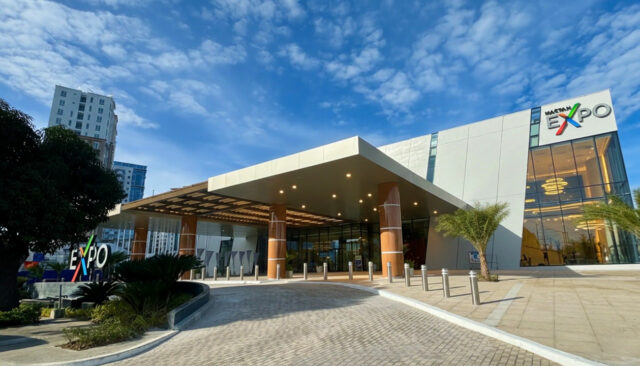
LISTED property developer Megaworld Corp. has entered the MICE (meetings, incentives, conferences, and exhibitions) sector with the opening of Mactan Expo, its first standalone convention center in the 30-hectare The Mactan Newtown township in Lapu-Lapu City, Cebu.

“One of Megaworld’s opening salvos in nation-building was the expansion of our hotels, and now we are entering the MICE business with the main goal of providing essential developments and world-class convention facilities,” Megaworld President and Chief Executive Officer Lourdes T. Gutierrez-Alfonso said in a statement on Wednesday.

The P1.5-billion Mactan Expo will host the ASEAN Travel Exchange (TRAVEX), a key event of the ASEAN Tourism Forum (ATF) 2026, from Jan. 28 to 30, as part of the Philippines’ upcoming ASEAN Summit.

“Designed to set a new benchmark for world-class conventions and events in the Philippines, Mactan Expo is a celebration of Cebuano identity, with every element reflecting the island’s culture and natural beauty while supporting seamless large-scale gatherings,” the company said.

The move is part of Megaworld’s strategy to diversify its development portfolio across its townships nationwide.

“After Cebu, we will explore other key growth areas to expand this business as we aim to attract more international conventions and events, just like the ASEAN Summit, which will become a landmark hosting for Megaworld’s first-ever convention center,” Ms. Alfonso said.

Megaworld has appointed veteran MICE leader Louella Caridad to head its MICE division, overseeing the development, management, and operations of the company’s convention and exhibition facilities in major growth regions nationwide.

The unit will partner with Megaworld Hotels & Resorts to offer integrated events with venues, accommodations, and food services.

Ms. Caridad previously served as chief operating officer of World Trade Center Metro Manila and has more than 20 years of experience in retail, real estate operations, energy solutions, and property management.

The company said it plans to capitalize on rising tourism in the Philippines by expanding its MICE activities, including more hotels and convention centers in key cities over the next few years.

Megaworld shares rose 2.33% to P2.20 apiece on Wednesday. — Alexandria Grace C. Magno