Home Blog Page 144

Iran’s new leader, still silent, was elevated by the Revolutionary Guards

Iran’s new supreme leader, Mojtaba Khamenei, the second son of late Iran's Supreme Leader Ayatollah Ali Khamenei, attends a rally in Tehran, Iran, May 31, 2019. — via REUTERS/HAMID FOROOTAN

DUBAI — Iran’s Revolutionary Guards forced through the choice of Mojtaba Khamenei as the new supreme leader, seeing him as a more pliant version of his father who would back their hardline policies, bludgeoning aside the concerns of pragmatists, senior Iranian sources said.

Already very powerful, the Guards have gained yet greater sway since the war began and quickly overcame the misgivings of senior political and clerical figures whose opposition to the choice delayed the announcement by hours, the sources said.

Adding to the concerns of those who opposed Mr. Khamenei’s installation as supreme leader, he had still issued no statement by Tuesday evening, nearly 48 hours after his selection during a war that has killed more than a thousand Iranians.

Mr. Khamenei’s selection, engineered by the Guards, may add up to a more aggressive stance abroad and sterner internal repression, said the three senior Iranian sources, a reformist former official and another insider.

Two of them said they feared the Guards’ domination of the system would further transform the Islamic Republic into a military state with only a thin veneer of religious legitimacy, undermining an already shrinking support base and allowing less room to address complex threats.

NEW LEADER MAY HAVE BEEN WOUNDED IN STRIKE

Though an influential backroom operator for decades spent running his father’s office, Mojtaba Khamenei remains an obscure figure to many Iranians and may have been wounded in the US-Israeli strikes that killed his father.

A state television anchor appeared to confirm widespread rumours Mr. Khamenei was hurt, describing him as a “janbaz”, or “wounded veteran” of the Ramadan War, as Iran calls the current conflict. Reuters has not been able to confirm his condition.

That – and security fears after his father’s assassination on February 28 – may explain his silence since the 88-member Assembly of Experts announced late on Sunday that they had elected him as the country’s supreme leader.

Authority is most visibly held by the Guards and the supreme leader’s office, known as the beyt, which operates a parallel system of influence across the bureaucracy.

Any doubts over who was really in charge evaporated on Saturday when President Masoud Pezeshkian, part of a triumvirate mandated to rule during the gap between leaders, was forced into a climbdown after apologizing to Gulf states for attacks. Senior Guards were furious at his apology, sources told Reuters.

One of the three senior sources, who said the Guards were now running Iran, said the late Ayatollah Ali Khamenei had been able to rein in the corps, balancing its views against those of political and clerical elites in the system.

But even assuming the new leader is well enough to take the helm, the Guards may now get the final say in major decisions in future, the source added.

Alex Vatanka, a senior fellow at the Middle East Institute in Washington, DC said: “Mojtaba owes his position to the Revolutionary Guards and as such he is not going to be as supreme as his father was.”

BLUNT GUARDS MESSAGE TO BACK KHAMENEI

The choice of leader constitutionally belongs to the Assembly of Experts, but in both elections of a new leader since the Islamic Revolution of 1979, it has been swayed by the advice of other power brokers.

When Ayatollah Ruhollah Khomeini died in 1989, the kingmaker was influential politician Ali Akbar Hashemi Rafsanjani, who told the assembly that Mr.vKhomeini had whispered Mr. Khamenei’s name to him on his deathbed.

This time, the kingmakers were the Guards and they were a lot blunter in their messages, all five of the sources said. The Guards used the argument that the war required a fast process and selecting a candidate who defied the United States.

Because their hall in the seminary city of Qom was bombed, the Assembly of Experts had to gather in a different – so far undisclosed location – and some of the members could not be present or even informed of the vote, said one member, Ayatollah Mohsen Heydari, on state television.

The body reached its quorum of two-thirds, he said, without specifying how many had in fact taken part, with 85-90% of those present backing Mojtaba Khamenei.

It was not clear how many of those not present might have backed or opposed him but the figures showed less than the unanimous decision the Guards may have hoped for.

CONCERNS ABOUT HARDER LINE

A group of ayatollahs had disliked the apparent hereditary succession and feared that the choice would alienate even many supporters of the ruling system, said two of the sources.

Behind the scenes, some clerics and members of the political establishment were trying to push for an alternative in numerous discussions over the past week, one of the sources said.

However, the reformist former official said the Guards had threatened critics of Mr. Khamenei’s accession. The Islamic Republic insider said the Guards had contacted members of the assembly, prompting objections, but in the end they felt compelled to support him.

Mr. Khamenei’s appointment was originally intended to be announced on Sunday morning, but only came late in the evening as a result of the lingering opposition to his choice, all five sources said.

As head of the beyt for many years under his father, Mojtaba Khamenei had built very close ties with the Guards, particularly the second-tier commanders who have replaced the top generals killed in the war, one of the officials said.

The upshot, said the reformist former official, will be a foreign and domestic policy moving in a more radical direction with the Guards finally having what they sought for years: full control. — Reuters

Oil shock to bring inflation above 4%

An attendant updates the fuel prices at a gas station in Cubao, Quezon City, March 10, 2026. — PHILIPPINE STAR/MIGUEL DE GUZMAN

By Kenneth Christiane L. Basilio, Reporter

THE IRAN war could trim 0.2-0.3% from the Philippines’ gross domestic product (GDP) growth this year, as the oil shock could drive inflation to above 4% this year, Department of Economy, Planning, and Development (DEPDev) Secretary Arsenio M. Balisacan said on Tuesday,

At the same time, the House Ways and Means Committee passed a proposal authorizing President Ferdinand R. Marcos, Jr. to suspend excise taxes on fuel products, advancing a proposal aimed at cushioning the impact of volatile oil prices on consumers.

“The suspension of excise taxes… could reduce the inflationary effects of oil prices and global oil price escalation,” Mr. Balisacan told lawmakers at a congressional hearing. “Oil prices affect practically all goods and services produced in this economy, so the effect is considerable.”

He said the soaring pump prices will stoke inflation, eroding Filipinos’ purchasing power and weighing on economic activity.

As a net importer of oil, the Philippines is highly sensitive to sharp fluctuations in global oil prices.

While fuel retailers agreed to stagger this week’s big-time price adjustments, the surging prices risk reigniting inflation.

According to its baseline scenario presented to the House Energy Committee, the DEPDev projected inflation could quicken to 4.5-5.1% this month, and 4.5-4.8% in April, with full-year inflation seen settling at 4-4.2%, above the central bank’s target band.

In a worst-case scenario where oil prices hit $140 this month and stay above $80 until September, DEPDev said inflation could accelerate to 6.3-7.5% in March and 6.4-7.5% in April, bringing the full-year print to 4.5-4.8%.

Inflation could settle at 3.5-3.6% in 2027 under its baseline scenario, and at 3.6-3.7% under the  second scenario, according to DEPDev’s presentation.

“With this kind of inflation, if you don’t do anything, that’s going to hit hard the consumers and substantially reduce household consumption spending, affecting our economy,” Mr. Balisacan said.   

Unchecked inflation could drag the country’s full-year growth “back below 5%,” he said, adding that the Development Budget Coordination Committee is still targeting 2026 growth of 5-6% and 5.5-6.5% for 2027.

“We are assessing the situation when the new number comes in May. But with the impact we are seeing, that could push us back below 5%,” he said.

Philippine GDP growth slowed to 4.4% in 2025, the slowest in five years, as the flood control scandal weighed on government spending, investments and consumer spending.

EXCISE TAX SUSPENSION
Mr. Balisacan said the economic impact of continuous increases in gas prices could be tempered by suspending excise taxes, which would help ease the burden on consumers.

“A temporary suspension of excise tax collections could restore part of the purchasing power,” he said.

The House Ways and Means Committee on Tuesday approved an unnumbered consolidated bill that would give the President special powers to suspend or reduce excise taxes of petrol during national and global emergencies for no more than six months.

Any suspension or cut in the fuel excise tax rate could be extended beyond six months through a joint congressional resolution.

Any extension cannot last longer than a year, according to Ways and Means Committee Chair and Marikina Rep. Romero “Miro” S. Quimbo.

He said the bill also requires the President to submit to Congress a report backing his decision to cut the excise tax, including estimates of foregone revenue and the impact on inflation, fuel prices and economic activity.

“We are dependent on the international market. Whatever happens there, we do not have leverage,” Mr. Quimbo told reporters. “The only thing that we can leverage to reduce fuel prices is by removing excise taxes.”

Moves to suspend the collection of petrol duties have gained traction in Congress after successive fuel price hikes that will likely drive consumer prices higher.

The Philippine Chamber of Commerce and Industry (PCCI) said it supported efforts to empower Mr. Marcos “to implement measures that will absorb and stabilize prices” amid fuel hikes. 

“Our request to government is to absorb temporarily the fuel price increases,” PCCI President Perry A. Ferrer said in a statement. “Hopefully, the President will be given the authority to exercise and use other means that will help cushion potential shocks this week or next week.”

A 2017 law previously allowed the government to suspend the collection of excise tax on petroleum products when world oil prices reach $80 per barrel for three straight months, but the provision lapsed six years ago.

Mr. Balisacan said revenue losses from the suspension of excise taxes on petrol could reach P43.3 billion if the suspension lasts three months, and P106 billion if extended until September.

“If you suspend excise taxes, that would mean less revenue collection for the government. That would impact our projects and programs and mean less fiscal resources,” he said. 

Projections from the Department of Finance showed suspending excise tax collections could lead to P136 billion in foregone revenue, which the department said could widen the government’s budget deficit and raise the country’s debt.

“While the effects on the revenue is quite a bit, the net effect on the economy of not doing anything about it is even worse,” said Mr. Balisacan.

Temporarily halting excise tax collections on fuel products could lead to cheaper fuel and ease inflation, he added.

According to the DEPDev, suspending excise taxes from March to May could help inflation ease to 3.6-4.2% in March and 3.6-3.9% in April. This could bring full-year inflation at 3.9-4.1% by end-2026, under the baseline scenario.

On the other hand, if global prices remain elevated and excise taxes are suspended from March to September, inflation could settle at 5.4-6.6% in March and 5.5-6.5% in April, with full-year inflation at 4.-4.3%.

For 2027, DEPDev sees inflation settling at 3.5-3.6% under the baseline scenario, and  3.6-3.7% under the worst-case scenario.

DEPLOYMENT BAN?
Mr. Balisacan said remittances from overseas Filipino workers (OFWs) could also be affected if the government decides to impose a ban on deployment to the Middle East.

The local economy could lose between P226.6 billion and P232 billion if about 550,000 Filipinos are repatriated, he said. 

“If you assume a total deployment ban… this reduction represents about 65% of the remittances from the region,” he said. “It’s quite a significant impact on our OFWs… and also the economy.”

There are an estimated 2.41 million Filipinos in Middle Eastern countries. More than 975,000 are stationed in the United Arab Emirates, while others are in Saudi Arabia (813,000), Qatar (250,000), and Kuwait (211,000). There are about 800 Filipinos in Iran and 31,000 in Israel, according to data from the Foreign Affairs department.

Meralco power rates increase in March

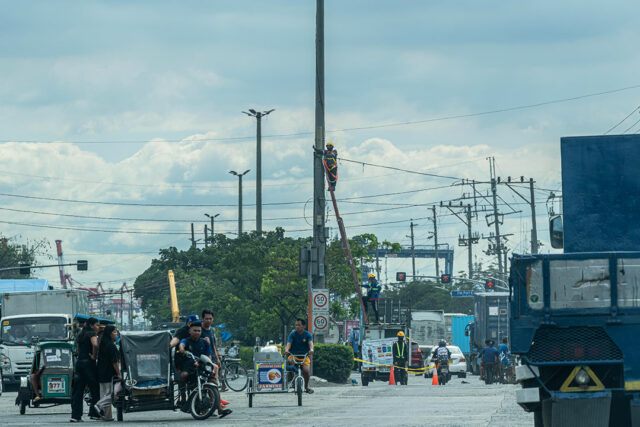
Electric linemen work on power posts along a road in Tondo, Manila on Monday. — PHILIPPINE STAR/RYAN BALDEMOR

By Sheldeen Joy Talavera, Reporter

OVER EIGHT MILLION customers served by Manila Electric Co. (Meralco) will have to tighten their belts this month as the power distributor announced a rate hike, citing higher transmission and generation charges.

However, Meralco consumers may see even higher bills in April as the widening Middle East war continues to drive up global oil prices.

In a statement on Tuesday, the company announced an increase of P0.6427 per kilowatt-hour (kWh), bringing the overall rate to P13.8161 per kWh in March from P13.1734 per kWh in February.

The upward adjustment translates to an increase of around P129 in the electricity bills of typical consumers consuming 200 kWh. Households consuming 300 kWh, 400 kWh, and 500 kWh will have to pay an additional P193, P257, and P321 in their bills.

Driving this month’s power rate hike was the P0.2880 per kWh increase in transmission charge, fueled by higher costs of ancillary service procured by the grid operator from the reserve market.

The costs from the reserve market, an avenue where generators sell backup electricity capacities, accounted for almost half of the total transmission charge for the period.

Also contributing to the upward adjustment was the generation charge which increased by P0.2209 per kWh to P7.8607 per kWh. Fixed charges from the second extension of the power purchase agreement with a gas-fired power plant in Batangas added around P0.38 per kWh to this month’s generation charge.

These offset the decline in the cost of power procured from the Wholesale Electricity Spot Market (WESM) amounting to P1.0952 per kWh, as supply conditions in the Luzon grid improved.

Meralco began collecting the P0.2817 per kWh price adjustment sought by four power generators for fuel costs recovery, as approved by the Energy Regulatory Commission (ERC).

The impact of this adjustment, totaling about P789 million, was more than offset by the completion of the recovery of a previous adjustment which amounted to P858 million.

Other charges, including taxes, registered a net increase of P0.1338 per kWh.

This month’s rate also reflected the implementation of the new uniform national lifeline subsidy rate of P0.01 per kWh in accordance with an ERC directive earlier this year.

“Pass-through charges for generation and transmission are paid to the power suppliers and the grid operator, respectively; while taxes, universal charges, and renewable energy subsidies are all remitted to the government,” the company said.

Meanwhile, Meralco’s distribution charge remained unchanged since the P0.0360 per kWh reduction in August 2022.

HIGHER RATES LOOM
Meanwhile, the recent surge in fuel prices did not contribute to this month’s electricity rate hike but could impact rates next month, according to Joe R. Zaldarriaga, Meralco’s vice-president and head of corporate communications.

“(The increase) will probably be felt next month in April, based on the current March supply month,” he said at a press briefing in Filipino.

Mr. Zaldarriaga said that the expected rise in power demand amid the onset of summer months, exacerbated by the Middle East war, “are most probably going to drive prices higher.”

While oil does not form part of Meralco’s power supply, the rise in global fuel costs could trigger increases in coal and gas prices as well, which the company largely depends on for supply.

Currently, gas accounts for 60% of Meralco’s power supply requirements, followed by coal at 20-25%, and renewable energy at 10%. The rest is sourced at the country’s electricity spot market.   

Lawrence S. Fernandez, vice-president and head of utility economics, said that higher fuel costs will affect electricity rates, although the extent will depend on how long the situation in the Middle East continues.

“Actually, the increase in global oil prices has no direct impact on generation costs in Luzon. But Luzon’s power generation uses liquefied natural gas and coal, and usually, when there’s pressure from rising oil prices, both liquefied gas and coal tend to follow,” Mr. Fernandez said.

Meralco Chairman Manuel V. Pangilinan said last week that the company will undertake a comprehensive reassessment of its fuel position and sourcing strategy.

“We want to ensure adequate supply of power and manage price volatility as responsibly as possible. Have made it clear to the team that we must help protect consumers as cost of goods rises globally,” he said in a post on X.

Meralco Executive Vice-President and Chief Operating Officer Ronnie L. Aperocho said the company is “closely coordinating” with its power suppliers to keep generation charges at least-cost while prioritizing reliability across its system.

“We are optimizing our energy mix and fully leveraging cost-efficient sources, regardless of technology. In addition, we are carefully managing our exposure to the WESM, where price volatility is high,” he said in a separate statement on Tuesday.

He said the company will also secure lower-cost replacement power whenever needed.

In line with the government’s call to strengthen energy efficiency across all sectors, Mr. Aperocho has called on the industrial and commercial customers to participate in the Interruptible Load Program, a proactive measure to help preserve available supply should de-loading from the grid become necessary.

For residential customers, he said the company is intensifying its efforts to provide simple and actionable tips for households to better manage their electricity consumption.

Meralco is the country’s largest private electric distribution utility, serving more than 8.2 million customers in Metro Manila and nearby provinces, including Bulacan, Cavite, Rizal, and parts of Laguna, Batangas, Pampanga, and Quezon.

Meralco’s controlling stakeholder, Beacon Electric Asset Holdings, Inc., is partly owned by PLDT Inc. Hastings Holdings, Inc., a unit of PLDT Beneficial Trust Fund subsidiary MediaQuest Holdings, Inc., has an interest in BusinessWorld through the Philippine Star Group, which it controls.

Philippine banks’ loan growth in January slowest in nearly two years

STOCK PHOTO | Image from Freepik

By Katherine K. Chan, Reporter

PHILIPPINE BANKS’ lending growth slowed to a near two-year low in January as outstanding loans continued to expand at a single-digit pace, preliminary central bank data showed.

Based on data released by the Bangko Sentral ng Pilipinas (BSP) late on Monday, universal and commercial banks’ total outstanding loans, net of reverse repurchase agreements, grew by 9.3% to P14.236 trillion in January from P13.02 trillion a year earlier.

This was the slowest pace seen in 23 months or since 8.7% in February 2024.

January’s loan growth was likewise slower than the revised 9.6% in December.

On a seasonally adjusted basis, bank lending grew by 1% month on month.

“The slowest bank loan growth in nearly two years is consistent with the slower economy largely brought about by government underspending especially on infrastructure amid the political noise or anomalous flood control projects since the latter part of 2025 that also weighed down on investments, many of which are financed by loans,” Rizal Commercial Banking Corp. Chief Economist Michael L. Ricafort said in a Viber message.

Meanwhile, Jonathan L. Ravelas, a senior adviser at Reyes Tacandong & Co., said the slowdown in lending was mainly because both banks and borrowers have turned more cautious.

“High interest rates and global uncertainty are making banks more selective, while businesses are delaying expansion and focusing on cash flow,” he said via Viber.

In January, big banks lent out a total of P13.939 trillion to residents, up 9.9% from the P12.689 trillion disbursed in the same month last year. Growth of loans for residents was slower than December’s 10.06%.

Loans for residents’ production activities amounted to nearly P12 trillion in January, up 8.2% from the P11.089 trillion logged a year ago. This accounted for the bulk or 84.3% of outstanding loans during the month.

Lending for electricity, gas, steam and air-conditioning supply rose by 20.3%, followed by transportation and storage (19.1%), real estate activities (9.1%), wholesale and retail trade, repair of motor vehicles and motorcycles (8.3%), financial and insurance activities (5.5%), and information and communication (4.9%).

At the same time, consumer loans to residents, which was 13.6% of the total loans, grew by 21.3% year on year to P1.94 trillion in the first month of 2026 from nearly P1.6 trillion in 2025.

Credit card loans jumped by an annual 27.7% to P1.2 trillion in January from P940.073 billion a year ago. Loans for motor vehicles also rose by 14.9% to P530.285 billion in January from P461.658 billion, while salary-based general purpose consumption loans went up by 5% to P165.724 billion from P157.893 billion a year ago.

Meanwhile, lending for nonresidents reached P296.391 billion in January, down by an annual 10.4% — steeper than the revised 8% decline in December.

“The BSP monitors bank loans because they are a key transmission channel of monetary policy,” the central bank said in a statement.

“Looking ahead, the BSP will ensure that domestic liquidity and bank lending conditions remain consistent with its price and financial stability mandates,” it added.

In the coming months, demand for loans may ease as uncertainty surrounding the ongoing Middle East war could hurt businesses’ profit margins and consumers’ disposable income, Mr. Ricafort said.

Mr. Ravelas also said that risks emerging from costlier oil and market volatility amid the war could push lenders and consumers to be even more wary.

Oil shocks arising from the supply disruption caused by the war in the Middle East have raised inflationary risks for most oil importing countries, including the Philippines. This has fueled talk of central banks tightening monetary policy.

BSP Governor Eli M. Remolona, Jr. has said that an over $100-per-barrel oil price could bring Philippine inflation past 4%, which could prompt them to end their easing cycle and hike rates for the first time in over two years.

“In the near term, lending may stay soft, but if inflation stabilizes and rates ease later on, we could see a gradual pickup — likely starting with working-capital loans rather than aggressive expansion,” Mr. Ravelas said.

MONEY SUPPLY CLIMBS
Separate preliminary BSP data also showed that the economy had P19.711 trillion in liquidity in January, expanding by 8.6% from P18.149 trillion in the same month in 2025.

This was the fastest domestic liquidity (M3) growth seen in about five years or since the 9.5% in February 2021.

Month on month, M3 edged up by 0.8% on a seasonally adjusted basis.

M3 is a measure of the amount of money in the economy that includes currencies in circulation, bank deposits, and other financial assets easily convertible to cash.

Domestic claims, which include those from private and government sectors, stood at P22.297 trillion, up 10% year on year from P20.275 trillion.

This, as increasing loans to nonfinancial private corporations and households boosted claims on the private sector by 10.6% to P14.466 trillion in January from P13.083 trillion last year.

Meanwhile, net claims on the central government climbed by 8.9% to P5.888 trillion in January from P5.406 trillion a year prior due to higher borrowings.

Claims on a sector refer to that sector’s liabilities to depository corporations such as banks and the central bank.

Central bank data also showed that net foreign assets (NFAs) in peso terms amounted to P7.545 trillion in January, climbing by 10.2% from P6.844 trillion a year ago.

Broken down, the central bank’s NFAs were 9.2% higher year on year to P6.623 trillion, while banks’ NFAs jumped by 18.1% to P922.863 billion.

NFAs reflect the difference between depository corporations’ claims and liabilities to nonresidents.

Philippines improves in global connectedness — DHL report

A view shows a DHL plane at the airport of Almaty, Kazakhstan, Dec. 5, 2024. — REUTERS/PAVEL MIKHEYEV

By Justine Irish D. Tabile, Senior Reporter

HANOI — The Philippines improved three spots to 59th in the DHL Global Connectedness Report 2026, placing it in the middle among its Southeast Asian neighbors.

Launched on Tuesday, the biennial report, which measures the state and trajectory of globalization across 180 countries, showed that the Philippines scored 51.9 points out of 100 in 2024, lower than the 52.1 points in 2023.

However, the Philippines’ ranking improved to 59th spot in 2024 from 62nd place in 2023.

At 59th, this was the highest ranking the country achieved in the DHL index since it ranked 57th in 2019.

The report was made with the New York University (NYU) Stern School of Business.

Despite the improvement in the ranking, the report showed that the Philippines ranked low based on the depth of its integration, placing 134th with a score of 43.1.

On the other hand, the country ranked 27th based on the breadth of its integration with a score of 62.6.

The DHL report measures depth, or the international flows relative to total activity, and breadth, or the distribution of international flows across countries, across four pillars: trade, capital, information, and people.

Across the four pillars, the country ranked the highest in capital at 47th, while it ranked 50th in the information pillar, 57th in the people pillar, and 59th in the trade pillar.

Among Association of Southeast Asian Nations members, the Philippines came in fifth. Singapore ranked first overall with a score of 77.8; followed by Malaysia, which ranked 16th with a score of 60.8; Thailand, at 27th with a score of 58.4; and Vietnam, at 36th with a score of 57.3.

Meanwhile, the Philippines fared better than Brunei Darussalam (69th), Cambodia (73rd), Laos (109th), Indonesia (112th), Timor-Leste (139th), and Myanmar (160th).

The DHL report showed that the country’s goods exports as a share of gross domestic product (GDP) ranked 117th across 180 economies, while its services exports ranked 76th.

The country fared better in terms of announced greenfield foreign direct investments (FDIs) as a share of GDP (51st) and mergers and acquisitions as a percentage of GDP (39th).

However, the report showed that the country ranked low, at 125th and 102nd, in FDI inward stocks and FDI inflows, respectively.

After Singapore, the other most globally connected countries are Luxembourg (2nd), the Netherlands (3rd), Ireland (4th), and Switzerland (5th).

These were followed by Hong Kong, the United Arab Emirates, Belgium, the United Kingdom, and Denmark.

DHL Express Chief Executive Officer John Pearson said that the world’s level of globalization was 25% in 2025.

“Globalization is holding its ground — and that alone speaks volumes about its value,” he said at the event.

Mr. Pearson said that one of the key takeaways of the report is that the trade growth is expected to be at the same average pace as the past decade of 2.6% in the 2026 to 2029 period.

“When you look at the data, it suggests that global trade is resilient,” he said, noting that global goods trade grew faster in 2025 than in any year since 2017.

Meanwhile, Steven A. Altman, director of the DHL Initiative on Globalization at NYU Stern, said that the forecast points to a lot of potential for trade growth in the Philippines.

“I think the Philippines really stands out as a country that has a lot of potential for trade growth,” Mr. Altman, who is also a co-author of the report, said at the launch.

He said that the country could tap this potential through “policies that improve accessibility, domestic business environment, and international relations.”

“My hope is that the forecasts that show that optimistic picture for the Philippines are going to come to fruition in the years to come,” he added.

John Paolo R. Rivera, a senior research fellow at the Philippine Institute for Development Studies, said that the report’s findings present opportunities for the Philippines to expand exports and attract investment.

“The report also highlights the need to improve logistics efficiency, digital infrastructure, and trade competitiveness since countries that are more connected tend to benefit more from global trade flows,” Mr. Rivera said in a Viber message.

“It reinforces the importance of strengthening the country’s role in regional supply chains and global services trade like electronics, information technology and business process management, tourism, and logistics,” he added.

Foundation for Economic Freedom President Calixto V. Chikiamco said that the Philippines should be more “outward looking” by increasing the share of exports as a percentage of GDP.

To achieve this, he said that the country should make exports profitable by undervaluing the currency, foster competition in the domestic market, and sign more free trade agreements.

“Countries that are export-oriented and outward-looking, such as China, Taiwan, South Korea, Japan, and Singapore, have better governance and better bureaucracies than inward-looking countries like the Philippines,” he said in a Viber message.

“This is because for their export champions to compete in the global market, they need to have better governance and more efficient states,” he added.

SMFB profit climbs 13% to P46.3B on food, spirits growth

SANMIGUELFOODS.COM

SAN MIGUEL Food and Beverage, Inc. (SMFB), the food and beverage subsidiary of San Miguel Corp. (SMC), reported a consolidated net income of P46.3 billion for 2025, a 13.2% increase from the P40.9 billion recorded in 2024.

This performance was supported by growth in the food segment, continued expansion in spirits, and increased international beer sales, the company said in a statement on Tuesday. The company has yet to release its full financial report for 2025.

“2025 was a strong year for SMFB, and that is a credit to our people across the organization. We will continue investing in our brands and operations so we can serve more Filipino families and deliver long-term value to our shareholders,” SMFB Chairman Ramon S. Ang said.

Consolidated revenues for the year rose 4.54% to P419.1 billion, while income from operations grew by 9.32% to P61 billion.

Attributable net income rose by 17%, which the company said reflected improved returns for shareholders.

The food segment was a primary contributor to the company’s profit growth, with net income rising 38% to P11.6 billion.

Operating income for the segment increased by 30% to P17.3 billion, and revenues grew 6% to P196.3 billion.

According to the company, this growth was driven by improved performance in the feeds business and strong demand for poultry.

The company’s branded businesses also reported solid results, particularly Magnolia Dairy and Coffee and Purefoods meats, which saw higher sales of products such as corned beef, luncheon meat, and various processed meats.

In the beer segment, consolidated revenues remained stable at P155.4 billion, matching the previous year’s performance.

International beer revenues grew 3% to $285 million, supported by higher sales volumes.

However, domestic beer revenues, which totaled P139.1 billion, were affected by continued pressure on consumer spending and successive increases in excise taxes since 2020.

To maintain an operating income of P32.9 billion and a domestic net income of P26.5 billion, the company said it employed cost management, portfolio optimization, and targeted consumer engagement.

The spirits segment continued its upward trend, with revenues increasing by 8% to P67.4 billion.

The company attributed this growth to steady volumes and effective pricing strategies.

On Tuesday, SMFB’s share price increased by 2.13% to P52.70. — Alexandria Grace C. Magno

Hotel101 opens 680-room Madrid hotel

THE 680-ROOM HOTEL101-MADRID — HOTEL101 GLOBAL HOLDINGS CORP.

HOTEL101 GLOBAL Holdings Corp., the Nasdaq-listed hospitality arm of DoubleDragon Corp., has launched Hotel101-Madrid, marking its first project in Europe and the first Filipino homegrown hotel brand to operate overseas.

The 680-room Hotel101-Madrid, located in Madrid’s Valdebebas district, has started accepting bookings, the company said in a statement on Tuesday.

“This landmark opening represents a historic milestone for the company and will make history today as the first-ever Filipino homegrown hotel brand to operate overseas,” the company said.

Hotel101-Madrid offers its signature “HappyRoom” units with kitchenettes and four-star amenities, including swimming pools, function rooms, a business center, a full-size gym, the HBNB Kitchen restaurant by Valencia’s Grupo La Sucursal, a convenience store, a laundry room, more than 200 parking spaces, and a 24/7 reception.

The company said guests will receive the same Hotel101 experience offered at its properties in other markets.

Hotel101-Madrid is among the five largest hotels in Spain based on room count.

The property is located minutes from Madrid-Barajas Airport, across from a train station, and near IFEMA, Spain’s largest convention center, with links to the city center and business districts.

It is also located near Ciudad Real Madrid, the training complex of Real Madrid, and the planned Formula 1 Madrid Grand Prix circuit, which the company said may attract sports and event visitors. The hotel targets both business and leisure travelers seeking modern and affordable accommodations in Madrid.

Hotel101 currently operates nine properties in the Philippines and is developing projects in Hokkaido, Japan, and Los Angeles in the United States.

In November last year, the company signed a joint venture agreement to develop a 429-room condotel on a 1.4-hectare site in San Donato Milanese, marking its second planned project in Europe as it expands overseas.

Hotel101 Global had a market capitalization of about $1.9 billion, or roughly P113 billion, as of March 9, 2026.

The company operates an asset-light prop-tech hospitality platform that uses a standardized global condotel business model.

DoubleDragon shares went up by 0.11% to close at P9.30 each on Tuesday. — Alexandria Grace C. Magno

JFC profit grows 5.4% to P10.87B; sets up to P16-B capex for the year

JOLLIBEE Foods Corp. (JFC) reported an attributable net income of P10.87 billion for 2025, up 5.4% from P10.32 billion in 2024.

In its 2025 annual report, the listed fastfood chain said consolidated revenues rose by 13% to P305.11 billion from P269.94 billion a year earlier.

The company said “the increase in revenues was driven by the increase in organic revenues and the impact of the acquisition of Compose Coffee and Tim Ho Wan which were consolidated in JFC’s financials starting Aug. 16, 2024 and Jan. 3, 2025, respectively.”

Systemwide sales, which include sales from both company-owned and franchised stores, increased by 13% to P390.28 billion in 2025.

Operating income rose by 19.3% to P20.15 billion in 2025 from P16.89 billion in 2024, as revenue growth outpaced the increase in general and administrative expenses.

General and administrative expenses rose by 4.2% to P31 billion.

Direct costs increased by 13.8% to P248.36 billion. The cost of inventories rose by 17.4% to P146.61 billion, which the company said was “faster than the increase in revenues.”

JFC attributed the increase to higher raw material costs and the consolidation of the newly acquired Compose Coffee and Tim Ho Wan brands.

Gross profit for the year reached P56.75 billion, up 9.7% from P51.72 billion in 2024.

Net interest expense increased by 43.3% to P6.90 billion, driven by “higher bank loans and increased interest related to PFRS 16 lease liabilities.”

Provision for income tax rose by 51.9% to P5.15 billion, which the company said was “primarily due to higher taxable income from improved profitability of certain subsidiaries.”

The Philippines remained the group’s largest contributor to operating income.

According to the report, the “domestic business remains to be the main driver of growth contributing 81% operating income to Global JFC,” while the international business improved its contribution to 19% from 12.7% in the previous year.

For 2026, JFC allocated P13 billion to P16 billion for capital expenditures (capex) to fund new store openings, renovations, and investments in technology.

The company also said it plans to “separate its international operations and business from its Philippine operations,” with plans to list the international business on a US securities exchange by late 2027.

At the stock exchange on Tuesday, shares in the company rose by 0.1% to end at P195.20 apiece. — A.G.C.M.

Filinvest Land plans P11.57-B bond issuance

FILINVEST.COM

FILINVEST LAND, INC. (FLI) said its executive committee has approved the offer and issuance of up to P11.57 billion in fixed-rate peso bonds with tenors of up to 10 years.

“This latest bond issuance will be the third tranche out of the P35-billion shelf-registered Philippine peso-denominated bonds of the company approved by the Securities and Exchange Commission,” the company said in a disclosure on Tuesday.

FLI appointed BDO Capital & Investment Corp., BPI Capital Corp., China Bank Capital Corp., East West Banking Corp., First Metro Investment Corp., Land Bank of the Philippines, RCBC Capital Corp., and SB Capital & Investment Corp. as joint lead underwriters and bookrunners for the planned bond offering.

The company also appointed the Philippine Depository & Trust Corp. (PDTC) as registrar and paying agent for the third tranche bonds, while Philippine Rating Services Corp. (PhilRatings) will provide the issue credit rating.

“The third tranche bonds shall be listed with the Philippine Dealing and Exchange Corp. (PDEx) as and when issued,” the company said.

“The executive committee of the company has further authorized the management to evaluate all aspects relating to the proposed offering of the bonds, including the determination of the timing thereof,” it added.

In an earlier disclosure, FLI said the planned retail bond offering could raise up to P11.57 billion to fund expansion projects outside Metro Manila.

In March last year, the company raised P12 billion from the second tranche of its shelf-registered bond program, which it said supported its retail and industrial expansion.

FLI’s portfolio includes office towers, mid-rise and high-rise residential developments, townships, mixed-use projects, malls, and leisure developments.

At the local bourse on Tuesday, shares in FLI were unchanged at P0.77 apiece. — Alexandria Grace C. Magno

SEC eases rules for early stockholders’ meetings

SEC.GOV.PH

THE Securities and Exchange Commission (SEC) has eased rules for publicly listed companies (PLCs) and other issuers of registered securities seeking to hold their annual stockholders’ meetings (ASMs) earlier than the date specified in their bylaws.

In a notice dated March 9, the SEC’s Markets and Securities Regulation Department (MSRD) said these companies will no longer need prior approval from the Commission to conduct early ASMs.

“Instead of obtaining prior approval from the SEC, all PLCs and other companies with registered securities must submit a written notice to the Commission regarding the early conduct of their ASM at least 32 business days ahead of the scheduled meeting,” the SEC said in a statement on Tuesday.

Under the revised procedure, companies planning to hold an early ASM must send a notice to the MSRD via e-mail stating the reason for the request and providing board approval through a Secretary’s Certificate.

The Commission said this requirement is intended to ensure compliance with timelines for filing and distributing the Preliminary Information Statement (PIS) and the Definitive Information Statement (DIS) under Republic Act No. 8799, or the Securities Regulation Code, and its implementing rules.

Companies must also disclose the early conduct of the ASM and the reason for the change by filing SEC Form 17-C on their websites and, for PLCs, on the Philippine Stock Exchange (PSE) Edge disclosure platform.

The SEC added that covered companies must ensure that stockholders’ rights are protected, promote minority stockholder participation in the ASM, and comply with the deadlines for filing the PIS and DIS and distributing the required information statements. — Alexandria Grace C. Magno

BPI approves P6.1-B loan for Aboitiz wind project

BW FILE PHOTO

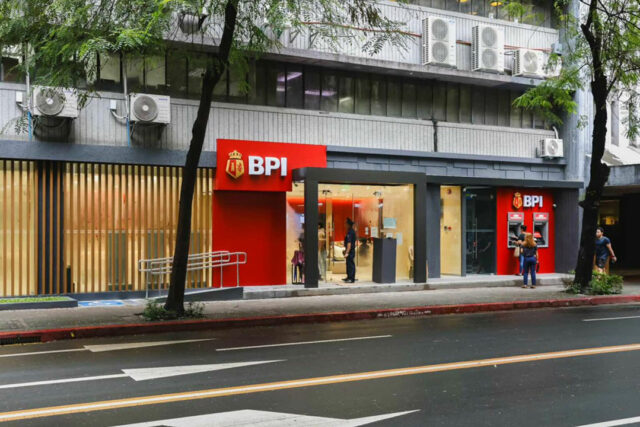
BANK of the Philippine Islands (BPI) has approved a P6.1-billion project finance loan to renewable energy developer Cornerstone Energy Development, Inc. (CEDI), a subsidiary of Aboitiz Renewables, Inc.

The loan will finance Aboitiz Power Corp.’s first wind energy project, a 58.5-megawatt (MW) onshore wind power facility in Libmanan, Camarines Sur, BPI said in a press release on Thursday.

“This project reflects the role we envision for BPI in accelerating the Philippines’ transition to a more sustainable energy landscape. Our collaboration with CEDI and the Aboitiz Group underscores our commitment to financing projects that deliver long-term environmental, social, and economic impact. We are proud to support initiatives for clean energy development,” BPI Institutional Banking Head Luis Geminiano E. Cruz said.

Once operational, the Camarines Sur Wind Power Project is expected to supply electricity to the grid and help reduce greenhouse gas emissions.

Construction of the project started last year.

The initiative is aligned with the sustainability goals of both BPI and CEDI, which aim to expand investments in renewable energy projects.

BPI said in May 2025 that it was on track to reach P1 trillion in sustainability-linked loans by this year.

The project is also expected to benefit seven communities in the municipality of Libmanan, Camarines Sur, through employment opportunities, infrastructure improvements, and community programs.

“Our continued partnership with BPI is proof that transformation does not happen in isolation. It happens when the right partners show up — consistently, reliably, and with conviction,” Aboitiz Renewables, Inc. President James D. Villaroman said. “Together, we are showing that progress and sustainability can go hand in hand — driving inclusive growth and helping build a stronger Philippines.”

BPI’s net income rose by 7.4% year on year to P66.62 billion in 2025 on sustained revenues despite higher expenses and provisions.

Shares in BPI closed at P103 apiece on Tuesday, up by P1.40 or 1.38% from Monday’s close. — Aaron Michael C. Sy

Maynilad nears completion of P10.5-B wastewater facility

MAYNILAD

WEST ZONE concessionaire Maynilad Water Services, Inc. said it is nearing completion of upgrades to several major water and wastewater infrastructure projects, including its largest wastewater treatment facility worth P10.5 billion.

In a statement on Tuesday, the water utility said it is in the final stage of upgrading the CAMANA (Caloocan-Malabon-Navotas) Water Reclamation Facility. The facility’s completion will be later than originally scheduled, as the company had earlier targeted finishing it by 2025.

Located in Maypajo, Caloocan City, the wastewater treatment facility is designed to improve sewerage services in South Caloocan, Malabon, and Navotas by treating up to 205 million liters of wastewater daily. Once operational, it is expected to serve about 1.2 million customers.

The upgraded plant, Maynilad’s largest wastewater treatment facility, is expected to expand treatment capacity in densely populated areas and support wastewater management and Manila Bay rehabilitation efforts.

The company is also completing major upgrades at the La Mesa Treatment Plant 2 (LMTP2) in Quezon City, a key component of its water supply system.

This forms part of Maynilad’s P7.9-billion project to upgrade the La Mesa Treatment Plants 1 and 2, which together produce around 2,400 million liters of water per day.

Meanwhile, the company is completing segments of the primary distribution pipeline along Daang Hari in Las Piñas City, which forms part of the distribution system of the Poblacion Water Treatment Plant in Muntinlupa.

Once integrated into the network, the completed pipeline segments are expected to support improved water distribution and pressure management in the southern portion of the concession area.

“These projects reflect our focus on disciplined execution and system readiness,” said Maynilad President and Chief Executive Officer Ramoncito S. Fernandez. “By upgrading critical facilities and strengthening our primary distribution network, we are reinforcing the reliability and resilience of our water and wastewater systems.”

The projects form part of Maynilad’s approved multi-year capital investment program, which aims to support water security, wastewater services, and non-revenue water reduction across its service area.

For 2026, the company has earmarked P30 billion in capital expenditures for water and wastewater projects.

Maynilad is the primary provider of water and wastewater services in the West Zone, which covers 11 cities in Metro Manila, three of which have partial coverage, as well as parts of Cavite province.

Metro Pacific Investments Corp., Maynilad’s majority shareholder, is one of three Philippine subsidiaries of First Pacific Co. Ltd., alongside Philex Mining Corp. and PLDT Inc.

Hastings Holdings, Inc., a unit of PLDT Beneficial Trust Fund subsidiary MediaQuest Holdings, Inc., has an interest in BusinessWorld through the Philippine Star Group, which it controls. — Sheldeen Joy Talavera