Home Blog Page 1439

Sean ‘Diddy’ Combs paid hotel security officer to hand over video, jury hears

Sean “Diddy” Combs on the talk show Late Night with Seth Myers. — IMDB

NEW YORK — Sean “Diddy” Combs paid a hotel security officer to hand over surveillance footage that showed the hip-hop mogul violently attacking his then-girlfriend Casandra Ventura in a hallway, the officer testified on Tuesday at Mr. Combs’ sex trafficking trial.

Eddy Garcia, who had worked at an Intercontinental hotel, told jurors that Mr. Combs contacted him shortly after the incident and asked for the footage. Mr. Combs said he would “take care” of Mr. Garcia if he gave him the video, Mr. Garcia said.

“He was concerned that this video would get out and that it would ruin his career,” said Mr. Garcia, who was granted immunity from prosecution to testify.

Mr. Combs, 55, has pleaded not guilty to five counts including racketeering conspiracy and sex trafficking.

Federal prosecutors in Manhattan say Mr. Combs over two decades coerced women, including Ms. Ventura, to take part in drug-fueled sexual performances with male sex workers known as “Freak Offs.”

The trial is in its fourth week.

Jurors had previously been shown a March 2016 surveillance video from the hallway of the Intercontinental hotel in Los Angeles where Mr. Combs, wearing only a towel, threw Ms. Ventura to the ground, kicked her, and dragged her away.

Ms. Ventura said the incident occurred after Mr. Combs had given her a black eye during a “Freak Off.”

Mr. Garcia said he relayed Mr. Combs’ message about the video to his boss, who told him he would give Mr. Combs the video in exchange for $50,000.

The next day, Mr. Garcia testified he saw his boss enter the room that hosted servers for the surveillance cameras.

He said the boss gave him a USB drive, which he gave to Mr. Combs, who later returned with a brown bag and a money counter.

Mr. Garcia said Mr. Combs ran cash from the bag through the counter, which displayed $100,000, returned the money to the bag, and handed the bag to him.

Mr. Combs’ lawyers have acknowledged he was at times abusive in domestic relationships, but argue that women who took part in “Freak Offs” did so consensually.

Prosecutors say bribery is among the racketeering acts that Mr. Combs or his employees undertook in order to facilitate “Freak Offs” and prevent word of his abuse from getting out.

Mr. Combs could face life in prison if convicted on all counts. Prosecutors have said they may finish presenting their case next week, allowing the defense to put on its case. — Reuters

Singlife Philippines launches product to help cover funeral, end-of-life expenses

SINGLIFE PHILIPPINES, Inc. has launched a whole life insurance product to help cover funeral arrangements or other end-of-life expenses.

The Protect from Funeral Costs product is now available on the insurer’s all-digital mobile platform, the Singlife Plan & Protect app.

“Losing someone you love is already one of life’s most difficult moments, and having to rely on abuloy or having to pass the hat just to pay for funeral costs makes it even harder. Protect from Funeral Costs allows you to prepare in advance and leave behind a final act of love, one that ensures your family can grieve without financial worry. It’s part of our mission at Singlife: to empower every Filipino toward financial independence — in life, and beyond it,” Singlife Philippines Chief Executive Officer Lester Cruz said in a statement on Wednesday.

The product offers a lump sum cash benefit of up to P500,000. Customers can avail of coverage ranging from P100,000 to P500,000, with premiums starting at P447 per month and with payment terms of five or 10 years.

“With funeral expenses in the Philippines typically exceeding P200,000, Singlife’s latest product provides straightforward, flexible coverage in the face of a very real financial risk,” it said.

“Whether it’s for a modest ceremony or a more elaborate farewell, your loved ones can decide how to use the money without being locked into a fixed package from a funeral service provider. The product was designed with key features to give customers a convenient and easy way to plan for their funeral expenses.”

The policy also features a built-in financial needs analysis that will help clients estimate the coverage needed based on their preferences. It will also build cash value over time, which can be borrowed by the fourth year.

Policyholders also have the option to extend their plan to their spouse, life partner, or child.

Beneficiaries will receive 10% of the cash benefit in advance upon submission of the policyholder’s death certificate and identity verification.

“This helps cover urgent funeral expenses while the remaining amount is released upon claim approval.”

Singlife Philippines’s premium income stood at P491.79 million as of end-2024, data from the Insurance Commission showed. It posted a net loss of P399.94 million last year. — Aaron Michael C. Sy

Philippines 54th most vulnerable globally in Catastrophic Risk Index

The Philippines improved* 10 places to 54th out of 163 countries in the latest edition of the Global Catastrophic Risk Index by the Global Governance Forum. Despite this, the country’s catastrophic index score worsened to 42.2 from 36.6 in the previous edition. It was also worse than the Asia & Pacific score of 37.9. This placed the country as the fourth-most vulnerable among its peers in the region.

Philippines 54<sup>th</sup> most vulnerable globally in Catastrophic Risk Index

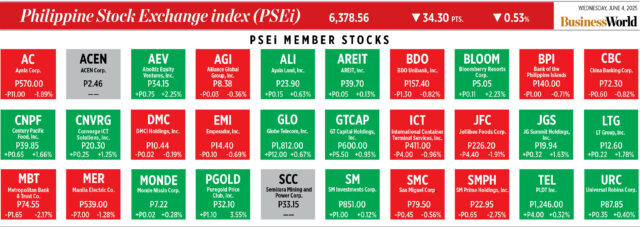
How PSEi member stocks performed — June 4, 2025

Here’s a quick glance at how PSEi stocks fared on Wednesday, June 4, 2025.


Lockheed Martin facility to service PAF aircraft

MIAA.GOV.PH/PHILSTAR FILE PHOTO

LOCKHEED Martin Corp. said that it will establish a repair and maintenance facility in the Philippines to service the F-16 fighter jet and the C-130 cargo plane.

“One of the flagship programs from a direct military perspective in supporting our forces is this repair capability… (serving) existing platforms like the C-130 and the F-16,” said Aimee P. Burnett, Lockheed Martin’s vice-president for Integrated Fighter Group Business Development.

The Philippine Air Force (PAF) operates the C-130 Hercules, a turboprop transport aircraft, and is set to receive 20 F-16 Vipers.

The US State Department recently cleared the sale to the Philippines of the F-16s in a package worth $5.58 billion, including spares, munitions, avionics, and technical support services.

Lockheed Martin plans to “work with and through local partners. We connect into and help develop and expand the aerospace and defense ecosystem, that’s in training and capability,” according to William L. Blair, Lockheed Martin Global, Inc. regional chief executive for Asia.

He noted the critical role played by maintenance, repair and overhaul in supporting the US bilateral engagement with the Philippines.

The Philippines has sought to bolster its ability to defend its territory in the face of Chinese encroachments in the South China Sea. Its defense spending plans include a P35-billion military modernization program over the next decade. — Adrian H. Halili

Cosmetics industry poised to maintain 10% growth this year

PHILSTAR FILE PHOTO

THE beauty and personal care industry is expected to sustain 10% growth this year, driven by product innovation and improved regulation.

“There are a lot of innovative products. And the regulations are also improving,” according to Christine Michelle P. Reyes, president of the Chamber of Cosmetics Industry of the Philippines, Inc.

Speaking on the sidelines of the Cosmobeauté Philippines 2025, she said beauty and personal care products continue to register “healthy” growth at retail level by volume and value. Last year, the value of beauty and personal care products grew at retail by 10.1%.

“The consumption pick-up in the previous year was due to lifestyle changes and easing of inflationary pressures,” she said.

“Middle-income groups are also growing in the Philippines alongside urbanization, with provincial areas attracting new consumers through the development of modern grocery retailers,” she added.

She said growth can also be attributed to improved consumer purchasing power due to easier access to credit.

She noted growing demand for sun care and sustainable products.

“The best-selling products are products that integrate SPF protection, and also climate and environmental issues are increasingly top of mind for players in beauty and personal care,” she added.

Trade Secretary Ma. Cristina A. Roque said Philippine beauty and personal care companies are ready to go global.

“This is our first time joining an international trade show such as this… I feel we really have companies that are ready to go global, especially those with products that are coconut-based and healthy,” she said.

“That will be the direction of Philippine products. We also have to be strategic in our approach when we sell our products because there are so many products from all over the world, and what can be our edge? Definitely the coconut-based products,” she added.

She said that most Philippine products are plant-based and organic, which could present a favorable contrast to products in the market that  are heavy on chemicals.

However, she said domestic companies are being challenged by the growth of e-commerce.

“We have a lot of products now from Korea, China, and Japan, some of which are really low-priced,” she said.

“But we are very competitive also because the cost of production in the Philippines is not that high,” she added.

She said that prospective countries for beauty and personal care exports include Thailand and Hong Kong, as well as the rest of ASEAN.

Scheduled to run from June 4 to 6, Cosmobeauté Philippines will be showcasing 250 brands and companies and business-to-business events.

“The journey towards Cosmobeauté Philippines 2025 is an interesting and empowering one,” said Rungphech Chitanuwat, country general manager of Informa Markets Philippines, the organizer of the event.

“This edition holds importance as it sets the latest trend and standard in events focused on skincare and cosmetics in the country,” she added.

Cosmobeauté Philippines serves as the kick-off event for the Cosmobeauté trade shows in Southeast Asia, such as Vietnam, Malaysia, and Indonesia. — Justine Irish D. Tabile

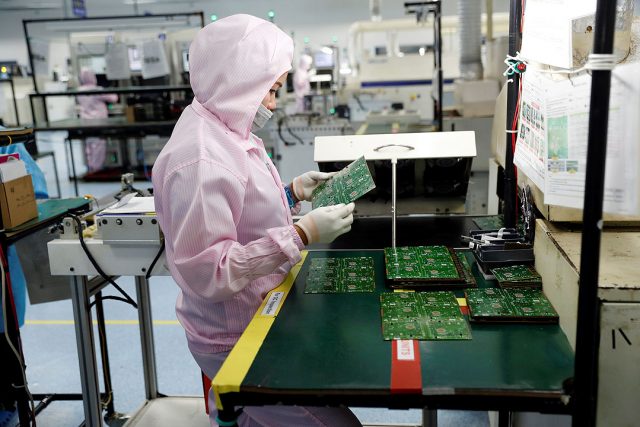
Semiconductor industry council to look into ease of doing business, talent dev’t issues

REUTERS

THE Semiconductor and Electronics Industry Advisory Council (SEIAC) said that it will focus on improving the ease of doing business and developing a talent pool.

“The SEIAC aims to address the problems, issues, and concerns of industry players and find solutions for these,” according to Secretary Frederick D. Go, the special assistant to the President for investment and economic affairs, who also chairs the council.

In a statement on Wednesday, Mr. Go said: “The council will focus on the ease of doing business for those in the assembly, test, and packaging (ATP) industry and develop a talent pool for the integrated circuit (IC) design industry.”

SEIAC said the Technical Education and Skills Development Authority (TESDA) and the Commission on Higher Education will play a role in ensuring that training, reskilling and upskilling programs are effective.

“(This) will grow the integrated circuit design sector and strengthen the assembly, test, and packaging as well as the electronics manufacturing services (EMS) segments,” it said.

“This likewise realizes the vision of making the Philippines a consistent and reliable global partner packaging $70 billion of semiconductors, assembling $40 billion of electronics, and providing globally recognized IC design services by 2030,” it added.

Created through Administrative Order No. 31, the SEIAC is tasked with supporting the development, promotion, and competitiveness of the semiconductor and electronics industry.

At its June 2 meeting, the council approved the establishment of three technical working groups focused on investment and business environment, talent development and education, and infrastructure and cluster development.

“These groups will be led by government agencies such as the Department of Trade and Industry (DTI), TESDA, and Bases Conversion and Development Authority, along with industry and academic representatives,” SEIAC said.

“Additionally, the council endorsed a private sector representative nominee, pending presidential appointment, to ensure active private sector involvement,” it added.

Apart from the creation of the council, the administrative order also directed the DTI to develop the Philippine Semiconductor and Electronics Industry Roadmap to serve as the framework in accelerating the growth of the country’s semiconductor and electronics industry.

According to the DTI, the 2030 Philippine Semiconductor and Electronics Industry Roadmap is still being finalized. — Justine Irish D. Tabile

Human element remains ‘most relevant’ even as organizations transition to greater AI use

REUTERS

By Beatriz Marie D. Cruz, Reporter

MADRID — While artificial intelligence (AI) has been replacing traditionally human tasks, human input remains the most important skill for entrepreneurs in an AI-driven era, an academic said.

“You’d never try to multiply numbers in your head, because you know the calculator will win, but all the things you do before and after (the automated task) are what the humans do,” Ikhlaq Sidhu, dean of IE School of Science and Technology, told journalists here on Tuesday.

“It still takes an input and an output, and there’s what you do with the output. So, the human parts are the ones that are the most relevant.”

When asked about what skill should future entrepreneurs possess as AI rapidly transforms businesses, Mr. Sidhu said: “being human… that is the number one skill.”

About 35% of Philippine leaders are considering workforce reductions to harness the productivity gains offered by AI, according to Microsoft’s 2025 Work Trends Index report.

According to Mr. Sidhu, the real danger is when “human outsource their minds to AI.”

“If you just say, ‘I don’t want to think anymore, for every question, I’ll just ask AI,’ and you turn off your critical thinking, curiosity, and the things that really drive a person, then it’s bad news for you.”

A 2025 study by Michael Gerlich, who heads the Center for Strategic Corporate Foresight and Sustainability at SBS Swiss Business School, found a negative correlation with AI tool reliance and critical thinking abilities. This emphasizes the need for “educational strategies that promote critical engagement with AI technologies,” it concluded.

Mr. Sidhu also cited the importance of integrating technical practices and industry insights when teaching science and highly technical courses.

In many universities, students’ understanding of science and technology-based programs tend to focus on teaching the fundamentals but with little practical application. This results in “narrow” learning experience disconnected from the needs of industries or ventures, Mr. Sidhu said.

“There’s some very abstract topics that people learn in technical fields, and when you spend all your time learning these abstract things, you don’t always know how to connect it to the things that are happening everyday or in the workplace,” he said.

Citing his experience as the founding director of the University of California at Berkeley’s Sutardja Center for Entrepreneurship & Technology, Mr. Sidhu noted that collaborations between students and industry yields superior results and better execution.

“You are able to take the learning and the results farther than you could than when there was only one type of student,” he said.

38 gov’t agencies sign deal to facilitate investment permits

FINANCE SECRETARY RALPH G. RECTO — PHOTO FROM DEPARTMENT OF FINANCE FACEBOOK PAGE

THE Department of Finance (DoF) and various other government agencies have agreed to institutionalize the Investment Facilitation Network (INFA-Net) to expedite the investment approval process.

“The signing of this joint memorandum agreement is a strong signal that we are serious about cutting red tape, improving the ease of doing business, and making the Philippines a more attractive destination for investors,” Finance Secretary Ralph G. Recto said in a statement.

According to the DoF, the agreement, signed on June 2, involves 38 government agencies working to streamline the issuance of permits, licenses, certifications, or authorizations.

In 2023, the Philippines was ranked 95th out of 190 economies by the World Bank in terms of ease of doing business.

INFA-Net was chaired by the Department of Trade and Industry-Board of Investments, and co-chaired by the Anti-Red Tape Authority.

The joint memorandum operationalizes parts of Executive Order No. 18, which created the green lane system of processing permits for priority projects.

Mr. Recto said the expedited-permit initiative will complement the Corporate Recovery and Tax Incentives for Enterprises to Maximize Opportunities for Reinvigorating the Economy (CREATE MORE) Act in attracting more investors.

“Our message is simple: we want you to invest here, and we will make it easier for you to do so,” he said.

The agreement is known as “Strengthening the Coordination Mechanism Between and Among the Investments Facilitation Network Members and Integration of the Provisions of Executive Order No. 18, series of 2023.” — Aubrey Rose A. Inosante

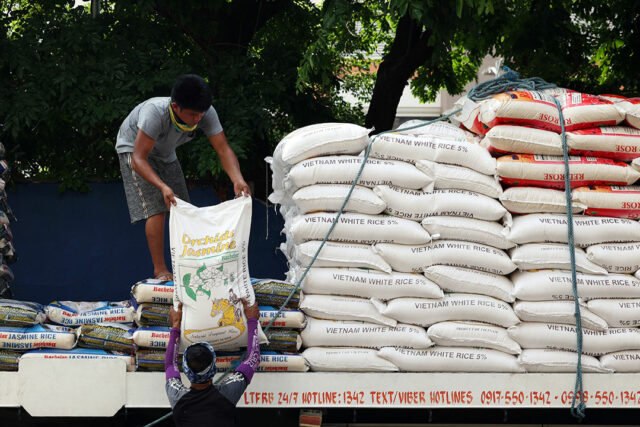
Private partners of P20 rice to pay transportation costs

PHILIPPINE STAR/KRIZ JOHN ROSALES

PRIVATE companies participating in the P20-per-kilo rice program will absorb the cost of moving inventory from government warehouses to their premises, according to the Department of Agriculture.

The companies in the program will provide the subsidized rice to about 120,000 minimum-wage workers starting June 13, Agriculture spokesman Arnel V. de Mesa said at a briefing. The companies will pick up the rice following notice provided by Food Terminal, Inc. (FTI) of available stock at the nearest National Food Authority (NFA) warehouse.

“The company will go to the nearest NFA (warehouse) to withdraw the rice allocation,” he said.

The company is free to impose any payment scheme on its employees, including salary deduction, but the commodity must be sold at P20 per kilo, Mr. De Mesa said.

The company will then remit the proceeds of the sale to the FTI. The FTI then remit payment to the NFA for the rice stocks it has withdrawn.

The payment setup with the FTI as intermediary was arrived at because the NFA currently lacks the power to sell rice directly to the public.

The revised Rice Tariffication Law of 2024 allows the NFA to sell rice during a declared food emergency, but only to government entities including the FTI and local government units (LGUs).

The P20-per-kilo rice program has been expanded since the pilot launch in Cebu province in May.

With NFA rice priced at P33 per kilo, the FTI and a partner LGU will need to pay P6.50 each in subsidies to close the P13 gap.

For rice sold in state-backed Kadiwa outlets, the FTI absorbs P9 for every kilo of rice sold, Mr. De Mesa noted.

He said 9,487 households or almost 40,000 individuals have already benefitted from the rice program, which features high-quality rice that needs to be cleared out of NFA warehouses because of the age of the inventory.

Mr. De Mesa said the NFA’s rice stocks have hit 400,000 metric tons, enough to sustain the program for the year.

The grains agency is expecting the construction of 36 new warehouses this year. — Kyle Aristophere T. Atienza

DICT to seek more funds for connectivity, data centers

DICT

THE Department of Information and Communications Technology (DICT) said it will seek a doubling in its budget for 2026 to aggressively pursue its connectivity and data center projects.

Funding is “around P17 billion now; (we’ll seek) almost double for next year,” Information and Communications Technology Secretary Henry Rhoel R. Aguda said at the Kapihan sa Manila Bay on Wednesday.

Much of the projected boost in funding “will be allocated to connectivity projects and IT skills development,” Mr. Aguda said via Viber.

“I am confident that we will get the support for our budget,” he said.

The DICT’s 2025 targets include connecting at least 90% of the country to the internet, from the current 85%.

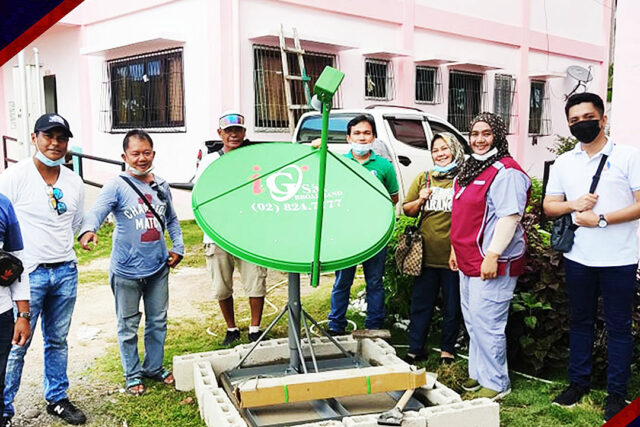
Mr. Aguda said the DICT will roll out a satellite service to connect isolated and disadvantaged areas of the country.

In March, the DICT said it will overhaul the free Wi-Fi Program to make use of low-earth orbit (LEO) satellites.

It announced plans to spend P6.5 billion annually to provide Wi-Fi access to more than 7,000 locations.

LEO satellites have the potential to increase internet capacity and reduce data transmission delays. Such satellites typically orbit at around 1,000 kilometers above the Earth.

Mr. Aguda said the DICT is also seeking to fund its data center program for next year.

In 2024, the DICT said data centers will require more funding to better handle the expected surge in data as the government digitizes. — Ashley Erika O. Jose

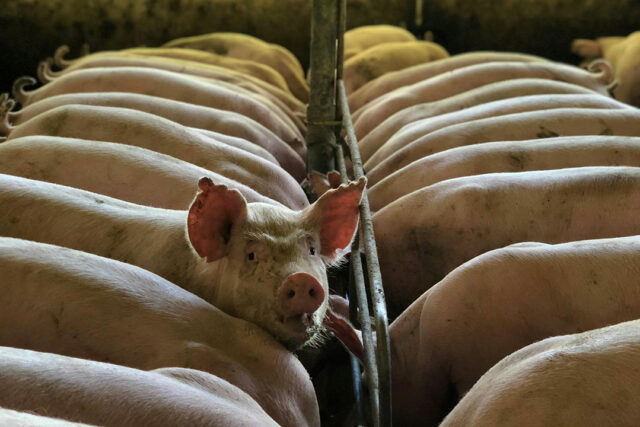
Unlicensed Central Luzon hog farms ordered to explain failure to register

STOCK PHOTO | Image by Barbara Barbosa from Pexels

THE Department of Agriculture (DA) said on Wednesday that the Bureau of Animal Industry (BAI) has issued show-cause orders to nine unlicensed hog farms in Central Luzon.

The farms in Bulacan, Pampanga, and Tarlac continue to operate “despite bypassing basic health, environmental, and safety regulations,” the DA said in a statement.

Their irregular operations “jeopardize national efforts to stabilize pork supply and pricing, especially as the country recovers from the lingering effects of African Swine Fever (ASF),” it added.

It said President Ferdinand R. Marcos, Jr. had called for a crackdown on unregistered livestock facilities that “distort the food supply chain and threaten price stability.”

“As we modernize Philippine agriculture, everyone must understand that unlicensed operations will not be tolerated,” Agriculture Secretary Francisco Tiu Laurel, Jr. said.

The BAI is currently evaluating responses from some of the farms, and further enforcement action may follow, the DA said.

The BAI has been instructed to assess the compliance of other hog farms across the country, it added. — Kyle Aristophere T. Atienza