Home Blog Page 1429

India allows exports of broken rice to cut stockpiles

REUTERS

MUMBAI — India allowed the export of 100% broken rice, the government said in a notification late on Friday, after inventories reached a record high at the start of February, nearly nine times the government’s target.

Exports of 100% broken rice could help reduce stocks in the world’s biggest exporter and enable poor African countries to secure the grain at lower prices, as well as support Asian animal feed and ethanol producers that rely on the grade.

India had banned exports of 100% broken rice in September 2022 and then imposed curbs on exports of all other rice grades in 2023 after poor rainfall raised concerns over production.

However, as the supply situation improved after the country harvested a record crop, New Delhi removed curbs on exports of all grades except 100% broken rice.

“Now that broken rice exports are allowed, we anticipate exporting around 2 million tons of this grade in 2025,” said B.V. Krishna Rao, president of the Rice Exporters’ Association.

India exported 3.9 million metric tons of broken rice in 2022, mainly to China for animal feed and to African countries such as Senegal and Djibouti for human consumption.

Broken rice is a byproduct of milling, and African countries prefer this grade because it is cheaper than other grades.

Indian broken rice is currently offered at $330 per metric ton, compared to approximately $300 from rival suppliers like Vietnam, Myanmar, and Pakistan, said Himanshu Agrawal, executive director at Satyam Balajee, a leading rice exporter.

“However, these competing countries have limited stocks. As their stocks deplete, buyers will switch to India, and exports will pick up in coming months.”

State granary reserves of rice, including unmilled paddy, totalled 67.6 million tons as of Feb. 1, compared to the government’s target of 7.6 million tons, data compiled by the Food Corp. of India showed. — Reuters

Premium dry gin featured at Ferrari 12Cilindri launch

Enjoying Rosso 12 cocktails are (from left) Ginebra San Miguel, Inc. (GSMI) New Product Development Manager Vera Bautista, gin enthusiast and host Paolo Abrera, and GSMI New Product Development Assistant Ranzel Poblete. — PHOTO FROM GINEBRA SAN MIGUEL

ARCHANGEL RESERVE Premium Dry Gin was served at the recent launch of the Ferrari 12Cilindri in the Philippines. Held at the Velocità Motors, Inc. showroom in San Juan City, guests were treated to an exclusive experience, witnessing the unveiling of the Ferrari 12Cilindri while enjoying the refined taste of Archangel Reserve in two specially crafted cocktails, the Classic Gin & Tonic and the signature Rosso 12. Made with Campari and pomegranate, the best-seller signature cocktail Rosso 12 is inspired by Ferrari’s signature red and powerful V12 engine. Archangel Reserve is a 90-proof premium dry gin bottled in an iconic emerald green one-liter frasco bottle commemorating Ginebra San Miguel’s 190-year heritage. This “premium masterpiece” is made from a select combination of fine botanicals.

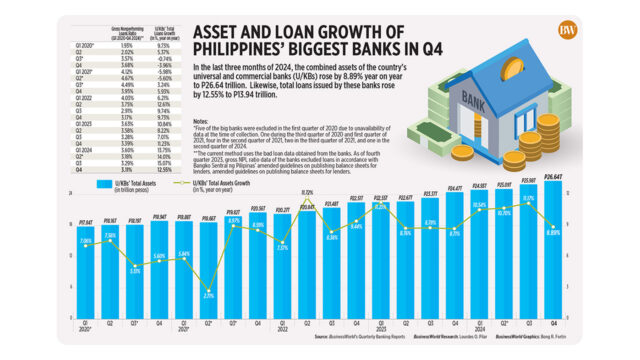
Asset and loan growth of Philippines’ biggest banks in Q4

THE AGGREGATE ASSETS of the Philippines’ largest banks grew by single digits in the fourth quarter of 2024, reflecting slowing economic growth and still-elevated interest rates. Read the full story.

Asset and loan growth of Philippines’ biggest banks in Q4

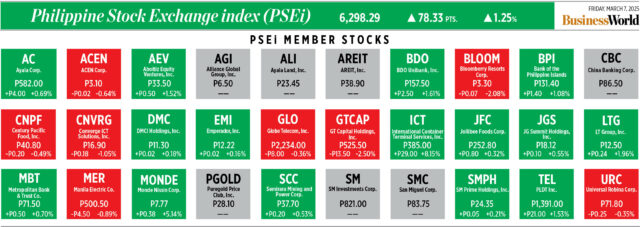
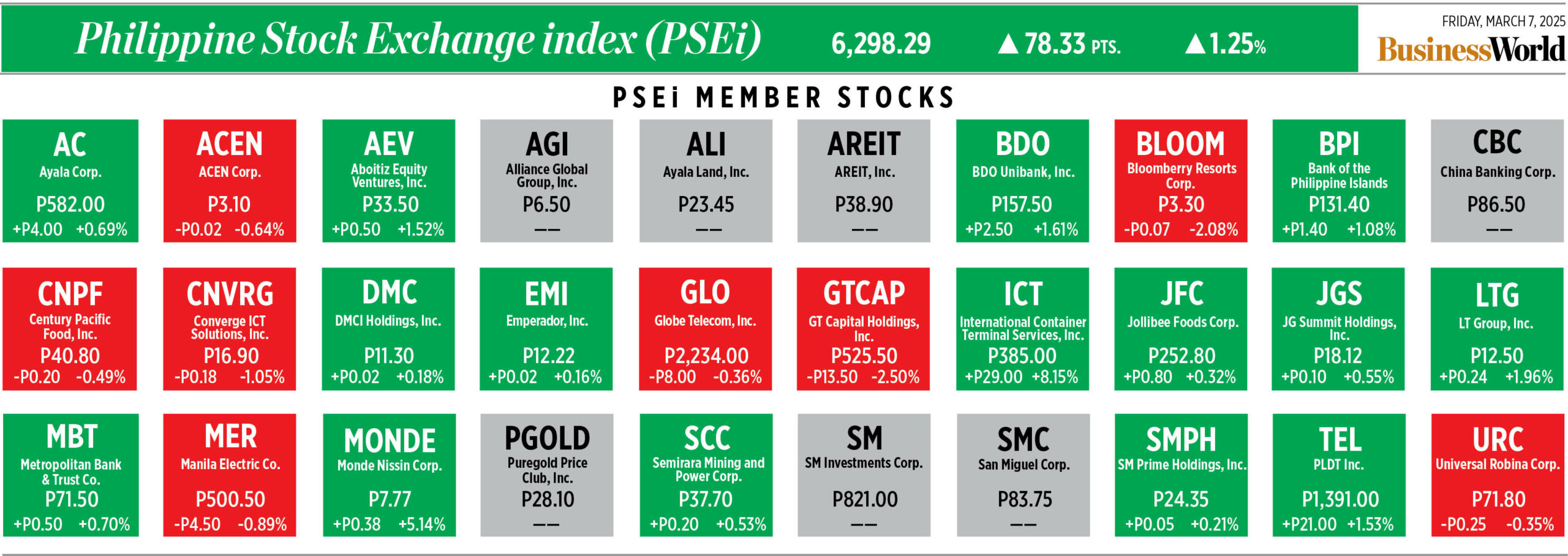
How PSEi member stocks performed — March 7, 2025

Here’s a quick glance at how PSEi stocks fared on Friday, March 7, 2025.


Peso may return to P56 level on cautious Fed

BW FILE PHOTO

THE PESO could continue its climb this week and return to the P56-per-dollar level, with the US Federal Reserve on wait-and-see mode as it awaits clarity on the Trump administration’s policies.

The local unit closed at P57.206 per dollar on Friday, strengthening by 11.4 centavos from its P57.32 finish on Thursday, Bankers Association of the Philippines data showed.

This was the peso’s best finish in nearly five months or since its P57.205-a-dollar close on Oct. 11, 2024.

Week on week, the peso jumped by 78.9 centavos from its P57.995 finish on Feb. 28.

The peso rose on Friday as most currencies rose against the dollar after the Trump administration delayed the planned tariffs against some Canadian and Mexican imports, Rizal Commercial Banking Corp. Chief Economist Michael L. Ricafort said in a Viber message.

“The dollar-peso traded lower on growing bets that the Fed will cut rates in June and after improving sentiment after President Donald J. Trump delayed the tariff on certain goods from Mexico and Canada, improving risk-off sentiment,” a trader said in a phone interview on Friday.

The US dollar wallowed near a four-month low in the Asian session Friday as ever-shifting tariff policies fanned uncertainty and increased concern about growth prospects for the world’s largest economy, leaving investors grasping for jobs data due later in the day, Reuters reported.

Another reprieve of levies aimed at Mexico and Canada announced by Mr. Trump on Thursday offered little relief, keeping the safe-haven yen not far off its strongest against the greenback since early October.

The reprieve expires on April 2 when Mr. Trump said he will impose reciprocal tariffs on all US trading partners.

The US dollar index, which measures the greenback against six major rivals, fell 0.05% to 104.15.

For this week, the trader said the peso’s movement against the dollar will depend on the US nonfarm payrolls data released after the market’s close on Friday.

“If employment is weak and unemployment is higher, the dollar will be weaker. But if there is a surprise uptick, this will be supportive of the dollar,” the trader said.

The trader sees the peso moving between P56.80 and P57.30 per dollar this week, while Mr. Ricafort expects it to range from P56.90 to P57.40.

US job growth picked up in February, but cracks are emerging in the once-resilient labor market amid a chaotic trade policy and deep federal government spending cuts that threaten to disrupt economic growth this year, Reuters reported.

The Labor department’s closely watched employment report on Friday, the first under Mr. Trump’s watch, showed a broader measure of unemployment surging to near a 3-1/2-year high last month as the ranks of part-time workers swelled.

The share of workers holding multiple jobs was the highest since the Great Recession. Economists said the Trump administration’s whiplash trade policy was making it difficult for businesses to plan ahead.

Business sentiment has plunged since January, erasing all the gains notched in the aftermath of Trump’s election victory in November. The stock market has sold off.

Nonfarm payrolls increased by 151,000 jobs last month after rising by a downwardly revised 125,000 in January, the Labor department’s Bureau of Labor Statistics said.

Economists polled by Reuters had forecast payrolls advancing by 160,000 jobs after a previously reported 143,000 gain in January. The survey of establishments showed job growth averaged 138,000 per month so far this year compared to 209,000 in the fourth quarter.

The Federal Reserve is expected to keep its benchmark overnight interest rate unchanged in the 4.25%-4.5% range this month as policy makers continue to monitor the economic impact of tariffs and an immigration crackdown.

Financial markets expect the US central bank to resume rate cuts in June, though much would depend on inflation.

The Fed paused rate cuts in January, having reduced the policy rate by 100 basis points since September, when it embarked on its easing cycle. The policy rate was hiked by 5.25 percentage points in 2022 and 2023 to tame inflation.

Fed Chair Jerome H. Powell said on Friday “we do not need to be in a hurry, and are well positioned to wait for greater clarity.”

Stocks on Wall Street edged higher after Mr. Powell’s comments. The dollar was lower against a basket of currencies. US Treasury yields rose. — A.M.C. Sy with Reuters

Shares may move sideways after five-day rally

REUTERS

PHILIPPINE SHARES could move sideways this week as investors monitor overseas developments, with profit-taking also likely to ensue after the market’s five-day rally.

On Friday, the bellwether Philippine Stock Exchange index (PSEi) rose by 1.25% or 78.33 points to close at 6,298.29, while the broader all shares index went up by 0.67% or 25.1 points to 3,724.20.

This was the PSEi’s best finish in six weeks or since it ended at 6,378.86 on Jan. 23.

Week on week, the PSEi surged by 5% or 300.32 points from its 5,997.97 close on Feb. 28.

“The local market exhibited upward momentum last week as it went on a five-day gaining streak. It was able to get past its 10-day and 50-day exponential moving averages, which are taken as bullish signs. Trading activity also improved, implying that the rally had conviction,” Philstocks Financial, Inc. Senior Research Analyst Japhet Louis O. Tantiangco said in a Viber message.

For this week, the market could move sideways, he said.

“Given the five-day rally, we may see some episodes of profit taking, which could cause the market to decline. Still, we expect optimism to remain driven by prospects on the BSP’s (Bangko Sentral ng Pilipinas) monetary policy easing following our latest inflation print, and our robust fourth quarter and 2024 corporate results,” he said.

Headline inflation slowed to 2.1% in February from 2.9% in January, the government reported last week. This was the slowest monthly print in five months or since the 1.9% in September 2024.

This was also below the BSP’s 2.2%-3% forecast for the month and the 2.6% median estimate in a BusinessWorld poll of 18 analysts.

The Monetary Board will next meet to discuss policy on April 3. Analysts said slower February inflation gives the BSP room to resume its rate-cut cycle at next month’s meeting following its surprise pause at the February review.

“The peso’s appreciation, if it continues, is also expected to help,” Mr. Tantiangco added. “A key downside risk to the market, however, is the uncertainties with respect to the US’ trade policies.”

He put the PSEi’s major support at 6,000 and major resistance at 6,400.

US President Donald J. Trump suspended on Thursday tariffs of 25% he had imposed last week on most goods from Canada and Mexico, the latest twist in a fluctuating trade policy that has whipsawed markets and fanned worries about inflation and growth, Reuters reported.

The exemptions for the two largest US trading partners, expire on April 2, when Mr. Trump has threatened to impose a global regime of reciprocal tariffs on all US trading partners.

Meanwhile, Rizal Commercial Banking Corp. Chief Economist Michael L. Ricafort placed the PSEi’s support at 6,000 and resistance at 6,300-6,400.

Online brokerage 2TradeAsia.com pegged the PSEi’s immediate support at 6,000 and resistance at 6,400. — Revin Mikhael D. Ochave with Reuters

Tourist convenience seen key to growing hospitality industry

PHILIPPINE STAR/ MIGUEL DE GUZMAN

By John Victor D. Ordoñez, Reporter

THE PHILIPPINE government should increase direct flight connections and make mobility more convenient for visitors, a Thai Chamber of Commerce official said.

Panida Thepkanjana, a director at the Thai Chamber of Commerce and Erawan hospitality group director, told BusinessWorld on the Thaifex Horec Asia 2025 trade show in Bangkok that if these issues are addressed, Thai investors see potential in the Philippine hospitality industry.

“I think that for the tourists, the important thing is convenience in traveling,” she said, noting that Philippine geography requires people to fly around “because you have so many islands.

Nevertheless, she added, “We see the potential of the Philippine market.”

The Philippine Statistics Authority reported that in 2023, Filipino tourist spending consisted of 19.3% hotels and restaurants, 17.1% on transportation and 16% on recreation and culture.

Erawan Group, which develops and operates hotels, has invested in more than 20 hotels in the Philippines, Ms. Thepkanjana said.

Last year, Philippine tourism receipts topped P760 billion, up 9.04% from a year earlier, exceeding the pre-pandemic level of P600.01 billion in 2019.

The US accounted for 947,891 visitors, boosted by nonstop flights from San Francisco to Manila offered by United Airlines, with Philippine Airlines also offering new nonstop service from Seattle.

Japanese arrivals rose 27% to 388,316, while visitors from China totaled 312,222, still significantly lower than pre-pandemic levels.

Ms. Thepkanjana said the Philippine hospitality industry should also embrace new technology such as artificial intelligence to reduce operating costs.

“But the human touch is also still important. If you go to the hotel and nobody is there, then the feeling is different, right? But we can have AI for the back of the house, to achieve efficiencies in booking, in operations,” she said.

The Philippine Hotel Industry Strategic Action Plan 2023-2028, which was launched by the Department of Tourism (DoT) and the Philippine Hotel Owners Association, Inc. in October, aims to close the Philippines’ 120,463-room gap by 2028.

According to the 2024 Philippine Accommodation Pipeline Report, private sector hotel developers have committed to 158 new accommodation projects, totaling 40,084 rooms and generating P250 billion in investment.

The DoT and Air France-KLM Group in December  inaugurated direct flights between Manila and Paris.

Ms. Thepkanjana said more flights from budget airlines would encourage more travel to the Philippines.

“In one trip you have to pay maybe 30% for traveling costs,” she said. “But budget airlines are very cheap. More and more people now have the power to travel.”

Thailand’s Charoen Pokphand Foods plans food processing operation in the Philippines

CPF-PHIL.COM

THAILAND’s Charoen Pokphand Foods PLC (CPF) plans to set up a food processing facility and distribution network in the Philippines within the next three years, officials said.

The Philippine Department of Agriculture (DA) made the announcement after sending a delegation to Thailand to explore best practices in farming, product development, and agricultural supply chain management.

The DA delegation led by Secretary Francisco Tiu Laurel, Jr. toured the company’s Nong Chok factory, which processes 70,000 metric tons of food products, including fillets, ready meals, hams, and sausages, largely for export to Europe.

The delegation also visited CPF group company Makro, a wholesale retailer.

The DA said the delegation discussed bilateral trade opportunities and potential investments in Philippine agriculture with their Thai counterparts and the private sector.

Mr. Laurel paid a visit to his Thai counterpart, Agriculture and Cooperatives Minister Narumon Pinyosinwat, and expressed the Philippines “openness to sourcing more rice, vegetables, poultry, and pork from Thailand.”

Mr. Narumon “expressed Thailand’s interest in exporting longan and poultry meat to the Philippines,” the DA said.

It said Mr. Laurel cited the Philippines’ desire to export Hass avocados and processed meats to Thailand. “We hope this recent visit will lead to greater trade between Manila and Bangkok, as well as more Thai investment in the Philippine agricultural sector,” he said.

“Thailand, a major rice exporter, offers many lessons in agricultural efficiency and food product exports to Europe.”

The DA team also visited several Thai agricultural projects to observe sustainable farming practices including the Cassava Collaborative Farm in Wang Muang, Saraburi, which practices a Bio-Circular-Green Economy model.

The team also visited an asparagus farm in Nakhon Pathom, inspecting efficient irrigation systems, contract farming practices, and implementation of farming and product standards, which have increased yields and incomes. The farm exports asparagus to Taiwan.

The Sanamchan Community Enterprise in Nakhon Pathom demonstrated the benefits of local wisdom, technology, and community resources in producing high-quality crispy vegetables and fruits for export, the DA said.

At the Asian Institute of Technology’s Smart Greenhouse, the delegation observed advanced climate control systems designed to optimize crop yields.

Potential collaborations were discussed regarding climate-resilient structures, crop varietal development, and sustainable agricultural and fisheries research, the DA said.

The delegation also visited major food and agricultural wholesale and retail markets, including Or Tor Kor, Simummuang, and Talaad Thai, which serve as critical hubs in Thailand’s agricultural supply chain, distributing fresh produce domestically and internationally.

“The visit to these markets provided the delegation with ideas to incorporate in the improvement plans for food terminals in the Philippines,” DA said. — Kyle Aristophere T. Atienza

NG gross borrowings hit P2.56 trillion in 2024

BW FILE PHOTO

THE National Government’s (NG) gross borrowings hit P2.56 trillion in 2024, coming in just under the P2.57 trillion borrowing plan, the Bureau of the Treasury (BTr) said.

The BTr said borrowing in 2024 rose 16.93%.

Gross domestic debt increased to P1.92 trillion last year, up 17.69%, accounting for 75% of borrowing in 2024.

The BTr was expected to borrow P1.928 trillion from domestic sources last year.

It raised P1.11 trillion from fixed-rate Treasury bonds (T-bonds), P584.86 billion from retail T-bonds, and P224.28 billion from Treasury bills (T-bills).

The government did not offer retail onshore dollar bonds and tokenized bonds in 2024, after raising P71.78 billion and P15 billion from these instruments in 2023, respectively.

Gross external debt rose 14.69% to P641.17 billion in 2024, also less than the P642.5-billion target for foreign borrowing.

External debt included P271.34 billion in program loans, P256.24 billion in global bonds and P113.59 billion in project loans.

In August, the government raised $2.5 billion from a triple-tranche, dollar-denominated global bond issue, the second such offering by the Marcos administration.

The first issue raised $3 billion in January 2023.

In December, gross borrowing fell 24% to P69.77 billion.

Domestic borrowing rose 78.06% year on year to P11.02 billion.

The BTr raised P15 billion from fixed-rate T-bonds while T-bills generated P3.99 billion.

On the other hand, external debt dropped 40.21% year on year to P58.76 billion. Borrowing consisted of P40.83 billion worth of new program loans and P17.93 billion in project loans.

Rizal Commercial Banking Corp. Chief Economist Michael L. Ricafort said elevated prices and interest rates since 2022 drove up government expenditure over the past three years resulting in higher borrowing.

“Reduced (gross borrowing) by the National Government of about P20 billion could signal a narrower budget deficit as a percentage of GDP or even in terms of the peso amount,” Mr. Ricafort said. 

The NG posted a budget deficit of P1.506 trillion in 2024, narrowing 0.38% year on year.

However, it overshot the P1.48-trillion deficit ceiling set by the Development Budget Coordination Committee.

Mr. Ricafort said this could bring the NG debt share of gross domestic product (GDP) to under the 60% international threshold for developing countries, from 60.7% at the end of 2024.

In an e-mail, Ateneo School of Government Dean and Economics Professor Philip Arnold P. Tuaño said the slight increase in borrowing may have been caused by the NG’s “desire to retire some of its debt given the lower interest rates environment in the past year.”

The Bangko Sentral ng Pilipinas (BSP) slashed borrowing costs by a total of 75 basis points in 2024. 

In its first policy meeting in February, the BSP left the target reverse repurchase rate unchanged at 5.75%.

He also noted that the 11% increase in expenditure lagged the 15% growth in government revenue, which paved the way for a decline in borrowing.

For 2025, Mr. Tuaño expects government spending to be significantly higher due to the midterm elections.

“It could be possible that the government might breach the deficit target,” he said.

The government borrowing plan is P2.55 trillion for 2025, against P2.57 trillion this year, consisting of P2.04 trillion in domestic borrowing and external borrowing of P507.41 billion.

Finance Secretary Ralph G. Recto in January said the Philippines is hoping to raise $3.5 billion in global bonds during the first half of 2025. — Aubrey Rose A. Inosante

Hostility to subsidies underlying Trump CHIPS Act repeal move

REUTERS

By Justine Irish D. Tabile, Reporter

THE Philippine chip industry will need to contend with the new mood in Washington that has made subsidizing foreign programs less likely to pass White House scrutiny, analysts and industry officials said.

The Philippine response to President Donald J. Trump’s call to repeal the US CHIPS and Science Act should be to develop new markets if semiconductor companies are to remain viable, with US policy now weighted towards imposing tariffs on many imports, analysts said.

“The Trump administration is seeking to shift from a policy of subsidies and fiscal support to the semiconductor industry to increasing tariffs on foreign imports,” Ateneo School of Government Dean and Economics Professor Philip Arnold P. Tuaño said in an e-mail.

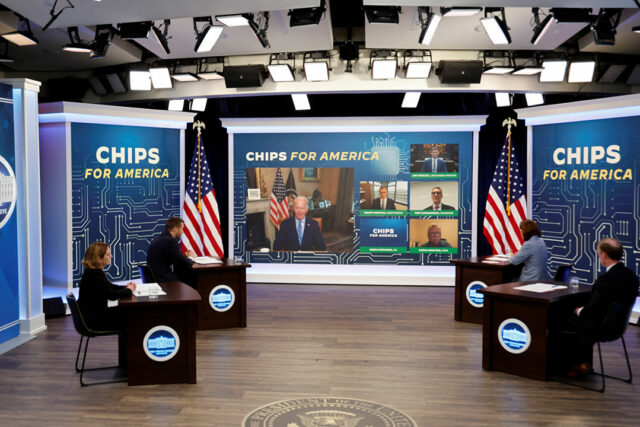
Last week, Mr. Trump proposed to US legislators the repeal of the CHIPS Act, which provides $52.7 billion in federal subsidies for semiconductor chip manufacturing and production, encouraging them to revive chipmaking in the US and diversify manufacturing sites away from China.

The Philippines is one of seven countries tapped to help diversify US on semiconductor supply chain.

“If this results in American semiconductor companies looking for more cost-efficient locations in terms of manufacturing and assembly, this may benefit the growth of Philippine semiconductor operations,” Mr. Tuaño said.

“But if the protectionist policies in the US result in higher tariffs, this could disrupt exports of semiconductor components assembled in this country for the US,” he added.

He said that the Philippines has been a top destination for US semiconductor investment.

“While the reversal of the CHIPS Act may result in lower investment by American manufacturers in the country … we could see this offset by the Philippines as an alternative to China, in which the US government has already erected tariff walls, in terms of semiconductor testing and assembly,” he added.

However, he said that the Philippines will need to position itself as a semiconductor testing and assembly hub.

This is through “strengthening its ties across the Southeast Asian region to increasingly leverage itself as part of the regional electronics ecosystem, improving training and education programs in engineering and assembly, and enabling stronger investments in infrastructure.”

Foreign Buyers Association of the Philippines President Robert M. Young said that he expects the Philippines to be the least affected by Mr. Trump’s America First policies.

“Somehow, if ever that will happen, the Philippines will be the least affected. I am saying this because we are the smallest player in the industry of chips. The lion’s share is in South Korea, Taiwan, and China,” he said via phone.

“There is another school of thought that perhaps this might be selective … Perhaps he will say that the Philippines is just a small player and we will just retain the chip subsidies,” he added.

However, he said that the Philippines will need to explore new markets to be able to maintain employment levels.

“We just have to look for other markets just to survive and at least continue what we are doing right now so that employment is not affected. Otherwise, it will really affect our economy,” he said.

“South Korea and Taiwan will be needing some subcontractors, and the Philippines can be one of them,” he added.

Rizal Commercial Banking Corp. Chief Economist Michael L. Ricafort said that scrapping the US CHIPS and Science Act in an effort to cut the US government’s expenditures will effectively reverse one of former US President Joe Biden’s initiatives.

“This effectively nullifies subsidies for US chipmakers to better secure the sources of semiconductors from allied countries such as the Philippines. So it is an opportunity lost for local electronic exporters to sell more to the US chipmakers,” he said in a Viber message.

Philippine Economic Zone Authority Director General Tereso O. Panga said that the reversal of the support will affect manpower training in the semiconductor industry amid a Philippine push to host front-end fabrication and advanced chip manufacturing facilities.

“The repeal of the Act may delay our vision of hosting more assembly, testing, and packaging (ATP)-based semiconductor firms and advanced wafer fabrication manufacturing facilities for lack of the skilled and knowledgeable workforce,” he said.

“The Philippines is currently recognized as a deep pool for engineering talent, which enables us to maintain a competitive edge in the global semiconductor industry,” he added.

Meanwhile, Semiconductor and Electronics Industries in the Philippines Foundation, Inc. (SEIPI) President Danilo C. Lachica said that the industry remains optimistic for modest growth despite Mr. Trump’s policies, specifically his plans to impose 25% tariffs on imported chips.

“It actually caused a little scare … But as we’ve kind of waded through the noise, as you know, we have a lot of several US multinational companies here, specifically in semiconductor ATP, which export back to the US,” he said during the Money Talks with Cathy Yang program on One News Channel.

“So, it seems like at this point anyway, we haven’t been affected by any tariffs. It’s business as usual. We’re still optimistic about growth being at least flat,” he added.

He said the volatility of US policy highlights the urgency of negotiating a free trade agreement (FTA) with the US.

“What’s important really is to establish an FTA with the US, whether bilateral or multilateral. Because while today we’re not seeing any impact, it’s evident that some of our members who deal with the federal government are seeing some delay, or if not cancellation, of orders because we’re not in trade agreement compliance,” he said.

“As soon as we get those FTAs and, of course, the Department of Trade and Industry (DTI) is on the ball working on it, we’ll see (these concerns diminish),” he added.

He said that the International Technology Security and Innovation Fund of the CHIPS and Science was also frozen along with the US Agency for International Development and State Department (USAID) grants.

“We’re looking at other avenues to continue advance ATP because that’s part of the new roadmap that DTI has funded. We’re going to grow ATP, integrated circuit design, and electronic manufacturing services,” he said.

“Hopefully, we can take baby steps towards having a lab scale or wafer fab operation,” he added.

Food service competitiveness seen depending on gov’t, private-sector tieups

ASIAFOODBEVERAGES.COM

THE GOVERNMENT needs to build more partnerships with the private sector to develop the food service industry and to promote its food products globally in keep in step with its neighbors, according to the Food Caterers Association of the Philippines (FCAP).

“The only difference between Thailand and Philippines is the support from the National Government,” FCAP President Francis Sevilla, Jr. told BusinessWorld on the sidelines of the Thaifex Horec Asia 2025 in Bangkok.

“In Thailand, we found out that their National Government through the Department of Tourism and Promotion have really supported the food service industry.”

According to the US Department of Agriculture’s (USDA) Foreign Agricultural service, the Philippine food services industry is projected to grow 12% this year as store networks and foot traffic are expected to expand.

The USDA said more customers are dining out due to the opening of new restaurants, cafés, kiosks, and bars, as more franchise international restaurants enter the Philippines.

It said that sales in full-service restaurants are expected to grow 10% next year due to store expansion. Full-service restaurants account for 17% of the industry.

When it comes to internationalizing its industry, however, the Philippines needs to invest in state-of-the-art kitchen equipment if the food service industry is competing with regional rivals.

“All the efforts to make the food service industry globally competitive, usually in our country, were initiatives of the private sector,” he said.

Thailand’s bid to position itself as the “kitchen of the world” has been key to its success in promoting its food products globally, Department of International Trade Promotion of the Thai Ministry of Commerce Director General Sunanta Kangvalkulkij told reporters at the trade fair.

“We also have some kind of policy to support Thai food and now we see that Thai food has some kind of good reputation. A lot of people around the world know Thai food more than ever,” she said.

She said her agency works closely with the Thai Ministry of Agriculture to boost the production and marketing of its produce, mainly fruit and rice.

“The Philippines, I think, has a very good opportunity (to develop hospitality and food services),” she said. — John Victor D. Ordoñez

Cybersecurity, digital infra seen as next DICT Secretary’s top priorities

IVAN JOHN E. UY — FACEBOOK.COM/DICTGOVPH

By Ashley Erika O. Jose, Reporter

A UNIFIED national cyber defense center and the expansion of digital infrastructure should top the to-do list of the next Secretary of Information and Communications Technology, technology and cybersecurity analysts said.

“The new Secretary should support the national development goals of the government, particularly in digital transformation, economic growth, and national security,” Samuel V. Jacoba, founding president of the National Association of Data Protection Officers, said via Viber.

Last week, President Ferdinand R. Marcos, Jr. accepted the resignation of former Secretary Ivan John E. Uy from the Department of Information and Communications Technology (DICT).

Mr. Uy was appointed to head the DICT in June 2022. Among his initiatives were the SIM Card Registration Act, a law designed to curb spam calls and texts.

His tenure also focused on the expansion of the Free Public Internet Access Program to over 16,000 active sites and the drafting of the National Cybersecurity Plan.

The Palace and the DICT have not said why Mr. Uy resigned on March 6.

Presidential Communications Office Undersecretary Claire B. Castro said last week that Mr. Marcos will appoint an officer-in-charge until he names a new Secretary.

“Under (Mr. Uy’s) leadership, the Philippines made significant strides in improving its global standing in government digital transformation, cybersecurity, connectivity, and inclusivity,” the DICT said.

“The DICT assures the public that there will be no disruption in its services amid the leadership transition. The Department looks forward to welcoming its new Officer-in-Charge,” DICT Spokesperson and Assistant Secretary for Legal Affairs Renato A. Paraiso said in a statement.

Ronald B. Gustilo, national campaigner for Digital Pinoys, said the next Secretary must focus on cybersecurity, data privacy, improvement of digital infrastructure and artificial intelligence.

“The resignation of Mr. Uy comes at a critical time when digital transformation, cybersecurity, and consumer protection should be top priorities. Moving forward, the next Secretary must have strong expertise in digital technology, cybersecurity, and public policy to ensure that ongoing projects do not stall and that new initiatives effectively address the country’s growing digital challenges,” Mr. Gustilo said via Viber.

Mr. Gustilo said the new leader must have a clear position on artificial intelligence to address its misuse, possible risks posed by deepfakes, online scams and digital fraud.

The next Secretary should also expedite infrastructure and technology projects for government and underserved communities, according to Terry L. Ridon, convenor of think tank InfraWatch.

“The next appointee should also focus on strengthening government cybersecurity at all levels to stop massive data breaches happening across government agencies,” Mr. Ridon said.

Philippine organizations suffered an estimated $1 million in losses in 2023 due to cybersecurity incidents, according to connectivity cloud company Cloudflare, Inc.

According to a report by consulting firm Frost & Sullivan, the Philippines could sustain up to P200 billion in economic losses per year due to cybercrime.

The Philippines faces increasing threats of cyber attacks from ransomware to state-sponsored espionage, Mr. Jacoba said, adding that a national cyber defense center to centralize real-time cyber threat intelligence is necessary for rapid response and cyber resilience.

“These three priorities — Cybersecurity, Digital Infrastructure, and E-Governance — are essential for national security, economic growth, and government modernization. They also align with the administration’s push for digital transformation across all sectors of our society,” Mr. Jacoba said.