Home Blog Page 1382

Yields on term deposits drop after BSP decision

BW FILE PHOTO

TERM DEPOSIT YIELDS declined on Wednesday after the Bangko Sentral ng Pilipinas (BSP) delivered a second straight rate cut last week.

Total bids for the central bank’s term deposit facility (TDF) reached P112.339 billion, above the P100 billion placed on the auction block but below the P143.638 billion in tenders seen last week for a P140-billion offer. However, the central bank awarded only P96.531 billion in papers as the two-week deposits went undersubscribed.

Broken down, tenders for the seven-day term deposits stood at P65.808 billion, more than the P50 billion placed on the auction block but lower than the P94.542 billion in bids seen last week for the a P70-billion offer. The BSP made a full P50-billion award of the one-week tenor.

Banks asked for yields ranging from 5.1% to 5.385%, narrower than the 5.1% to 5.5055% margin seen last week. This caused the average rate of the one-week term deposits to fall by 18.03 basis points (bps) to 5.3013% from 5.4816% a week ago.

Meanwhile, the 14-day papers attracted bids worth P46.531 billion, below the P50 billion auctioned off by the BSP as well as the P49.096 billion in tenders fetched for the P70 billion on offer last week. The central bank accepted all the bids submitted for the tenor.

Accepted rates were from 5.25% to 5.53%, wider than the 5.46% to 5.53% range seen a week ago. As a result, the average yield of the 14-day deposits went down by 10.21 bps to 5.4117% from the 5.5138% fetched last week.

The BSP has not auctioned off 28-day term deposits for more than four years to give way to its weekly offerings of securities with the same tenor.

The TDF and BSP bills are used by the central bank to mop up excess liquidity in the financial system and to better guide market yields closer to the policy rate.

“The BSP TDF average auction yields declined, largely due to the 25-bp BSP rate cut on June 19… BSP TDF yields eased despite lower total bids and partial awards, partly reflecting higher bid yields,” Rizal Commercial Banking Corp. Chief Economist Michael L. Ricafort said in a Viber message.

Mr. Ricafort added that TDF rates dropped on easing inflation concerns amid the recent decline in global crude oil prices after Iran and Israel agreed to a ceasefire after exchanging airstrikes for 12 days.

The Monetary Board last week cut benchmark borrowing costs by 25 bps for a second straight meeting, bringing the target reverse repurchase rate to 5.25%, as expected by 15 out of 16 analysts in a BusinessWorld poll.

It has now lowered rates by 125 bps since it began its easing cycle in August last year.

BSP Governor Eli M. Remolona, Jr. said they could deliver at least one more 25-bp cut this year as the inflation outlook has moderated, but said they remain watchful of emerging price risks, including the conflict in the Middle East and global trade uncertainties.

The Monetary Board has three more policy meetings this year. — AMCS

Hilton breaks into cruise with a Waldorf Astoria Nile ship

By Fran Golden

WHEN Marriott dipped into cruising with its introduction of the Ritz-Carlton Yacht Collection brand in 2022, it was the first hotel company to head to the ocean. Then came Four Seasons, Orient Express, and Aman — all with plans to launch ocean yachts in the next two years. And now, as of May, Hilton Worldwide Holdings has decided to quietly join the fray with its flagship luxury brand Waldorf Astoria, which is set to introduce a Nile River cruiser in late 2026.

The Waldorf Astoria Nile River Experience will bear some of the hallmarks of the hotels that share its name: a Peacock Alley Bar, a monumental lobby clock and art deco design flourishes. (Yes, there will be plenty of Champagne, perhaps even enough to fill the Nile.) But Hilton’s Head of Luxury Brands Dino Michael says the decision to expand into cruising has more to do with the company’s heritage than keeping up with the competition.

Hilton, after all, has a long history in Egypt, stretching from the 1958 opening of the Nile Hilton to the 589-room Waldorf Astoria Cairo Heliopolis, which opened in 2023, and the months-old Hilton Cairo Nile Maadi. It also operated two “floating hotels” there in the 1960s, long before the phrase was trendy. The Isis and Orisis, two 184-passenger vessels launched in 1965 and 1966, each sailed for about 25 years up and down the Nile.

Rediscovering that history in the lead-up to the Cairo hotel opening made executives feel nostalgic, Mr. Michael says. “The conversation led from one thing to another.” Before long, he says, the team had concluded, “you know, we should do it again.”

With that in mind, Mr. Michael says the Nile River Experience won’t be part of a broader entrance by Hilton into the luxury cruise market, but rather “a distinctive offering that reimagines Nile River cruising through the lens of the Waldorf Astoria brand.”

EGYPT’S TOURISM MOMENT
The Nile is a crowded market for luxury cruising, with a broad range of companies sailing along similar routes. But it’s also thriving: Viking will have 10 ships sailing the Nile by 2026, and this fall will see the debut of two butler-serviced dahabeahs — wind-powered boats associated with Egyptian royalty — from lauded Indian hotelier Oberoi.

So is tourism in Egypt, generally. Despite the turmoil enveloping the broader Middle East, the country’s tourism ministry has seen record arrivals in the first months of 2025, with visitor numbers up almost 24% in April compared with the year before. That trend is expected to continue with the late 2025 opening of the long-awaited Grand Egyptian Museum and a newly unveiled, $30-million refurbishment to the tourism infrastructure around the famed pyramids of Giza.

To that booming backdrop, Hilton will add a five-deck vessel with a lavish rooftop deck and 29 river-view suites, each with personal concierges able to arrange “tailored programming” off the ship. “There was an existing vessel that was in need of a full renovation, which is great for us because you get to create from the ground up,” Mr. Michael says. He declines, however, to name the ship or the price of the project. The company’s local partner for the endeavor is Middle East for Nile Cruises and Hotels, owned by the Egyptian plastics manufacturer Al-Ahram Group, whose assets include a 21-year-old ship called The Nile Story.

The reimagined Hilton cruiser will sail a tried-and-true route. Departures will set sail from Luxor toward the Valley of the Kings and the intriguing market town of Aswan; other stops will include private docks at Esna, Edfu, and Kom Ombo, to see temples dedicated to the gods of crocodiles and falcons. Other experiences, such as helicopter rides and wellness-oriented excursions, are under discussion, though Mr. Michael says it’s too early to talk specifics; the goal, he says, is to avoid “touristy and overcrowded” spots and to seek “unique” opportunities to explore along the river.

POINTS HOUNDS WELCOME
One distinguishing factor is that guests will be able to earn and burn Hilton Honors points on the Waldorf Astoria Nile River Experience’s cruises. While prices have yet to be decided, Mr. Michael says bookings are expected to open for sale around the second quarter of 2026, and trips will range from four to six nights. The only other Nile cruises that can be paid for with loyalty points are much longer itineraries — nine- to 13-day trips with AmaWaterways, Viking and Uniworld River Cruises — which are bookable via Marriott Bonvoy’s Cruise With Points program.

And while travelers can also book the Waldorf Astoria in Cairo on points to extend their trips on either end, Hilton doesn’t plan to replicate that strategy for now. Where other brands such as Orient Express and Four Seasons are deliberately planning diverse rail and sea itineraries that can easily get combined with stays at nearby hotels, Hilton plans for now to stick to the Nile.

“Right now, it’s just something we felt was unique,” Mr. Michael says. “Given the popularity of Nile cruising and the huge opportunity that exists at that premium level, we thought Waldorf Astoria was the right fit.”

A Nile cruise, Mr. Michael says, is “on a lot of bucket lists — and when done well, it’s extraordinary.” Bloomberg

SEC discontinues joint certification for capital stock increase applications

BW FILE PHOTO

THE SECURITIES and Exchange Commission (SEC) has discontinued the use of joint certification for applications to increase capital stock through cash infusion due to weak public adoption.

In a notice on Wednesday, the SEC Financial Analysis and Audit Department said the decision followed a review of the joint certification requirement for applications to increase capital stock via cash infusion.

“It has been observed that there is a low rate of availment and adoption by the transacting public,” the notice said.

“In view of the foregoing, and in the interest of process efficiency and clarity, the use of the joint certification is hereby discontinued, effective immediately upon issuance of this notice,” it added.

In January, the SEC Company Registration and Monitoring Department implemented a new format for the cover sheet and joint certification to be used by stock corporations for applications to increase their capital stock through cash infusion.

The joint certification replaced several documents, including the certificate of increase, directors’ certificate, treasurer’s affidavit, and secretary’s certificates on the list of stockholders, nonexistence of intracorporate disputes, and waiver of preemptive rights.

Last month, the SEC launched six digital platforms and a data center to enhance the delivery of its services.

Some of the new platforms include the Electronic Workbench and Analytics Technical Computing Hub, which notifies corporations of the deadlines for filing reportorial requirements, and the SEC Verification of Electronic Records and Information Trust and Authentication System, which allows multiple authorized parties to approve and sign corporate documents, such as board resolutions and compliance reports, in real-time. — Revin Mikhael D. Ochave

Shangri-La The Fort, Manila accepted into global luxury travel group Virtuoso

Shangri-La The Fort, Manila has been accepted into Virtuoso’s exclusive portfolio of luxury travel partners, comprising 2,300 preferred suppliers in 100 countries. According to Amit Oberoi, general manager of Shangri-La The Fort, Manila, inclusion in Virtuoso will present new sales and marketing opportunities to the network’s luxury travel advisors and their highly desirable clientele. Virtuoso agencies worldwide sell an average of US$35 billion annually, making the network the most significant player in luxury travel.

“Virtuoso’s acceptance process is incredibly selective, so becoming a preferred partner is a true honor,” said Oberoi. “The reputation Virtuoso member agencies have for outstanding dedication to their clients is a perfect fit with our own bespoke approach to service. Now that we’re part of this renowned network, we look forward to offering Virtuoso advisors and their clients the special amenities, values and experiences that surpass their expectations.”

Shangri-La The Fort, Manila joins Virtuoso’s collection of the finest luxury hotels, resorts, cruise lines, airlines, tour operators and other travel entities worldwide. These partners, which specialize in world-class client service and experiences, provide superior offerings, rare opportunities and exceptional value for Virtuoso clients. These prestigious providers are able to market to Virtuoso clients via network vehicles and to Virtuoso agencies through multiple communications channels and events, including Virtuoso Travel Week, luxury travel’s preeminent worldwide gathering. Shangri-La The Fort, Manila’s acceptance into Virtuoso gives it direct relationships with the world’s leading leisure travel agencies in North and Latin America, the Caribbean, Europe, Asia-Pacific, Africa and the Middle East.

Located in the heart of Bonifacio Global City, Shangri-La The Fort features 576 elegantly appointed guestrooms and suites, award-winning dining experiences and its world-class fitness and wellness facilities at Kerry Sports Manila. With seamless access to retail, lifestyle and entertainment venues, the hotel serves as a dynamic hub for business and leisure travel.

For more information about Shangri-La The Fort, call +632 8820-0888 or visit www.shangri-la.com/manila/shangrilaatthefort.

About Company Name

Shangri-La Group is one of the world’s premier hospitality companies. Founded in 1971, the Group now operates over 100 hotels globally under the Shangri-La, Kerry, JEN and Traders brands. Renowned for its distinctive Asian hospitality and thoughtful service, Shangri-La offers guests memorable experiences across a diverse portfolio of destinations in Asia-Pacific, the Middle East, Europe and North America.

In addition to its hotels and resorts, the Group’s operations extend to mixed-use developments, residences, and lifestyle destinations that reflect its commitment to excellence, sustainability and innovation. With a deep-rooted Classification: Internal belief in caring for people and the communities it serves, Shangri-La continues to set new standards in luxury, comfort and service.

For more information, please visit www.shangri-la.com.

About Virtuoso

Virtuoso is the leading global travel agency network specializing in luxury and experiential travel. This by-invitation-only organization comprises over 1,200 travel agency locations with more than 20,000 travel advisors in 58 countries throughout North America, Latin America, the Caribbean, Europe, Asia-Pacific, Africa and the Middle East. Drawing upon its preferred relationships with 2,300 of the world’s best hotels and resorts, cruise lines, airlines, tour companies and premier destinations, the network provides its upscale clientele with exclusive amenities, rare experiences and privileged access. Normalized annual sales of US$35 billion make Virtuoso a powerhouse in the luxury travel industry. For more information, visit www.virtuoso.com.


Spotlight is BusinessWorld’s sponsored section that allows advertisers to amplify their brand and connect with BusinessWorld’s audience by publishing their stories on the BusinessWorld Web site. For more information, send an email to online@bworldonline.com.

Join us on Viber at https://bit.ly/3hv6bLA to get more updates and subscribe to BusinessWorld’s titles and get exclusive content through www.bworld-x.com.

RCBC eyes at least P3B from bond offer

RCBC/BW FILE PHOTO

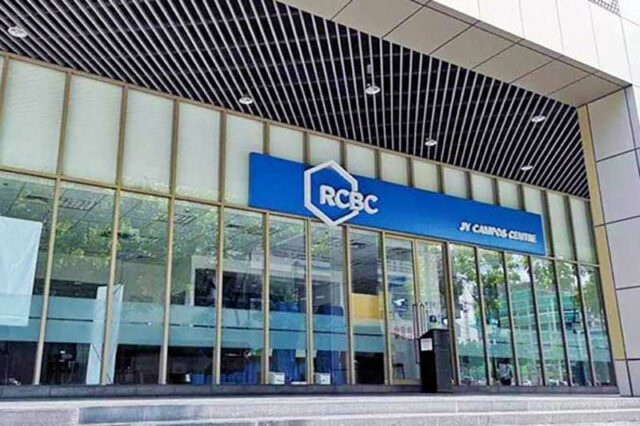
RIZAL COMMERCIAL Banking Corp. (RCBC) is looking to raise at least P3 billion from an offering of 2.5-year sustainability, marking its return to the peso debt market after over three years.

The bank on Wednesday started the public offer for its fixed-rate peso-denominated Series F ASEAN Sustainability Bonds, it said in a disclosure to the stock exchange.

“The bonds will be offered with a minimum issue size of P3 billion with an option to upsize,” RCBC said.

The offer period is set to run until July 9, unless shortened or extended by the bank, depending on market conditions. The bonds are scheduled to be issued, settled, and listed on the Philippine Dealing and Exchange Corp. on July 17.

The notes mark the eighth drawdown from RCBC’s P200-billion bond and commercial paper program, which was doubled in 2022 from the original P100 billion approved by the bank’s board of directors in 2019.

The bonds have a tenor of two years and six months and carry a fixed rate of 6% per annum.

They will be sold for a minimum investment amount of P100,000 and in increments of P10,000 thereafter.

“The funds to be raised from the offer will be used to finance or refinance, in whole or in part, the eligible green and social categories as described in the bank’s Sustainable Finance Framework,” RCBC said.

It said it received confirmation from the Securities and Exchange Commission on June 10 that the issue qualifies as an ASEAN Sustainability Bond issuance as it complies with the necessary standards.

Standard Chartered Bank (SCB) and RCBC Capital Corp. are the joint lead arrangers and bookrunners for the transaction. SCB is also a selling agent together with RCBC.

RCBC last tapped the domestic bond market in February 2022, raising P14.75 billion from the sale of 2.25-year ASEAN Sustainability Bonds.

The bank has raised P86.8 billion out of its P200-billion bond and commercial paper program, it said last month.

RCBC President and Chief Executive Officer (CEO) Eugene S. Acevedo said in November that the bank wants to tap both the onshore and offshore debt markets on a regular basis regularly starting this year as part of their new funding strategy to establish a constant presence in the capital markets.

Mr. Acevedo is set to retire within this year. RCBC Deputy CEO Reginaldo Anthony B. Cariaso, who was appointed to his post effective Jan. 1, is set to succeed him.

RCBC’s attributable net income rose by 10.26% year on year to P2.43 billion in the first quarter, driven by consumer loan growth.

Its shares climbed by five centavos or 0.2% to close at P25.05 each on Wednesday. — Aaron Michael C. Sy

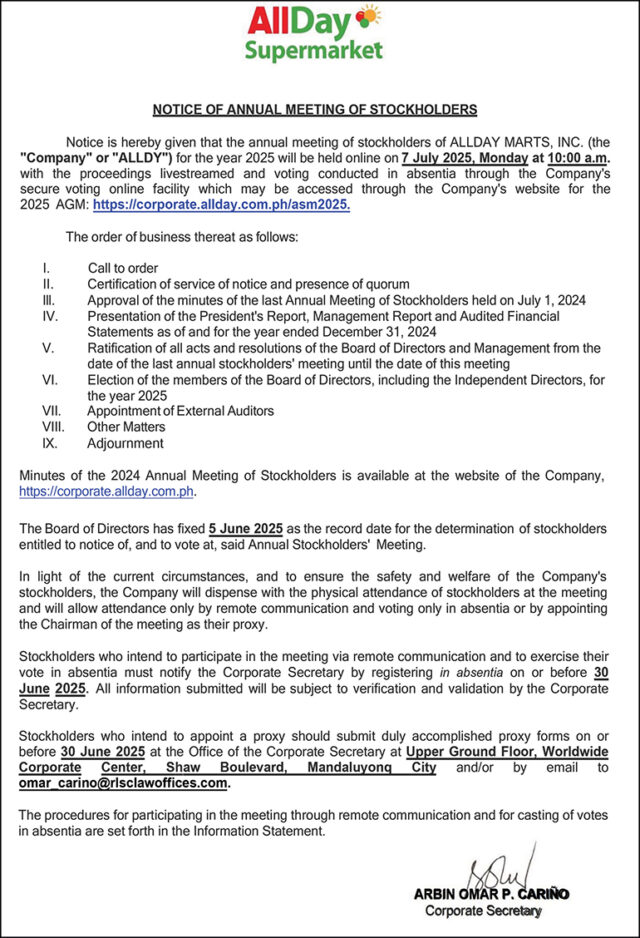
AllDay Marts, Inc. to hold online Annual Meeting of Stockholders on July 7


Spotlight is BusinessWorld’s sponsored section that allows advertisers to amplify their brand and connect with BusinessWorld’s audience by publishing their stories on the BusinessWorld Web site. For more information, send an email to online@bworldonline.com.

Join us on Viber at https://bit.ly/3hv6bLA to get more updates and subscribe to BusinessWorld’s titles and get exclusive content through www.bworld-x.com.

Truelogic rolls out AI search optimization service

TRUELOGIC, INC.

LOCAL digital marketing consultancy Truelogic, Inc. has launched a search optimization service that helps brands increase visibility in artificial intelligence (AI)-powered searches.

“As AI-generated answers — called AI Overviews — take up more space in search results, businesses that rely on web traffic must quickly adapt or risk being left behind,” it said in an e-mailed statement.

Truelogic’s new service helps brands adjust to the AI search era through AI visibility checks, content upgrades, speed boost, and authority building, it said.

A study by Truelogic titled “Navigating Google’s AI-Enhanced Search” showed that AI-generated answers in Google Search results grew to 13% in March from 6.5% in January.

Some platforms reported that eight out of 10 informational searches include an AI-generated answer.

“If you’re a bank, a school, a retailer or a real estate brand, and your customers search online before making decisions — this shift in Google’s search can directly impact your visibility and leads,” said Truelogic Managing Partner Bernard San Juan III.

“AI-generated answers are changing how people search and what they click. To stay competitive, your brand needs to show up in those answers.”

The company’s analysis of Philippine websites showed that the chances of being featured in AI answers in search engines increase when the company has a trusted and well-known website, clear and detailed content, and is mentioned by trusted sources, it said.

Websites that are fast and mobile-friendly also rank higher in search results, it said, with keyword rankings and page counts no longer as influential.

“Forget old SEO (search engine optimization) hacks,” Truelogic Head of Search and Analytics Timothy Uichico said. “Google’s AI rewards quality. Brands need to be fast, helpful and trustworthy — that’s what our new service is built to deliver.” Beatriz Marie D. Cruz

Dining In/Out (06/26/25)


Flavors of Vietnam at Sheraton Manila Bay

SHERATON MANILA BAY welcomes chef Nguyen Hung Thong of the Sheraton Hanoi for a special Vietnamese Food Festival from June 25 to 29 at Manila Bay Kitchen. This limited-time event, “Flavors of Vietnam,” brings the tastes of Vietnam to Manila. From bowls of pho to crispy Hanoi spring rolls, tamarind soft-shell crab, and galangal-braised fish, each dish is made with the chef’s signature flair for flavor, balance, and presentation. Festival highlights include the Lunch at ‘Nam (June 25 to 27), from  11:30 a.m. to 2 p.m., at P1,300 net. The menu includes green mango and seafood salad, grilled pork Bún Cha style, and authentic Vietnamese baguettes. The dinner buffet, from June 25 to 29 is offered from 6:30 to 9:30 p.m., at P2,950 net. These have live carving stations, pho, lemongrass Angus beef steaks, Vietnamese-style crab, and shrimp. For inquiries, contact Sheraton Manila Bay via their social media platforms on Facebook and Instagram (@sheratonmanilabay) or call 5318-0788 or e-mail reservations.manilabay@sheraton.


Evenings at the Whisky Library

THE WHISKY LIBRARY is home to the largest whisky collection in Manila. Start the night with Happy Hour, daily from 5 to 8 p.m. at P1,200 net. This early evening ritual features selections of classic cocktails, single malts, tequilas, and more. On Tuesdays, “Rhythm and Spirits” invites guests to indulge in music and mixology. From 8 p.m. to midnight at P1,500 net, live instrumental performances led by a saxophonist provide a backdrop to a pour-all-you-like experience, with whiskey sours, espresso martinis, and Tamnavulin Red Wine Cask on the menu. It’s Ladies’ Night every Wednesday from 9 p.m. to 1:30 a.m. at P1,200 net. The experience includes a selection of cocktails and access to the Tonic Temptress station: guests craft their ideal gin and tonic from an assortment of gins sourced from England and Italy, with artisanal mixers and garnishes such as dried citrus, edible flowers, and juniper berries. Fridays are ‘80s Night, from 8 p.m. to midnight at P1,500 net. For more information on Newport World Resorts, visit www.newportworldresorts.com and follow @newportworldresorts on Facebook, Instagram, and TikTok.


Catch a Pokémon at Krispy Kreme

KRISPY KREME brings Pokémon to life with its newest doughnut collection. This cooperation is the first of the many surprises that the doughnut brand is preparing as it celebrates 88 years since it was established in 1937. This newest collection includes first-generation Pokémon on the signature Krispy Kreme doughnuts. There’s Pikachu (a shell doughnut with citrus custard filling, dipped in yellow chocolate coating and yellow icing, topped with a combination of red, white, and yellow sprinkles, and finished off with a candy topper), Jigglypuff (a ring doughnut with cotton candy filling, dipped in strawberry chocolate, topped with blue sanding sugar, and finished off with a candy topper), Bulbasaur (a shell doughnut with apple filling, dipped in blue chocolate, decorated with green chocolate, finished off with a candy topper), Charmander (a ring doughnut filled with custard, dipped in orange chocolate mix, designed with icing, and finished off with a candy topper), Squirtle (a shell doughnut with blueberry creme filling, dipped in chocolate coating, designed with blue powder coating, and finished off with a candy topper), and Meowth (a ring doughnut with dark chocolate filling, dipped in milk chocolate, topped with chocolate creme, toffee bits, and finished off with a candy topper). These are available at Krispy Kreme stores nationwide, via dine-in, take-out, drive-through, or through Krispy Kreme’s delivery channels: now.krispykreme.com.ph, 888-79000, or GrabFood, FoodPanda, Pick.A.Roo, OrderMo, or Groover.


Pickup Coffee opens in Cebu

PICKUP COFFEE opens its first premium in-line branch, Pickup Prime, at SM Seaside City Cebu. Designed in collaboration with Hong Kong-based architectural partners, Deft, the space brings together modern style and the brand’s signature youthful energy. Adding to the experience are custom-designed art toys by Filipino artists Dondi Fernandez and Jesse Camacho. The menu will feature exclusive beverages that will be switched up every few months. For its pilot release, the lineup brings a fresh take on well-loved Filipino flavors through items like Mango Coco Milk, and Ube Coco Milk. Also on the menu is Kape Kastila Sundae Swirl, with creamy espresso soft serve. The brand partnered with Cebu’s LK Bakery to offer local exclusive bites. The collaboration includes several croissant variants, both sweet and savory. Customers can order via the app or use the self-ordering kiosks at the store. Customers at the new store can get 25% off (with a minimum spend of P300) on all orders made through the app until July 5.


Pancake House opens in Ilocos Norte

PANCAKE HOUSE opened its newest store in SM City Laoag, its first location in Ilocos Norte. Located on the Upper Ground Floor, the store is now serving all-time favorites from 10 a.m. to 9 p.m. daily. Meanwhile, Pancake House is wrapping up its Summer Creations series with a selection of limited-time creations (available until June 30). These include Strawberry Choco Dream Waffle (P159), Strawberry Blush Milkshake (P199), Choco Berry Bliss Milkshake (P199), Vanilla Strawberry Swirl Milkshake (P199), Strawberry Fizz Cooler (P139), Strawberry Yogurt Cooler (P139), Zesty Orange and Cream Cheese Waffle (P159), Vanilla Orange Swirl Milkshake (P199), Citrus Orange Cooler (P159), and Orange Yogurt Cooler (P159). All are available for dine-in, takeout, curbside pick-up, and delivery until June 30. The June 30 end date extends to the All-Day Breakfast Choose Any Two promo for P499. Mix and match two breakfast plates served with two drinks. These include Waffle with Buttermilk Pan Chicken, Fish and Chips, Pork Tocino Bowl, Fish Rolls Bowl, and the Arroz a la Cubana Bowl. All are available for dine-in, takeout, curbside pick-up, and delivery. For updates, follow @pancakehouseph on Facebook, Instagram, and YouTube or visit www.pancakehouse.com.ph.

DoE says power rates may drop below P0.50/kWh by 2050 with RE rollout

STOCK PHOTO | Image from Freepik

ELECTRICITY RATES may decline to below 50 centavos per kilowatt-hour (kWh) by 2050 as new renewable energy (RE) projects under the government’s Green Energy Auction Program (GEAP) come online, the Department of Energy (DoE) said.

At a forum hosted by the Institute for Climate and Sustainable Cities on Wednesday, Energy Undersecretary Rowena Cristina L. Guevara said the DoE asked the spot market operator to simulate electricity prices through 2050 based on the implementation of projects under GEAP.

“This is the number that we got: from 2026, Luzon, for example, on average will be P4.95 per kWh. By 2050, it will be P0.28 per kWh,” Ms. Guevara said.

In the Visayas, prices are projected to fall from around P5.28 per kWh in 2026 to P0.48 per kWh by 2050. In Mindanao, electricity rates may drop from P4.06 per kWh in 2026 to P0.36 per kWh by mid-century.

Ms. Guevara cited the United Kingdom’s experience with offshore wind development as an example of how prices for emerging technologies eventually decline.

“The price per megawatt-hour was £120. In four years’ time, that £120, on track for difference, went down to £42 in just four years’ time,” she said.

“So, the initial investment for new technologies might sound very high, but eventually it goes down. And we already asked IEMOP (Independent Electricity Market Operator of the Philippines) to do the simulation because we want to make sure that our consumers are protected,” Ms. Guevara added.

IEMOP operates the Wholesale Electricity Spot Market, where distribution utilities and other energy players procure additional power when their contracted supply is insufficient.

The DoE has launched five rounds of GEAP, which are expected to deliver more than 25,000 megawatts (MW) of capacity. Nearly all RE project awards under GEAP Round 3 have been accepted, representing a combined capacity of over 6,600 MW through 2035.

In a media release on Wednesday, the DoE said winning bidders confirmed their acceptance by submitting written confirmations.

Among those that accepted the award is Pan Pacific Renewable Power Phils. Corp., which submitted the largest total bid under GEAP-3 with two impounding hydropower projects totaling 2,300 MW in Apayao.

Coheco Badeo Corp. accepted the award for its 500-MW Kibungan Pumped-Storage Hydropower Project in Benguet.

Olympia Violago Water and Power, Inc. and Ahunan Power, Inc., both affiliates of Razon-led Prime Infrastructure Capital, Inc., accepted the award for their two pumped-storage projects in Rizal with a combined capacity of 2,000 MW.

San Roque Hydropower, Inc., an affiliate of the San Miguel Group, also accepted the award for three pumped-storage projects in Rizal and Laguna with a combined capacity of 1,850 MW.

The Energy Development Corp. (EDC) and its affiliate, Bac-Man Geothermal, Inc., confirmed their acceptance of the award for two geothermal facilities: the 5.645-MW Bago Binary Geothermal Power Plant – Unit 1 in Bago City, Negros Occidental, and the 21.573-MW Tanawon Geothermal Power Plant – Unit 1 in Sorsogon City, Sorsogon.

However, EDC’s 3.669-MW Mindanao 3 Binary Geothermal Power Plant Expansion Project Phase 3 – Unit 1, which was among the winning bids, was not included in the list of confirmed projects.

The GEAP aims to promote RE as a primary energy source through competitive selection. It supports the government’s target of increasing the RE share in the energy mix to 35% by 2030 and 50% by 2040. — Sheldeen Joy Talavera

UnionBank raises P16 billion from peso bonds

BW FILE PHOTO

UNION Bank of the Philippines, Inc. (UnionBank) has raised a combined P16 billion from its offering of dual-tranche fixed-rate peso bonds, above the P10-billion plan.

The bonds will be listed on the Philippine Dealing & Exchange Corp. on June 26 (Thursday), the bank said in a disclosure to the stock exchange. The issue marks UnionBank’s successful return to the domestic capital markets after nearly two years.

Broken down, the bank raised P9.2507 billion from the 1.5-year Series H bonds, which are priced at 5.88% per annum.

It also raised P6.7943 billion from the three-year Series I bonds that carry an interest rate of 6.02% per annum.

“The offering saw strong interest from institutional and retail investors, with both tranches exceeding their initial targets of P5 billion each,” UnionBank said.

“Proceeds from the issuance shall be used to extend term liabilities, expand funding base, support business expansion plans, and for other general corporate purposes.”

The bonds were sold at a minimum investment amount of P100,000 and increments of P50,000 thereafter.

They will be issued out of UnionBank’s P100-billion peso bond program, which was expanded from the original P50 billion in February.

ING Bank N.V. Manila Branch, Philippine Commercial Capital, Inc, and Standard Chartered Bank were the joint lead arrangers and bookrunners for the transaction. They were also the selling agents for the offer together with UnionBank.

UnionBank last tapped the domestic bond market in December 2023, raising a total of P18.168 billion from an offering of 1.5-year and three-year senior bonds. This was higher than the planned combined issue size of at least P2 billion, or P1 billion for each tenor.

UnionBank saw its attributable net income decline by 28.93% year on year to P1.4 billion in the first quarter due to one-time write-offs from a subsidiary and front-loaded non-recurring costs.

The bank’s shares dropped by 40 centavos or 1.23% to end at P32.10 apiece on Wednesday. — A.M.C. Sy

Laging handa

A US Air Force B-2 Spirit “Stealth” bomber — US AIR FORCE PHOTO BY TECH SGT. CECILIO RICARDO

Yup, like many of us, I was a Boy Scout in my youth.

One lesson I took to heart from that episode in my life is that organization’s motto, “Laging handa” (Be prepared), whose corollary is that lack of preparation courts the risk of failure.

It is an adage that gains special significance in times like today.

Intensifying, escalating, and/or expanding geopolitical conflicts have alarmed not a few folks, with some wondering if we are on the brink of another world war.

It is easy to see where they are coming from, with wars plaguing eastern Europe, the Middle East (involving the three superpowers either directly or indirectly), and parts of Africa (particularly Congo, Somalia, and Sudan), and China ramping up aggression in the South China Sea and staging massive mock aerial attacks on Taiwan. That means there is some form/level of conflict now raging in almost every corner of the world (except the Americas, Oceania, as well as the North and the South poles).

The brief direct armed exchange between the United States and Iran (which has threatened to block the strategic Strait of Hormuz which, in turn, would disrupt a fifth of the world’s oil shipments) — followed by a shaky Israel-Iran truce — has suddenly added risks to inflation, interest rate, and economic growth outlooks worldwide.

All these conflicts are on top of the jarring disruption caused by tariff turbulence from the US that has been reconfiguring global supply chains and forcing countries to fix exposed vulnerabilities by rethinking policies and rebalancing economic partnerships.

“How does one prepare for these kinds of eventualities?” a clearly worried friend messaged me a few days ago, to which I replied (with an internal shrug): “Normal preps lang.”

“Normal,” of course, in the sense that it should be routine for us by now — after a once-in-a-century pandemic, Russia’s invasion of Ukraine in February 2022, and amid the escalating and expanding Mideast crisis, etc. — to prepare for the unexpected. Very few people now use the term “black swan,” which was mainstreamed at the start of the pandemic, perhaps because almost everyone now braces for shocks.

At this point, allow me to credit BusinessWorld for affording me a valuable first-hand look at how an organization can enhance contingency planning, response, and resilience. Within a month of the declaration of the pandemic in mid-March 2020, a small group in the company sprang to action to maximize digital platforms to repackage and distribute content (with the expected initial resistance to change here and there, as can be expected in any organization), while the president, Miguel G. Belmonte, met employees regularly in order to give updates, field questions, and boost morale, without masking or sugarcoating hard facts. That was one fine example of agility and transparency for a mid-sized company amid a crisis.

Conditions and situations have changed for us all since then, but if there is anything that has remained constant all this time, it is that the only thing permanent is change (Heraclitus, 535-475 BC).

How does one position one’s business/organization on shifting sands?

Perhaps, now is a good time as any to check prescriptions that have been percolating out there. Here’s a glimpse:

AVOID PARALYSIS
In their June 23 MIT Sloan Management Review article, titled: “When Wait and See is Smart Strategy,” authors Adam Job, Nikolaus S. Lang, Ulrich Pidun, and Martin Reeves distinguished “wisely waiting” from “merely drifting” among corporate leaders.1

Noting that amid current uncertainty brought about by the tariff turmoil, “[c]ompanies are deferring investments… postponing sales… [and] delaying decisions…,” the authors recalled that an official of the International Chamber of Commerce said that these actions show “that companies are ‘kicking decisions down the road’ on supply chain restructuring as they watch how trade policies and relations develop.”

“Wait and see can be a dysfunctional response to change or uncertainty if it leads to missed opportunities or an increase in the eventual cost or risks related to actions,” they wrote.

At the same time, they added: “wait and see can also be a smart strategy for delaying commitments while observing an evolving situation.”

A decision to “wait and see” would make sense:

1.) amid temporarily elevated uncertainty, in a way that such a position can be reversed quickly when uncertainty lifts (hence, avoid hard-to-unwind commitments);

2.) when planned actions may spark a backlash, e.g., from the government, that may aggravate uncertainty;

3.) until target key information comes to light.

“Wait and see” is not advisable in the face of:

1.) an existential threat to one’s business;

2.) protracted uncertainty that could lead to a variety of potential operating conditions/environments (in which case, adopting modular/scalable, flexible responses to these possibilities would be the better choice).

In this period of uncertainty that can spike in blink of an eye, the authors counseled corporate leaders to ask five questions:

1.) Are we just drifting, or actively waiting as a strategic choice to avoid being locked into commitments that could eventually prove unviable/untenable?

2.) Do we understand which decisions may lead to such lock-in risks or political pushback?

3.) Are we able to detect signals from policy moves and competitors shifts?

4.) What precise triggers will prompt a shift from “pause” to “go” mode?

5.) Do we have playbooks ready for reengagement, and have we practiced deploying them?

THE RIGHT FRAMEWORK
Here’s another: a June 18 McKinsey Quarterly piece, titled: “A New Operating Model for a New World” — by authors Alexis Krivkovich, Amadeo Di Lodovico, Brooke Weddle, Dana Maor, Deepack Mahavedan, and Richard Steele — cautioned that “even the best strategy does not magically yield a strong performance.”2

They cited the need for an effective, flexible operating model that “can turn strategic potential into market-beating results.”

“Two-thirds of the organizations we surveyed have redesigned their operating models in the past two years, and half of the organizations say they plan to embark on a redesign in the next two years,” they wrote.

Citing studies by McKinsey & Co. showing that even high-performing firms suffer a 30% gap between their strategies’ full potential and what they actually deliver, the authors blamed flawed operating models for this shortcoming.

“Because executives today must address so many fast-moving geopolitical, technological, and societal trends, their operating model needs to anticipate and react to change just as rapidly,” the authors said.

“Our research shows that the operating model is one of the most significant enablers of performance within a CEO’s direct control.”

So, what are some of the best practices for operating model design? The authors identified 12 elements on which corporate leaders should focus their attention:

1.) purpose — an organization’s core reason for being (clear purpose helps employees and stakeholders navigate uncertainty);

2.) value agenda — how an organization creates value (a clear value agenda enables optimal resource allocation);

3.) structure — how accountable units and mission teams are designed (this facilitates and enhances prioritization and accountability);

4.) ecosystem — how an organization works with partners to create value (external partnerships create and share value beyond an organization’s boundaries and capabilities);

5.) leadership — how leaders make decisions and drive action (consistent, decisive leadership ensures clarity and speed of decision-making);

6.) governance — how to set priorities, allocate resources, and manage business performance (ensures that resource management is consistent and integrated with strategy);

7.) processes — how workflows are designed (clearly reflecting value creation at each step and across the organization);

8.) technology — how digital, data, and artificial intelligence (AI) are used to increase productivity and drive new sources of value;

9.) behaviors — how performance-based culture is nurtured across the organization (the “secret sauce” to quickly and effectively engaging the work force);

10.) rewards — how people are credited for performance, thus supporting desired behaviors and practices that increase value;

11.) talent — how an organization attracts and develops skills (the right capabilities are available to meet value-creation goals); and,

12.) footprint — how an organization deploys talent (resources and teams spread throughout an organization clearly reflect strategic priorities).

The resulting fit-to-purpose model enables leaders to achieve four measurable outcomes, namely: clarity (resources and accountabilities are aligned to strategy), speed (workflows are fast, tech-enabled, and smooth), skills (a future-ready workforce equipped to deliver the highest value), and commitment (establishing a performance-oriented culture).

And even after the adoption of a well-designed operating model, the organization may need tweaks or even an overhaul in a few years. Leaders faced with this prospect need to:

1.) Assess current strategic plans, identify areas where the group has not achieved goals fully, and identify potential root causes for such gaps;

2.) Define desired future performance across the four outcomes, with clear accountabilities and performance metrics;

3.) Spot inconsistencies across the 12 operating model elements cited earlier, and areas of poor execution;

4.) Evaluate trade-offs between refining a current operating model and adopting an entirely new design;

5.) Take stock of how leaders (including mid-level managers) can demonstrate the mindset and behavior shifts needed for a new model to succeed.

TRANSFORMATION
For the Boston Consulting Group, organizations may not only thrive amid economic uncertainty, they can seize the opportunity to transform themselves in order to sustain growth.

That statement struck a chord in me, since the economic lockdown amid the pandemic forced BusinessWorld to embrace digital platforms — a move that opened new revenue streams that fueled better revenue performance.

In an April 16 piece, titled: “The Transformation Paradox: How to Grow When the Growing Gets Tough,” authors Tuukka Seppä, Kristy Ellmer, Andreas Holmbom, Dominic C. Klemmer, Paul Catchlove, Martin Reeves, Ulrich Pidun, Gabe Boulsov and Adam Job cited 10 success factors for organizational transformation for sustained growth.3

The task of building capabilities covers:

1.) fostering a creative culture;

2.) adopting a long-term mindset;

3.) looking beyond the boundaries of one’s firm, i.e., industry, geopolitical, macroeconomic, and other factors affecting one’s peers;

4.) investing in innovation;

5.) building transformation experience to provide a stepping stone for future similar initiatives.

Meanwhile, executing change requires:

1.) setting up a formal program on improving processes and governance;

2.) appointing a chief transformation officer;

3.) crafting a compelling narrative to secure support from investors and other stakeholders;

4.) achieving higher cost efficiency than peers, reflecting a better operating model; and,

5.) transforming from a position of strength, preempting the next potential downturn.

NOT A PANACEA
And, of course, this discussion cannot ignore the compelling benefits of using emerging technologies that can speed up processes, boost quality, etc.

In a March 11 article, “The CEO’s Guide to Delivering Despite Uncertainty,” Boston Consulting said that “[h]ow companies integrate” AI “and rethink the way they work will make all the difference.”4

Companies that integrate AI into operations increase productivity, reduce costs, and improve customer and employee experience, the piece read.

At the same time, it cautioned that firms that “successfully implement and scale AI initiatives often fail to root out old behaviors and legacy infrastructure that the new technologies were designed to replace, so they were unable to realize savings.”

“Start by reshaping core functions, not just automating processes,” Boston Consulting said.

“Go beyond streamlining existing workflows and, instead, pursue efficiency and new business capabilities,” it added.

“Align AI initiatives with business priorities, focusing on two to four transformation areas that will have the greatest impact.”

Finally, it is crucial to set clear key performance metrics that measure cost savings, and new value creation, particularly in terms of revenue impact, customer experience, and product or service innovation.

Boston Consulting then advised businesses to invest in talent and organizational change by dedicating 70% of AI transformation efforts to upskilling workers and embedding the technology into daily decision making.

And so, there you have them folks: more ingredients for your ever-evolving business playbooks.

1  https://tinyurl.com/237kdeyl

2  https://tinyurl.com/23ygqqfo

3  https://tinyurl.com/28dfmdj5

4  https://tinyurl.com/2595t67z


Wilfredo G. Reyes was editor-in-chief of BusinessWorld from 2020 through 2023.

Geofencing: Defending Filipino mobile users from rising cyberthreats

REUTERS

By Jan Sysmans

ON AVERAGE, Filipinos use 11 mobile applications per day — one of the highest rates in Southeast Asia. Smartphones have become central to everyday life as the nation undergoes a mobile-first digital transformation.

Over half or 54.7% of mobile phone users in the Philippines prefer apps over websites for digital tasks, while 61.6% rely on e-wallets for payments, according to Appdome’s 2024 Philippine Mobile Consumer Survey. This growing reliance on smartphones aligns with the country’s Digital Transformation Roadmap, which aims to expand digital access and public services nationwide.

With increased usage, of course, comes increased risk. As mobile use pervades both urban and rural regions, the risk of digital fraud grows proportionally. In 2024 alone, the Philippines recorded P409 million in losses to online fraud — largely due to phishing, account takeovers (ATOs), and credential stuffing attacks. These threats underline the urgency for modern, context-aware security controls that extend beyond traditional methods.

One strategy is geofencing, a location-based security mechanism that uses geographic boundaries to implement access controls, detect anomalies, and deter fraud. As it is commonly associated with marketing or logistics, geofencing’s use in mobile cybersecurity remains under-leveraged. When implemented correctly, geofencing can be used to fortify mobile app security in the Philippines.

THE ESCALATING CYBERTHREAT LANDSCAPE
Cybercrime in the Philippines is rising at a staggering rate. Cybercrime complaints surged by 71.9% in the first quarter of 2025 compared to the same period the previous year, jumping from 1,891 to 3,251 cases, according to the Cybercrime Investigation and Coordinating Center (CICC). This increase underscores how cybercriminals are evolving faster than conventional security models can keep pace with.

Financial institutions are a popular target. According to the Bangko Sentral ng Pilipinas (BSP), supervised institutions reported losses of P5.82 billion due to cyber incidents in 2024, up from P5.67 billion in 2023. Most of these were due to phishing, card-not-present fraud, and ATOs. In addition to financial repercussions, these cyber incidents also undermine consumer trust and confidence in digital systems.

Cyberattackers increasingly utilize virtual private networks and proxies to mask their geographic location and bypass regional security controls. This allows attackers to impersonate legitimate users, create fake accounts, and exploit Know Your Customer (KYC) processes. By hiding their true location, threat actors can attack with minimal resistance, particularly on mobile platforms that lack native geographic data.

This is where geofencing offers a clear advantage: it introduces geographic intelligence into mobile security so that organizations can take actions based on data about real-world locations and user behavior.

WHAT IS GEOFENCING?
By using a device’s GPS, Wi-Fi, cellular data, or IP address, geofencing establishes virtual geographic boundaries. An app with geofencing can instantly initiate certain security procedures when a device enters or exits designated zones. With this method, businesses can implement location-based, dynamic controls, like requiring step-up authentication for sensitive transactions, blocking access from high-risk areas, or flagging suspicious activity.

By adding a behavioral component to mobile security threat detection that other methods don’t, geofencing enables apps to recognize when a user logs in from geographically disparate locations or tries to conceal their location by using anonymization tools. As a result, apps can distinguish between trustworthy users and possible scammers, decreasing false positives and improving detection accuracy.

THE SECURITY CHALLENGES GEOFENCING SOLVES
Geofencing addresses some of the biggest mobile security threats today, including ATOs, location spoofing, credential stuffing, and fraudulent transactions. By verifying that user behavior aligns with expected geographic norms, it can provide more robust security. This is especially useful for high-risk uses like onboarding, KYC or high-value financial transactions.

It also eases compliance efforts by implementing location-based controls in line with regional regulations and data privacy laws. For businesses operating across multiple jurisdictions, this can help streamline and simplify governance efforts.

Geofencing is especially effective because it is able to enhance security without adding friction for users. Unlike cloud-dependent security systems, geofencing decisions are enforced directly on the app. It doesn’t need a constant network connection, external application programming interfaces (APIs), or third-party infrastructure to do its job. This results in near-zero latency, maintains protection in low-connectivity environments, and ensures frictionless operation with no throttling or service disruptions. For mobile-first users, frictionless security is paramount.

THE ROUTE TO HIGHER SECURITY WITH GEOFENCING
As cyberattacks become more frequent and sophisticated, particularly in mobile-driven economies like the Philippines, so should cyber defenses. Traditional methods are becoming increasingly ineffective against modern tactics like location spoofing and credential-based attacks.

Geofencing adds a powerful yet low-friction layer of security to mobile apps by integrating real-time, location-based intelligence. Organizations are therefore empowered to proactively prevent fraud, protect users, and maintain compliance without compromising performance or experience. As the Philippines grows into its mobile-first era, intelligent embedded solutions like geofencing will be critical in securing trust, integrity, and resilience among the nation’s mobile users.


Jan Sysmans is a mobile app security evangelist at Appdome.