Home Blog Page 1334

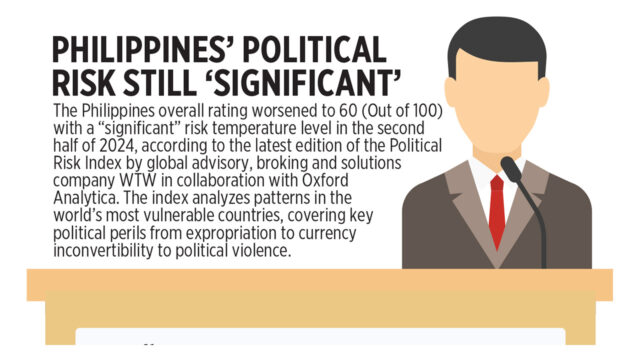
Philippines’ political risk still ‘significant’

The Philippines overall rating worsened to 60 (Out of 100) with a “significant” risk temperature level in the second half of 2024, according to the latest edition of the Political Risk Index by global advisory, broking and solutions company WTW in collaboration with Oxford Analytica. The index analyzes patterns in the world’s most vulnerable countries, covering key political perils from expropriation to currency inconvertibility to political violence.

Philippines’ political risk still ‘significant’

CPG profit up 31% on premium and affordable residential units

CENTURY-PROPERTIES.COM

LISTED real estate developer Century Properties Group, Inc. (CPG) posted a banner year after its net profit rose by 31% to P2.44 billion for 2024 from P1.86 billion in 2023, led by its premium residential and affordable housing segments.

Revenue increased by 15% to P14.64 billion last year, CPG said in a statement to the stock exchange on Thursday.

The first-home segment accounted for P9.9 billion in revenue, up by 34% from P7.4 billion in 2023, while its higher-end offerings contributed P3 billion. Its leasing and property management arms added P1.31 billion and P464 million, respectively.

CPG’s total assets increased by 3% to P55.9 billion while interest-bearing debt dropped by 16%.

“We are very pleased with our 2024 performance, which reflects our commitment to operational excellence, successful project completions, and effective debt management,” CPG President and Chief Executive Officer Marco R. Antonio said.

“Our focus on delivering affordable, quality homes continues to meet the strong demand across various market segments,” he added.

Mr. Antonio said last year’s growth came as CPG launched multiple affordable and premium residential projects in North and South Luzon, as well as in Visayas.

“The government’s infrastructure flagship projects — especially those boosting nationwide connectivity — will quickly drive progress and, consequently, increase the demand for quality homes across the country,” he said.

“Additionally, we ventured into the Visayas, bringing our promise of quality, affordable homes to more Filipino families,” he added.

Meanwhile, CPG Chief Financial Officer Ponciano S. Carreon, Jr. is optimistic about the company’s future growth, saying that the country’s favorable macroeconomic outlook is a potential tailwind.

“Our healthy financial position and key indicators will enable us to continue on our planned trajectory, with more than enough cushion to navigate persistent industry headwinds and increase value for our shareholders over time,” he said.

“Our positive outlook on current and expected domestic policies, along with the stable economic landscape, gives us high confidence in CPG’s expansion through organic growth, strategic acquisitions, and partnerships,” he added.

CPG shares rose by 3.39% or two centavos to 61 centavos apiece on Thursday. — Revin Mikhael D. Ochave

Variations on the theme of wealth

FREEPIK

“Let me tell you about the very rich. They are different from you and me.” — F. Scott Fitzgerald

The rich are a class apart (and above the crowd). Envied and impervious to what the rest of the world has to say.

The famous banker JP Morgan, once said that you are rich when “…You can buy what you want, do what you want and not give a damn what it costs.”

“Rich” is a quality that describes a person, a lifestyle, elements that project an image of refinement, quality, and exclusivity. “Rich” is a state of mind, an attitude. In this context, one can be very wealthy in material, measurable terms, but be impoverished in the mind.

One can be financially challenged but be rich in spiritually.

It is necessary to qualify that, although the rich are insulated from problems of survival, they are not invulnerable. They have larger-than-life problems that ordinary mortals do not have — how to keep their money intact, how to increase and preserve their investments, how to avoid paying exorbitant taxes, how to “save face.” Image is important too.

Studies have shown how diminished wealth causes severe depression, desperation, and suicide among the über-rich.

Wealth is relative.

Writer Henry James said that one is rich if one can meet the demands of his imagination. In this mode of thought, rich individuals satisfy their whims by spending huge amounts of money. Their passion is to acquire expensive possessions such as luxurious properties, golf club shares, the latest toys, planes, helicopters, yachts, and people.

The problem with this attitude is not knowing when it is enough. The level of satisfaction or gratification seems to keep increasing.

Financial advisors and bankers discreetly classify wealthy clients according to a finely calibrated chart.

“High net worth” used to apply to clients with at least $5 million, depending on the markets. “Substantial wealth” applied to clients worth more than $100 million. These numbers have risen in the past 25 years due to the global financial tsunami and the unpredictable high tech digital money.

Individuals who have lost their fortunes are called “discontinuities.”

A member of old society’s powerful and wealthy oligarchy once deprecatingly called himself nouveau pauvre (new poor). He belonged to an aristocratic genteel set. Two decades later, fate smiled. The family fortune rose again, and they reacquired much more than what they had lost. They became more powerful. The estimated cost was very high. He wisely chose to remain low key and become socially responsible. He never forgot the humble and difficult circumstances that he and his family had endured during the years of exile. Lessons learned.

Financial institutions do not distinguish between nouveau riche (new money) and old rich. That distinction is reserved for the qualified social scientists and the few credible society arbiters to comment on, speculate, or classify.

In the Philippine context, old money is vintage money — wealth that has stayed in the family for at least four generations. This would be from the 1920s or earlier, or pre-World War II. Anything acquired from the 1950s to the present is considered new money. The origin and years are important. Provenance, as in art.

Like good fine wine, money must be aged property. People who have money are distinguished from one another by their manners, mannerisms, and pedigree. The old rich hide it. The new rich flaunt it. This is not PC (politically correct) during hard times.

More than a century ago, John Jacob Astor remarked that a rich man had assets worth a million dollars. That was when the purchasing power of the dollar was roughly equivalent to maybe $50 (a guesstimate).

More than 30 years ago, a millionaire was defined by bankers and brokers as someone with an annual income of more than one million plus dollars.

The Forbes List now classifies global wealth according to the billions of dollars that they have.

There is a fine but notable distinction.

Rich people are classified according to the age and source of their wealth. Here are some categories:

1. Heirs – rich inheritors of money made by their ancestors.

2. The Rich and Famous – individuals who are famous because they are rich.

3. The Rich and Powerful – individuals who are powerful because they are rich.

4. The Generous Rich – individuals with big hearts who give and help others though their foundations and CSR projects. Many prefer to remain private and anonymous.

The sub-categories consist of the following:

Old rich, working rich, idle rich, useless rich, new rich. The robber barons are those who acquired their wealth through dubious activities (i.e., the manufacture of liquor during the prohibition years, fuels and vehicles. And supplying arms, fuel and vehicles to the enemy during the war.)

Entrepreneurs – people who made their fortunes through honest hard work, and great timing.

Arrivistes – socially ambitious people and fortune hunters who married into money (heirs and heiresses).

Cronies – people who made money through political influence and connections. Some cronies are recycled holdovers or returnees from exile.

Lucky rich – people who struck gold, literally, in their mining activities; those who hit the lotto jackpot; the shrewd stock market investors (who’ve have good timing), and beneficiaries from wealthy, generous employers.

Filthy rich – swindlers with their pyramid schemes, smugglers, human traffickers, gambling and drug lords and dealers, gun runners, brothel owners, lotto lords, proprietors of illegal dens, money launderers.

Miserable rich – the Scrooges who penny-pinch, hoard, count, and worry about their millions and billions. They are the stingy people who do not help others.

These profiles illustrate the types of rich people we can recognize.

There is no accurate standard to quantify the heart’s intentions. (Numbers do not suffice.) True generosity grows and expands to make a difference in the lives of others.

“Rich is not what you have but who you have beside you.” — Anonymous


Maria Victoria Rufino is an artist, writer and businesswoman. She is president and executive producer of Maverick Productions.

mavrufino@gmail.com

WFH becomes Australian election battleground

REUTERS

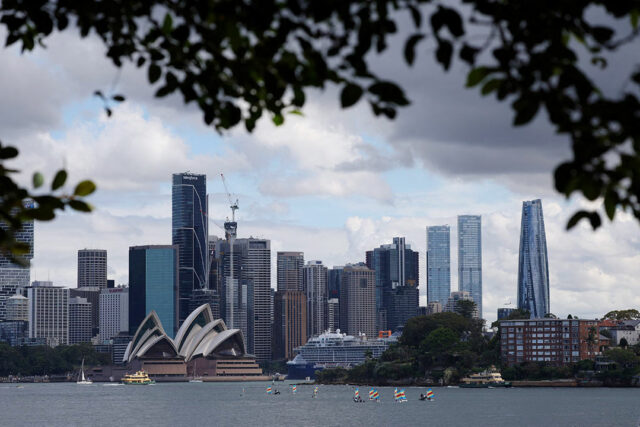
SYDNEY — A plan by Australia’s opposition to force government workers back to the office full time could affect millions, a trade union grouping said on Monday, with the issue featuring in a nationwide election due within months.

This month the Liberal Party said if elected, it would bar hundreds of thousands of government employees from working from home (WFH), except for exceptional circumstances.

But the resulting increased traffic congestion would have a knock-on effect on millions more workers, said the Australian Council of Trade Unions, whose 38 members together represent almost 2 million workers.

“Forcing hundreds of thousands of workers back on the roads will mean less time with kids and more time in traffic,” said the grouping’s chief executive, Michele O’Neil.

The Liberal Party pledge puts it at odds with the ruling Labor Party in campaigning for the election that must be held by May, at which the high cost of living tops voters’ concerns.

On Sunday, Prime Minister Anthony Albanese said allowing employees to work remotely had allowed workers to spend more time with their families, as well as save on commuting.

“We know that working from home has had a range of advantages,” he told a news conference, calling the opposition “out of touch” for the plan to curb it for government workers.

Labor and the Liberal-led center-right coalition are near-deadlocked in the latest opinion polls, with swing seats on the outskirts of major cities — among the most exposed to the high cost of living — likely to be crucial.

Labor has seen a modest bounce in outer metropolitan areas in recent weeks, in part due to the Liberal Party’s proposed curbs on working from home, polling by YouGov and the Australian Associated Press showed. — Reuters

PayMongo partners with billing platform Mochi 

FINANCIAL TECHNOLOGY company PayMongo Philippines, Inc. has partnered with billing and collections platform Mochi to allow businesses to improve transaction processing.

“The PayMongo-Mochi partnership delivers a unified solution that eliminates manual processes, enhances transaction security, and optimizes financial operations,” venture capital firm Kaya Founders, which supports the two companies as part of its portfolio, said in a statement.

“This collaboration aims to simplify how companies manage receivables and cash flow, ensuring faster payments and reduced operational inefficiencies as digital payments continue to rise,” it said. “With the Philippines at the forefront of digital financial services adoption, businesses need to adapt to consumer expectations for secure and seamless payment experiences.”

Digital payments in the Philippines are expected to hit $107.42 billion this year, according to German research platform Statista.

The Bangko Sentral ng Pilipinas wants digital payments to make up 60-70% of total retail transactions by 2028.

“Our collaboration with Mochi underscores our commitment to supporting the growth of MSMEs (micro, small, and medium enterprises) and fintech in the Philippines,” PayMongo President and Chief Executive Office Elmer “Jojo” M. Malolos said. “With Mochi’s advanced billing and collections automation integrated into PayMongo’s payments platform, we are empowering Filipino businesses to navigate the digital economy with confidence.”

“This collaboration will provide companies with the tools they need to manage finances effortlessly and focus on growing their business,” Mochi CEO Guaya Melgar added. — B.M.D. Cruz

Monde Nissin swings to profit with P450-M net income

BW FILE PHOTO

MONDE NISSIN CORP. saw a P450-million net income for 2024, reversing a P626.58-million net loss in 2023, driven by volume growth in its Asia-Pacific business.

“Reported net income for the year was P450 million, primarily due to higher core net income after tax, offset by a P6.8-billion after-tax, non-cash impairment of assets in the meat alternative business and a P2.6-billion non-cash accounting loss on the fair value of the meat alternative guaranty asset,” Monde Nissin said in a regulatory filing on Thursday.

Consolidated revenue rose by 3.7% to P83.1 billion, while gross profit grew by 16% to P28.7 billion. Core attributable net income increased by 28.6% to P9.8 billion.

Net sales in the Asia-Pacific branded food and beverage (APAC-BFB) segment rose by 5.4% to P69.5 billion, driven by volume growth across all categories.

“Our APAC BFB business delivered strong top-line growth and profitability, resulting in record revenues and core net income for both the quarter and the year. This success was driven by volume growth across all categories,” Monde Nissin Chief Executive Officer Henry Soesanto said.

“We anticipate mid-single-digit revenue growth in 2025, while we expect full-year gross margin to be broadly in line with last year. Margin trends will vary quarter to quarter based on our cost savings plans, commodity lock-ins, and base comparison,” he added.

However, Monde Nissin said revenue in the meat alternative segment declined by 4.5% to P13.59 billion.

“Regarding our meat alternative business, we achieved earnings before interest, taxes, depreciation, and amortization (EBITDA) neutrality for the year by focusing on cost reduction and efficiency improvement,” Mr. Soesanto said.

“Additionally, unfavorable market conditions resulted in a mark-to-market loss of P2.6 billion on our guaranty asset. Despite ongoing revenue challenges, we expect a noticeable and durable improvement in EBITDA this year compared to the largely breakeven numbers we have seen over the past couple of years, reducing the risk of further impairments,” he added.

Monde Nissin shares fell by 2.37% or 17 centavos to P7.01 apiece on Thursday. — Revin Mikhael D. Ochave

Hegseth’s Asia tour won’t fix the US credibility crisis

PHILIPPINE STAR/JOHN RYAN BALDEMOR

THE BATTLE of Iwo Jima in World War II was one of the bloodiest in the history of the US Marine Corps. Nearly 7,000 American soldiers died. On the Japanese side, the scale of the casualties was exponentially higher. The epic military operation is a reminder of America’s commitment to the Indo-Pacific region. Eighty years later, US Secretary of Defense Pete Hegseth has a chance to show that resolve again. The alternative is to accept that China will play a more important role in the region — and take the space as the US retreats.

The timing of Hegseth’s first Asian tour couldn’t be more awkward. President Donald Trump’s “America First” mantra is raising eyebrows, but so is his administration’s apparent incompetence. The revelation that US plans to bomb Houthi targets in Yemen were accidentally exposed via a commercial messaging app is worrying for nations that have depended on Washington’s military assistance. Compounding that sense of unreliability: More Trump tariffs are expected next week and allies are likely to be included.

The White House is batting away criticism of the intelligence leak, but it raises serious questions. If the US can be so careless with its own military plans, how much should others rely on it? Hegseth’s itinerary includes visits to the Philippines and Japan. Both US treaty allies should use this opportunity to get firm answers on how much support they can count on, but also shore up their capabilities in the face of Washington’s unpredictability.

The China challenge is getting harder to manage. Manila and Tokyo both have overlapping maritime claims with Beijing in the South and East China seas. These are becoming more difficult to fight as the People’s Liberation Army expands its capabilities around the world, using the full force of its coast guard and advanced undersea cable-cutting technology to its advantage.

Also in the mix is Taiwan’s security, which is important for Japan because of its geographic proximity. President Joe Biden’s administration relied on a network of support among allies to keep countries safe and stand up to China. There’s no indication that will continue under Trump.

There have been some moments of clarity. The defense secretary has had conversations with some key Asian allies, including the Philippines and Thailand, affirming iron-clad support for Manila. Joint Indo-Pacific drills between Australia, India, Japan, South Korea, and the US took place earlier this month, and are set to continue despite objections from China.

But some of the other signals from Washington aren’t as encouraging. Under Biden, the US pledged to ramp up its military presence in Japan with the creation of a joint force headquarters. Those plans may be scrapped to save costs, according to NBC and other local media reports. Trump has questioned why American money is being used to help Japan and other Asian allies defend themselves. These mixed messages are unsettling for the region.

Meanwhile, Beijing continues to get more assertive. Activities by Chinese vessels near a set of uninhabited islands in the East China Sea — called the Senkaku in Japan and the Diaoyu in China — are “clearly escalating,” Japanese Foreign Minister Takeshi Iwaya said on Monday. The Philippine defense chief has called the superpower’s expansive claims in the South China Sea “the biggest fiction and lie” that no Southeast Asian country would accept, adding that President Xi Jinping’s aggressive policies have undermined international goodwill fostered by his predecessors.

Hegseth is due to meet his counterparts in Manila and Tokyo. No doubt China will be at the top of their agendas. The three defense secretaries should signal to Beijing that the US is firmly committed to a free and open Indo-Pacific region — and it’s not just rhetoric. Washington can do this by announcing expanded military exercises, like the annual US-Philippine Balikatan drills. They’ve been growing in size in recent years and both sides should indicate a firm desire for that to continue. The Keen Sword war games between Tokyo and Washington are also a good way to show Beijing that the US presence in the region is here to stay.

Both Asian allies should also tout an increase in their defense budgets as evidence that they are serious about self-reliance, as Trump has insisted upon. Understanding the president’s transactional approach is key in this era, so they should also commit to buying more American weapons.

Manila has already expressed its intention to acquire the US Typhon missile system as part of a push to secure its maritime interests. Tokyo has quietly been buying American weapons, too. These initiatives should continue, despite criticism by Beijing that such moves are destabilizing to Asia.

The last eight decades have seen US supremacy in the Indo-Pacific region grow from strength to strength. For the most part, that’s kept Asia safe. To mark those ties, Hegseth is scheduled to visit Iwo Jima to attend a Japan-US joint memorial ceremony marking the 80th anniversary of the end of World War II. Washington needs to decide whether it still wants to maintain its relevance in the region. American credibility and regional security hang in the balance.

BLOOMBERG OPINION

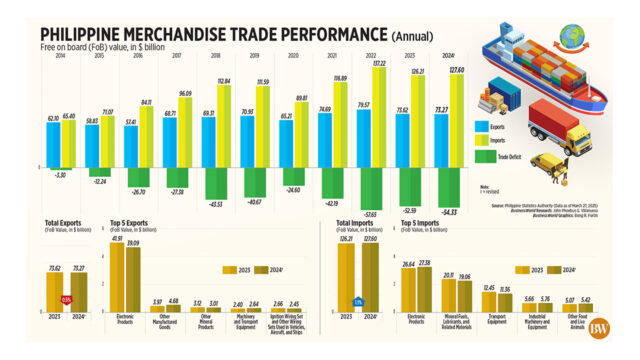
Philippine Merchandise Trade Performance (Annual)

THE 2024 trade-in-goods deficit was revised to $54.33 billion from the $54.21 billion reported in January, the Philippine Statistics Authority said on Thursday. Read the full story.

Philippine Merchandise Trade Performance (Annual)

Rules for writing commendation letters

I read a past article of yours on the “lost art” of writing employee commendation letters. The trouble is that our employees are comfortable performing only the minimum requirements of their job. Even if we would want to commend people, there’s simply no reason to celebrate anything. So, what’s the cure? — Water Spider.

No matter what, don’t lower your standards, but make them reasonably achievable and realistic for everyone. To do that, the key is “to catch people doing something right.” That’s the prescription of American author and management consultant Ken Blanchard, who wrote the 1999 classic Catch People Doing Something Right.

I know how difficult it is to catch people doing something right, but it’s not exactly impossible, if you know how. Would it require micro-management? Far from it. You have to watch people perform their routine from a distance. That’s only possible if you know the basic content of their tasks, their performance standards, their timeline, and the department goals.

Blanchard says: “Catching people doing things right provides satisfaction and motivates good performance. So, remember: give praise immediately, make it specific, and encourage the person to keep up the good work. It’s a great way to interact with and affirm the people in your life — and it will make you feel good about yourself too.”

That means creating an environment where people are motivated to work not necessarily hard, but smart enough to exceed your expectations. Blanchard’s advice points to an approach to persuading direct reports and other similarly situated employees to achieve what you want them to.

Try to remember when you were commended by your boss for doing an excellent job. How did it feel? I’ll bet you were on cloud nine and looking for ways to do it again, perhaps while aspiring for a promotion or merit increase.

It would help to know how to write an ideal letter which goes beyond saying, “great job,” which may seem meaningless after a while, especially if not accompanied by specifics on how the “great job” was performed and how it benefited the organization.

LOST ART
The Lost Art of Writing Commendation Letters was published in this space on Jan. 27, 2023. The article emphasized the basic elements of the ideal letter. To refresh the memory, let me enumerate the following elements:

​One, specific description of the employee’s extraordinary accomplishment. Note the key phrase is “extraordinary accomplishment.”

Two, the beneficial impact of the achievement on the organization. It could be in the form of financial gain or an improved image.

​Three, immediacy. The faster the letter is issued, the better. Any delay could diminish the positive impact of the letter.

​Four, formality, as opposed to a casual communication like an e-mail.

​And last, no false expectations of a promotion or pay increase.

​Many of these elements can’t be found elsewhere, even if you resort to ChatGPT. As of this writing, ChatGPT offers an answer that might help you write a professionally made letter, properly formatted, with an appropriate salutation, opening paragraph, body of text, and closing paragraph.

This is useful for composing a respectable commendation letter. Per my experience, however, people managers must touch on many more important points to maximize the letter’s beneficial effects on the employees. Here are some of those points:

One is rank of the signatories. The higher the rank, the better as it emphasizes the significance of the achievement. Depending on the achievement and impact, the chief executive officer (CEO) could be included as a signatory, along with the department head and immediate boss.

If an employee is being lauded for perfect attendance, the signatory could be the immediate boss, copy furnished to the department head and the HR department, but not the CEO.

Two, 201 folders. Ensure that a copy of the commendation letter is included in the employee’s file with the HR department. Also, it is recommended that a digital copy be prepared for easier access. Both formats are necessary to establish institutional memory in regard to an employee’s achievement.

This involves giving the original copy to the employee, with a duplicate copy retained for 201 files.

Three, public sharing. Again, depending on the significance of an employee’s achievement, it is advisable to share the information with employees and management. It may include the publication of the employee’s accomplishment through a circular for posting on all bulletin boards.

It’s also advisable to write a feature article, complete with photos published in the company newsletter or similar publications. Whatever the value of an achievement, you can maximize the process by giving a printed copy of the commendation letter to the employee’s spouse or parents.

In conclusion, don’t take the process of writing a commendation letter lightly. Otherwise, it may reflect on the sincerity of management. Go ahead and reflect on your experience. Then find ways to catch people doing something right with your help.


Bring Rey Elbo’s unique leadership program called “Superior Subordinate Supervision” to your management teams. Learn from his unique methodology. Send an e-mail to elbonomics@gmail.com or via https://reyelbo.com.

Actor Depardieu says hand on the buttocks is not sexual assault, tells court he did not touch plaintiff

Gérard Depardieu in a scene from 2021’s Adieu Paris.

PARIS — Actor Gerard Depardieu, on the third day of a sexual assault trial, told a Paris court on Wednesday that he did not consider placing a hand on a person’s buttocks sexual assault and that some women were too easily shocked, but denied assault.

A towering figure of French cinema, Mr. Depardieu, 76, has faced a growing number of sexual assault allegations in recent years, which has put a spotlight on how women are treated in the movie industry.

Mr. Depardieu has denied wrongdoing and this is the first case over which he is standing trial. He is accused of sexually assaulting two women on a film set in 2021.

“Sexual assault is something more serious than that … But a hand on someone’s buttocks, it’s not … (that),” Mr. Depardieu said, when asked about allegations by one of the two plaintiffs that he had groped her, though he later said he didn’t know what “sexual assault” meant.

He also denied touching her: “I did not touch her buttocks, I did not touch her breasts, I did none of that.”

The young woman, the second plaintiff to testify, said Mr. Depardieu had sexually assaulted her.

“I was petrified, I was shocked, I did not know what to say,” said the woman, who has asked that her name not be released publicly.

The French criminal code clearly spells out that touching someone’s buttocks by surprise, constraint, or threat is sexual assault.

CRITICISM OF #METOO MOVEMENT
During the first two days of the trial, which started on Monday, Mr. Depardieu criticized the #MeToo movement. He described it on Tuesday as “a form of hysteria.”

The global #MeToo movement has exposed powerful men who have been accused of sexual harassment in fields including entertainment, politics, and business.

Earlier in the trial, Mr. Depardieu admitted grabbing the other plaintiff, Amelie K, by the hips, but denied it was assault.

His lawyer Jeremie Assous has opted for an aggressive line of defense, saying the accusations were false and investigators biased and wanting to bring Mr. Depardieu down.

If found guilty, Mr. Depardieu could face a sentence of up to five years in jail and a €75,000 ($81,000) fine.

Mr. Depardieu is also facing rape allegations in a separate case.

Actress Charlotte Arnould, who has accused him of raping her in 2018 when she was 22, was among those present to follow the trial’s proceedings.

Mr. Depardieu’s lawyer alluded to her in court and called her a liar. As Ms. Arnould burst into tears, Amelie K looked at her, smiling kindly in a show of support.

The Paris prosecutor’s office last year said Mr. Depardieu should face trial over Ms. Arnould’s complaint. Mr. Depardieu has denied any wrongdoing. It is now up to an investigative judge to say if there will be a trial over those allegations. — Reuters

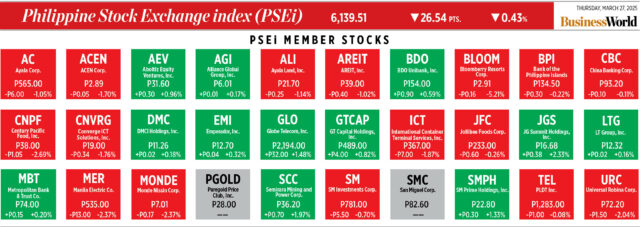
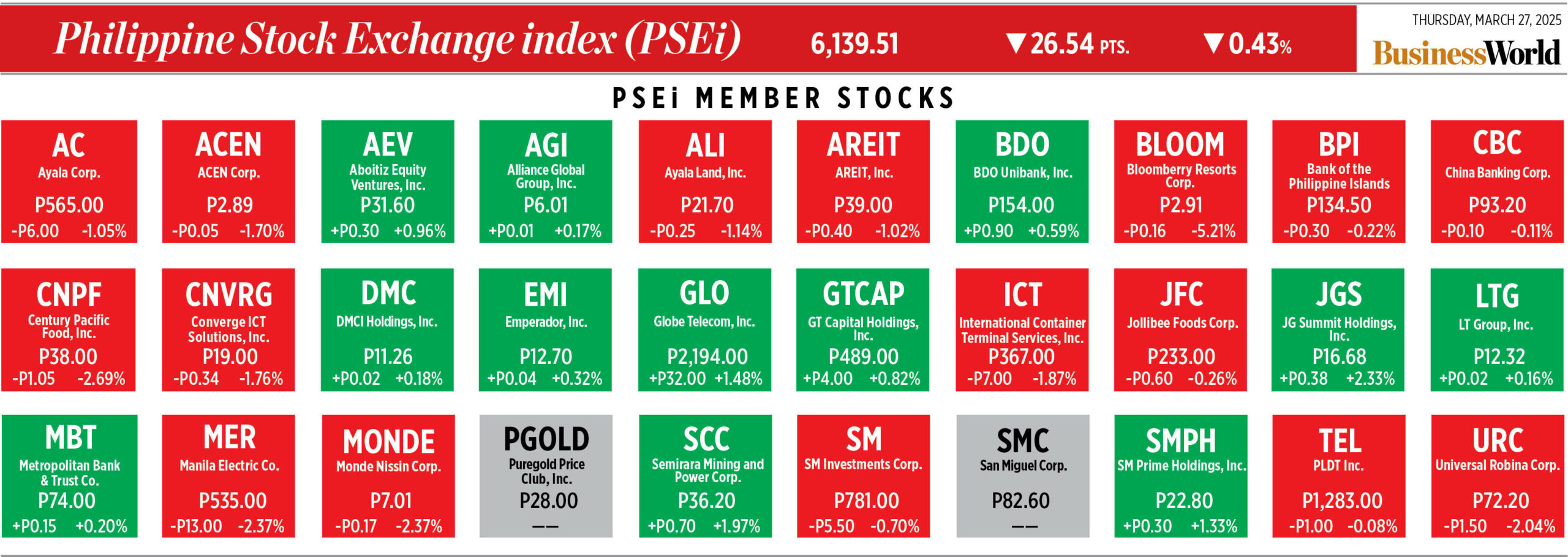
How PSEi member stocks performed — March 27, 2025

Here’s a quick glance at how PSEi stocks fared on Thursday, March 27, 2025.


BMI trims PHL growth forecast

Traffic builds up along South Luzon Expressway, April 5, 2023. — PHILIPPINE STAR/RUSSELL PALMA

FITCH SOLUTIONS unit BMI cut its gross domestic product  growth forecast for the Philippines this year to 6.2%, amid a general tempering of growth expectations across the region in the face of a looming trade war.

In a report, BMI said its earlier projection was 6.3% issued in February.

It maintained its growth forecast for 2026 at 6.7% and expects growth of 6.6% between 2027 and 2029. All its forecasts fall within the government’s 6-8% full-year target band for 2025 through 2028.

The economy grew 5.6% in 2024, missing the government’s 6-6.5% target.

“We expect that India will remain Asia’s fastest-growing large economy, expanding by 6.6% in FY2025/26. The country will be followed by the Philippines (6.2%) and Indonesia (5.3%),” BMI said.

In an interview with Bloomberg TV, Finance Secretary Ralph G. Recto on March 19 expressed confidence the Philippines will expand by at least 6% this year.

Meanwhile, Budget Secretary Amenah F. Pangandaman said a Development Budget Coordination Committee meeting is expected to review targets at the end of March.

BMI also left its growth forecast this year for Asia unchanged at 4.5%, but warned that US trade policy could pose risks to manufacturing exporters.

Ahead of the reciprocal tariffs due on April 2, US President Donald J. Trump unveiled a 25% tariff on imported cars and light trucks starting next week, Reuters reported.

BMI said that risks to the outlook for Asia are tilted to the downside, as countries such as Vietnam and Cambodia have established a “complex cross-border supply chains” which makes them heavily dependent on exports.

“Strong exports provided a boost to headline growth in 2024 and a tariff-induced hit to global trade would create a significant headwind,” BMI said.

Meanwhile, BMI Chief Economist Cedric Chehab found it surprising that US President Donald J. Trump remains silent on Southeast and East Asian tariffs following a meeting with Japanese Prime Minister Shigeru Ishiba.

He said it might be possible that Mr. Trump is waiting for the April 2 deadline.

“Maybe because he realizes that with East Asia and Southeast Asia,it’s important to maintain very strong diplomatic relations, because if Trump wants to pivot towards applying greater pressure on China,then he has to do it from Asia. So perhaps that’s one of the reasons,” he said.

Mr. Chehab speculated that even if no tariffs are imposed on the region, slower US and Chinese growth “will naturally impact Southeast Asian economies.”

BMI also lowered its global forecast to 2.5% for 2025 from its previous projection of 2.6% issued in February, largely due to its revision to the US growth forecast, which it lowered from 2.1% to 1.9%.

“Let’s say Trump were to implement a 10% tariff on Southeast Asian economies;that would certainly be negative for regional growth within Southeast Asia, (which are) very open economies,” he said.

In the report, BMI said its core assumption is Mr. Trump will increase the average effective tariff rate by between 5-8 percentage points, to a level of about 8-11%.

“Given Trump’s more aggressive stance of late, we have been flagging the risk that the average tariff rate could rise to 10-15%,” it said.

BMI also expects the Federal Reserve to remain on pause before cutting by 25 basis points in June or July and again at the end of 2025.

The Fed on March 20 held its benchmark overnight rate steady in the 4.25%-4.5% range, citing expectations of rising prices due to the impact of tariffs on all its trading partners.

Analysts have said the Fed rate cut pause may further delay the Bangko Central ng Pilipinas’ own easing cycle. — Aubrey Rose A. Inosante