Home Blog Page 1305

Special Olympics Pilipinas, Milo Philippines and DepEd promote sports inclusivity through unified learning

BIÑAN CITY, Laguna — Milo Philippines has given its full support to the Special Olympics Pilipinas and the Department of Education (DepEd), in championing a more inclusive future through unified learning in sports at the inaugural Unified Brigada Eskwela Palaro, a one-day event that celebrated inclusive education by bringing together students of all abilities to learn and play side by side.

As part of its commitment to making sports accessible for all Filipino children, Milo supported this initiative to underscore that the values instilled through sports such as grit, discipline, and teamwork, should be available to every child, including those with intellectual and developmental disabilities.

“Milo believes that sports can be a powerful tool in effecting positive change in individuals and the whole society,” said Carlo Sampan, Head of Sports, Milo  Philippines.

Unified learning, a term pioneered by Special Olympics, refers to an inclusive educational environment where students with and without disabilities, learn, play, and participate equally together in shared environments. The Unified Brigada Eskwela Palaro gave children and parents a preview of what unified learning is all about, serving as a powerful platform for kids to learn understanding, empathy and growth.

Held at the Alonte Sports Arena in Biñan City, the event gathered over 200 students from 23 DepEd schools recognized as “Unified Champion Schools” or schools that adopt inclusive practices such as unified sports, inclusive youth leadership and whole-school engagement.

The event featured various activities on sports and leadership, including the Milo Best Center Basketball Clinic, where children participated in engaging basketball drills designed to teach the fundamentals of the sport.

According to a study by the University of Massachusetts and Special Olympics, children who participate in unified sports activities show significant enhancements in social and emotional development, along with a stronger sense of belonging in school. Parents observed noticeable improvements in their children’s confidence, behavior, and ability to connect with others.

The partnership between Milo and Special Olympics Pilipinas plays a crucial role in scaling awareness and implementation of inclusivity in both education and sports. By supporting and promoting inclusivity through events like the Unified Brigada Eskwela Palaro, they are building pathways where every child can thrive, be recognized, and reach their full potential through active play.

Dodgers’ two-out rally puts away rival Giants in extras

THE Los Angeles Dodgers strung together two-out bloop singles by Freddie Freeman and Andy Pages around an infield hit by Teoscar Hernandez, each producing a run, in a relatively quiet 11-inning uprising that resulted in a 5-2 road victory over the San Francisco Giants on Sunday afternoon.

Baseball’s traditional first half was extended by two innings when Giants pinch hitter Luis Matos smacked a one-out, two-run home run off Dodgers closer Tanner Scott in the last of the ninth, drawing the hosts even at 2-2.

The blown save was the major-league-leading seventh of the season for Scott, who had set the table for Matos when he served up a single to Matt Chapman one batter earlier.

After neither team scored in the 10th, the Giants’ sixth pitcher, Spencer Bivens (2-3), was one out away from stranding two baserunners in the 11th.

Freeman, though, popped a single between four San Francisco defenders in short right-center field, scoring extra-inning automatic runner James Outman. — Reuters

China’s exporters rush to beat Trump’s next big tariff deadline

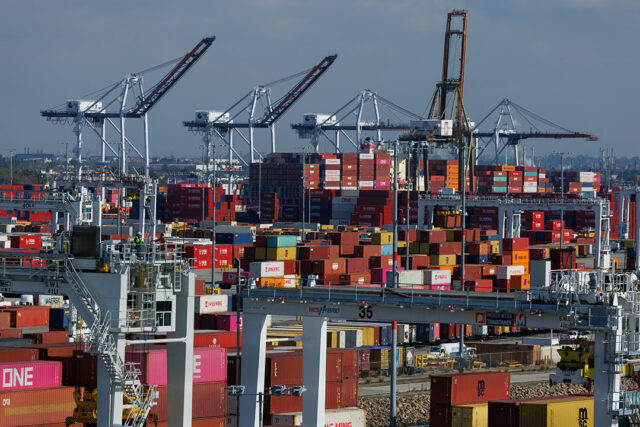
A drone view shows shipping containers from China at the Port of Los Angeles in Wilmington, California, Feb. 4, 2025. — REUTERS

BEIJING — China’s exports regained momentum in June as firms rushed out orders to capitalize on a fragile tariff truce between Beijing and Washington ahead of a looming deadline next month, with shipments to Southeast Asian transit hubs particularly strong.

Businesses on both sides of the Pacific are waiting to see whether the world’s two largest economies can agree on a more durable deal or if global supply chains will again be upended by the reimposition of duties exceeding 100%.

Chinese producers, facing weak demand at home and harsher conditions in the United States, where they sell more than $400 billion worth of goods annually, are also hedging their bets and racing to grab market share in economies closer to home.

Customs data on Monday showed outbound shipments from China rose 5.8% year-on-year in June, beating a forecast 5.0% increase in a Reuters poll and May’s 4.8% growth.

“There are some signs that frontloading demand is beginning to wane gradually,” said Chim Lee, senior analyst at the Economist Intelligence Unit. “While frontloading ahead of the August tariff pause deadline is likely to continue, freight rates for China-bound shipments to the US have started to decline.”

“Trade diversion and rerouting appear to be continuing, which will attract the attention of policymakers in the US and other markets,” he added.

Imports rebounded 1.1%, following a 3.4% decline in May. Economists had predicted a 1.3% rise.

The upbeat set of data helped lift market sentiment with the blue-chip CSI300 up 0.2% at the midday trading break, while the Shanghai Composite Index gained 0.4%, nearing its highest level since October.

Analysts and exporters are watching to see whether a deal agreed in June between US and Chinese negotiators will hold, after an earlier agreement reached in May was strained by a series of export controls that disrupted global supply chains for key industries.

Exports to the US grew 32.4% month-on-month, with June the first full month of Chinese goods benefitting from reduced US tariffs, although year-on-year growth remained negative.

Meanwhile, outbound shipments to the 10-member Association of Southeast Asian Nations jumped 16.8%.

China’s June trade surplus came in at $114.7 billion, up from $103.22 billion in May.

China’s rare earths exports rose 32% in June from the month before, the customs data showed, in a sign that agreements struck last month to free up the flow of the metals were possibly bearing fruit.

But Chinese negotiators will struggle to talk the US into bringing tariffs down to levels that enable producers to turn a profit, analysts say, warning additional duties that exceed 35% will wipe out margins.

“Tariffs are likely to remain high and Chinese manufacturers face growing constraints on their ability to rapidly expand global market share by slashing prices,” said Zichun Huang, China economist at Capital Economics.

“We therefore expect export growth to slow over the coming quarters, weighing on economic growth,” she added.

GLOBAL TRADE WAR
Beijing faces an Aug. 12 deadline to reach a durable deal with the White House.

In the meantime, Mr. Trump continues to broaden his global trade offensive with new tariffs on other partners.

Analysts warn those measures could indirectly hurt Beijing by pressuring third countries used heavily for transshipments of Chinese goods.

Mr. Trump recently unveiled a 40% tariff on US-bound transshipments through Vietnam, a move that could undermine Chinese manufacturers looking to reroute shipments and avoid higher duties.

The US president has also threatened a 10% charge on imports from BRICS countries, in which China is a founding member, raising further risks for Beijing.

Backing its fellow BRICS member, China’s soybean imports in June hit a same-month record high, buoyed by a surge in purchases from top supplier Brazil to 9.73 million tons, which Mr. Trump has slapped with 50% tariffs. Imports of US soybeans, meanwhile, were just 724,000 tons.

China’s crude oil imports rebounded last month and reached the highest daily rate since August 2023, after refineries from Saudi Arabia and Iran increased operations. Iron ore imports climbed 8% from May. — Reuters

EU ready to hit US with €21-billion tariff list, Italy foreign minister says

Fifty-euro notes are seen in this file photo. — REUTERS

MILAN — The European Union (EU) has already prepared a list of tariffs worth €21 billion ($24.52 billion) on US goods if the two sides fail to reach a trade deal, Italy’s Foreign Minister Antonio Tajani said in a newspaper interview on Monday.

President Donald J. Trump on Saturday threatened to impose a 30% tariff on imports from Mexico and the EU starting on Aug. 1, after weeks of negotiations with major US trading partners failed to reach a comprehensive deal.

Mr. Tajani also told daily Il Messaggero that to help the euro zone economy the European Central Bank should consider a new “quantitative easing” bond-buying-program, and more interest rate cuts.

The EU said on Sunday it would extend its suspension of countermeasures to US tariffs until early August and continue to press for a negotiated settlement.

Mr. Tajani said the €21-billion package of tariffs the EU has already prepared could be followed by a second set if a deal with the US proves impossible. He added, however, that he was confident that progress could be made in negotiations.

“Tariffs hurt everyone, starting with the United States,” he said. “If stock markets fall that puts at risk the pensions and the savings of the Americans.”

He said the goal should be “zero tariffs” and an open market among Canada, the United States, Mexico and Europe.

German Chancellor Friedrich Merz said on Sunday he would work intensively with French President Emmanuel Macron and European Commission President Ursula von der Leyen to resolve the escalating trade war with the United States.

European Trade Commissioner Maros Sefcovic said on Monday that Washington and Brussels were approaching a positive outcome for both sides, and warned that a 30% tariff would practically eliminate trade. — Reuters

Singapore economy grows 4.3% in 2nd quarter, avoids technical recession

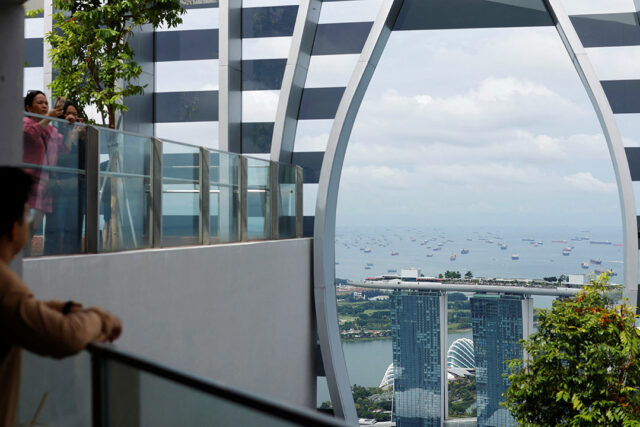
VISITORS take in the view of the city skyline from a rooftop in the central business district in Singapore, July 26, 2022. — REUTERS/EDGAR SU

SINGAPORE — Singapore’s economy grew a faster-than-expected 4.3% in the second quarter year-on-year, preliminary government data showed on Monday, despite a dimming outlook due to global economic uncertainty.

The trade ministry’s advance estimate for gross domestic product in the April to June period compared to an expected expansion of 3.5% according to economists polled by Reuters.

On a quarter-on-quarter seasonally adjusted basis, gross domestic product (GDP) grew 1.4% in the April to June period, the advance estimates showed, avoiding a technical recession after the first quarter’s revised 0.5% contraction.

“The economy is holding up despite tariffs and geopolitical shocks. The de-escalation in the US-China tariff war and front-loading of exports during the 90-day reprieve has cushioned the tariff shocks,” said Maybank economist Chua Hak Bin.

On Thursday, Trade Minister Gan Kim Yong said the economy likely held up well in the first half of 2025 as businesses took advantage of the pause in tariffs to front-load exports to the US, but warned that growth could slow in the next six to 12 months.

The trade ministry in April downgraded the city-state’s GDP forecast for 2025 to a range of 0% to 2% from 1% to 3%.

Maybank’s Chua said his team’s forecast for Singapore’s GDP for 2025 is 2.4%. He expects the central bank to maintain its monetary policy settings at the upcoming review this month given the strength of the economy.

US President Donald J. Trump notified more than 20 countries last week of tariffs of 20% to 50% that will kick in from Aug. 1, warning that any reprisals would draw a like-for-like response.

Singapore has not yet received a letter from the Trump administration this round and its exports are still subject to the 10% baseline tariff announced in April.

The tariff was levied on Singapore despite a free trade agreement in place with the island nation since 2004.

Mr. Gan has said he will travel to the US for trade talks at the end of July with the aim of securing pharmaceutical concessions.

Mr. Trump said he would impose a 50% tariff on copper and soon introduce long-threatened levies on semiconductors and pharmaceuticals, broadening a trade war that has rattled markets worldwide. — Reuters

South Korea preparing to order airlines to check fuel switches on Boeing jets

STOCK PHOTO | Image by Stefan Fluck from Unsplash

SEOUL — South Korea’s transport ministry is preparing to order all airlines in the country that operate Boeing jets to examine fuel switches in accordance with a 2018 advisory from the US Federal Aviation Administration (FAA), the ministry’s foreign media spokesperson said on Monday.

The spokesperson did not give a timeline for the checks. Boeing did not immediately respond to a request for comment.

Fuel switch locks have come under scrutiny after a preliminary report into the crash of an Air India’s Boeing 787-8 jet that killed 260 people last month mentioned a 2018 advisory from the FAA.

The FAA advisory recommended, but did not mandate, operators of several Boeing models, including the 787, to inspect the locking feature of the fuel cutoff switches to ensure they could not be moved accidentally.

Reuters reported on Sunday, citing a document and sources, that the planemaker and the FAA have privately issued notifications to airlines and regulators that the fuel switch locks on Boeing planes are safe and checks are not required.

The Air India preliminary report said the airline had not carried out the FAA’s suggested inspections as the FAA’s 2018 advisory was not a mandate. But it also said maintenance records showed that the throttle control module, which includes the fuel switches, was replaced in 2019 and 2023 on the plane involved in the crash. — Reuters

Italy’s abortion taboos challenged by new law in Sicily

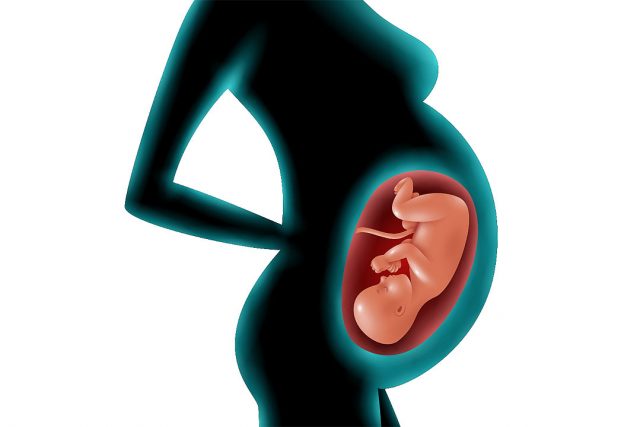
MACROVECTOR-FREEPIK

CATANIA, Italy — Monia, a Sicilian woman in her early forties, was overjoyed when she discovered in October 2022 she was expecting her first child. Her doctor, however, recommended a genetic test due to her age, and the result was one no parent wants to receive.

The fetus had a genetic syndrome. Monia, who declined to give her surname, asked her gynecologist what she could do.

“Nothing. You don’t want to terminate, do you?” the doctor asked her, she said.

He was a conscientious objector, Monia said, one of hundreds on the southern Italian island. More than 80% of gynecologists in Sicily refuse to perform abortions for moral or religious reasons, according to the latest health ministry data, which dates to 2022, even though the procedure has been a legal right for women in Italy since 1978.

To address that situation, in late May Sicily’s regional council — run by a center-right coalition — passed a law in a secret ballot requiring all public hospitals to create dedicated abortion wards and to hire staff willing to provide the service.

Under the national rules, abortion is permitted within the first 90 days of a pregnancy, or later if there are risks to the mother’s health or fetal abnormalities. The latter circumstance applied to Monia, who went to the Sant’Antonio Abate hospital in the city of Trapani, in western Sicily, to terminate her pregnancy.

“All the gynecologists were objectors,” she said. “An obstetrician gave me a bed with only a mattress cover and said they would administer a pill every three hours until I went into labor.” She was told she would receive no further assistance.

Her story is far from unique in southern Italy, where cultural traditions are more conservative than in the Catholic country’s richer north and center.

At first, Monia’s pills were ineffective, but after five days and a change of treatment she finally miscarried, attended to by a doctor and a midwife.

Hospital staff referred to her as “Article 6,” she said, after the provision in the law that allows abortions beyond 90 days.

In response to a request for comment, the Sant’Antonio Abate hospital said it was sorry for Monia’s “difficult experience.” However, the hospital said it was unable to verify the facts because both the hospital manager and the head of the gynecology department at that time had left.

The hospital said it now has three non-objecting doctors and was able to provide abortion services.

Abortions are only available in around half of Sicily’s hospitals, health ministry data shows, a figure much lower than in central and northern Italy, where rates are around 70%.

Like most of his colleagues, Fabio Guardala, a 60-year-old doctor, refuses to perform abortions. He operates at the Cannizzaro hospital in the Sicilian city of Catania, on the east coast of the island.

“A doctor’s job is to heal,” said Mr. Guardala, who is also deputy head of a healthcare unit at his local Catholic church. “Abortion is not treatment but killing. Nobody can force a doctor to kill.”

Silvia Vaccari, president of the Italian federation of midwives, FNOPO, said health outcomes can be grim in areas where legal abortions are hard to access.

“The absence of facilities sometimes leads people to turn to non-professionals, putting them at risk of death, or to continue with pregnancies and give birth to babies who are abandoned in places where they may never be found alive,” she said.

CATHOLIC INFLUENCE
Most other European Union countries allow health workers to refuse to perform abortions on ethical grounds, according to a 2022 study published in the Acta Biomedica journal. But the right is generally exercised far less commonly than in southern Italy.

One exception is deeply Catholic Poland, where abortion is only legal in cases of rape or incest or when a woman’s health or life is at risk. The Acta study said many Polish women have been forced to travel abroad to terminate their pregnancies.

Abortion has always been contentious in Italy, a Catholic country that hosts the Vatican. Right-wing Prime Minister Giorgia Meloni passed legislation last year to try to deter women from terminating pregnancies.

Pro-life groups have been allowed into abortion advice clinics, in a move Ms. Meloni’s party said was aimed at giving women an opportunity for reflection before making a final decision.

Nationally, the number of abortions dropped to 65,000 in 2022, according to the latest health ministry data, against 110,000 in 2011. More than 60% of gynecologists are conscientious objectors.

On the island of Sardinia, the region’s ruling, left-leaning 5-Star Movement last month presented a law proposal similar to the one adopted in Sicily, suggesting that other southern regions may soon follow its example.

Dario Safina, a center-left Democratic Party lawmaker in Sicily and the promoter of the new law, said many Sicilian women seeking an abortion feel forced to resort to the private sector.

“Access to abortion is not a problem for those who can afford it, because they can go to a private clinic. But healthcare based on wealth is the end of democracy,” he said.

Some doctors argue Sicily’s high objection rates are not only due to ethics but also to staff shortages and poor working conditions that make it harder for gynecologists to provide abortions on top of their regular duties.

Data from the GIMBE Foundation, a health sector think-tank, shows Sicily had nine healthcare workers per 1,000 residents in 2022, compared with a national average of 11.6 and far below the northern and central Emilia Romagna and Tuscany regions with 15.

“Hospitals always try to exploit doctors’ work without paying them properly, so sometimes professionals are reluctant to perform abortions,” said Salvatore Incandela, head of the Sicilian arm of AOGOI, Italy’s gynecologists’ association.

Italian anti-abortion group Pro-Life Together rejects this, saying non-objectors in Sicily were only required to perform 1.5 abortions a week on average in 2022 — still above a national average of 0.9.

LEGAL CHALLENGES?
Six Sicilian hospital managers and health professionals contacted by Reuters said the new legislation could strengthen the service, but it was still important to ensure doctors could opt out as allowed under 1978 national law that sanctioned the right to abortion.

Under the law, health workers are exempted from abortion procedures if they declare an ethical or religious objection, so long as the woman’s life is not in immediate danger.

Gaetano Sirna, the director general of Catania’s Policlinico-San Marco hospital, one of the city’s largest, said even with just six non-objecting gynecologists out of a total of 39, he could still ensure abortions for those who needed them.

“We have no problems guaranteeing the availability (of doctors)… gynecologists are free to declare themselves as objectors; we do not discriminate,” he told Reuters.

Abortion is not the only case in which conscientious objection is permitted in Italy. It used to be grounds for avoiding compulsory military service, which was abolished in the early 2000s, and an opt-out for scientists from conducting animal experiments was introduced in the early 1990s.

Giorgia Landolfo, a pro-abortion activist in Catania, called the new law in Sicily a “landmark,” but said she feared it would be hard to enforce.

Some anti-abortion groups say it will be challenged in court on the ground that job postings reserved for non-objectors discriminate against the others.

“Many measures in the past aimed at hiring non-objectors have been challenged and ultimately came to nothing,” said Vito Trojano, the head of SIGO, the Italian Obstetrics and Gynecology Society.

Some Sicilian politicians who strongly oppose the new rules believe the region should instead bolster its healthcare and support facilities for pregnant women, who often feel abandoned and see no alternative to abortion.

“Life is life from the moment of conception,” said Margherita La Rocca, a Sicilian lawmaker from the center-right Forza Italia party. “The fetus cannot just be considered a clump of cells when it’s convenient.” — Reuters


Government subsidy seen to bring down power costs, spur new industries

“The government should consider subsidizing a portion of power costs to lessen consumer burden. Lower electricity bills could also stimulate the growth of new industries, says Alfredo “Al” S. Panlilio, president of the Management Association of the Philippines (MAP).

Interview by Edg Adrian Eva
Video editing by Arjale Queral

Digital transformation key to easing business in PH

“Businesses need digital transformation to boost ease of doing business in the Philippines, says Alfredo “Al” S. Panlilio, president of the Management Association of the Philippines (MAP).

Interview by Edg Adrian Eva
Video editing by Arjale Queral

Philippines will hold firm on 2016 arbitral ruling against China, foreign affairs secretary says

PHILIPPINE COAST GUARD/HANDOUT VIA REUTERS
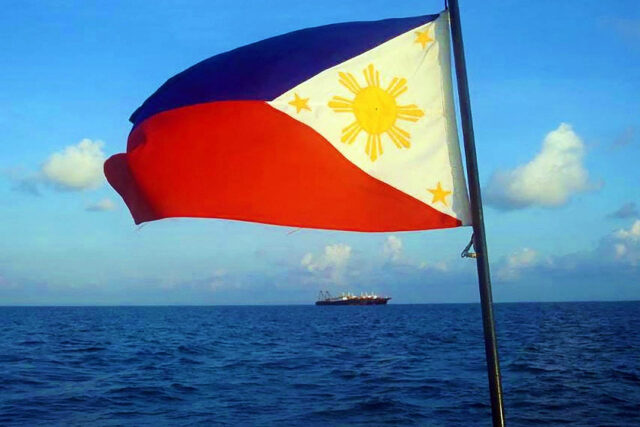
MANILA – The Philippines will remain firm in its position on the 2016 arbitral ruling that found China’s sweeping claims in the South China Sea had no legal basis, its foreign affairs secretary said on Monday.
Foreign Affairs Secretary Theresa Lazaro also said the Philippines has “strong” communication lines with China. – Reuters

Russia, China discuss Ukraine war and ties with the United States

WIKIMEDIA/MIL.RU

 – Russia and China’s foreign ministers on Sunday discussed their relations with the United States and the prospects for ending the war in Ukraine, China and Russia’s foreign ministries said in a statement.

President Vladimir Putin’s foreign minister, Sergei Lavrov, met Chinese Foreign Minister Wang Yi, in Beijing on Sunday. Lavrov is due to attend a meeting of the Shanghai Cooperation Organization’s (SCO) foreign ministers in China.

“The parties also discussed relations with the United States and prospects for resolving the Ukrainian crisis,” Russia’s foreign ministry said.

“The importance of strengthening close coordination between the two countries in the international arena, including in the United Nations and its Security Council, the SCO, BRICS, the G20 and APEC, was emphasized,” the ministry said.

The close contact between the two countries was to “promote the development and revitalization of each other, and jointly respond to the challenges brought about by a turbulent and changing world,” China’s Foreign Ministry said.

Both sides also exchanged views on the Korean Peninsula and the Iranian nuclear issue, China’s Foreign Ministry said.

China and Russia declared a “no limits” partnership in February 2022 when Putin visited Beijing, days before he sent tens of thousands of troops into Ukraine. Putin has sometimes described China as an “ally”.

The U.S. casts China as its biggest competitor and Russia as its biggest nation-state threat. – Reuters

UK agrees deal with Vietnam to remove pharmaceutical trade barriers

MIZIANITKA FROM PIXABAY

 – Britain said it would strike an agreement with Vietnam to make it easier for pharmaceutical firms to sell UK-made medicines in the Southeast Asian nation, under a new trade strategy that emphasizes quick, industry-specific deals.

Britain launched the new strategy last month, promising a nimbler approach compared to the emphasis it placed on full-fledged free trade agreements following its departure from the European Union.

Vietnam will hasten the registration of new medicines and vaccines, while recognizing approvals from more regulators, including Britain’s Medicines and Healthcare products Regulatory Agency, the British government told Reuters in a statement. The deal is expected to be confirmed later on Monday.

“The removal of pharmaceutical barriers with one of our closest trading partners in Asia is a boost for the UK pharmaceutical industry and proof our Industrial and Trade Strategies are already delivering,” British trade minister Douglas Alexander said.

The deal could be worth 250 million pounds ($337 million) to the British pharmaceutical sector over the next five years, the government added.

The UK-Vietnamese Joint Economic and Trade Committee will meet in London on Monday and also discuss financial services and renewable energy.

Britain has taken a tougher line on some other sectors, however, with steel imports from Vietnam set to be restricted under a new quota regime.

Life sciences, including pharmaceuticals, are a priority sector under Britain’s new industrial strategy, which was also launched last month.

However, that plan has been delayed by a dispute over drug pricing with the British pharmaceutical sector, which says the government needs to value medicines more fairly and adjust the payments they make back to the health service. – Reuters

ADVERTISEMENT
ADVERTISEMENT