Home Blog Page 1303

Sta. Lucia Land, Inc. to hold its Special Stockholders’ Meeting on Aug. 12 via Zoom


Spotlight is BusinessWorld’s sponsored section that allows advertisers to amplify their brand and connect with BusinessWorld’s audience by publishing their stories on the BusinessWorld Web site. For more information, send an email to online@bworldonline.com.

Join us on Viber at https://bit.ly/3hv6bLA to get more updates and subscribe to BusinessWorld’s titles and get exclusive content through www.bworld-x.com.

Microsoft to sign EU AI code of practice; Meta rebuffs guidelines

REUTERS

BRUSSELS — Microsoft will likely sign the European Union’s (EU) code of practice to help companies comply with the bloc’s landmark artificial intelligence (AI) rules, its president told Reuters on Friday, while Meta Platforms rebuffed the guidelines.

Drawn up by 13 independent experts, the voluntary code of practice aims to provide legal certainty to signatories. They will have to publish summaries of the content used to train their general-purpose AI models and put in place a policy to comply with EU copyright law.

The code is part of the AI Act which came into force in June 2024 and will apply to Google owner Alphabet, Facebook owner Meta, OpenAI, Anthropic, Mistral and thousands of companies.

“I think it’s likely we will sign. We need to read the documents,” Microsoft President Brad Smith told Reuters.

“Our goal is to find a way to be supportive and at the same time one of the things we really welcome is the direct engagement by the AI Office with industry,” he said, referring to the EU’s regulatory body for AI.

Meta reiterated its criticism of the code.

“Meta won’t be signing it. This code introduces a number of legal uncertainties for model developers, as well as measures which go far beyond the scope of the AI Act,” Meta’s Chief Global Affairs Officer Joel Kaplan said in a blog post on LinkedIn on Friday.

The US social media giant has the same concerns as a group of 45 European companies, he said.

“We share concerns raised by these businesses that this over-reach will throttle the development and deployment of frontier AI models in Europe, and stunt European companies looking to build businesses on top of them,” Mr. Kaplan said.

OpenAI and Mistral have signed the code. — Reuters

MaArte expands to fund 9 grants

PERFUMES from Oscar Mejia III

Annual fashion and crafts bazaar expands with 160 exhibitors

THE ANNUAL MaArte at The Pen is determined to be more than just a shopping event. The goal? To fund nine grants supporting various museum programs and projects nationwide.

The MaArte at The Pen bazaar, which offers locally made goods, will run from Aug. 7 to 10, Thursday to Sunday, across three floors of Makati’s The Peninsula Manila hotel.

Three of the grants the bazaar will fund fall under the National Museum of the Philippines. There will be grants for the architectural arts and built heritage division, the botany and national herbarium division, and the zoology division’s entomology section.

Six other organizations will benefit from the bazaar — HABI: The Philippine Textile Council, the Museum of Contemporary Art and Design, the Cordillera Textile Project, the Imelda Cajipe-Endaya retrospective, the Carlos “Botong” Francisco studio-museum in Angono, and the “Art Weave at the Museum” collection in the Cordillera region.

Gemma Cruz-Araneta, vice-president of the Museum Foundation of the Philippines, Inc. (MFPI), told BusinessWorld in an interview during the July 15 preview that the increase in the number of exhibitors, from 147 last year to 160 this year, is a “good problem” to have.

“We are really so happy because every year we seem to get more participants. Sometimes we have not enough space for them.”

MaArte Fair this year will be occupying The Conservatory, the Rigodon Ballroom, the Upper Lobby, the 5th floor guest rooms, the 2nd floor meeting rooms, and the Garcia Villa and Balagtas function rooms of The Peninsula Manila.

For Ms. Cruz-Araneta, going to the bazaar is a must, especially for those who want to assist in “the main purpose of the MFPI, which is to help the National Museum with its various needs.”

“Sometimes they need equipment, scholarships, and grants, and we give them the funds that we raise from the MaArte Fair. “

EXHIBITORS
Returning exhibitors from previous editions of the bazaar include modern Filipiniana designer Happy Andrada, art-inspired jeweler Artjoy, perfumer Oscar Mejia III, hand-beaded footwear designer Alexie Nethercott, and accessory and brasswork designer Neil Felipp.

Newbies to the fair include ready-to-wear Filipiniana brand Yssa Studio, period-inspired contemporary men’s wear Construction Layers, Aklanon barong brand Raquel’s Piña, and upcycled clothing brand Angkan by Carol de Leon.

Those curious about craft beverages will want to check out Palaweño Brewery, which is the first craft beer in Palawan, and La Mesa Mead’s honey and mead.

“The variety and diversity only show that the Filipino creativity, the handicrafts, they keep developing despite difficult times,” said Ms. Cruz-Araneta.

Danny Jacinto, MFPI president, said at the preview that the nine grants to be funded by the fair this year were chosen “based on the applications they sent to the foundation.”

“We’re proud to say that this is our biggest number of grants so far,” he said.

For updates, visit the MFPI and MaArte’s official social media pages on Facebook and Instagram or check out www.museumfoundationph.org. — Brontë H. Lacsamana

Lynk & Co 02 gets segment-best NCAP safety mark

PHOTO FROM LYNK & CO PHILIPPINES

THE LYNK & CO 02 E-SUV recently received a five-star rating from the Euro New Car Assessment Program (NCAP), a world-renowned, independent safety organization that crash-tests new vehicles and provides ratings based on their safety performance. This is the highest score for a compact SUV in the Euro NCAP’s current evaluation cycle, confirming the 02 as the safest vehicle in its class tested in 2025.

With outstanding results across all assessment categories — including the highest-ever recorded rating of 89% for Safety Assistance — the all-electric 02 “sets a new safety benchmark in its segment while continuing to embody Lynk & Co’s commitment to combining innovative design, real-world sustainability, and advanced technology,” said Lynk & Co Philippines in a release. “The 02 e-SUV now joins its stablemate, the 01 PHEV, as a new energy Lynk & Co ride with full marks for safety, as assessed and confirmed by the Euro NCAP.”

The 02’s rating was based on safety test performance across four categories: Adult Occupant, Child Occupant, Vulnerable Road Users, and Safety Assist. It achieved outstanding results in every area: 90% for Adult Occupant Protection, 87% for Child Occupant Protection, and 83% for Vulnerable Road User Protection.

Lynk & Co dealerships are located in Alabang, Angeles, BGC, North EDSA, and Quezon Avenue. For more information, follow Lynk & Co Philippines on social media: Facebook (LynkCoPhilippines) and Instagram (lynkco_philippines) or call the hotline at 0917-175-LYNK (5965) to inquire. Visit LynkCo.ph.

Globe partners with global telcos for submarine cable system

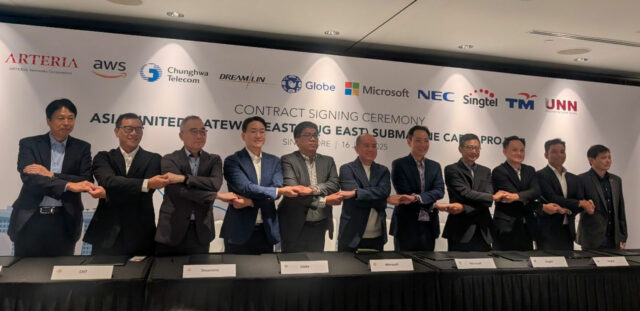
Globe joins global tech and telco companies at the Asia United Gateway (AUG) East Submarine Cable Project contract signing. — GLOBE TELECOM, INC.

AYALA-LED Globe Telecom, Inc. said it will work with global technology and telecommunications (telco) companies to develop an 8,900-kilometer submarine cable system aimed at delivering additional bandwidth and strengthening network diversity and reliability.

In a statement on Sunday, the listed telecommunications company said it has joined the Asia United Gateway East (AUG East) project to support East Asia’s rising demand for high-speed, high-capacity connectivity, fueled by the development of artificial intelligence (AI).

The cable will follow a key route linking the digital hubs of Singapore and Japan, with landing points in the Philippines, Brunei, Malaysia, South Korea, and Taiwan.

The project is expected to be completed by the third quarter of 2029.

“This new data superhighway strengthens our nation’s digital backbone. It gives businesses the scale, speed, and reliability they need to compete globally and embrace technologies that can uplift lives and drive inclusive progress for all Filipinos,” said Globe President and Chief Executive Officer Carl R. Cruz.

Raymond Policarpio, Globe Business vice-president and head of strategy management and business investments, said that the investment in the AUG East cable system “is a cornerstone of our long-term strategy to future-proof the Philippines’ digital infrastructure.”

“As AI-powered applications become increasingly pervasive, the demand for resilient, high-capacity international connectivity will also experience a surge,” Mr. Policarpio said.

“By securing our stake in this vital digital thoroughfare, we are proactively enabling our enterprise clients to leverage cutting-edge technologies, drive innovation, and expand their global reach, ensuring the Philippines remains a competitive hub in the digital economy,” he added.

Globe said that AUG East can deliver massive capacity to “data-hungry enterprises, equivalent to streaming millions of ultra-high-definition movies simultaneously.” — Sheldeen Joy Talavera

Last sugar shipments to US could land before higher tariffs kick in

PHILSTAR FILE PHOTO

THE Sugar Regulatory Administration (SRA) on Sunday said the last batch of Philippine sugar exports to the US for crop year 2024-2025 is scheduled to arrive in time not to be charged the higher tariffs that will kick in next month.

Exporters in April dispatched two vessels carrying 33,000 metric tons each of raw sugar, to fulfill the US sugar quota for 2025.

The first shipment has arrived in the US, while the second shipment is scheduled to arrive on July 22, SRA Administrator Pablo Luis S. Azcona told BusinessWorld.

“The first shipment was charged a 10% tariff, and the second shipment, hopefully makes it before the August deadline (to qualify for the) 10% rate; otherwise, it will be charged 20%,” he said.

The US in early April imposed reciprocal tariffs on its trading partners but froze them pending trade talks. In the interim it charged a 10% baseline tariff on nearly all imports. Last week the US sent a tariff letter to the Philippines informing it that its rate will be 20%, up from the initial April rate of 17%.

“All being said, we hope this crop year 2024-25, (our sugar) exports will only be affected by the increased tariff of 10% and not the 20%,” Mr. Azcona said.

The US sugar allocation for the Philippines is the third highest after those of the Dominican Republic and Brazil.

The SRA has said that only those who participated in the voluntary purchase of locally produced sugar for export to the US can import sugar in this year’s first round of shipments. — Kyle Aristophere T. Atienza

Guns and Butter: Should Marcos play the mutual‑defense card?

STOCK PHOTO | Image from Freepik

When President Ferdinand Marcos, Jr. sits down with US President Donald Trump in Washington, DC this week, he brings a test case for the entire Indo‑Pacific region. From Sydney to Seoul, capitals are wrestling with the same puzzle: how to keep US security guarantees intact while avoiding the heavy new tariffs the White House has aimed at almost everyone. The Philippines, bound to Washington by a 73‑year‑old Mutual Defense Treaty (MDT) and desperate to shield its exporters from a looming 20% duty, is about to find out whether guns can really buy butter.

The early evidence is not encouraging. After a hundred days of shuttle diplomacy, Japan still faces a blanket 25% tariff that is set to kick in on Aug. 1 unless eleventh‑hour talks succeed. Tokyo’s chief negotiator, Ryosei Akazawa, heads back to Washington next week, but officials privately concede the alliance has provided “no automatic rebate at the customs window”1. South Korea, home to nearly 30,000 US troops, lost an earlier exemption in February and is staring at the same surcharge2. Even the European Union has been threatened with a 30% levy for failing to strike a broader trade deal3. If military alliances alone could buy relief,  these negotiations would have ended differently.

Australia illustrates the broader dilemma. Canberra lifted $20 billion in Chinese trade barriers last year while doubling down on the AUKUS submarine pact with Washington; it still faces the baseline 10% US tariff that entered force in April, and officials warn a higher tranche could follow if talks stall4. Prime Minister Anthony Albanese’s July visit to Beijing drew criticism at home for yielding few hard concessions, yet business leaders insist the trip was necessary hedge‑building in an era when neither ally nor market can be taken for granted5. That logic now frames Manila’s own gambit.

Yet Philippine diplomats still hope the MDT can tip the scales. Under the Enhanced Defense Cooperation Agreement, Washington already enjoys access to nine Philippine bases, several within missile range of contested South China Sea features. The United States has just announced a major upgrade of one logistics hub to help sustain resupply missions to Second Thomas Shoal6. If these facilities matter so much to US strategy, the argument runs, surely tariff relief should follow naturally.

But guns rarely trump spreadsheets in Trump‑era bargaining. Tokyo’s failure shows why. Japanese negotiators offered expanded market access for US beef and digital‑trade guarantees yet discovered that the White House values optics — cuts to the bilateral deficit — more than alliance rituals7. South Korea’s fate is similar: its security role against North Korea won no tariff waiver once the administration decided Korean electric‑vehicle exports undercut “American jobs”8. The takeaway for Manila is stark: the MDT is not a magic key, only one bargaining chip.

First, the Philippines must separate — but carefully sequence — security and trade. Marcos should lock down a fresh public statement on the MDT and base upgrades before shifting to tariffs. Framed this way, customs relief becomes a logical complement to a partnership Washington already says it needs. Treating tariffs as a price tag on sovereignty, by contrast, risks congressional blowback and domestic anger in Manila.

Second, the government should arrive with a compliance regime in hand. Vietnam’s near‑miss offers the template. Hanoi persuaded Trump to cut a threatened 46% tariff to 20%, but only after conceding strict origin‑tracing rules — and even now exporters complain the annexes remain so vague that banks hesitate to finance shipments9. Marcos can avoid that limbo by tabling, on day one, a “trusted‑exporter” program: digital certificates, third‑party factory audits and a real‑time hotline for US Customs. Any tariff waiver would then snap back automatically if rules are broken. Investors in Cavite and Clark care more about certainty than grace.

Third, Jakarta’s recent success shows the power of hard assets. Indonesia leveraged nickel, copper, and Boeing purchases to cut its threatened tariff from 32% to 19% while promising lower duties on US exports10. The Philippines can assemble a similar bundle: nickel ore from Surigao, copper concentrates from Tampakan, and a rapidly growing renewable‑energy sector that needs US turbines. Bundled with a vow to admit more American farm goods, that package gives Trump a jobs narrative that transcends security talking points.

Fourth, Manila must mind the home front. Chinese Coast Guard water‑cannons near Scarborough and Second Thomas Shoals have hardened public opinion. If voters perceive that tariff concessions were bought at the expense of firmer US deterrence, the political backlash could undo years of alliance rebuilding. That danger argues for sequencing: security first, tariffs second, with neither overtly traded for the other.

Fifth, review clauses are essential. Japan’s stalled talks demonstrate how oral assurances evaporate when enforcement disputes arise. Manila should insist on quarterly consultations and a 60‑day cure window before higher duties can snap back, giving exporters — and Wall Street lenders — predictability.

Playing the MDT card also forces the Philippines to confront its peculiar geography. Manila depends on China for roughly $41 billion in annual trade and on Washington for the patrols that keep those sea lanes open. Balancing the two is no longer abstract theory; it determines factory shifts, peso exchange rates, and, potentially, national security.

The broader Indo‑Pacific debate now turns on a single question: can any country maintain deep economic ties with China while relying on the US security umbrella? Japan, South Korea, and Australia have tried, each with mixed results. ASEAN has pushed “open regionalism,” signing the world’s largest trade pact with China (the Regional Comprehensive Economic Partnership or RCEP) even as individual members expand defense drills with the United States. The Philippines is simply the latest, most vivid illustration of that tightrope.

None of this guarantees success. Analysts warn that even a best‑case deal may only trim Manila’s tariff rate to 10%, enough to keep some export lines profitable but hardly a free pass11. Trump’s tariff playbook is an all‑purpose lever; the goalposts can move with a single tweet. Still, rejecting the MDT card entirely would leave Manila playing defense on two flanks: tariff hikes on one side, Chinese pressure on the other.

Success therefore lies in disciplined hedging. Firm up the alliance without commodifying it. Offer market access and critical minerals that speak to American voters. Arrive with enforceable traceability to calm US sceptics. And weave in review clauses that protect Philippine businesses when the political winds shift.

If Marcos can pull off that choreography, Manila will show smaller Indo‑Pacific states that the security‑trade trade‑off is not zero‑sum. Australia, still angling for its own tariff waiver even as it deepens ties with Beijing, will take note. So will Japan and South Korea, whose disappointment on tariffs may become leverage in their next negotiating round. ASEAN neighbors, eyeing the same shoals of economic dependence and security need, will watch just as closely.

The stakes could hardly be higher. A mis‑step could sour US sentiment, invite more Chinese pressure, and rattle foreign investors already wary of supply‑chain rerouting. A deft bargain, by contrast, could lock in lower tariffs for Philippine exporters, reinforce deterrence in the South China Sea and — perhaps — offer a blueprint for other middle powers caught between the two superpowers.

Marcos therefore walks into the Oval Office carrying more than his own country’s fortunes. He represents a region searching for a viable path between economic gravity and security necessity. The MDT may not be the trump card many once imagined, but if played with care — sequenced, backed by concrete offers, anchored in domestic legitimacy — it could still help Manila defuse the tariff time‑bomb and show the Indo‑Pacific how to keep both trade routes and treaty lines open.

1 https://tinyurl.com/28a69vcr

2 https://tinyurl.com/2bltp5by

3 https://tinyurl.com/2xkxtqgc

4 https://tinyurl.com/22qj99oe

5 https://tinyurl.com/2ysobufq

6 https://tinyurl.com/2abzqp49

7 https://tinyurl.com/28a69vcr

8 https://tinyurl.com/2bltp5by

9 https://tinyurl.com/26bc7llp

10 https://tinyurl.com/2cnsdckr

11 https://tinyurl.com/2dysqk69


Eduardo Araral, PhD is an associate professor at the Lee Kuan Yew School of Public Policy, National University of Singapore. This op-ed is written in his personal capacity.


American Express top brass allays competition concerns after profit beat

AMERICAN Express’ (AmEx) top brass reassured investors concerned about intensifying competition for affluent customers after resilient spending by cardholders helped the company surpass second-quarter profit estimates on Friday.

A long history in the premium segment and targeted acquisitions in recent years have given the credit card giant the heft to provide more compelling offerings than its competitors, its executives said.

The remarks come days after Citigroup unveiled plans to launch a new premium credit card, Citi Strata Elite, later this quarter to boost its appeal among wealthy customers.

“Bring it on,” AmEx Chief Financial Officer Christophe Le Caillec said in an interview with Reuters. “We’ve been in that space for decades and we have built assets that our competitors do not have,” he said.

Higher competition would encourage more customers to explore premium options. When they do, Mr. Le Caillec said he believes they will choose AmEx.

The company has long pursued a strategy centered on perks that give its cardholders a sense of exclusivity, rather than simple cashbacks. Analysts say the playbook has helped it build a loyal customer base, one that rivals may struggle to replicate quickly.

The acquisitions of Resy and Tock in recent years also set the company apart, Mr. Le Caillec said. The platforms offer AmEx cardholders privileged access to 27,000 restaurants worldwide.

AmEx will also roll out updates to its Platinum cards later this year for consumers and businesses in the United States, making its “largest investment ever in a card refresh.”

STABLE SPENDING
Excluding one-time items, AmEx earned $4.08 per share for the three months ended June 30, compared with the $3.89 per share analysts were expecting, according to estimates compiled by LSEG.

The beat underscores how the credit card giant’s focus on wealthy customers has helped insulate it from the effects of waning consumer confidence, which is more pronounced among lower-income households.

“While economic turbulence could affect spending volume, we expect the company’s credit quality to outperform peers’ in any environment,” Morningstar analyst Michael Miller wrote in a note.

AmEx’s numbers offer valuable insight into evolving trends around travel and discretionary spending, especially among the most creditworthy borrowers.

Big banks said earlier this week that consumers remain in good financial shape despite high borrowing costs, trade policy uncertainty and a job market where companies are increasingly cautious about hiring.

AmEx’s total revenue rose 9% to $17.9 billion, also above the $17.7 billion analysts were expecting.

Still, the New York-based company boosted its provisions for credit losses to $1.4 billion from $1.3 billion earlier. It also noted softer airline spending amid ongoing economic uncertainty, but said overall volumes would be stable. — Reuters

Ayala Malls heads for refresh, expansion projects

ARTIST’S Rendition of the reimagined Ayala Malls Glorietta 4 facade

WE’RE sure you’ve noticed that Glorietta and Greenbelt in Makati are getting facelifts, but so are many of the land conglomerate’s other properties. In a press conference on July 17 at the Glorietta Grand Mall (which was the hallway that shared an entrance with Rustan’s beauty department), Ayala family members and executives shared what’s next for Glorietta and its other expansions.

Ayala Malls Chief Operating Officer Paul Birkett said in response to a question about the reason for renovations, “With the exception of George Clooney, very few things get better with age.”

Feeling lost at Glorietta? So were they.

About Glorietta, he said, “It’s grown over time: one part then another part added, then another, which is why we all continue to get lost as we’re walking around. We had to go back to basics.”

Glorietta Grand Mall is just the first step. Throughout this year and the next, visitors will be seeing the freshening up of hallways, carparks, activity centers, cinemas, and even facades and entrances.

PARKS, STORES, AND GIANT SCREENS
The Glorietta 4 Park — the small green space with a dolphin fountain which is bounded by the Glorietta 4 entrance, Glorietta 5, and One Ayala — will be transformed into The Plaza by next year, serving as a nice view from improved balconies and al fresco dining areas in the surrounding buildings.

Glorietta is one of four flagship properties that they’ve identified, along with Greenbelt, TriNoma in Quezon City, and Ayala Center Cebu. All of these will also be improved.

Greenbelt will see even more stores, including premier Filipino brands, alongside its expected global luxury offerings. The complex will also see renovations in the theaters, lobbies, and food options. Greenbelt 2 will especially benefit from the food options, with a rooftop dining destination with over 20 outlets. Greenbelt 1, which has been demolished, will be resurrected as a space for flagship stores.

TriNoma will benefit from the rollout of giant movie screens, four times bigger than average (further innovations in its cinemas will be introduced) while unveiling a new transport terminal; the better since it will be connected to the Grand Central Station linking some of the city’s train systems. It will also expand next year, with an additional 17,000 square meters (sq.m.) of retail and office space.

Ayala Center Cebu, meanwhile, has already finished some of its upgrades, including a new activity center with an LED wall. It will have improved dining options, in addition to about 8,000 sq.m. of new space.

Other malls will see increases in space as well: Ayala Malls Marquee in Pampanga will have an additional 36,000 sq.m. of new space, and Abreeza in Davao will have an additional 22,000 sq.m. Overall, Ayala Malls will roll out an additional 700,000 sq.m. of leasable space over the next five years. These include openings in Kawit, Cavite with Evo City, improved experiences in Laguna’s Nuvali through a new Lakeside, Arca South (which is opening in December), and another new mall, Ayala Malls Gatewalk Cebu.

“We will be ready to welcome you very, very soon to what will be world-class destinations,” said Mr. Burkett in a speech.

Mariana Zobel de Ayala, a member of the Zobel de Ayala family and senior vice-president and head of leasing and hospitality for Ayala Land, Inc., said, “We really feel we owe all of you a little bit of an update. You’ve all been so patient, along with our consumers to live through this incredible endeavor with us.”

She reminded reporters present that in 2024, they announced a P30-billion investment for the four flagship properties, as well as another P4.5 billion this year to redevelop other malls like Marquee, Abreeza, Cloverleaf, and Fairview Terraces. “Over the next five years, we’ll strategically expand our footprint,” she said. She also reported that the four flagship properties have increased 14% in revenue quarter-on-quarter, bringing an 11% increase across the portfolio.

“What we’re doing with Ayala Malls goes beyond reimagination. It’s a strategic pillar of Ayala Land’s… growth strategy, focused on building places that people love,” she said. “Our malls are more than just commercial centers: they’re essential parts of the estates we build, and the central parts of Filipino life.” — Joseph L. Garcia

BJ Mercantile brings in Thaco trucks and buses

From left are BJ Mercantile, Inc. (BJM) Sales Associate Marvy Sales; BJM Sales Manager Don Ramos; BJM Marketing Manager Peachy Tamayo; BJM Vice-President Leilani Lim Tan; Thaco Auto Vice-President for Production and Business Doat Dat Ninh; Thaco Auto Director of Truck and Bus Export Sales Nguyen Ngoc Trung; and Thaco Auto Truck and Bus Export Sales Manager Tran Dinh Quang. — PHOTO FROM BJ MERCANTILE, INC.

CONGLOMERATE BJ MERCANTILE, INC. (BJM) recently expanded its automotive portfolio through a partnership with Vietnamese automotive firm Thaco. Through a memorandum of understanding (MoU), BJM will become the official sales outlet, service provider, and parts distributor of Thaco trucks and buses in the Philippines.

From its beginnings in 1974 as an importer of used engines and trucks, BJM now has various interests spanning automotive, logistics, real estate, petroleum, cold storage, and marine transport. This new development enables BJM to continue to expand its presence in the commercial vehicle space by offering more choices. “Over the years, it has built a reputation for excellent after-sales service, technical expertise, and strong relationships,” said the company in a release.

“We are honored to partner with Thaco and are excited to offer their high-quality trucks and buses to the Philippine market,” said BJM Vice-President Leilani Lim Tan. “This collaboration aligns with our commitment to provide innovative, cost-effective, and reliable transport solutions to support the growth of Filipino businesses.”

Founded in 1997, Thaco is a “dominant player” in Vietnam’s automotive industry and one of Southeast Asia’s largest auto manufacturers. Its state-of-the-art Chu Lai Truong Hai Industrial Complex is among the most advanced automotive manufacturing hubs in the region, capable of producing a wide range of vehicles from light-duty trucks to full-sized buses and passenger cars, said BJM.

Its lineup of trucks and buses, built using durable and efficient Chinese chassis platforms, are known for their practicality, fuel-efficiency, and competitive pricing. These are expected to meet the needs of the Philippines’ growing logistics, construction, and transport sectors. With over two decades of automotive engineering and manufacturing experience, Thaco’s vehicles are designed for tropical climates and heavy-duty use making them ideal for local roads.

BJM automotive portfolio also includes Scania, Ashok-Leyland, Fuso, and Hongqi.

SN Aboitiz Power eyes solar projects for portfolio diversification

STOCK PHOTO | Image by American Public Power Association from Unsplash

SN ABOITIZ POWER GROUP (SNAP), a joint venture between Aboitiz Power Corp. and Norwegian firm Scatec, is seeking to diversify its portfolio by pursuing solar power projects.

“We’re very eager to build out our next leg. We envisioned not being just a hydro player. So, batteries are now taking shape,” SNAP President Joseph S. Yu told reporters last week.

“We still have hydro projects in the works, but the third leg is solar plants, and we intend to be in all to help the industry along.”

Mr. Yu said there are already solar power projects in the company’s pipeline but declined to provide details.

The company is accelerating the investment decision process for up to 200 megawatts (MW) of energy storage systems.

“We need them as soon as possible. The grid needs it. So, we’re trying to help the NGCP (National Grid Corp. of the Philippines) in the mission to stabilize the grid,” Mr. Yu said.

SNAP is a renewable energy developer that owns and operates the 112.5-MW Ambuklao and 140-MW Binga hydroelectric power plants in Benguet, and the Magat hydroelectric power plant with a capacity of up to 388 MW located on the border of Isabela and Ifugao.

It also operates the 8.5-MW Maris hydro and the 24-MW Magat battery energy storage system (BESS) in Isabela.

Currently, SNAP is constructing its 40-MW Binga BESS in Benguet and the 16-MW Magat BESS Phase 2.

The company is targeting a total battery energy storage capacity of 80 MW by 2026. — Sheldeen Joy Talavera

Misdeclared farm products marked for disposal — DA

PHILSTAR/MIGUEL DE GUZMAN

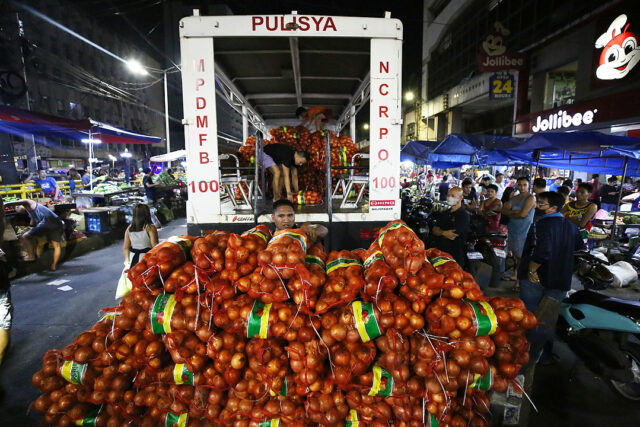
THE Department of Agriculture (DA) has ordered the disposal of over 500 metric tons of misdeclared and smuggled vegetables.

Citing the Bureau of Plant Industry’s (BPI) food safety analyses, the DA said onions and carrots from the haul seized by the Bureau of Customs at the Ports of Manila and Subic were free of harmful contaminants such as E. coli and Salmonella, pesticide residues or heavy metals but “further organoleptic assessment revealed significant deterioration.”

“The onions and carrots showed signs of early sprouting, visible rotting, and foul odors indicating putrefaction,” BPI Director Glenn Panganiban said. 

The 17 containers involved, with an estimated market value of P66 million, arrived at Philippine ports containing undeclared products.

Of the 13 containers intercepted in Subic, 12 contained red and yellow onions, while one held carrots.

Meanwhile, four containers at the Port of Manila contained onions.

“The cargo was shipped from China, and the misdeclaration raises concerns about possible illegal activity and the growing problem of agricultural smuggling in the country,” the DA said.

In Subic, six of the 13 containers loaded with onions were misdeclared as chicken lollipops, while other shipments were falsely labeled as smoked frankfurters or chicken sausage.

The importers involved, including Beaches Consumer Goods Trading, EPCB Consumer Goods Trading, and others, face “severe penalties” for violating import and food safety laws, the DA said.

“These companies will be added to the growing list of importers blacklisted by the DA,” Agriculture Secretary Francisco Tiu Laurel, Jr. was quoted as saying.

“Given the significant value of the cargo, some of these importers may be the first to face legal action under the Anti-Agricultural Economic Sabotage Act.”

Tests are underway on two more containers opened recently and whose contents were mislabeled as chicken poppers “but were actually loaded with Peking duck and chicken breast,” the DA said.

“These containers, consigned to 1024 Consumer Goods Trading, are being examined by the Bureau of Animal Industry,” it added. — Kyle Aristophere T. Atienza